Shakti Dubey — GS Paper 1 (Sure Shot Test 01)
What’s inside this copy
- ▸Definition-first discipline: she literally opens almost every answer by defining the keyword before arguing — a clean, repeatable intro template
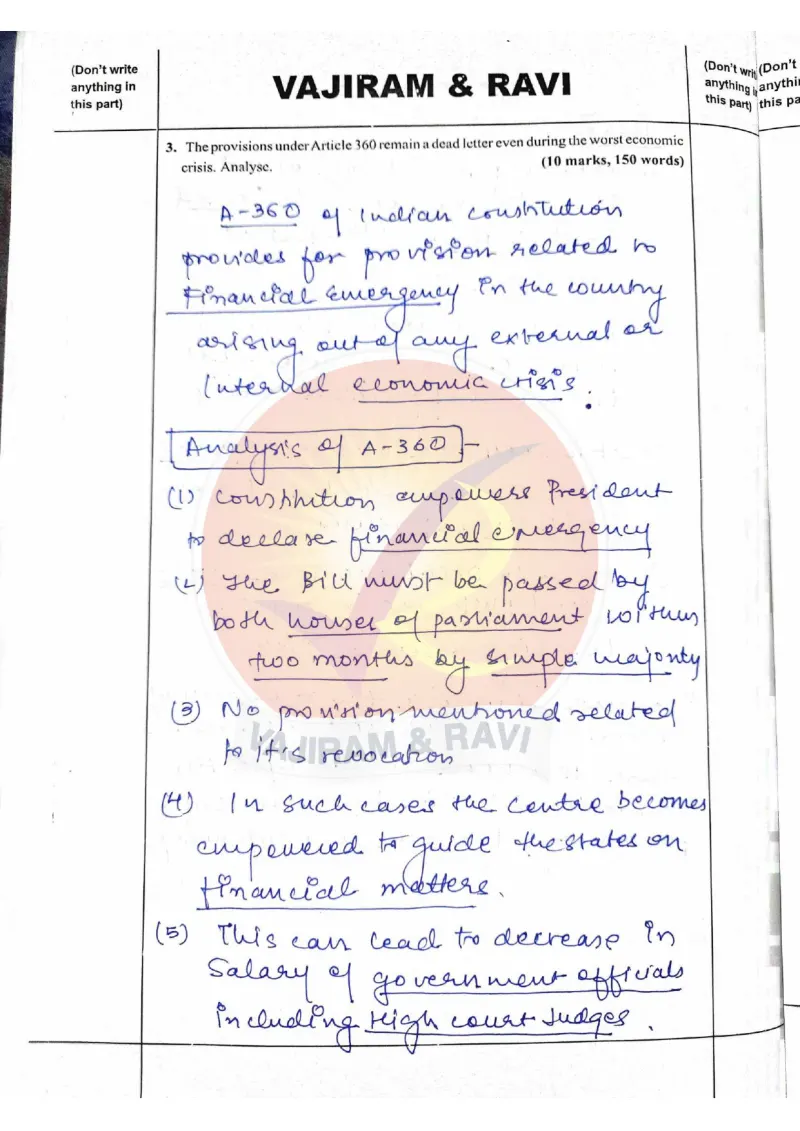
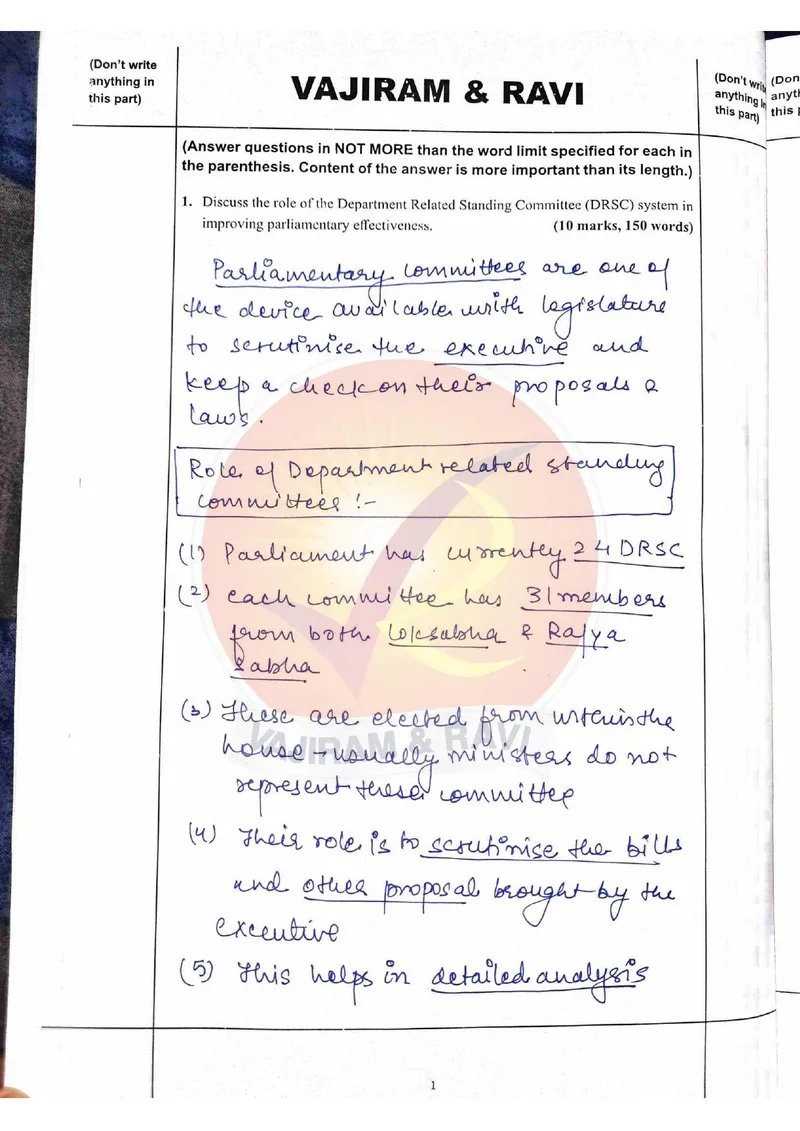
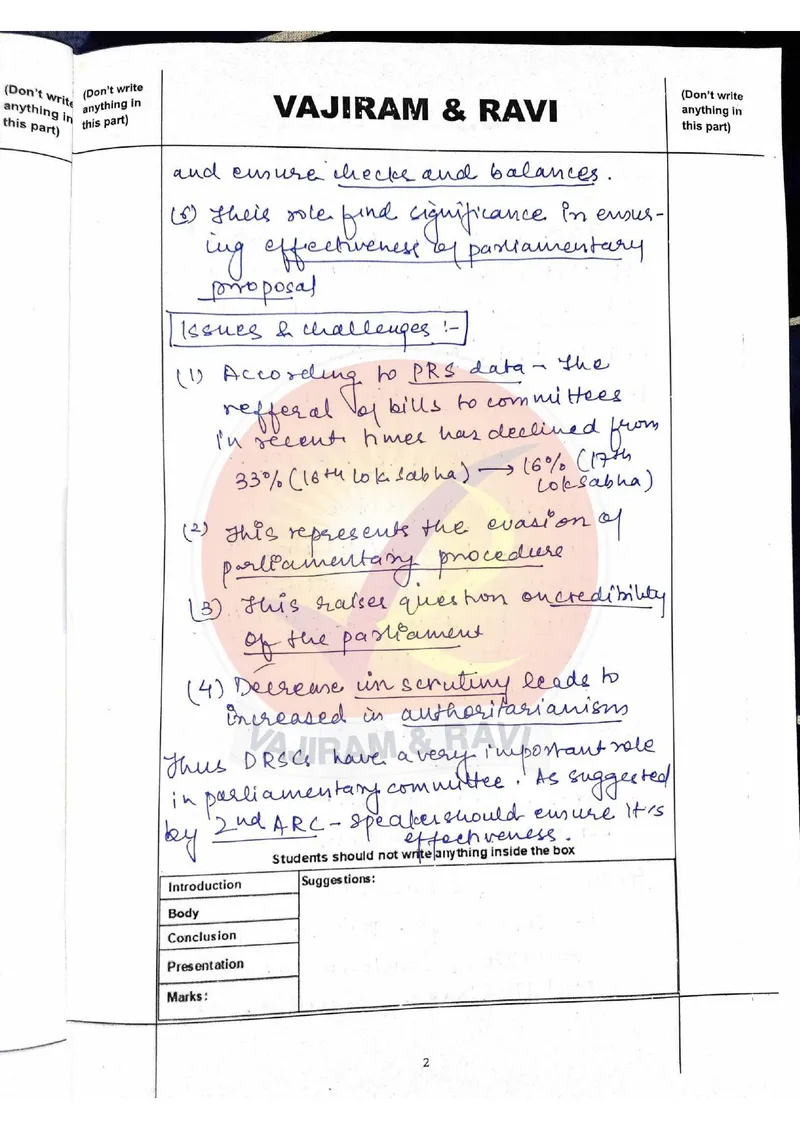
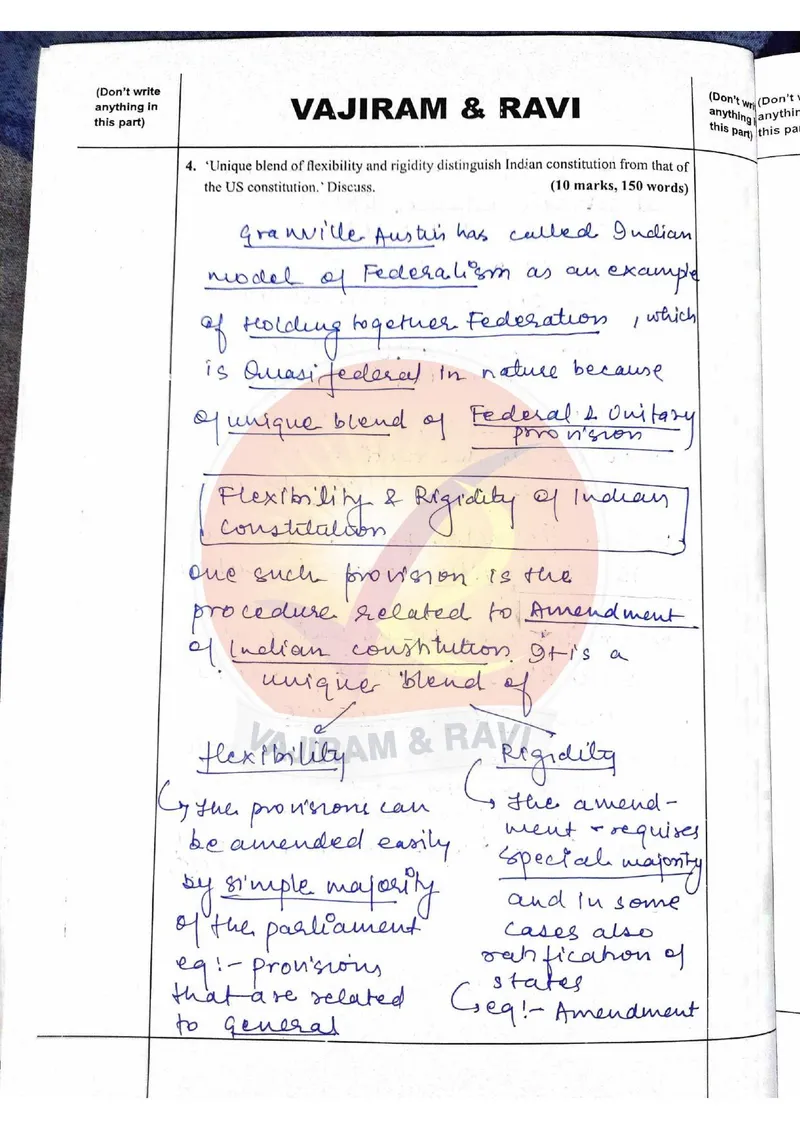
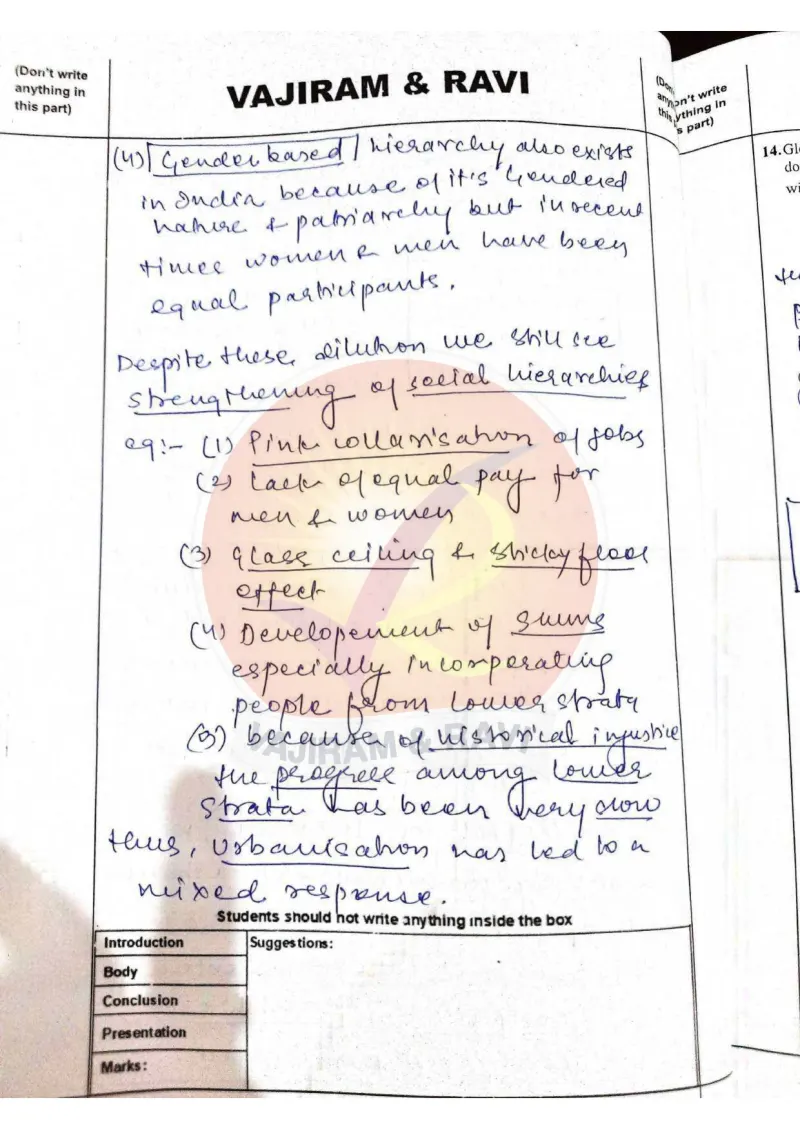
- ▸Heavy use of boxed, underlined mini-headings plus numbered points makes each answer skimmable in seconds — strong presentation under time pressure
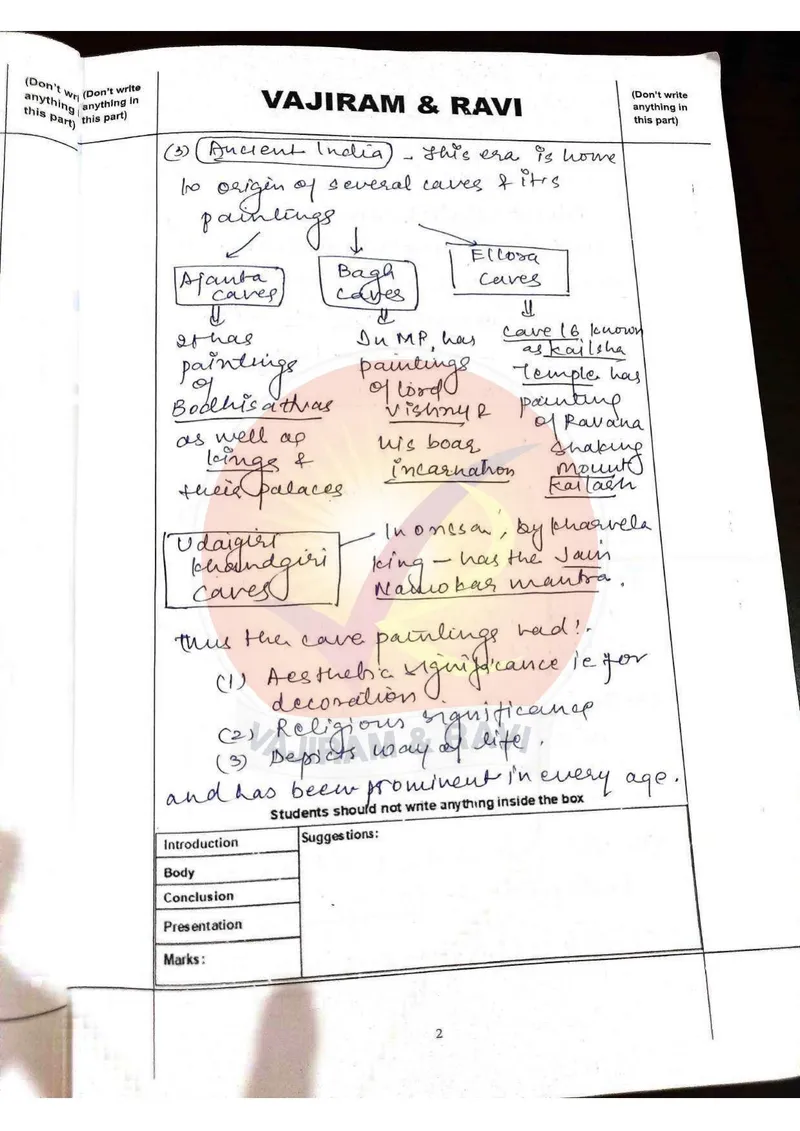
- ▸Diagrams are simple but effective: a boxed flowchart of cave sites (Q1), a plate-boundary branch tree (Q9), and a hand-drawn world sketch-map for palm-oil producers (Q16)
- ▸Every conclusion starts with 'Thus…' and lands a balanced one-liner ('double-edged sword', 'need for judicious use of water') — a tidy sign-off formula
- ▸Topical, current examples carry the GS1 answers: Cyclone Remal (2024), G20 gifts of Indian crafts, Joshimath subsidence, IPCC 6th Assessment Report, MSP-at-WTO
- ▸Full coverage: all 20 questions attempted with even depth (10-markers ~2 pages, 15-markers ~3 pages) — the evaluator's top praise was completing every question with equal attention
What to learn from this copy
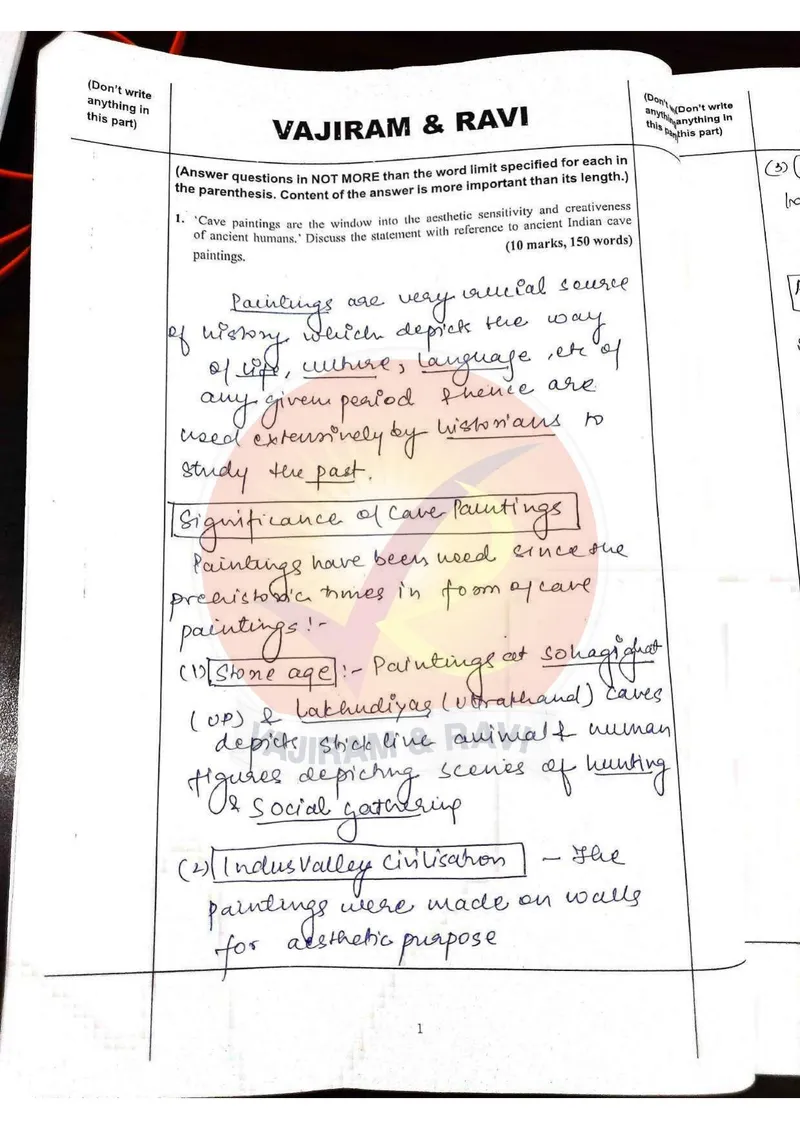
- ★She opens almost every answer with a one-line definition of the keyword before arguing ('Foreign policy can be defined as...', 'Globalisation can be defined as...', 'Communalism can be defined as...', 'Paintings are a very crucial source of history...') -> build one reusable definition-led intro template so you settle the demand and start the body in seconds instead of burning time hunting for an opening.
- ★For factual GS1 questions she packs specific, named instances rather than vague description: Q1 cites exact cave sites with their content (Sohagighat & Lakhudiyar stone-age caves, Ajanta Bodhisattvas, Ellora Cave 16 Kailasha showing Ravana shaking Mount Kailash, Udayagiri-Khandgiri with Kharavela and the Jain Namokar mantra) -> memorise 4-5 concrete, attributable examples per static topic so an art/history answer reads as evidence, not generalities.
- ★She converts geography answers into the same branch/tree typology diagram repeatedly — plate boundaries (divergent/transform/convergent) feeding island formation in Q9, and the same branch style for cyclones (temperate/tropical), coral reefs (barrier/atoll/fringing) and ozone (tropospheric/stratospheric) -> pre-practise one classification-diagram format you can deploy on any 'types/formation of X' question to show structure fast.
- ★She anchors GS1 in current affairs the examiner will recognise: Cyclone Remal (2024) and Hamoon (2023) in Q10, G20 summit gifts of Indian crafts in Q14, plus Joshimath subsidence, IPCC 6th Assessment Report and the MSP-at-WTO issue -> deliberately wire one recent, datable hook into each static GS1 answer to lift it above textbook content.
- ★She closes with a fixed sign-off formula — every conclusion starts 'Thus...' and lands a balanced one-liner like 'double-edged sword' or 'need for judicious use of water' -> keep a tight, pre-set conclusion stub so you never trail off mid-thought when time runs short.
- ★She attempted all 20 questions with even depth (10-markers ~2 pages, 15-markers ~3 pages), and this completeness was the evaluator's top praise -> spreading effort evenly to finish the full paper, rather than over-investing early answers, is itself a scoring strategy the marker rewarded.
Questions attempted: Cave paintings as window into aesthetic sensitivity of ancient humans (10m/150w); Subsidiary Alliance turning 'British Empire in India' into 'of India' (10m/150w); Mass nationalism as watershed; reaction of Indian business community (10m/150w), and 17 more below.
Questions attempted in this booklet (20)+
- 1.Cave paintings as window into aesthetic sensitivity of ancient humans (10m/150w)
- 2.Subsidiary Alliance turning 'British Empire in India' into 'of India' (10m/150w)
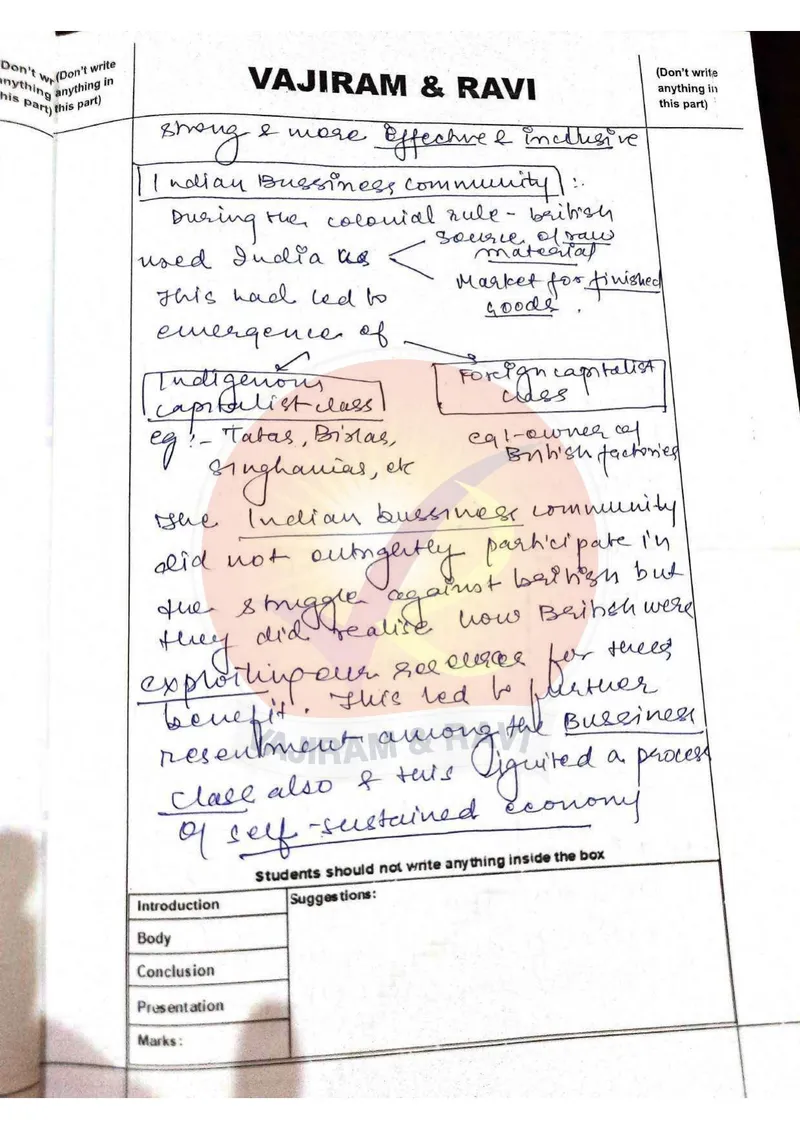
- 3.Mass nationalism as watershed; reaction of Indian business community (10m/150w)
- 4.Non-alignment as bedrock of Indian foreign policy (10m/150w)
- 5.Colonial legacy as primary source of political instability in Africa (10m/150w)
- 6.Sustainable urban development & reassessment of land-use patterns (10m/150w)
- 7.Socio-cultural vs economic factors in women's migration in India (10m/150w)
- 8.Significance of IT industries in promoting regional development (10m/150w)
- 9.Formation of islands in the Indian Ocean Region (10m/150w)
- 10.Major tropical cyclones of 2023-2024 and impacts on local communities (10m/150w)
- 11.Gandhi as 'true disciple' of Tilak; Gandhian methods vs extremism (15m/250w)
- 12.'Partition was a necessary evil' — analyse (15m/250w)
- 13.Extent to which urbanisation influenced social hierarchy in India (15m/250w)
- 14.Effects of globalisation on the Indian craft industry (15m/250w)
- 15.Rise of communalism & measures to contain it (15m/250w)
- 16.Distribution of major palm-oil producing countries & their environmental issues (15m/250w)
- 17.Water as the chief architect of the earth's surface (15m/250w)
- 18.'Tropical rainforests of the ocean' (coral reefs) under threat; rejuvenation measures (15m/250w)
- 19.Geographical concentration of ozone holes & remedial measures (15m/250w)
- 20.Global warming & extreme weather; recent natural hazards in Indian subcontinent (15m/250w)
Examples, data & evidence used
- Q1: Sohagighat (UP) & Lakhudiyar (Uttarakhand) stone-age caves; Ajanta (Bodhisattvas, kings & palaces); Bagh caves MP (Vishnu's boar/Varaha incarnation); Ellora Cave 16 / Kailasha temple (Ravana shaking Mount Kailash); Udayagiri-Khandgiri caves Odisha (Kharavela, Jain Namokar mantra)
- Q2: Richard Wellesley (Subsidiary Alliance); Doctrine of Lapse under Dalhousie; states annexed — Hyderabad, Bharatpur, Satara, Jaunpur
- Q3: Mahatma Gandhi, Satyagraha & non-violence (South Africa); business houses Tatas, Birlas, Singhanias; indigenous vs foreign capitalist class
- Q4: NAM as Nehru's brainchild; co-leaders Nasser (Egypt), Sukarno (Indonesia), Tito (Yugoslavia), Kwame Nkrumah; Russia-Ukraine war (India bought oil); MSP issue at WTO; mixed-economy model; '76 years of independence'
- Q5: Scholars Hamza Alavi & Kwame Nkrumah; 'overdeveloped state' / 'soft states' concepts; military coups in Angola, DRC, Somalia; Scramble for Africa
- Q6: NITI Aayog 'SFNI@75' — by 2050 ~50% of India urban; urban heat islands; Miyawaki method for urban forestry; sponge cities
- Q7: MoSPI migration report; marriage as dominant driver of women's migration vs men's economic migration; agriculture/animal husbandry
- Q8: Industrial Revolution 4.0 (AI, ML, cryptocurrency); industrial corridors; proposed Defence Industrial Corridor in UP; brain-drain prevention
- Q9: Plate interactions (divergent/transform/convergent); Pacific Ring of Fire; seamounts; coral islands — Lakshadweep, Bali, Sumatra; coral polyps/calcareous deposits
- Q10: Temperate (frontal) vs Tropical (thermal) cyclones; Cyclone Hamoon (2023); Cyclone Remal (2024, Bangladesh coast, May); early-warning systems
- Q11: Gandhi entered politics 1915; Tilak active from early 20th c.; Swarajya; Home Rule League; Satyagraha vs sedition/extremism
- Q12: 15 Aug 1947; Revolt of 1857; Divide & Rule; Two-Nation Theory; Quit India Movement & WWII; August Offer, Cripps Mission, Wavell Plan; C. Rajagopalachari formula, Desai-Liaquat Pact; opposed by Maulana Azad, Gandhi, Khan Abdul Ghaffar Khan
- Q13: Varna hierarchy (Brahmin/Kshatriya/Vaishya/Shudra/'untouchables'); NITI Aayog SFNI@75; inter-dining & inter-caste marriage; pink-collarisation, glass ceiling & sticky-floor
- Q14: 'Global village'; Banarasi & Kanchipuram silk sarees; Channapatna toys, Moonj products; cheap Chinese machine-made toys; G20 Summit gifts of crafts to foreign leaders
Quotes the candidate used
- Q12: '...We will let them have Pakistan, instead of having unrest for years to come' — written by the candidate (in quotes) as the view of leaders like Rajagopalachari & Nehru; it is her paraphrase rather than a sourced verbatim quotation
- Q12: 1857 Revolt described as the 'first war of independence', attributed to V.D. Savarkar
- Note: the candidate uses very few quotations/thinkers overall — the evaluator explicitly suggested she 'explore some philosophers/leaders for effective arguments'
How it’s written: Strongly templated, exam-disciplined structure. Intro is definition-led — she opens almost every answer by defining the key term ('Paintings are a very crucial source of history...', 'Foreign policy can be defined as...', 'Globalisation can be defined as...', 'Communalism can be defined as...'). Body is built from n…
Diagrams & visuals: Flowchart with boxed nodes and arrows — cave sites in Q1 (Ajanta / Bagh / Ellora boxes; separate Udayagiri-Khandgiri box); Branch/tree classification diagram — plate-boundary interactions (divergent / transform / convergent) feeding island formation, Q9; Hand-drawn sketch world map with shaded regions (India, Africa, South-East Asia labelled) for palm-oil distribution, Q16; Recurring boxed and heavily-underlined sub-headings used as a visual structuring device across nearly every answer; OCR text-layer indicates similar small typology branches were also drawn for cyclones (temperate/tropical), coral reefs (barrier/atoll/fringing) and ozone (tropospheric/stratospheric) — consistent with the branch style verified on images
Evaluator: No numeric marks are written on this booklet (a test-series fair copy).