
Apeksh Jakhar — DrishtiIAS Essay copy
What’s inside this copy
- ▸Single essay on culture and the individual, opening with the Nehru-attributed line 'Culture is the widening of the mind and of the spirit.'
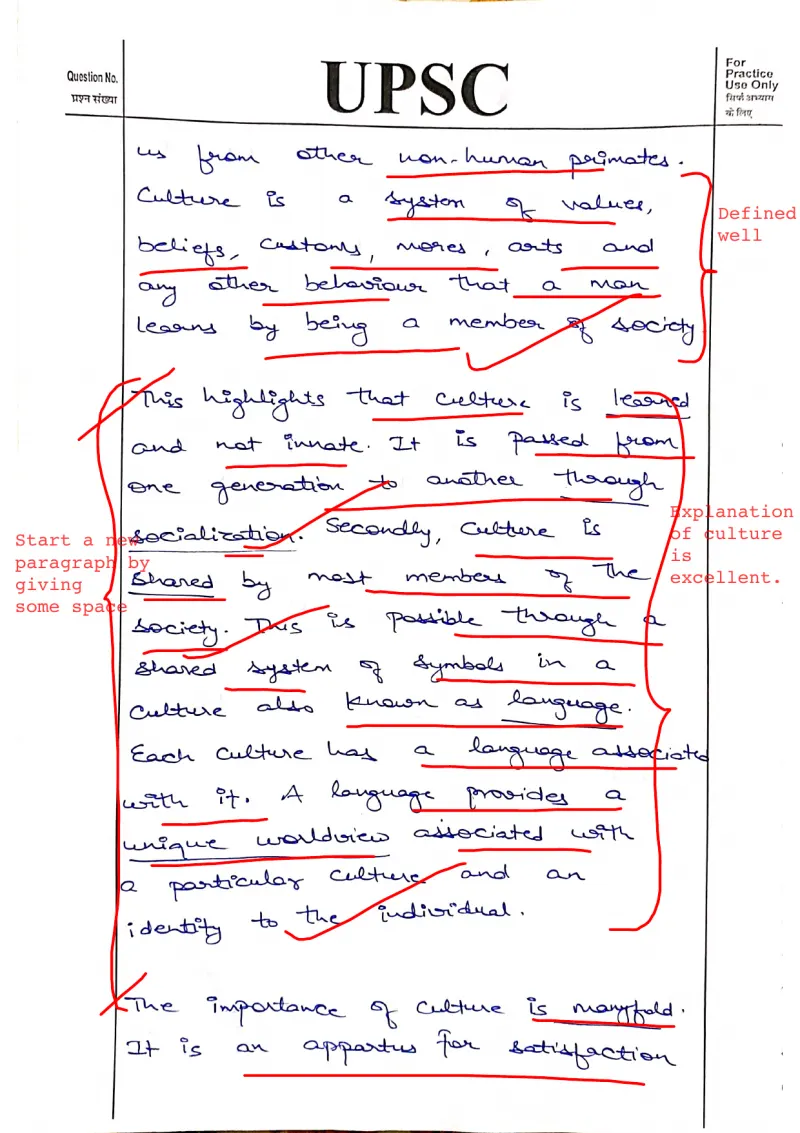
- ▸Anthropological hook (narrow birth canal, post-birth brain growth) earned the evaluator's 'well introduced to the topic.'
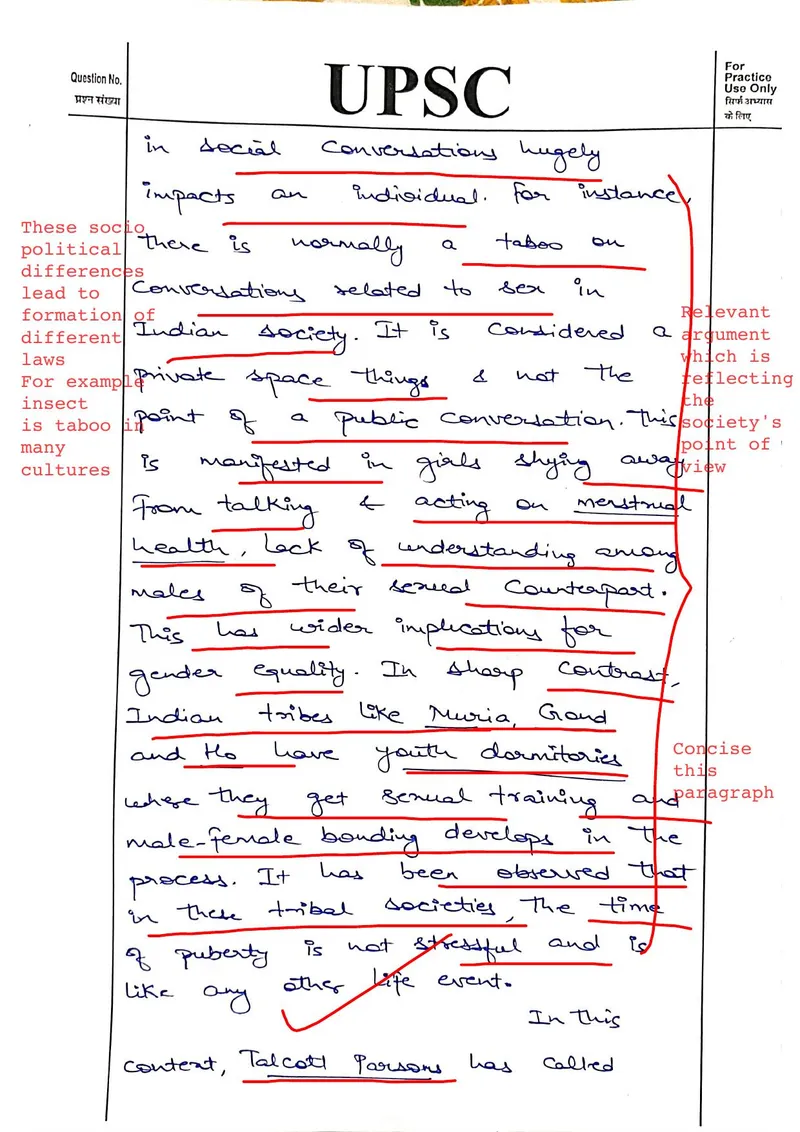
- ▸Unusually rich, multi-disciplinary example bank — Germany's R&D culture, Stalinist USSR, Muria/Gond/Ho youth dormitories, Galileo, Newton-Leibniz, Orwell's 1984.
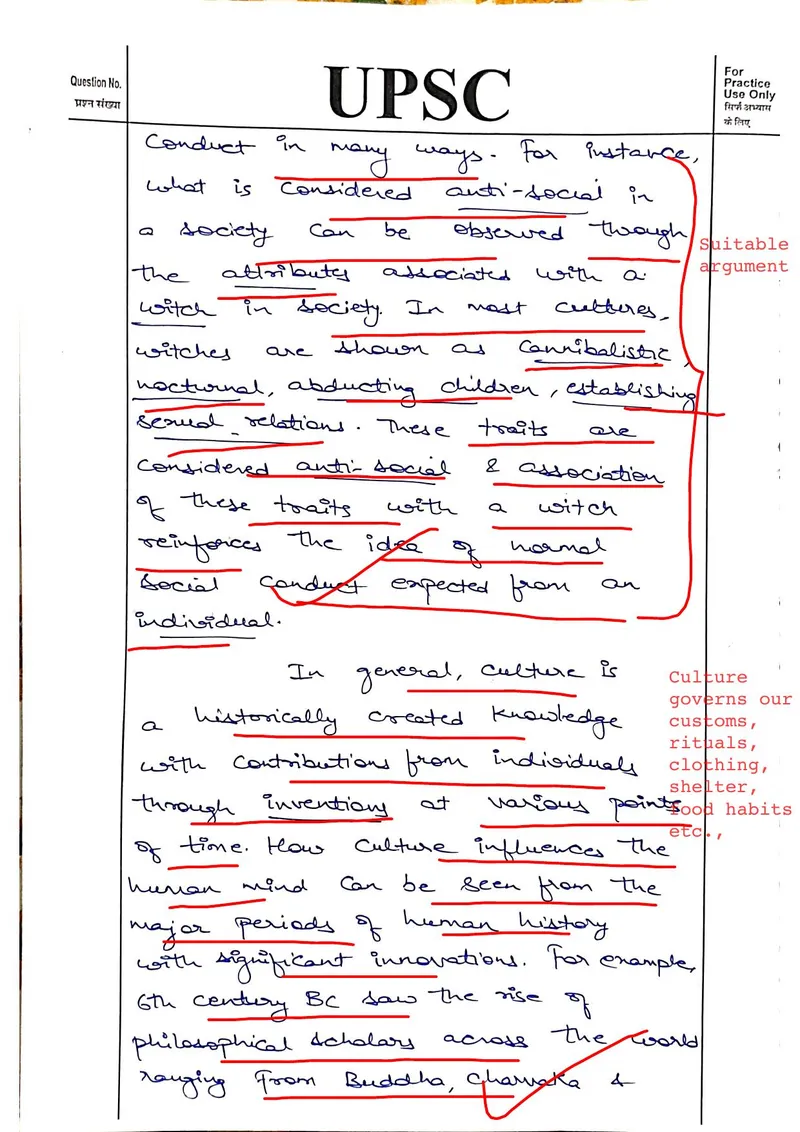
- ▸Sociology woven in well: Talcott Parsons' 'recurrent barbarian invasion' and the superorganic view of culture.
- ▸Keyword underlining and tight interlinking drew repeated praise ('Interlinking is good', 'You have underlined the keywords').
- ▸Synthesising conclusion — 'both culture and the individual influence each other' — rated 'appealing and gives a sense of completion.'
What to learn from this copy
- ★Opened the culture essay not with a definition but with an anthropological hook -- the narrow human birth canal forcing post-birth brain development, proving behaviour is learned not innate -- which earned the evaluator's verbatim 'well introduced to the topic.' -> Hook an abstract essay (here, 'culture') with a concrete, slightly counter-intuitive fact that *demonstrates* your thesis, instead of stating it; it buys evaluator goodwill in the first paragraph.
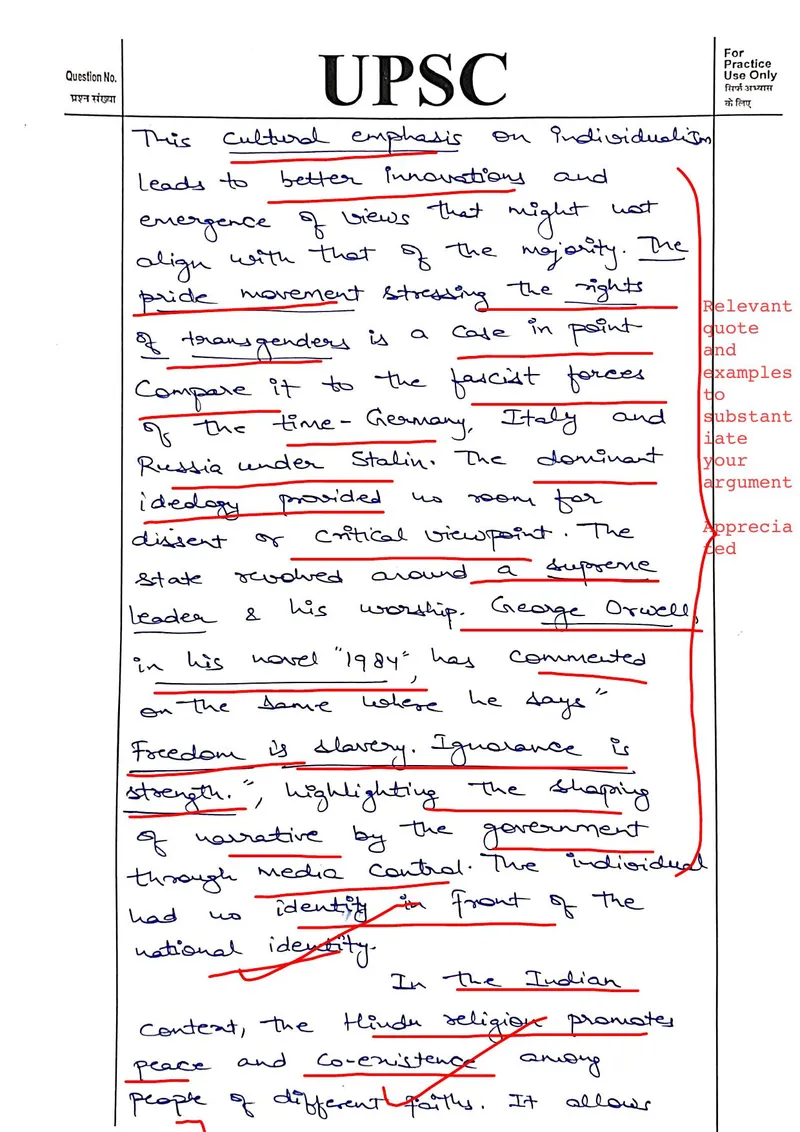
- ★Built an unusually wide, cross-disciplinary example bank to argue both sides -- Germany's R&D culture (>3% GDP), Stalinist USSR and Orwell's '1984' ('Freedom is slavery. Ignorance is strength.') for culture-as-narrowing, vs Galileo, the simultaneous Newton-Leibniz calculus, and 6th c. BC philosophers (Buddha, Charvaka, Mahavira) for culture-as-widening. -> Stock examples from genuinely different domains (economics, history, science, literature) and deliberately deploy them on *opposite* sides of the question, so the essay reads as balanced argument rather than one-sided assertion.
- ★Reached for less-common, India-rooted illustrations -- the Muria, Gond and Ho tribal youth dormitories, the Gurukul-vs-modern-education contrast, and the menstrual-health/sex taboo silence -- rather than only textbook names. -> A couple of fresh, specific examples that most candidates won't use differentiate a copy more than another quote from a famous thinker.
- ★Wove sociology in as analytical scaffolding, not name-dropping -- Talcott Parsons' 'recurrent barbarian invasion' framing of a child's birth and the superorganic view of culture -- which the evaluator marked 'Defined well' and 'Explanation of culture is excellent.' -> Use a named theoretical concept to *explain a mechanism* (how each new generation is enculturated), so the discipline does argumentative work instead of decorating the page.
- ★Closed by explicitly synthesising the two-way relationship -- 'both culture and the individual influence each other' -- which the evaluator rated 'appealing and gives a sense of completion,' and the body's tight cross-referencing drew 'Interlinking is good.' -> End by resolving the question's tension into a single integrative statement that loops back to your thesis; a conclusion that synthesises (not summarises) is what reads as 'complete.'
Questions attempted: Culture and the individual — does culture widen the mind/spirit or narrow worldview; how culture and the individual shape each other.
Questions attempted in this booklet (1)+
- Essay (single, unnumbered).Culture and the individual — does culture widen the mind/spirit or narrow worldview; how culture and the individual shape each other
Examples, data & evidence used
- Human birth canal / post-birth brain development (culture is learned)
- Germany — peer learning + >3% GDP on R&D
- USSR under Stalin — conformist society
- Indian Gurukul vs modern competitive education
- Sex taboo and menstrual-health silence in Indian society
- Muria, Gond, Ho tribes — youth dormitories
- Galileo vs the Church
- Witch stereotypes defining anti-social conduct
- 6th c. BC philosophers — Buddha, Charvaka, Mahavira, Greek scholars
- Newton & Leibniz — calculus invented simultaneously
- Lord Buddha — equality, non-violence
- Pride movement / transgender rights
- Fascist Germany, Italy, Stalinist Russia
- Hindu pluralism vs caste system
Quotes the candidate used
- 'Culture is the widening of the mind and of the spirit.' — opening/title line; evaluator notes it is by Jawaharlal Nehru (candidate did not attribute it in text)
- George Orwell, '1984': 'Freedom is slavery. Ignorance is strength.'
- Talcott Parsons (sociologist) — birth of a child in society as a 'recurrent barbarian invasion' (concept/paraphrase, author named)
How it’s written: Opens with the Nehru-attributed title quote, then an anthropological hook (birth canal, post-birth brain development, learned behaviour) before defining culture as a "system of values, beliefs, customs, mores, arts" citing anthropologists. Uses an explicit interior sub-heading ("Culture – Broadening horizon or narro…
Diagrams & visuals: none visible
Evaluator: Heavily annotated in red — running margin comments plus dense keyword underlining and a final feedback box. Praise (verbatim): "well introduced to the topic", "Interlinking is good", "Defined well", "Explanation of culture is excellent",…