
Shishir Gupta — ForumIAS MGP Copy 1
What’s inside this copy
- ▸Topper-style economy of words: every answer defines, lists pros/cons, and concludes within the 150-word cap
- ▸Strong factual anchoring — Amendment numbers, Schedules, Economic Survey 2018 figures, Nobel laureate attribution
- ▸Uses boxes, arrows and underlining to make scannable structure for the examiner
- ▸Memorable conceptual hooks: Klitgaard's corruption formula and 'red tapism to red carpet'
- ▸Balanced argumentation — e.g. Q2 weighs US/India democracy against China's authoritarian growth
- ▸This file is only Q1-Q9 of a 20-question paper; Q1-Q8 answered, Q9 left blank
What to learn from this copy
- ★On the open-data/transparency answer (Q6) Shishir compressed the entire mechanism of corruption into one boxed formula, 'Discretion + Monopoly − Accountability = Corruption' (Klitgaard's), and paired it with the phrase 'from red tapism to red carpet' -> carry one crisp, boxed equation or coinage per high-frequency theme so the examiner instantly sees you've conceptualised the issue, not just listed points.
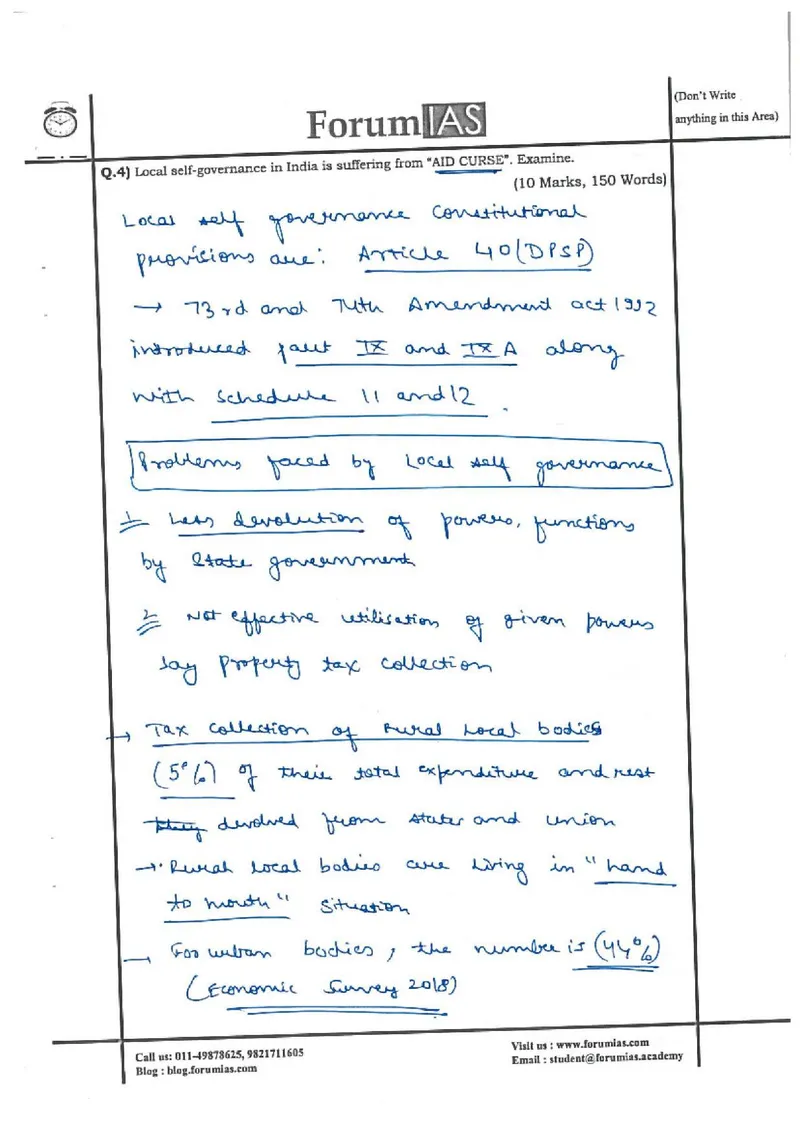
- ★He anchored the fiscal-devolution answer (Q4) in exact Economic Survey 2018 figures — rural local bodies raise ~5% of their own expenditure vs urban ~44% — alongside Article 40, the 73rd/74th Amendment 1992, Part IX & IXA and Schedules 11 & 12 -> stock 2-3 precise, attributable data points (survey %s, amendment numbers, schedules) per static topic; a single quantified contrast does more work than a paragraph of generalities.
- ★On Q6 he replaced a static list with a 'Present → Desired' arrow flow contrasting work culture (Avoid/Bypass/Confuse/delay → Responsive/Open/Accountable/disciplined), and on Q4 a causal chain 'Ineffective local bodies ⇒ Less trust ⇒ creation of SPV/parastatal bodies' -> use arrow-flows to show transformation or causation, not decoration — they prove you understand the 'why/how', which plain bullets hide.
- ★His democracy-and-development answer (Q2) deliberately set both sides against each other — MGNREGA's ~85,000 km of rural roads (2017-18) and US/India democratic credentials versus China's growth under a communist regime with weak distribution, and Pakistan as a near-failed state -> build balance from concrete contrasting cases, not 'on one hand / on the other'; naming the counter-example (China, Pakistan) is what makes the nuance credible.
- ★Every answer follows the same tight 150-word microstructure: a definition/context opening line, development via numbered points and explicit '+ / −' splits, then a 'Thus/Hence' verdict -> lock in one repeatable skeleton (define → +/− → judgement) so under time pressure you never burn words deciding how to organise, and always land an explicit conclusion.
Questions attempted: Anti-Defection law vs representative democracy; needs reform; Do democracy and development go hand in hand; Political theatre / surgical strikes vs Pakistan asymmetric warfare, and 6 more below.
Questions attempted in this booklet (9)+
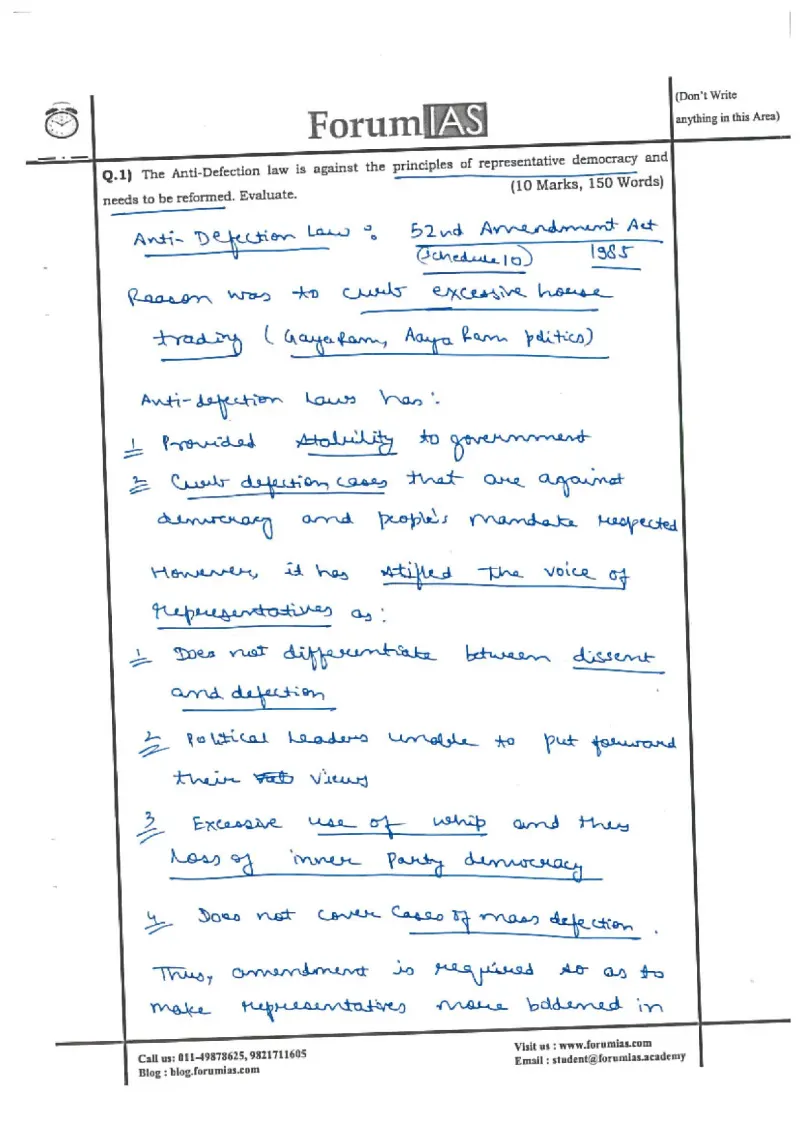
- 1.Anti-Defection law vs representative democracy; needs reform
- 2.Do democracy and development go hand in hand
- 3.Political theatre / surgical strikes vs Pakistan asymmetric warfare
- 4.Local self-governance suffering from 'AID CURSE' (fiscal devolution)
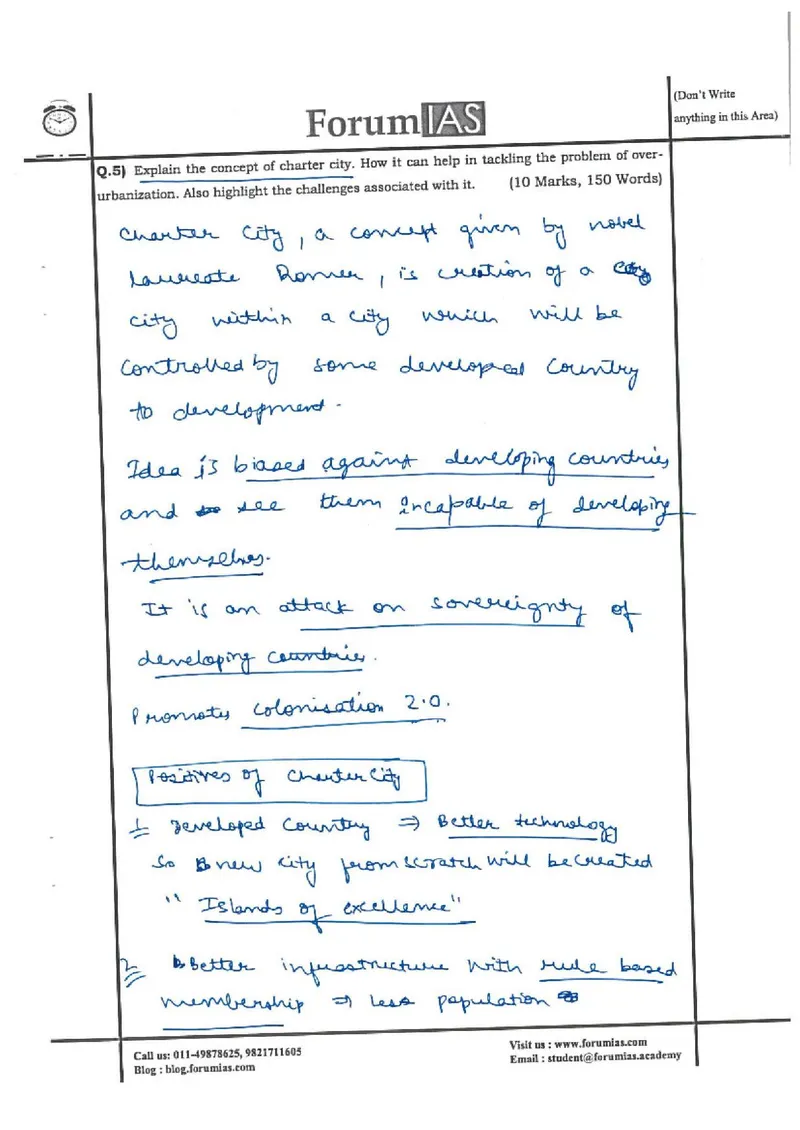
- 5.Charter city concept, over-urbanization, challenges
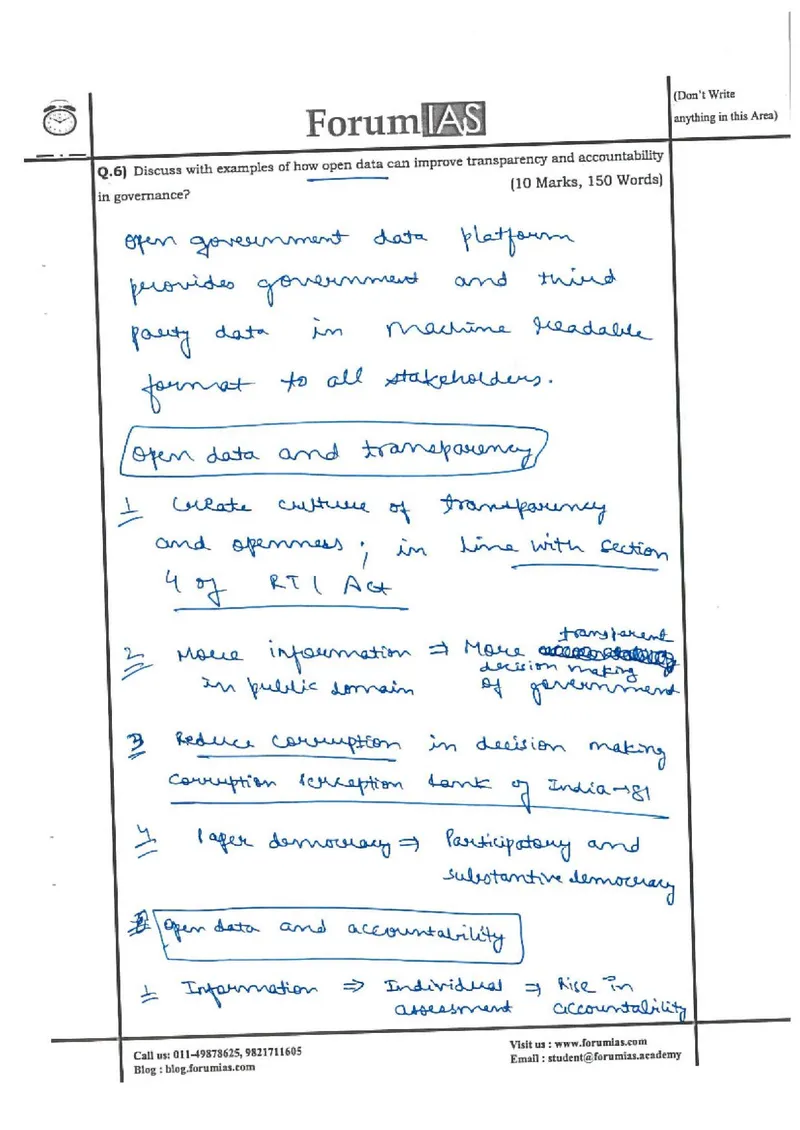
- 6.Open data improving transparency and accountability
- 7.India's Afghan peace-process stand vs Quad grouping
- 8.Strength of democracy judged by strength of opposition
- 9.Governance beyond crisis management / 'holding the fort' — PRINTED BUT NOT ATTEMPTED (answer blank)
Examples, data & evidence used
- 52nd Amendment Act 1985 / 10th Schedule; 'Aaya Ram Gaya Ram' politics (Q1)
- MGNREGA social audit — ~85,000 km rural roads built 2017-18 (Q2)
- Pakistan as a near-failed state; China's progress under a communist regime but weak distribution (Q2)
- Balakot strike by Indian Air Force; Multi Agency Centre; UNSC (Q3)
- Article 40 (DPSP), 73rd & 74th Amendment Act 1992, Part IX & IXA, Schedules 11 & 12 (Q4)
- Economic Survey 2018 — rural local bodies raise ~5% of own expenditure, urban ~44%; MCD strike in Delhi; SPV/parastatal bodies (Q4)
- Paul Romer (Nobel laureate) charter-city concept; 'colonisation 2.0'; satellite town (Q5)
- Open Government Data platform; Section 4 of RTI Act; corruption index India 81 (Q6)
- Moscow process / 'Afghan-led, Afghan-owned'; Taliban & ISIS; Iran and Central Asia stakes (Q7)
- Emergency 1975; Public Accounts Committee, Lokpal, CBI, no-confidence vote (Q8)
Quotes the candidate used
- ex-PM Vajpayee (paraphrased) — India should 'neither provoke nor get provoked' and focus on economic development (Q3)
- 'Discretion + Monopoly − Accountability = Corruption' — boxed formula; student gives no author (Klitgaard's formula) (Q6)
- 'from red tapism to red carpet' (Q6)
- 'Gaya Ram, Aaya Ram politics' — colloquial reference, no author (Q1)
How it’s written: Tight, exam-ready microstructure within the 150-word limit. Each answer opens with a definition/context line, then develops via numbered points and '+/−' (positive/negative) splits, with a 'Thus/Hence' conclusion. Heavy use of arrows for causal chains, boxed headings (e.g. 'Anti-Defection Law', 'Negatives of grants/…
Diagrams & visuals: No maps used; Q6: 'Present → Desired' arrow flow contrasting bureaucratic work culture (Avoid/Bypass/Confuse/delay → Responsive/Open/Accountable/disciplined); Q4: causal flow 'Ineffective local bodies ⇒ Less trust ⇒ creation of SPV/parastatal bodies'; Boxed key terms/headings throughout (Q1, Q4, Q6); no formal diagrams or charts
Evaluator: No examiner marks or comments are filled in on this copy.