
Yashaswi Raj Vardhan — NextIAS GS Paper 2 copy
What’s inside this copy
- ▸Every one of the 10 answers opens with a current-affairs hook and closes with a quotable one-liner — textbook intro/conclusion discipline.
- ▸Exceptional citation density: ~25 distinct Articles plus 10 Acts, 10 court cases and the Sarkaria/Punchhi/2nd ARC/NCRWC committees deployed precisely on point.
- ▸Three hand-drawn visuals used purposefully: India-vs-USA court comparison table, a 74th-Amendment mind-map, and a Legislature-Executive-Judiciary 'checks & balances' triangle.
- ▸Strong comparative-governance flavour — UK neutral-Speaker model, Japan 'glocalisation' model, US judiciary contrast — beyond the bare Indian syllabus.
- ▸Quotes land well: Ambedkar's 'dead letter' on Art 356 and Justice Surya Kant's 'democracy without dissent is a contradiction'.
- ▸Answers stay analytical, not just descriptive — e.g., 'populism narrows governance to winnability' and 'NITI Aayog's effectiveness depends on those running it'.
What to learn from this copy
- ★Every one of the 10 answers opens with a current-affairs hook tied to the exact provision being asked — '~1.4 lakh contempt-of-court cases pending vs govt' for Q2, 'SC in 2025... Tamil Nadu Governor case' for Q10, '65% of urban bodies lack a master plan (NITI Aayog, 2021)' for Q6 -> Anchor your intro to a specific, recent, on-point statistic or case rather than a generic definition; it instantly signals relevance and currency to the examiner.
- ★He pairs the right constitutional authority with the right quote at the right moment: Ambedkar's 'dead letter' prophecy in the Art 356 / President's-rule answer (Q7), and Justice Surya Kant's 'democracy without dissent is a contradiction' in the criminal-contempt vs free-speech answer (Q2) -> Memorise one or two pinpoint quotes per high-frequency theme and deploy them where they actually argue your point, not as decoration.
- ★Citation is dense but precise and on-point — ~25 Articles (76, 105, 129, 142, 356, 200 etc.), specific Acts (Contempt of Court Act 1971, 52nd Amendment 1985, 74th Amendment 1992), live cases (SR Bommai 1994, Tamil Nadu Governor 2025, Maharashtra 2022), and the matching committees (Sarkaria, Punchhi, 2nd ARC, NCRWC) -> Build per-topic 'evidence kits' of article + act + landmark case + relevant committee so every claim is backed by a named authority, not vague assertion.
- ★He brings in comparative-governance models beyond the bare Indian syllabus exactly where they sharpen the argument — UK's neutral-Speaker convention ('once a Speaker, always a Speaker') for anti-defection (Q8), Japan's 'glocalisation' for urban governance (Q6), and a US-judiciary contrast for contempt/free-speech (Q2) -> Keep a small bank of foreign best-practice models mapped to specific Indian problems; using them as a 'way forward' lifts an answer above textbook recall.
- ★Diagrams do analytical work rather than fill space: a two-column Indian-vs-USA court table with hierarchy flowcharts (Q2), a 74th-Amendment mind-map radiating to women's reservation, 12th Schedule and SEC/SFC (Q6), and a Legislature–Executive–Judiciary 'checks and balances' triangle with labelled arrows like summon/prorogue, scrutiny, writ (Q9) -> Reserve diagrams for comparison, structure-mapping or relationship questions where a visual genuinely compresses information the prose would labour over.
- ★Answers stay analytical, not descriptive — lines like 'populism narrows governance to winnability' and 'NITI Aayog's effectiveness depends on those running it' (Q1), plus the critical use of the 'One Nation One X' one-size-fits-all framing against NITI's nationalising tendency -> Push past listing facts to a judgement or trade-off; a crisp evaluative one-liner is what separates a scoring answer from a competent one.
Questions attempted: NITI Aayog vs Planning Commission; cooperative & competitive federalism; Indian vs USA judiciary; contempt of court & free speech; Freebies/populism in elections; constitutional welfare provisions & reforms, and 7 more below.
Questions attempted in this booklet (10)+
- 1.NITI Aayog vs Planning Commission; cooperative & competitive federalism
- 2.Indian vs USA judiciary; contempt of court & free speech
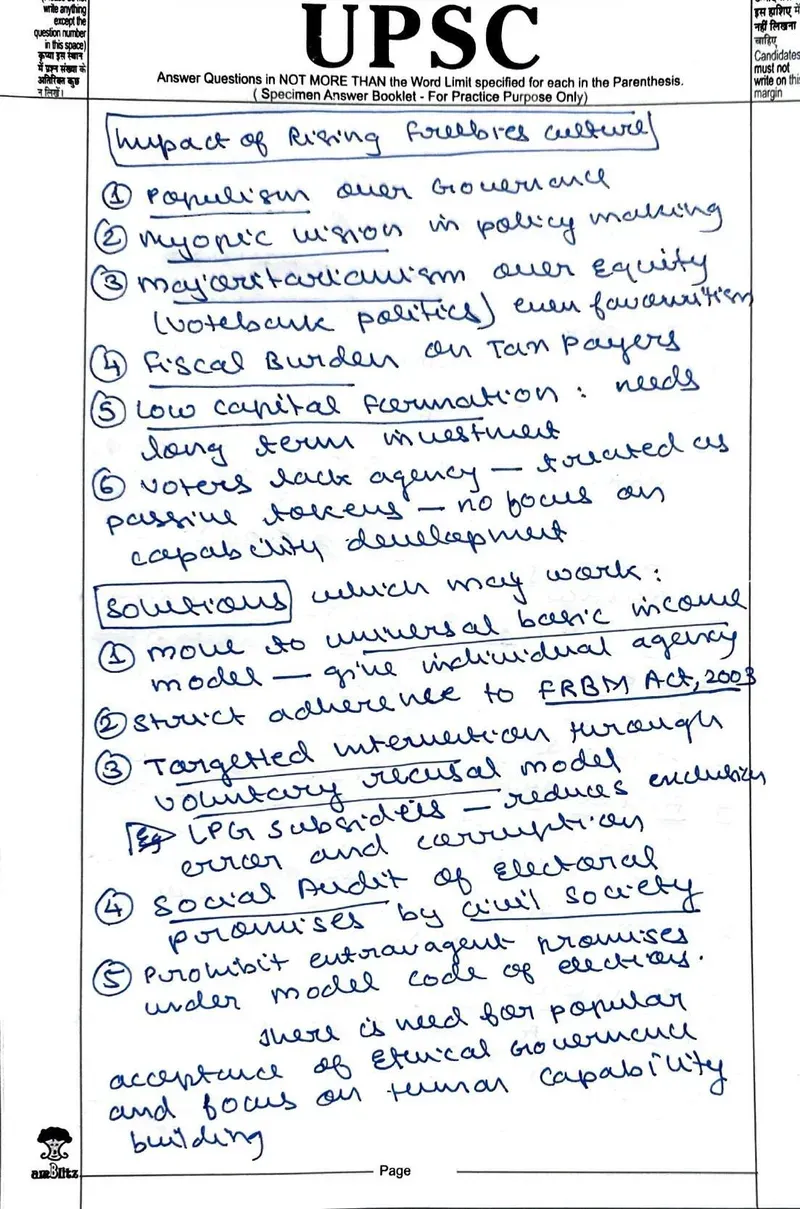
- 3.Freebies/populism in elections; constitutional welfare provisions & reforms
- 4.Attorney General of India — roles, limitations, safeguards
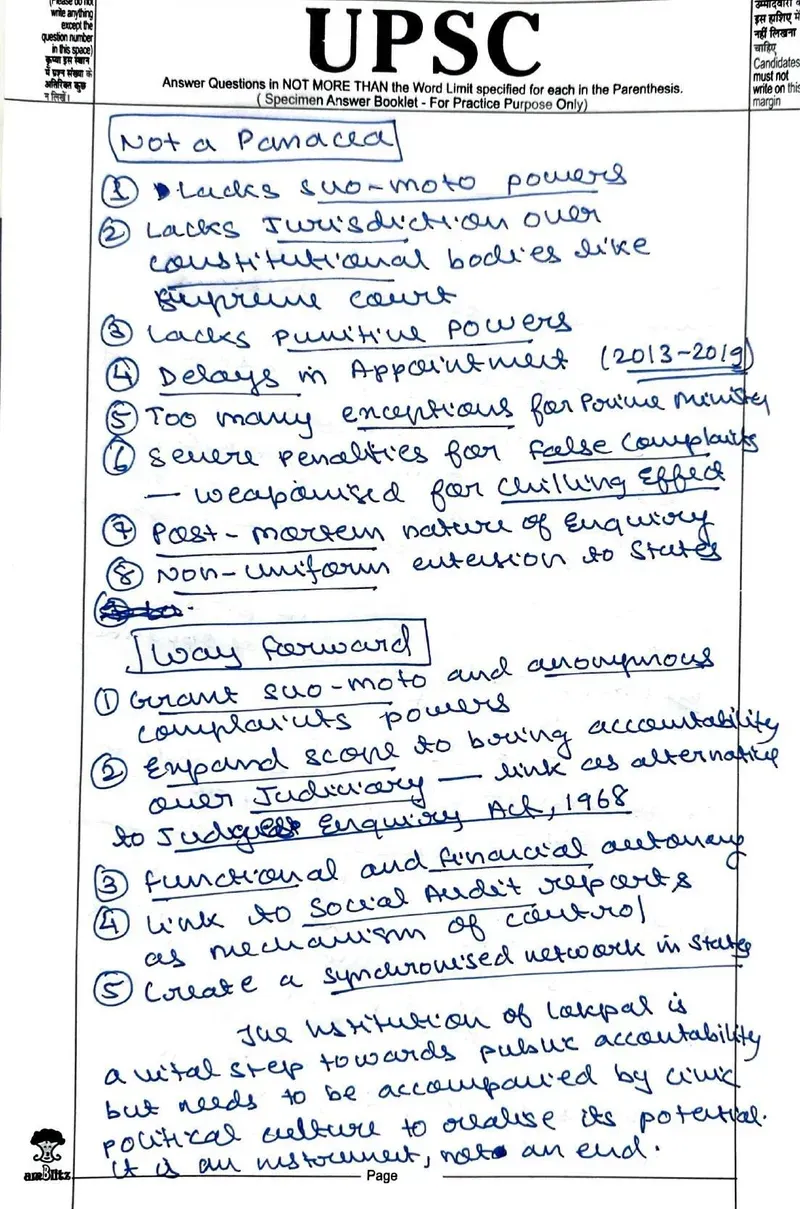
- 5.Lokpal — significance, limitations, way forward
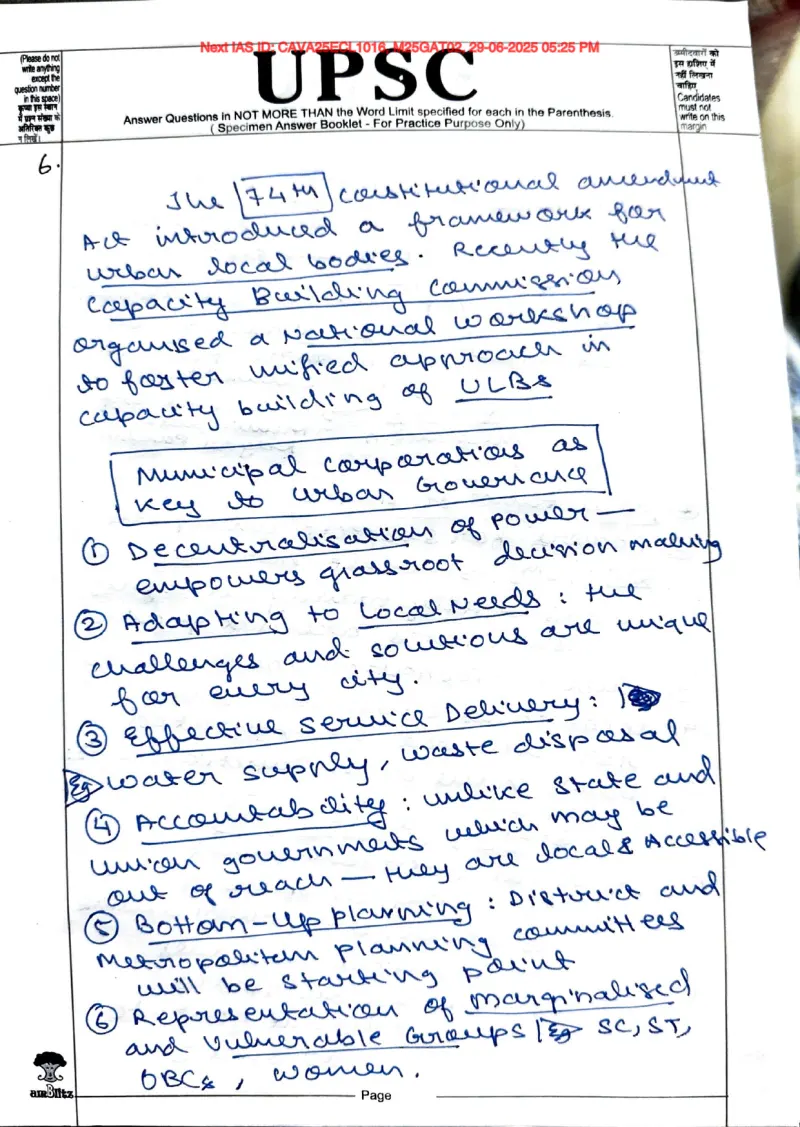
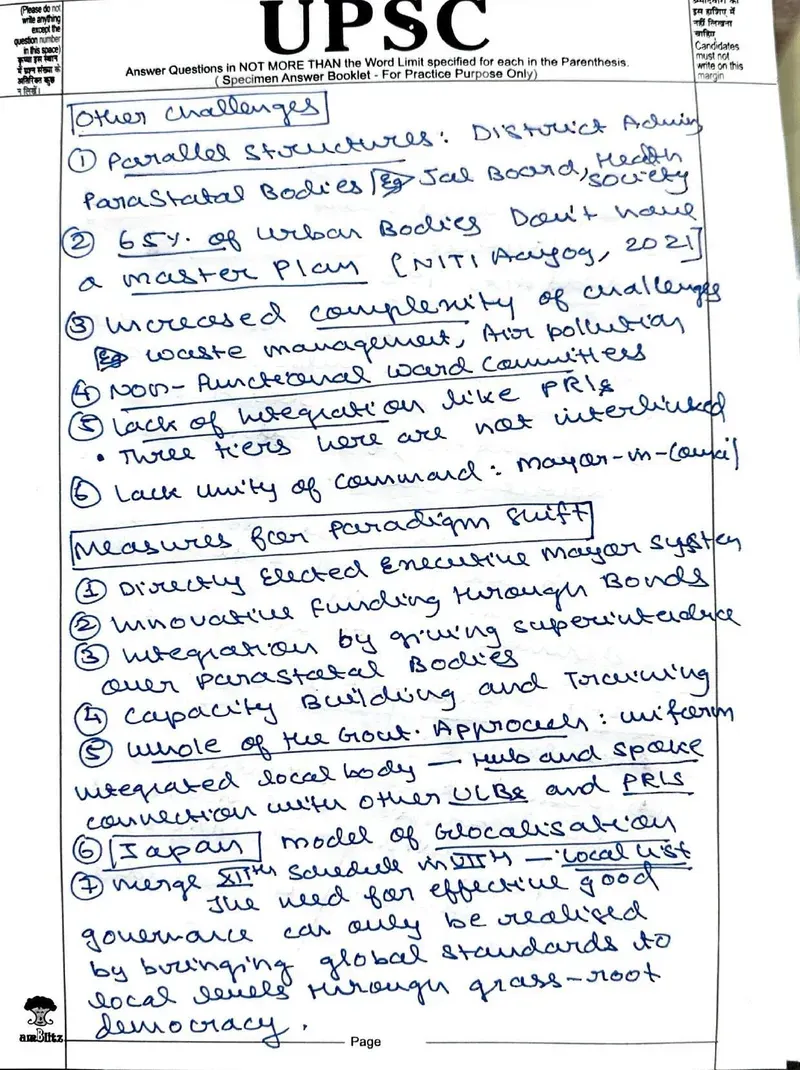
- 6.74th CAA & urban local bodies; municipal corporations in urban governance
- 7.President's rule / Article 356 — provisions, safeguards, criticism
- 8.Anti-Defection Law (10th Schedule, 52nd Amendment) — provisions & reforms
- 9.Parliamentary scrutiny & control over the executive; checks and balances
- 10.Governor's role in state legislative process; assent to Bills
Examples, data & evidence used
- Articles: 76, 105, 129, 142, 143, 19(2), 15 & 16, 38, 39, 41, 47, 102, 168, 174, 175, 176, 192, 200, 201, 355, 356, 365; 10th, 11th & 12th Schedules
- Acts: Contempt of Court Act 1971, CrPC 1973, Government of India Act 1935, MGNREGA 2005, NFSA 2013, FRBM Act 2003, 52nd Amendment Act 1985, 74th Amendment Act 1992, Judges Enquiry Act 1968, Representation of People Act
- Cases: KM Nanavati case, SR Bommai (1994), Uttarakhand Assembly/Harish Rawat (2016), Jammu & Kashmir case, Tamil Nadu Governor case (2025), West Bengal/Kerala/Punjab Governor cases, Maharashtra (2022), Himachal Pradesh (2024)
- Commissions/bodies: Sarkaria Commission, Punchhi Commission, 2nd ARC, NCRWC, Finance Commission, Capacity Building Commission, CVC, CBI, CAG, Election Commission
- Schemes/programmes: Atal Innovation Mission, Smart City, AMRUT, Aspirational Districts, PM Gati Shakti, Vibrant Villages, e-Amrit (EV), NDAP (National Data Analytics Platform), LPG subsidy (DBT)
- Data/reports: ~1.4 lakh contempt-of-court cases pending vs govt; 65% of urban bodies lack a master plan (NITI Aayog, 2021); President's rule invoked >100 times; Lokpal appointment delay 2013-2019
- NITI documents: 'India @ 75', 'India @ 2047'
- Thinkers/authorities: Dr. B.R. Ambedkar ('dead letter'), Justice Surya Kant
- Comparative models: UK model (neutral Speaker — 'once a Speaker, always a Speaker'), Japan model of glocalisation, Universal Basic Income
Quotes the candidate used
- "Democracy without dissent is a contradiction" — attributed to Justice Surya Kant (Supreme Court), in Q2 on criminal contempt
- Article 356 will remain a "dead letter" — Dr. B.R. Ambedkar, in Q7 on President's rule
- "One Nation One X" / one-size-fits-all approach — used critically in Q1 on NITI Aayog's nationalising tendency
How it’s written: Highly consistent, structured template across all 10 answers: (1) a short contextual intro that anchors to a recent event/news (e.g., '1.4 lakh contempt cases pending', 'SC in 2025... Tamil Nadu case', 'recently the Capacity Building Commission...'); (2) boxed/underlined sub-headings (e.g., 'Significance', 'Challeng…
Diagrams & visuals: Q2 (p.4): two-column comparison table — Indian courts vs USA courts, with hierarchy flowcharts (SC -> HC -> District Courts; US-SC -> Circuit Courts -> US-DC); Q6 (p.13): spider/mind-map diagram centred on '74th AA, 1992' radiating to 1/3 women reservation, 12th Schedule, 5-yr term, planning mechanism, State Election/Finance Commission, ULB tiers; Q9 (p.21): triangular 'checks and balances' diagram linking Legislature–Executive–Judiciary with labelled arrows (summon/prorogue, scrutiny, appoint, review/writ, remove)
Evaluator: No examiner marks or comments are filled in on this copy.