
Zinnia Aurora — ForumIAS GS copy
EssayPDF · 1.2 MB
What’s inside this copy
- ▸This is an ESSAY (EGP) copy, not GS — only one essay attempted (machines/men thinking, topic 4)
- ▸Completely unevaluated: zero marks, ticks or comments; index table, marking scheme, mid-essay-review and feedback boxes all left blank
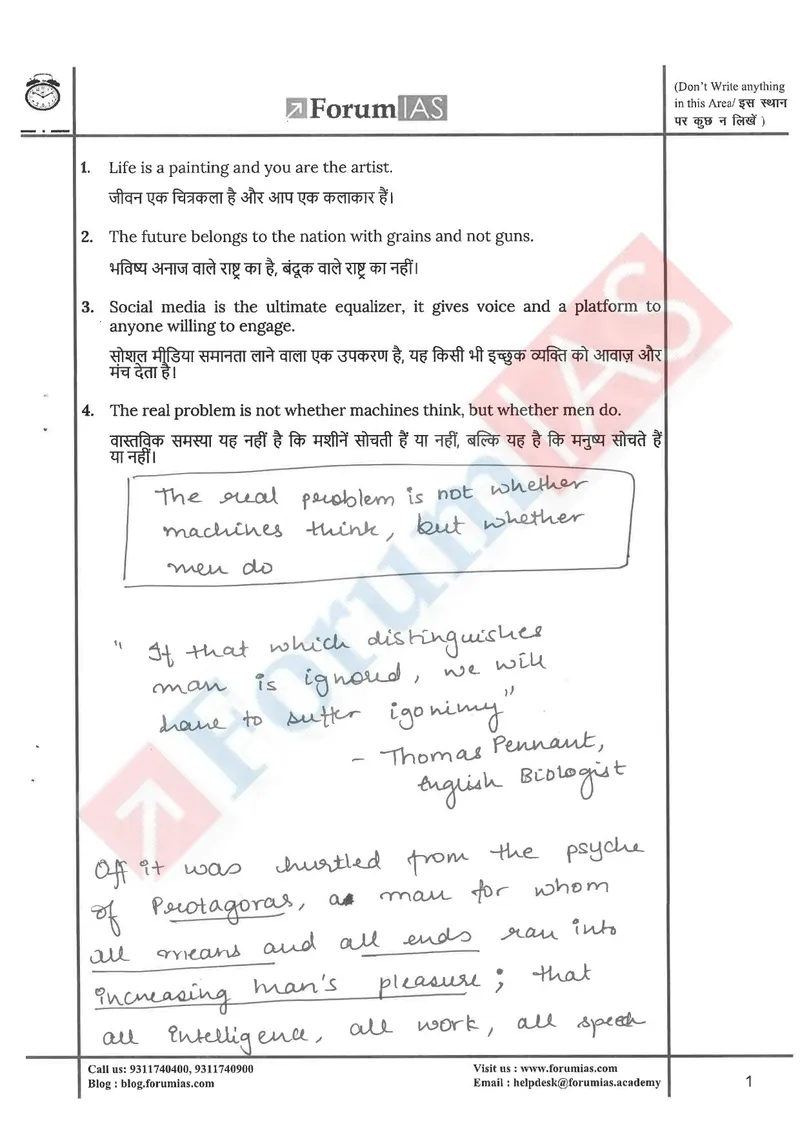
- ▸Opens with a hand-boxed topic line plus a Thomas Pennant epigraph, then frames the whole essay on Protagoras' 'Homo mensura'
- ▸A sustained Frankenstein-vs-Franz-Fanon literary motif runs end to end (the 'brain to mind' transformation, the 'Monster')
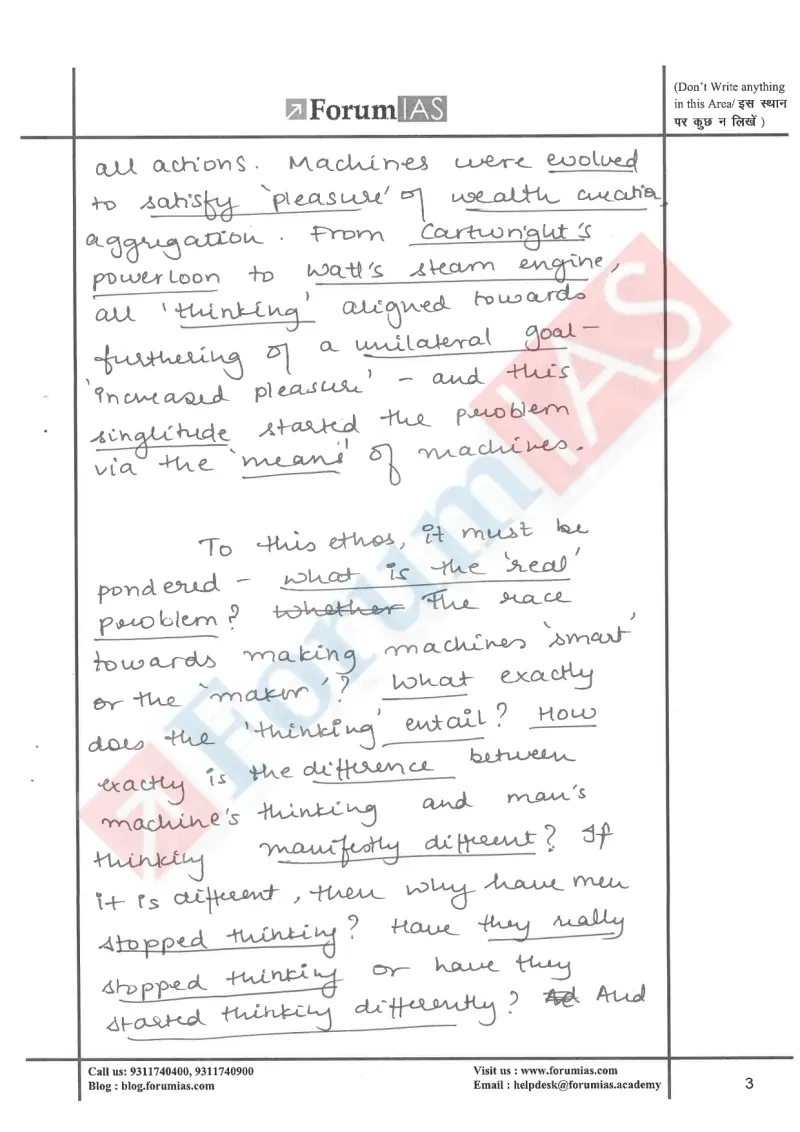
- ▸Unusually wide referencing across philosophy, history and policy — Descartes, Gandhi, Foucault, Chomsky, Marcuse, Schindler, Cartwright/Watt, plus MGNREGA and DBT
- ▸Heavy keyword underlining and rhetorical questions; closes optimistically on man-machine synergy — 'think rationally... wildly... boldly... conquer its well-rounded Galilean Eureka!'
What to learn from this copy
- ★The essay is anchored to a single philosophical thesis from the first lines — a hand-boxed reproduction of the topic, a Thomas Pennant epigraph ('If that which distinguishes man is ignored, we will have to suffer ignominy'), then Protagoras' 'Homo mensura' (man is the measure of all things) — so 'whether men think' is set up as the real axis before any example arrives -> Open an essay by planting one organising idea/quotation that names the question's true stake, then judge every later paragraph against it instead of drifting across loosely-linked points.
- ★A single literary motif — Frankenstein and 'the Monster' (Mary Shelley) played against Franz Fanon, tracking a 'brain to mind' transformation — is carried from introduction to conclusion rather than dropped after one mention -> Pick one recurring image or character and thread it through the whole essay; a returning motif gives a 12-page answer visible unity that a scatter of unrelated quotes cannot.
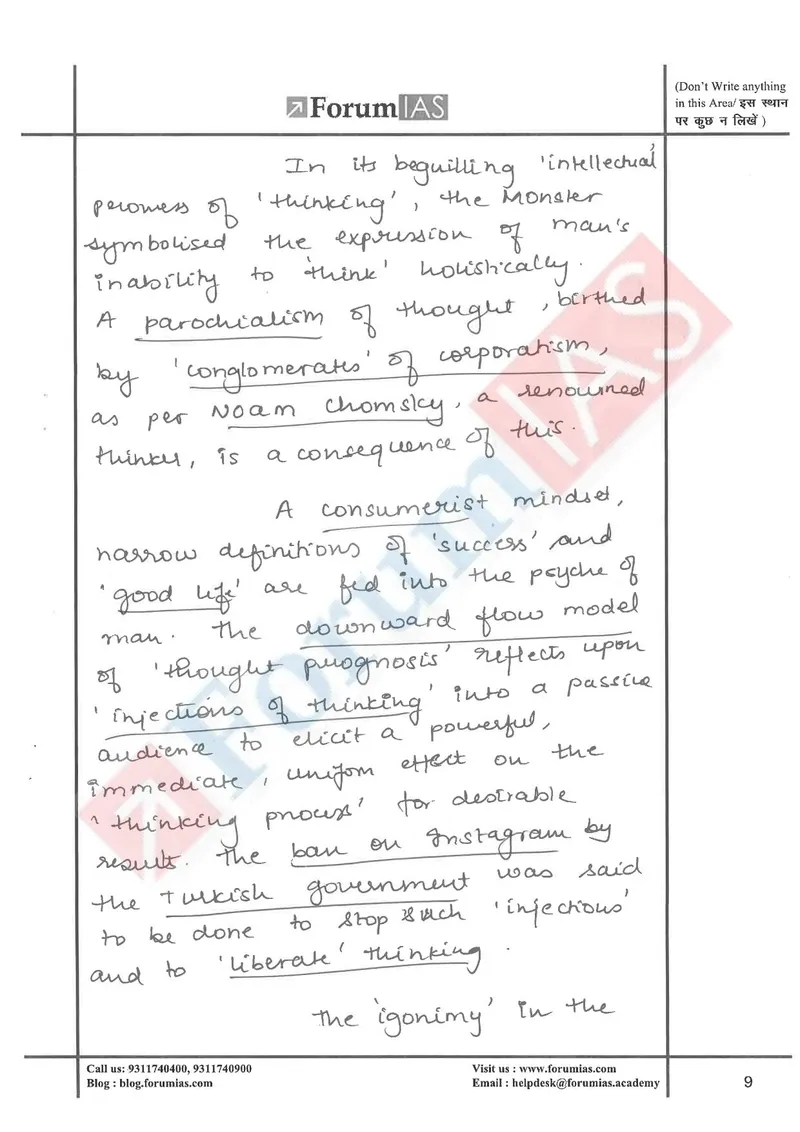
- ★References are deliberately spread across disciplines and then bent back to the man-vs-machine theme — Descartes' 'I think, therefore I am' and Marcuse's 'One Dimensional Man' for philosophy, Cartwright's power loom and Watt's steam engine for the Industrial Revolution origin of 'machine', Foucault's 'homogenisation' and Chomsky's 'conglomerates of corporatism' for critique, Schindler and Gandhi ('Science without morality is a sin', 'Machinery is like a snake hole') for ethics, plus policy hooks like MGNREGA and DBT -> Stock an essay with examples from genuinely different domains (philosophy, history, economy, policy, ethics) so a single theme is shown from many angles — breadth of evidence reads as range of thought, not name-dropping, as long as each example services the central claim.
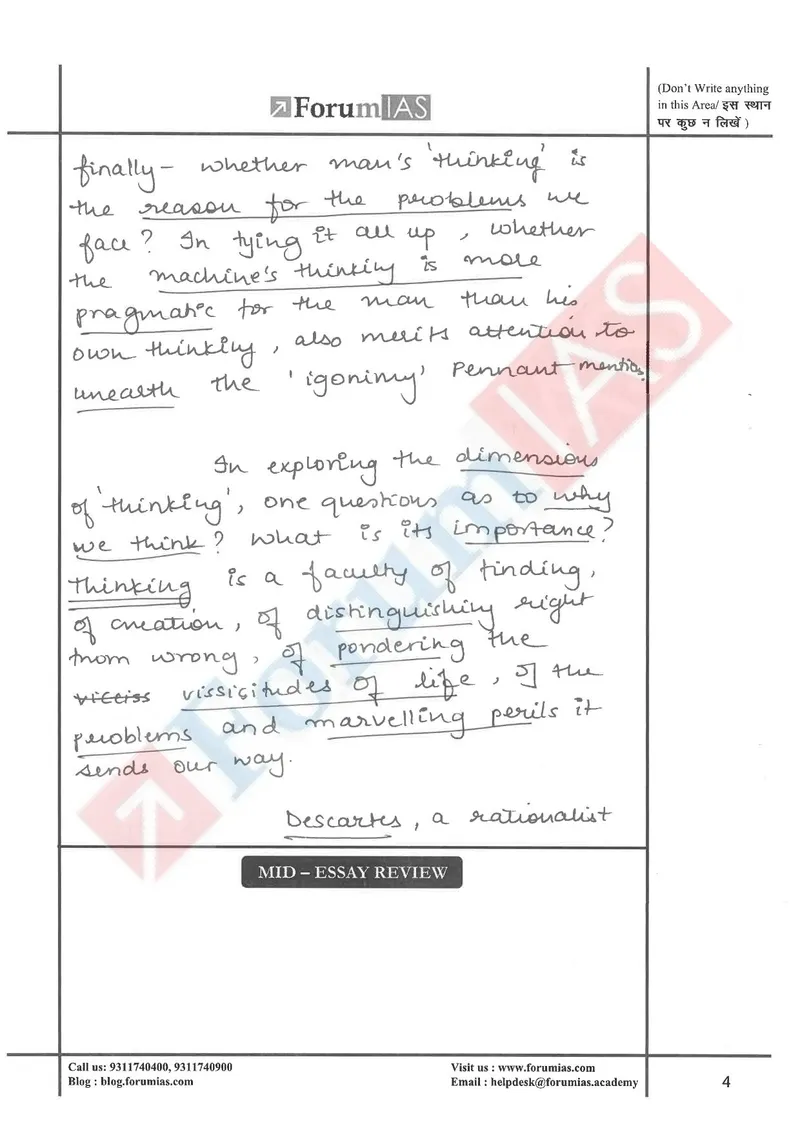
- ★The body is built on a chain of rhetorical questions that progressively define what the 'real problem' is, and the essay deliberately resolves on an optimistic note of man-machine synergy ('think rationally... wildly... boldly... conquer its well-rounded Galilean Eureka!') rather than ending on alarm -> Use posed questions to structure the argument's movement and end with a constructive, forward-looking resolution; a deliberate hopeful close lands better than trailing off or a purely pessimistic warning.
Questions attempted: Topic 4 chosen: 'The real problem is not whether machines think, but whether men do.' (philosophy of mind/technology/humanism). No marks written..
Questions attempted in this booklet (1)+
- Q1 (Essay).Topic 4 chosen: 'The real problem is not whether machines think, but whether men do.' (philosophy of mind/technology/humanism). No marks written.
Examples, data & evidence used
- Protagoras / 'Homo mensura' (man is the measure of all things)
- Descartes (rationalist) — 'I think, therefore I am'
- Frankenstein and 'The Monster' (Mary Shelley) — recurring motif, incl. 'Monster study' and children left 'stuttering'
- Franz Fanon
- Oskar Schindler — Nazi-turned-humanist who built hospitals instead of concentration camps
- Gandhiji
- Michel Foucault — 'homogenisation' of thinking
- Noam Chomsky — parochialism / 'conglomerates of corporatism'
- Cartwright's power loom and Watt's steam engine (Industrial Revolution)
- Mahmud of Ghazni (plunder)
- Vera English vs giants like General Electric (whistleblowing/nuclear leaks)
- Mussolini's chauvinism / autarkic thinking vs Radhakrishnan, Vivekananda and Aurobindo's universalism
- Herbert (written 'Henry') Marcuse — 'One Dimensional Man'
- Quantum computer and Artificial Intelligence
Quotes the candidate used
- 'If that which distinguishes man is ignored, we will have to suffer ignominy' — Thomas Pennant, English Biologist (used as opening epigraph; candidate spells it 'igonimy')
- 'Homo mensura!' — Protagoras
- 'I think, therefore, I am!' — Descartes
- 'Machinery is like a snake hole.' — Gandhiji
- 'Science without morality is a sin.' — Gandhiji
How it’s written: Single essay, ~12 handwritten pages (numbered 1-12 at foot). Introduction: reproduces the topic in a hand-drawn box, then a Thomas Pennant epigraph, opening on Protagoras' 'Homo mensura' and the pleasure-driven origin of 'machine' (Industrial Revolution). Body: a string of rhetorical questions defining the 'real pro…
Evaluator: No examiner marks or comments are filled in on this copy.