
Astha Jain — NextIAS Essay copy
What’s inside this copy
- ▸Both essays hook the reader with a concrete human story before analysis — Riya, the slum schoolgirl whose flooded home symbolises unplanned urbanisation; Sushant Singh Rajput for loneliness
- ▸Strong counter-view in Section-B reframes loneliness as 'a breeding ground of creativity', citing Newton conceiving gravity and Anne Frank realising her potential
- ▸Coined, quotable lines: cities as 'islands of prosperity within oceans of poverty' and tech life giving 'shelter without warmth, food without taste, life without meaning'
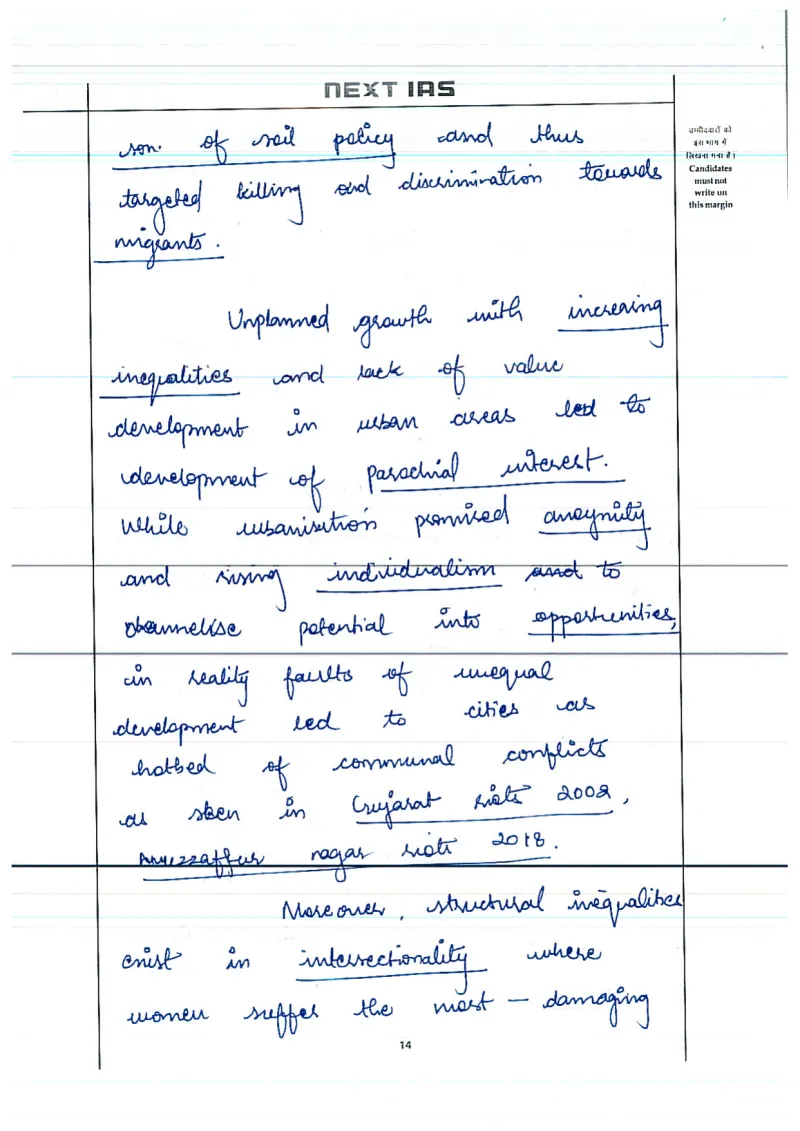
- ▸Broad example bank spanning history (Indus Valley), governance (Indore, Smart Cities), disasters (Chennai, Dwarka, Delhi seismic) and society (Gujarat/Muzaffarnagar riots)
- ▸Neat, legible blue-ink cursive with disciplined underlining of keywords for emphasis
- ▸Copy is UNEVALUATED — no marks, ticks, or examiner feedback recorded on any page
What to learn from this copy
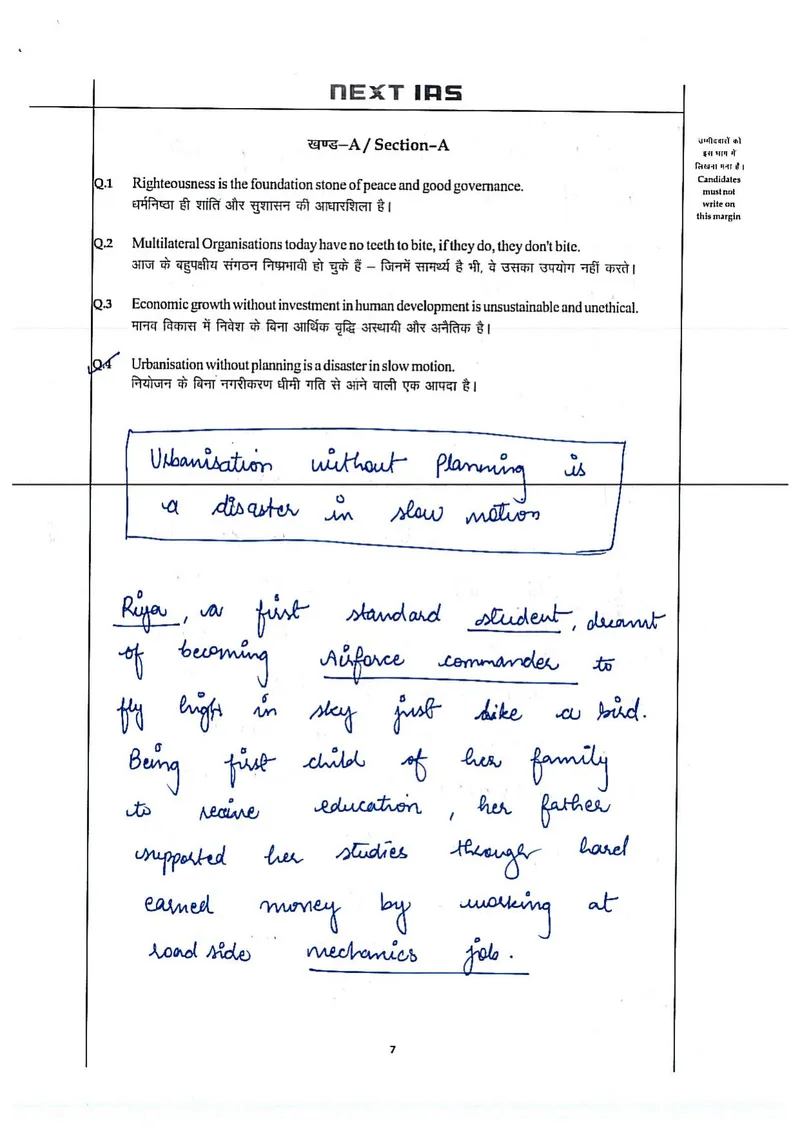
- ★Both essays open with a concrete human story before any analysis: Section-A starts with 'Riya', a first-standard slum girl who dreams of becoming an Air Force commander, whose mechanic father's home is washed away in floods, and Section-B opens on Sushant Singh Rajput's suicide -> Earn the examiner's attention in the first paragraph with one specific, named human scene that embodies the theme, then pivot to argument — don't open with a textbook definition.
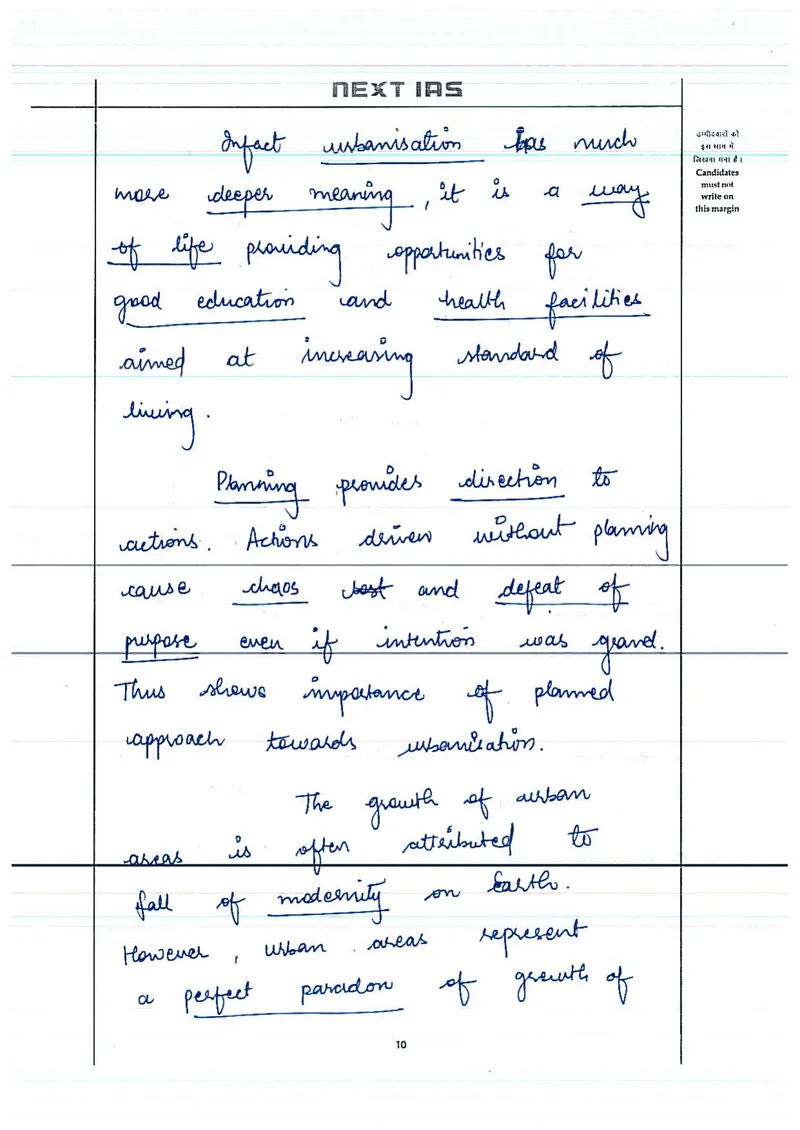
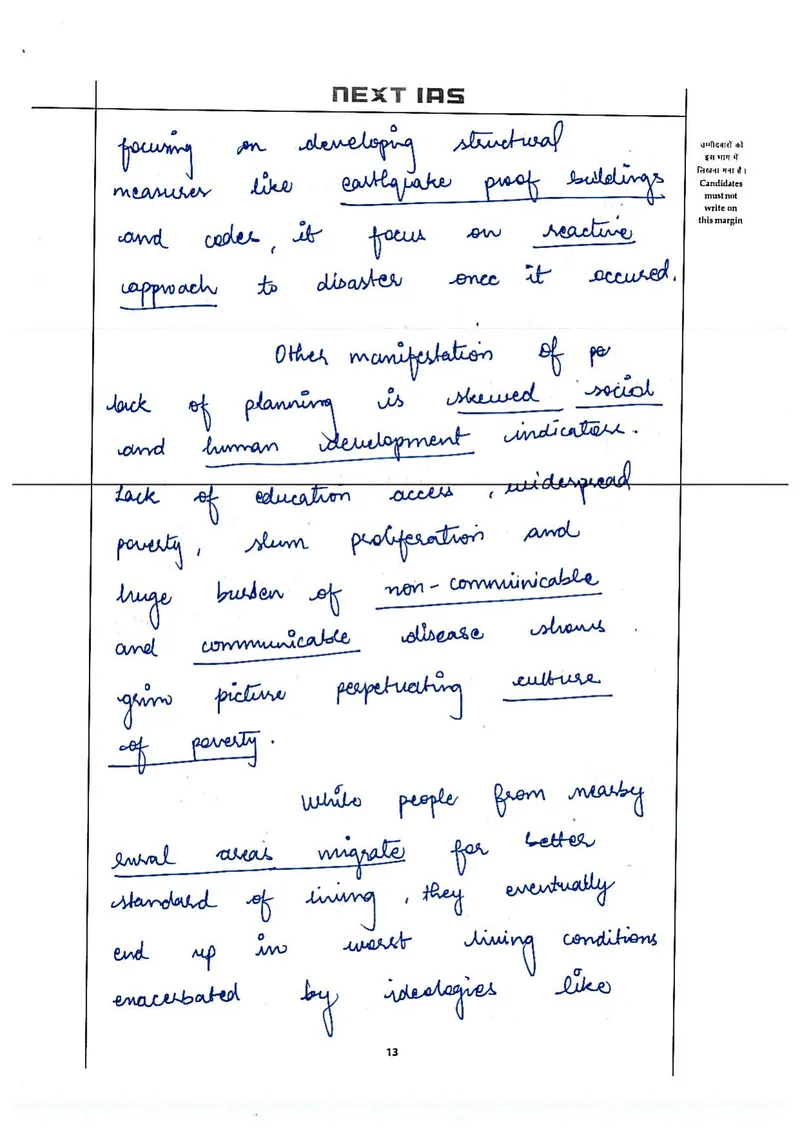
- ★On 'urbanisation without planning', she anchors the ideal in history before diagnosing failure — Indus Valley's planned cities, fortified settlements, standardised bricks and drainage — then contrasts live failures: Chennai floods from sewage mismanagement, Dwarka becoming a 'flooded city', Delhi's reactive seismic-zone approach -> Build an essay's example bank across registers (ancient history, current governance, recent disasters) so each body point rests on a different, verifiable instance rather than repeating one domain.
- ★She manufactures her own quotable lines instead of only borrowing them: cities as 'islands of prosperity within oceans of poverty', and tech life giving 'shelter without warmth, food without taste, life without meaning' -> Coin a few crisp, parallel-structured phrases of your own that compress the essay's thesis; original epigrammatic lines stick with an examiner more than another famous quotation.
- ★In Section-B she refuses a one-sided take on loneliness, reframing it as 'a breeding ground of creativity' with Newton conceiving gravity in isolation and Anne Frank realising her potential -> Deliberately build a strong counter-view section so the essay reads as balanced reasoning, not a one-directional rant — the dialectical turn shows maturity of thought.
- ★She brought structural discipline to the page itself: each chosen topic statement is hand-drawn in a box at the top, keywords are underlined for emphasis in neat blue cursive, and pages 30-32 hold mind-map planning notes -> Plan the essay on rough pages first and use light visual cues (boxed prompt, underlined keywords) so the script stays legible and the examiner can track your argument at a glance.
Questions attempted: Urbanisation without planning is a disaster in slow motion; The most terrible poverty is loneliness and the feeling of being unloved.
Questions attempted in this booklet (2)+
- Section-A, Q.4.Urbanisation without planning is a disaster in slow motion
- Section-B, Q.6.The most terrible poverty is loneliness and the feeling of being unloved
Examples, data & evidence used
- Riya anecdote — first-standard girl dreaming of becoming an Air Force commander, father a roadside mechanic, home washed away in floods (Section-A opening hook)
- Indus Valley Civilisation — planned cities, fortified settlements, standardised bricks, sanitised drainage
- Indore — top performer in cleanliness due to planned, responsive government (Swachh ranking)
- Chennai floods — sewage mismanagement during heavy rainfall
- Dwarka (Delhi) — became a 'flooded city' for a moment
- Delhi — high seismic zone, reactive vs proactive disaster approach / building codes
- 'Islands of prosperity within oceans of poverty' — high skyscrapers beside slums
- Urban heat island and particulate-matter pollution
- Gujarat riots 2002 and Muzaffarnagar riots 2018 (as written) — cities as hotbeds of communal conflict
- 'Son of soil' policy — targeted killing and discrimination against migrants
- Intersectionality — women suffering most from structural inequalities
- Mission LiFE (Lifestyle for Environment)
- Smart Cities Mission
- Sushant Singh Rajput — actor's suicide (Section-B opening hook)
Quotes the candidate used
- 'Dead people receive more flowers than the living ones, because regret is greater than gratitude.' — attributed to Anne Frank
- Yuval Noah Harari (attributed/paraphrased) — humans survive because of their ability to forge relationships
How it’s written: Two-section format; candidate boxed each chosen topic statement at the top before writing. Both essays open with a vivid human narrative hook (Riya the slum schoolgirl for Section-A; Sushant Singh Rajput for Section-B) then pivot to analysis. Section-A flow: deeper meaning of urbanisation as a way of life -> problem…
Diagrams & visuals: No formal diagrams or maps in the essay body; Topic statements hand-drawn in boxes at the start of each essay; Rough-work pages (30-32) contain bullet/mind-map style planning notes, not illustrative diagrams
Evaluator: No examiner marks or comments are filled in on this copy.