
Monika Srivastava — Vajiram & Ravi GS copy
What’s inside this copy
- ▸Vajiram & Ravi 'Rankers' Programme' answer copy of Monika Srivastava (AIR 16, CSE 2025); GS Paper IV (Ethics); cover note states 'Attempted only 12 questions' — Q1-Q11 (Section A, 10 marks/150 words each) plus one Section B case study (Q12, 20 marks).
- ▸Highly consistent answer template throughout: underlined quote/definition intro -> underlined thematic heading -> numbered points (i, ii, iii...) each paired with an 'eg ->' real-world example -> a branching mind-map diagram -> a vision-led conclusion.
- ▸Example-dense and current-affairs heavy: Satyendra Dubey, TN Seshan, M Visvesvaraya, Kiran Bedi, Ira Singhal, Neeraj Chopra, Malala, Greta Thunberg, plus schemes like Mission Karmayogi, Sugamya Bharat Abhiyan, Mission LiFE and the International Solar Alliance.
- ▸Almost every answer closes on a national-vision phrase — Ram Rajya, Vishwaguru, Vasudhaiva Kutumbakam, Viksit Bharat, Sabka Saath Sabka Vishwas, ethical governance.
- ▸Gandhi recurs as an anchor — NCM-withdrawal resilience (Q6b), conscience-over-majority (Q6c), and the 'enough for needs not greed' quote closing Q9.
- ▸Liberal use of branching mind-map / flow diagrams (equanimity, empathy, moral obligations, stakeholders) and a triple-bottom-line people-profit-planet sketch; no geographic maps.
What to learn from this copy
- ★She ran one disciplined template through all 12 answers: an underlined quote/definition opener, then an underlined thematic heading, then numbered points (i, ii, iii) where EVERY point is paired with a concrete 'eg ->' real-world case, then a mind-map, then a vision conclusion. -> In Ethics, build a repeatable answer skeleton so each point automatically carries an example and you never write an abstract claim without grounding it.
- ★She never left a value as theory — she anchored each one to a named person: Satyendra Dubey (Golden Quadrilateral whistleblower) for intellectual integrity, M Visvesvaraya's two-candle story for impartiality vs neutrality, Raja Ram Mohan Roy's abolition of Sati for conscience over majority. -> Keep a stock of specific named administrators/reformers and attach a precise act to each, so abstract ethical terms become demonstrated, not asserted.
- ★She got high mileage from one versatile example — TN Seshan (electoral reforms despite political criticism) is reused across Q3 (tolerance in governance), Q6 (standing firm in controversy) and Q10 (impartiality vs neutrality). -> Master a few deep, multi-angle examples you can re-frame for different questions, rather than memorising a long shallow list.
- ★She opened and framed answers with crisp quotations matched to the theme — 'Education without values... makes man a more clever devil' for the family-vs-school question (Q2), and her own line for Q6(c), 'There is a court above all courts i.e. the court of conscience and all of us are answerable to that.' -> A short, on-theme quote at the top instantly sets the ethical frame; learn a handful per theme (and you can phrase your own).
- ★Her diagrams were content-specific to ethics rather than decorative: a people-profit-planet triple-bottom-line sketch for intergenerational ethics (Q9) and a Gita mind-map of Nishkama Karma, SwaDharma, Sthitaprajna and Viveka for Q11. -> Use diagrams to organise the actual concepts the question demands (frameworks, branches of causes), not generic boxes.
- ★Almost every answer lands on a national-vision phrase — Ram Rajya, Vishwaguru, Vasudhaiva Kutumbakam, Viksit Bharat, Sabka Saath Sabka Vishwas. -> A forward-looking, value-laden closing line gives each Ethics answer a confident, governance-oriented finish instead of trailing off.
Questions attempted: Short notes (~150 words each): (a) Intellectual Integrity; (b) Citizen's / Tax Charter; Role of family vs educational institutions in inculcation of values; Tolerance as a value essential for good governance, and 9 more below.
Questions attempted in this booklet (12)+
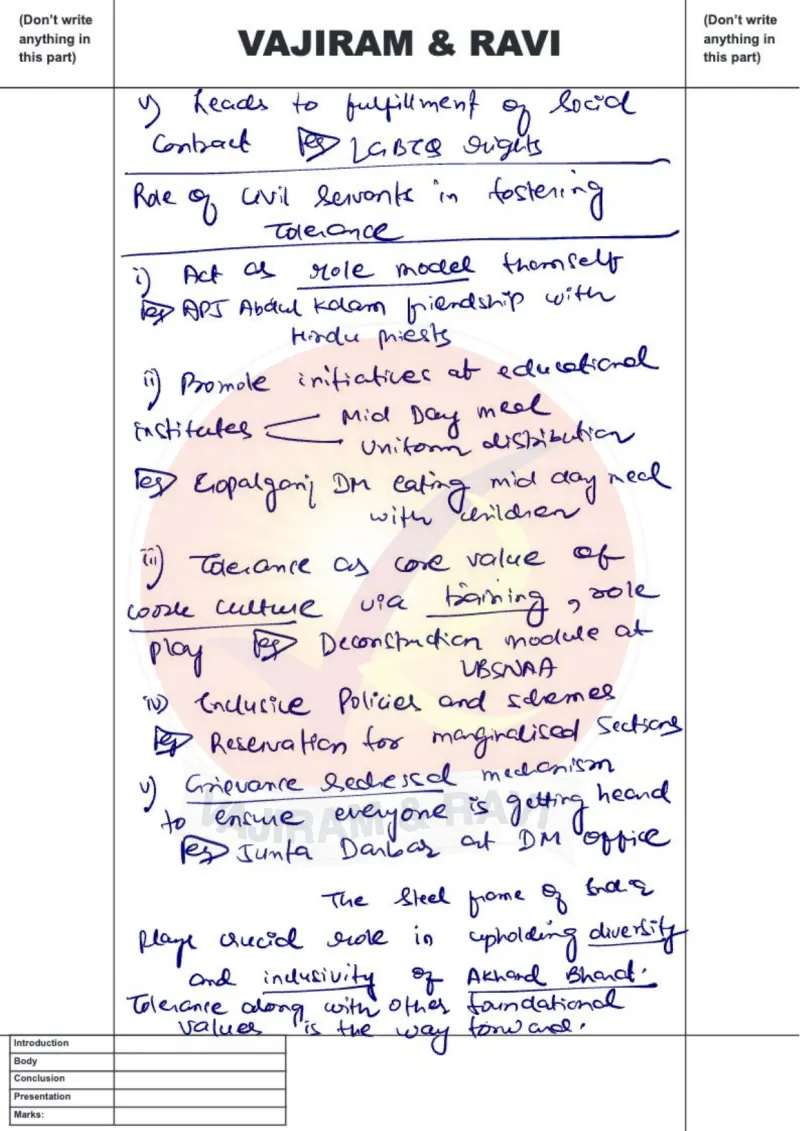
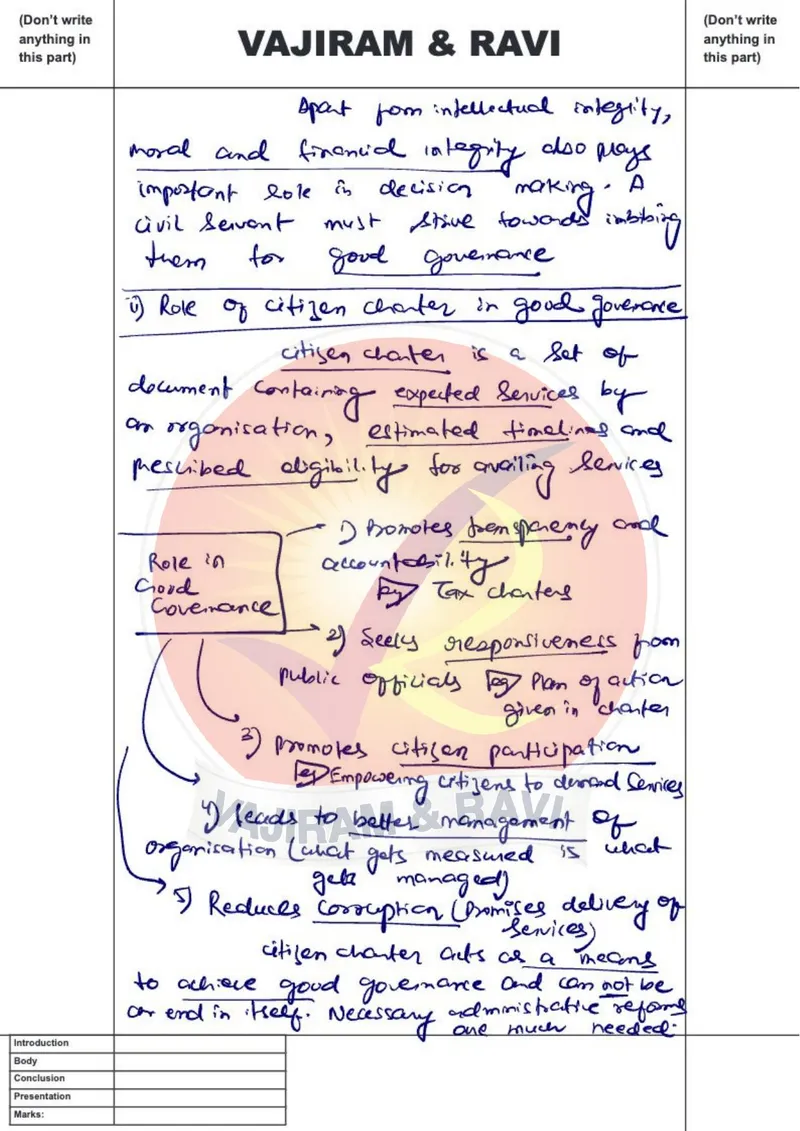
- Q1.Short notes (~150 words each): (a) Intellectual Integrity; (b) Citizen's / Tax Charter
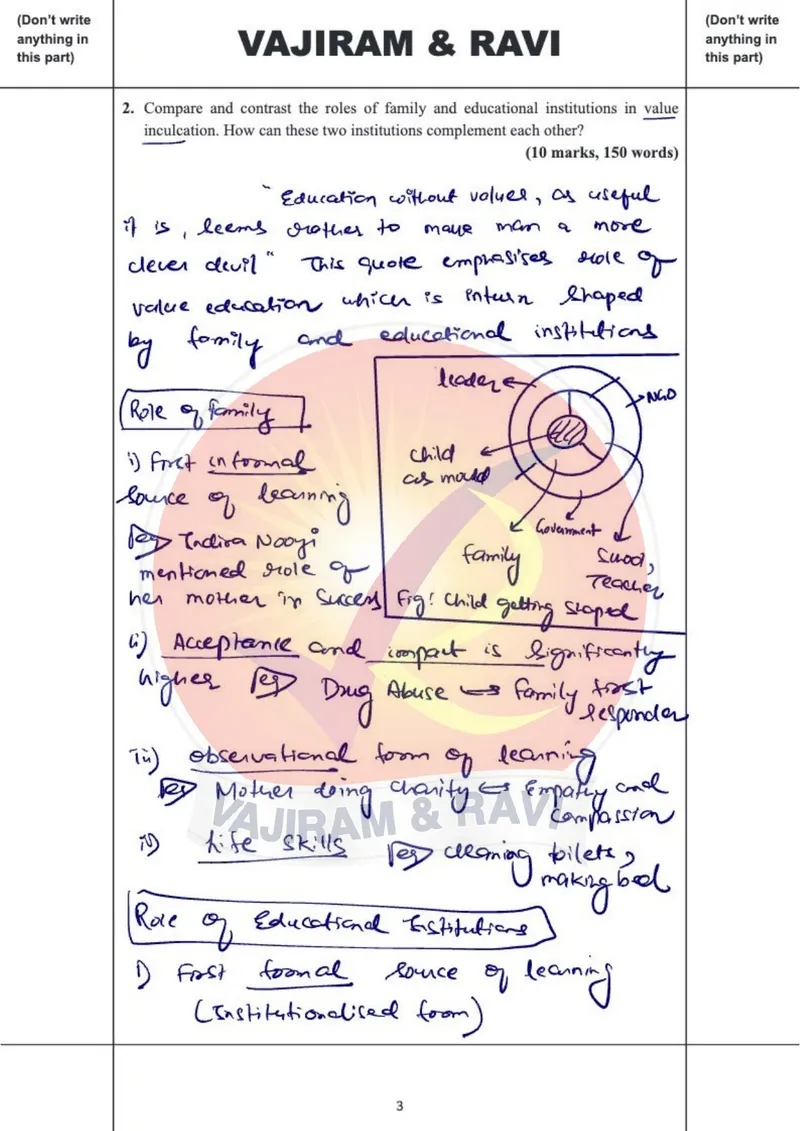
- Q2.Role of family vs educational institutions in inculcation of values
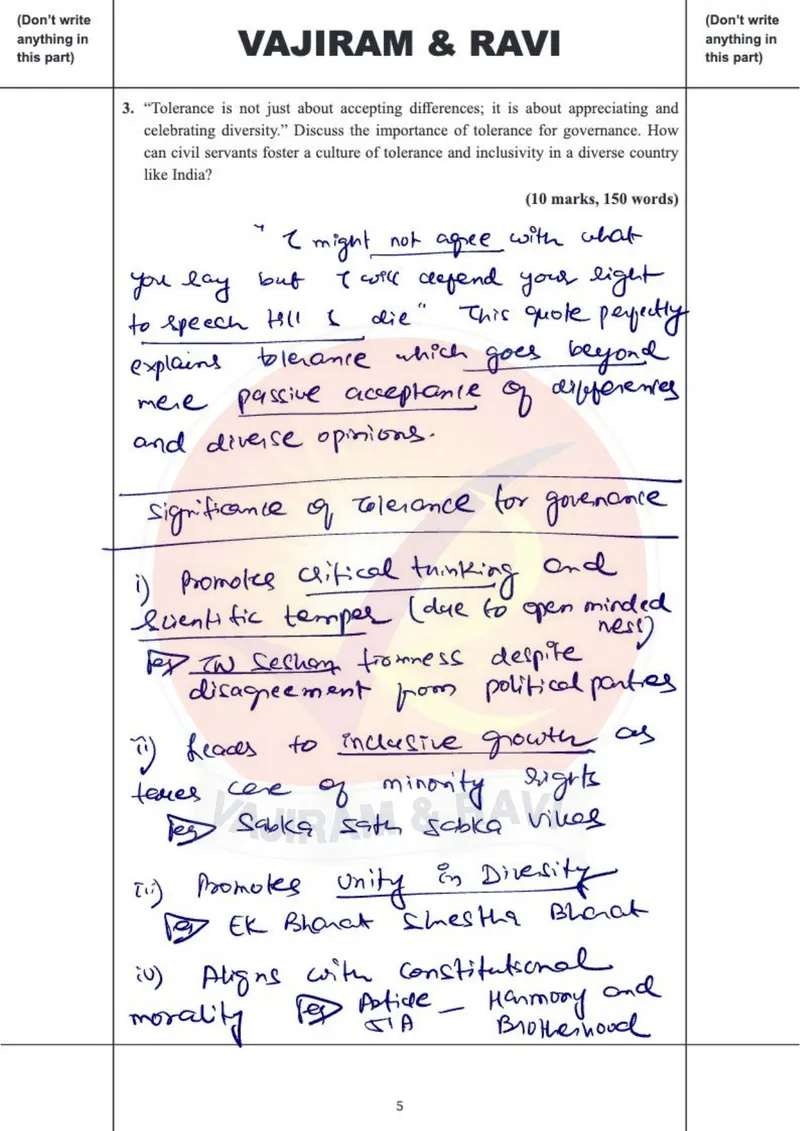
- Q3.Tolerance as a value essential for good governance
- Q4.Whether character is more accurately revealed in private vs public life (critically examine)
- Q5.Accountability mechanisms vs bureaucratic delays/inefficiency; striking a balance between accountability and efficiency
- Q6.Meaning of three quotations in present context — (a) David Hume on reason as slave of passions, (b) Martin Luther King Jr. on the ultimate measure of a person, (c) Mahatma Gandhi on conscience vs majority
- Q7.How emotionally intelligent civil servants can use empathy to improve governance and service delivery
- Q8.Ethical implications of the widening rich-poor nation gap; moral obligation of developed countries to assist developing ones
- Q9.Environmental / intergenerational ethics — 'we borrow the earth from our children'
- Q10.Distinction between impartiality and neutrality in public service
- Q11.Relevance of the teachings of the Bhagavad Gita in public service
- Q12.Section B case study — District Collector handling Kerala-type landslide disaster (ethical issues, persuasion of stakeholders, and reforms/way forward)
Examples, data & evidence used
- Satyendra Dubey (Golden Quadrilateral whistleblower) — intellectual integrity / SwaDharma
- Durga Shakti Nagpal (action against sand mafia)
- Raja Ram Mohan Roy (conscience-led abolition of Sati)
- Indira Nooyi (values from upbringing)
- Sudama-Krishna (values/relationship anecdote)
- Mid-Day Meal scheme
- NEP 2020 (Panchakosha concept)
- TN Seshan (electoral reforms despite political criticism) — cited across Q3, Q6, Q10
- Dr APJ Abdul Kalam
- Gopalganj DM eating mid-day meal with children
- LBSNAA training — deconstruction module, field immersion, village visits
- Janta Darbar at DM office
- M Visvesvaraya (the two-candle story)
- Lal Bahadur Shastri
Quotes the candidate used
- Q2 (candidate-written, no author shown): 'Education without values... seems rather to make man a more clever devil'
- Q3 (candidate-written, no author shown): 'I might not agree with what you say but I will defend your right to speech till I die'
- Q6 printed exam quotations with authors: David Hume — 'Reason is, and ought only to be the slave of the passions, and can never pretend to any other office than to serve and obey them.'; Martin Luther King Jr. — 'The ultimate measure of a person is not where they stand in moments of comfort and convenience, but where they stand at times of challenge and controversy.'; Mahatma Gandhi — 'In matters of conscience, the law of the majority has no place.'
- Q6(c) (candidate-written, no author shown): 'There is a court above all courts i.e. court of conscience and all of us are answerable to that'
- Q7 printed exam quotation (no author shown): 'Empathy is seeing with the eyes of another, listening with the ears of another, and feeling with the heart of another.'
- Q7 (candidate-written, no author shown): 'Empathy and compassion are not signs of weak but tools for strong'
- Q8 (candidate-written, no author shown): 'Poverty anywhere is a threat to prosperity everywhere'
- Q9 closing (attributed in copy to Gandhiji): 'Earth has enough for everyone's needs, but not for anyone's greed'
How it’s written: Single-candidate file, correctly labelled: filename and cover both read 'MONIKA SRIVASTAVA Rank16', so it is genuine and not misassembled/interleaved. 32-page scanned handwritten PDF on Vajiram & Ravi answer sheets (V&R header on every page; 'Don't write anything in this part' margins). Front matter (cover, mentor-f…
Diagrams & visuals: Q2: a 'child getting shaped' flow diagram showing values flowing from family and educational institutions; Q6(b): a 'Building equanimity' branching mind-map (role models / self-reflection & introspection / role of family & educational institutions / training in simulation, e.g. NDA module); Q7: two branching diagrams — 'ways to develop empathy' (training/LBSNAA field immersion, role of school/Panchakosha, self-reflection) and 'needs more than empathy' (iron fist for terrorists & criminals, global issues, national security/AFSPA); Q8: a 'Moral obligations of developed nations' branching diagram (Common but Differentiated Responsibility / Climate Finance / sustainable debt-Paris Club / humanitarian assistance-Maitri vaccine), plus an 'ETHICAL IMPLICATIONS OF WIDENING GAP' block-heading with arrow links; Q9: a people-profit-planet (triple-bottom-line) diagram; Q11: a mind-map of Gita concepts (Nishkama Karma, SwaDharma, Sthitaprajna, Viveka)
Evaluator: No examiner marks or comments are filled in on this copy.