
Junaid Ahmad — answer booklet 12
What’s inside this copy
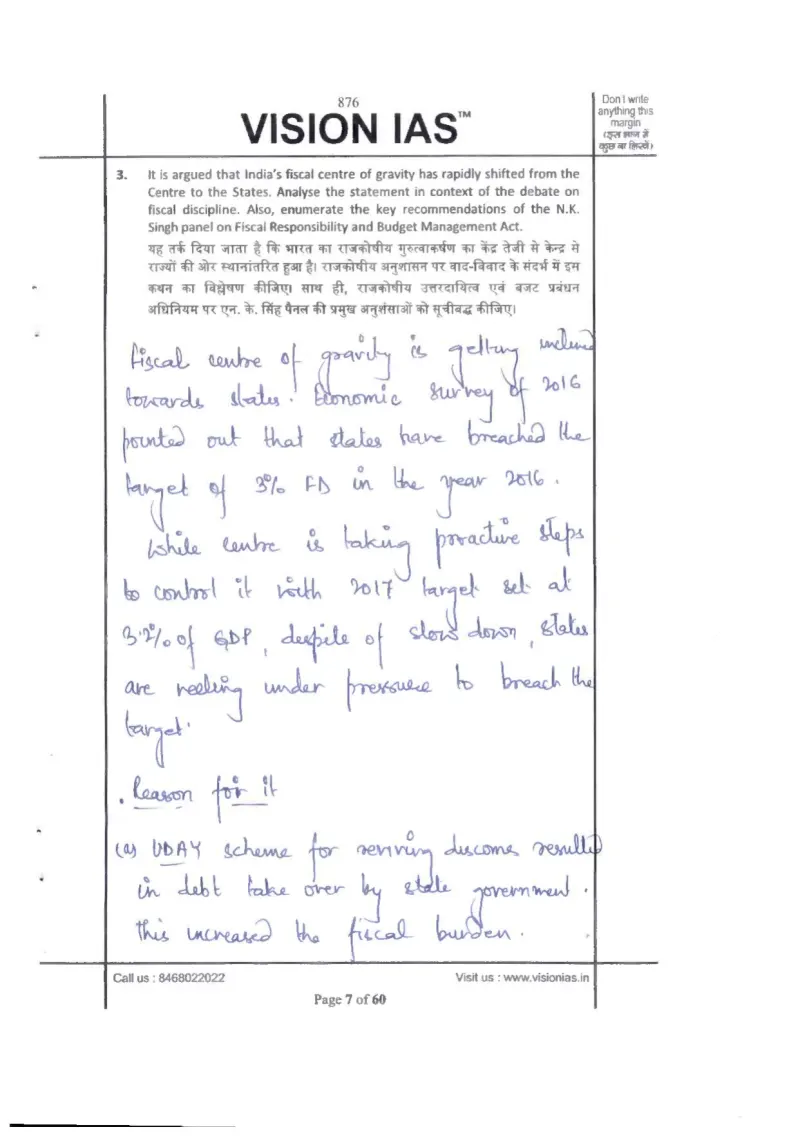
- ▸Almost every answer opens with a hard data hook — Q1 leads with 'India 130 of 190', Q6 with 'SMEs ~38% of GDP and over 8 crore jobs', Q8 with per-capita energy figures — anchoring the answer in facts immediately.
- ▸Runs a consistent skeleton across answers: context/definition -> '•' thematic headers (Importance/Challenges/Steps taken by govt) -> lettered (a)-(d) sub-parts -> one-line forward-looking conclusion.
- ▸Uses arrow-led (->) nested micro-bullets instead of long paragraphs, making points fast to scan — strong structure-presentation discipline.
- ▸Substantiates with named committees and reports — N.K. Singh FRBM panel, M.S. Swaminathan (MSP = 50% + cost), Justice Verma & Jeevan Reddy on AFSPA, Shekatkar & Naresh Chandra on civil-military integration.
- ▸Substitutes diagrams for prose where useful — a clean circular 'Disaster cycle' flowchart (Q12) and a heat-wave temperature-threshold note (Q13).
- ▸Disciplined word management: ~200 words / 2-3 pages per answer, and left Q9 (IT-BPM) and Q11 (climate risk insurance) completely blank rather than writing filler.
What to learn from this copy
- ★Junaid opens almost every answer with a hard data hook in the very first line — Q1 leads with 'India stands at 130 out of 190 countries', Q6 with SMEs being '~38% of GDP and over 8 crore people', Q8 with per-capita energy figures (~1075 kWh rising to ~5000 kWh by 2050), Q10 with network lengths (~66,000 km railways, ~50 lakh km roads). -> Don't warm up with a generic definition; lead with one specific number that frames the issue, so the examiner sees command of facts in the first sentence.
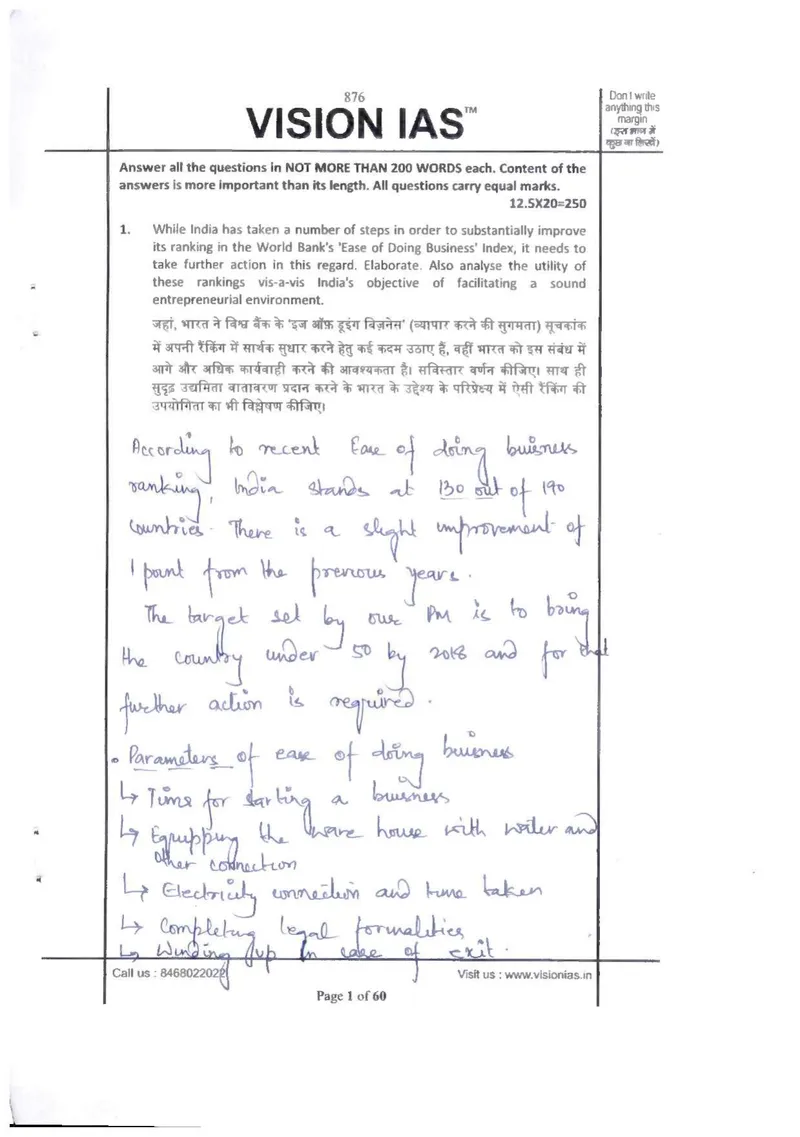
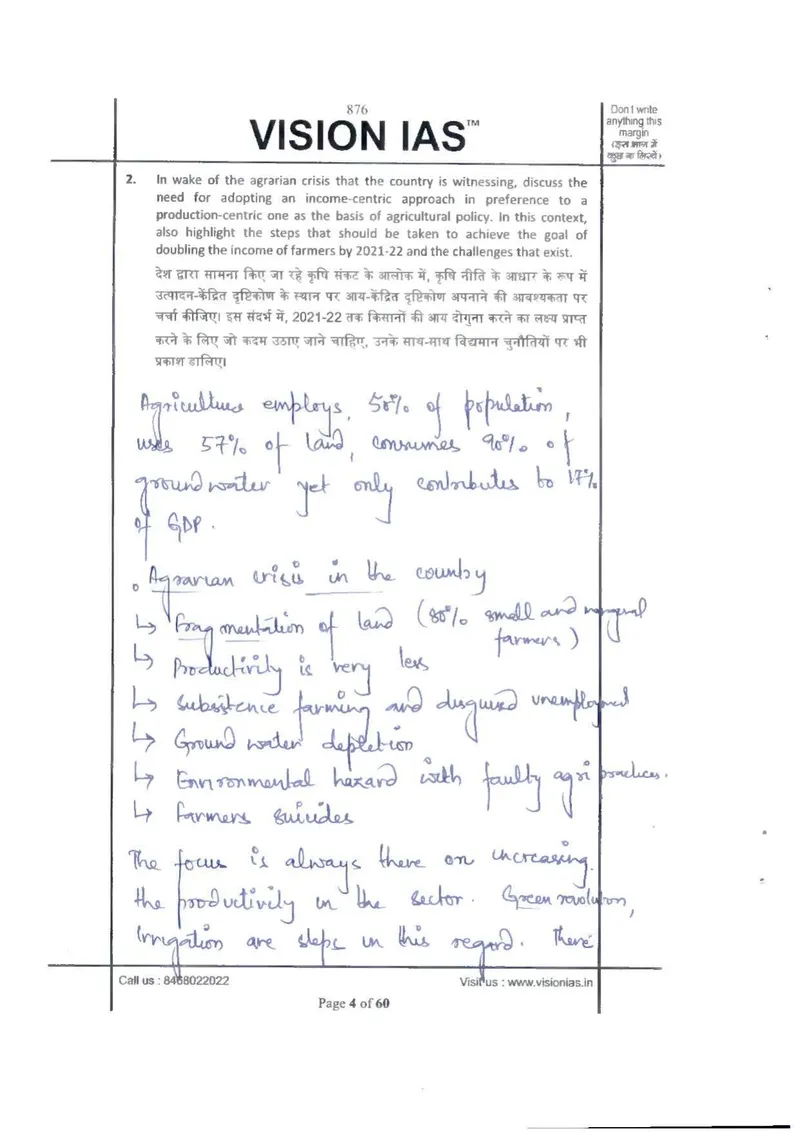
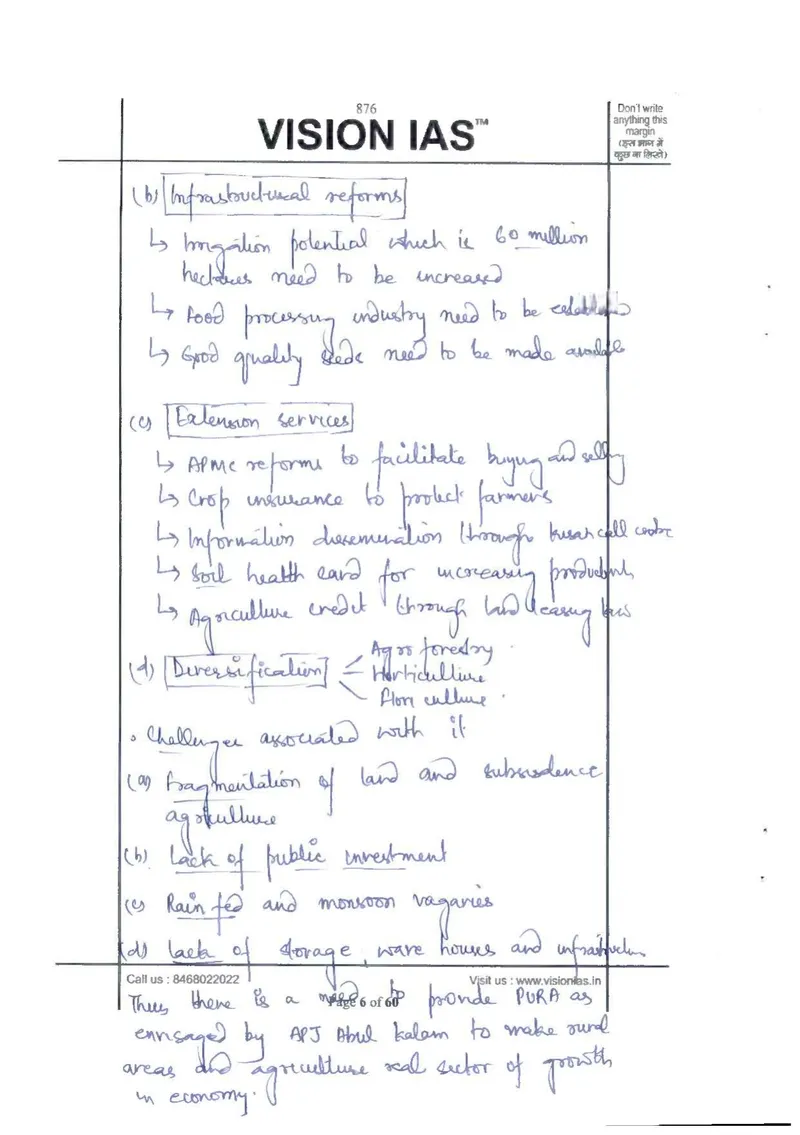
- ★He substantiates arguments with named committees and their exact recommendations rather than vague references — N.K. Singh FRBM panel (debt-to-GDP ~68% to 60%, split ~40% Centre/20% States by 2023, escape clause, fiscal council) in Q3, M.S. Swaminathan (MSP = 50% + production cost) in Q2, and Justice Verma & Jeevan Reddy on AFSPA in Q18, Shekatkar & Naresh Chandra on civil-military integration in Q20. -> Memorise committee NAME + its one signature number/proposal as a paired unit; citing the specific recommendation, not just the panel's name, is what converts a generic point into an authoritative one.
- ★He runs an identical, scannable skeleton across all answers — context/definition, then '•' thematic headers (Importance / Challenges / Steps taken by govt), then lettered (a)-(d) sub-parts, then a one-line forward-looking conclusion — using arrow-led (->) nested micro-bullets instead of long paragraphs. -> Build one reusable answer template you can deploy under time pressure so structure becomes automatic and every point is instantly locatable by the examiner.
- ★Where a process or threshold beats prose, he draws it: Q12 replaces explanation with a clean circular 'Disaster cycle' flowchart (Preparedness -> Response -> Rehabilitation -> Recovery -> Prevention -> Mitigation), and Q13 uses a heat-wave temperature-threshold mini-table (normal max 40C plains/30C hills; departure 5-6C = heat wave, 7C = severe). -> Use a diagram specifically when content is a cycle or a set of numeric cut-offs — it carries information faster and more accurately than a paragraph.
- ★He chose precision over coverage: each answer stays at ~200 words / 2-3 pages, and he left Q9 (IT-BPM) and Q11 (climate risk insurance) completely blank rather than padding them with filler. -> If you genuinely don't know a question, leaving it blank and protecting your strong answers' quality and time is a deliberate strategy, not a failure.
Questions attempted: Ease of Doing Business Index — steps taken & further action needed; utility of the rankings for India's entrepreneurial environment (attempted); Agrarian crisis — income-centric vs production-centric agriculture policy; doubling farmers' income by 2021-22, steps & challenges (attempted); Fiscal centre of gravity shifting Centre to States; fiscal discipline debate; N.K. Singh FRBM panel recommendations (attempted), and 17 more below.
Questions attempted in this booklet (20)+
- 1.Ease of Doing Business Index — steps taken & further action needed; utility of the rankings for India's entrepreneurial environment (attempted)
- 2.Agrarian crisis — income-centric vs production-centric agriculture policy; doubling farmers' income by 2021-22, steps & challenges (attempted)
- 3.Fiscal centre of gravity shifting Centre to States; fiscal discipline debate; N.K. Singh FRBM panel recommendations (attempted)
- 4.Strategic sale/disinvestment of state-run PSUs; NITI Aayog suggestions (attempted)
- 5.Shell companies — not legally defined nor understood; recent developments & steps to deal with them (attempted)
- 6.SMEs as key to involving a larger population in the economy; challenges & government measures (attempted)
- 7.Growing informalization of industrial labour — reasons, issues, reforms (attempted)
- 8.Local & global energy-space developments to be reflected in India's energy policy (attempted)
- 9.IT-BPM industry as global powerhouse; challenges (LEFT BLANK — not attempted, answer space empty)
- 10.Multi-modal logistics & transport for a more competitive economy (attempted)
- 11.Climate risk insurance within a climate risk management system (LEFT BLANK — not attempted, answer space empty)
- 12.Why women are vulnerable to natural disasters; women's role in the disaster risk management cycle (attempted, with diagram)
- 13.Heat waves as a natural disaster; recent developments & government actions (attempted, with temperature-threshold note)
- 14.Genome editing — healthcare benefits vs ethical/regulatory apprehensions (attempted)
- 15.Supercomputers' benefits; objectives & implementation of National Supercomputing Mission (attempted)
- 16.Cryptocurrencies — disruption of traditional banking & regulatory challenges (attempted)
- 17.Strengthening the Outer Space Treaty 1967 via a binding agreement; traditional & emerging challenges (attempted)
- 18.AFSPA at ~60 years — countering insurgencies, role of states & local communities (attempted)
- 19.Indigenisation of defence production — challenges, opportunities & government measures (attempted)
- 20.Civil-military institutional cooperation/coordination for a clear strategic vision (attempted)
Examples, data & evidence used
- Ease of Doing Business: India ranked 130 of 190; PM's target to bring India under 50 by 2018 (image-verified)
- Shram Suvidha Portal, National Career Service, Insolvency and Bankruptcy Code, SARFAESI Act amendment, Maternity (Benefit) Act, e-Biz single-window clearance, Moody's report on GDP upside
- Agriculture: M.S. Swaminathan recommendation (MSP = 50% + production cost); doubling farmers' income by 2021-22; PURA envisaged by A.P.J. Abdul Kalam; APMC reforms, Kisan Call Centre, Soil Health Card, crop insurance, contract/cooperative farming; ~60 million ha irrigation potential
- Fiscal/FRBM: Economic Survey (states breaching 3% fiscal deficit); UDAY scheme (discom debt); 7th Pay Commission; farm-loan waivers; N.K. Singh committee — debt-to-GDP target (cited ~68% now to 60%, split ~40% Centre/20% States by 2023), escape clause for national calamity, fiscal council, 3% FD continuation
- PSU disinvestment: NITI Aayog suggestions; Air India & BSNL (loss-making, ~Rs 50,000 crore debt cited); Bank Indradhanush; strategic/foreign-private partnerships
- Shell companies: Panama Papers leak; FDI via Mauritius & Cayman Islands; P-Notes; round-tripping; GAAR; POEM (Place of Effective Management); BEPS; DTAA treaties (India-Mauritius, India-Singapore); FATF; World Bank/IMF
- SMEs: ~38% of GDP, employ ~8 crore people; Make in India; MUDRA bank, India Aspiration Fund, SMILE fund (SIDBI); Stand-up India, Start-up India; Zero Defect Zero Effect; NAM (National Agriculture Market); Shram Suvidha portal
- Informalization: Factories Act, Industrial Disputes Act; India Skill Report (~2.13% formally skill-trained); PMKVY, DDUGKY; Rajasthan factory-act amendment; textiles/MSME
- Energy: per-capita consumption (~1075 kWh) rising to ~5000 kWh by 2050; 175 GW renewable target; DDUGJY; Paris climate deal & INDCs; shale gas; NITI Aayog Draft Energy Policy; GEF, GCF, $100 billion fund; International Solar Alliance; smart meters/grids; coal (~300 billion tonnes, ~60% of generation)
- Logistics: ~66,000 km railways, ~50 lakh km roads; Sagarmala; Jal Marg Vikas project; merchant shipping; National Civil Aviation Policy; UDAN; Golden Quadrilateral
- Disasters & women: World Bank report; climate refugees; menstruation/sanitation vulnerabilities; circular Disaster-cycle diagram
- Heat waves: ~2000+ deaths in 2016; IMD/Meteorology Dept; thresholds (normal max 40C plains/30C hills; departure 5-6C = heat wave, 7C = severe); ULB water kiosks/shelters/plantation; hospital saline-drop priority
- Genome editing: CRISPR (CRISPR-Cas9); leukemia, CHARGE syndrome; designer babies; pluripotent stem cells; MTP Act / abortion regulation
- Supercomputers: PARAM; National Supercomputing Mission; ISRO; Monsoon Mission; atomic clocks; cryogenic engines
How it’s written: Highly templated, point-form answers. Each answer typically opens with a one-line data hook or definition (e.g., Q1: "India stands at 130 out of 190 countries"; Q6: SMEs "38% to GDP... over 8 crore people"; Q8: per-capita energy figures; Q10: railway/road network lengths). The body is broken into thematic blocks wit…
Diagrams & visuals: Q12: circular 'Disaster cycle' flowchart — Preparedness -> Response -> Rehabilitation -> Recovery -> Prevention -> Mitigation (drawn as a labelled cycle); Q13: heat-wave temperature-threshold note/mini-table — normal max 40C plains / 30C hills; departure 5-6C = heat wave, 7C = severe heat wave; Throughout: arrow-led (->) nested bullet hierarchies under '•' headers and lettered (a)-(d) sub-parts, used in place of prose. No maps observed.
Evaluator: No examiner marks or comments are filled in on this copy.