This collection holds five of Pakshal Secretry’s NextIAS test-series copies, labelled Rank 8 in the 2025 archive.
It spans GS-I, GS-III, a GS-IV full-length test and two essay tests.
We read 4 of these booklets page by page — below is exactly what’s inside: the questions Pakshal attempted, the examples and quotations used, and how each answer was structured. Every copy is a free PDF.
Rank 8 · CSE 20255 free PDFsUpdated 29 Jun 2026
Inside Pakshal Secretry’s answer copies
Pakshal Secretry — NextIAS GS-I test copy
GS Mains (International Relations & current affairs)PDF · 5.9 MB
What’s inside this copy
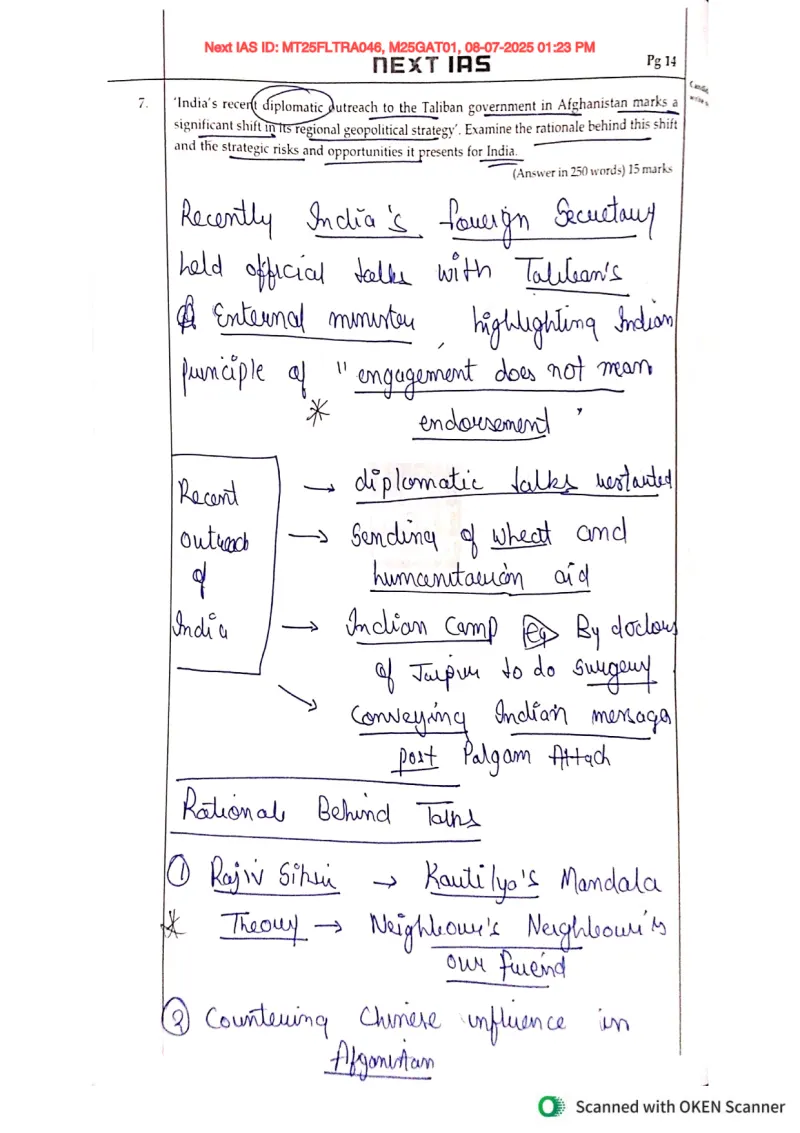
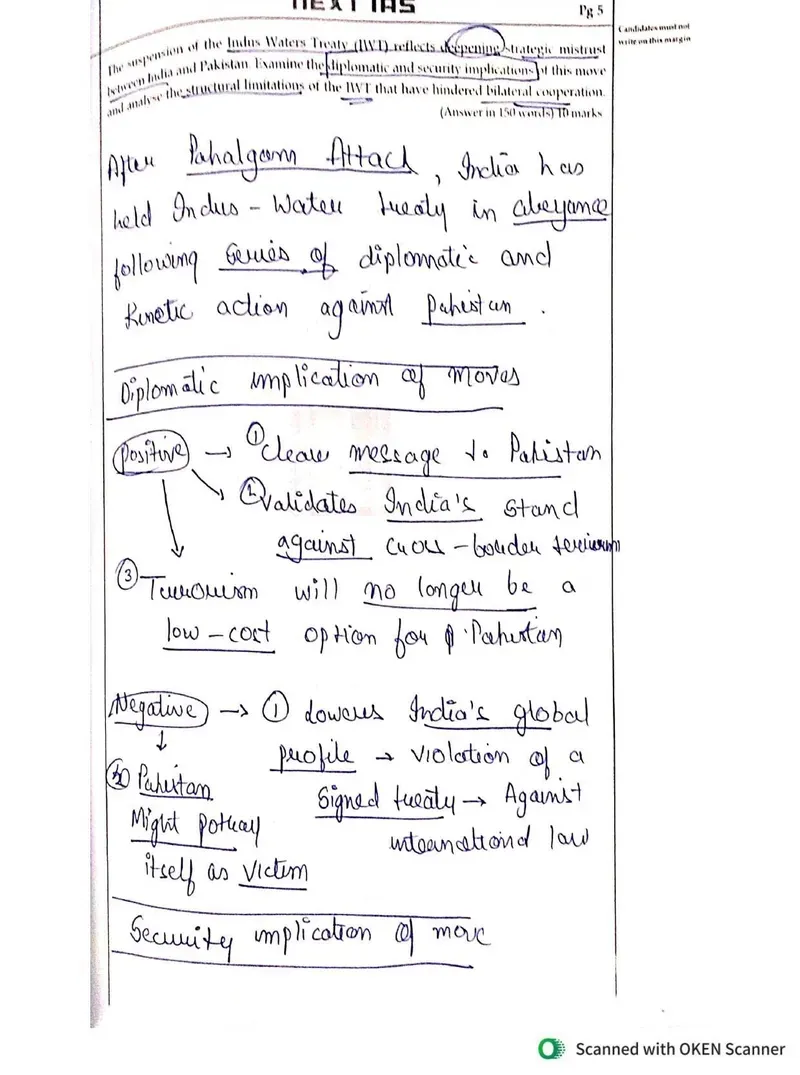
▸A pure current-affairs play: all 10 answers are pulled straight from 2024-25 headlines — Trump-era reciprocal tariffs, IWT-in-abeyance after Pahalgam, the Red Sea/Houthi crisis, BRICS' Kazan expansion, India-Taliban talks, the Iran-Israel war, WTO paralysis and the India-China thaw.
▸Signature sign-off style: every answer closes with a marquee quote — 'Blood and water can't flow together' and 'This is not an era of war' (Modi), 'Dragon-Elephant Tango' (Xi), Jaishankar on China, and Pascal Lamy on the WTO.
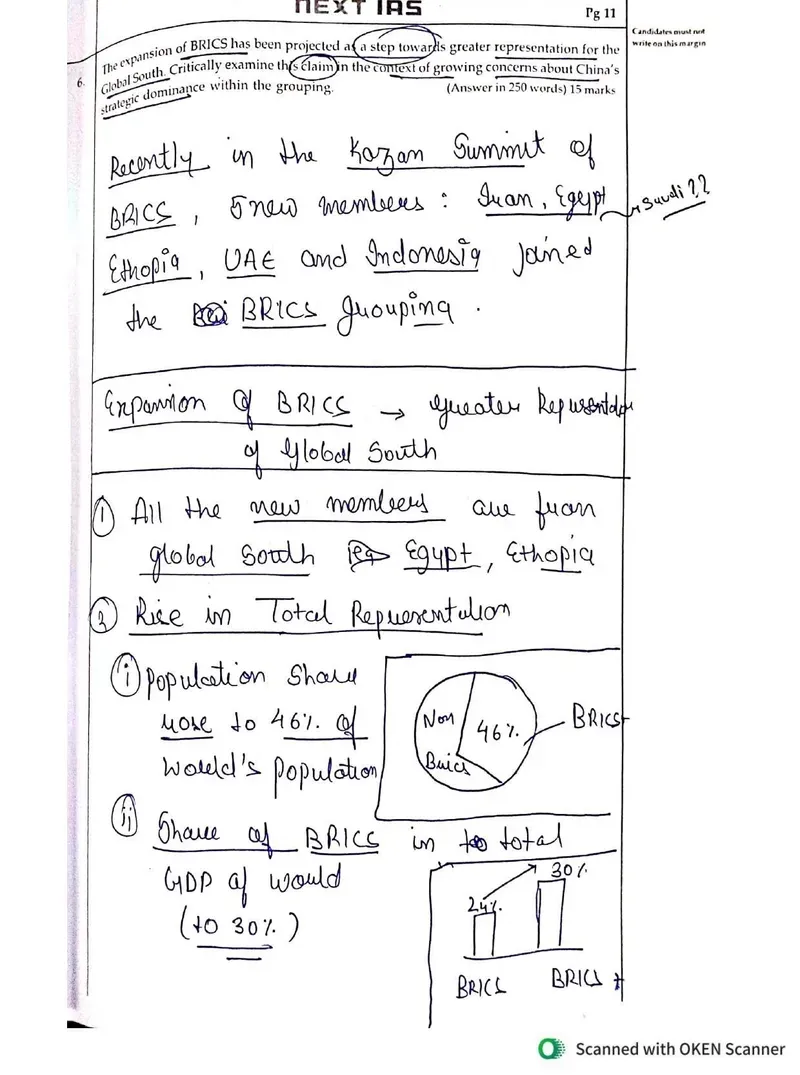
▸Heavy data recall: $120bn diaspora remittances, BRICS at ~46% of world population and ~30% of GDP, China's 63% share of BRICS GDP, $117bn India-China trade, and a Rs 10,700 cr import-bill hit per $1 rise in crude.
▸Visual-first answers: pie and bar charts for BRICS, a 'WTO cornerstone of trade' concept box, a Red Sea strategic-importance tree, and an India-China trade-deficit graph.
▸Thinker-anchored analysis: Kautilya's Mandala theory (via Rajiv Sikri), C. Raja Mohan, Brahma Chellaney, the LM Singhvi Committee and Reagan's 'trust but verify' are deployed to back arguments.
▸Near-complete effort — 9 of 10 questions fully attempted; only Q4 (IORA/maritime security) was left blank but for a single intro line.
What to learn from this copy
★Topic-matched authority quote as the closing line on EVERY answer — Modi's 'Blood and water can't flow together' to seal the IWT answer (Q3), 'This is not an era of war' on the Iran-Israel balancing answer (Q8), Xi's 'Dragon-Elephant Tango' and Jaishankar's 'stable, but not normal and remain sensitive' on India-China (Q10), and Pascal Lamy on WTO reform (Q9). The quote is never generic — it is the specific figure on that specific issue. -> Bank 1-2 issue-specific quotes per hot topic (PM/EAM/relevant thinker) and use them to land the conclusion, not as decoration.
★Hard, specific numbers built into the analysis rather than vague 'large/significant' claims: $120bn diaspora remittances (highest in the world), BRICS at ~46% of world population and ~30% of GDP with China alone at 63% of BRICS GDP, $117bn India-China trade against an ~$85bn deficit, and 'Rs 10,700 cr import-bill rise per $1 increase in crude.' -> Memorise 2-3 precise figures per current-affairs topic; one exact statistic (like the per-dollar-crude import-bill number) signals real command and beats a paragraph of adjectives.
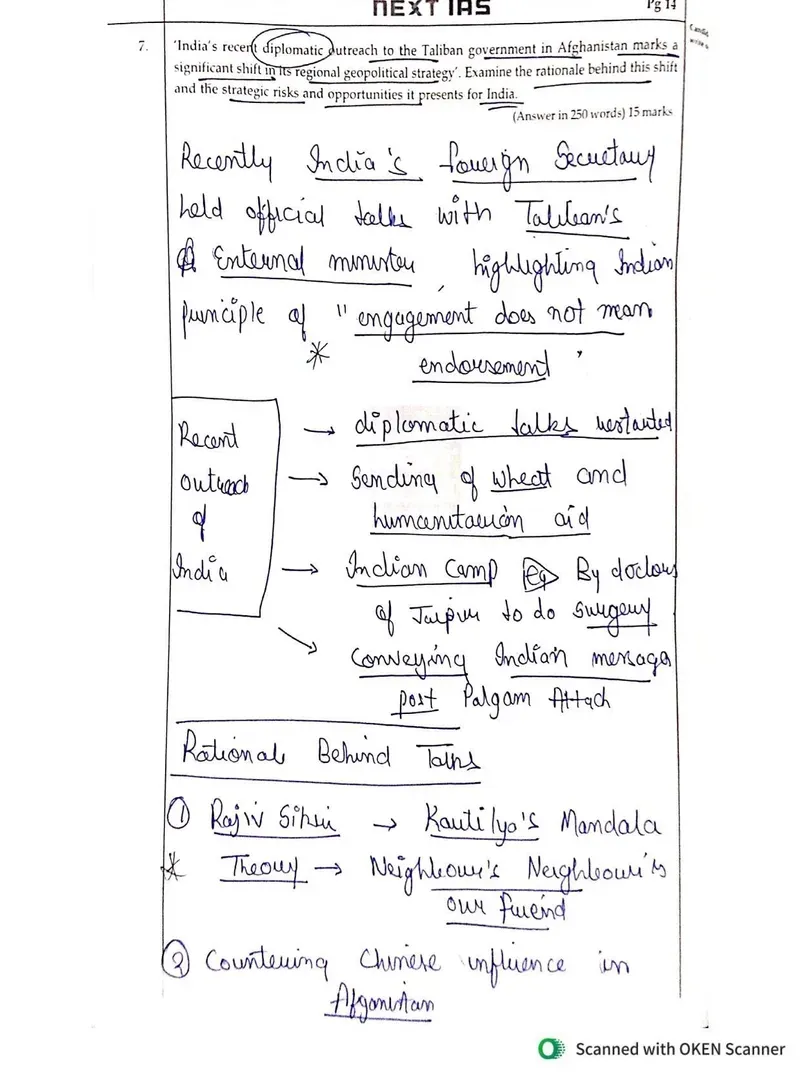
★Named-framework anchoring to convert description into analysis: justifying India's Taliban outreach through Kautilya's Mandala theory via Rajiv Sikri ('neighbour's neighbour is our friend', Q7), reading India-China stabilisation through Reagan's 'trust but verify' (Q10), and citing Brahma Chellaney on the IWT (Q3) and C. Raja Mohan on Afghanistan. -> Attach a recognised thinker or theory to your core argument so the answer reads as analysis grounded in IR thought, not headline recap.
★Data-carrying diagrams, not decorative ones: the Q6 BRICS pie (46% population) and bar (GDP rising 24%->30%) and the Q10 line/bar showing the India-China trade deficit widening (~$65bn in 2020 to ~$101bn in 2024) each visualise the exact statistic the argument turns on; the Q9 'WTO: cornerstone of trade' concept box maps four functions (tariff reduction, globalisation, MFN, non-discrimination). -> Make diagrams encode your key numbers or your structural points, so the visual does analytical work instead of filling space.
★Crisp coined/named constructs that compress a whole sub-point into a memorable label: the '4Cs framework' (Care, Connect, Celebrate, Collaborate) for diaspora engagement (Q2), the 'Himalayan Quad' (China-Pak-Bangladesh-Afghanistan) and China's 'Three Warfares' (media/psychological/legal) plus 'salami slicing' on the China answers, and 'engagement does not mean endorsement' as India's stated Taliban principle (Q7). -> Build answers around a short labelled framework or coinage — it organises the body, aids recall, and gives the examiner a clean hook.
Questions attempted: US reciprocal tariffs / inward-looking economic strategies — geopolitical & economic implications for India (full attempt); Indian diaspora — global profile, socio-economic role, welfare/engagement challenges (full attempt); Suspension of Indus Waters Treaty — diplomatic/security implications & structural limitations of IWT (full attempt), and 7 more below.
Questions attempted in this booklet (10)+
1.US reciprocal tariffs / inward-looking economic strategies — geopolitical & economic implications for India (full attempt)
9.WTO crisis of relevance — challenges & revival measures in a multipolar world (full attempt, with concept diagram)
10.India-China relations — stabilisation efforts & structural challenges to normalisation (full attempt, with trade graph)
Examples, data & evidence used
America First & Brexit (economic nationalism); friendshoring/onshoring; spaghetti-bowl problem; China+1; India as 'Voice of Global South'; Chinese rare-earth (REE) restrictions; India-UK FTA; IMF analysis on job loss
Diaspora ~32-35 million, $120bn remittances (highest in world); ISKCON, Ayurveda, Bollywood (soft power); diaspora role in India-US Nuclear Deal; Gita Gopinath (IMF); Harsh Jain / Dream11 (brain gain); LM Singhvi Committee; Pravasi Bharatiya Divas; 4Cs framework (Care, Connect, Celebrate, Collaborate)
IWT: Pahalgam attack; India as 'upper riparian state'; 80% of water to Pakistan; Ratle & Kishanganga projects; Brahma Chellaney
Red Sea: Israel-Hamas & Israel-Iran wars; Suez Canal; ~40% of global trade; MV-Ruen attack; Hezbollah & Hamas; Operation Prosperity Guardian; IMEC corridor
BRICS: Kazan Summit; new members Iran, Egypt, Ethiopia, UAE, Indonesia (Saudi noted); ~46% world population & ~30% global GDP; NDB; BRICS Bridge Platform; China = 63% of BRICS GDP & 40% of BRICS population; RC-vs-BIS divide; CNN report
Taliban: India's Foreign Secretary-Taliban talks; wheat/humanitarian aid; Jaipur doctors' camp; Rajiv Sikri & Kautilya's Mandala theory; Delhi as home ground of Afghanistan Cricket Board; ~$3bn Indian development projects; INSTC; 'Himalayan Quad' (China-Pak-Bangladesh-Afghanistan); C. Raja Mohan
Iran-Israel: Israeli strike on Iran's nuclear sites; Chabahar Port; Shia people-to-people ties; Joint Barak missile production; Israel water partnership; $15bn India-Israel trade; Rs 10,700 cr import-bill rise per $1 crude increase; Houthis; 1991 Gulf crisis; de-hyphenation
WTO: formed post Uruguay Round (1995/1996); MFN & non-discrimination principles; US reciprocal tariff & aluminium-tariff violation; US blocking Appellate Body appointments; Public Stockholding issue; Agreement on Agriculture; EU CBAM; Doha Development Agenda; Pascal Lamy (ex-WTO DG)
India-China: EAM S. Jaishankar; PM-Xi meeting on SCO sidelines; LAC disengagement & pre-2020 patrolling; $117bn bilateral trade; NSA Doval-Wang Yi talks; ~$85bn trade deficit; 'salami slicing' in Ladakh; cartographic warfare in Arunachal; China's Three Warfares (media/psychological/legal); BRI & String of Pearls; Xiaokang (dual-use) villages; Brahmaputra mega-dam; Economic Survey 2022-23; Reagan's 'trust but verify'
Quotes the candidate used
'Blood and water can't flow together' — PM Modi (Q3)
'Expansion of BRICS is a reminder to all multilateral bodies to evolve with changing times' — PM Modi (Q6)
'This is not an era of war' — PM Modi (Q8)
'Dragon-Elephant Tango is the only way forward' — President Xi Jinping (Q10)
'Ties with China are stable, but not normal and remain sensitive' — EAM S. Jaishankar (Q10)
WTO needs to evolve and reform itself to stay relevant in changing times — Pascal Lamy, ex-WTO DG (Q9)
'Engagement does not mean endorsement' — India's principle on Taliban (Q7)
'Neighbour's neighbour is our friend' — Rajiv Sikri, via Kautilya's Mandala theory (Q7)
How it’s written: Disciplined, textbook UPSC mains structure on every answer: a 2-4 line intro anchored in a recent event, a clearly sub-headed body (e.g. Diplomatic / Economic / Security implications; Challenges vs Way Forward), and a one-line conclusion sealed with a leader/thinker quote. Heavy use of headings, underlined keywords,…
Diagrams & visuals: Q6: pie chart — BRICS ~46% of world population (BRICS vs Non-BRICS); Q6: bar chart — BRICS share of world GDP rising 24% to 30% (BRICS vs BRICS+); Q9: concept-box diagram — 'WTO: cornerstone of trade' with four radiating functions (tariff-barrier reduction, fuelled globalisation, MFN principle, non-discrimination); Q10: line/bar graph — India-China trade deficit, imports rising ~$65bn (2020) to ~$101bn (2024); Q5: tree/flow diagram — Red Sea 'strategic importance' (40% of global trade, energy security/oil shipment, Suez Canal cost to Europe); plus a margin note 'Map of Red Sea' — a labelled placeholder only, no actual map drawn; Q1, Q7, Q8, Q10: bracket-and-arrow flow notation used to organise points (trade-pattern shift; India's Taliban outreach; India's strategic ties with Iran/Israel; India-China stabilisation efforts)
Evaluator: No marks or written examiner feedback anywhere on the copy. The 'Marks Obtained' column, 'Grand Total /125', EVAL CODE, GRADED DATE, the REMARKS box, the Macro-Comments page (Strengths / Areas of Improvement / Improvement Suggestions) an…
▸Rank-8 topper attempts all 10 GS-III questions, a complete Science-&-Tech plus internal-security spread, every answer closed with a forward-looking line
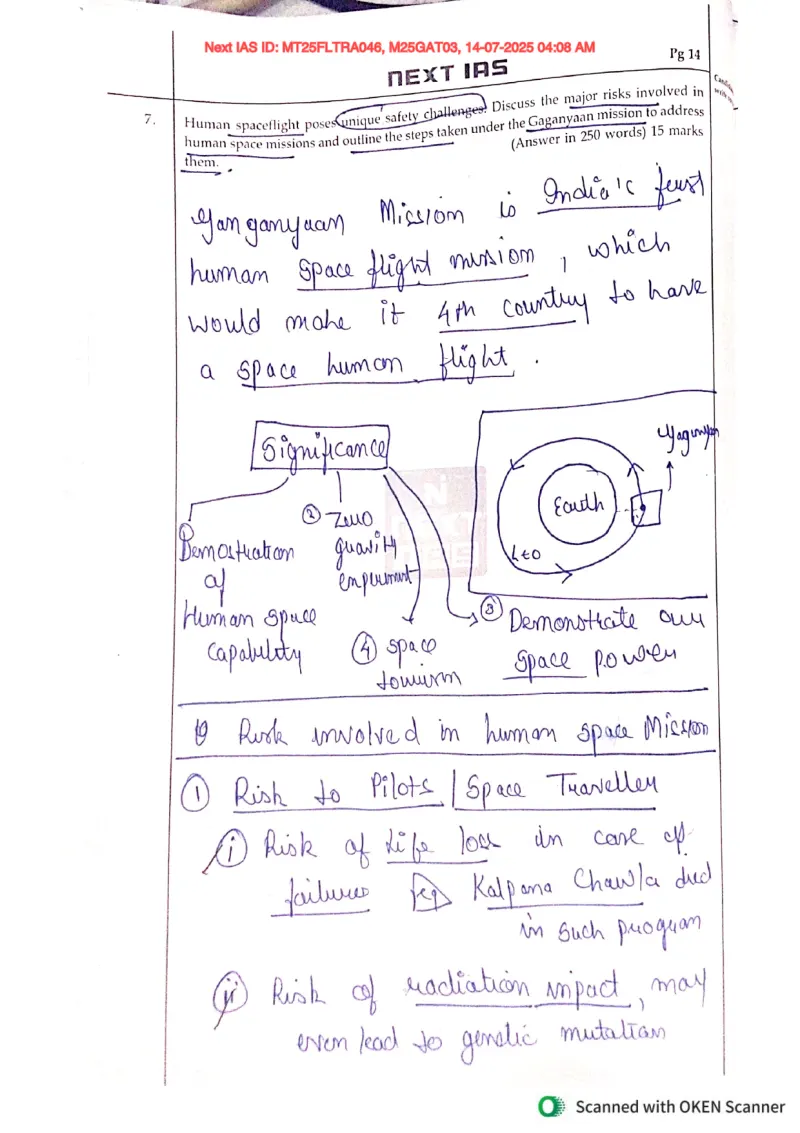
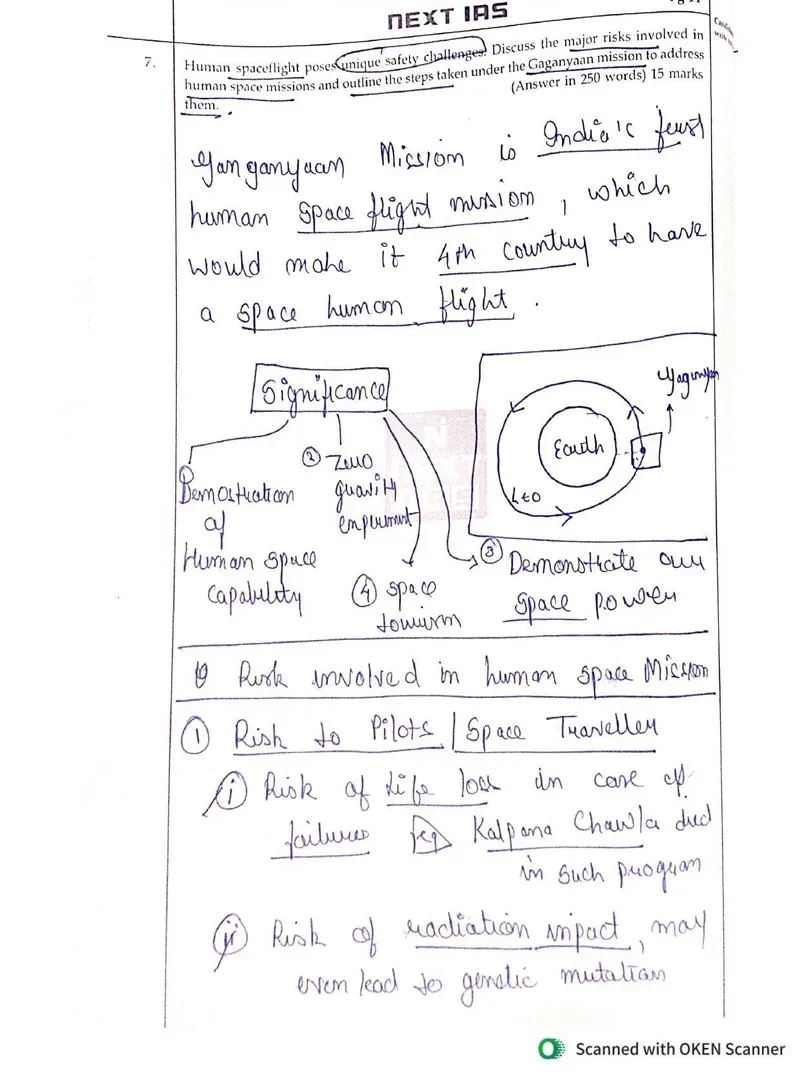
▸Diagram-led answering: Lagrange-point map, vertical-vs-horizontal RLV sketches, an India-Pakistan strike map (Muridke/Bahawalpur), a Gaganyaan LEO + escape-module sketch, an energy-trilemma triangle, and an mRNA mechanism flow with an immune-response graph
▸Data-anchored points throughout: $7.8 bn IoT market, +45% yield (Dalwai), $300 bn UPI, 99.9% Aadhaar, Rs 1.5 lakh cr JAM savings, 8.1 GW to 100 GW nuclear, 10-month mRNA development
▸Value-addition via committees and missions: Shekatkar Committee, Madhukar Gupta Committee, Dalwai Committee, Mission Shakti 2019 (ASAT)
▸A C. Raja Mohan quotation is deployed to elevate the Operation Sindoor answer
What to learn from this copy
★Turned abstract S&T concepts into purpose-built diagrams rather than decorative ones: a Sun-Earth Lagrange-point map (L1-L5) to locate Aditya-L1, vertical-vs-horizontal RLV contrast sketches, a Gaganyaan LEO orbit + escape-module sketch, and an mRNA flow (cell/vector -> spike protein -> immune response) paired with a PIR-vs-SIR immune-response-over-time graph -> for any S&T question, draw the actual mechanism/geometry, not a generic box-chart; the diagram should carry information the prose can't, like orbit positions or a response curve over time.
★Anchored almost every body point to one hard figure tied to a named source: IoT market ~$7.8 bn and +45% yield from the Dalwai Committee, ~$300 bn UPI throughput, 99.9% Aadhaar coverage, ~Rs 1.5 lakh crore JAM savings, nuclear 8.1 GW (2024) against the 100 GW goal, mRNA developed in ~10 months -> pre-memorise a few precise number-plus-attribution pairs per high-yield theme so each claim lands as evidence rather than assertion.
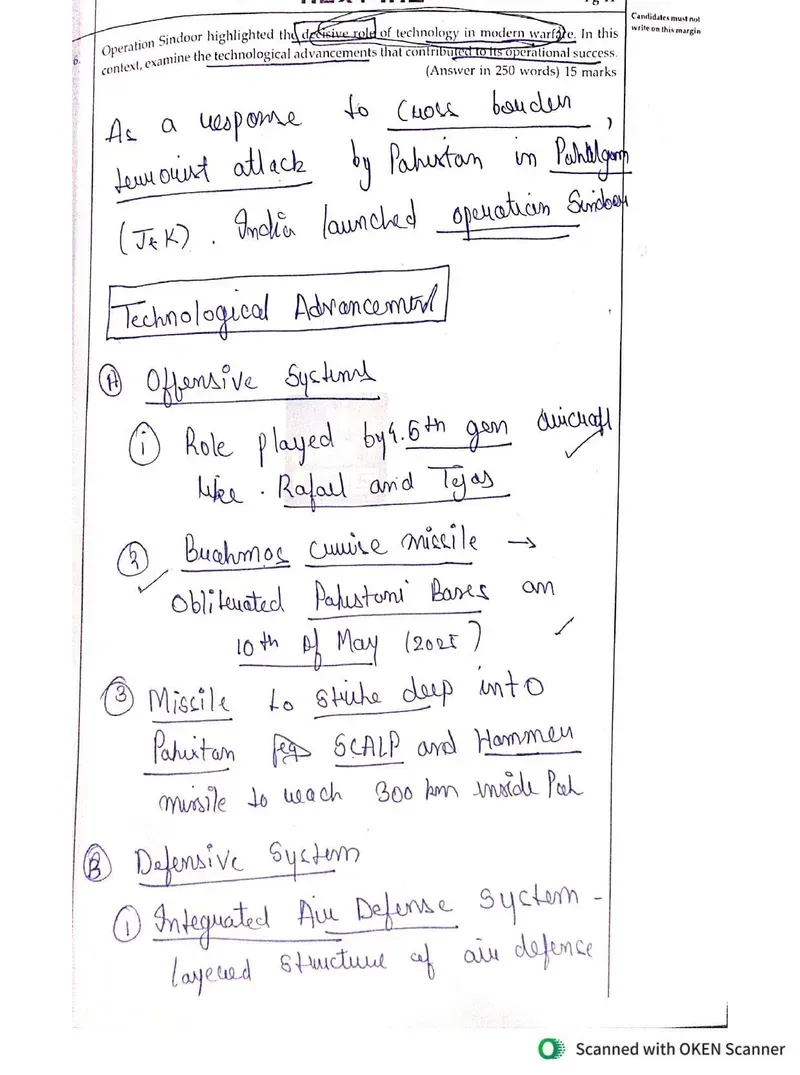
★Built the Operation Sindoor (250-word) answer around a specific tech inventory rather than vague 'modern weapons' language - Rafale & Tejas (4.5-gen), BrahMos, SCALP & Hammer (~300 km), S-400 downing a Shaheen missile, Akashteer, Integrated Air Defence, Indo-Israel drones - and opened/closed it with a named C. Raja Mohan line ('not just about retribution, but defined a new line of tolerance... displayed our technological might') -> name the exact systems/actors a question rewards, and deploy one credible expert quotation to frame a topical security/strategy answer.
★Used committees and named missions as low-cost value-addition spread across answers: Shekatkar Committee (space & cyber commands) and Madhukar Gupta Committee in the fifth-gen warfare answer, Dalwai Committee for agri-IoT, Mission Shakti 2019 (ASAT) -> keep a stock of relevant committee names mapped to each GS-3 sub-theme; dropping the right committee signals depth in one phrase.
★Pulled answers into the present by citing the latest concrete developments - Shubhanshu Shukla's flight and Vyommitra for Gaganyaan, SpaceX's Falcon-9 booster-catch for RLVs, Shukrayaan's 2027 timeline and 'India as 4th country with a dedicated Venus mission', BrahMos strikes dated 10 May 2025 -> tie each static topic to its newest milestone with a date or 'first/4th' framing, which shows the examiner you are current, not textbook-bound.
Questions attempted: Aditya-L1 mission — scientific objectives and broader significance for India (150 words); Internet of Things (IoT) — transformative potential for India's information infrastructure and role in agriculture (150 words); Reusable Launch Vehicles (RLVs) — hurdles in development and India's progress (150 words), and 7 more below.
Questions attempted in this booklet (10)+
1.Aditya-L1 mission — scientific objectives and broader significance for India (150 words)
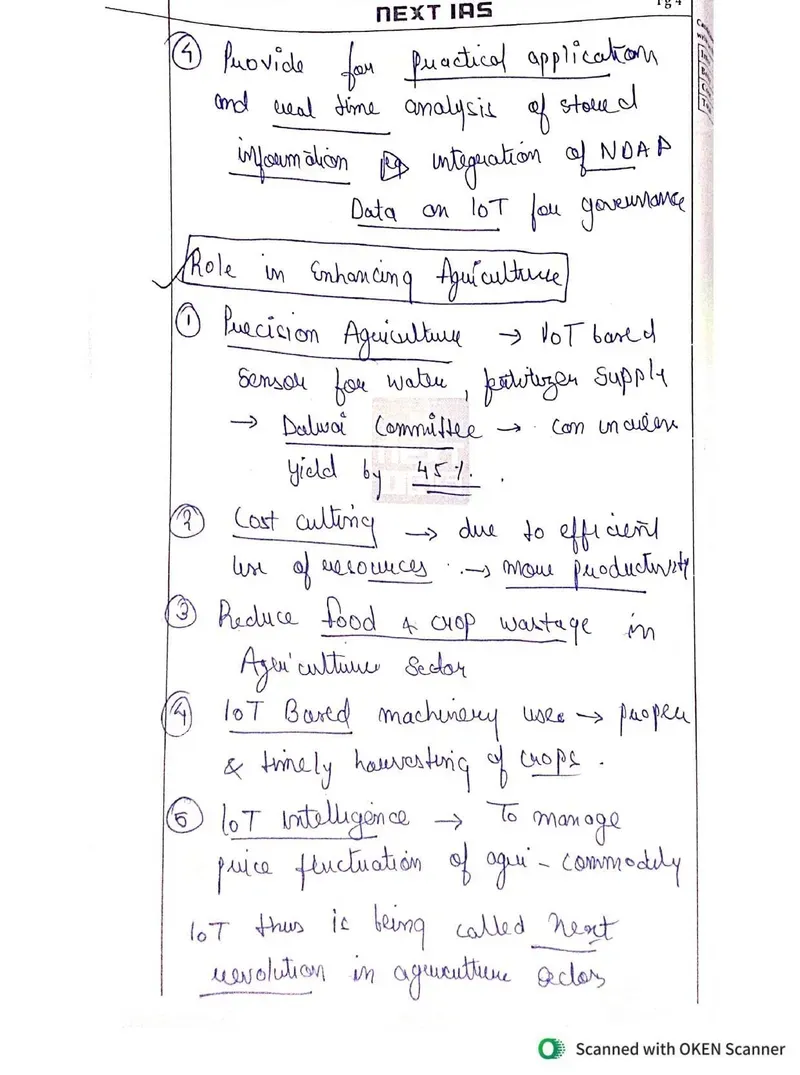
2.Internet of Things (IoT) — transformative potential for India's information infrastructure and role in agriculture (150 words)
3.Reusable Launch Vehicles (RLVs) — hurdles in development and India's progress (150 words)
4.Digital Public Infrastructure (DPI) — accelerating development and the digital stack for agriculture (150 words)
7.Human spaceflight risks and steps under the Gaganyaan mission to address them (250 words)
8.India's nuclear energy technological advancements and contribution to developmental goals (250 words)
9.mRNA vaccines — how they function and how they differ from DNA-based vaccines (250 words)
10.Fifth-generation warfare — emerging challenges and measures for India's preparedness (250 words)
Examples, data & evidence used
Aditya-L1 payloads: ASPEX, SUIT, PAPA (and a Sun-ray polarimetry/POLIX experiment); coronal heating to 1-2 million degC; Lagrange points L1-L5; complements Parker Solar Probe & Solar Orbiter
IoT: McKinsey study, India IoT market ~$7.8 bn, Dalwai Committee (yield up to +45%), integration of NDAP data for governance
RLVs: SpaceX Falcon 9 booster-catch with mechanical arms, launch cost cut from $20,000 to <$100 (per kg, written '/km'), ROSCOSMOS RLV programme, RLV-TD mission (2023), Teflon/Kevlar polymer by Ahmedabad SAC, NGLV
Gaganyaan: Kalpana Chawla, Chandrayaan-2, Kessler Syndrome, Vyommitra robot, escape module, human-rated GSLV by SAC Ahmedabad, Kevlar shielding, AI simulation testbed, NASA collaboration, Shubhanshu Shukla flight
Nuclear: 8.1 GW capacity (2024) toward 100 GW goal, SMRs (deployment by ~2035), NPCIL/BHAVINI Kalpakkam plant (2nd-stage), BARC 3rd-gen prototype, ITER fusion, fusion reactor project in Gujarat, Tarapur plant, PHWR at Kudankulam, thorium fertile-to-fissile, NSG non-membership, Kudankulam protests, ASS (Affordability-Sustainability-Security) energy trilemma, Viksit Bharat 2047, Energy Aatmanirbharta by 2040, private players in atomic energy
mRNA vaccines: India's mRNA vaccine developed in ~10 months during COVID-19, spike-protein expression, PIR vs SIR immune response; example given as 'Covishield' (mRNA) vs a DNA vaccine — factual slip, reported as written; storage 0 degC vs 2-8 degC
C. Raja Mohan (Q6, Operation Sindoor): "Operation Sindoor was not just about retribution, but defined a new line of tolerance for India and displayed our technological might & power"
How it’s written: Highly templated, exam-ready architecture across all answers: short definitional intro, body under boxed/underlined headers (e.g., "Scientific Objective", "Significance", "Challenges", "Technological Advancement", "Way Forward"), numbered points with roman sub-points, liberal arrows and keyword underlining, and a on…
Diagrams & visuals: Q1: Sun-Earth Lagrange-point diagram (L1-L5) locating Aditya-L1; Q3: sketches contrasting vertical RLV vs horizontal RLV; Q6: hand-drawn map of India/Pakistan marking Operation Sindoor strike sites Muridke and Bahawalpur (X = strikes); Q7: Earth-LEO-Gaganyaan capsule orbit diagram and an Escape Module (EM) sketch; Q8: 'ASS' triangle diagram of the energy trilemma (Affordability-Sustainability-Security); Q9: mRNA mechanism flow diagram (cell/vector/mRNA -> spike protein -> immune response) plus a PIR vs SIR immune-response-over-time graph (fig 2)
Evaluator: No numerical marks are recorded anywhere — the front mark table (per-question Marks Obtained), Grand Total ("/125"), EVAL CODE and GRADED DATE are all blank, and the macro-comment boxes (Strengths / Areas of Improvement / Improvement Sug…
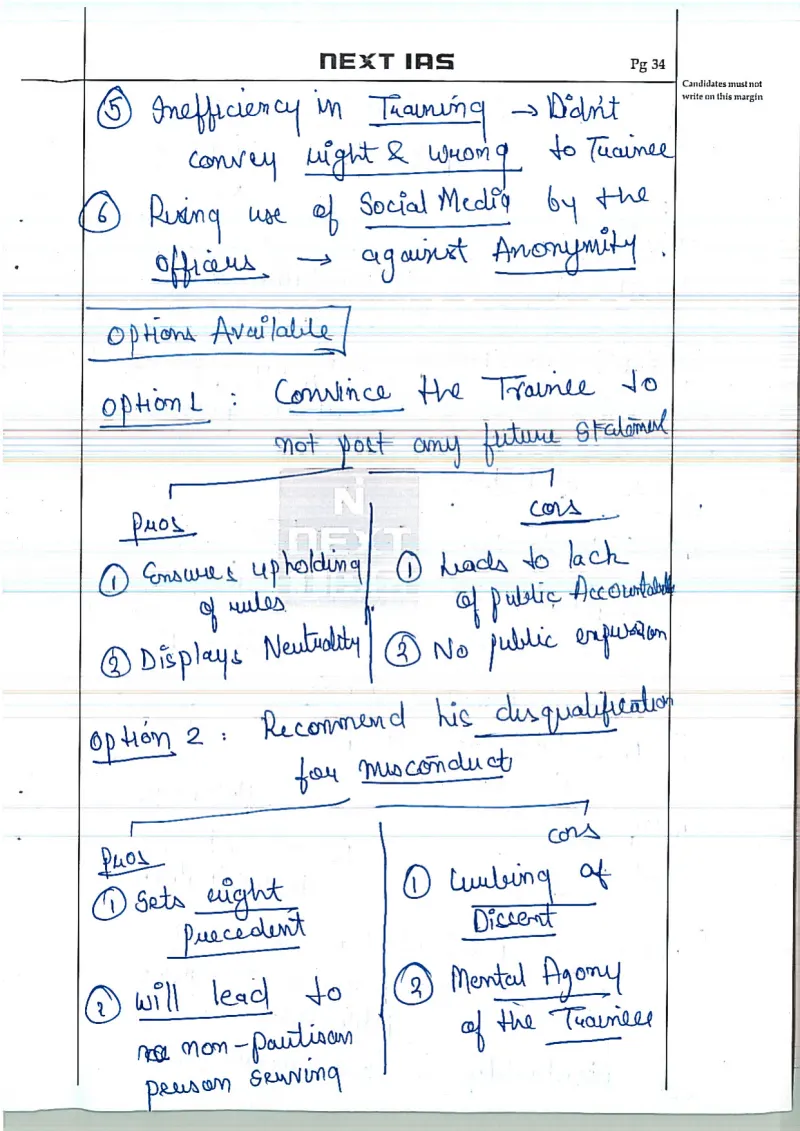
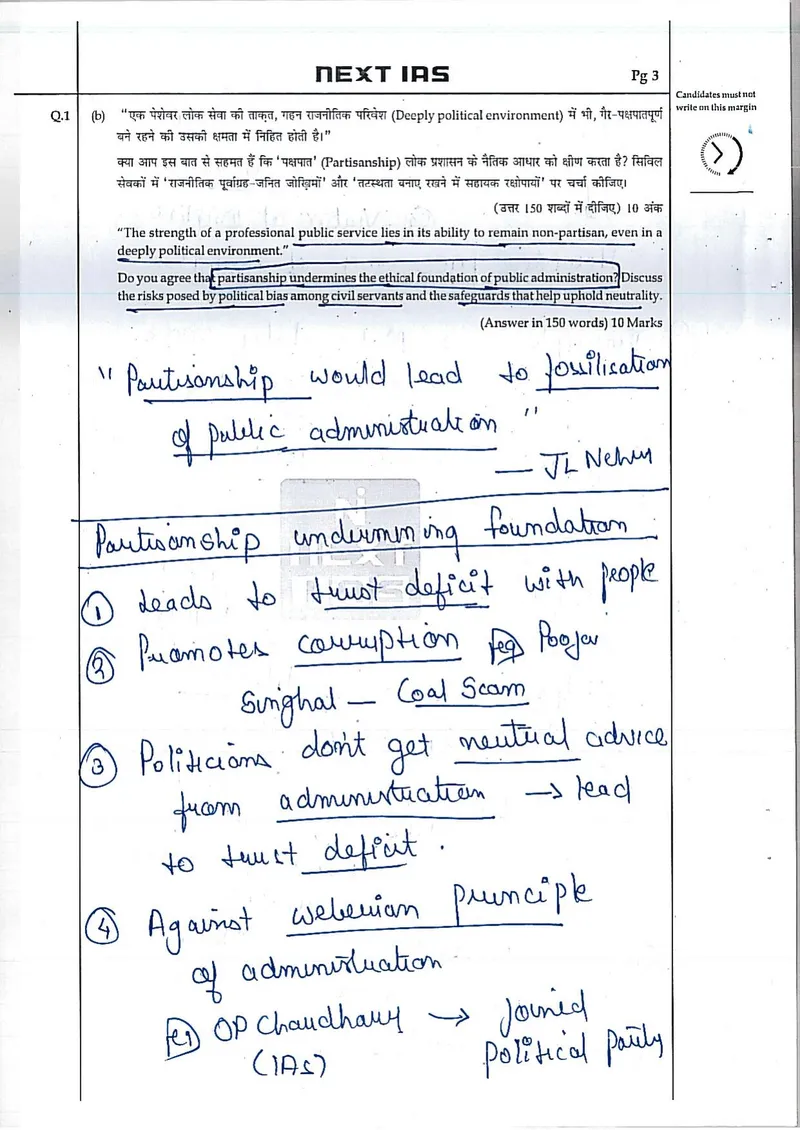
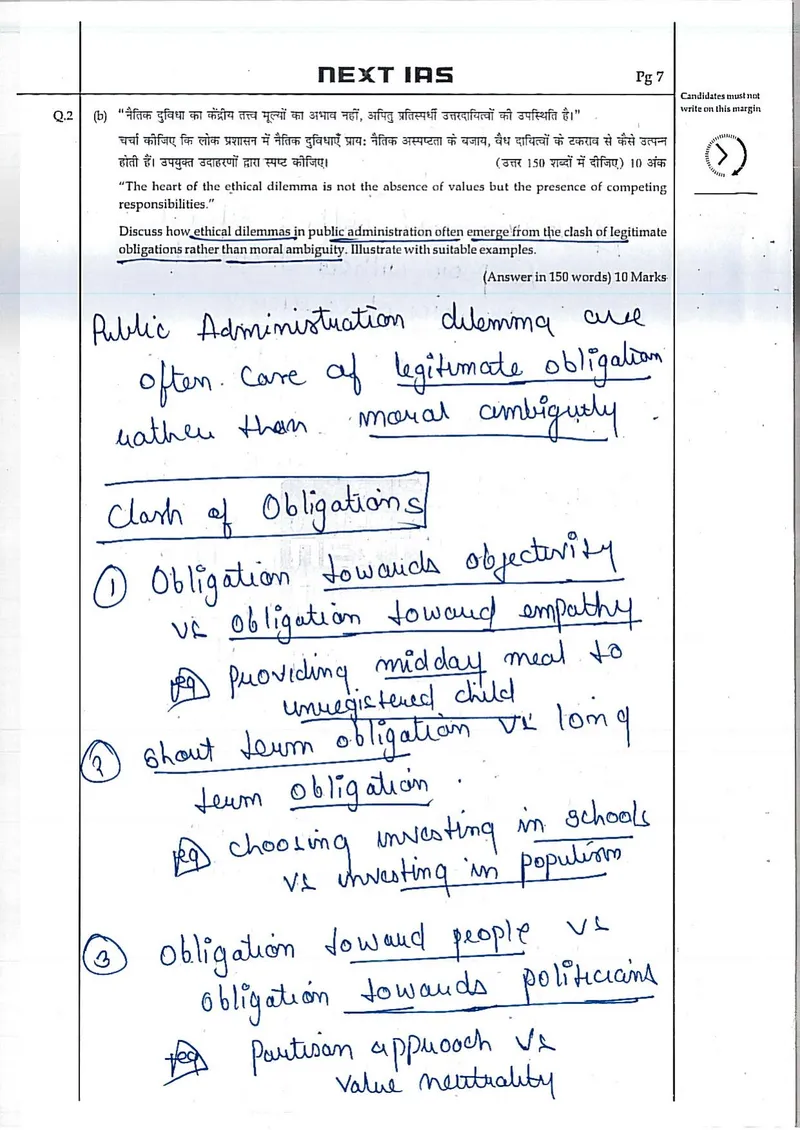
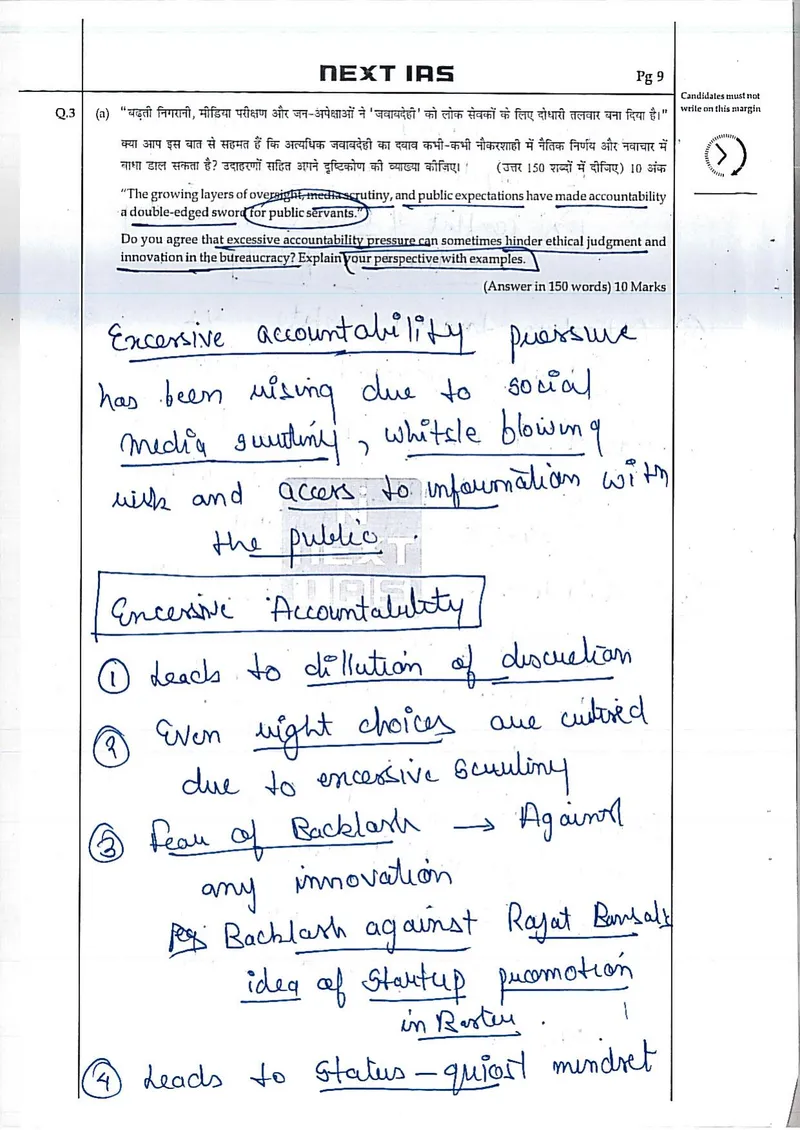
▸Opens the duty-ethics answer (Q1a) by naming the cost of over-emphasising duty — Red Tapism, disregard for ends, short-sightedness — before mapping it in a branching diagram
▸Anchors the slum-eviction case study in precedent + the Constitution, quoting the Supreme Court's Olga Tellis case on slum dwellers' dignity under Article 21
▸Breaks the 250-word case study into three boxed blocks — Ethical Challenges, Course of Action, Ways to Reconcile — each a crisp numbered list
▸Backs recommendations with a real scheme: cites Odisha's Jaga Mission as an innovative model for regularising informal colonies
▸Names the core tension as 'judicial populism' vs administrative reality, and advises filing a review / seeking an SC timeline extension to avoid contempt while protecting evictees
▸Closes on a values-led one-liner — a 'right balance (Madhyam Marg)' between legal compliance and humanitarian obligation
What to learn from this copy
★On the slum-eviction case study Pakshal didn't argue from sentiment — he anchored compassion in hard law, quoting the Supreme Court's Olga Tellis ruling that 'Right of Slum Dwellers to live with dignity is protected under Article 21'. -> In GS4 case studies, ground the humane option in a named precedent + constitutional article so the examiner reads it as a defensible administrative position, not a soft opinion.
★He named a real, replicable model instead of vague suggestions — citing Odisha's Jaga Mission as an innovative way to regularise informal colonies as part of his course of action. -> Back your recommended course of action with one concrete existing scheme/best-practice by name; it converts a generic 'rehabilitate them' into an actionable, credible answer.
★He coined a sharp label for the central tension — 'judicial populism' (court decisions ignoring administrative reality) vs the state's rehabilitation duty — and gave a precise, contempt-aware route: file a review / seek an SC timeline extension. -> Diagnose the ethical conflict in one crisp phrase, then offer a legally safe, specific step rather than a vague 'balance both sides'.
★The 250-word case study was split into three boxed blocks — Ethical Challenges, Course of Action, Ways to Reconcile — each a tight numbered list mirroring the sub-parts asked. -> Mirror the question's sub-demands as labelled boxed sections so the examiner can tick each requirement; structure that matches the demand reads as completeness.
★Q1(a) opened by first stating the cost of the wrong approach — over-focus on duty producing 'Red Tapism', disregard for ends, and short-sightedness — then mapped those three consequences in a branching diagram before building the answer. -> Lead by naming the problem/cost concretely (and visualise multi-part consequences as a quick branch diagram) before prescribing the fix; it shows you understood the demand's nuance.
★He closed on a values-led one-liner, framing the resolution as a 'right balance (Madhyam Marg)' between legal compliance and humanitarian obligation. -> End ethics answers with a short, named principle (here the golden-mean/middle-path) that reconciles the competing values — a memorable synthesis beats a flat summary.
Questions attempted: Administrative ethics: "Duty forms the cornerstone of administrative ethics, yet without integration of other ethical perspectives, it risks becoming mechanical compliance." Discuss how the interplay of duty, virtue, principle and consequences can enrich ethical decision-making in public administration. (150 words / 10 marks). NOTE: only the first page of this answer is present; the continuation is missing/replaced.; Court-ordered eviction of a long-vacant slum/informal settlement via PIL vs the state's rehabilitation commitment under its urban housing scheme; sub-parts ask for the core ethical challenges, how to reconcile legal mandates with humanitarian obligations in informal urban settlements, and a course of action respecting judicial authority while upholding compassion, fairness and responsible governance..
Questions attempted in this booklet (2)+
Q1(a).Administrative ethics: "Duty forms the cornerstone of administrative ethics, yet without integration of other ethical perspectives, it risks becoming mechanical compliance." Discuss how the interplay of duty, virtue, principle and consequences can enrich ethical decision-making in public administration. (150 words / 10 marks). NOTE: only the first page of this answer is present; the continuation is missing/replaced.
Case study (booklet Pg 53-56; Q-number not determinable, one of the 20-mark / 250-word case studies, Q7-Q12).Court-ordered eviction of a long-vacant slum/informal settlement via PIL vs the state's rehabilitation commitment under its urban housing scheme; sub-parts ask for the core ethical challenges, how to reconcile legal mandates with humanitarian obligations in informal urban settlements, and a course of action respecting judicial authority while upholding compassion, fairness and responsible governance.
Examples, data & evidence used
Olga Tellis case (Supreme Court) — cited for slum dwellers' right to live with dignity
Article 21 (right to life/dignity)
Jaga Mission, Odisha — cited as an innovative model for regularising informal colonies
State 'Urban Housing Scheme' rehabilitation commitment (referenced from the case)
Concept of 'Madhyam Marg' (middle path / golden mean) used in the conclusion
Concept of 'judicial populism' (court decisions without regard to administrative challenges)
Whole-of-government approach; human-centric eviction process
'Red Tapism' / 'Red carpet instead of Red Tapism' (Q1a)
Quotes the candidate used
"Right of Slum Dwellers to live with dignity is protected under Article 21" — attributed by the candidate to the Supreme Court in the Olga Tellis case
How it’s written: Pakshal's GS4 answers are written in blue ink, in a points-based format with circled serial numbers (1,2,3...), heavy underlining of keywords, and boxed sub-headings. Q1(a) opens by stating the problem (over-focus on duty leading to Red Tapism, non-regard to ends, short-sightedness), then uses a branching diagram ("…
Diagrams & visuals: Q1(a): a hand-drawn branching/flow diagram of 'Problem of mechanical duty focus' with three arrowed consequences, plus boxed sub-headings; Case study: boxed section headers ('Ethical Challenges', 'Course of Action', 'Ways to Reconcile') and arrow-led points (structured lists rather than full diagrams)
Evaluator: No examiner marks or comments are filled in on this copy.
From the part of this booklet that is Pakshal’s GS4 — the duty-ethics theory question and the Olga Tellis slum-eviction case study.
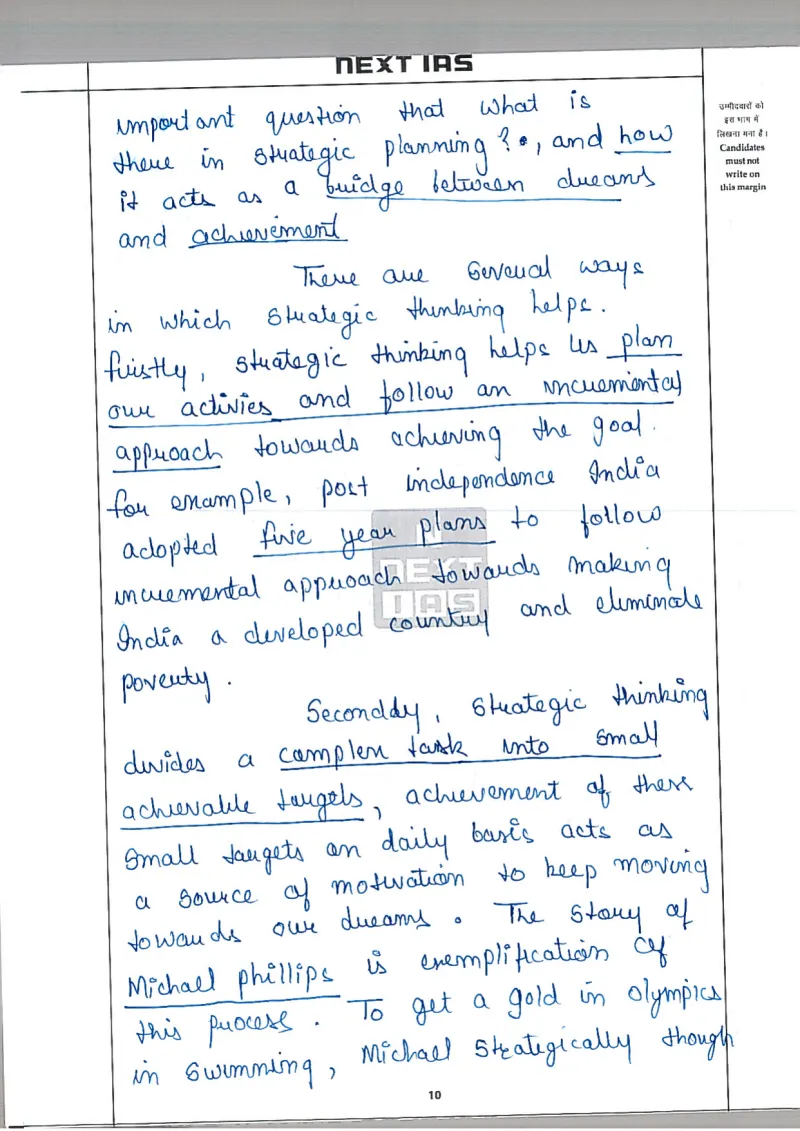
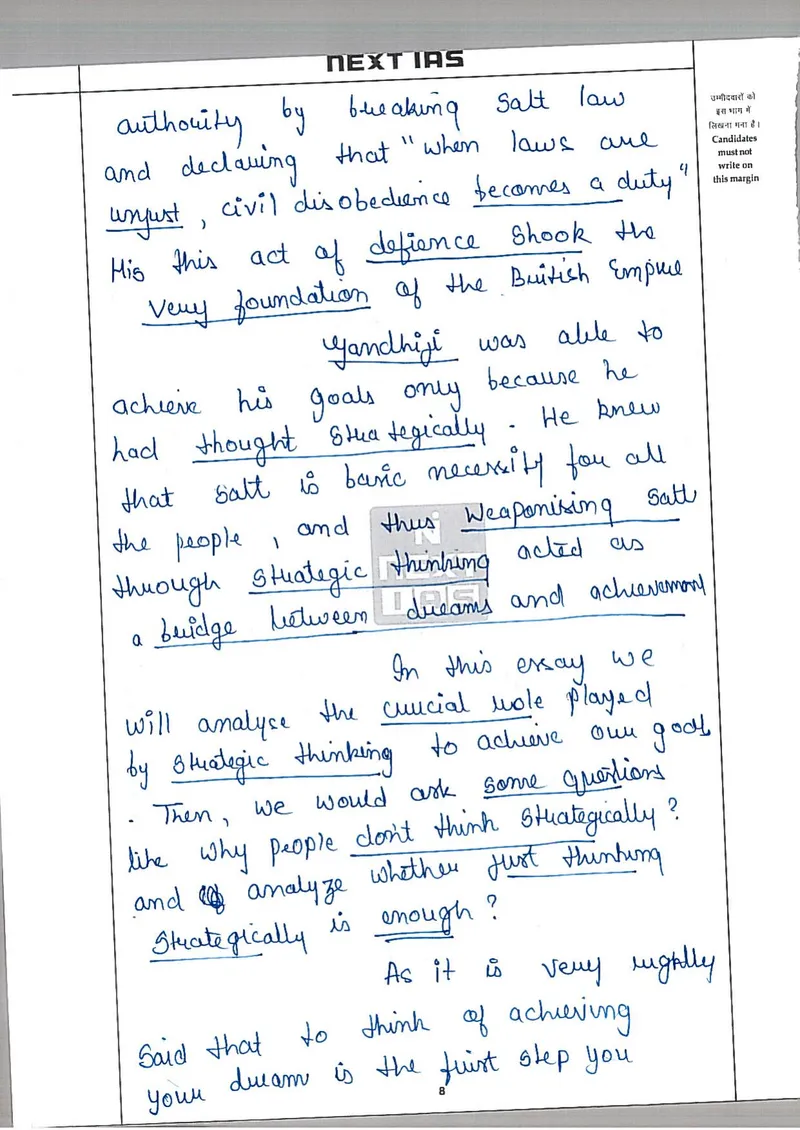
▸Both essays open with a story-style hook — Gandhi's 'what could challenge the mighty British Empire? Salt' and Adi Shankara being taught humility by Lord Shiva disguised as a Chandala — before stating an explicit roadmap of the questions the essay will tackle.
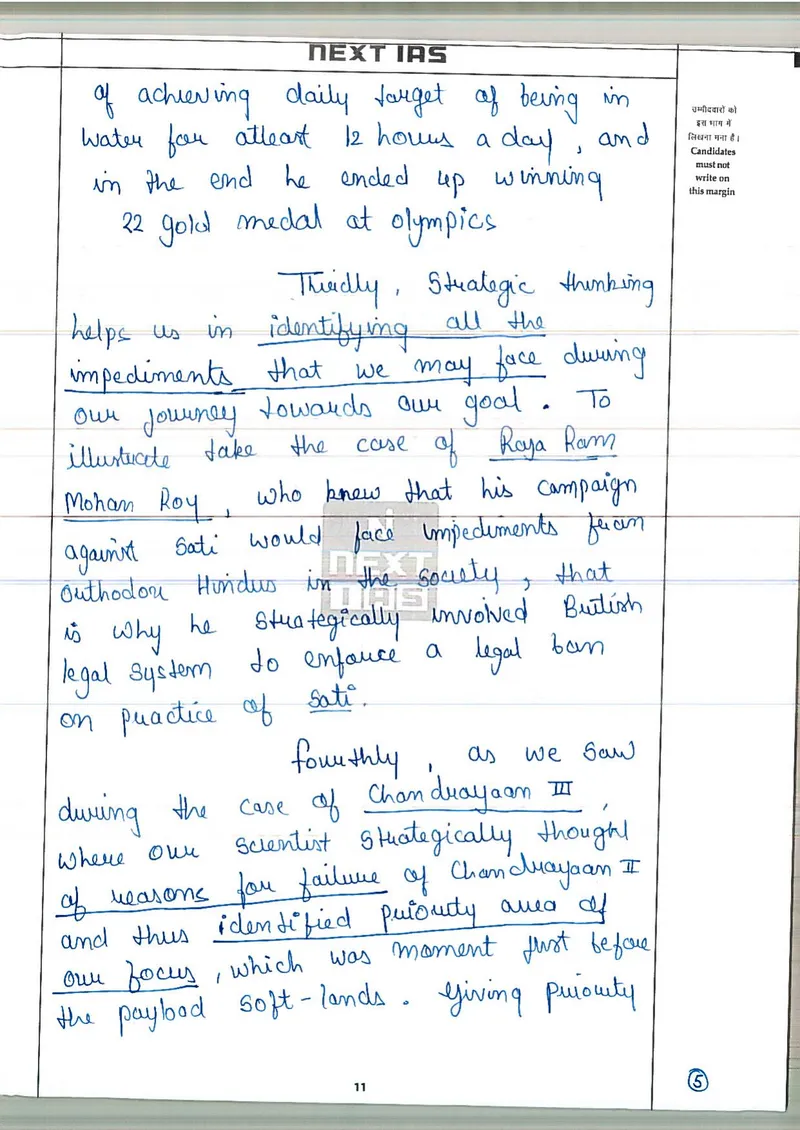
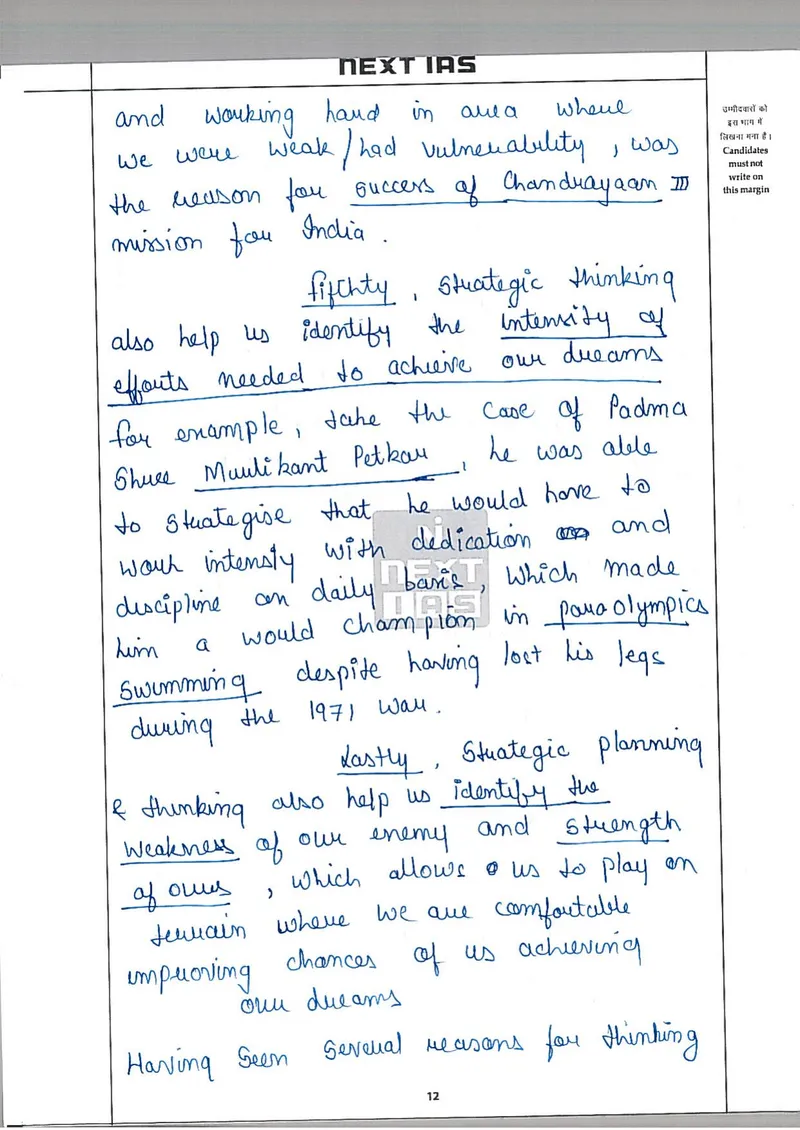
▸The body is built as an enumerated chain ('Firstly... Secondly... Lastly'), with almost every point anchored to a concrete real-world example, giving very high example density.
▸Examples span an unusually wide canvas: Chanakya, Churchill/WWII, Five Year Plans, Michael Phelps, Chandrayaan, Murlikant Petkar, Raja Ram Mohan Roy and Mission LiFE in a single essay.
▸Deliberately builds a counter-view — strategic thinking doesn't always succeed because of luck/external factors (2022 World Cup final loss) — before moving to the way-forward, showing balance.
▸Each essay closes by linking the abstract theme to contemporary governance and global issues (climate change, UNSC reform) and signs off on a crisp slogan-style line ('Think strategically, act decisively').
▸Liberal use of Sanskrit shlokas and thinker quotes (Vidya dadati Vinayam, Vinayam dadati patram, Maslow, Kalam, Vivekananda, Bhagavad Gita) woven into the argument.
What to learn from this copy
★Both essays open with a narrative hook BEFORE the thesis - the strategy essay starts with 'what could challenge the mighty British Empire? Salt' (Gandhi/Dandi), the humility essay with Adi Shankara being taught humility by Lord Shiva disguised as a Chandala near Asi Ghat - and each hook is immediately followed by an explicit roadmap paragraph listing the questions the essay will tackle ('we will analyse... then ask why people don't think strategically... and whether thinking alone is enough'). -> Earn the examiner's attention with a concrete story in the first lines, then signpost your structure in one sentence so the reader knows exactly where the essay is going.
★Almost every enumerated body point (Firstly/Secondly/.../Lastly) is anchored to a named, concrete example, and the examples are drawn from a deliberately wide canvas in a single essay - Chanakya (Sam, Daam, Dand, Bhed to make Chandragupta a chakravarti), Churchill drawing the USA into WWII, the Five Year Plans, Michael Phelps, Chandrayaan's soft-landing focus, Para-swimmer Murlikant Petkar, and Raja Ram Mohan Roy using British courts to ban Sati. -> Don't repeat the same two or three stock examples; build a personal example-bank spanning history, polity, sport, science and reform so each abstract point lands on a fresh, specific illustration.
★The strategy essay deliberately builds a counter-view before the way-forward - it argues strategic thinking does NOT always succeed because of luck/external factors, citing India planning each match yet losing the 2022 World Cup final. -> Pre-empt the obvious objection to your own thesis with a concrete counter-example; this 'yes, but...' move signals balance and lifts an essay above one-sided cheerleading.
★Each essay closes by pulling the abstract theme into contemporary governance and global issues - Mission LiFE and mindful consumption, climate change, UNSC reform - and then signs off on a crisp slogan-style line ('Think strategically, act decisively'). -> Land the conclusion in the present-day policy world rather than vague platitudes, and end on one memorable, quotable line that crystallises the whole argument.
★In the humility essay the argument is carried by a chain of paired Sanskrit shlokas - 'Vidya dadati Vinayam' (education gives humility) leading into 'Vinayam dadati patram' (humility gives worthiness) - reinforced by a paraphrased Gita line that the arrogant 'become a servant of their arrogance and ultimately fail.' -> Use a short, accurately-paired quotation or shloka as a logical link in the chain (cause -> effect), not as decorative filler dropped at random.
Questions attempted: Essay: "Strategic thinking is the bridge between dreams and achievement."; Essay: "Life is a long lesson in humility.".
Questions attempted in this booklet (2)+
Q4 (Section-A).Essay: "Strategic thinking is the bridge between dreams and achievement."
Q5 (Section-B).Essay: "Life is a long lesson in humility."
Examples, data & evidence used
Gandhiji — Salt Satyagraha / Dandi March, reaching Dandi coast with 78 delegates and breaking the salt law (weaponising salt as a basic necessity)
Chanakya — dethroned Dhanananda and made Chandragupta Maurya a chakravarti samrat using Sam, Daam, Dand, Bhed
Churchill — strategically coordinating the Allies and drawing the USA in during World War II to prevail over the Nazis
India's post-independence Five Year Plans — incremental approach to development and poverty elimination
Michael Phelps (written 'Michael Phillips') — Olympic swimmer, daily target of hours in water, won ~22 Olympic gold medals
Raja Ram Mohan Roy — campaign against Sati, strategically used the British legal system to enforce a legal ban
Chandrayaan mission — scientists identifying the soft-landing moment as the priority/vulnerability area, leading to success
Murlikant Petkar (written 'Muulikant Petkau') — Padma Shri, Paralympics swimming champion despite losing his legs in the 1971 war
Duryodhana (Mahabharata) — lack of foresightedness; would have given 5 villages had he thought strategically
Kota — recent suicide of a young girl before attempting the JEE exam (self-doubt / fear of failure)
2022 World Cup — Indian cricket team planned each match strategically yet lost the final due to circumstances/luck (counter-view)
Mission LiFE — cited in conclusion for mindful consumption / fighting climate change
UNSC reforms (written 'UNBC') and climate change — cited as contemporary domains needing strategic thinking
Adi Shankara / Adi Shankaracharya — Chandala near Asi Ghat who was Lord Shiva in disguise; led him to compose 'Manisha Panchakam'
Quotes the candidate used
"When laws are unjust, civil disobedience becomes a duty" (in the Gandhi / salt-law passage; no author named)
"Dreams are [not what you see in sleep but] those that should not let one sleep" — attributed to APJ Abdul Kalam
"Arise and stop not till the dreams are achieved" — attributed to Swami Vivekananda
"Move away, I need to perform my daily ritual" — attributed to Adi Shankara
Bhagavad Gita / Shri Krishna (paraphrased): a person who won't be humble would eventually become a servant of his arrogance and ultimately fail
How it’s written: Anecdote-first introductions (a narrative hook), immediately followed by an explicit roadmap paragraph ('In this essay we will analyse... then ask why people don't think strategically... and whether thinking alone is enough'). Body organised as enumerated points (Firstly/Secondly/.../Lastly), each tied to a named ex…
Diagrams & visuals: The essays themselves are pure prose — no charts, tables or maps drawn within the answer body; Rough-work pages (printed pp. 29-30) contain hand-drawn mind-maps / spider diagrams: boxed central concepts ('Humility', 'Need', 'Life without humility', 'Arrogance', 'Strategic thinking') with arrows branching out to sub-points and examples; Rough-work also has a question-based skeleton (D1-D4) and an example-bank list for both essays; (Marks-detail table and Evaluator's-feedback grids are pre-printed booklet forms, not candidate-drawn)
Evaluator: No examiner marks or comments are filled in on this copy.
How many Pakshal Secretry answer copies can I download here?+
This page links to 5 of Pakshal Secretry's mains answer copies (GS1, GS3, Ethics (GS4) and Essay) as free PDFs, from the UnlockIAS topper-copy archive. Each opens in Google Drive — no sign-up or payment.
What rank did Pakshal Secretry get and in which year?+
Pakshal Secretry secured Rank 8 in UPSC CSE 2025.
Are Pakshal Secretry's answer copies evaluated with marks?+
These are Pakshal Secretry's test-series mains booklets. Most are clean (unmarked) fair copies — their value is in the actual answers: the questions attempted, the examples and quotations used, and how the answers are structured, which we summarise on this page. A few topper copies in the wider library do carry the evaluator's qualitative feedback.
What can I learn from Pakshal Secretry's answer copies?+
Decode the pattern, don't copy the content. For example, in Pakshal Secretry's copies: a pure current-affairs play: all 10 answers are pulled straight from 2024-25 headlines — Trump-era reciprocal tariffs, IWT-in-abeyance after Pahalgam, the Red Sea/Houthi crisis, BRICS' Kazan expansion, India-Taliban talks, the Iran-Israel war, WTO paralysis and the India-China thaw.. Read a copy, then write the same question yourself and compare structure, example density and conclusion quality.
Are these Pakshal Secretry copies really free?+
Yes — every PDF on this page is free to view and download. UnlockIAS hosts this index for free educational use; credit for each booklet belongs to the candidate and the evaluating test series.
Studying Pakshal Secretry's copies shows you the target; the Sherlocking Mains programme trains you to hit it — daily answer writing with AWE Bot evaluation and mentorship. Or get one Mains answer evaluated free.