
Gyanendra Bharti — DrishtiIAS GS Paper 4 (Ethics) copy
What’s inside this copy
- ▸Scored 107/250 on this Drishti GS-4 (Test-4) ethics mock and attempted all 12 questions (candidate later Rank 537, CSE 2023).
- ▸Signature strength noted by evaluator: every answer opens by defining the key term ('very well defined the key term', 'your habit of introducing with defining key terminologies is good').
- ▸Memorable framing devices - a boxed 'Attitude + Aptitude = Altitude' and a three-circle Venn for 'probity'.
- ▸Section B case studies (Q7-12) were the strongest, scoring 8.0-9.5 each, vs Section A theory parts running 3.0-5.0.
- ▸Case-study method is solid: clear stakeholder mapping ('very well discussed/identified') and option-by-option Merit/Demerit analysis.
- ▸Recurring real examples - Armstrong Pame (IAS), Metroman Sreedharan, Satyam scam, Rajat Gupta, Osama Bin Laden, Odisha 'millet lady'.
What to learn from this copy
- ★His case studies (Q7-12) carried the copy, scoring 8.0-9.5 each versus 3.0-5.0 on the theory parts, by doing two concrete things the evaluator flagged: explicit stakeholder mapping ('very well discussed/identified') and an option-by-option Merit/Demerit table for each course of action (e.g. the Aravalli illegal-mining SP case and the mid-day-meal snake/mob-justice BDO case) -> in GS4, weight your prep and exam time toward case studies, and answer them with a structured stakeholders-then-options-then-merit/demerit format rather than a narrative.
- ★Every answer opened by defining the key term, underlined, which the evaluator singled out twice ('very well defined the key term', 'your habit of introducing with defining key terminologies is good') -> lead each ethics answer with a crisp definition of the central concept (aptitude, probity, ethical dilemma) before any discussion; it is a low-cost, repeatable opening that examiners reward.
- ★He built memorable visual anchors that compressed the whole answer: a boxed equation 'Attitude + Aptitude = Altitude' as the Q1(b) conclusion, a nested Venn putting 'Code of Conduct' inside the larger 'Code of Ethics' circle (Q2a), and a three-circle Venn (Integrity, Transparency, Honesty around Accountability) for probity (Q6a) -> turn a definition or distinction into one self-explanatory diagram or equation; it makes the relationship instantly clear and gives the answer a recall hook.
- ★He sourced examples widely and matched each to the exact point: Armstrong Pame (IAS) building a ~100 km road without government funds for attitude/leadership, the Odisha 'millet lady' reviving 30+ native millets, Satyam scam and Rajat Gupta insider trading for corporate-governance failures, and Osama Bin Laden as 'knowledge without integrity' for the Samuel Johnson quote -> keep a small bank of versatile real examples (an IAS innovator, a corporate scandal, an unconventional changemaker) and deploy the specific one that fits the prompt's exact theme, not a generic name-drop.
Questions attempted: What is aptitude? Is it different from interest, skill and intelligence?; Quote: 'It is an attitude, not aptitude, which determines one's altitude'; Distinction between code of conduct and code of ethics (with examples), and 16 more below.
Questions attempted in this booklet (19)+
- 1(a).What is aptitude? Is it different from interest, skill and intelligence?
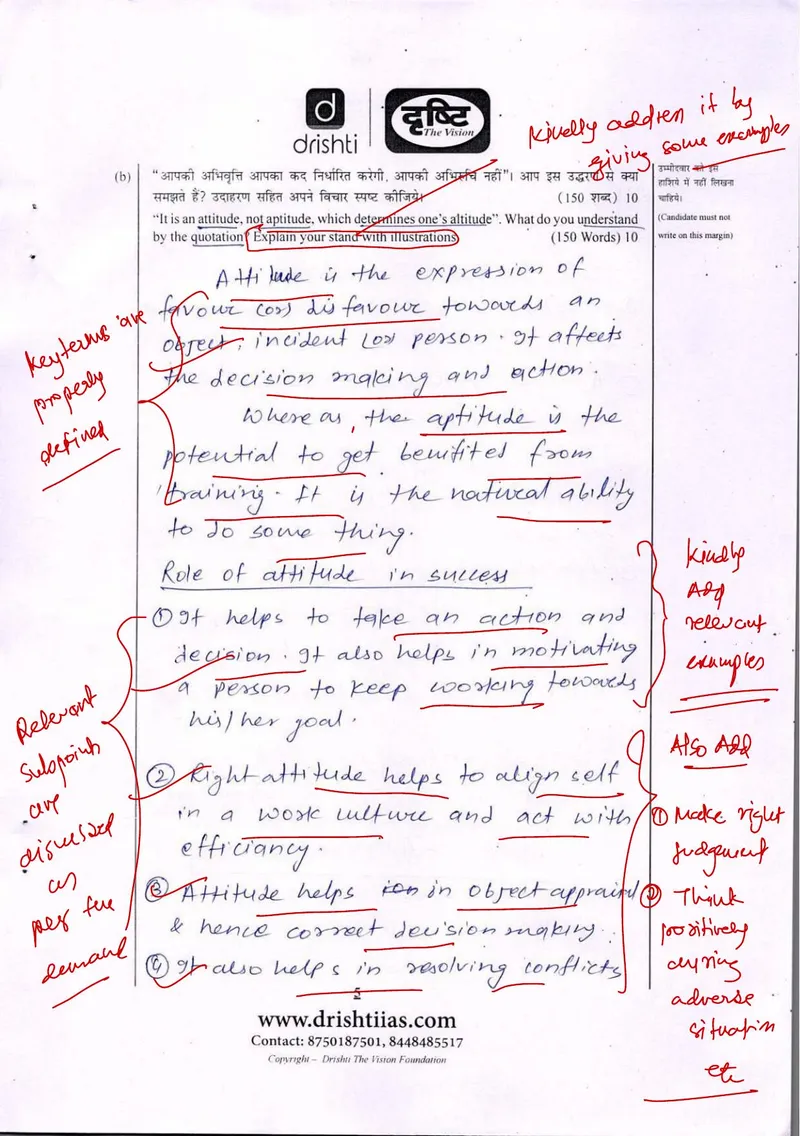
- 1(b).Quote: 'It is an attitude, not aptitude, which determines one's altitude'
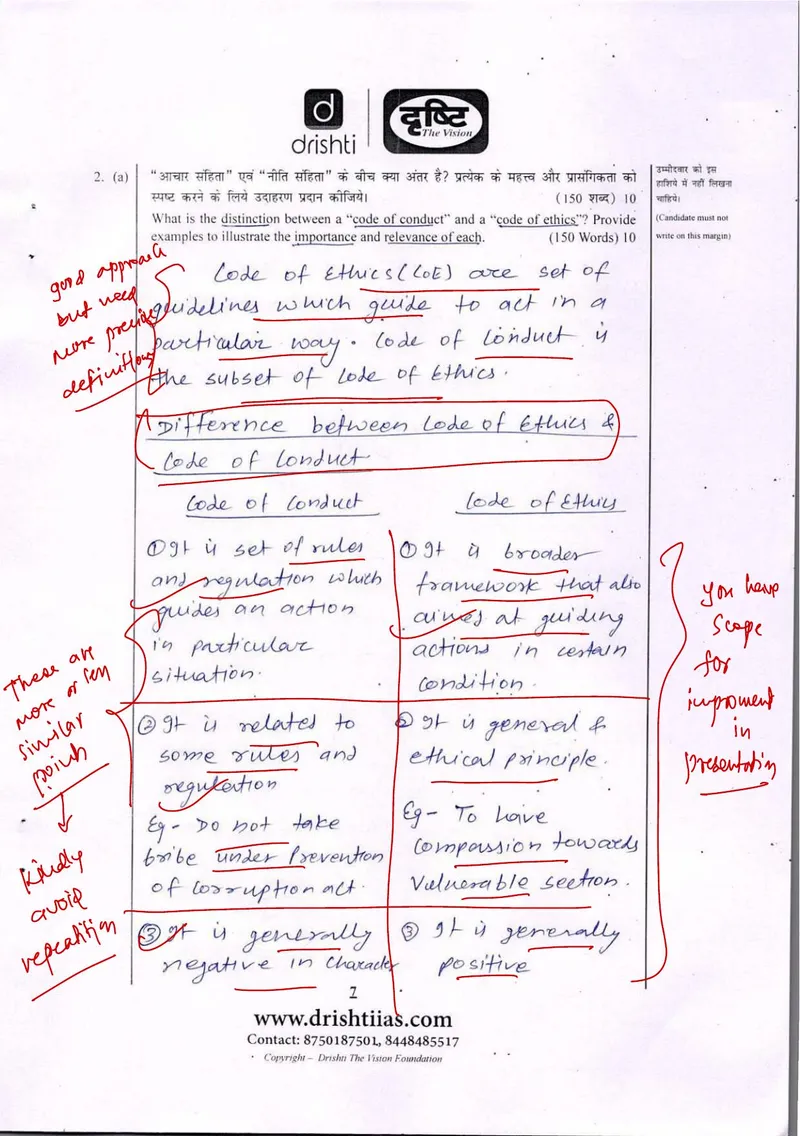
- 2(a).Distinction between code of conduct and code of ethics (with examples)
- 2(b).Anonymity and impartiality as fundamental characteristics of the Indian Civil Service
- 3(a).Quote (Eleanor Roosevelt): 'You can often change your circumstances by changing your attitude'
- 3(b).Quote (Samuel Johnson): 'Integrity without knowledge is weak and useless, and knowledge without integrity is dangerous and dreadful'
- 3(c).Quote (Swami Vivekananda): 'I care only for the spirit - when that is right, everything will be righted by itself'
- 4(a).Emotional intelligence and interpersonal relationships in the workplace (team dynamics, collaboration, conflict resolution)
- 4(b).Corporate governance and ethical issues with corporate governance in India
- 5(a).What is an ethical dilemma? Ethical concerns and dilemmas in public institutions
- 5(b).Short notes: ethical governance; objectivity & dedication; ethical perversions of private sector; empathy & compassion; RTI Act 2005
- 6(a).Probity in governance - purpose, importance and measures
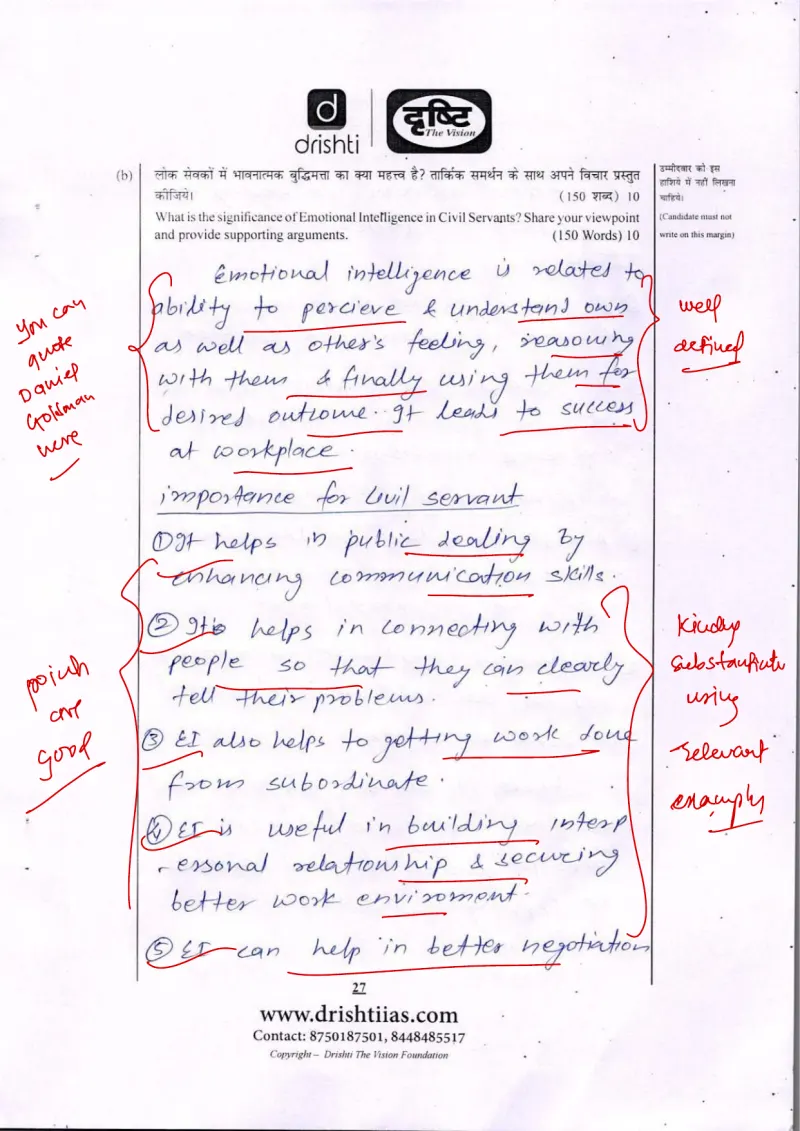
- 6(b).Significance of Emotional Intelligence in civil servants
- 7.Case study: SP in a district with illegal mining mafia (Aravalli), DSP killed, local MLA involved
- 8.Case study: SP amid communal unrest, child shot at refugee camp, fake news about ambulance misuse
- 9.Case study: Rohan/Raman - friend obtains fake EWS certificate for CUET admission
- 10.Case study: Ravi, structural engineer - bridge collapses twice, design flaw, contractor is MLA's brother; are 'errors/failures' acceptable for human progress
- 11.Case study: Radhika (wrestler) - coach sexually exploiting minor trainee Shruti; political connections
- 12.Case study: BDO - mid-day-meal snake incident, villagers gheraoed/vandalised school, mob justice vs cook's livelihood
Examples, data & evidence used
- Aptitude/skill/interest illustrations: a child painting an object (aptitude), drawing a good portrait (skill), being interested in singing (interest)
- Code of conduct vs code of ethics: 'do not take bribe under Prevention of Corruption Act', not revealing official secrets, coming to office on time (conduct) vs compassion towards vulnerable, giving medicine without prescription to save a life (ethics)
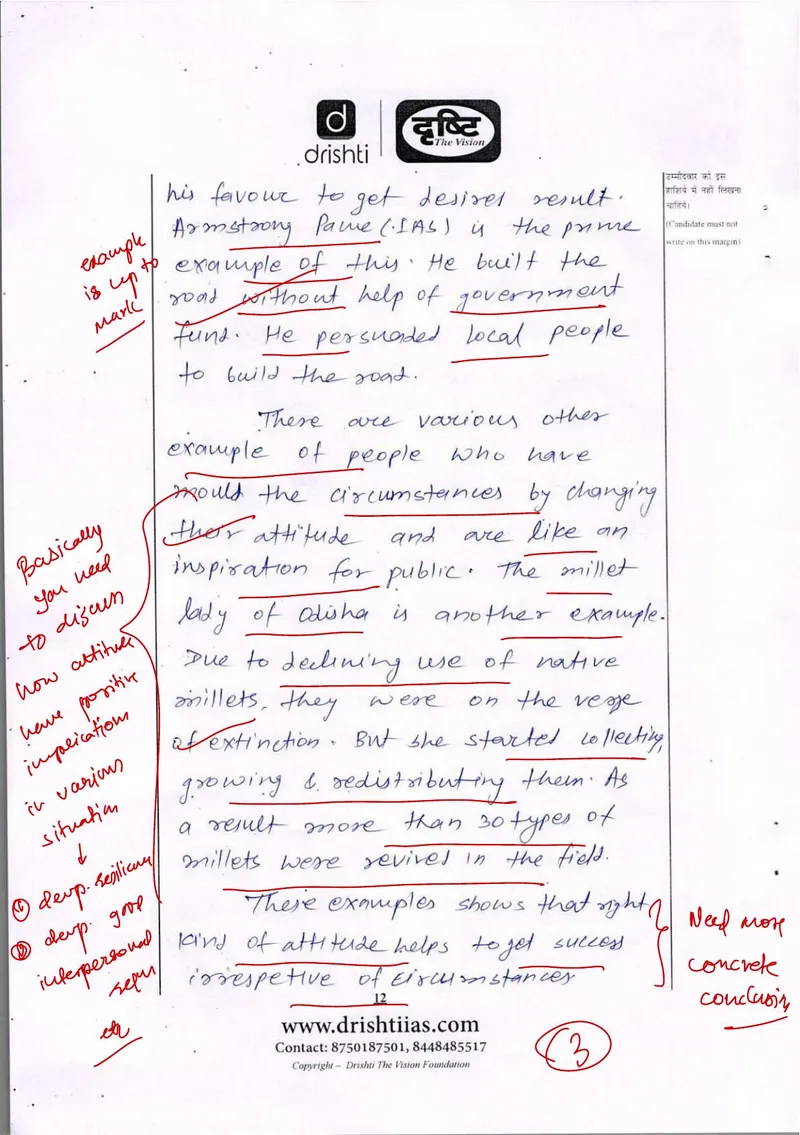
- Armstrong Pame (IAS) - built a ~100 km road without government funds by persuading local people (cited in Q3a and Q6b)
- Metroman E. Sreedharan - role in development of Delhi Metro (Q6b)
- The 'millet lady of Odisha' - revived 30+ types of native millets by collecting, growing and redistributing them (Q3a)
- Osama Bin Laden - had knowledge but used it for destruction (knowledge without integrity, Q3b)
- Helping a friend cheat in an exam; supporting dowry before marriage (integrity without knowledge, Q3b)
- Corporate governance ethical issues: Rajat Gupta case (insider trading), Satyam scam (auditor-management nexus), Cyrus Mistry case (opaqueness); Uday Kotak Committee and OECD framework (Q4b)
- Voting for a corrupt politician / voting on caste-religious lines leading to defective democracy (Q3b)
- Institutional/legal tools: RTI Act (Article 19), Lokpal & Lokayukta, CBI, CVC, audit, courts (probity / RTI note)
Quotes the candidate used
- Eleanor Roosevelt - 'You can often change your circumstances by changing your attitude' (Q3a prompt, interpreted by candidate)
- Samuel Johnson - 'Integrity without knowledge is weak and useless, and knowledge without integrity is dangerous and dreadful' (Q3b prompt)
- Swami Vivekananda - 'I care only for the spirit - when that is right, everything will be righted by itself' (Q3c prompt)
- 'It is an attitude, not aptitude, which determines one's altitude' (Q1b prompt; no author printed)
- Note: evaluator SUGGESTED quoting Daniel Goleman on EI (Q6b) - the candidate did NOT actually cite him
How it’s written: Disciplined, repeatable template. Theory answers open with a definition of key terms (heavily underlined), then labelled sub-headings ("Element of aptitude", "Role of anonymity in civil services", "Purpose & importance of probity", "Tools to ensure probity"), numbered points, and a short conclusion - sometimes a box…
Diagrams & visuals: Q1(a): flow diagram 'before -> interest -> Task' with an arrow noting 'during task we need aptitude'; Q1: arrow diagram contrasting 'Skill -> Past' vs 'Aptitude -> Futuristic'; Q1(b): boxed equation 'Attitude + Aptitude = Altitude' as the conclusion; Q2(a): Venn diagram - 'Code of Ethics' (outer circle) containing 'Code of Conduct' (inner circle); Q6(a): three-circle Venn diagram for probity (Integrity, Transparency, Honesty overlapping with Accountability), shaded centre labelled 'figure probity'; No geographical maps used
Evaluator: Extensive red-ink annotation throughout plus a full one-page handwritten overall feedback letter and per-question circled marks. Overall letter ('Dear Gyanendra'): (1) 'You have attempted all the questions which is really appreciated'; (…