
Ranga Manju — Vajiram & Ravi GS Paper 4 (Ethics) copy
What’s inside this copy
- ▸Full-length topper attempt: every one of the 13 Section-A items and all 6 Section-B case studies attempted, in order, within page limits.
- ▸Exceptionally example-dense — names real administrators (IAS Sagayam, Prashant Nair's 'Compassionate Kozhikode', Shashank's nutrition gardens, 'Lunch with the Collector') and sharp negative cases (Asaram, Ram Rahim, KPS Gill via Rupan Deol Bajaj v. KPS Gill).
- ▸Strong philosophical anchoring: Charvaka/Epicurus/hedonism for Hume, Karmaphala + Doctrine of Double Effect for the Gita, Polluter Pays/Public Trust/Gaia/deep ecology for environment.
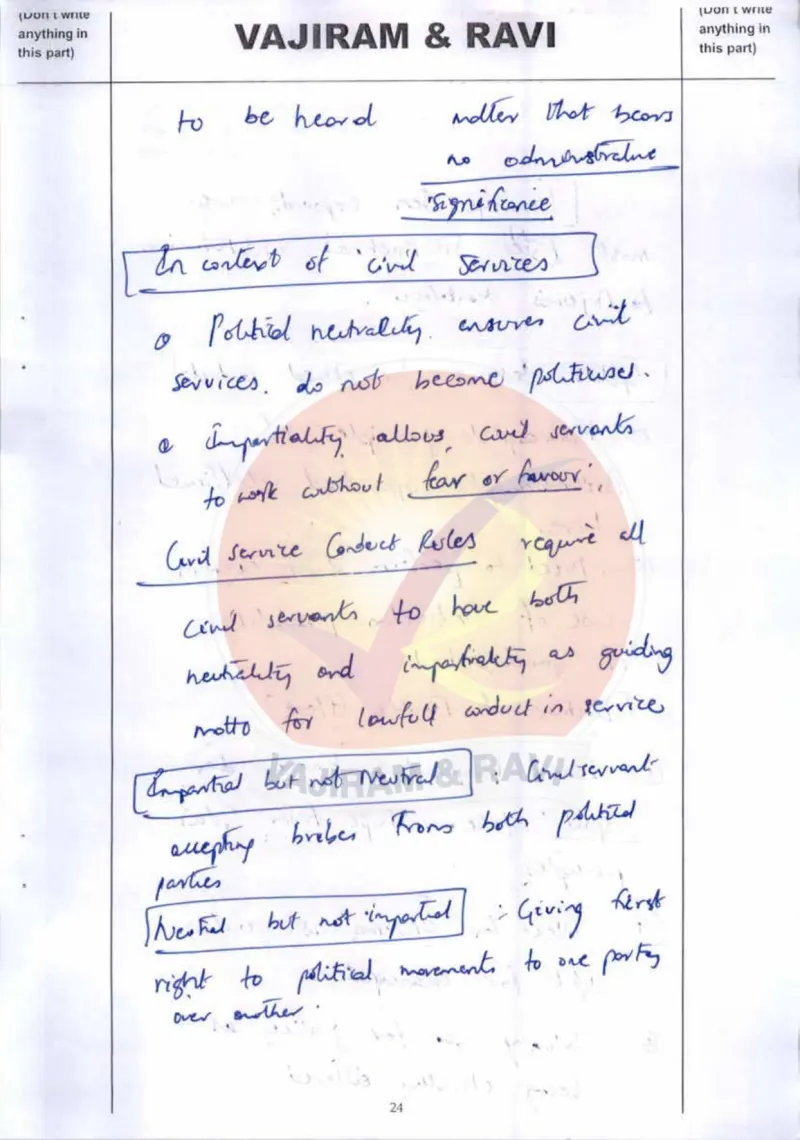
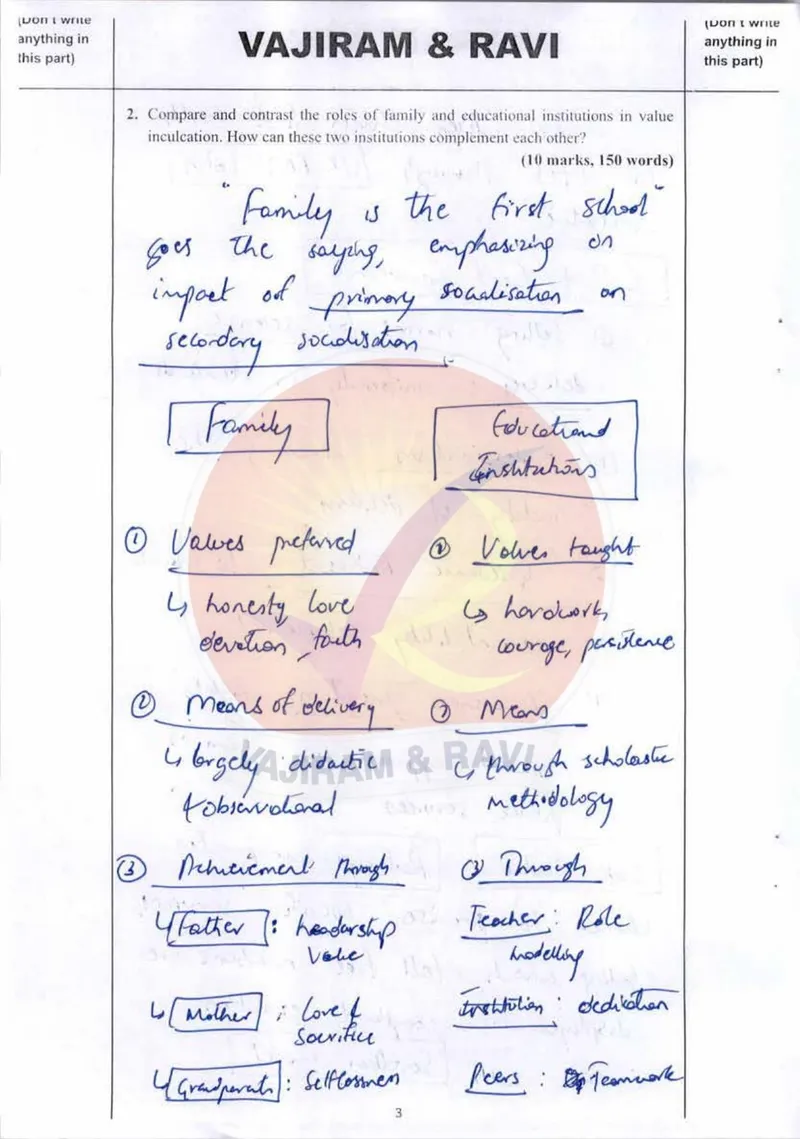
- ▸Clean presentation — boxed keywords, underlined sub-headers, arrows, and genuine two-column compare-and-contrast (Q2 family vs school; Q10 impartiality vs neutrality).
- ▸Signature format: each answer opens with a quotation hook and closes with a one-line takeaway; body is crisp and keyword-driven.
- ▸Current-affairs fluency woven in: Oxfam 2024 (1% holds ~40% wealth), Kamakoti panel on AI, Puja Khedkar, cough-syrup export crisis, PM-LiFE, SEBI BRSR.
What to learn from this copy
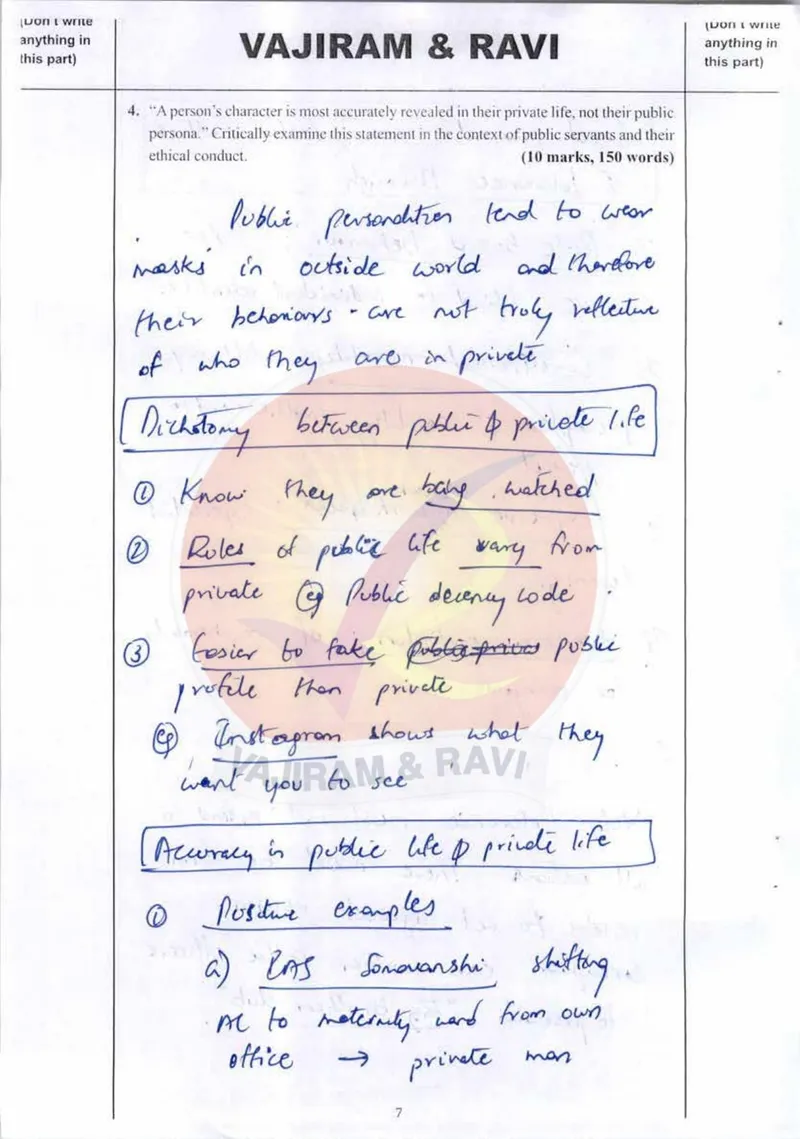
- ★In Q4 ("character revealed in private life") Ranga Manju stacked matched real cases on both sides — positives like IAS Sagayam, Lal Bahadur Shastri (wealth under Rs 500 at death), and the AC-shifted-to-the-maternity-ward officer, against negatives Asaram, Ram Rahim, and KPS Gill (citing the actual case Rupan Deol Bajaj v. KPS Gill) -> stock an Ethics answer with named, verifiable people and cite the case law by name; balanced positive-and-negative examples prove a claim far better than abstract assertion.
- ★Quotation answers were anchored in named philosophy, not vague morality — Charvaka/Lokayata, Epicurus and hedonism to unpack Hume's "reason is slave of the passions" (Q6a), and Karmaphala plus the Doctrine of Double Effect for the Gita (Q11), with environmental ethics framed via Polluter Pays / Public Trust / Gaia / deep ecology (Q9) -> attach a specific named doctrine or school to abstract prompts so the examiner sees conceptual depth rather than commentary.
- ★Genuine two-column compare-and-contrast layouts with boxed column headers were used exactly where the question demanded comparison — Q2 (family vs educational institutions) and Q10 (impartiality vs neutrality) -> match the visual structure to the verb of the question; a side-by-side table for an explicit 'compare and contrast' or 'difference between' question is high-signal, unlike decorative diagrams.
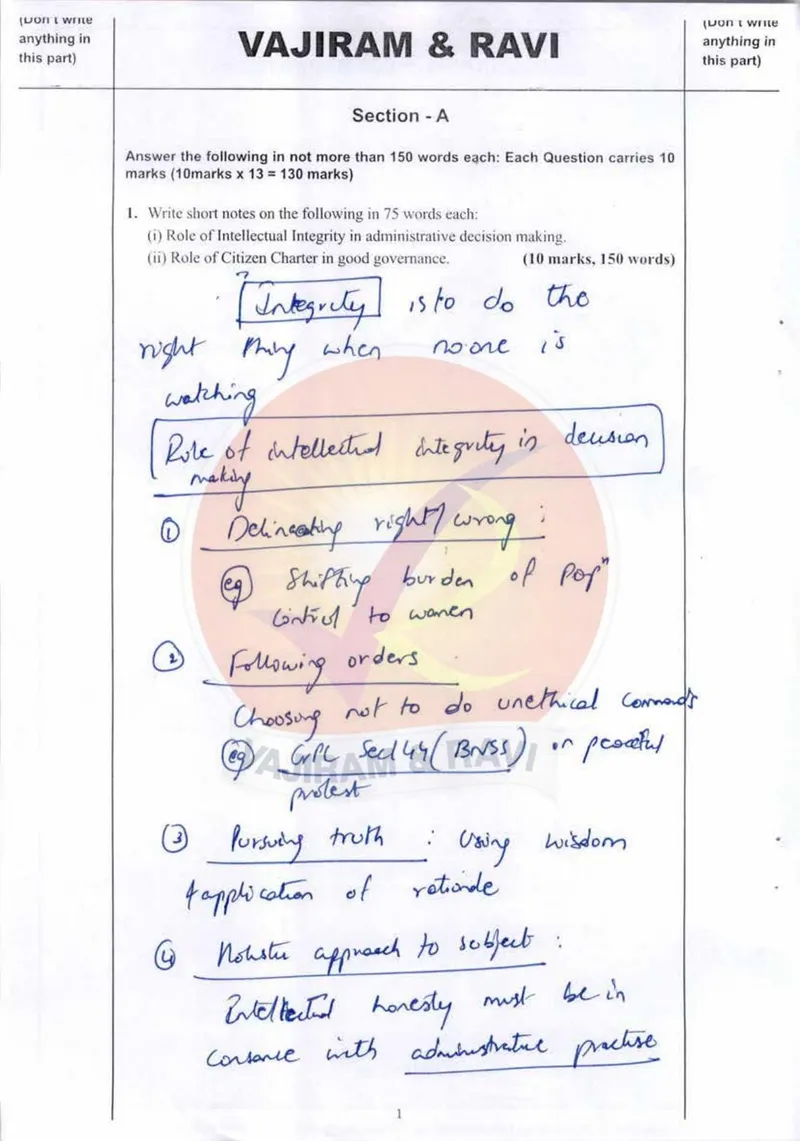
- ★Every answer ran a consistent template: a quotation/proverb hook opening (e.g., "Integrity is to do the right thing when no one is watching" for Q1, "Family is the first school" for Q2) into a framing line, then underlined sub-headers, closing on a one-line takeaway -> a repeatable intro-body-conclusion skeleton lets you write fast and uniformly under time pressure across 19 attempts without reinventing structure each time.
- ★Current affairs were woven in as concrete data points, not name-drops — Oxfam 2024 (1% holds ~40% of wealth) for the rich-poor gap (Q8), the Kamakoti panel for AI policy (Q14), plus Puja Khedkar, the cough-syrup export crisis, PM-LiFE and SEBI BRSR -> ground ethics arguments in dated, specific contemporary references to show the answer is current and rooted in real governance, not timeless platitude.
- ★It was a complete full-length attempt: all 13 Section-A items and all 6 Section-B case studies (Kerala landslides, AI task force, GoodLife Pharma/Revivol, CPWD harassment, etc.) attempted in order, within page limits -> finishing the whole paper within limits is itself a scoring strength; partial papers cap your ceiling regardless of per-answer quality.
Questions attempted: Short notes (75 words each): (i) Role of intellectual integrity in administrative decision-making; (ii) Role of Citizen's Charter in good governance; Compare and contrast family vs educational institutions in value inculcation; how they complement each other; Tolerance as appreciating/celebrating diversity; importance for governance; how civil servants foster tolerance and inclusivity, and 16 more below.
Questions attempted in this booklet (19)+
- Q1.Short notes (75 words each): (i) Role of intellectual integrity in administrative decision-making; (ii) Role of Citizen's Charter in good governance
- Q2.Compare and contrast family vs educational institutions in value inculcation; how they complement each other
- Q3.Tolerance as appreciating/celebrating diversity; importance for governance; how civil servants foster tolerance and inclusivity
- Q4."A person's character is revealed in private life, not public persona" — critically examined for public servants' ethical conduct
- Q5.Accountability mechanisms vs bureaucratic delays/inefficiency in Indian administration; balancing accountability and efficiency
- Q6a.Quotation — David Hume: "Reason is, and ought only to be the slave of the passions"
- Q6b.Quotation — Martin Luther King Jr.: ultimate measure of a person is where they stand at times of challenge and controversy
- Q6c.Quotation — Mahatma Gandhi: "In matters of conscience, the law of the majority has no place"
- Q7.Empathy and emotional intelligence in civil servants to improve governance and service delivery
- Q8.Ethical implications of the widening rich-poor nation gap; moral obligation of developed countries to assist developing ones
- Q9.Environmental ethics — "we borrow the earth from our children"; responsibilities of individuals, corporations, governments to future generations
- Q10.Difference between impartiality and neutrality in the civil service
- Q11.Relevance of Bhagavad Gita teachings for ethical conduct in contemporary public administration
- Q12.Case study — Kerala landslides; District Collector balancing relief/rehabilitation, transparency, safety vs cultural attachment to ancestral land, equitable distribution under media scrutiny
- Q13.Case study — Ministry of Rural Development; limited women's participation in SHGs/village councils; engaging male members; institutional/policy changes
- Q14.Case study — Head of national AI task force; formulating a comprehensive national AI policy framework (jobs, privacy, bias, accountability/black-box)
- Q15.Case study — 'GoodLife Pharma'/'Revivol'; undisclosed fatal side effects, suppressed trial data, complicit superior; dilemmas, course of action, corporate governance fixes
- Q16.Case study — Young IAS SDM; absenteeism, file backlog, bribery/favouritism; steps to improve work culture and service delivery; challenges
- Q17.Case study — Additional DG, CPWD; insecure Chief Architect harassing new Senior Architect (Seema); ethical issues, options to retain her, preventive measures
Examples, data & evidence used
- Indian Railways Citizen's Charter — toll-free numbers and complaint-escalation (Q1)
- NEP 2020 — parent-teacher exchanges/'school-family double helix' (Q2)
- Atheist officer granting permission for a temple procession (Q3, tolerance)
- IAS officer shifting his office AC to a maternity ward — public role vs private virtue (Q4)
- IAS Sagayam, Tamil Nadu — corruption-free, lives humbly (Q4)
- Lal Bahadur Shastri — wealth less than ₹500 when he died as PM (Q4)
- Asaram Bapu — devotional in public, predator in private (Q4, negative)
- KPS Gill — war hero in public, molester in private; SC case Rupan Deol Bajaj v. KPS Gill (Q4)
- Ram Rahim — religious figure in public, convict in private (Q4, negative)
- FRA 2006 — tribals not evicted by Forest Dept; accountability ensures justice (Q5)
- Charvaka's Lokayata philosophy / Epicurus / hedonism / materialism (Q6a, Hume)
- Abraham Lincoln on character tested in adversity; COVID-19 frontline 'warriors' (Q6b, MLK)
- Galileo's heliocentrism vs the Church's geocentrism; Orwell's 1984; demand for Dravida Nadu (Q6c, majority can be wrong)
- Harper Lee, 'Go Set a Watchman' (conscience) (Q6c)
Quotes the candidate used
- David Hume — "Reason is, and ought only to be the slave of the passions..." (Q6a, paper-set quote)
- Martin Luther King Jr. — "The ultimate measure of a person is... where they stand at times of challenge and controversy" (Q6b, paper-set quote)
- Mahatma Gandhi — "In matters of conscience, the law of the majority has no place" (Q6c, paper-set quote)
- "We do not inherit the earth from our ancestors; we borrow it from our children" — attributed by candidate to Gandhi (Q9, paper-set quote)
- "Integrity is to do the right thing when no one is watching" — used as intro hook (Q1; unattributed in copy)
- "Family is the first school" — proverb used as intro (Q2)
- Rudyard Kipling, 'If' — treat commoners and kings, success and failure alike (Q6b)
- "Give me a mask and I'll tell you the truth" — saying used in intro (Q4; unattributed in copy)
How it’s written: Highly consistent template across all answers: an intro hook (a quotation or proverb in quote marks, sometimes bracketed) leading into a stated framing line, then clearly headed/underlined sub-sections (e.g., "Importance...", "How civil servants can...", conclusion). Body is keyword-dense and telegraphic, organised…
Diagrams & visuals: Two-column compare-and-contrast layout with boxed column headers — Q2 (Family vs Educational Institutions); Two-column comparison — Q10 (Impartiality vs Neutrality); Boxed keywords/headers used as emphasis devices throughout (e.g., boxed 'Father/Mother/Grandparents', 'Moral obligations: Yes'); Arrows (->) used to show linkage/flow between points; Underlining of sub-headers for visual segmentation. No geographic maps and no elaborate pictorial flowcharts/diagrams beyond these presentation devices.
Evaluator: No examiner marks or comments are filled in on this copy.