
Diksha Rai — NextIAS GS Paper 4 (Ethics) copy
What’s inside this copy
- ▸Genuine Diksha Rai copy — NextIAS 'Ethics Enhancer Test 2024' (EE2401, Test 01, 07-Aug-2024); all 12 questions attempted across Section A (theory) and Section B (case studies), ~56 booklet pages.
- ▸Example-saturated answer writing — almost every point carries an 'eg-': Nolan Committee, 2nd ARC, Sreedharan, V. Kurien, Shastri, T.N. Seshan, Irom Sharmila, Armstrong Pame, M. Visvesvaraya, Satyendra Dubey, Enron, Amazon's biased AI tool, and many more.
- ▸Strong thinker/quote scaffolding: Kant (categorical imperative, human dignity), Gandhi (conscience, trusteeship, 'commerce without morality'), Amartya Sen (capability approach), Plato, Daniel Goleman, Vivekananda's Daridra Narayan.
- ▸Disciplined, repeatable case-study template: framing intro -> stakeholder spider-map -> options in Merits/Demerits tables -> numbered chosen course of action -> ethical-theory conclusion.
- ▸Neat, legible blue-ink cursive with hand-drawn mind-maps and two-column tables — clean, examiner-friendly presentation.
- ▸Copy is UNEVALUATED: no marks awarded and no evaluator feedback anywhere — it is shared as a topper reference, so no scores can be reported.
What to learn from this copy
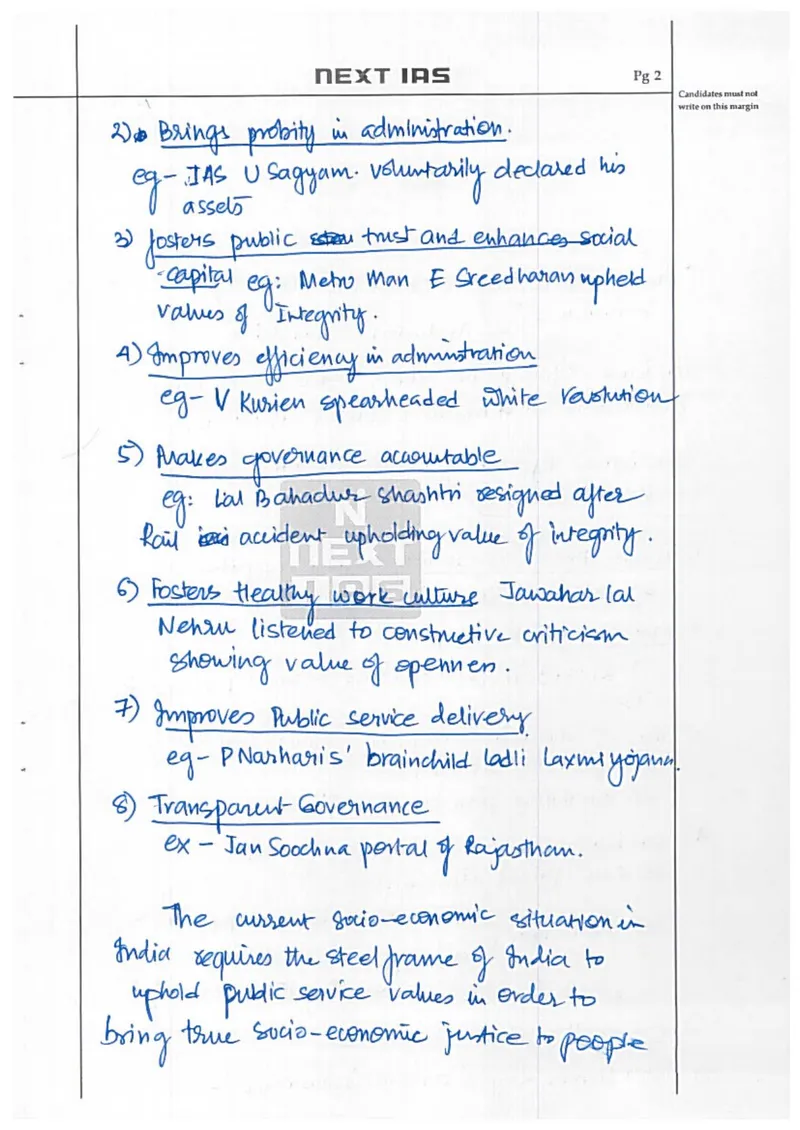
- ★In Q1(a) Diksha opened the abstract 'public service values vs eloquent statements' debate not with theory but with a hand-drawn mind-map of the Nolan Committee's seven principles (Openness, Selflessness, Honesty, Objectivity, Integrity, Leadership), then anchored each value to a real officer -- U. Sagayam voluntarily declaring assets, E. Sreedharan, V. Kurien's White Revolution, Lal Bahadur Shastri resigning after a rail accident -> convert a vague 'are values just words?' prompt into something concrete by pairing each named value with one real administrator who lived it, so the examiner sees evidence, not assertion.
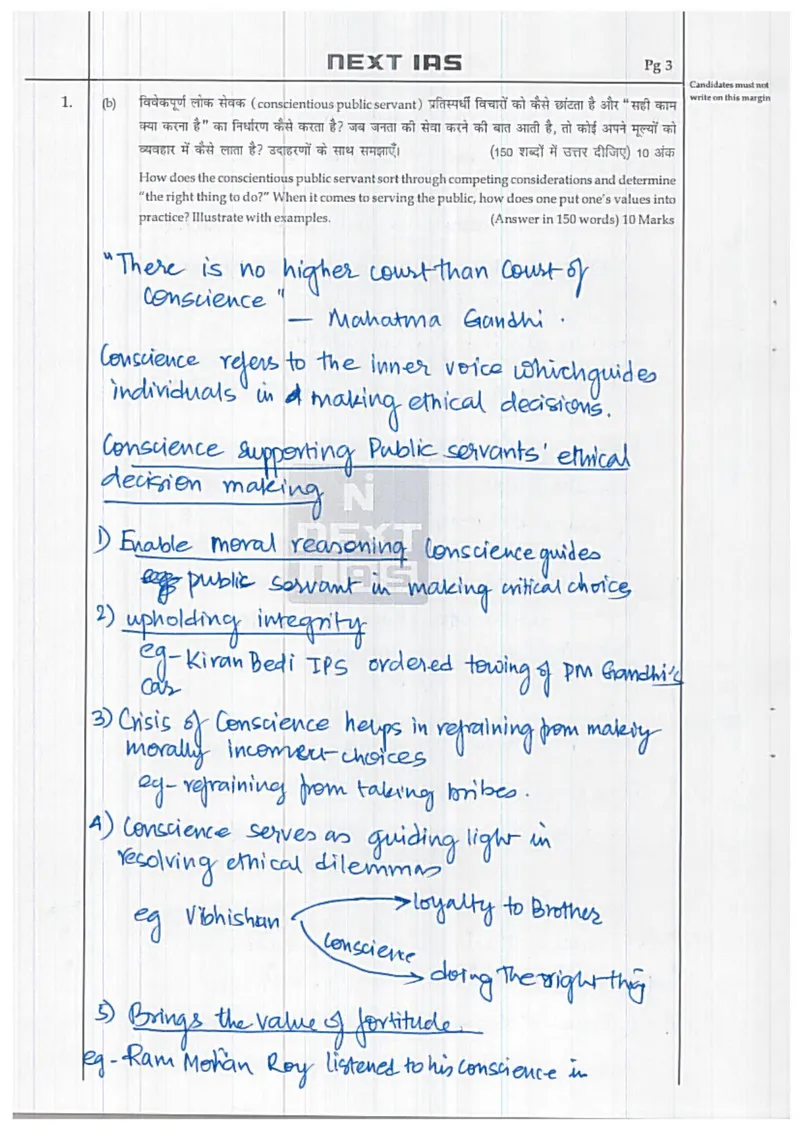
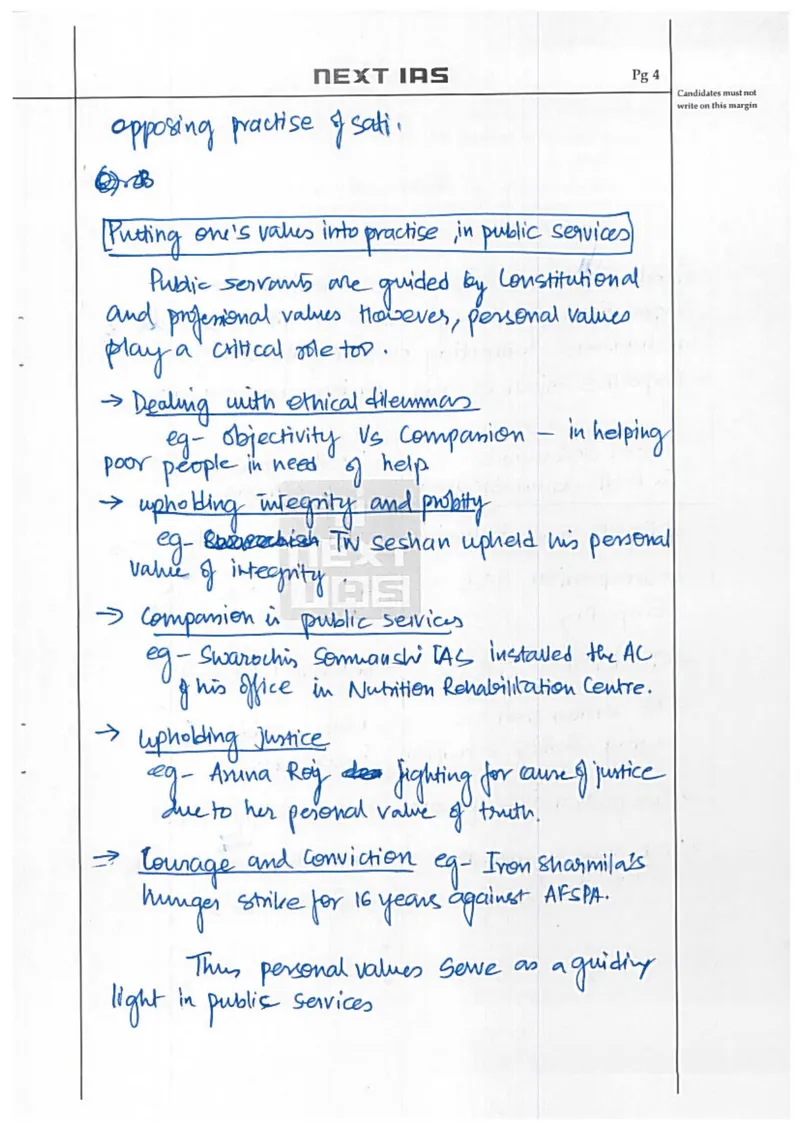
- ★Across Section A nearly every body point carries an 'eg-' tag rather than floating as a bare claim -- in Q1(b) on conscience vs loyalty she stacks Kiran Bedi towing Indira Gandhi's car, Vibhishan, Raja Ram Mohan Roy opposing sati, T.N. Seshan, Aruna Roy, and Irom Sharmila's 16-year hunger strike -> in ethics, one illustrative example per point is the unit of credibility; build a deep, reusable bank of named figures so you can attach a concrete case to any argument under time pressure.
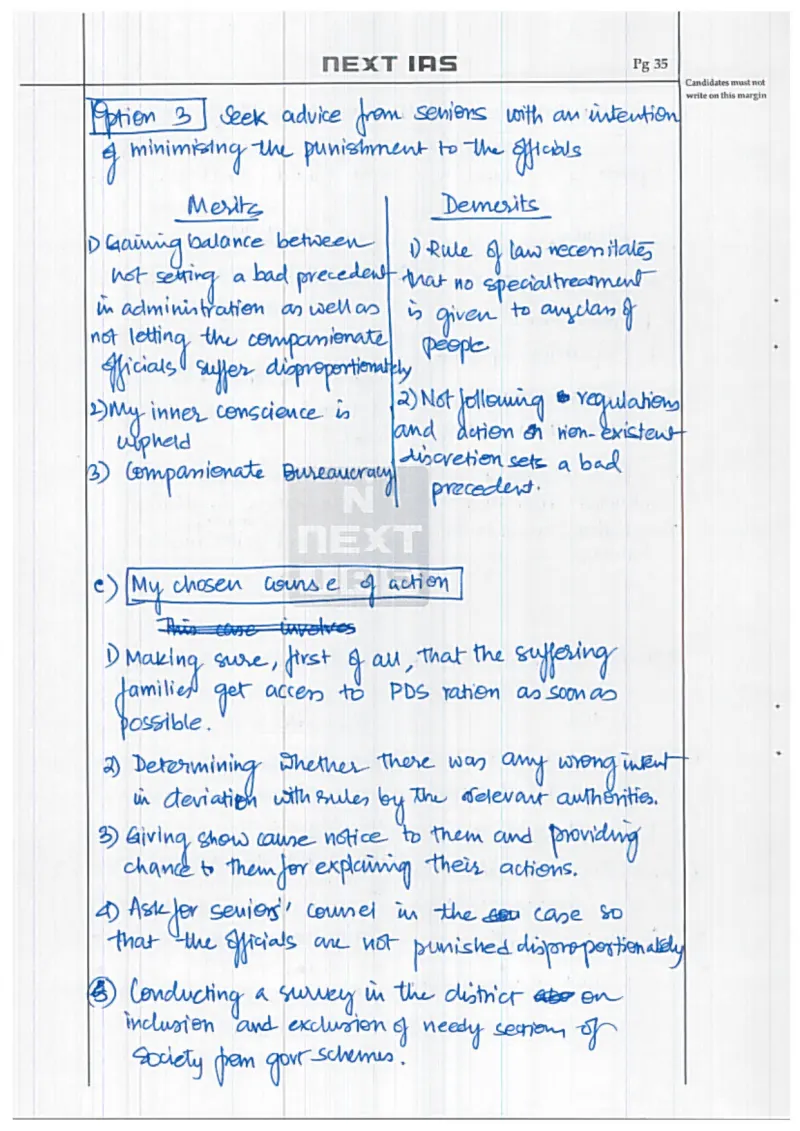
- ★She ran one disciplined, repeatable template for all six case studies (Q7-Q12): framing intro -> stakeholder spider-map -> each option laid out in a Merits/Demerits two-column table -> a numbered chosen course of action -> an ethical-theory conclusion -- e.g. Q7 Beta Technologies maps CFO, Legal Head, company, CEO, Government, Shareholders and Society as distinct stakeholders -> a fixed, mechanical case-study skeleton guarantees you never omit stakeholders or the decision step, and makes the answer instantly navigable for an examiner.
- ★She wove thinkers precisely to the question rather than decoratively -- Kant's categorical imperative for Q6(b), Gandhi's 'commerce without morality' as a deadly sin against the Q10 water-tanker cartel, Amartya Sen's capability approach, and Daniel Goleman plus Jacinda Ardern's 'not enough fuel in the tank' resignation for the Q3(b) emotional-intelligence prompt -> match each quote/theorist to the specific dilemma it actually resolves; relevance, not name-dropping, is what a thinker citation buys you.
- ★Even for high-abstraction theory questions she used structural devices to organise thought -- a comparative two-column public-administration-vs-corporations layout for Q2(a) on good governance -> use tables/columns not just in case studies but to discipline comparative theory answers, forcing parity of treatment on both sides.
Questions attempted: Relationship between Public Service Values and Public Administration Ethics; whether PSV are mere eloquent statements or have utility; How a conscientious public servant sorts competing considerations and puts values into practice; Good governance in public administration vs corporations; three principles for corporate good governance, and 16 more below.
Questions attempted in this booklet (19)+
- 1(a).Relationship between Public Service Values and Public Administration Ethics; whether PSV are mere eloquent statements or have utility
- 1(b).How a conscientious public servant sorts competing considerations and puts values into practice
- 2(a).Good governance in public administration vs corporations; three principles for corporate good governance
- 2(b).Ethical principles to maintain integrity of the public procurement process
- 3(a).Balancing stakeholder interests, official obligations and regime values; which deserves most moral weight
- 3(b).Whether self-awareness and empathy (emotional skills) are essential for effective health/social interventions
- 4(a).How civil servants' political and moral attitudes impact work ethics and daily decision-making
- 4(b).'Motive has nothing to do with morality of an action' — is motive irrelevant?
- 5(a).Contemporary relevance of Jain Tirthankaras' vow-based moral philosophy
- 5(b).Ethical dilemmas of economic sanctions in international relations and how to balance them
- 6(a).Quote: 'Wars begin in the minds of men...love and compassion would have built the defences of peace'
- 6(b).Quote: Kant's categorical imperative — 'live as if the maxim of your actions were to become universal law'
- 6(c).Quote: 'The golden rule of conduct is mutual toleration...truth in fragments'
- 7.Case study: new CEO of Beta Technologies — CFO's earnings manipulation and vendor conflict-of-interest
- 8.Case study: DDO — mid-day-meal grain diverted by schools to feed starving families (compassion vs rules)
- 9.Case study: SP — Bima Yojna premiums deducted from illiterate villagers without informed consent
- 10.Case study: junior engineer — water-tanker cartel with political backing; SP unwilling to act
- 11.Case study: AquaTech ethics officer — fatal mine-clearing robot malfunction, fixing accountability + AI ethics
- 12.Case study: DDO — allocating limited funds to fight witchcraft superstition vs basic services; RTI challenge
Examples, data & evidence used
- Nolan Committee (Seven Principles of Public Life) — drawn as a mind-map in Q1(a)
- 2nd ARC principles of good governance (Q2a)
- IAS U. Sagayam — voluntarily declared assets (Q1a)
- E. Sreedharan (Metro Man) — integrity (Q1a)
- V. Kurien — White Revolution (Q1a)
- Lal Bahadur Shastri — resigned after rail accident (Q1a)
- Jawaharlal Nehru — listened to constructive criticism (Q1a)
- P. Narahari — Ladli Laxmi Yojana; Jan Soochna Portal, Rajasthan (Q1a)
- Kiran Bedi (IPS) — towing PM Indira Gandhi's car (Q1b)
- Vibhishan — loyalty vs conscience; Raja Ram Mohan Roy opposing sati (Q1b)
- T.N. Seshan — integrity; Aruna Roy — justice/RTI; Irom Sharmila — 16-year hunger strike vs AFSPA (Q1b)
- SEBI Listing Agreement; BRSR norms; Microsoft diversity hiring; Gandhi's trusteeship axiom (Q2a)
- GeM (Govt e-Marketplace), coal-block auctions, Shanta Kumar Committee on PDS corruption, RTI Act/Article 19 disclosures (Q2b)
- Jacinda Ardern — NZ PM resignation citing self-awareness ('not enough fuel in the tank'); Daniel Goleman on EI (Q3b)
Quotes the candidate used
- 'There is no higher court than the court of conscience' — Mahatma Gandhi (Q1b)
- 'Commerce without morality' as one of the seven deadly sins — Mahatma Gandhi (Q10)
- 'May you live your life as if the maxim of your actions were to become universal law' — Immanuel Kant (Q6b, question prompt expanded by candidate)
- 'Do unto others what you want done to yourself' — Bhagavad Gita (Q6b)
- 'I may not agree with what you said, but I will defend to death your right to say so' — written unattributed (commonly Voltaire/Evelyn Beatrice Hall) (Q6c)
- Jacinda Ardern paraphrase — 'not enough fuel in the tank left' (Q3b)
How it’s written: Full-length booklet, all 12 questions attempted in printed order, each answer keyed to its question number. Section A (Q1-6, ~150-word theory answers): definition-first opening, then point-wise body where nearly every point is backed by an 'eg-' example, frequent underlining of headers/keywords, occasional hand-draw…
Diagrams & visuals: Hand-drawn mind-map / spider diagram of Nolan Committee public-service values (Openness, Selflessness, Honesty, Objectivity, Integrity, Leadership) — Q1(a); Comparative two-column structure: good governance in public administration vs corporations — Q2(a); Stakeholder spider-maps in case studies (e.g., Q7 Beta Technologies: CFO, Legal Head, company, CEO, Government, Shareholders, Society; also Q10, Q11, Q12); Merits/Demerits two-column tables for each option in every Section-B case study (Q7-Q12); No geographic maps used
Evaluator: No examiner marks or comments are filled in on this copy.