
Shruti Sharma — GS Paper 4 (Ethics) evaluated copy
What’s inside this copy
- ▸Scored 111/250 overall on the Vajiram & Ravi GS-IV Ethics Full Paper (Test 04, 2021), evaluated 25 Dec and reviewed 26 Dec 2021.
- ▸Evaluator graded three of four parameters 'Very Good' (Language & Articulation, Conceptual Clarity & Content, Number of Attempts) and Structure & Presentation 'Good'.
- ▸Relentlessly example-driven: nearly every point is pinned to a real case — Tulasi Gowda, the Idu Mishmi tribe, Chetan Singh Rathore IPS, Sanjukta Parashar, the DoPT 4 E's and Mission Karmayogi.
- ▸Answers open with crisp, well-chosen quotes — Marcus Aurelius ('Masters of the world have been masters of their mind', praised as a 'good analogy'), Mark Twain and Plato.
- ▸Visual thinker: boxed triangle for the ethical dilemma, a LAWS-vs-ETHICS table, and a COVID school-closure flow chart all used to compress arguments.
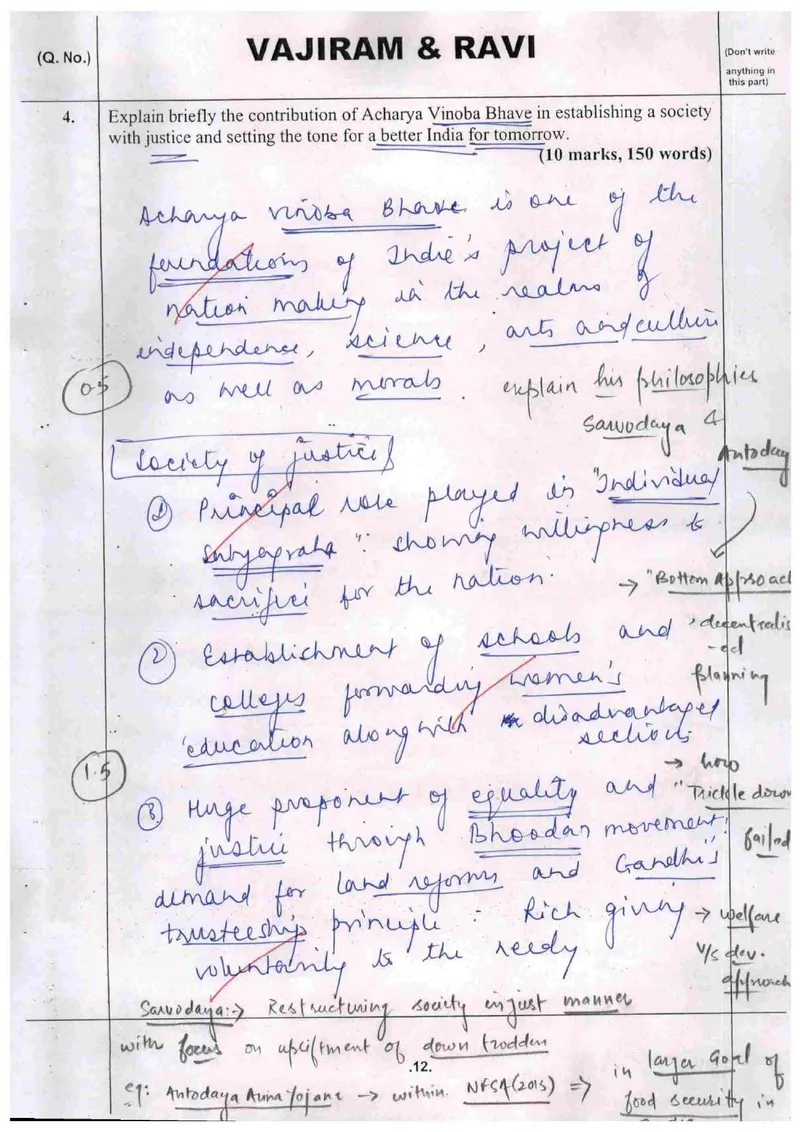
- ▸Marks were shed where the precise demand slipped — Q4 (Vinoba Bhave) drew 'Misunderstood the demand of Question' and Q5(b) 'missed demand of 2nd part'.
What to learn from this copy
- ★For environmental ethics Q2(a) she did not stop at one example — she stacked grassroots, named, verifiable cases: the 'pipal' tree worshipped since Harappan times, Telangana's Yadadri Tree Model, Padma Shri Tulasi Gowda, the Assam 'elephant doctor', and the Idu Mishmi tribe treating tigers as kin; the evaluator's note 'good articulation with examples' is the payoff. Lesson: in Ethics, convert every abstract value into a cluster of specific named real-world instances (people, schemes, tribes) rather than generic statements — that density is what drew the 'Very Good' on Conceptual Clarity & Content.
- ★Every answer opens with a deliberate 'anchor' in a short underlined intro — a quote, a constitutional article, or a named personality (e.g. Sardar Patel's 'steel frame' for Q6(a), Article 15 for Q5(a), Marcus Aurelius for Q5(b)) — and this consistency earned 'Very Good' on Language & Articulation. Lesson: build one repeatable opening template (quote/article/personality + underlined sub-headings like 'Importance', 'Society of justice') so every answer reads structured under time pressure.
- ★She picks quotes that actually fit the argument, not decoration: Marcus Aurelius's 'Masters of the world have been masters of their mind' for emotional intelligence in administration (Q5(b)) drew an explicit 'good analogy' from the evaluator. Lesson: a quote scores only when it maps tightly onto the question's demand — choose for relevance to the specific point, not for fame.
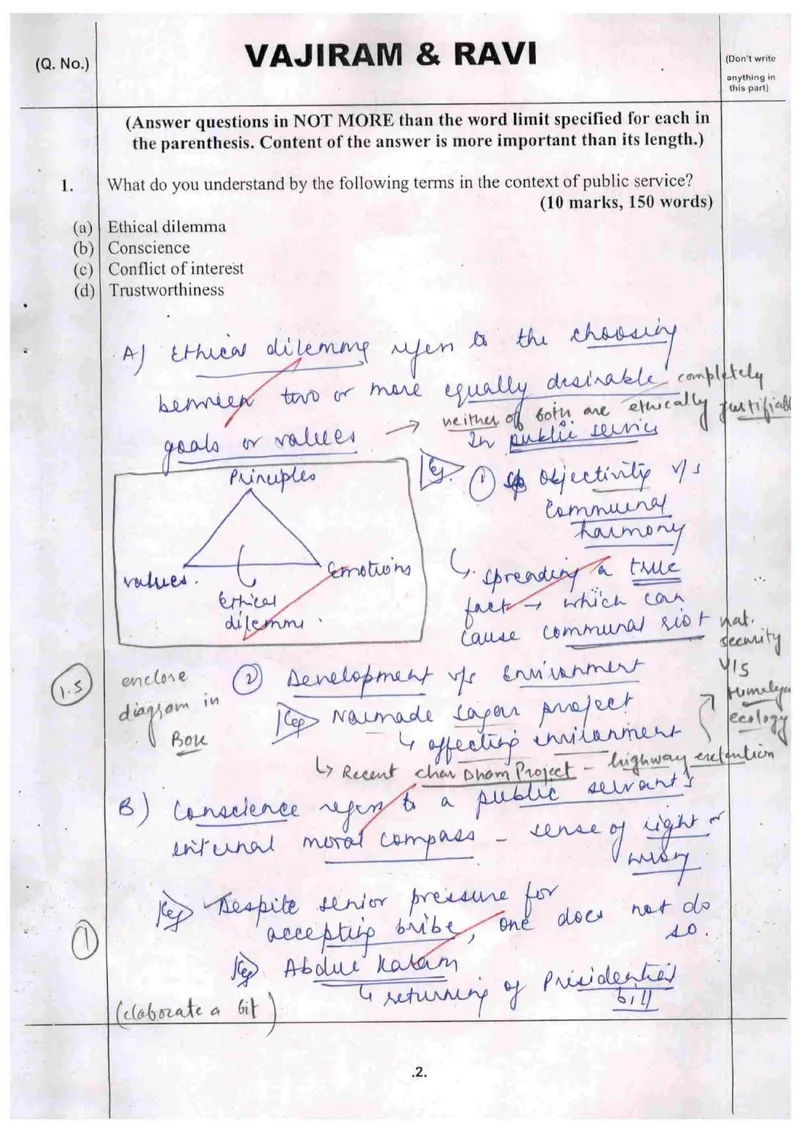
- ★She compresses arguments into labelled visuals — a boxed triangle of Principles + Values + Emotions converging on 'ethical dilemma' (Q1), a two-column LAWS vs ETHICS table (Q2a), and a flow diagram from 'academic development affected' to girl-child dropout/child labour (Q3b). Lesson: use diagrams to carry the structure of definitions and comparisons; note the examiner's 'enclose diagram in a box' — always frame diagrams cleanly so they read as deliberate, not scribbled.
- ★Where she lost marks the cause was named precisely: on Q4 she drifted from the demand ('misunderstood the demand of Question', only 5/10) and even claimed Vinoba Bhave laid the foundation for India's space and nuclear programme — a stretch the evaluator flagged with '??'; Q5(b) lost marks for 'missed demand of 2nd part'. Lesson: re-read what the question actually asks (especially each sub-part) and never inflate a personality's contribution with unverifiable claims — examiners catch the overreach and the off-demand content both.
Questions attempted: Public-service terms explained: (a) ethical dilemma (b) conscience (c) conflict of interest (d) trustworthiness; Environmental ethics; how laws and ethics differ; Whether the utilitarian approach can be the foundation of morals and legislation, and 6 more below.
Questions attempted in this booklet (9)+
- Q1.Public-service terms explained: (a) ethical dilemma (b) conscience (c) conflict of interest (d) trustworthiness — 5/10
- Q2(a).Environmental ethics; how laws and ethics differ — 5/10
- Q2(b).Whether the utilitarian approach can be the foundation of morals and legislation — 4.5/10
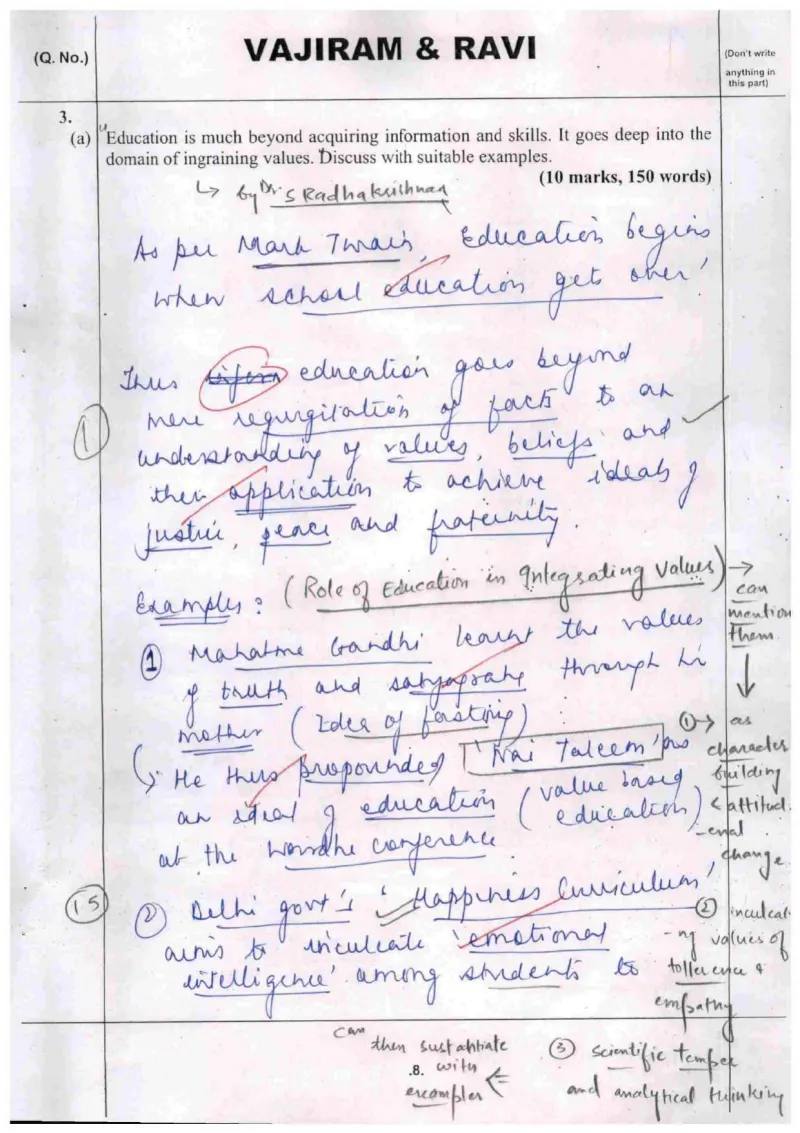
- Q3(a).Education goes beyond information/skills into ingraining values — 4.5/10
- Q3(b).Pandemic school closure hampering both academic and moral development of pupils — 3/10
- Q4.Contribution of Acharya Vinoba Bhave to a society with justice / a better India — 5/10
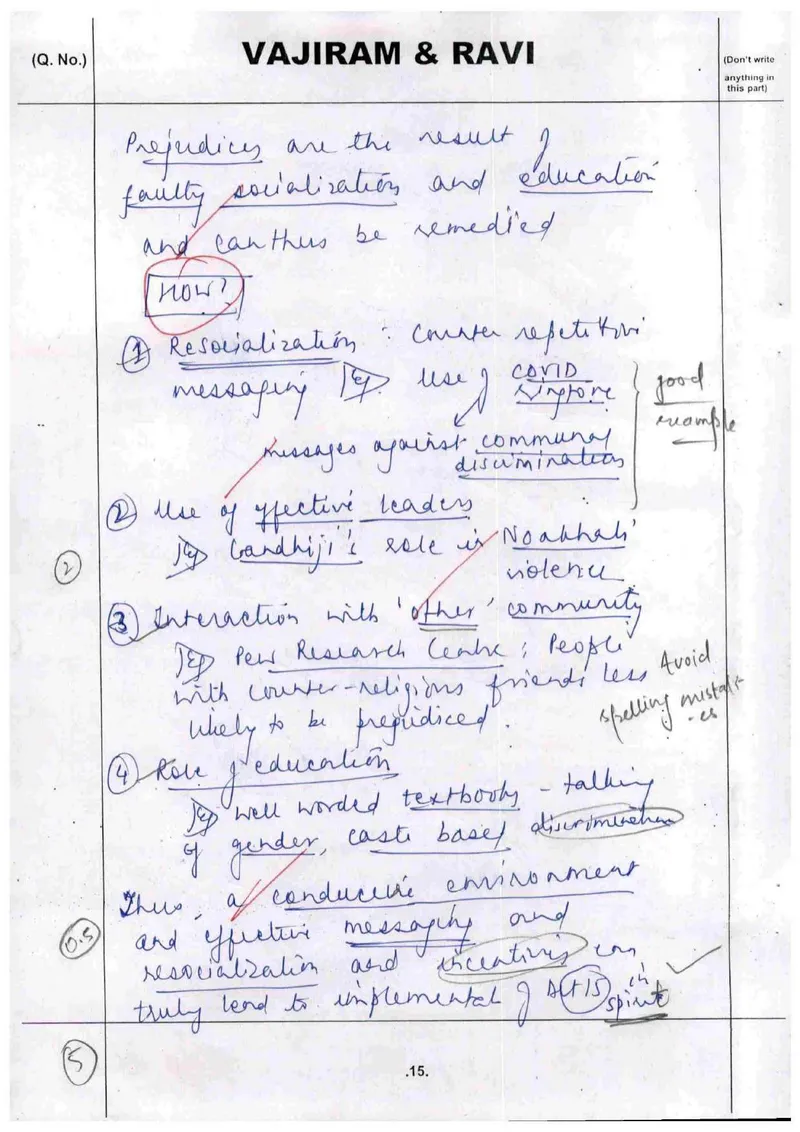
- Q5(a).Difference between prejudice and discrimination; ways to overcome prejudice — 5/10
- Q5(b).Application of emotional intelligence to administration; how EI can be enhanced — 4/10
- Q6(a).Civil servants as custodians of public resources — importance of holistic competence — 4.5/10
Examples, data & evidence used
- Q1: Development v/s Environment framed via Narmada Sagar dam and the recent Char Dham highway project; Dr A.P.J. Abdul Kalam returning the President's bill (conscience); objectivity v/s communal harmony in national security
- Q2(a): the 'pipal' tree worshipped since Harappan times; Yadadri Tree Model of urban forestry (Telangana); Tulasi Gowda (Padma Shri); the 'elephant doctor' of Assam (Padma Shri); Idu Mishmi tribe of Arunachal treating tigers as kin; abortion laws (context-dependence); the Holocaust in Germany (legal but unethical); affirmative-action laws
- Q2(b): Jeremy Bentham and James Mill (utilitarianism); the Trolley problem; Kantian ethics / torture to extract information (means ignored); dam-displacement; Gandhiji on matters of conscience; Plato's virtue ethics
- Q3(a): statement attributed in margin to Dr S. Radhakrishnan; Gandhi's 'Nai Taleem' (Wardha conference); Delhi government's 'Happiness Curriculum'; Tagore's Vishwa Bharati / Shanti Niketan ('universal citizen'); Japanese 'Chi-Toku-Tai' (knowledge-body-mindfulness); NEP 2020
- Q3(b): Azim Premji Institute report (>2/3rd children); ASER (only ~50% online access); UNICEF (2021); girl-child dropout/early marriage and boys into child labour; mid-day meal and uniform dress glossing over class/caste; Leonardo da Vinci as 'multifaceted' human
- Q4: Acharya Vinoba Bhave — Individual Satyagraha, Bhoodan movement, Gandhi's trusteeship, Sarvodaya and Antyodaya, Antyodaya Anna Yojana within NFSA (2013); claim that he laid the foundation for India's space and nuclear programme with Homi Bhabha / ISRO & BARC (evaluator flagged this with '??')
- Q5(a): Article 15 of the Constitution; stereotype illustrations ('women inherently weak', 'Bania' community, 'Blacks'); apartheid in South Africa; untouchability of Dalits; non-employment of women in the army; Gandhiji's role in Noakhali; Pew Research Centre (counter-religious friends less prejudiced); COVID-warrior anti-communal messaging
- Q5(b): Chetan Singh Rathore (IPS) using the national anthem to control a crowd; an IAS officer in Bijapur (legible as 'Tambeli Ayyaj') building a hospital for adivasis in a Maoist area; the Naga–Kuki conflict; the 2008 nuclear deal (diplomacy); Sanjukta Parashar (Bodo militancy); SP K. Sinha carrying a dead body for 2 km (empathy); Mo Sarkar initiative (Odisha)
- Q6(a): Sardar Patel calling the bureaucracy the 'steel frame'; RTI Act (evidence-based policy); DoPT's 4 E's of holistic competence (Ethos, Ethics, Equity, Effectiveness); 2nd ARC recommendations; 360-degree performance management; Mission Karmayogi
Quotes the candidate used
- Marcus Aurelius (Stoic), Q5(b): 'Masters of the world have been masters of their mind' — evaluator wrote 'good analogy' beside it
- Mark Twain, Q3(a): 'Education begins when school education gets over'
- Plato, Q3(a): 'Information must be passed through the sieve of wisdom to become knowledge'
- Gandhiji, Q2(b) (paraphrased): in matters of conscience, the law of the majority (utilitarianism) has no place
- Q5(b) used 'War happens when language fails' with no author attribution visible (reported unattributed)
How it’s written: Highly consistent template across every answer: a short underlined intro that opens with an anchor — a quote, a constitutional article, or a named personality (e.g., Sardar Patel's 'steel frame', Article 15, Marcus Aurelius) — followed by clearly labelled, underlined sub-headings ('Importance', 'Society of justice',…
Diagrams & visuals: Q1: boxed triangle diagram — Principles + Values + Emotions converging to 'Ethical dilemma' (evaluator margin: 'enclose diagram in Box'); Q2(a): two-column comparison table, LAWS vs ETHICS; Q3(b): branch/flow diagram from 'Academic development affected' to girl-child dropout, child labour, inaccessibility to online education, forgotten learning; Q5(a): small flow — negative attitude breaking into Behavioural / Affective / Cognitive aspects; Q6(a): boxed triangle (Resources–Civil servants–Information–Trust) plus bracketed flow diagrams for 'Areas of competence' and DoPT's '4 E's'; No maps were used anywhere in the scanned pages
Evaluator: Fully evaluated: 111/250 on the Vajiram & Ravi GS-IV ethics full test (evaluated 25 Dec 2021). Parameter ratings — Language & Articulation, Conceptual Clarity & Content and Number of Questions Attempted all “Very Good”; Structure & Presentation “Good”. Sample examiner notes: “enclose diagram in a box”, “good articulation with examples”, and on Q4 (Vinoba Bhave) “misunderstood the demand of the question”.
The scan holds the answers through Q6(a); the cover marks table records the full 111/250 even though the later answer sheets aren’t in this file.