
Shagun Kaushal — Vajiram & Ravi Essay copy
EssayPDF · 27.9 MB
What’s inside this copy
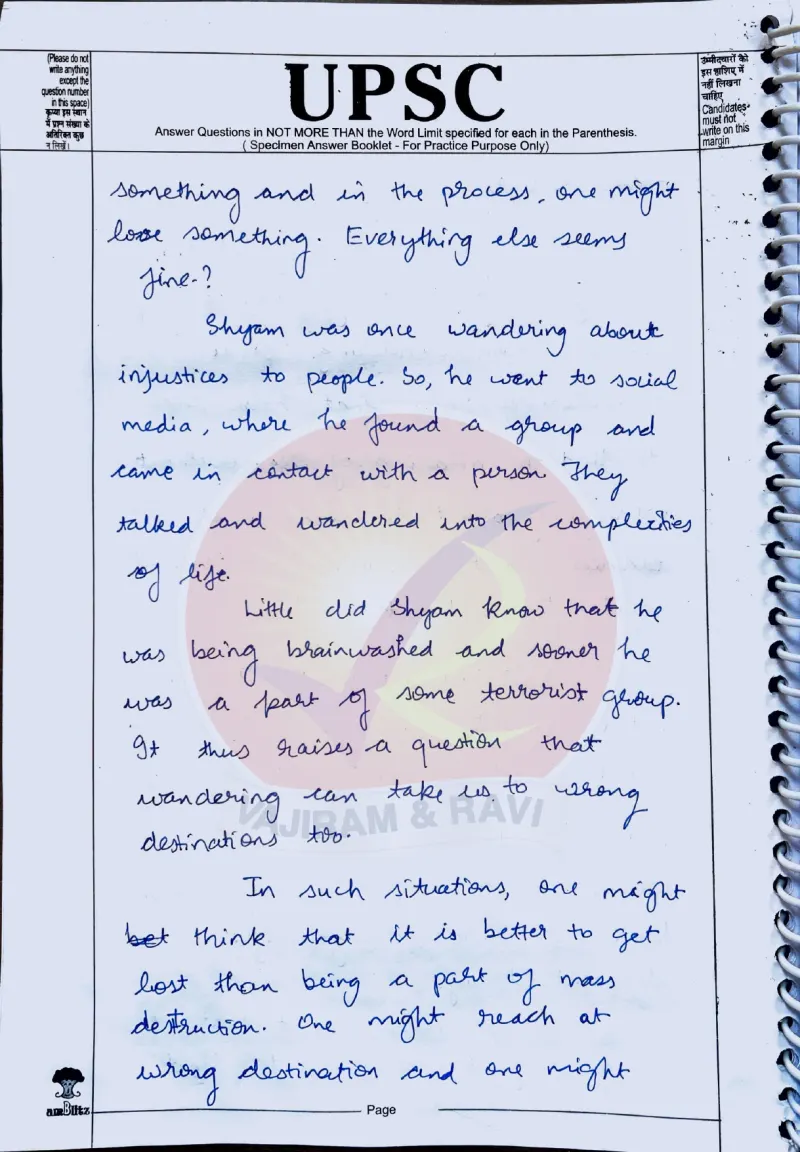
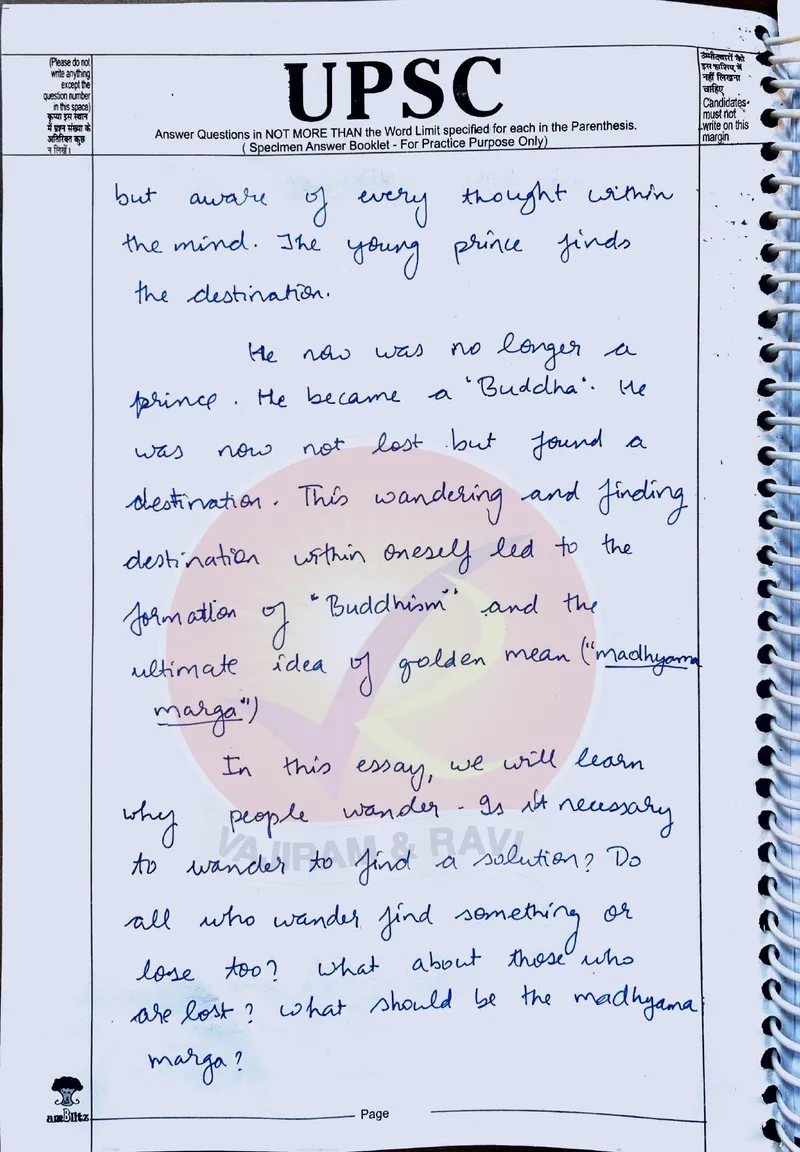
- ▸Opens Essay 1 by retelling Buddha's renunciation — the prince who 'was now not lost but found a destination', landing the Madhyama marga / golden-mean thesis
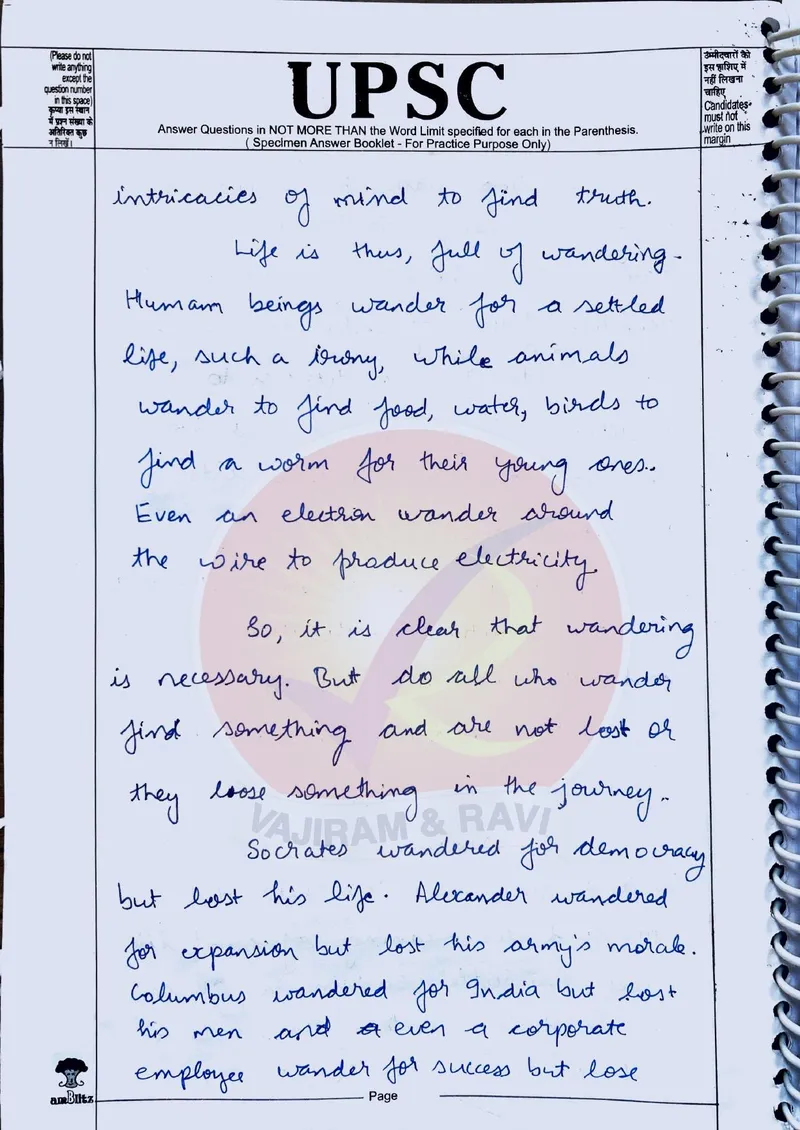
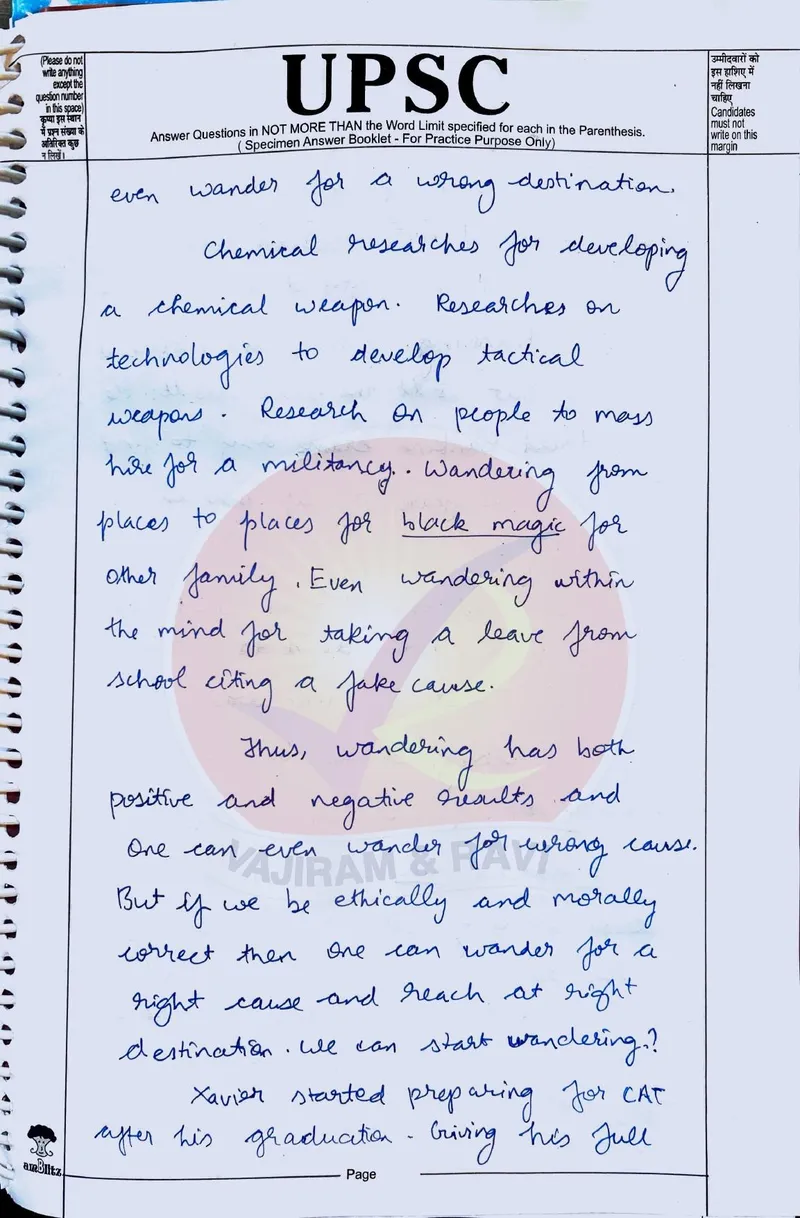
- ▸Builds a ladder of wanderers who paid a price: Socrates lost his life, Alexander his army's morale, Columbus sought India — turning the prompt into a cost-benefit meditation
- ▸Uses living examples well: Kohli's retirement and Djokovic conceding to Alcaraz & Sinner illustrate 'knowing when to stop wandering and reroute'
- ▸Essay 2 is a tight cause-and-effect history arc: UK need-turns-to-greed → colonisation → World Wars → Pax Britannica to Pax Americana, framed with Hegemonic Stability Theory and Modelski's '100-year rule'
- ▸Shows nuance by arguing the counter-case — ruler-biased chronicles and human cognitive bias mean history can entrench status-quo conservatism
- ▸Lands a modern, India-positive conclusion: learn from the colonial past and the 1991 crisis but 'modify as per situations' using dialectics, reasoning and data-analytics — strategic autonomy, fastest-growing economy
What to learn from this copy
- ★Opens Essay 1 not with a definition but with Buddha's renunciation narrative, resolving it in one pivot line - the prince 'was now not lost but found a destination' - which directly births the Madhyama marga / golden-mean thesis -> Use a story whose ending IS your thesis: the anecdote should mechanically deliver your central argument, not just decorate the intro.
- ★Builds a deliberate 'ladder of wanderers who paid a price' - Socrates lost his life, Alexander lost his army's morale, Columbus was seeking India - turning 'Not all who wander are lost' into an explicit cost-benefit meditation rather than a one-sided celebration -> Stack examples that complicate the prompt; a graded series showing both gains and costs proves you have weighed the statement instead of merely agreeing with it.
- ★Reaches for contemporary, verifiable examples on a philosophical topic - Virat Kohli's retirement and Djokovic conceding to young Alcaraz & Sinner - to illustrate 'knowing when to stop wandering and reroute' -> Anchor abstract themes in current, checkable events; living examples signal awareness and freshness where most candidates default to the same historical stock.
- ★Structures Essay 2 as a single tight cause-and-effect arc (UK need-turns-to-greed -> colonisation -> World Wars -> Pax Britannica to Pax Americana) and names the academic scaffolding - Hegemonic Stability Theory and Modelski's '100-year rule' -> Drive a history/IR essay with one causal spine and label it with a recognised framework; the named theory raises analytical altitude above mere event-listing.
- ★Refuses a single verdict by arguing the counter-case - ruler-biased chronicles and human cognitive bias mean history can entrench status-quo conservatism - before landing an India-positive close (learn from the colonial past and 1991 crisis but 'modify as per situations' using dialectics and data-analytics) -> Build in a genuine counter-argument, then resolve it forward-looking; the dialectical turn plus a constructive, nation-grounded conclusion is what separates a balanced essay from a one-note one.
Questions attempted: Not all who wander are lost; The only thing we learn from history is that we learn nothing from history.
Questions attempted in this booklet (2)+
- Essay 1.Not all who wander are lost
- Essay 2.The only thing we learn from history is that we learn nothing from history
Examples, data & evidence used
- Gautama Buddha — the young prince leaving home, penance/fasting, finding the 'golden mean' (Madhyama marga) and founding Buddhism
- India's founding fathers / Constituent Assembly — partition, drafting the Constitution, world's largest surviving democracy
- Plato — search for the just state; theory of the Philosopher King
- Aristotle — eudaimonia (the good life); law given 'without passion'
- Socrates — wandered for democracy but lost his life
- Alexander — wandered for expansion but lost his army's morale
- Columbus — wandered seeking India
- Gandhiji — travelled across India to mobilise masses for the freedom struggle
- Bhagavad Gita / Shri Krishna — act without attachment to results (Nishkama Karma)
- Virat Kohli (retirement) and Novak Djokovic vs young blood Alcaraz & Sinner — knowing when to stop
- Robert Frost's 'The Road Not Taken' — two roads diverging, taking the road less travelled
- Sun Tzu — 'learn thy enemy'
- Kautilya — building the Mauryan Empire
- Pax Britannica to Pax Americana; USA's break from Britain; COVID-19 as a chance for global collaboration
Quotes the candidate used
- Essay topic / leitmotif: 'Not all who wander are lost' (J.R.R. Tolkien — author not named in copy)
- Essay topic: 'The only thing we learn from history is that we learn nothing from history' (Hegel — author not named in copy)
- 'A ship in harbour is safe, but that is not what it is made for' (John A. Shedd — author not named in copy)
- 'History repeats itself, first as a tragedy, second as a farce' (Marx — author not named in copy)
- 'Learn thy enemy' — attributed in copy to Sun Tzu
- Bhagavad Gita / Shri Krishna paraphrase — work without expecting results (Krishna/Gita named in copy)
- Paraphrase of Frost's 'The Road Not Taken' — 'I took the road less travelled and it changed all' (poet not named)
How it’s written: Both essays follow the same template: a narrative/anecdotal hook (Buddha's renunciation for E1; UK Industrial Revolution prosperity for E2), an explicit thesis-as-roadmap paragraph closing the intro (a string of guiding questions: 'why people wander... Do all who wander find something or lose too?... what should be…
Diagrams & visuals: None visible — both essays are continuous prose with no diagrams, flowcharts, tables or maps; only the student's own underlining of keywords/phrases for emphasis
Evaluator: No examiner marks or comments are filled in on this copy.