Kanishak Kataria Answer Copy — AIR 1, UPSC CSE 2018
Kanishak Kataria secured All India Rank 1 in UPSC CSE 2018.
Five of his mains test-series answer booklets are preserved in this archive.
We read 3 of these booklets page by page — below is exactly what’s inside: the questions Kanishak attempted, the examples and quotations used, and how each answer was structured. Every copy is a free PDF.
AIR 1 · CSE 20184 free PDFsUpdated 29 Jun 2026
Inside Kanishak Kataria’s answer copies
Kanishak Kataria — answer booklet 1
GS Mains (Polity, Governance & IR)PDF · 6.5 MB
What’s inside this copy
▸Unevaluated VisionIAS GS copy (Test Code 1067, Jaipur, 22/8/2018): every marks field and the examiner-comments page are blank — no scores or remarks anywhere.
▸Heavy use of boxed sub-headings with branching arrows (mind-map style) — the NITI Aayog (Q3) and NCM (Q14) answers are written as flow diagrams rather than prose.
▸Answers the BRICS vs IBSA question (Q10) as a clean two-column comparison instead of paragraphs.
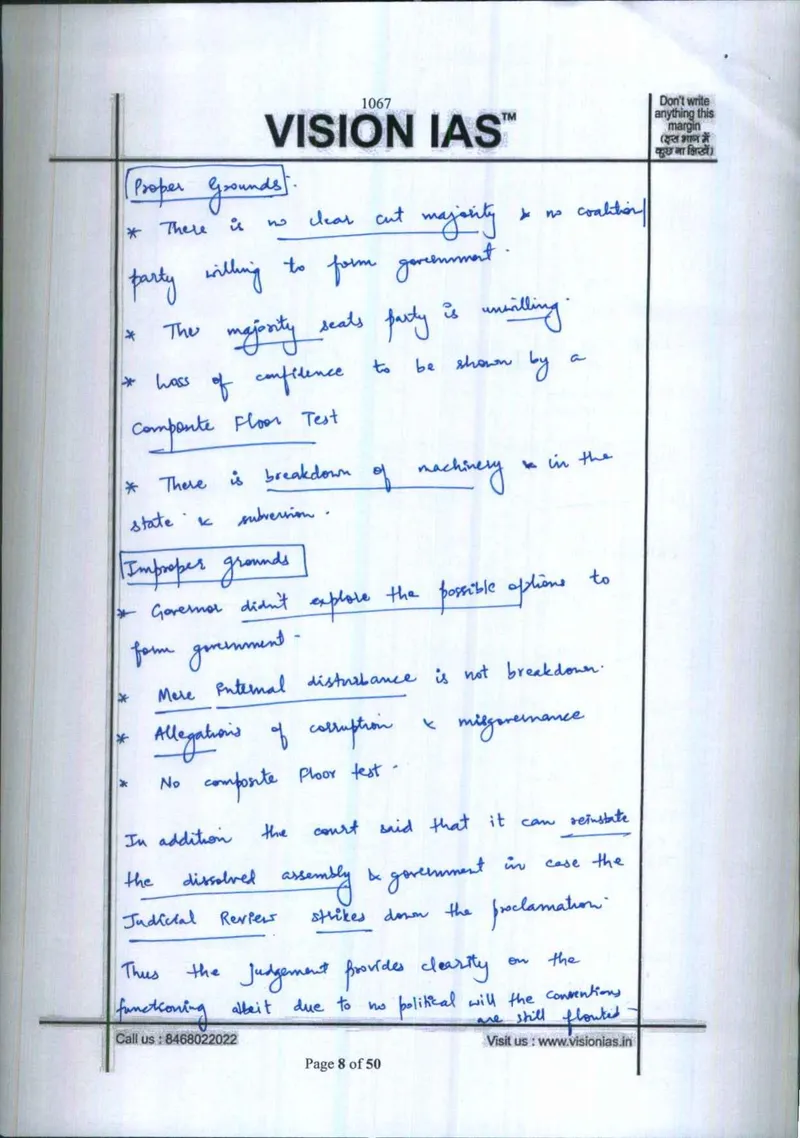
▸Opens analytical answers with a hook: quotes Ambedkar's 'dead letter' line on Article 356 (Q4) and frames Strategic Autonomy via PM Modi's Shangri-La Dialogue (Q9).
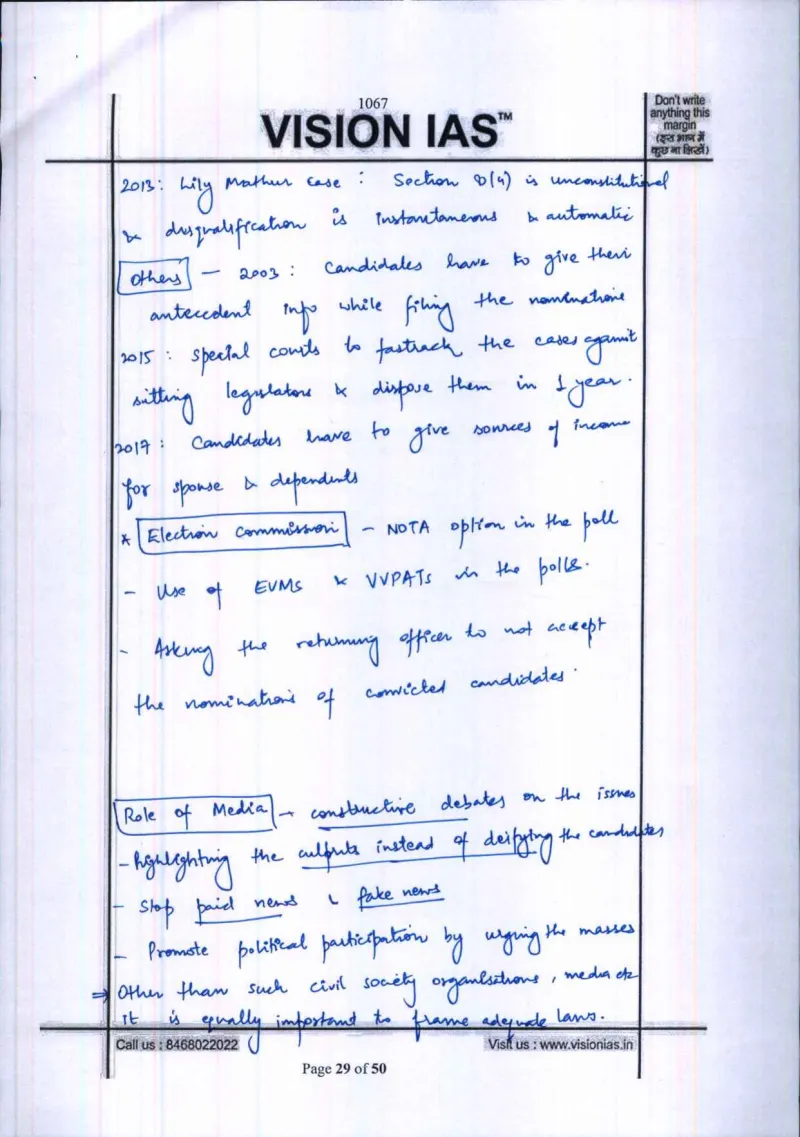
▸Polity answers are anchored in specific case law and provisions — S.R. Bommai (1994), Lily Thomas (2013), Section 8(4) RPA 1951, Articles 32/226/129/215/136.
▸IR answers are example-dense — STA-1 status, Malabar & Vajra Prahar exercises, S-400 Triumf, H-1B and WTO solar/food-subsidy disputes (Q19); even coins an 'ITIT = IITT' wordplay for India-Israel ties (Q20).
What to learn from this copy
★Kanishak opens analytical answers with a sharp hook instead of a textbook definition: Q4 (Article 356/Bommai) begins by quoting Ambedkar's Constituent Assembly line that Article 356 should remain a 'dead letter', and Q9 frames Strategic Autonomy through PM Modi's Shangri-La Dialogue. -> Lead a 'comment/critically analyse' answer with a one-line authoritative quote or a topical real-world anchor so the very first sentence signals depth and sets up your argument.
★He anchors polity answers in named case law and exact provisions rather than vague principles: S.R. Bommai (1994) with the composite floor test for Q4, Lily Thomas (2013) and Section 8(4) of RPA 1951 for criminalisation of politics (Q13), and writs tied to Articles 32/226/129/215/136. -> For polity questions, cite the specific landmark judgment + article/section by number; this precision is what separates a top-scoring constitutional answer from a generic one.
★He varies the answer format to fit the demand: BRICS vs IBSA (Q10) is written as a clean two-column side-by-side comparison rather than paragraphs, and NITI Aayog (Q3) and the NCM mandate (Q14) are rendered as boxed mind-map/flow diagrams with branching arrows instead of prose. -> When a question is explicitly comparative or asks for challenges/measures, switch to a two-column or boxed-flow layout — it saves time, signals structure to the examiner, and is ideal for short 10-markers.
★His IR answers are deliberately example-dense and current: Q19 (India-US) packs in STA-1 status, Malabar and Vajra Prahar exercises, the S-400 deal, and H-1B and WTO solar/food-subsidy disputes, showing both cooperation and divergence with concrete instances. -> Build IR 'examine with recent developments' answers from a stock of named exercises, agreements, and live disputes so each claim is backed by a specific, datable fact rather than generalities.
★He uses memorable, self-coined framing devices to make a point stick — for Q20 (India-Israel) he coins the 'ITIT = IITT' wordplay to capture the relationship. -> A crisp original mnemonic or phrasing can give an otherwise standard answer a distinctive, examiner-memorable edge, as long as it genuinely compresses your argument rather than being decoration.
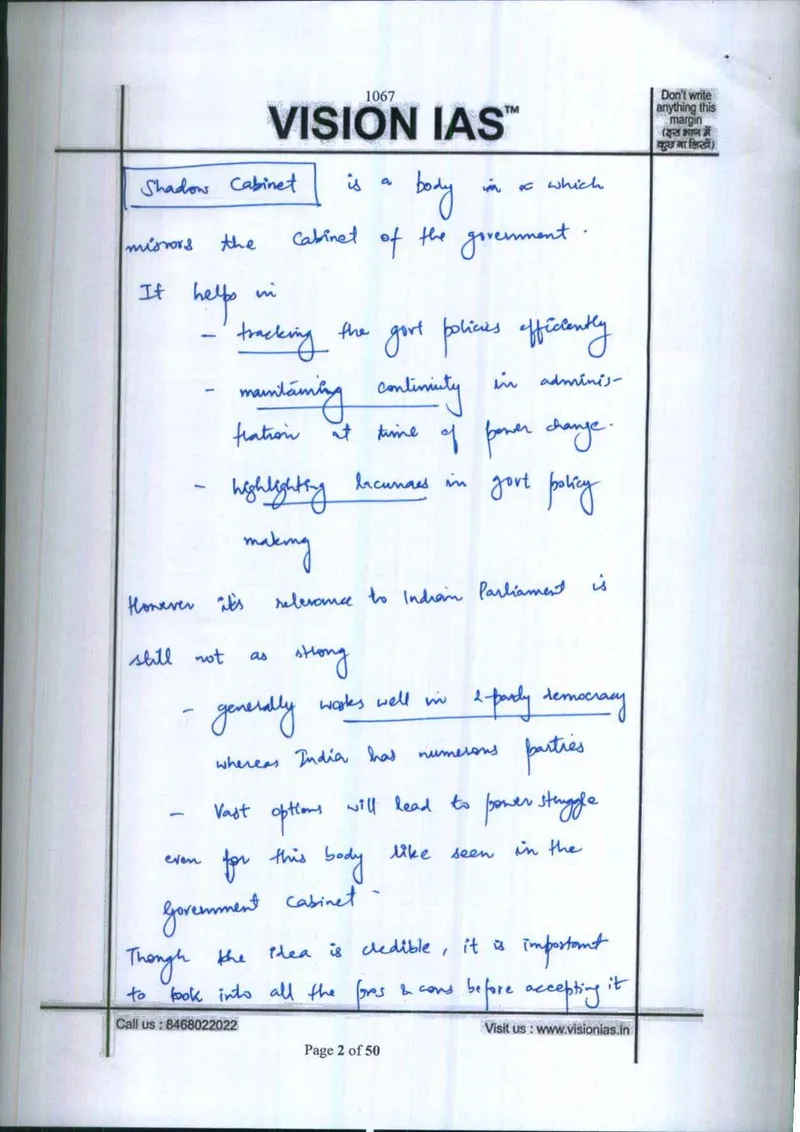
Questions attempted: Role of opposition in a democracy like India; whether Parliament can benefit from a shadow cabinet; 'Where there is a right, there is a remedy' — nature and significance of writs in India with examples; Objectives of NITI Aayog, its performance since inception, measures to make it more effective, and 17 more below.
Questions attempted in this booklet (20)+
1.Role of opposition in a democracy like India; whether Parliament can benefit from a shadow cabinet
2.'Where there is a right, there is a remedy' — nature and significance of writs in India with examples
3.Objectives of NITI Aayog, its performance since inception, measures to make it more effective
4.Article 356, failure of political conventions, and the clarity provided by the S.R. Bommai case — comment
5.Press freedom and good governance are not mutually exclusive — comment
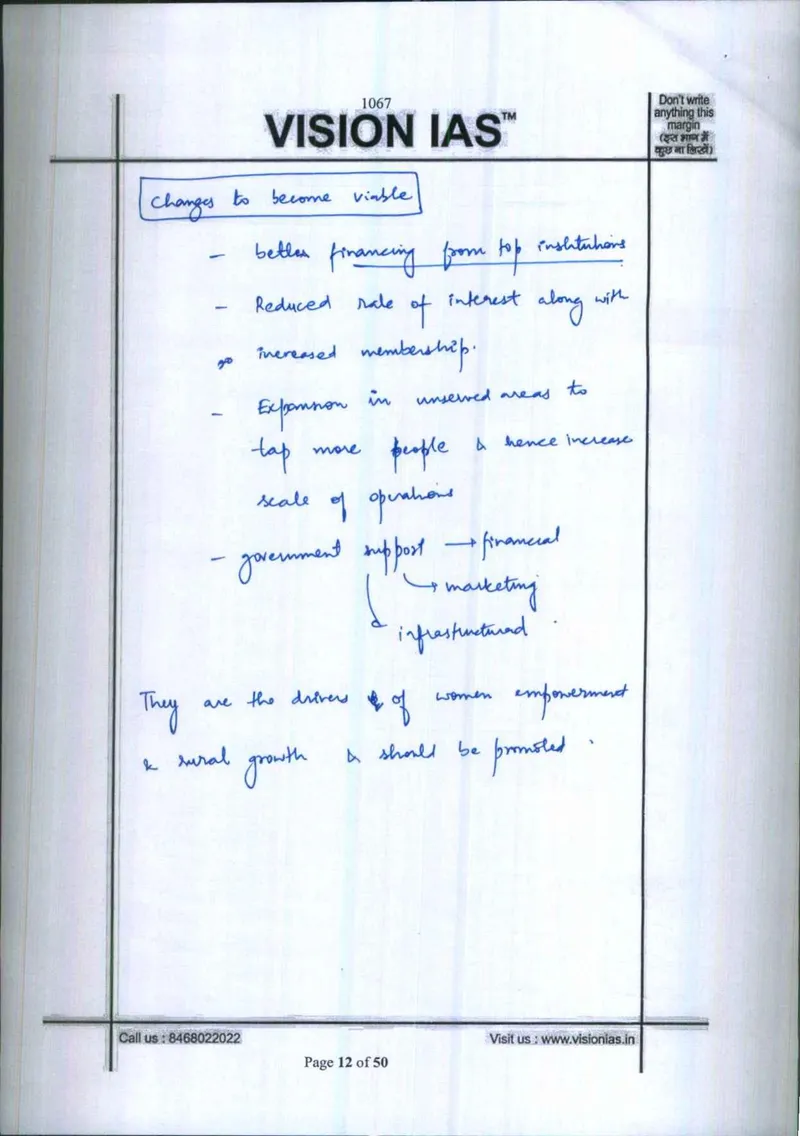
6.SHGs and financial inclusion; evolving into viable business enterprises; rural growth & women's entrepreneurship
7.Neglect of state higher-education institutions vs central/autonomous ones; significance of RUSA
8.Role of PRIs in political empowerment of women; measures to raise their participation
9.What is Strategic Autonomy? Critical examination of its elements in India's contemporary foreign policy
10.IBSA vs BRICS as examples of India's multialignment; differences in orientation; relevance for India
11.Modes of Alternate Dispute Redressal (ADR) in India; problems; suggestions to improve effectiveness
12.Contempt of court power — needed but due for a relook; critically analyse
13.Criminalisation of politics; role of Supreme Court & Election Commission; positive role of media
14.Mandate of National Commission for Minorities (NCM); challenges; measures (answered very briefly as a flow diagram)
15.Lateral entry into senior bureaucracy as a small step in higher civil-service reforms; analyse
16.'Transformation of Aspirational Districts' programme — contours and novel strategy (answered briefly)
17.India's performance on health-related MDGs; relevant SDGs; India's capacity to meet them
18.Rights under Forest Rights Act 2006; gaps in community forest (resource) rights implementation; measures
19.India-US ties: progress alongside significant divergences; examine with recent developments
20.India-Israel: structural security differences, worldviews and absence of shared enemies limiting strategic rapprochement; critically discuss
Examples, data & evidence used
Articles 32 and 226; Part III Fundamental Rights; Article 32 as Right to Constitutional Remedies (Q2)
Writs: Habeas Corpus, Mandamus, Certiorari, Prohibition, Quo Warranto (Q2)
Planning Commission, NITI Aayog set up by executive order; Atal Tinkering Labs (ATL); SATH; Aspirational District Programme; 3-year agenda (Q3)
Dr. B.R. Ambedkar's Constituent Assembly remark that Article 356 should remain a 'dead letter'; S.R. Bommai judgement 1994; President's Rule; Babri Masjid incident; composite floor test (Q4)
SEWA; Lijjat Papad as SHG success stories (Q6)
RUSA (Rashtriya Uchchatar Shiksha Abhiyan); public expenditure on education noted as under ~2% (Q7)
73rd Constitutional Amendment Act; Articles 243-243O; one-third reservation for women in PRIs; 108th Amendment Bill (women's reservation in legislatures/Parliament) (Q8)
Strategic Autonomy; PM Modi's Shangri-La Dialogue; Belt & Road Initiative; South Asia Satellite; Quad; S-400; Iran oil imports; WTO (Q9)
BRICS (Brazil, Russia, India, China, South Africa) vs IBSA (India, Brazil, South Africa) (Q10)
Articles 129 and 215 (Courts of Record); Contempt of Courts Act; civil vs criminal contempt; contempt removed in UK; truth accepted as a defence (Q12)
First-Past-The-Post system; Section 8(4) RPA 1951; Lily Thomas case 2013; Ramesh Dalal case; affidavit-disclosure judgments; NOTA; EVMs and VVPATs; special courts (2015) to fast-track legislators' cases (Q13)
National Commission for Minorities (NCM) (Q14)
Lateral entry; 2nd ARC recommendations; VRS for non-performers; citizen charters; 'Maximum Governance, Minimum Government'; blockchain and Artificial Intelligence as policy complexities (Q15)
Quotes the candidate used
Article 356 should remain a 'dead letter' — attributed to Dr. B.R. Ambedkar (Constituent Assembly), used to open the Q4 Bommai answer
'Maximum Governance, Minimum Government' — government slogan referenced in the Q15 lateral-entry answer
How it’s written: Consistent template across answers: a short contextual/definitional intro (e.g., Q3 'NITI Aayog was set up by executive order to replace the Planning Commission'; Q9 framed via PM Modi's Shangri-La Dialogue; Q4 opens with the Ambedkar 'dead letter' line; Q17 'MDGs were selected in year 2000'). Body is built around b…
Diagrams & visuals: Flow/mind-map diagrams with boxed labels and branching arrows: Q3 NITI Aayog ('Reforms' box branching to four points), Q14 NCM ('Challenges' and 'Measures' boxes each fanning out to arrowed points), and arrow-led 'Problems' list in Q11 ADR; Two-column comparison layout: Q10 BRICS (left) vs IBSA (right), bulleted side by side — functions as a comparison table; Extensive underlining of keywords/headings for emphasis throughout; no maps drawn (subject matter is polity/governance/IR)
Evaluator: No examiner marks or comments are filled in on this copy.
▸Every answer follows the same disciplined skeleton: a 1-2 line context/definition intro, then boxed ALL-CAPS sub-headings (SUCCESSES/ISSUES/CHALLENGES/MEASURES/WAY FORWARD) with crisp bullets, closing on a one-line normative verdict
▸Answers are data-anchored: Parliament sittings (~66 days/yr, ~6% budget discussed), ADR's ~69% unaccounted poll funds, ~70% out-of-pocket health spend and 1.2%-of-GDP public health outlay are dropped in as evidence
▸Dense, accurate constitutional-article recall is threaded through the polity answers (Art 280/275/131 for Finance Commission; Art 50/13/142/72 for judiciary; Art 16(4A), 326, 39 for the Constitution-synthesis answer)
▸Case law and committees are named precisely — Nagaraj, Indira Gandhi vs Raj Narain, Vineet Narain, Vishaka; NCRWC, Venkatachaliah Commission, NK Singh's 15th FC
▸'Critically discuss' prompts are handled as a genuine two-sided ledger (benefits vs concerns) before a balanced verdict — seen on electoral bonds, PoCA amendments, reservation-in-promotion and Ayushman Bharat
▸Memorable framing lines do the conclusion's work: 'Accountability is the soul of democracy', FC as the 'Balancing Wheel of Indian Federalism', and a coined 'Organic Federalism' as the way forward
What to learn from this copy
★He turns soft polity claims into hard evidence: the Parliament answer drops 'sittings ~66 days/yr, budget discussed only ~6% / ~35 hours', the electoral-bond answer cites ADR's '~69% unaccounted funds, corporate funding ~88%', and the Ayushman answer uses '~70% out-of-pocket health spend, 1.2%-of-GDP public health outlay'. -> Memorise 2-3 exact statistics per high-frequency topic so generic assertions ('Parliament is in decline', 'health funding is low') land as proven facts, not opinion.
★His conclusions are one coined or borrowed phrase that does the work of a paragraph: he ends the Parliament answer on 'Accountability is the soul of democracy', labels the Finance Commission the 'Balancing Wheel of Indian Federalism', and offers a self-coined 'Organic Federalism' as the way forward in Q14. -> Bank a short, memorable normative line per theme to close on a verdict the examiner remembers, rather than trailing off after the last bullet.
★Constitutional recall is precise and clustered to the demand, not name-dropped: Art 280/275/131 for the Finance Commission, Art 50/13/142/72 for the independent judiciary, and Art 16(4A)/326/39 for the Constitution-synthesis answer. -> When a polity question has clear constitutional hooks, thread the exact relevant articles into the body so the answer reads as legally literate, not bookish.
★He pins arguments to named cases and committees instead of vague 'experts say': Nagaraj on reservation-in-promotion, Indira Gandhi vs Raj Narain and Vineet Narain on the judiciary, Vishaka, plus NCRWC, the Venkatachaliah Commission and NK Singh's 15th FC. -> Attach a specific case or committee to each major contention, especially for 'critically discuss' polity questions, to signal source-grounded depth.
★'Critically discuss' prompts are answered as a genuine two-sided ledger before a balanced verdict, applied consistently to electoral bonds, PoCA amendments, reservation-in-promotion and Ayushman Bharat. -> Treat the directive literally: build explicit benefits-vs-concerns sides (e.g. boxed sub-headings) and only then judge, rather than arguing one way.
★Every answer runs the same disciplined skeleton: a 1-2 line context/definition intro, then boxed ALL-CAPS sub-headings (SUCCESSES/ISSUES/CHALLENGES/MEASURES/WAY FORWARD) with crisp bullets, closing on a one-line verdict; the judiciary answer (p.28) even branches a boxed 'CHALLENGES' via arrows into 'Judicial Overreach', 'overlap of powers' and 'Executive overreach by Judiciary'. -> Pre-fix a repeatable structural template so under time pressure you produce a scannable, evaluator-friendly answer every time without re-inventing layout.
Questions attempted: Steady decline in efficacy of Parliament as an institution of accountability — analyse + measures; Panchayati Raj Institutions as both remarkable success and staggering failure; CAG as conscience-keeper and watchdog; making auditing more effective, and 15 more below.
Questions attempted in this booklet (18)+
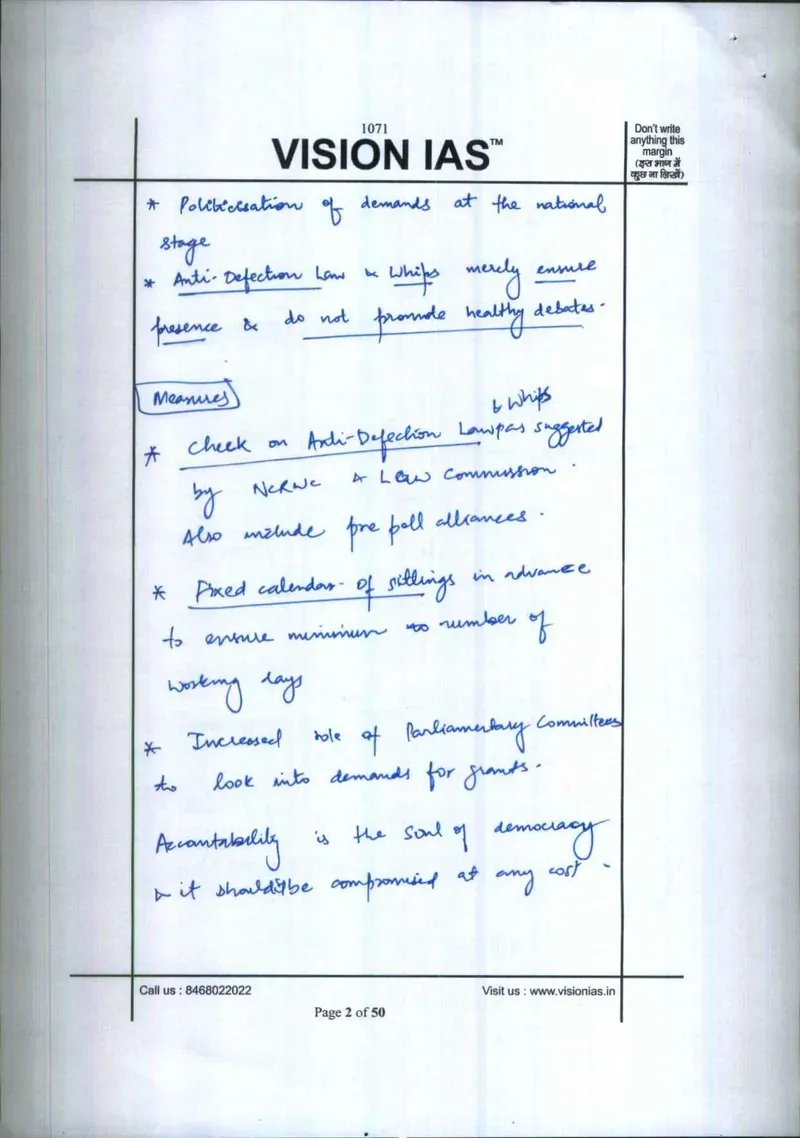
1.Steady decline in efficacy of Parliament as an institution of accountability — analyse + measures
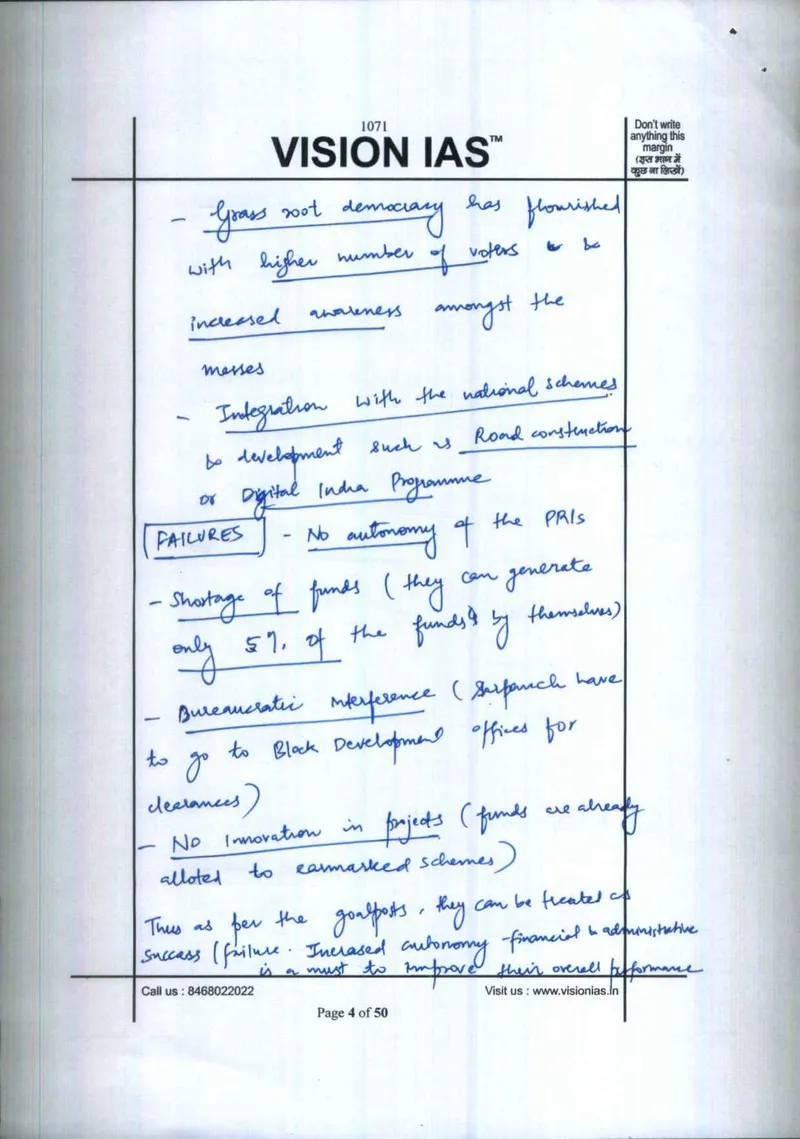
2.Panchayati Raj Institutions as both remarkable success and staggering failure
3.CAG as conscience-keeper and watchdog; making auditing more effective
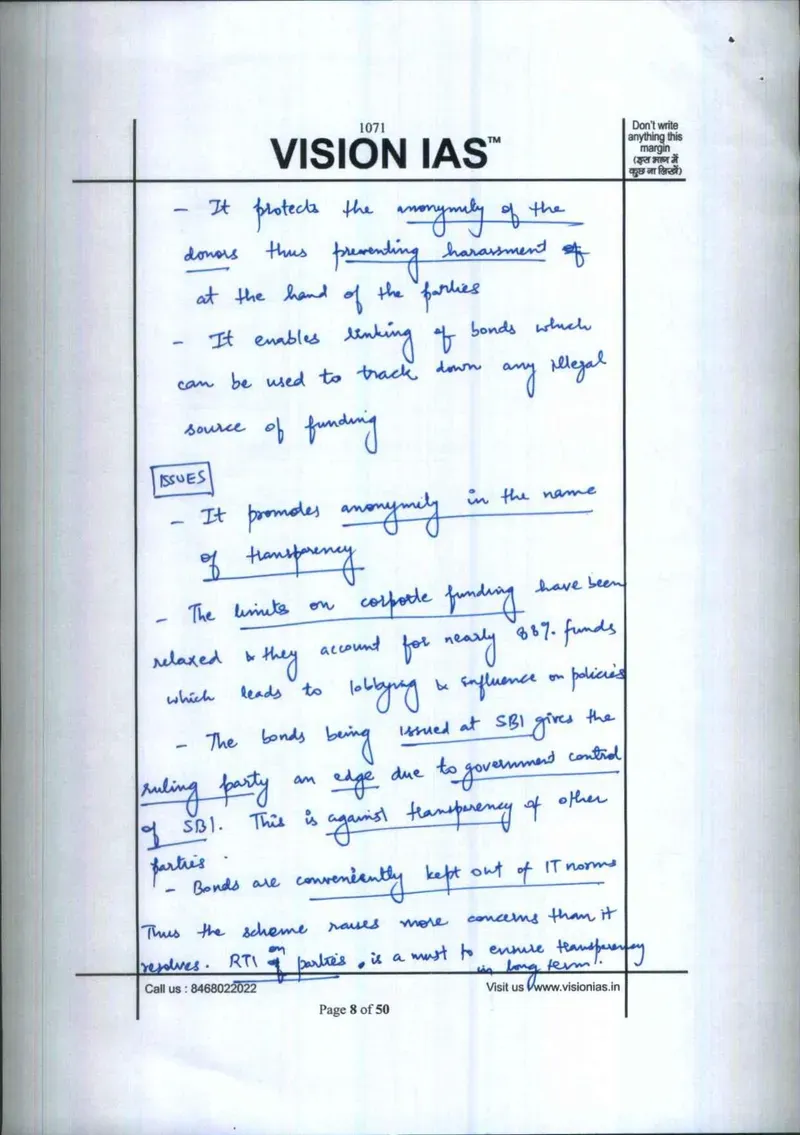
4.Transparency in political funding vs the Electoral Bond Scheme — critically discuss
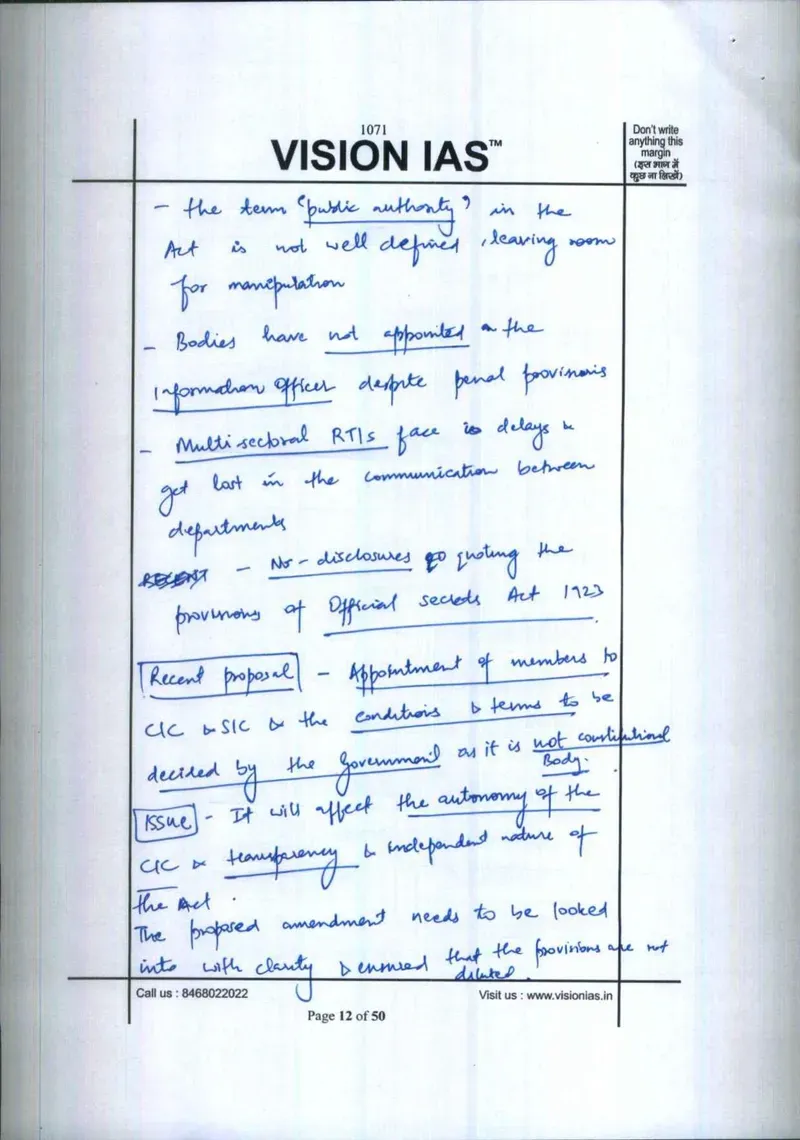
6.RTI Act implementation shortfalls and issues with proposed amendments
7.Evolving policy on reservation in promotions vs social justice — critical
8.Food paradox (enough food produced, not all get to eat); major interventions
9.Indian Ocean as a global stage for economic, social and cultural dialogue
10.Evolution / shift in India's climate change negotiation stance
11.Constitutional role of Finance Commission + debated TOR of 15th FC
12.Spirit of the Constitution as synthesis of Indian values, Western democratic/socialist movements and the freedom struggle
13.Importance of independent judiciary in a democracy + constitutional safeguards
15.Recent amendments to Prevention of Corruption Act, 1988 — balance of enforcement vs stringency
17.Problems in India's teacher-training system and how to address them
18.Obstacles in implementing Ayushman Bharat — critical
19.India diversifying cooperation/diplomatic profile in Africa to offset China's financial clout
20.US sanctions on adversaries (CAATSA) and how India can shield strategic interests
Examples, data & evidence used
Anti-Defection Law and Whips; NCRWC and Law Commission recommendations; fixed calendar of sittings; pre-poll alliances; Parliamentary Committees on demands for grants (Q1)
73rd Constitutional Amendment Act, 1992; ~40% women participation in PRIs; PRIs generate only ~5% of own funds; Digital India Programme; Sarpanch dependence on Block Development Office (Q2)
CAG safeguards: salary under Charged Expenditure on Consolidated Fund of India, removal like a Supreme Court judge, security of tenure; RAW exempt from audit on national-security grounds; post-mortem/recommendatory nature of audit (Q3)
Electoral Bond Scheme (Budget 2017-18); Association for Democratic Reforms (ADR) ~69% unaccounted funds, corporate funding ~88%; sub-Rs 2000 cash cap; SBI as issuer; RTI for political parties (Q4)
RTI Act 2005; Article 19 & Article 21 (Right to Information integral); CIC/SIC; Official Secrets Act 1923; public-authority definition; political parties outside RTI (Q6)
Reservation in promotions: Nagaraj case; 77th Amendment; Article 16(4A); tests of backwardness, inadequacy of representation, administrative efficiency (Q7)
Food security interventions: Integrated Child Development Scheme (ICDS), Mid-Day Meal Scheme, National Food Security Mission, Public Distribution System, fortification of flour/rice; ~27% undernourishment, ~30% food wastage from poor storage (Q8)
Indian Ocean: ~80% oil imports & ~90% trade by volume via ocean; Polymetallic Nodules / sole exploration rights; Project Mausam; Spice Route; ITEC (Indian Technical & Economic Cooperation); IORA; BIMSTEC; aid to Maldives (Q9)
Climate: Kyoto Protocol; Common But Differentiated Responsibilities; International Solar Alliance; 175 GW (extra by 2022) / RE target ~50% by 2030; INDCs; thermal ~65% of generation (Q10)
Finance Commission: Article 280, Article 275 (Grants-in-Aid), Article 131 (original jurisdiction); NK Singh as 15th FC chair; 2011 census weightage; GST/Ease of Doing Business/fiscal deficit; NITI Aayog Health Index (Q11)
Constitution synthesis sources: French Republic (Liberty-Equality-Fraternity), US Constitution (Fundamental Rights, no taxation without representation), British polity (Rule of Law, Parliamentary democracy), Irish Constitution (DPSP), Russian Revolution (socialism); Article 39, Articles 15 & 16, Article 326; Karachi Session (Q12)
Independent judiciary: Article 50; Indira Gandhi vs Raj Narain; Basic Structure doctrine; Article 13; Judicial Review; doctrine of Pith & Substance; colourable legislation; Article 142 (judicial activism); Vishaka guidelines; Vineet Narain case (CBI under CVC); Article 72 (pardon); Collegium (Q13)
Federalism: modelled on Canadian Constitution / unitary bias; ~42% devolution; paradiplomacy (West Bengal-Bangladesh, Kerala-Middle East); NITI Aayog cooperative/competitive federalism; MCOCA; Article 263 Inter-State Council; Venkatachaliah Commission on Governor; inter-state river disputes (Cauvery, Mahadayi, Mahanadi); All India Services; Special Category demand; 'Organic Federalism' as way forward (Q14)
Quotes the candidate used
"Accountability is the soul of democracy" — candidate's own concluding line in the Parliament answer (Q1), arguing it should not be compromised at any cost
Finance Commission described as the "Balancing Wheel of Indian Federalism", attributed to the Constituent Assembly (Q11)
Villages referred to as "Village Republics", attributed to Gandhi, in the Constitution-synthesis answer (Q12)
How it’s written: Highly templated, point-based answers. Each opens with a 1-2 line context/definition introduction (e.g., "Indian Parliament performs several functions like...", "RTI Act was passed in 2005 after the Supreme Court ruling..."). The body is organised under clear ALL-CAPS sub-headings, often boxed or underlined — recurr…
Diagrams & visuals: No formal diagrams, maps, charts or tables observed; Boxed / underlined ALL-CAPS sub-headings used as visual organisers throughout (e.g., 'Measures', 'CHALLENGES', 'IMPROVEMENTS'); Arrow / branch 'tree'-style notation linking a heading to sub-points — clearest in the judiciary answer (p.28), where a boxed 'CHALLENGES' branches via arrows into 'Judicial Overreach', 'overlap of powers' and 'Executive overreach by Judiciary → collegium process'
Evaluator: No marks, scores, ticks or substantive margin comments visible. The cover index "Marks Obtained" column and "Total Marks Obtained" are blank, as is the "Overall Macro Comments/feedback" box (only the pre-printed "All the Best" line and t…
▸AIR 1 Kanishak Kataria's VisionIAS GS mock (Test 1068, Jaipur, Aug 2018) — a clean, fully unmarked copy with no scores entered anywhere.
▸His signature is structure over prose: underlined keywords, circled/boxed sub-heads (SOLAR/WIND, Failure/Successes, HISTORY) and '→' bullets instead of paragraphs.
▸Even the topper left a question essentially blank — Q7 (food irradiation) is a single line, the rest of the space struck empty — showing ruthless time triage.
▸Dense, specific factual recall: Q14 fires off NMOOP, SAMPADA, Mega Food Parks & FSSAI; Q10 names FIU-IND, NATGRID and the SAMADHAN doctrine's 'No Access to Funding' plank.
▸Comfortable with data: canal ~38% vs tubewell ~65% vs drip/sprinkler ~90% irrigation efficiency (Q5); trade deficit widening 0.67%→1.9% of GDP (Q15).
▸Takes clear positions in conclusions — India should NOT join the NPT in its current discriminatory form (Q18); the Model Contract Farming Act 2018 is 'a step in the right direction' (Q12).
What to learn from this copy
★He answers with policy-instrument density, not vague gestures: Q14 (agri exports) fires off NMOOP, SAMPADA, Mega Food Parks, FSSAI and AGMARK in one answer, and Q10 (terror funding) names FIU-IND, NATGRID and the SAMADHAN doctrine's specific 'No Access to Funding' plank -> stock each topic with 4-5 named schemes/bodies/committees so every point lands a concrete keyword instead of a generic phrase like 'government should create awareness'.
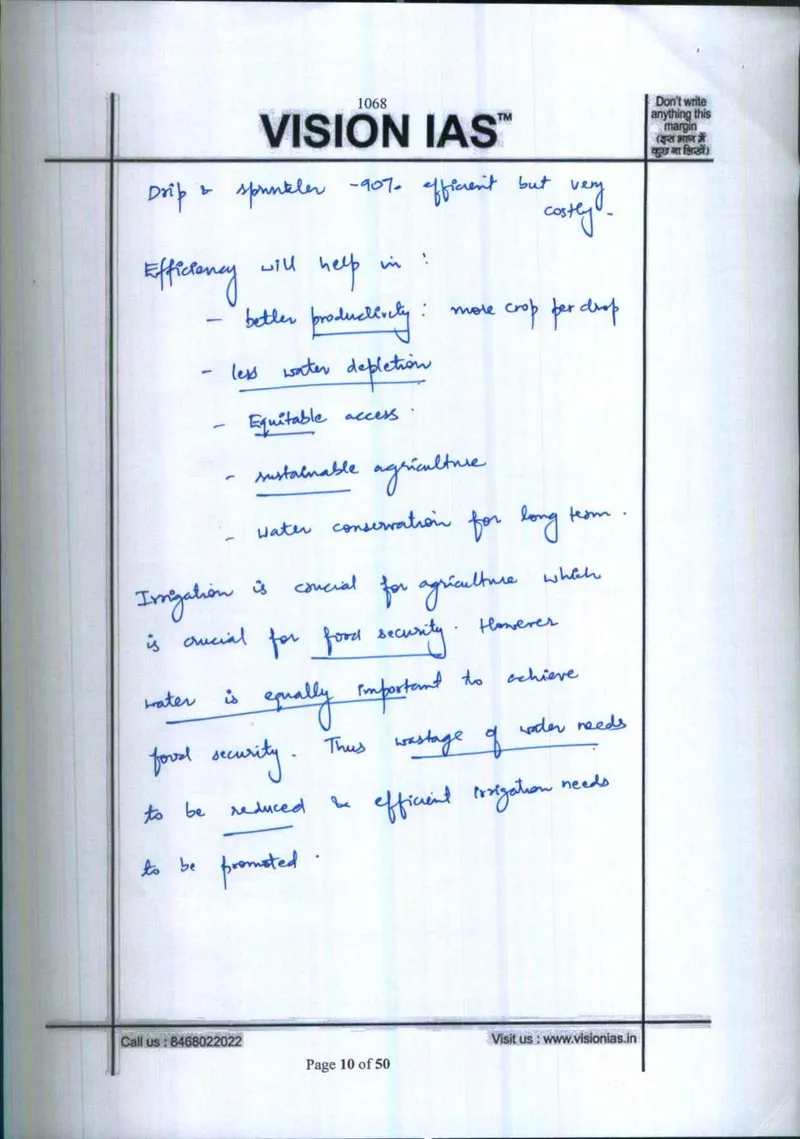
★He uses comparative numbers to make a point quantitatively: Q5 contrasts irrigation efficiency as canal ~38% vs tubewell ~65% vs drip/sprinkler ~90%, and Q15 tracks the trade deficit widening 0.67%->1.9% of GDP -> memorise a few comparison-ready data points per theme so you can demonstrate (not just assert) why drip beats canals or why a deficit is worsening.
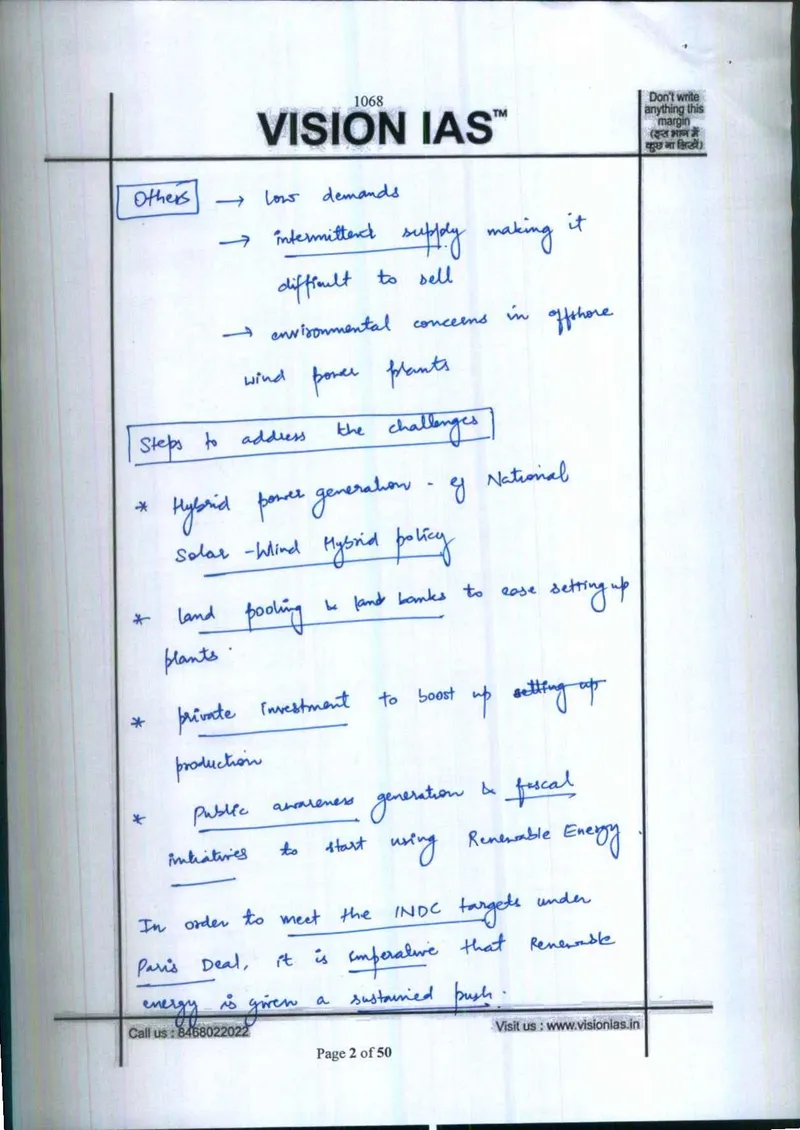
★His whole copy runs one repeatable template: a one-line intro, an arrow-bulleted ('->') body grouped under labelled sub-heads that are visually circled/boxed (SOLAR/WIND in Q1, Failure/Successes in Q17), then a short conclusion -> build answers as scannable point-blocks with signposted boxed sub-heads rather than dense paragraphs, so an examiner can see your structure in two seconds.
★He commits to a clear stance in conclusions instead of fence-sitting: Q18 concludes India should NOT join the NPT in its current discriminatory form, and Q12 judges the Model Contract Farming Act 2018 'a step in the right direction' -> when a question invites evaluation, end with an explicit, reasoned verdict rather than a neutral 'thus it has pros and cons'.
★Even as AIR 1 he triaged ruthlessly: Q7 (food irradiation) is a single line with the rest of the space deliberately left blank rather than padded with filler -> if you don't know a question, write what little you have and move on; don't burn minutes manufacturing weak content that crowds out stronger answers.
Questions attempted: Challenges in sustainably scaling up renewable energy in India + remedies; Government policies/indicators to finance urban development; municipal bonds; Financial exclusion of rural India; government & RBI measures, and 17 more below.
Questions attempted in this booklet (20)+
1.Challenges in sustainably scaling up renewable energy in India + remedies
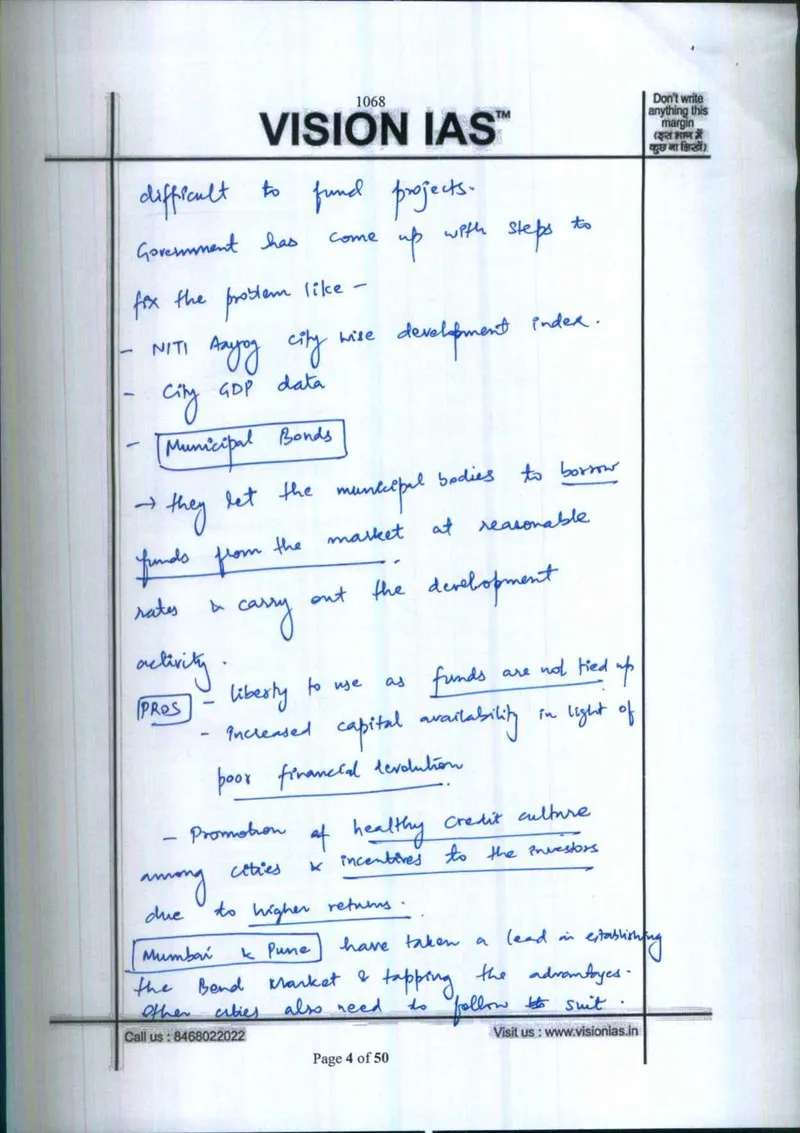
2.Government policies/indicators to finance urban development; municipal bonds
3.Financial exclusion of rural India; government & RBI measures
4.Environmental Accounting — meaning, rationale, status in India
5.Access to irrigation vs efficiency of water use
6.Mainstreaming indigenous traditional knowledge in disaster risk reduction
7.Food irradiation — ESSENTIALLY UNANSWERED (one-line attempt; rest of allotted space blank)
8.Technology as both cause and cure of fake news
9.Defence Planning Committee — features & role (brief, under-developed)
19.Maritime security, Western Indian Ocean, Djibouti Code of Conduct amendments
20.Space programme — from peaceful use to strengthening security capabilities
Examples, data & evidence used
Q1: National Solar-Wind Hybrid Policy; INDC targets under Paris Deal; land banks/land pooling
Q2: Municipal bonds; NITI Aayog city-wise development index; Mumbai & Pune leading bond-market issuance; 2011 census decadal urban growth
Q3: JAM trinity (Jan Dhan, Aadhaar, Mobile); RBI Priority Sector Lending incl. MSMEs; Vittiya Saksharta Abhiyan; Banking Correspondents / Bank Mitras; Core Banking via Post Offices
Q4: ~3% of GDP cost of environmental degradation; INDC 175 GW renewable target; Energy Conservation Building Codes; UJALA LED scheme; CSR funding; SDGs
Q5: ~60% of farmland rain-fed; ~1500 m3 water/person/year; canal ~38% vs tubewell ~65% vs drip/sprinkler ~90% irrigation efficiency
Q6: Sendai Framework for Disaster Risk Reduction; indigenous knowledge of terrain; animals sensing earthquakes
Q8: WhatsApp mass-forwarding; blockchain anonymity; mob lynching; AI/Machine Learning & Deep Net for verification/spam filtering
Q10: FIU-IND; NATGRID (to include financial data); SAMADHAN doctrine ('No Access to Funding' component); ISI-sponsored terror funding in Pakistan
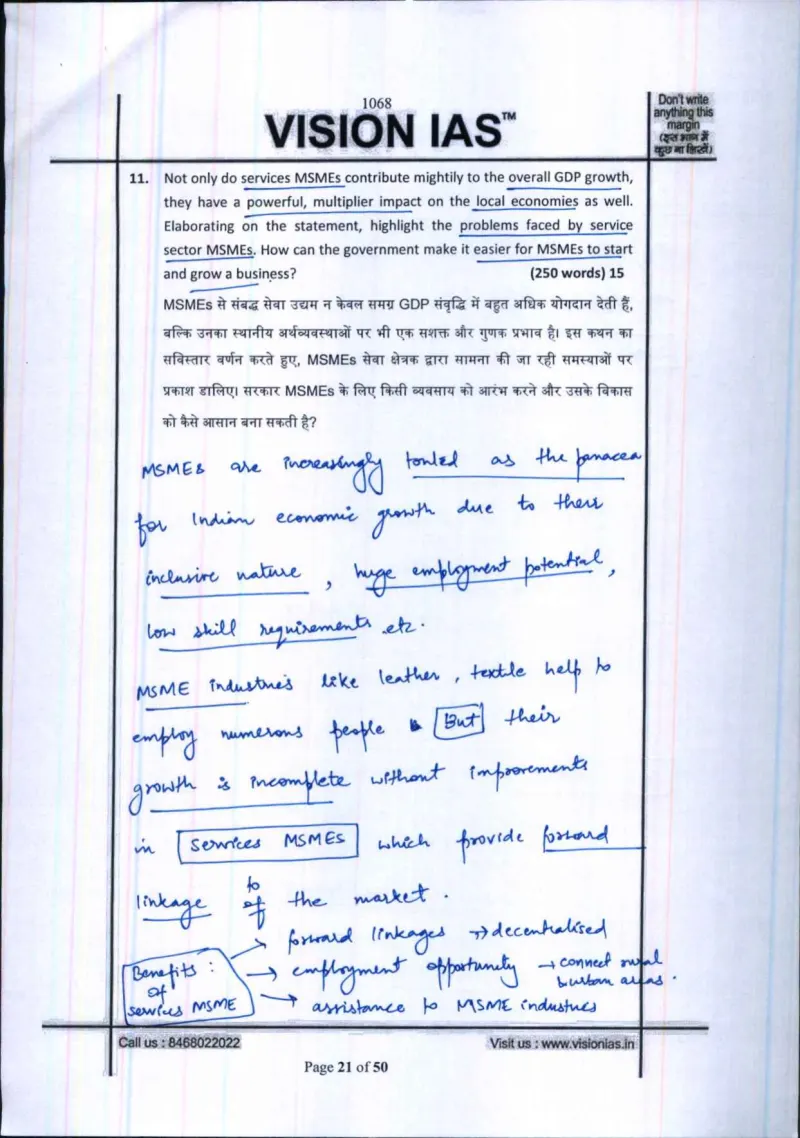
Q11: 'Champions of Services Sector' (identified services MSMEs); leather & textile linkages; Ease of Doing Business
Q12: Model Contract Farming Act 2018 (allows FPOs, bars sale of farmer land, insurance access); MSP; AGMARK quality standards
Q14: 100% FDI in food processing; FSSAI & AGMARK standards; NMOOP (oilseeds/oil palm); SAMPADA scheme; Mega Food Parks; ~17% GDP vs ~57% workforce in agriculture; pulse-import deals (e.g. Madagascar)
Q15: Purchasing Power Parity vs exchange rate; trade deficit 0.67% (2016-17) to 1.9% (2017-18) of GDP; fiscal deficit ~3.5%; growth >6.5%; OPEC production cuts; US quantitative-easing rollback/interest rates; US-China trade war diverting Chinese steel to India; demonetisation & GST disruption; INR depreciation; India imports ~80% of oil
Q16: High FRP straining mills; compulsory jute packaging; competition from gud/jaggery; Rangarajan Committee (2013) guidelines; capital subsidy for machinery
Quotes the candidate used
Q4 sustainable-development aphorism — paraphrased '(we) don't inherit the Earth but borrow it from the future generation' (no author attributed)
Q5 slogan 'more crop per drop' (no author attributed)
Q8 motif 'technology is a double-edged sword' (no author attributed)
How it’s written: Highly systematised, point-form answers rather than dense prose. Consistent template: a short intro line, a body of arrow-bulleted ("→") points grouped under labelled sub-heads, and a brief conclusion. Sub-headings are boxed or circled for emphasis — e.g. circled SOLAR/WIND (Q1), boxed Failure/Successes (Q17), boxed…
Diagrams & visuals: None visible. Across the cover plus ~9 directly inspected page-images (spanning Q1, Q6-Q10, Q12, Q17, Q19, Q20) all answers are linear point/arrow-form text with boxed word-headers only — no flowcharts, tables, sketches or maps, including in Q19 (maritime/Indian Ocean) and Q20 (space) where a map/diagram would have been natural.
Evaluator: No examiner marks or comments are filled in on this copy.
▸The OCR text of his GS booklets shows tightly structured answers with liberal use of headings and point-wise arguments.
▸Read alongside the Akshat Jain (AIR 2) and Junaid Ahmad (AIR 3) booklets from the same year to compare three top-3 writing styles on similar questions.
How many Kanishak Kataria answer copies can I download here?+
This page links to 4 of Kanishak Kataria's mains answer copies (General Studies) as free PDFs, from the UnlockIAS topper-copy archive. Each opens in Google Drive — no sign-up or payment.
What rank did Kanishak Kataria get and in which year?+
Kanishak Kataria secured AIR 1 in UPSC CSE 2018.
Are Kanishak Kataria's answer copies evaluated with marks?+
These are Kanishak Kataria's test-series mains booklets. Most are clean (unmarked) fair copies — their value is in the actual answers: the questions attempted, the examples and quotations used, and how the answers are structured, which we summarise on this page. A few topper copies in the wider library do carry the evaluator's qualitative feedback.
What can I learn from Kanishak Kataria's answer copies?+
Decode the pattern, don't copy the content. For example, in Kanishak Kataria's copies: unevaluated VisionIAS GS copy (Test Code 1067, Jaipur, 22/8/2018): every marks field and the examiner-comments page are blank — no scores or remarks anywhere.. Read a copy, then write the same question yourself and compare structure, example density and conclusion quality.
Are these Kanishak Kataria copies really free?+
Yes — every PDF on this page is free to view and download. UnlockIAS hosts this index for free educational use; credit for each booklet belongs to the candidate and the evaluating test series.
Studying Kanishak Kataria's copies shows you the target; the Sherlocking Mains programme trains you to hit it — daily answer writing with AWE Bot evaluation and mentorship. Or get one Mains answer evaluated free.