
Natisha Mathur — ForumIAS MGP Copy 1
Essay (ForumIAS MGP)PDF · 5.3 MB
What’s inside this copy
- ▸ForumIAS MGP Essay booklet (Test Code 22025, barcode MGPQ007379) by Natisha Mathur — two full essays, one per section.
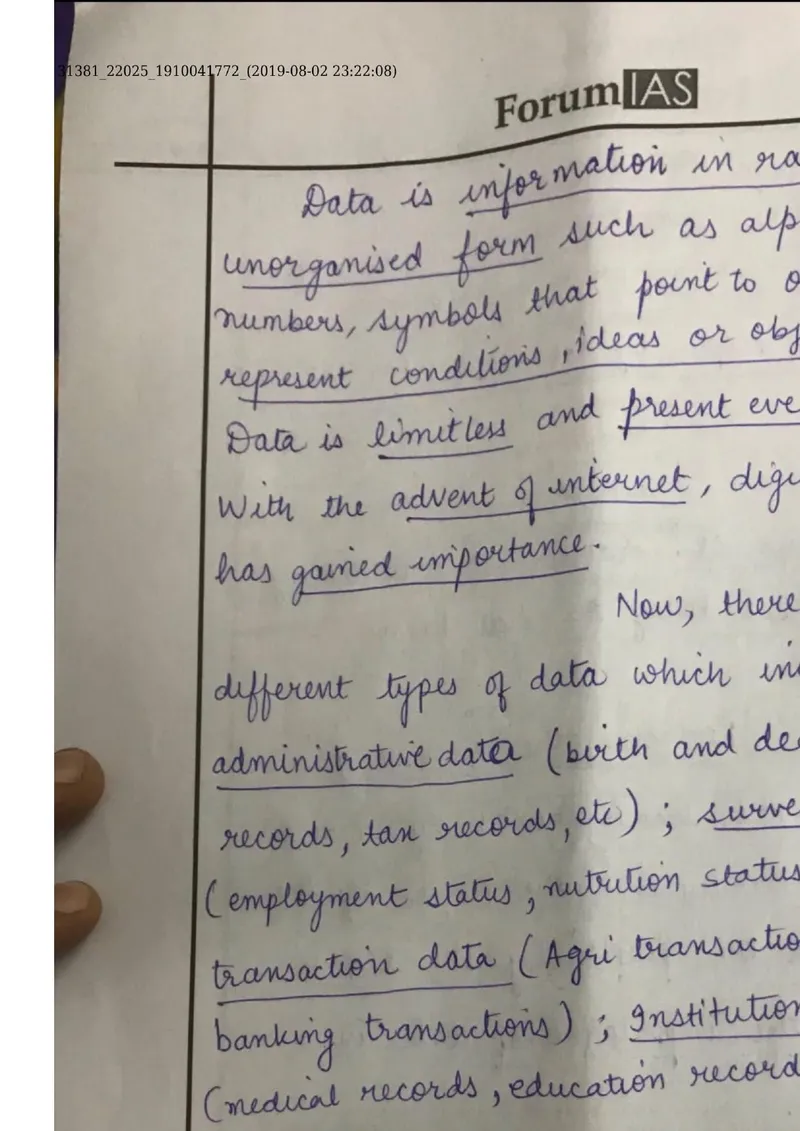
- ▸Section A on data governance opens with 'Data is the new oil' and reframes Lincoln's 'of the people, by the people, for the people' for the data age.
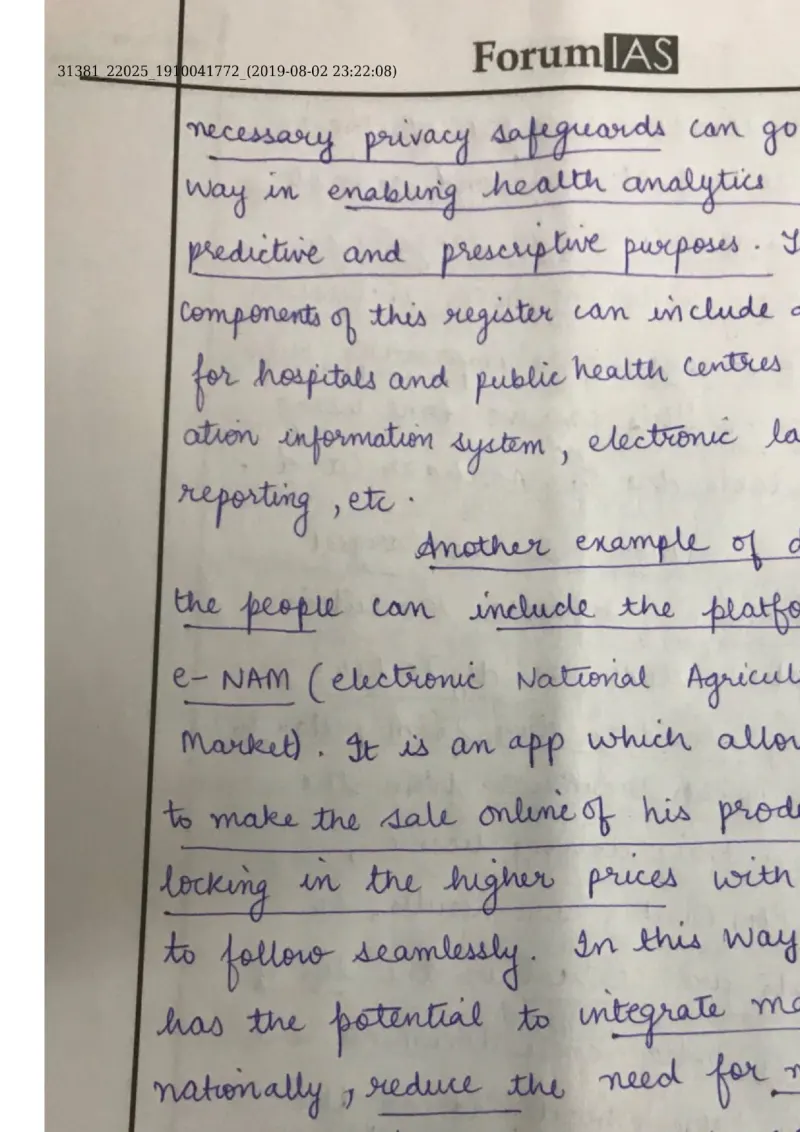
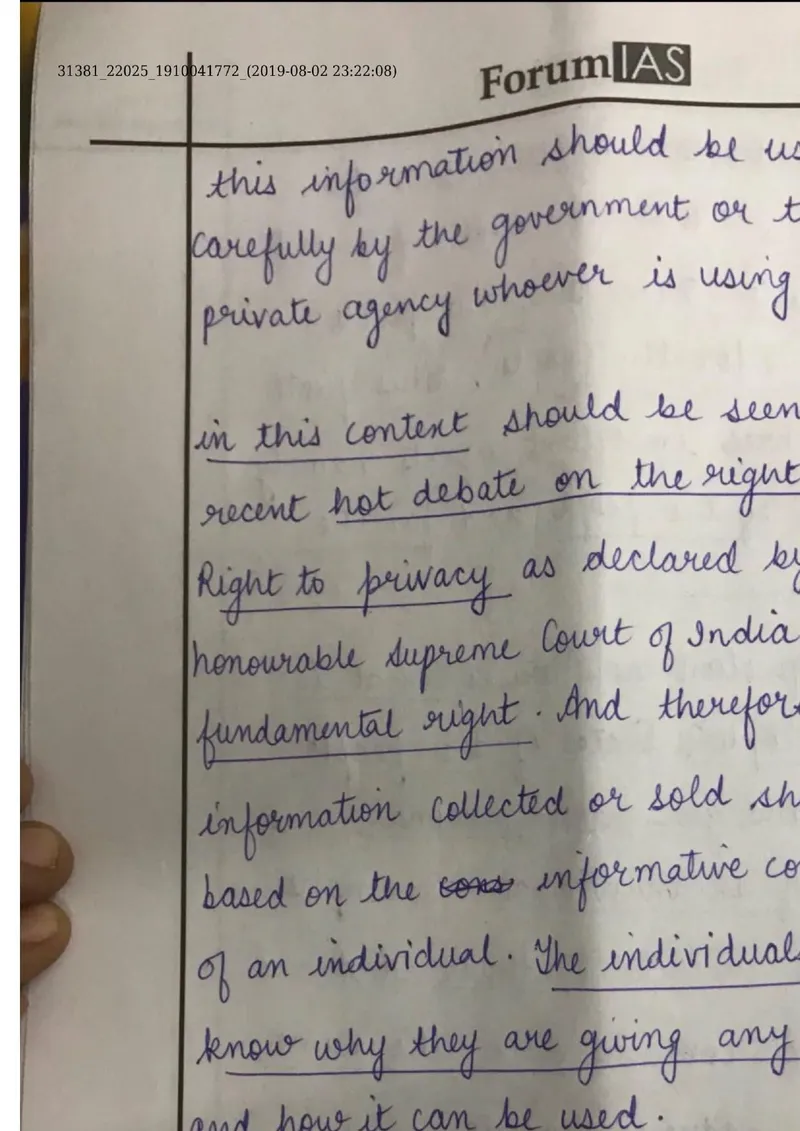
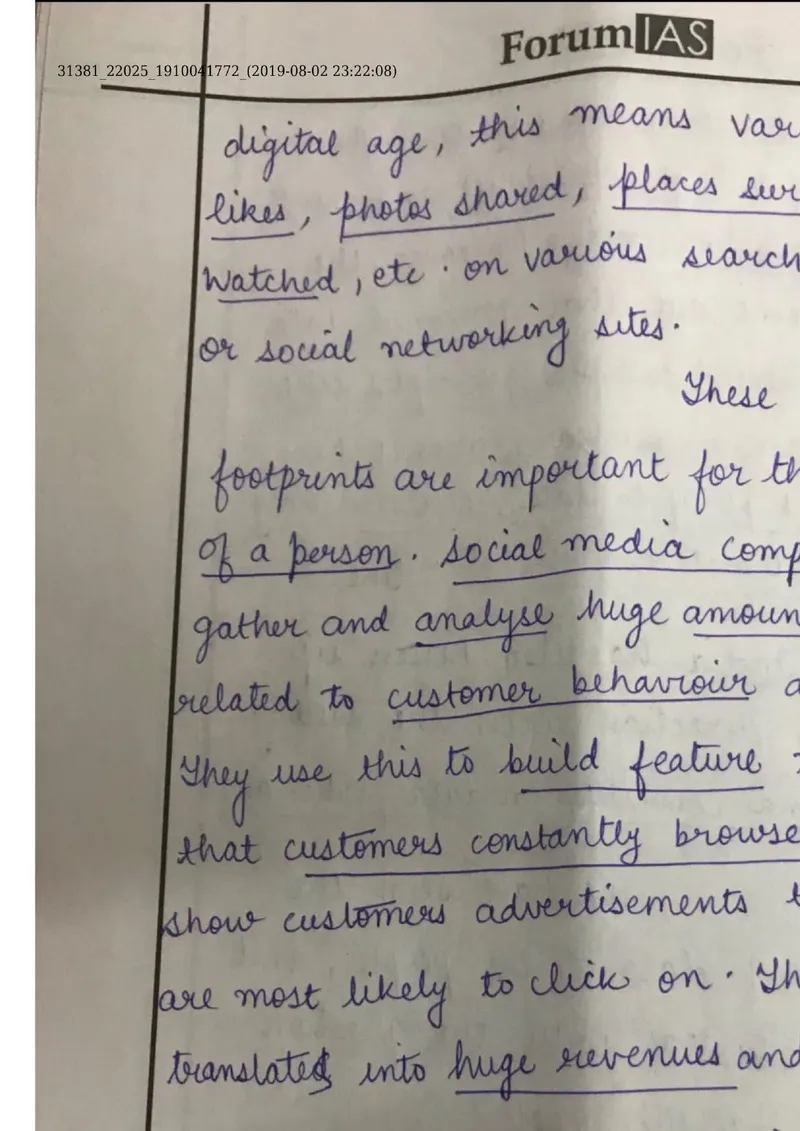
- ▸Section A is example-dense: Aadhaar, Cambridge Analytica (50 million Facebook users, US election & Brexit), Srikrishna Committee, Right to Privacy judgement, DigiLocker, e-NAM.
- ▸Section A closes with a numbered way-forward and a utilitarian 'greater good for maximum number' conclusion.
- ▸Section B ('It is not the answer that enlightens, but the question') draws on the Katha Upanishad's Nachiketa-Yama dialogue and Buddha's quest into the cause of suffering.
- ▸Section B links questioning to social change — Ambedkar challenging the 'supremacy of Brahmanism' and women's movements questioning patriarchy.
What to learn from this copy
- ★She built her entire data-governance essay around ONE borrowed structure — taking Lincoln's 'of the people, by the people, for the people' and decoding each of the three prongs against the topic 'Data: Of the People, By the People, For the People' (define -> decode the three aspects -> illustrate). -> When the essay title itself echoes a famous line, hijack that line's structure to organise your whole essay; the three-part phrase gives you three ready-made body sections.
- ★Section A is deliberately example-dense and current: Cambridge Analytica with the precise figure (~50 million Facebook users used to influence the US election and Brexit), the Srikrishna Committee, the Right to Privacy judgement, Aadhaar/Voter ID, DigiLocker and e-NAM all in one essay. -> Stock a single abstract essay with 6-8 concrete, named instances (with a number or a case where you can) rather than staying conceptual — specificity is what separates a topper's data essay from a generic one.
- ★She opened each essay with a sharp hook tied to the theme — 'Data is the new oil' for the data essay, and the topic's own line 'It is not the answer that enlightens, but the question' for Section B — then immediately set up her argument. -> Lead with a recognised one-liner that frames the topic, instead of a slow generic introduction.
- ★For the abstract Section B topic on questioning, she reached for philosophical depth: the Katha Upanishad's Nachiketa-Yama dialogue (quoting 'O Lord of Death, what comes after death?') and Buddha questioning the cause of suffering, then escalated to social change with Ambedkar challenging 'the supremacy of Brahmanism' and women's movements questioning patriarchy. -> On a philosophical essay, build a ladder of illustrations from the spiritual/classical to the socio-political so one abstract claim ('questions drive progress') is proved across multiple planes.
- ★Her data essay ends with a numbered way-forward (First/Third/Fourth/Fifth) and a utilitarian 'greater good for maximum number' conclusion rather than trailing off. -> Close a governance-type essay with a numbered, actionable way-forward and a principled one-line verdict so the conclusion adds direction instead of just summarising.
Questions attempted: Essay: Data — 'Of the People, By the People, For the People' (data governance / privacy); Essay: 'It is not the answer that enlightens, but the question' (Section B also listed topic 2, 'Stress laid on rights must also be laid on duties', which was not chosen).
Questions attempted in this booklet (2)+
- Q.1 (Section A).Essay: Data — 'Of the People, By the People, For the People' (data governance / privacy)
- Q.2 (Section B).Essay: 'It is not the answer that enlightens, but the question' (Section B also listed topic 2, 'Stress laid on rights must also be laid on duties', which was not chosen)
Examples, data & evidence used
- Section A — Aadhaar and Voter ID as state-held citizen data
- Section A — Srikrishna Committee on data protection
- Section A — Cambridge Analytica: data of ~50 million Facebook users used to influence the US election and Brexit
- Section A — Economic Survey of India 2018-19
- Section A — NSSO data
- Section A — Jiyo Parsi scheme
- Section A — DigiLocker
- Section A — e-NAM
- Section A — Data Access Fiduciary Architecture
- Section A — Right to Privacy Supreme Court judgement
- Section B — Nachiketa and Yama (Katha Upanishad): knowledge of atman / immortality / freedom from the cycle of births
- Section B — Gautam Buddha questioning the cause of suffering, leading to enlightenment
- Section B — a child's inquisitiveness ('how?', 'why?') maturing into rational thinking
- Section B — researchers/professionals asking 'what is the best solution?' producing vaccines, medicines and infrastructure
Quotes the candidate used
- "Data is the new oil" (Section A opening)
- "Democracy is of the people, by the people and for the people" — Lincoln framing, adapted to data (Section A)
- "It is not the answer that enlightens, but the question" — Section B essay topic, quoted at the start
- "O Lord of Death, what comes after death?" — Nachiketa, from the Katha Upanishad (Section B)
How it’s written: Essay-type booklet, two sections, one essay each, in neat legible cursive with heavy underlining of keywords throughout. Section A (Data) follows a clear define → decode the three aspects (of/by/for the people) → illustrate with examples → numbered way-forward (the candidate numbers steps as First/Third/Fourth/Fifth…
Evaluator: No examiner marks or comments are filled in on this copy.