
Arpit Kumar — DrishtiIAS Essay copy
What’s inside this copy
- ▸Cover confirms Arpit Kumar, 'Essay', Drishti Mentorship Programme (Mains)-2024 (Max 250); the entire evaluator marks table is left blank
- ▸Only Section A attempted: a ~10-page essay on 'The past is better guide to future than present'; Section B (Essay-2) is completely blank
- ▸Strong dialectical architecture with five bold underlined headers, resolving past vs present into a synthesis ('Collective Wisdom of Past and Present')
- ▸Eclectic, wide example bank — Russia-Ukraine/NATO, Oppenheimer's fission bomb, Freud's subconscious mind, Oxfam 77%-wealth stat, CRISPR, Shikhandi and Akbar's eunuch officials
- ▸Anchored by the Rigvedic shloka 'Aano Bhadra Kratavo Yantu Vishwatah' (linked to the PM) and a coined opening epigram on history
- ▸MISASSEMBLY FLAG: physical page 13 is a FOREIGN Physics Wallah / OnlyIAS GS answer on landslide disaster-management (Doppler/LIDAR, Hazard Zonation, Gadgil-Kasturirangan, eco-sensitive zones, 2nd ARC, Sendai Framework) with its own office-use feedback grid — NOT Drishti and NOT this Essay; it sits exactly where the essay's closing page should be
What to learn from this copy
- ★Arpit didn't just list pros and cons of 'past vs present' — he built a true dialectic, naming his stages as bold underlined headers like 'A Classic Case Study of Unlearned Past' (thesis) and 'Past - The Eternal Guide' (antithesis), then resolving them into an explicit synthesis 'Collective Wisdom of Past and Present.' -> On a 'X is better than Y' essay topic, don't pick a side flatly; stage thesis-antithesis-synthesis and give the resolution its own named section so the examiner sees you transcended the binary rather than just argued one half.
- ★He stocked one essay with examples from genuinely different domains rather than five history anecdotes — IR (Russia-Ukraine/Crimea, NATO encirclement, the 'security dilemma' and North Korea/Iran proliferation), hard science (CRISPR built on prior DNA/RNA knowledge, Oppenheimer's fission bomb as a 'Pandora's box'), psychology (Freud's subconscious and negative habits), economics (Oxfam's 'top 10% hold 77% of wealth'), and social history (Mahabharata's Shikhandi and Akbar's eunuch officials vs present-day transgender stigma). -> Range across disciplines, not just more examples in one field — each fresh domain demonstrates broader awareness and lets you re-prove the same thesis from a new angle so it never reads as one-note.
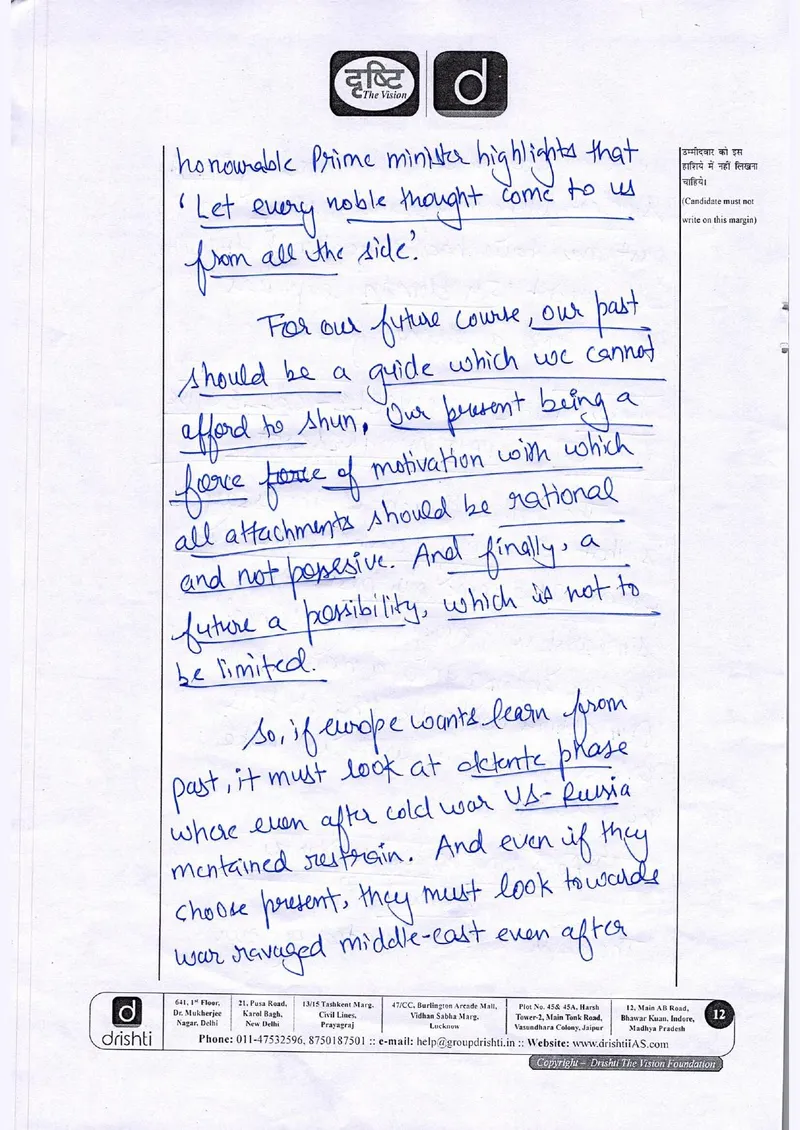
- ★He bookended the essay with India-rooted intellectual anchors and made them current: the Rigvedic shloka 'Aano Bhadra Kratavo Yantu Vishwatah' ('Let every noble thought come to us from all the sides') tied to the present-day PM and World Yoga Day/Vasudhaiva Kutumbakam, plus a closing line 'a guide can only show a person where he wishes to go.' -> Pull a classical or scriptural line into the intro/conclusion AND link it to a live contemporary reference — it shows the 'past guides present' thesis lived in your own framing, not just in your body paragraphs.
Questions attempted: The past is better guide to future than present — attempted, ~10 sides of writing (physical pp.3-12); Not attempted — Section-B 'Topic:' line left blank and all Section-B pages (pp.17-28) blank; no second essay written.
Questions attempted in this booklet (2)+
- Section A (Essay-1).The past is better guide to future than present — attempted, ~10 sides of writing (physical pp.3-12)
- Section B (Essay-2).Not attempted — Section-B 'Topic:' line left blank and all Section-B pages (pp.17-28) blank; no second essay written
Examples, data & evidence used
- Russia-Ukraine war — annexation of Crimea and the 2021/2022 invasion of Ukraine; Europe misjudging Russia as weak by its 'present' situation
- Ever-expanding NATO and continuous encirclement of Russia
- Industrial Revolution and Industry 4.0 ('ER 4.0') needing to learn from past for equity-based development
- Oxfam report — top 10% holding 77% of wealth (inequality critique of present)
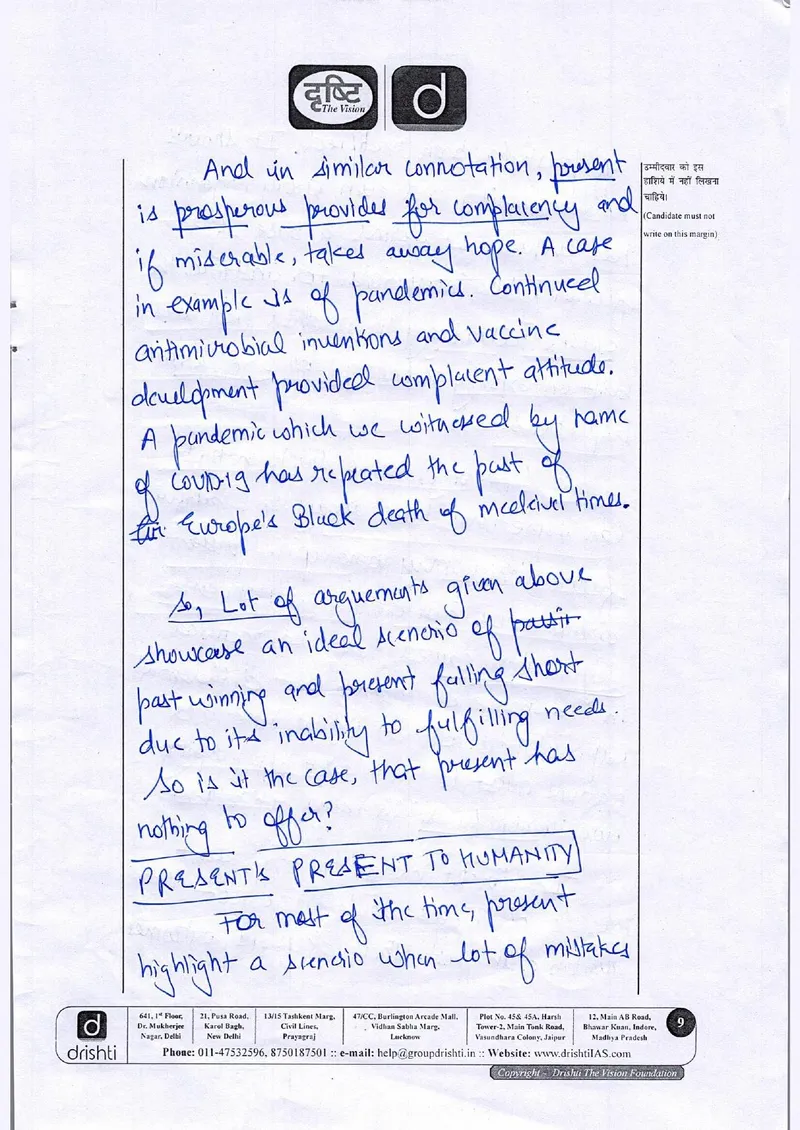
- COVID-19 pandemic compared to Europe's medieval Black Death; complacency from antimicrobial/vaccine development
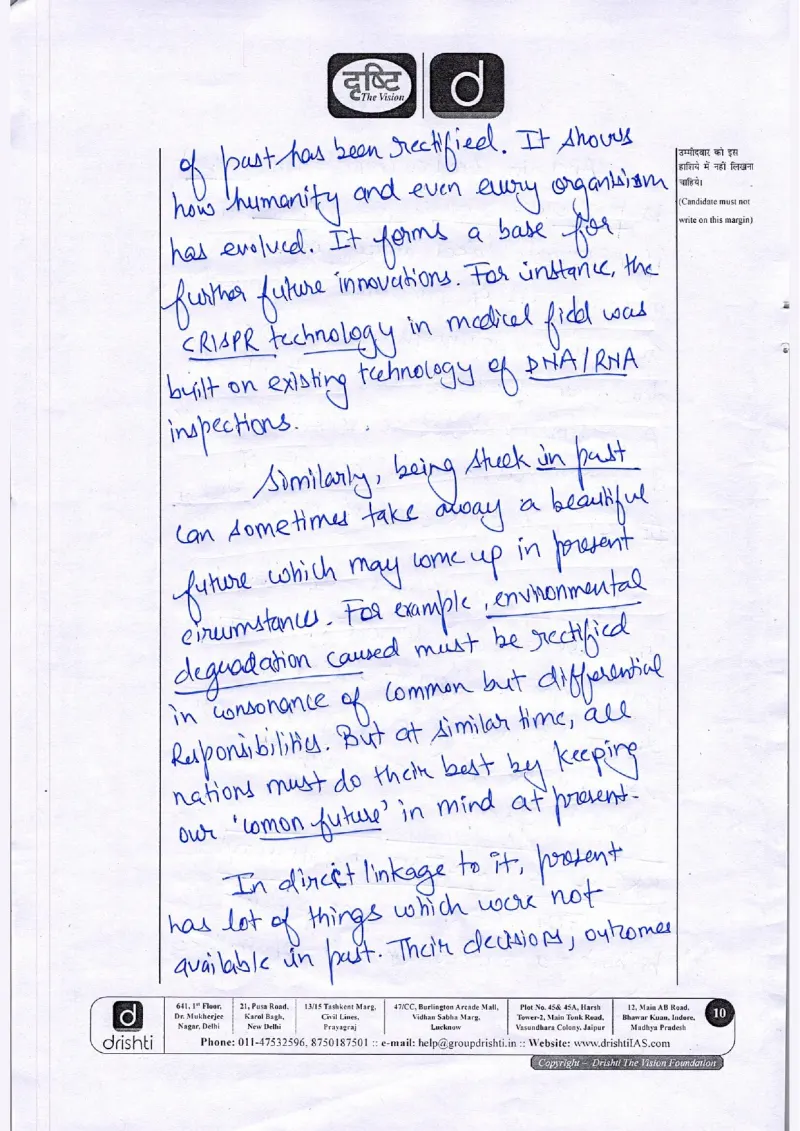
- CRISPR technology in the medical field built on existing DNA/RNA knowledge
- Common But Differentiated Responsibilities and 'common future' on environmental degradation
- Oppenheimer's fission-bomb experiment opening a 'Pandora's box' of outcomes
- 'Security dilemma' as a constant feature of international politics; nuclear proliferation by North Korea and Iran
- Transgender acceptance across time — Mahabharata's Shikhandi and eunuch officials of Akbar vs present-day stigma
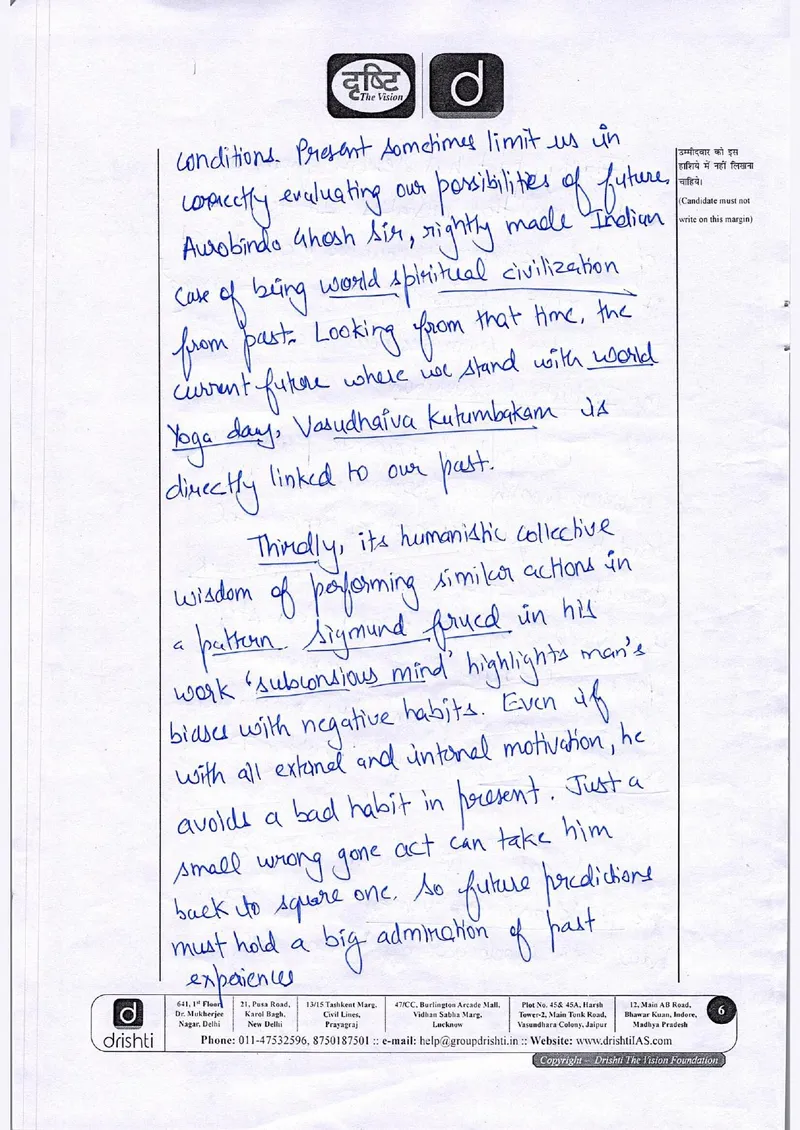
- Aurobindo Ghosh — India as the world's spiritual civilisation; World Yoga Day and Vasudhaiva Kutumbakam linked to the past
- Sigmund Freud's work on the 'subconscious mind' and negative habits
- Détente phase of US-Russia restraint after the Cold War
- A remote-village student empowered by the '5G domain'/digital technology of the present
Quotes the candidate used
- Opening epigram: 'History has lot to offer to intelligent human and yet lot to conceal from repetitive fool' — no author attributed (appears coined/uncredited)
- 'Aano Bhadra Kratavo Yantu Vishwatah' (Rigvedic Sanskrit shloka) — rendered as 'Let every noble thought come to us from all the side'; candidate ties it to the 'honourable Prime Minister'
- Conclusion line (on the displaced/offset final page): 'a guide can only show a person where he wishes to go' — attributed only as 'rightly said', author not legible
How it’s written: Single essay (Section A only). Intro pairs a coined history epigram with the topic, then a dialectical thesis-antithesis-synthesis built around five bold, underlined thematic headers: (1) 'A Classic Case Study of Unlearned Past', (2) 'Past - The Eternal Guide', (3) 'Present's Unability to Present a Future Paradox',…
Diagrams & visuals: None within the essay — the candidate relied on underlined headers and underlined keywords only; no diagrams, charts or maps in the Essay-1 answer
Evaluator: No examiner marks or comments are filled in on this copy.