
Apsara N — InsightsIAS GS Paper 3 copy
What’s inside this copy
- ▸Economy-only sectional copy — InsightsIAS IPM/YLM 2.0 Test Series 2024, Test-15; cover confirms 'APSARA N', roll 4440216, dated 03-10-2023; all 20 Qs are GS3 Economy.
- ▸Unevaluated script: index 'Marks Obtained', Total and Remarks all blank and no ticks anywhere, so no marks can be reported.
- ▸17 of 20 attempted; Q7 (Gig Economy), Q16 (MSME) and Q17 (National Logistics Policy) left entirely blank; Q11 (industrial policy) only partially done (1947 & 1956).
- ▸Strong data-and-scheme recall: GHI rank 107, Oxfam top-1%=40% wealth, NFHS-5 57% women anaemic, GER 26%, FRBM 3%, N.K. Singh committee, German debt-brake.
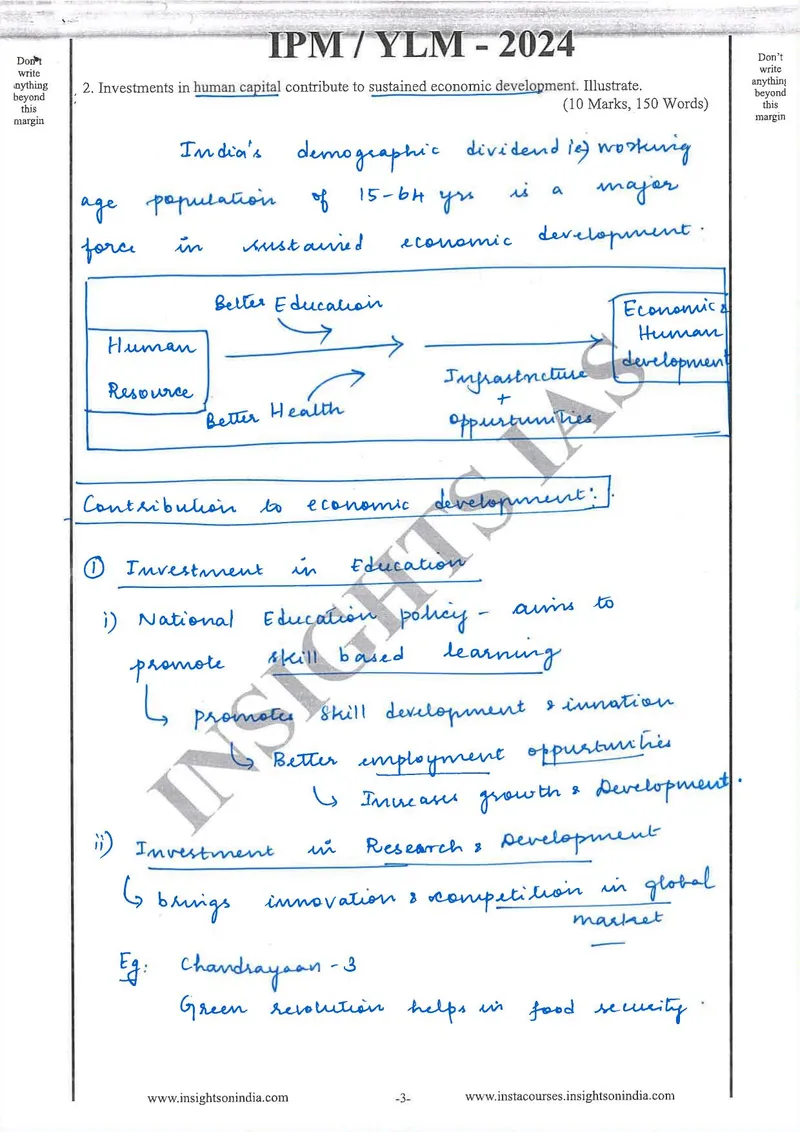
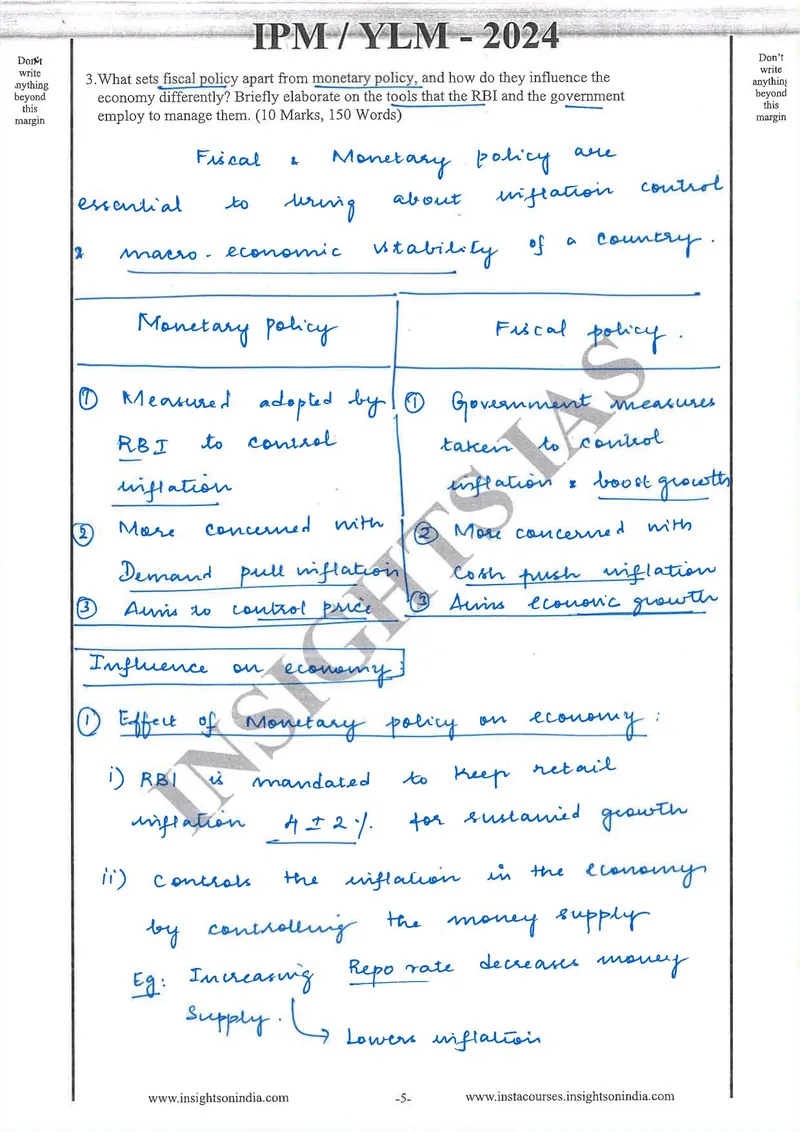
- ▸Uses visual answers to compress content: boxed human-capital flow (Q2), Monetary-vs-Fiscal two-column table (Q3), outcome-budgeting comparison (Q10) — but no maps.
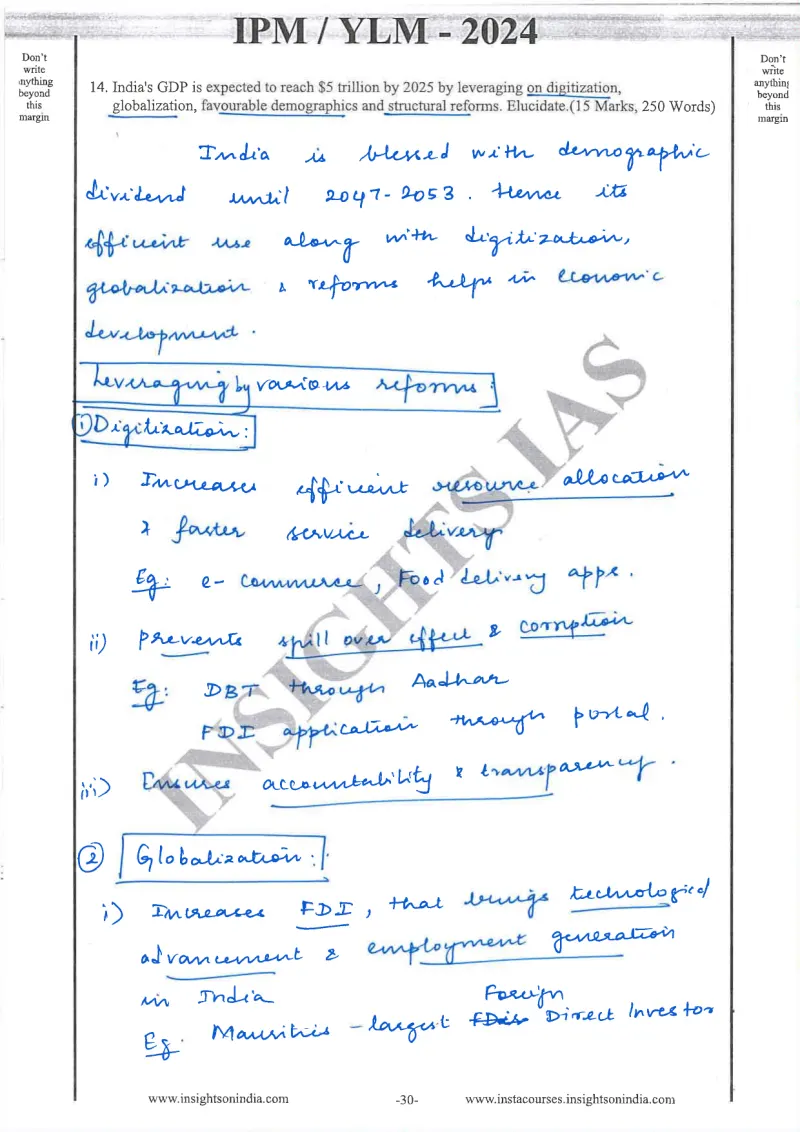
- ▸Signature presentation: underlined headers + numbered points + cascading down-arrow logic chains + frequent 'Eg:' examples, in neat blue ink within margins.
What to learn from this copy
- ★Each answer opens with a one-line data- or body-anchored definition before the body — e.g. inclusive-growth framed via OECD, clean-energy via the IPCC report — instead of a vague generic opener -> lead with a sourced, authoritative one-liner so the examiner sees you've located the question in real institutional/data terrain from line one.
- ★Converts heavy economics into compact visuals at the exact points where prose would sprawl: a boxed flow chain in Q2 (Human Resource -> Better Education/Health -> Infrastructure+Opportunities -> Economic & Human development), a two-column Monetary-vs-Fiscal table in Q3, and a Previous-vs-Outcome budgeting comparison diagram in Q10 -> reserve diagrams for genuinely comparative or causal-chain questions where they save words, not as decoration.
- ★Dense, precise factual loading throughout — GHI rank 107, Oxfam top-1%=40% of wealth, NFHS-5 57% women anaemic, GER 26%, FRBM 3% target, plus the N.K. Singh committee and German debt-brake — with sources named (Oxfam, OECD, NFHS-5, NITI Aayog) rather than vague 'studies show' -> memorise 4-5 hard numbers with their source per economy theme so claims are verifiable and not hand-waved.
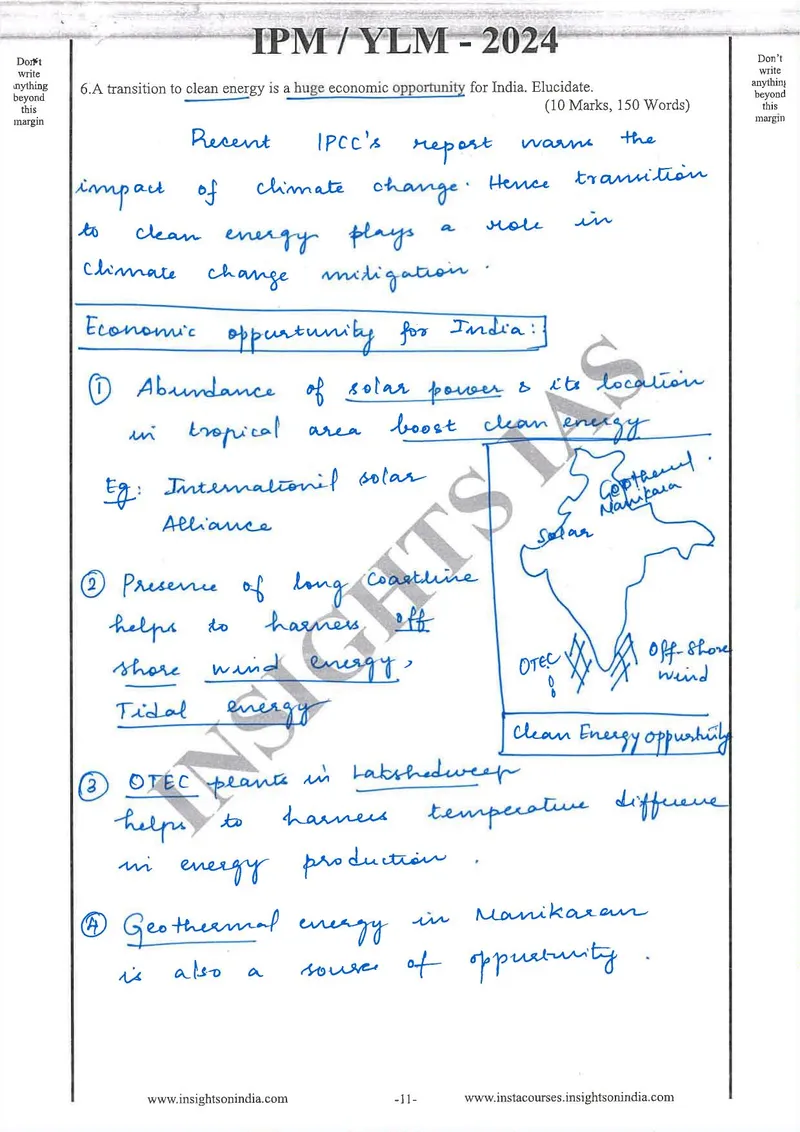
- ★Pairs nearly every analytical point with a tagged 'Eg:' instance — Air India privatisation and BSNL for PSUs, the Kerala community-led participative governance model, OTEC/geothermal at Manikaran/offshore wind off Lakshadweep for clean energy -> attach a concrete, often non-obvious example to each argument so abstract economics is grounded in identifiable cases.
- ★Uses a signature cascade of right-angled down-arrows to physically link cause to effect within points -> a consistent visual logic device makes your reasoning chain scannable and shows the examiner the causal mechanism, not just a list of disconnected bullets.
Questions attempted: Why poverty persists in India despite eradication measures (10m); Human capital investment & sustained economic development — with boxed flow diagram (10m); Fiscal vs monetary policy + RBI/govt tools — with comparison table (10m), and 14 more below.
Questions attempted in this booklet (17)+
- 1.Why poverty persists in India despite eradication measures (10m)
- 2.Human capital investment & sustained economic development — with boxed flow diagram (10m)
- 3.Fiscal vs monetary policy + RBI/govt tools — with comparison table (10m)
- 4.Inclusive growth, indicators, beyond mere economic growth (10m)
- 5.PSUs as 'overfed part of undernourished economy' + reforms (10m)
- 6.Clean energy transition as an economic opportunity (10m)
- 8.Sovereign Green Bonds & significance (brief, ~1 page) (10m)
- 9.De-dollarization & insulation from geopolitical risk (10m)
- 10.Outcome budgeting & effective implementation — with mini comparison diagram (10m)
- 11.Evolution of India's industrial policies since Independence — PARTIAL (only 1947 & 1956 covered; rest blank) (15m)
- 12.PLI scheme — production, jobs, growth, exports (15m)
- 13.Food inflation factors, impact on vulnerable, control challenges (15m)
- 14.$5 trillion economy via digitization/globalization/demographics/reforms (15m)
- 15.Central & state fiscal deficit — causes, ramifications, remedies (15m)
- 18.Digitization opportunities/challenges + Digital India contribution (15m)
- 19.Multiplier effects of infrastructure investment + govt policies (15m)
- 20.GST — formalization, growth, implementation challenges (15m)
Examples, data & evidence used
- Global Hunger Index rank 107
- Oxfam: top 1% holds ~40% of wealth
- NFHS-5: 57% women anaemic
- GER 26% (skilling/education gap)
- MGNREGA, National Rural Livelihood Mission, Skill India, Sarva Shiksha, PM Kaushal, PM Vishwakarma
- Kerala community-led participative governance model
- Chandrayaan-3; Green Revolution & food security
- Ayushman Bharat, PM Janani Suraksha Yojana, PM Poshan 2.0
- OECD (inclusive growth); 128th Constitutional Amendment Bill
- PM Jan Dhan Yojana, DBT; NITI Aayog 'India @75'
- Air India privatisation; BSNL (PSU example)
- IPCC report; International Solar Alliance
- OTEC, geothermal at Manikaran, offshore wind (Lakshadweep), Brahmaputra hydropower
- Zero Budget Natural Farming; Panchamrit
Quotes the candidate used
- None visible — no verbatim quotations with named authors. Only data-source attributions are used (Oxfam, OECD, NFHS-5, IPCC, NITI Aayog), not quotations.
How it’s written: Consistent intro-body-conclusion format. Each answer opens with a one-line definition/context (often citing data or a body like OECD/IPCC), then underlined section headers, numbered points (i, ii, iii), and a distinctive cascade of right-angled sub-arrows that link cause to effect. Examples are flagged liberally wit…
Diagrams & visuals: Q2: boxed flow diagram — Human Resource -> Better Education / Better Health -> Infrastructure + Opportunities -> Economic & Human development; Q3: two-column comparison table — Monetary policy vs Fiscal policy; Q10: small comparison/flow diagram — Previous budgeting vs Outcome budgeting; Q1: short branching list/tree of poverty-eradication schemes; Throughout: cascading sub-point arrows (the candidate's signature 'down-right arrow' chains); No maps used
Evaluator: No examiner marks or comments are filled in on this copy.