
Preeti Suman — DrishtiIAS Essay copy
What’s inside this copy
- ▸Scored 86/250 overall (47 in Section A on patience/time, 39 in Section B on democracy) in the Drishti Mains-2023 mentorship test
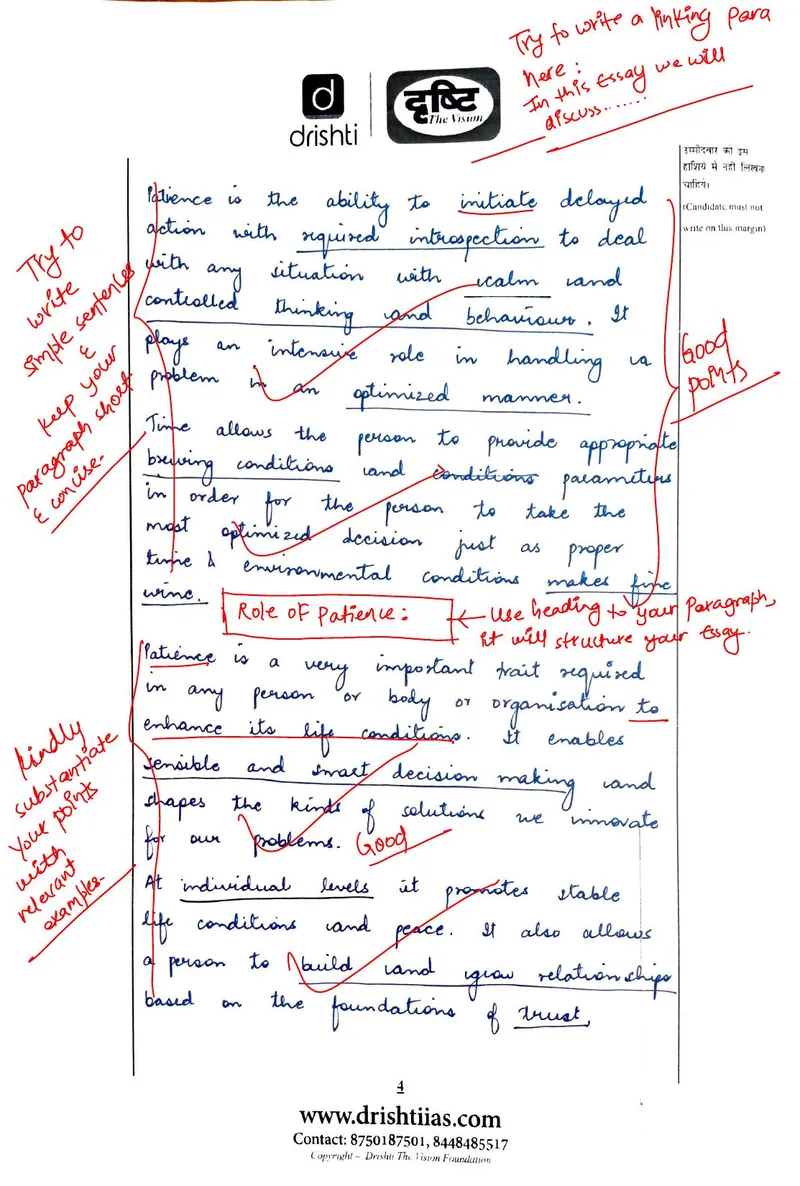
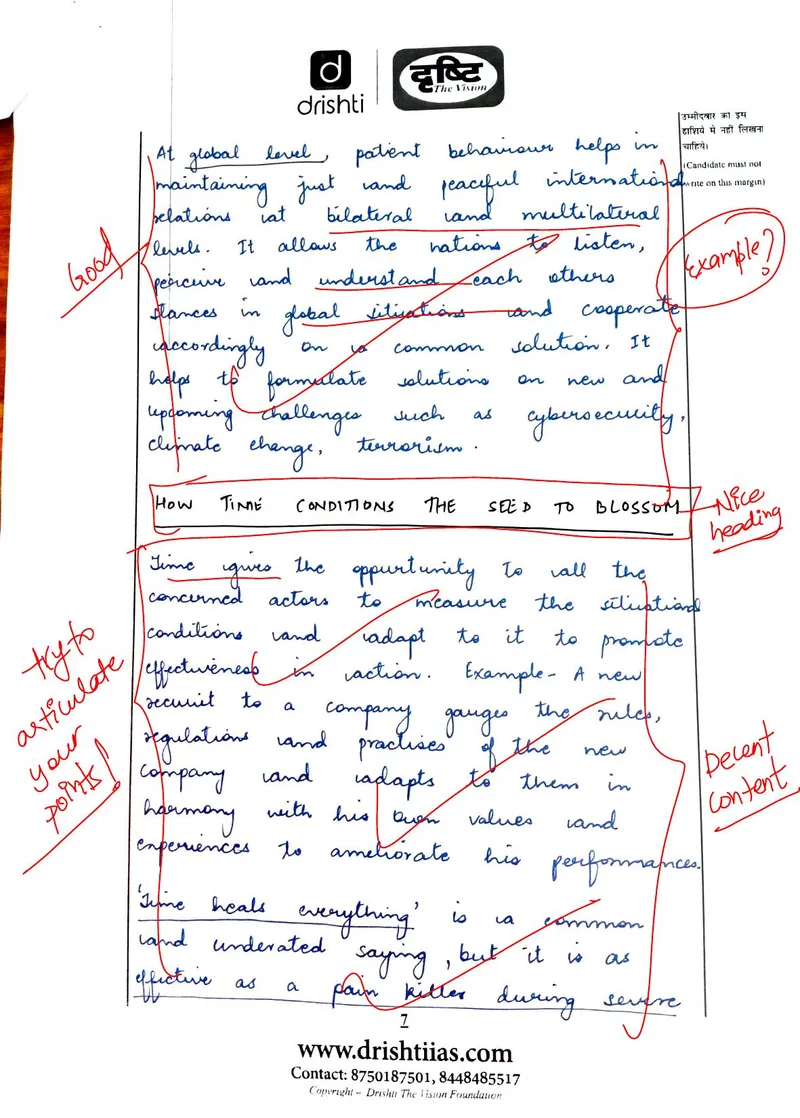
- ▸Signature technique: argues every theme across a tidy ladder of individual → societal → organisational → national → global levels
- ▸Rich, current example bank — 1971 War/Manekshaw, Galwan 2020, Taliban engagement, RBI repo management, Pew 2017 data, Panchamrit
- ▸Builds genuine balance: both essays carry a dedicated counter-section (patience can backlash; uniformity is sometimes required)
- ▸Uses capitalised question-headings as navigation, keeping a long handwritten essay readable and examiner-friendly
- ▸Closes each essay with a concrete way-forward rather than a generic summary
What to learn from this copy
- ★Pairs a positive and negative instance of the SAME theme to argue causally, not just name-drop: in Essay A she uses Gen. Manekshaw asking Indira Gandhi for three months to prepare before the 1971 war (patience -> victory) AND the 2020 Galwan clashes framed as impatient/impulsive behaviour. -> For abstract-quote essays, mine each example as evidence for or against the thesis; a matched pro/anti pair proves the idea better than a list of unconnected achievements.
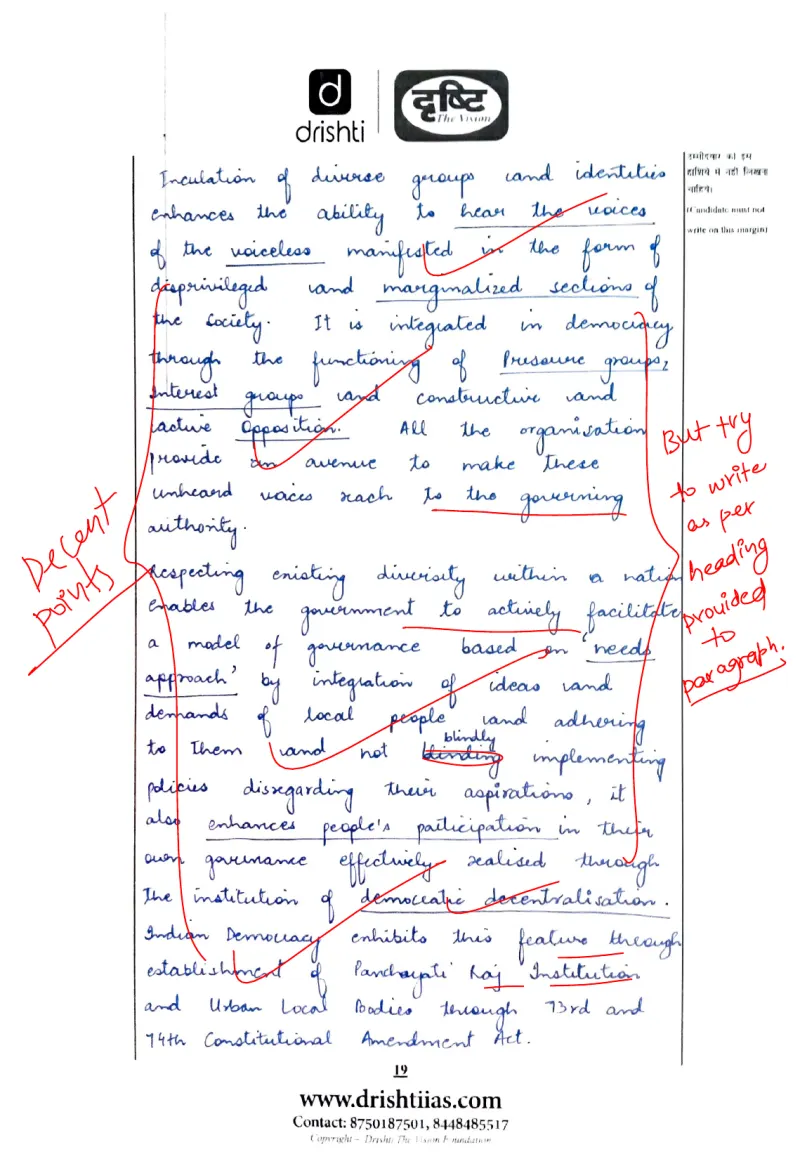
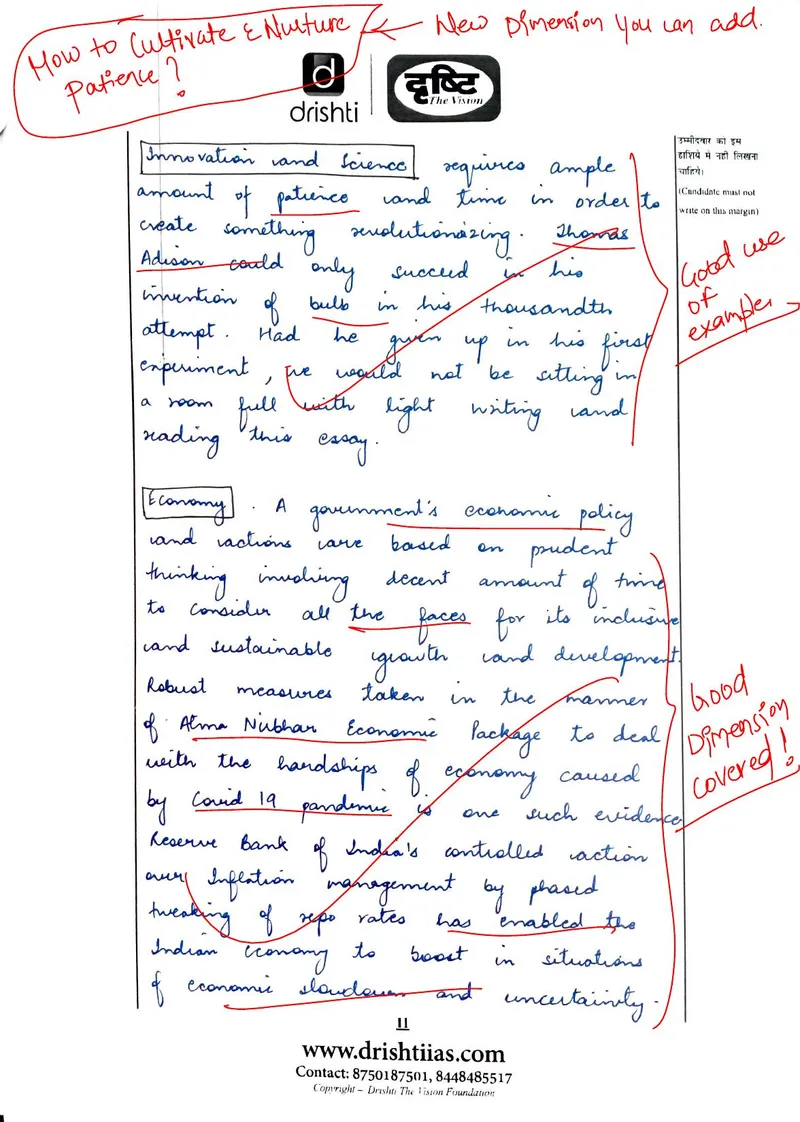
- ★Runs every theme up a fixed ladder — individual -> societal -> organisational -> national -> global (e.g. Essay A moves from Edison's perseverance to RBI's phased repo-rate inflation management to India's calibrated Taliban/Russia-Ukraine stance). -> Keep one reusable scaffold of widening scales so a single abstract prompt instantly yields breadth across dimensions instead of a one-note argument.
- ★Builds a deliberate counter-section in BOTH essays rather than arguing one-sidedly: 'patience can backlash' in Essay A and 'why uniformity is sometimes required' in Essay B. -> A dedicated antithesis block signals balanced, non-dogmatic thinking — examiners reward the essay that argues against itself before resolving.
- ★Grounds the democracy essay in genealogy plus one hard statistic: opens with Cleisthenes founding democracy in Athens and the Demos+Kratos etymology, traces Magna Carta and Social Contract thinkers (Hobbes/Locke/Montesquieu), then anchors with Pew 2017 data (57% of 167 surveyed countries are democracies). -> Trace a concept from its origin and back the claim with one precise figure; etymology-to-data depth beats vague generalities.
- ★Uses capitalised headings that restate the question as navigation ('EMBRACING DIVERSITY: WHY AND HOW?', 'CULTURE OF DIALOGUE AND COMPROMISE') and closes each essay with a concrete way-forward instead of a generic summary. -> Mirror the prompt's own words in your sub-headings so a long handwritten essay stays examiner-friendly and visibly on-topic, and end on actionable resolution.
Questions attempted: Patience and time grow the seed that blossoms into wisdom; Democracy is not about uniformity; it is about embracing diversity and fostering a culture of dialogue and compromise.
Questions attempted in this booklet (2)+
- Section A – Topic 4.Patience and time grow the seed that blossoms into wisdom
- Section B – Topic 7.Democracy is not about uniformity; it is about embracing diversity and fostering a culture of dialogue and compromise
Examples, data & evidence used
- Essay A: 1971 India-Pakistan War — Gen. Sam Manekshaw advising Indira Gandhi to give the army three months to prepare, leading to victory
- Essay A: Thomas Edison inventing the bulb on his ~1000th attempt (perseverance)
- Essay A: Indian National Movement — Moderates' prayer-and-petition approach; Gandhiji's Satyagraha / non-violence
- Essay A: COVID-19 Economic Package and RBI inflation management via phased repo-rate tweaking
- Essay A: 2020 India-China border (Galwan) clashes attributed to impatient/impulsive behaviour
- Essay A: India's calibrated Afghanistan/Taliban engagement (shift from 'Afghan-led, owned' to engaged) and neutral stance on Russia-Ukraine war
- Essay A: District Magistrate of Noida (Suhas) listening to residents; India's Panchamrit and EU carbon-neutral-by-2050 commitment; 'March Run' year-end spending as a negative example
- Essay B: Cleisthenes founding democracy in Athens; Demos + Kratos etymology
- Essay B: Magna Carta (13th-century England) as early surrender of monarchical power
- Essay B: 2017 Pew Research — 57% of 167 countries surveyed adopted a democratic model
- Essay B: Hobbes, Locke (Social Contract), Montesquieu (Separation of Powers); French Revolution ideals of liberty, equality, fraternity
- Essay B: 73rd & 74th Constitutional Amendment Acts (Panchayati Raj / Urban Local Bodies); NITI Aayog and 7th Schedule; Universal Adult Franchise
- Essay B: Indian reservation (SC/ST/Women/EWS/Disabled) vs American race-based affirmative action
- Essay B: Inter-State Councils, Zonal Councils, River Water Boards; Karnataka-Maharashtra (Belgaum) border & Cauvery water disputes
Quotes the candidate used
- 'Time heals everything' (used as a common saying; no author attributed)
- 'Time and tide waits for none' (proverb; no author attributed)
- 'Better late than never' (in rough-work notes; no author attributed)
- Pluralist Theory of power referenced via Raymond Aron in Essay B (cited as a thinker, not a direct quote)
How it’s written: Both essays follow a clear intro–body–conclusion arc with capitalised sub-headings as signposts. Essay A uses headings such as 'HOW TIME CONDITIONS THE SEED TO BLOSSOM' and 'INSTANCES OF BLOSSOMING WISDOM'; Essay B uses 'EMBRACING DIVERSITY: WHY AND HOW?', 'CULTURE OF DIALOGUE AND COMPROMISE', 'WHY UNIFORMITY IS NOT…
Diagrams & visuals: None clearly visible in the text layer — both pieces are prose essays carried by capitalised sub-headings rather than figures; the appended rough-work pages contain only outline flow-arrows and bracketed planning notes, not formal diagrams or maps
Evaluator: Marks clearly written on the cover sheet: Section A (Topic 4) = 47, Section B (Topic 7) = 39, Grand Total = 86/250. A printed six-point Drishti feedback rubric is on the cover (1. Context, 2. Introduction, 3. Content, 4. Language/Flow, 5…