
Pedditi Dhatri Reddy — ForumIAS MGP Copy 1
What’s inside this copy
- ▸Cover confirms the candidate: 'DHATRI REDDY', Roll 1910016125, ForumIAS FIAS-2018 GS Paper 2 (Test Code 11034), online mode, 15/9/2018.
- ▸CONTAMINATION: only ~7 answer images are Dhatri's; 11 answer images belong to a different candidate (different hand, no scan header, separate 2x2 feedback template).
- ▸The intruding pages are from a later/different paper — they cite the 'recent Balakot strike' (Feb 2019), impossible in a Sept-2018 exam.
- ▸Copy is unevaluated: no marks in the index table, no ticks in the parameter grid, all per-question feedback boxes blank.
- ▸Dhatri's answers are crisp, point-wise and well within the 150-word format, with clear sub-headings and explicit conclusions.
- ▸Strong visual structuring — YES/NO comparison table (secularism), tree diagram (UNESCO functions), mind-map (welfare transparency).
What to learn from this copy
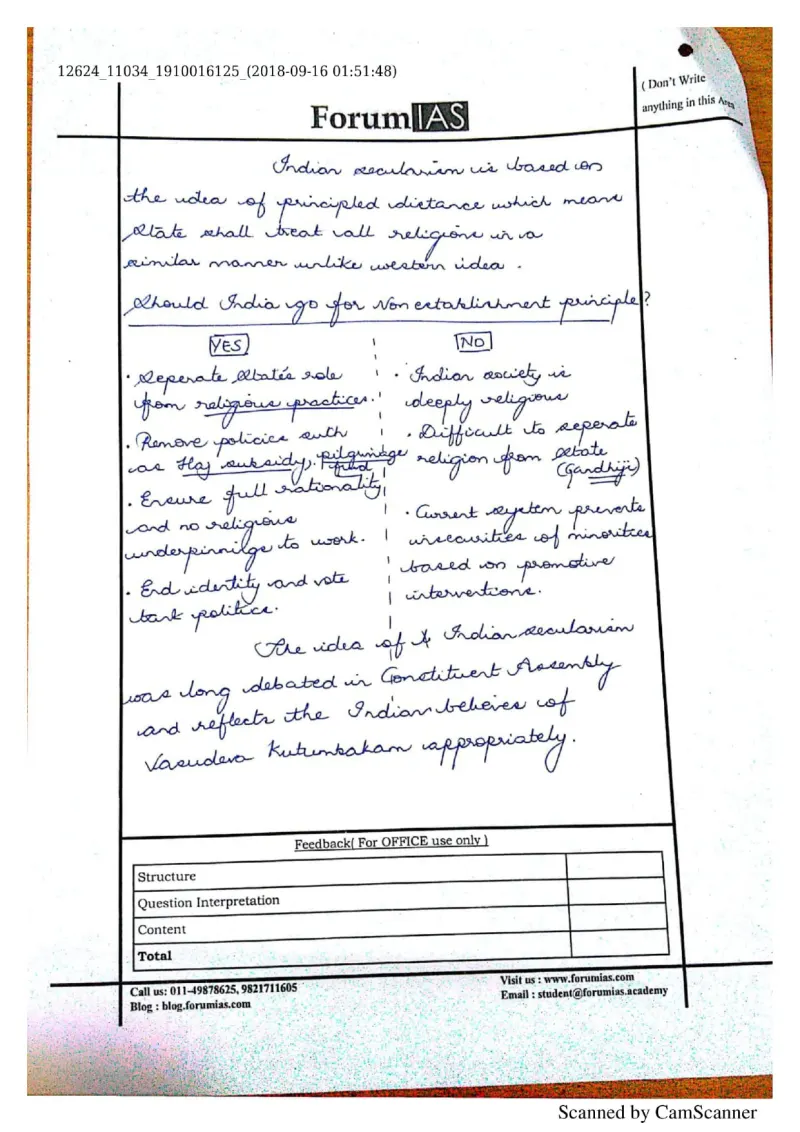
- ★On the secularism question (Q2), Dhatri didn't just describe Indian secularism — she anchored it on the concept of 'principled distance' as the defining contrast with the US non-establishment model, laid the two models side-by-side in a YES/NO comparison table, brought in Gandhiji, and closed with 'Vasudhaiva Kutumbakam'. -> When a question asks 'should India adopt X foreign model', frame the whole answer around one sharp distinguishing concept and adjudicate it in a two-column table rather than writing loose paragraphs.
- ★She used the Economic Survey as a recurring analytical anchor across unrelated questions — competitive federalism (Q3), ease of doing business (Q4), judicial pendency (Q5), and subsidy/welfare leakage (Q10). -> Master one or two authoritative source documents deeply enough that you can deploy them as evidence across many different GS answers, instead of hunting for a fresh example each time.
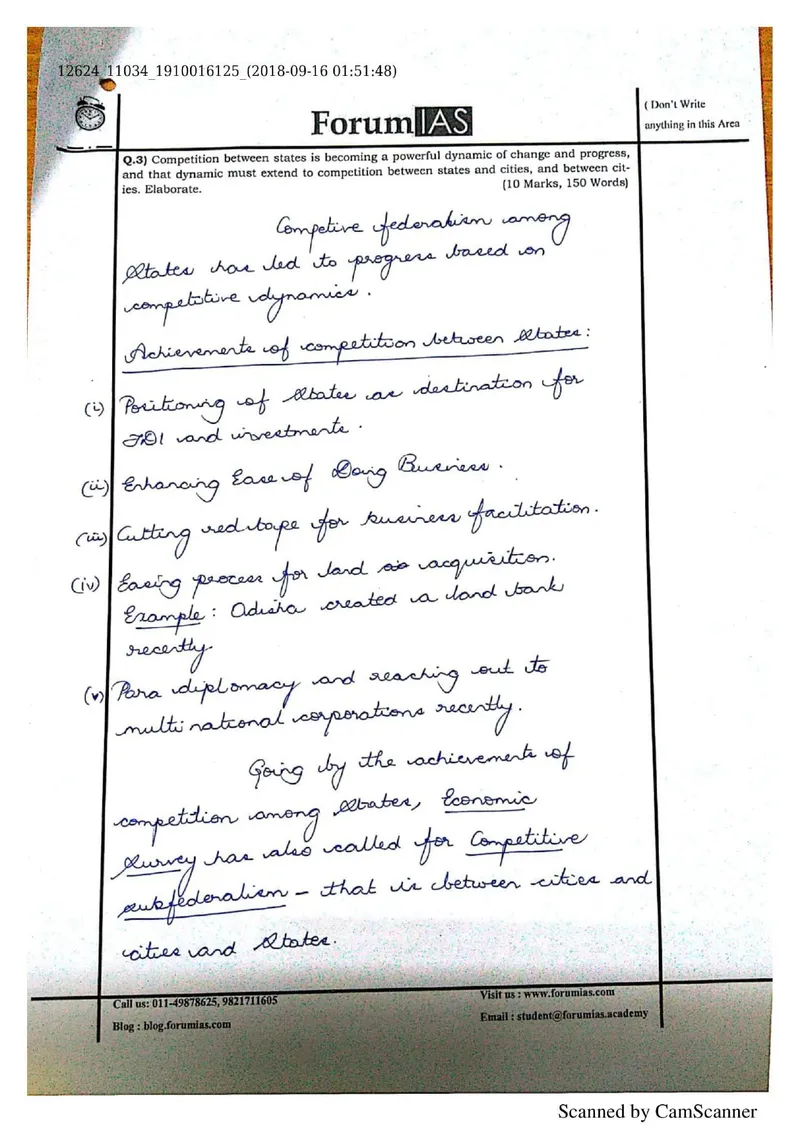
- ★Her examples are specific and current rather than vague: 'Odisha created a land bank' for FDI/ease of doing business, Hyderabad and Bangalore as competition-driven service-sector hubs (Q3), MKSS as the model of social audit, and India placed 'at 145' on the Global Hunger Index (Q6). -> Replace generic claims with one named, concrete instance (a specific state scheme, a named civil-society model, an exact index rank) — it signals you actually know the terrain.
- ★She converted content into purpose-built visuals matched to the question type: a branching tree/flowchart for 'Functions of UNESCO' (Q8) and a mind-map with branching arrows for welfare transparency and free flow of information (Q10). -> Use a diagram that fits the demand — a tree for mapping functions/components, a mind-map for showing interconnected drivers — not a decorative box.
- ★Even in the strict 150-word limit, her genuine pages run tightly point-wise: a short intro, numbered/roman sub-points under bold-underlined sub-headings ('FACTORS:', 'Socio-economic / Politico-cultural', 'Need for further competition', 'Way Forward'), and an explicit closing line ('Thus...', 'Way Forward:'). -> Pre-decide a skeleton of labelled sub-headings before writing so a short answer still reads as structured analysis with a clear conclusion, never as a wall of text.
Questions attempted: Montague-Chelmsford Reforms as basis for GoI Act 1935 & the Constitution (image-verified, Dhatri's hand, pp.3-4); Constitution's secular character from collective reading of provisions; should India adopt US-style non-establishment principle (image-verified, p.6); Competitive federalism — competition between states, and between states & cities (image-verified, p.8), and 6 more below.
Questions attempted in this booklet (9)+
- 1.Montague-Chelmsford Reforms as basis for GoI Act 1935 & the Constitution (image-verified, Dhatri's hand, pp.3-4)
- 2.Constitution's secular character from collective reading of provisions; should India adopt US-style non-establishment principle (image-verified, p.6)
- 3.Competitive federalism — competition between states, and between states & cities (image-verified, p.8)
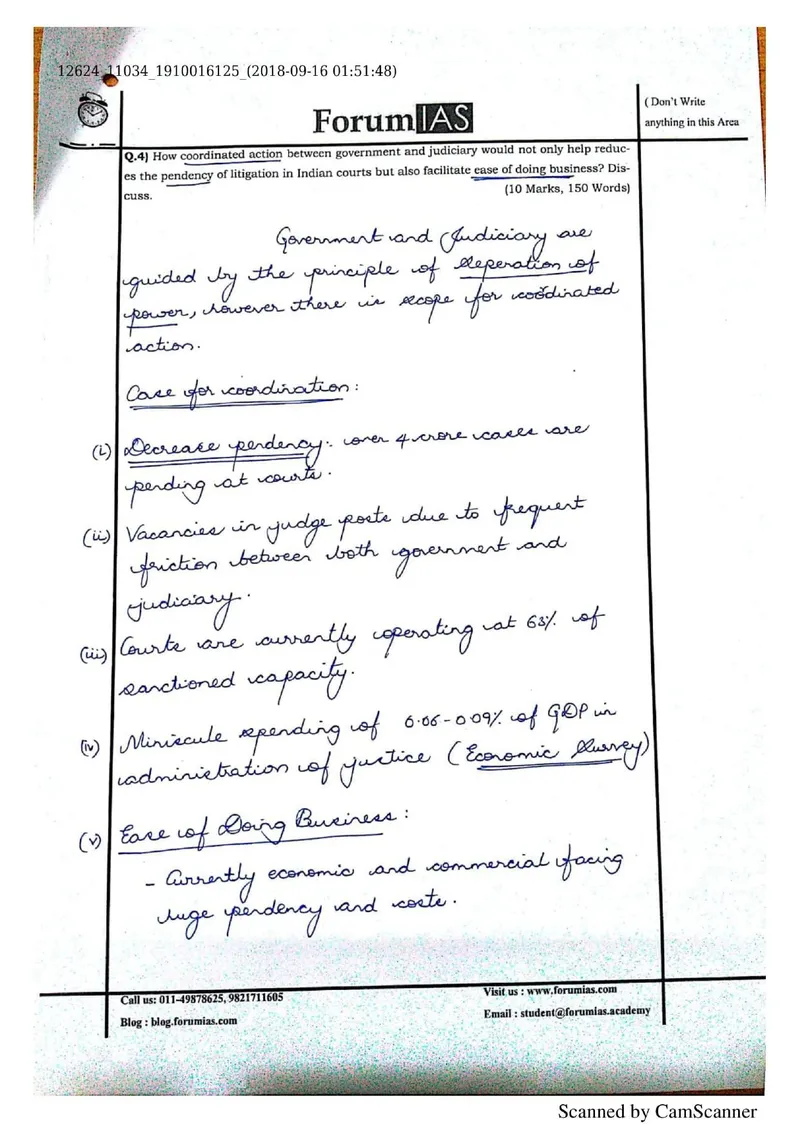
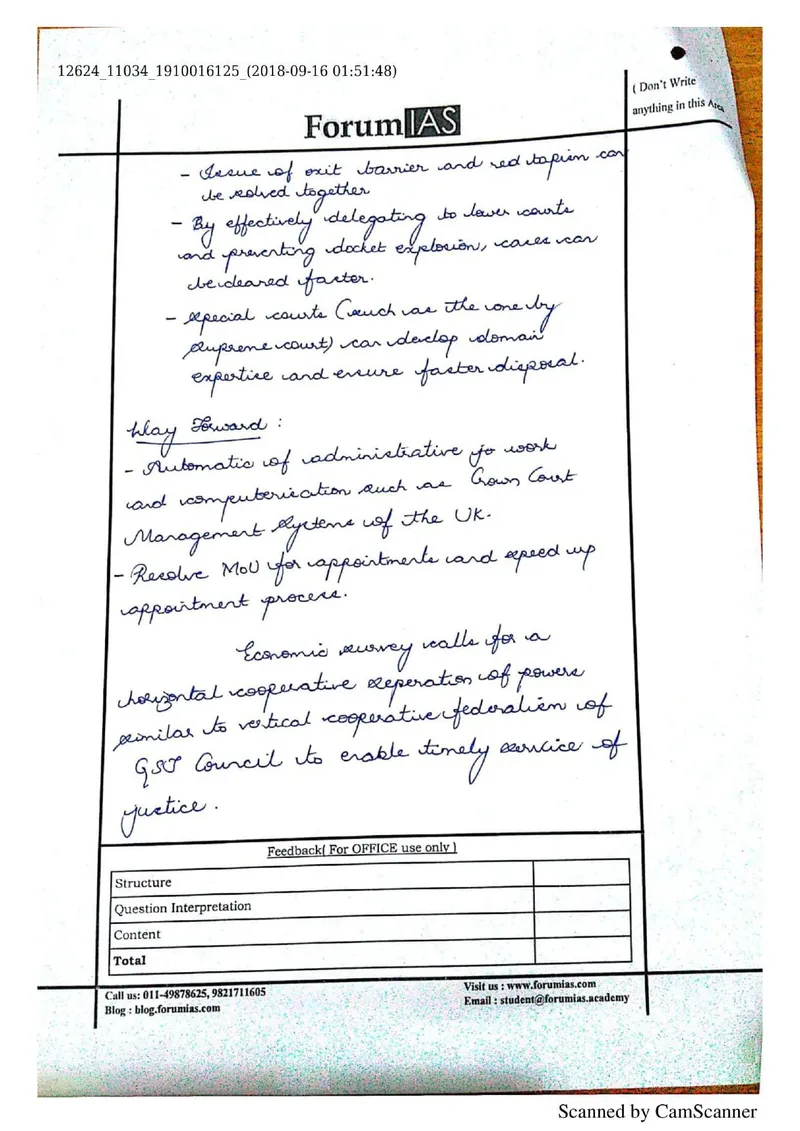
- 4.Coordinated govt-judiciary action to cut litigation pendency & ease of doing business (text-layer only; her image page replaced by the other candidate's page)
- 5.Demand for judicial accountability & transparency in higher judiciary; how to ensure it (text-layer only; image page replaced)
- 6.Global Hunger Index low rank — socio-economic & politico-cultural causes of man-made starvation (image-verified, p.13)
- 8.UNESCO functions & how far it has met its mandate (image-verified, p.15)
- 9.India-France strategic-autonomy partnership adapting to changing global context (text-layer only; image page replaced)
- 10.Capture of social-welfare benefits prevented by transparency & free flow of information (image-verified, p.20)
Examples, data & evidence used
- Economic Survey — repeatedly invoked as the analytical anchor (Q3 competitive federalism, Q4 ease of doing business, Q5, Q10 subsidy leakage)
- Odisha created a land bank recently (Q3, FDI/ease of doing business)
- Hyderabad & Bangalore both rendered as service-sector destinations via competitive growth (Q3, image-verified p.8)
- MKSS as a model of social audit (Q10, image-verified p.20)
- Gandhiji invoked in the non-establishment debate (Q2, image-verified p.6)
- Global Hunger Index — India placed very low (she wrote India 'at 145'); one of the worst performers (Q6, image-verified p.13)
- UNESCO World Heritage list awareness; US withdrawal citing bias; mandate overlap with UNICEF (Q8, text-layer + p.15)
- France supports India's UNSC permanent-seat bid; defence/technology-transfer cooperation (Q9, text-layer)
- Collegium opacity and the dissent by 4 judges cited for judicial-transparency demand (Q5, text-layer)
Quotes the candidate used
- 'Vasudeva Kutumbakam' (Vasudhaiva Kutumbakam) — used to close the secularism answer (Q2, image-verified p.6); no author attributed
- 'Principled distance' — invoked as the defining idea of Indian secularism vs the Western model (Q2); a concept/phrase, not an attributed quotation
How it’s written: Dhatri's answers (the genuine pages) are tightly point-wise: short intro, numbered/roman sub-points under bold-underlined sub-headings (e.g., "Features of...", "FACTORS:", "Socio-economic / Politico-cultural", "Need for further competition", "Way Forward"), and an explicit concluding line ("Thus...", "Way Forward:")…
Diagrams & visuals: Q2: two-column YES/NO comparison table weighing the non-establishment principle (image-verified p.6); Q8: branching tree / flowchart with arrows mapping 'Functions of UNESCO' (image-verified p.15); Q10: mind-map / flow diagram with branching arrows for 'Transparency in political systems' and 'Free flow of information' (image-verified p.20); No geographical maps used in Dhatri's pages
Evaluator: No examiner marks or comments are filled in on this copy.