Shakti Dubey secured All India Rank 1 in UPSC CSE 2024.
This collection contains eight of her Vajiram & Ravi “Sure Shot” mains test-series booklets — two each for GS Paper 1, GS Paper 2, GS Paper 3 and GS Paper 4 (Ethics).
We read 4 of these booklets page by page — below is exactly what’s inside: the questions Shakti attempted, the examples and quotations used, and how each answer was structured. Every copy is a free PDF.
AIR 1 · CSE 20248 free PDFsUpdated 29 Jun 2026
Inside Shakti Dubey’s answer copies
Shakti Dubey — GS Paper 1 (Sure Shot Test 01)
GS Paper 1PDF · 14.4 MB
What’s inside this copy
▸Definition-first discipline: she literally opens almost every answer by defining the keyword before arguing — a clean, repeatable intro template
▸Heavy use of boxed, underlined mini-headings plus numbered points makes each answer skimmable in seconds — strong presentation under time pressure
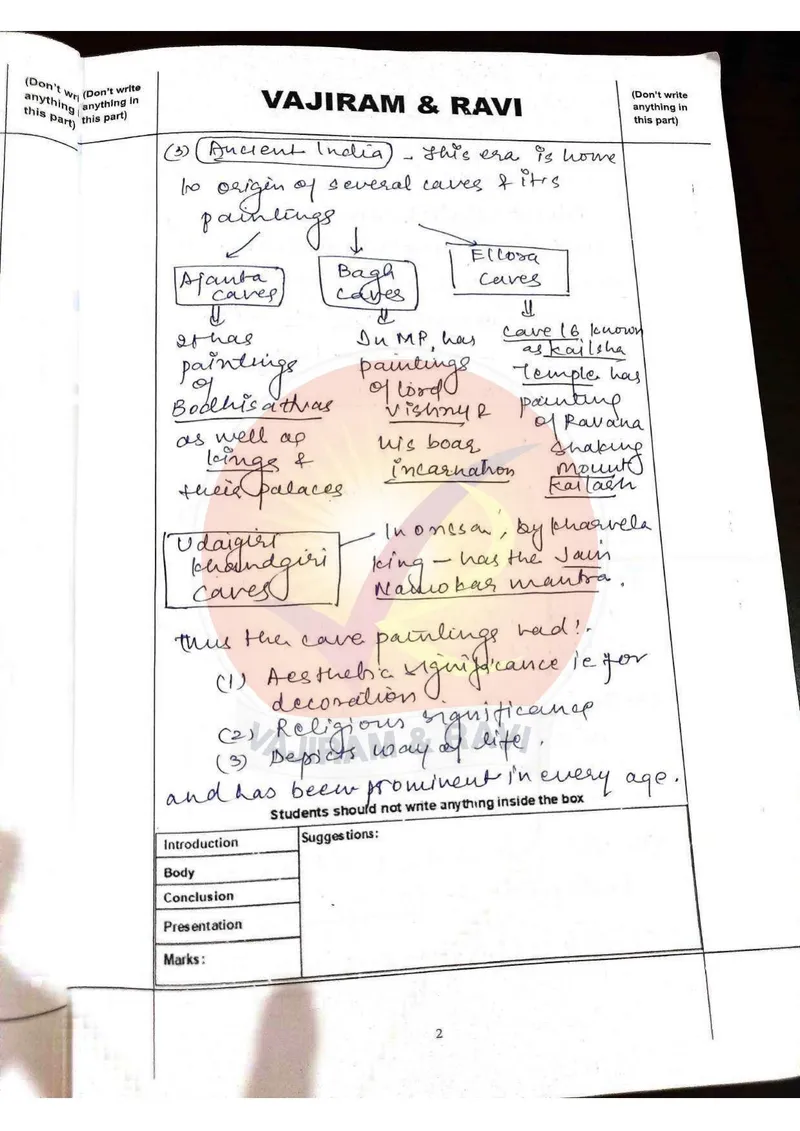
▸Diagrams are simple but effective: a boxed flowchart of cave sites (Q1), a plate-boundary branch tree (Q9), and a hand-drawn world sketch-map for palm-oil producers (Q16)
▸Every conclusion starts with 'Thus…' and lands a balanced one-liner ('double-edged sword', 'need for judicious use of water') — a tidy sign-off formula
▸Topical, current examples carry the GS1 answers: Cyclone Remal (2024), G20 gifts of Indian crafts, Joshimath subsidence, IPCC 6th Assessment Report, MSP-at-WTO
▸Full coverage: all 20 questions attempted with even depth (10-markers ~2 pages, 15-markers ~3 pages) — the evaluator's top praise was completing every question with equal attention
What to learn from this copy
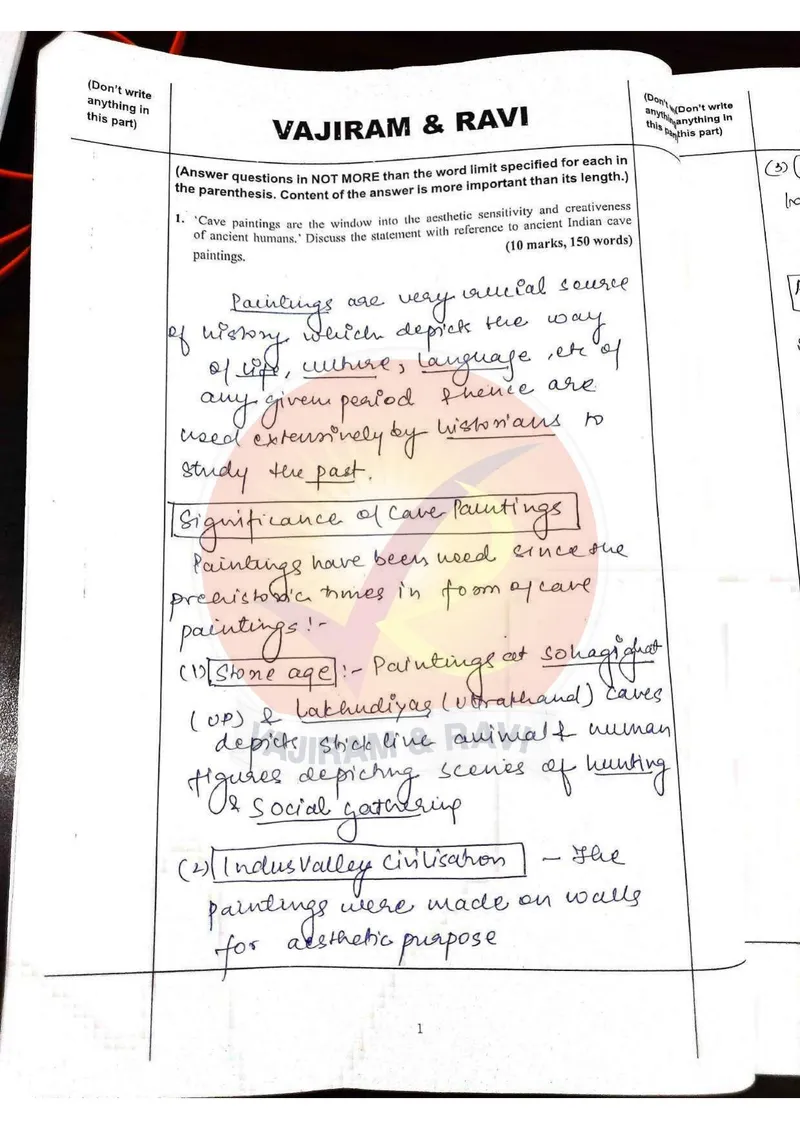
★She opens almost every answer with a one-line definition of the keyword before arguing ('Foreign policy can be defined as...', 'Globalisation can be defined as...', 'Communalism can be defined as...', 'Paintings are a very crucial source of history...') -> build one reusable definition-led intro template so you settle the demand and start the body in seconds instead of burning time hunting for an opening.
★For factual GS1 questions she packs specific, named instances rather than vague description: Q1 cites exact cave sites with their content (Sohagighat & Lakhudiyar stone-age caves, Ajanta Bodhisattvas, Ellora Cave 16 Kailasha showing Ravana shaking Mount Kailash, Udayagiri-Khandgiri with Kharavela and the Jain Namokar mantra) -> memorise 4-5 concrete, attributable examples per static topic so an art/history answer reads as evidence, not generalities.
★She converts geography answers into the same branch/tree typology diagram repeatedly — plate boundaries (divergent/transform/convergent) feeding island formation in Q9, and the same branch style for cyclones (temperate/tropical), coral reefs (barrier/atoll/fringing) and ozone (tropospheric/stratospheric) -> pre-practise one classification-diagram format you can deploy on any 'types/formation of X' question to show structure fast.
★She anchors GS1 in current affairs the examiner will recognise: Cyclone Remal (2024) and Hamoon (2023) in Q10, G20 summit gifts of Indian crafts in Q14, plus Joshimath subsidence, IPCC 6th Assessment Report and the MSP-at-WTO issue -> deliberately wire one recent, datable hook into each static GS1 answer to lift it above textbook content.
★She closes with a fixed sign-off formula — every conclusion starts 'Thus...' and lands a balanced one-liner like 'double-edged sword' or 'need for judicious use of water' -> keep a tight, pre-set conclusion stub so you never trail off mid-thought when time runs short.
★She attempted all 20 questions with even depth (10-markers ~2 pages, 15-markers ~3 pages), and this completeness was the evaluator's top praise -> spreading effort evenly to finish the full paper, rather than over-investing early answers, is itself a scoring strategy the marker rewarded.
Questions attempted: Cave paintings as window into aesthetic sensitivity of ancient humans (10m/150w); Subsidiary Alliance turning 'British Empire in India' into 'of India' (10m/150w); Mass nationalism as watershed; reaction of Indian business community (10m/150w), and 17 more below.
Questions attempted in this booklet (20)+
1.Cave paintings as window into aesthetic sensitivity of ancient humans (10m/150w)
2.Subsidiary Alliance turning 'British Empire in India' into 'of India' (10m/150w)
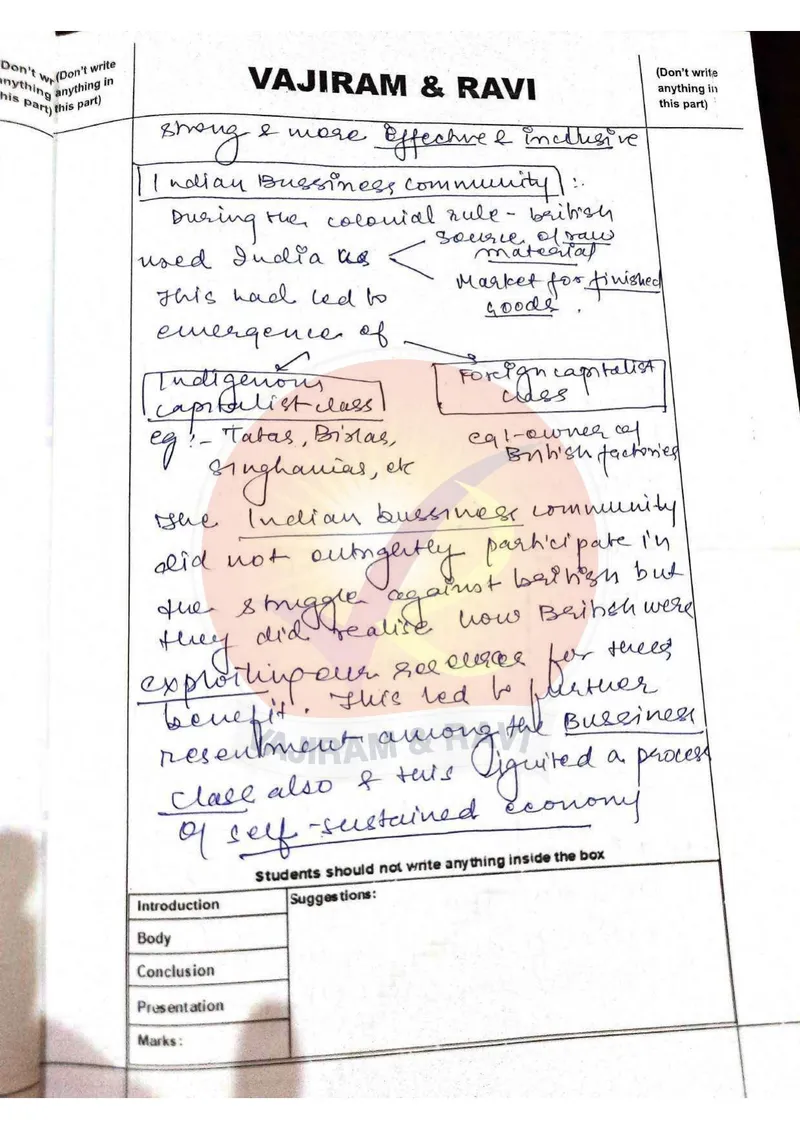
3.Mass nationalism as watershed; reaction of Indian business community (10m/150w)
4.Non-alignment as bedrock of Indian foreign policy (10m/150w)
5.Colonial legacy as primary source of political instability in Africa (10m/150w)
6.Sustainable urban development & reassessment of land-use patterns (10m/150w)
7.Socio-cultural vs economic factors in women's migration in India (10m/150w)
8.Significance of IT industries in promoting regional development (10m/150w)
9.Formation of islands in the Indian Ocean Region (10m/150w)
10.Major tropical cyclones of 2023-2024 and impacts on local communities (10m/150w)
11.Gandhi as 'true disciple' of Tilak; Gandhian methods vs extremism (15m/250w)
12.'Partition was a necessary evil' — analyse (15m/250w)
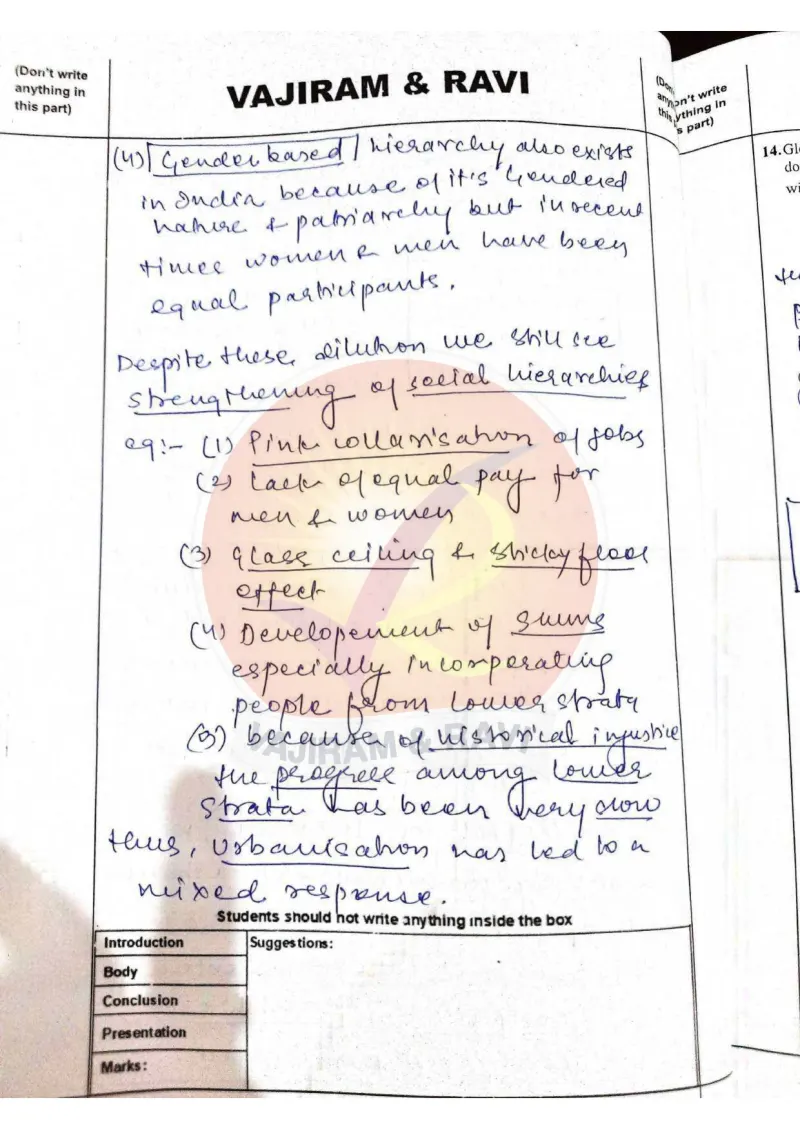
13.Extent to which urbanisation influenced social hierarchy in India (15m/250w)
14.Effects of globalisation on the Indian craft industry (15m/250w)
15.Rise of communalism & measures to contain it (15m/250w)
16.Distribution of major palm-oil producing countries & their environmental issues (15m/250w)
17.Water as the chief architect of the earth's surface (15m/250w)
18.'Tropical rainforests of the ocean' (coral reefs) under threat; rejuvenation measures (15m/250w)
19.Geographical concentration of ozone holes & remedial measures (15m/250w)
20.Global warming & extreme weather; recent natural hazards in Indian subcontinent (15m/250w)
Q2: Richard Wellesley (Subsidiary Alliance); Doctrine of Lapse under Dalhousie; states annexed — Hyderabad, Bharatpur, Satara, Jaunpur
Q3: Mahatma Gandhi, Satyagraha & non-violence (South Africa); business houses Tatas, Birlas, Singhanias; indigenous vs foreign capitalist class
Q4: NAM as Nehru's brainchild; co-leaders Nasser (Egypt), Sukarno (Indonesia), Tito (Yugoslavia), Kwame Nkrumah; Russia-Ukraine war (India bought oil); MSP issue at WTO; mixed-economy model; '76 years of independence'
Q5: Scholars Hamza Alavi & Kwame Nkrumah; 'overdeveloped state' / 'soft states' concepts; military coups in Angola, DRC, Somalia; Scramble for Africa
Q6: NITI Aayog 'SFNI@75' — by 2050 ~50% of India urban; urban heat islands; Miyawaki method for urban forestry; sponge cities
Q7: MoSPI migration report; marriage as dominant driver of women's migration vs men's economic migration; agriculture/animal husbandry
Q9: Plate interactions (divergent/transform/convergent); Pacific Ring of Fire; seamounts; coral islands — Lakshadweep, Bali, Sumatra; coral polyps/calcareous deposits
Q10: Temperate (frontal) vs Tropical (thermal) cyclones; Cyclone Hamoon (2023); Cyclone Remal (2024, Bangladesh coast, May); early-warning systems
Q11: Gandhi entered politics 1915; Tilak active from early 20th c.; Swarajya; Home Rule League; Satyagraha vs sedition/extremism
Q12: 15 Aug 1947; Revolt of 1857; Divide & Rule; Two-Nation Theory; Quit India Movement & WWII; August Offer, Cripps Mission, Wavell Plan; C. Rajagopalachari formula, Desai-Liaquat Pact; opposed by Maulana Azad, Gandhi, Khan Abdul Ghaffar Khan
Q14: 'Global village'; Banarasi & Kanchipuram silk sarees; Channapatna toys, Moonj products; cheap Chinese machine-made toys; G20 Summit gifts of crafts to foreign leaders
Quotes the candidate used
Q12: '...We will let them have Pakistan, instead of having unrest for years to come' — written by the candidate (in quotes) as the view of leaders like Rajagopalachari & Nehru; it is her paraphrase rather than a sourced verbatim quotation
Q12: 1857 Revolt described as the 'first war of independence', attributed to V.D. Savarkar
Note: the candidate uses very few quotations/thinkers overall — the evaluator explicitly suggested she 'explore some philosophers/leaders for effective arguments'
How it’s written: Strongly templated, exam-disciplined structure. Intro is definition-led — she opens almost every answer by defining the key term ('Paintings are a very crucial source of history...', 'Foreign policy can be defined as...', 'Globalisation can be defined as...', 'Communalism can be defined as...'). Body is built from n…
Diagrams & visuals: Flowchart with boxed nodes and arrows — cave sites in Q1 (Ajanta / Bagh / Ellora boxes; separate Udayagiri-Khandgiri box); Branch/tree classification diagram — plate-boundary interactions (divergent / transform / convergent) feeding island formation, Q9; Hand-drawn sketch world map with shaded regions (India, Africa, South-East Asia labelled) for palm-oil distribution, Q16; Recurring boxed and heavily-underlined sub-headings used as a visual structuring device across nearly every answer; OCR text-layer indicates similar small typology branches were also drawn for cyclones (temperate/tropical), coral reefs (barrier/atoll/fringing) and ozone (tropospheric/stratospheric) — consistent with the branch style verified on images
Evaluator: No numeric marks are written on this booklet (a test-series fair copy).
▸Every one of the 20 answers opens with a 2-4 line context-setter (a definition, a thinker, a data point, or a current-affairs hook) before a boxed/underlined sub-heading.
▸Answers are written almost entirely in crisp numbered points with keywords underlined, not flowing paragraphs — built for fast examiner scanning.
▸Hand-drawn outline maps anchor all three IR-heavy answers: BBIN, the Gujral Doctrine neighbourhood, and the Indian Ocean rim (IORA).
▸Visual compression tools recur: a Venn diagram (Government ∩ Citizen = Civil Servants) and spider mind-maps for civil-service values and features of good governance.
▸The 15-mark answers follow a disciplined skeleton: intro -> provisions/analysis -> Issues/Challenges -> Way Forward -> one-line conclusion.
▸Claims are consistently backed by specific data and cases (PRS 33%->16% bill referral, US 25 vs India 108 amendments, Census 2011 elderly 11%, Kesavananda Bharati & IR Coelho, CEC Act 2023, 84th Amendment Act 2002).
What to learn from this copy
★Every one of the 20 answers opens with a 2-4 line context-setter pegged to a fresh, specific hook before the first sub-heading — India-PNG MoU for India Stack (Q17), the PM's Good Governance Day for Mission Karmayogi (Q15), the CEC Act 2023 for the EC question (Q14), India's aid to Sri Lanka for the Gujral Doctrine (Q18). -> Don't open with a textbook definition; lead with a current, answer-specific anchor (a recent MoU, Act, or event) so the examiner sees relevance from line one.
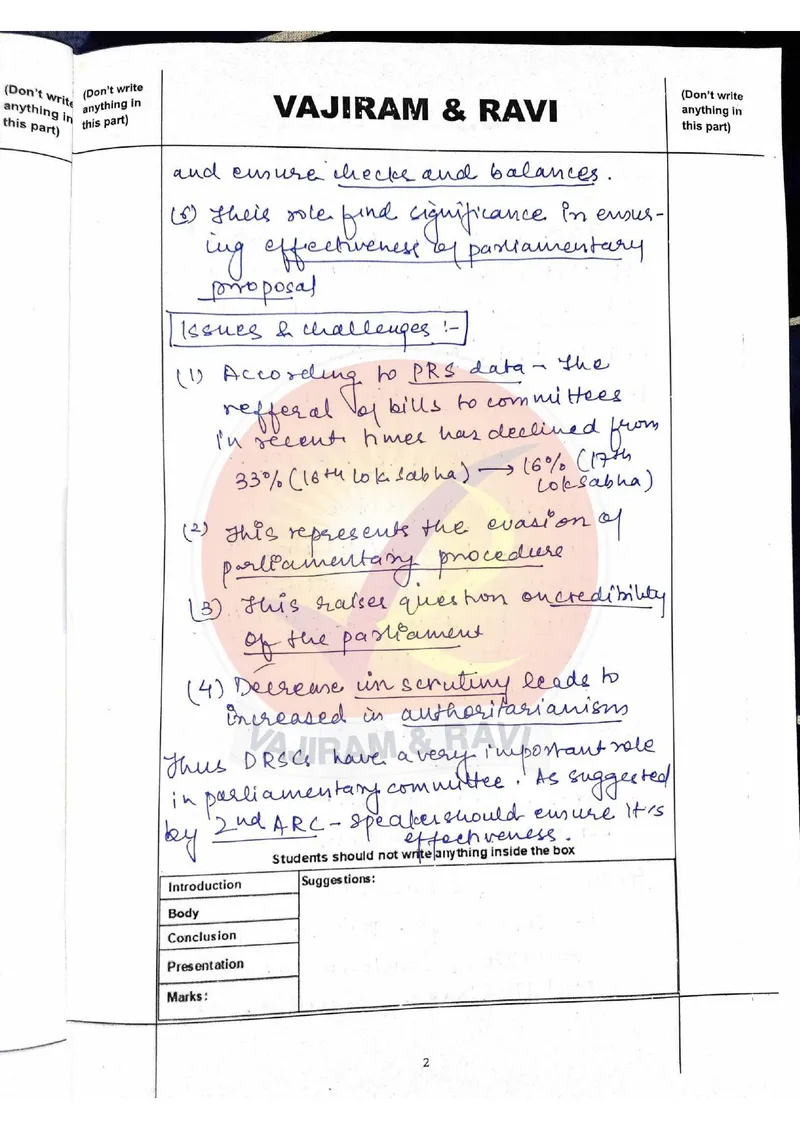
★Claims are nailed down with exact comparative numbers, not adjectives: PRS data showing bill referral to committees fell from 33% (16th LS) to 16% (17th LS) on the DRSC question, US ~25 amendments in two centuries vs India's 108 in 70 years on the flexibility/rigidity question, Census 2011 elderly at 11% on geriatric health, and 84% informal-sector workers contributing over half of GDP for platform workers. -> Memorise a few precise, contrasting data pairs per theme — a single 33%->16% or 25-vs-108 figure proves a point faster than a paragraph of assertion.
★Hand-drawn outline maps anchor all three IR-heavy answers — the BBIN bloc (India + Nepal/Bhutan/Bangladesh) in Q10, the full neighbourhood (China, Pakistan, Nepal, Bhutan, Myanmar, Bangladesh, Sri Lanka) for the Gujral Doctrine in Q18, and the Indian Ocean rim sketch for IORA in Q19. -> When a question is geographically grounded (groupings, neighbourhood policy, maritime regions), a quick outline map instantly demonstrates spatial command that prose cannot.
★Polity and governance answers are validated with the right named authorities and case law rather than generic theory: Kesavananda Bharati and IR Coelho on judicial review/supremacy of the constitution (Q12), and Granville Austin's 'Holding Together' / quasi-federal characterisation paired with the amendment-count contrast on the US-vs-India question (Q4). -> Carry one canonical case or thinker per core constitutional concept so you can cite Kesavananda/Coelho or Austin precisely where the demand calls for it.
★The 15-mark answers run on a disciplined, repeatable skeleton — intro -> provisions/analysis -> Issues/Challenges -> Way Forward -> one-line conclusion — and concepts are compressed visually, e.g. the Venn diagram showing Government n Citizen = Civil Servants in Q15 and spider mind-maps for civil-service values and features of good governance. -> Pre-fix one structural template for 15-markers so you never lose time deciding layout, and reserve a diagram for the one idea best shown as an overlap or web rather than spelled out.
Questions attempted: Role of Department Related Standing Committees (DRSC) in improving parliamentary effectiveness (10m); Presence of multiple parastatals eroding autonomy of Urban Local Bodies (10m); Article 360 (Financial Emergency) remaining a dead letter even in worst economic crisis (10m), and 17 more below.
Questions attempted in this booklet (20)+
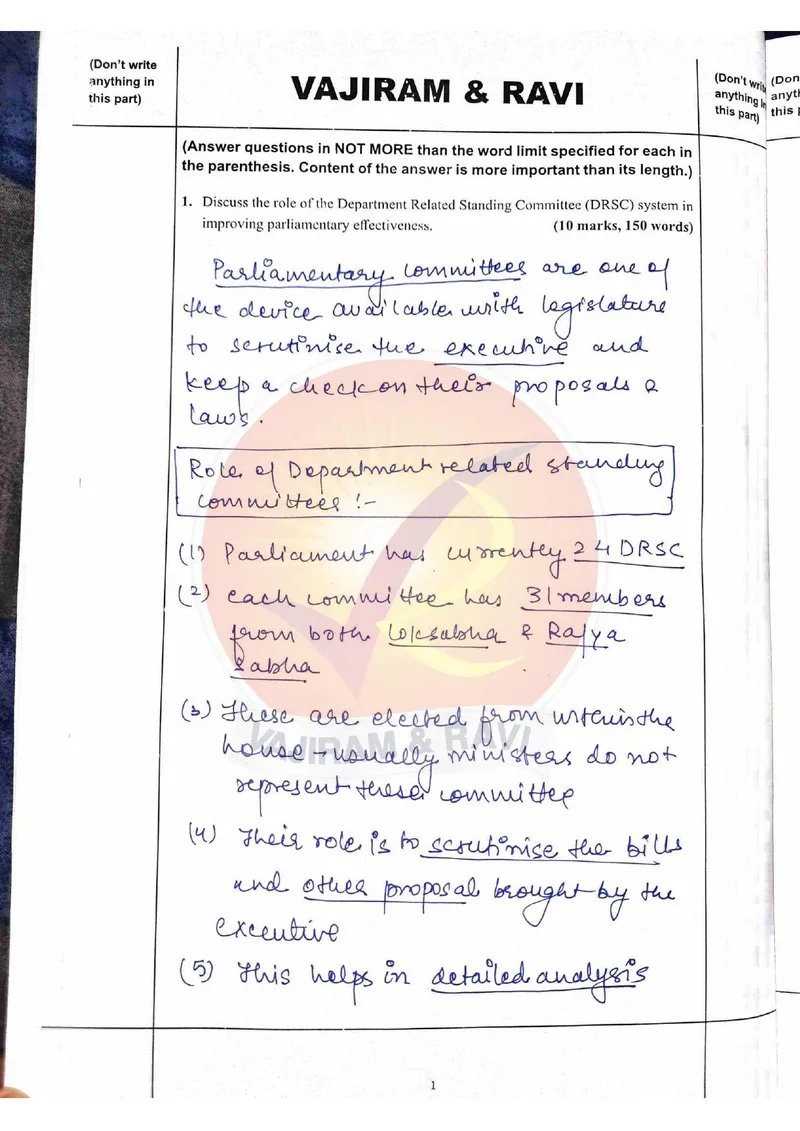
1.Role of Department Related Standing Committees (DRSC) in improving parliamentary effectiveness (10m)
2.Presence of multiple parastatals eroding autonomy of Urban Local Bodies (10m)
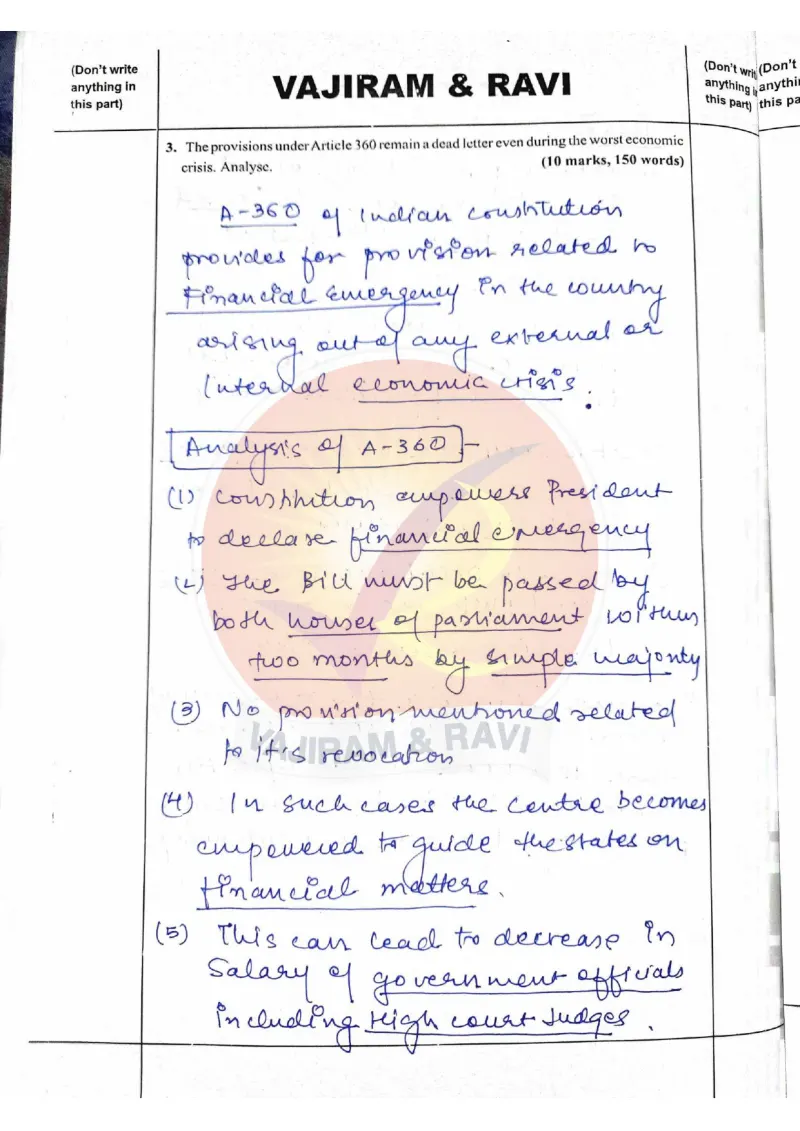
3.Article 360 (Financial Emergency) remaining a dead letter even in worst economic crisis (10m)
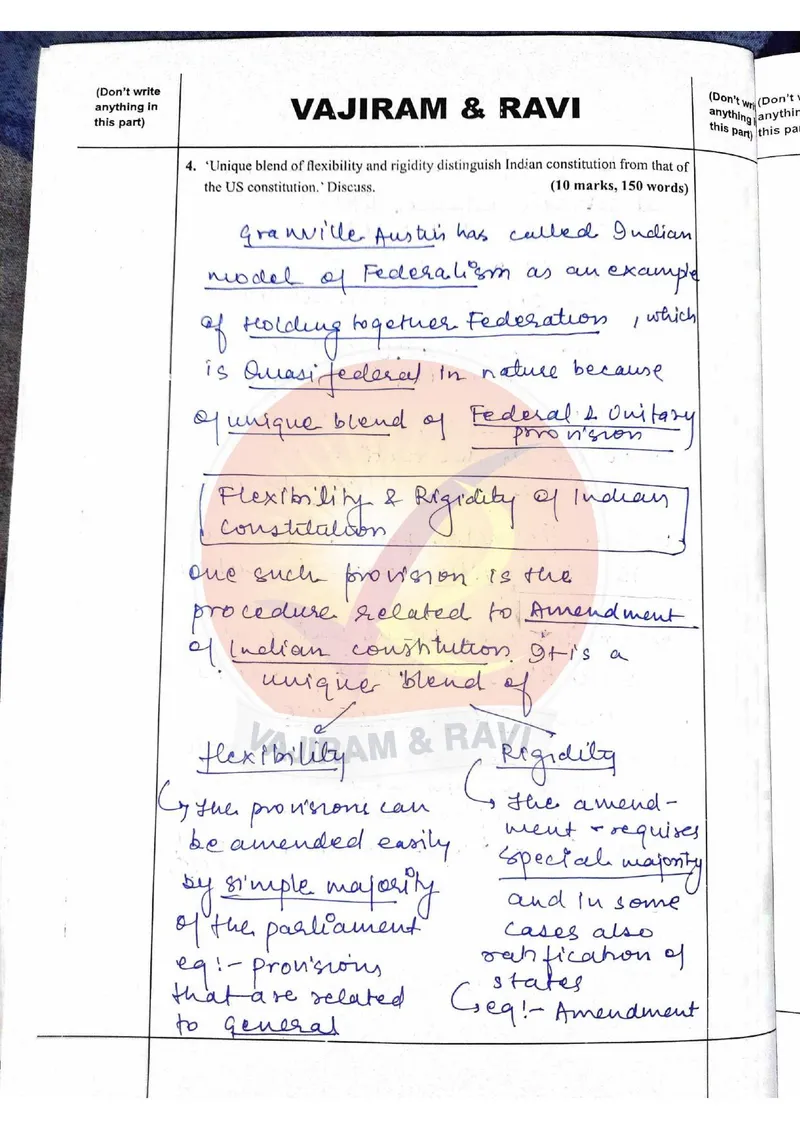
4.Unique blend of flexibility and rigidity distinguishing the Indian constitution from the US constitution (10m)
5.Role of microfinance institutions (MFI) in rural financial empowerment (10m)
6.Aspirational District Programme as a template for good governance (10m)
7.Rising informality in employment and social security, with reference to platform workers (10m)
8.Demographic transition and healthcare intervention, with reference to geriatric health in India (10m)
9.Funding as a limitation for multilateral organisations, with reference to UNESCO (10m)
10.BBIN grouping and regional integration in South Asia (10m)
11.Centre's elastic/substantial vs states' inelastic/inadequate financial resources (15m)
12.Supremacy of the constitution and judicial review in India (15m)
13.Delimitation process as a wedge between representative democracy and federalism; measures for federal units (15m)
14.Impact of recent changes to election commissioners' appointment process on autonomy of the EC (15m)
15.Civil service accountability and performance targets, with reference to Mission Karmayogi (15m)
16.Forest Rights Act 2006: justice to tribal community, implementation status and measures (15m)
17.India Stack and its role in good governance and ease of living (15m)
18.Relevance of the Gujral Doctrine in India's foreign policy (15m)
19.Objectives of the Indian Ocean Rim Association (IORA) and its strategic importance for India (15m)
20.Strategic challenges of active decoupling from China and benefits for India's growth (15m)
Examples, data & evidence used
2nd ARC (recommendation that Speaker ensure DRSC effectiveness)
PRS Legislative Research data: bill referral to committees declined from 33% (16th Lok Sabha) to 16% (17th Lok Sabha)
74th Constitutional Amendment Act 1992; Part IX-A; 12th Schedule
RBI monetary policy alongside fiscal policy for fiscal prudence
Granville Austin ('Holding Together' federation; quasi-federal); US constitution amended ~25 times in two centuries vs Indian constitution 108 amendments in 70 years
Viksit Bharat (goal referenced in MFI answer)
World Bank definition of governance / two values of good governance: Transparency and Accountability (Q6 and Q17)
Aspirational District Programme: launched 2018; 112 backward districts; SDG 2030; target areas Health & Nutrition, Education, Agriculture, Infrastructure
Platform/gig workers: 84% informal sector contributing >half of GDP; >80% of informal-sector jobs taken by women; Maternity Benefit scheme not applying to gig workers
Geriatric health: Census 2011 (senior citizens 11% of population); PM Jan Arogya Yojana; Ayushman Bharat Mission; Digital Health Mission; PM-BJP (Pradhan Mantri Bharatiya Janaushadhi Pariyojana); Alzheimer's, Parkinson's
UNESCO: specialised UN agency, 195 member states; multilateralism arising post World War II
BBIN Motor Vehicle Agreement
Quotes the candidate used
'Tribal Panchsheel' — invoked and attributed to J.L. Nehru (Q16 intro)
'Steel Frame of India' — used for the civil services (Q15), attributed to the PM's Good Governance Day remarks
'Sabka Saath, Sabka Vikas' — government slogan used in Q17 conclusion
'China+1' — phrase used to frame Q20
How it’s written: Highly templated and consistent across all 20 answers. Introduction: 2-4 lines, typically a definition, a thinker/report, a data point, or a current-affairs hook (e.g., India-PNG MoU for India Stack; PM's Good Governance Day for Mission Karmayogi; CEC Act 2023 for the EC question; India's aid to Sri Lanka for the Gu…
Diagrams & visuals: Hand-drawn outline maps: BBIN (India + Nepal/Bhutan/Bangladesh) in Q10; India + all neighbours (China, Pakistan, Nepal, Bhutan, Myanmar, Bangladesh, Sri Lanka) in Q18; Indian Ocean rim sketch in Q19; Venn diagram (Government overlapping Citizen = Civil Servants) in Q15; Spider / mind-maps: 'features of Good Governance' in Q6; civil-service 'values' web in Q15 conclusion; Two-column comparison (Flexibility vs Rigidity) in Q4; Arrow / branching flowcharts: 'MFIs help us tackle' (Q5), 'Issues' of platform workers (Q7), UNESCO 'Issues' bracket (Q9), India Stack stakeholders + World Bank values (Q17), FRA balance diagram (Q16), China supply-chain branching (Q20); No formal data tables were drawn
Evaluator: No examiner marks or comments are filled in on this copy.
▸Shakti Dubey (CSE 2024, AIR-1) attempted all 20 questions of the Vajiram & Ravi Sure Shot GS3 full-length test, submitted 20 Aug 2024 (Admin No. 1600 0330).
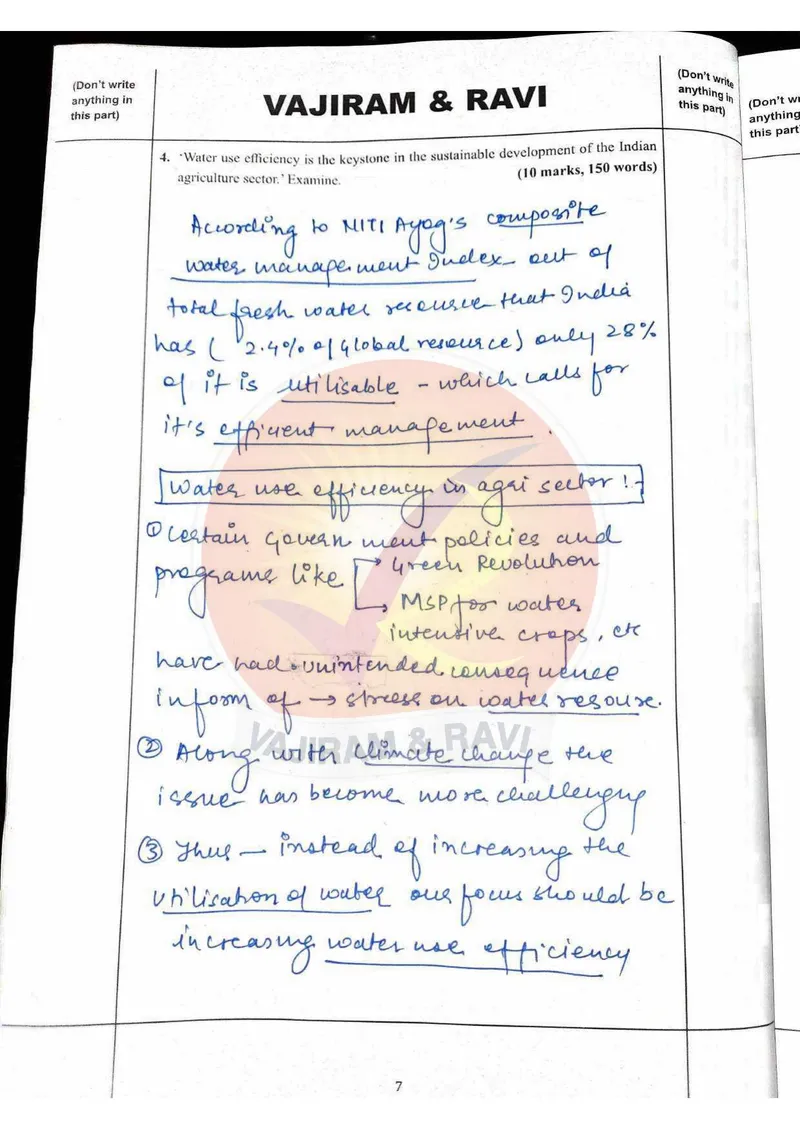
▸Nearly every answer opens with a hard data or report anchor — NITI Aayog's Composite Water Management Index, IPCC 6th Assessment, UNEP's 400-million-tonne plastic figure, NCRB fake-news stats, Resecurity's 800-million breach number.
▸A disciplined intro-body-conclusion template — underlined keywords, numbered points, and a 'Thus...' conclusion that ties back to SDGs, Panchamrit, Vision 2047 or the $5-trillion-economy goal.
▸Uses a hand-drawn 3-stage Fast Breeder Reactor flow diagram (U-238 to Pu-239 to thorium) to explain India's nuclear program visually.
▸The booklet is completely unevaluated — no marks, ticks or examiner suggestions anywhere; the /250 cover grid and all per-question boxes are blank, so this is the raw answer copy rather than a marked one.
What to learn from this copy
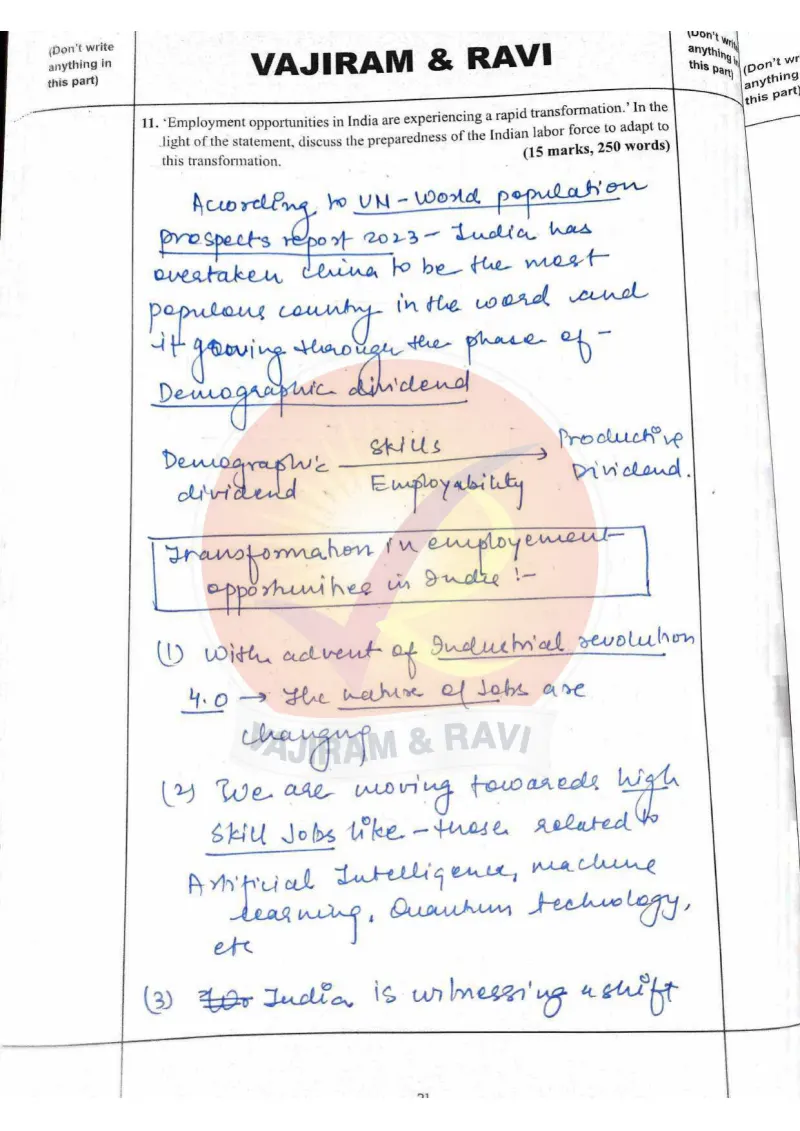
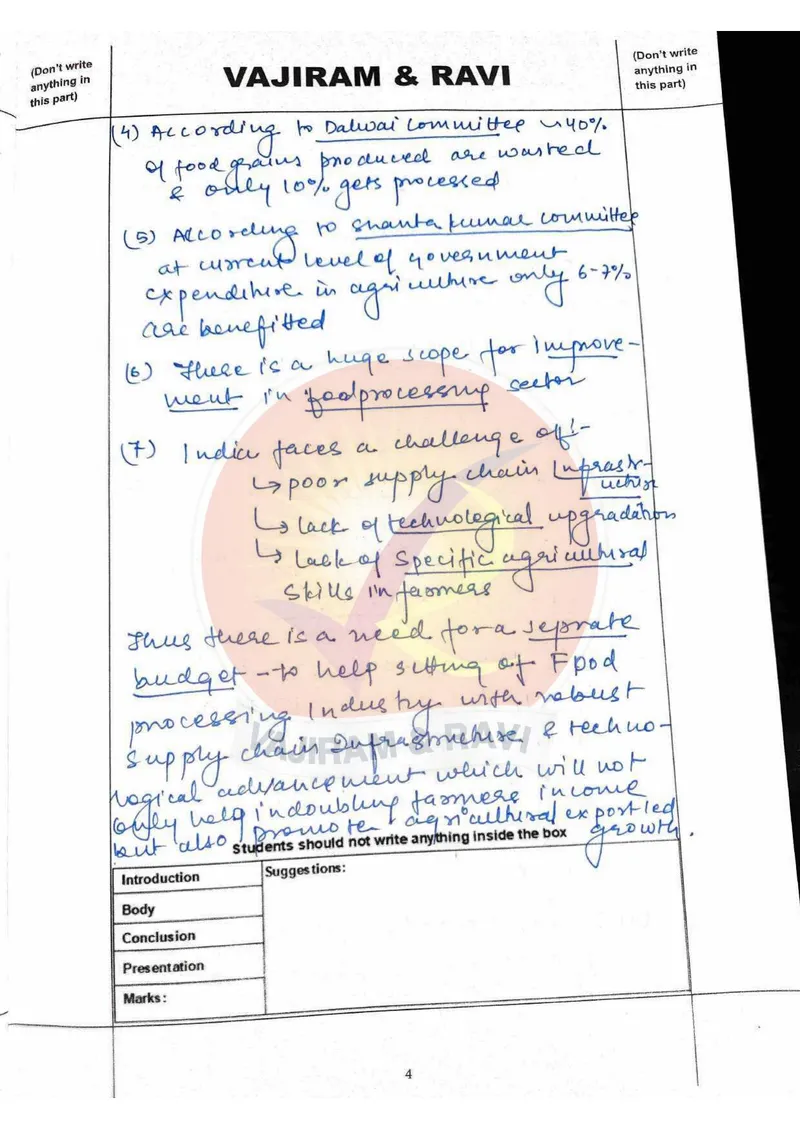
★She opens almost every answer with a hard data or report anchor rather than a textbook definition - Q4 leads with the NITI Aayog Composite Water Management Index (India holds 2.4% of global freshwater, only ~28% utilisable), Q9 with World Bank figures (India = 18% of world population but ~4% of freshwater, extracts ~25% of groundwater), and Q2-Q3 with the Dalwai Committee's ~40% food-grain wastage / only ~10% processed -> lead your intro with one precise, sourced number that frames the problem, so the examiner sees command of facts in the first two lines.
★She pairs schemes with committee findings that carry an argument, not just names - e.g. the Shanta Kumar Committee's 'only ~6-7% of farmers benefit from govt expenditure' to argue agriculture's structural neglect (Q2), and the World Bank 'Rs 3.5-4 return per Re 1 of private investment' to justify PPP (Q5) -> cite committees/data that prove your point, not decorative acronyms; one figure that advances the argument beats five name-drops.
★She converts process- and chain-type questions into hand-drawn flow diagrams - the Q7 three-stage nuclear program drawn as U-238 -> Pu-239/fissile U -> (U-235 + Pu-239 + thorium) -> thorium energy with linking arrows, and the Q8 EIA sequence Screening -> Scoping -> Risk Calculation -> Monitoring -> Mitigation -> Decision-making -> when a topic is inherently sequential or staged, a labelled flow diagram both saves words and visibly demonstrates the mechanism.
★She closes with a forward-looking 'Thus...' conclusion that maps the answer onto a national goal - SDG-2, the Panchamrit targets, COP28's tripling-nuclear pledge, Vision 2047 or the $5-trillion-economy goal -> end by tying your specific topic to a recognised national/global commitment, which signals big-picture awareness and gives the answer a deliberate landing point.
★She brings in a sharp global best-practice comparison where it sharpens the prescription - Israel's root-zone/drip irrigation as the model for water-use efficiency (Q4) -> when arguing what India should do, name one concrete external benchmark instead of a vague 'learn from other countries', so your recommendation is specific and credible.
Questions attempted: Off-budget borrowings: meaning and associated issues (10m); Whether agriculture needs a separate budget for its transformation (10m); E-commerce revolutionizing agriculture supply chains (10m), and 17 more below.
Questions attempted in this booklet (20)+
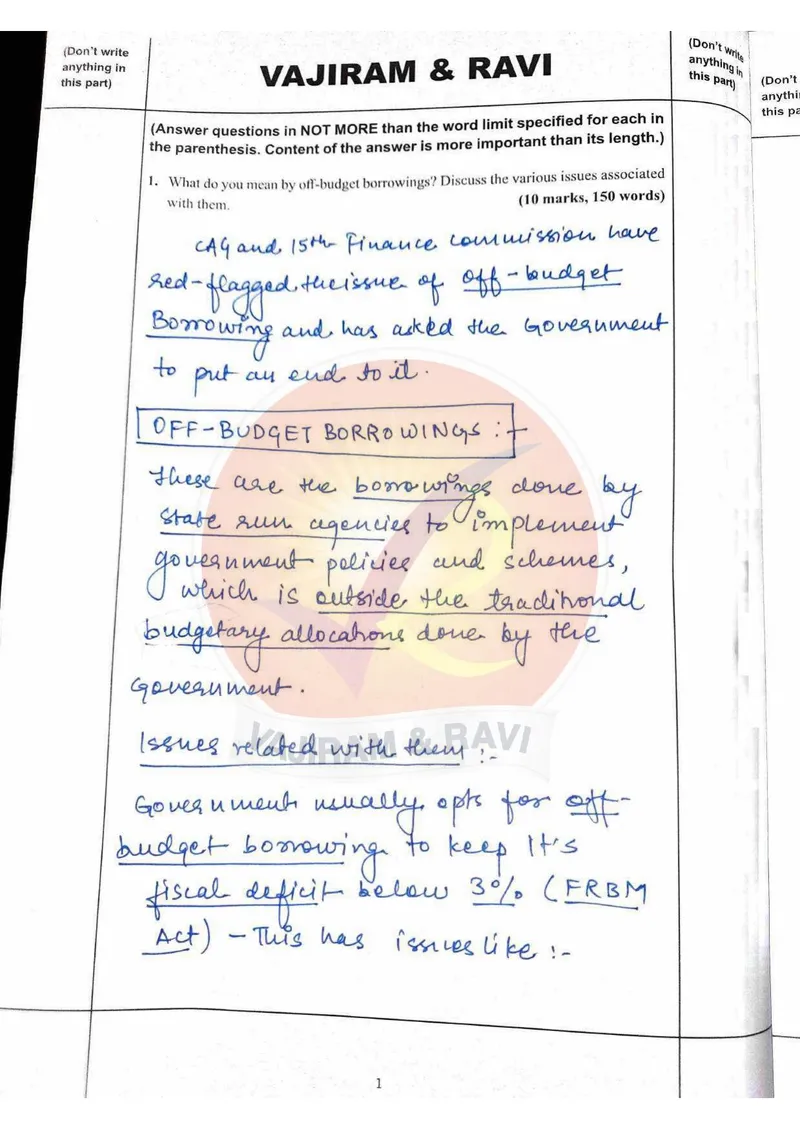
1.Off-budget borrowings: meaning and associated issues (10m)
2.Whether agriculture needs a separate budget for its transformation (10m)
6.Biotechnology for ensuring food security in India (10m)
7.Significance of Fast Breeder Reactor (FBR) in India's nuclear energy program (10m)
8.How EIA promotes environmental awareness (10m)
9.Overexploitation straining groundwater quality and quantity (10m)
10.Disinformation as internal security threat; State's role in preventing fake news (10m)
11.Transformation in employment and preparedness of Indian labour force (15m)
12.Liberalization vs social equity; measures for inclusive growth (15m)
13.Livestock's role in rural socio-economic uplift; opportunities for farmers (15m)
14.PLI scheme objectives and role in indigenous semiconductor industry (15m)
15.Infrastructure project delays, cost overruns: causes and solutions (15m)
16.Private sector opportunities in the Indian space industry (15m)
17.Plastic waste as ecological threat; government containment measures (15m)
18.Disaster vulnerability of coastal cities; relevance of Sendai Framework (15m)
19.Rising cyber attacks; need for a dedicated cyber security force (15m)
20.Socio-economic functions across borders making border management complex (15m)
Examples, data & evidence used
CAG and 15th Finance Commission red-flagging off-budget borrowing (Q1)
FRBM Act / fiscal-deficit target (Q1, Q5)
Dalwai Committee — ~40% of food grains wasted, only ~10% processed (Q2, Q3)
Shanta Kumar Committee — only ~6-7% of farmers benefit from govt expenditure (Q2)
24 agro-climatic zones as comparative advantage (Q2)
ONDC (Open Network for Digital Commerce) and e-NAM / Govt e-marketplace linking APMC mandis (Q3)
NITI Aayog Composite Water Management Index — India has 2.4% of global freshwater, only ~28% utilisable (Q4)
Israel's root-zone watering / drip irrigation as best practice (Q4)
NITI Aayog report advocating PPP; World Bank figure of ~Rs 3.5-4 return per Re 1 of private investment (Q5)
IPCC 6th Assessment Report on warming and food security (Q6)
Bt cotton, Golden Rice (Vitamin A), Nano urea by IFFCO, PUSA Decomposer; SDG-2 (Q6)
HJ Bhabha's 3-stage nuclear program (started 1969); India 2nd country after Russia with an FBR; Kalpakkam plant (TN); COP28 tripling-nuclear pledge; Panchamrit targets (Q7)
EIA process steps and 70% (80% for private partnership) population-consent point (Q8)
World Bank data — India: 18% of world population, ~4% of freshwater, extracts ~25% groundwater; Green Revolution side-effects; Arsenic/Uranium contamination in >12% of areas (Q9)
How it’s written: Uniform structure across all 20 answers, written neatly in blue ink. Each answer: (1) a short context-setting introduction citing a report/committee/data point; (2) a boxed or underlined sub-heading (e.g., "OFF-BUDGET BORROWINGS:-", "Significance of FBR", "Role of State in preventing Fake news"); (3) a numbered enum…
Diagrams & visuals: Q7 (FBR): hand-drawn 3-stage nuclear-program flow diagram — Stage 1 (U-238 to Pu-239/fissile U) -> Stage 2 (U-235 + Pu-239 + thorium) -> Stage 3 (thorium to generate nuclear energy), with arrows linking stages (image-verified); Q8 (EIA): process-flow style listing of EIA steps — Screening -> Scoping -> Risk Calculation -> Monitoring -> Mitigation -> Decision making (seen in text layer; not separately image-verified)
Evaluator: No examiner marks or comments are filled in on this copy.
Shakti Dubey — GS Paper 4 Ethics (Sure Shot Test 08)
GS Paper 4 · EthicsPDF · 15.8 MB
What’s inside this copy
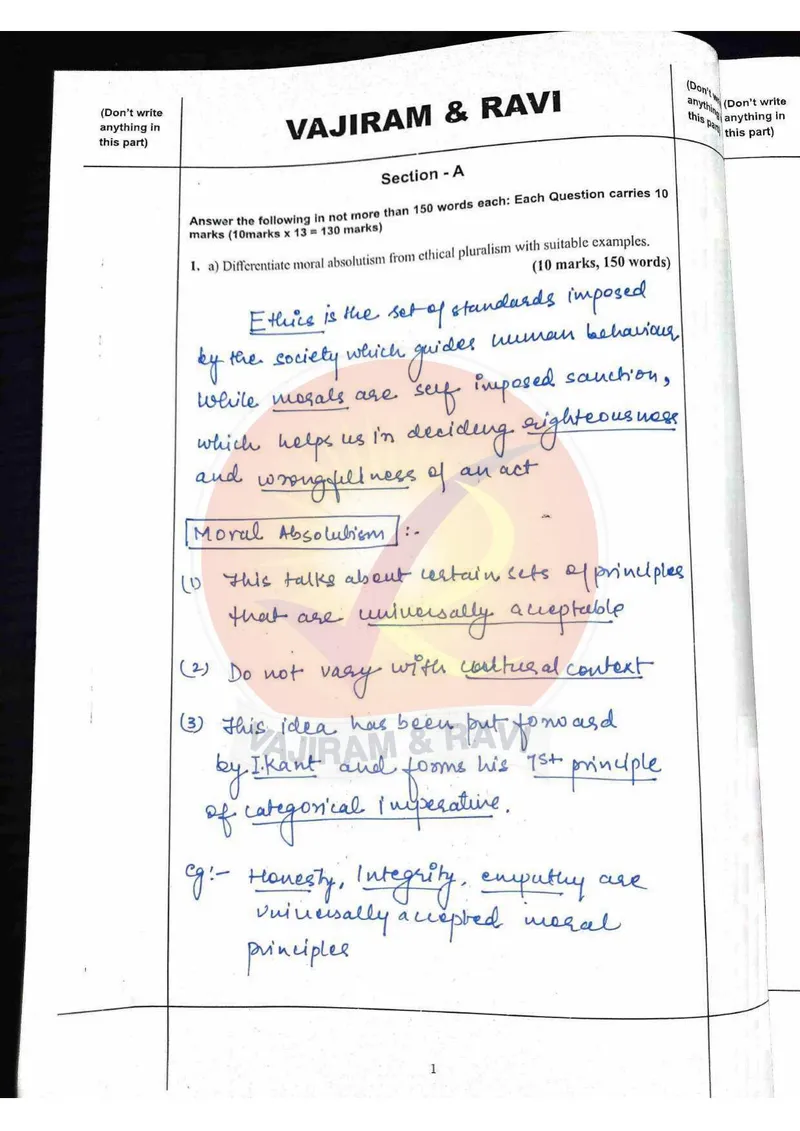
▸Every 10-marker opens with a hook — a quote (Gandhi, Greta Thunberg, Thiruvalluvar, Mother Teresa) or a report/data point (IPCC 6th AR, World Economic Forum, 2nd ARC) — before defining the core term.
▸Bodies are crisp numbered points and almost every point is fused to a real 'eg:-' example, making the answers example-dense rather than abstract.
▸Signature move: pair an ethics thinker with an Indian instance — Rawls' Difference Principle, Kant's categorical imperative, Plato's cardinal virtues, Bentham–Mill utilitarianism, Bhagavad Gita's Nishkama Karma.
▸The attitude answer (4a) is anchored by a hand-drawn flowchart: Belief/Value system → Attitude (positive/negative) → Behaviour.
▸Section-B case studies use a fixed template: framing line → stakeholder diagram → numbered ethical issues → each option weighed Positive vs Negative → chosen option with reasons → way forward.
▸Leans on a deep bench of named role models to concretise values — Kiran Bedi (Tihar), Chhavi Rajawat (Soda Sarpanch), Satyendra Dubey, U. Sagayam, Ela Bhatt (SEWA), Dashrath Manjhi, Lal Bahadur Shastri.
What to learn from this copy
★Every 10-marker opens with a 'hook' before the term is even defined — a quotation (e.g. 'Sunlight is the best disinfectant' to open the citizen-charter/transparency answer 2a, Greta Thunberg's 'act as if our house is on fire' to open the climate-finance answer 5a, Gandhi's 'court above the court of law' to open the conscience answer 6a) OR an authority/data anchor (2nd ARC, IPCC 6th AR, WEF) -> Bank one or two relevant hooks per ethics theme and lead with them, so the examiner sees framing before content; an authority/report works just as well as a quote when you don't have one.
★Shakti's signature move is pairing a Western ethics thinker with a concrete Indian instance — Kant's categorical imperative (1a), Rawls' Difference Principle, Plato's cardinal virtues, Bentham-Mill utilitarianism, and Bhagavad Gita's Nishkama Karma, then grounding values in named role models like Kiran Bedi (Tihar), Chhavi Rajawat (Soda Sarpanch), Satyendra Dubey, U. Sagayam, Ela Bhatt (SEWA) and Dashrath Manjhi -> Build a fixed 'thinker + Indian example' bench so abstract ethics points always land on a real referent instead of staying theoretical.
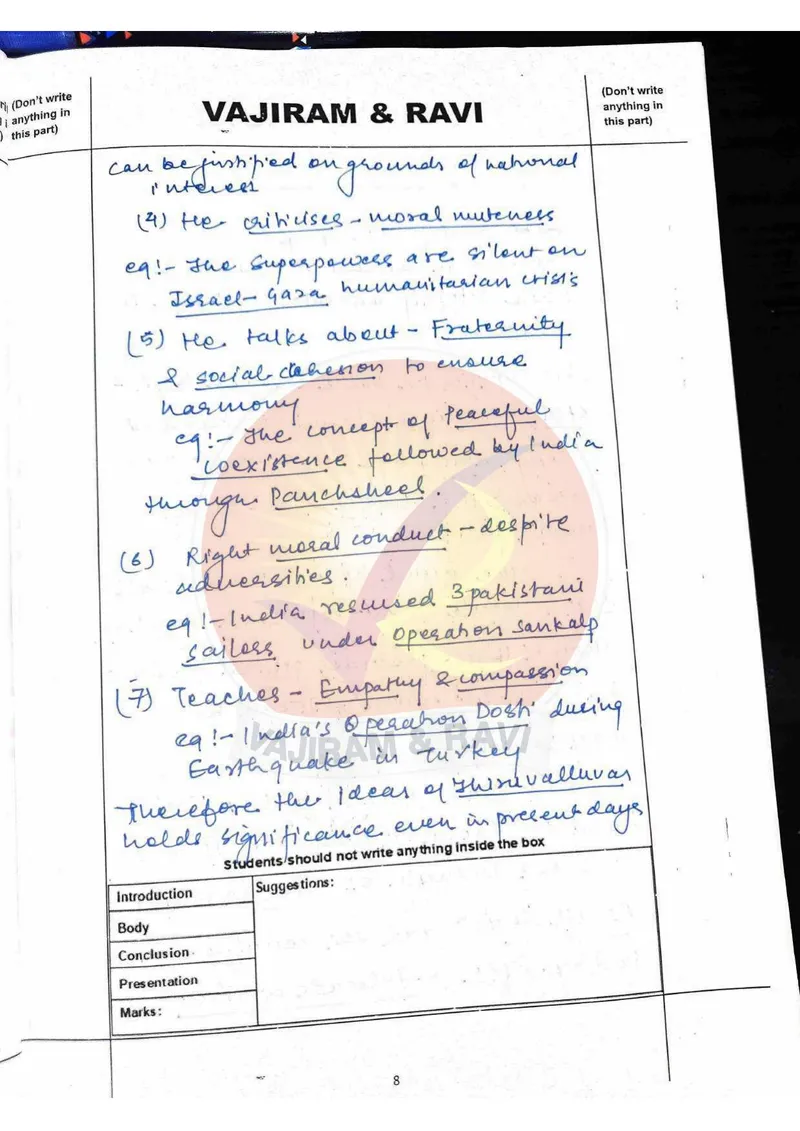
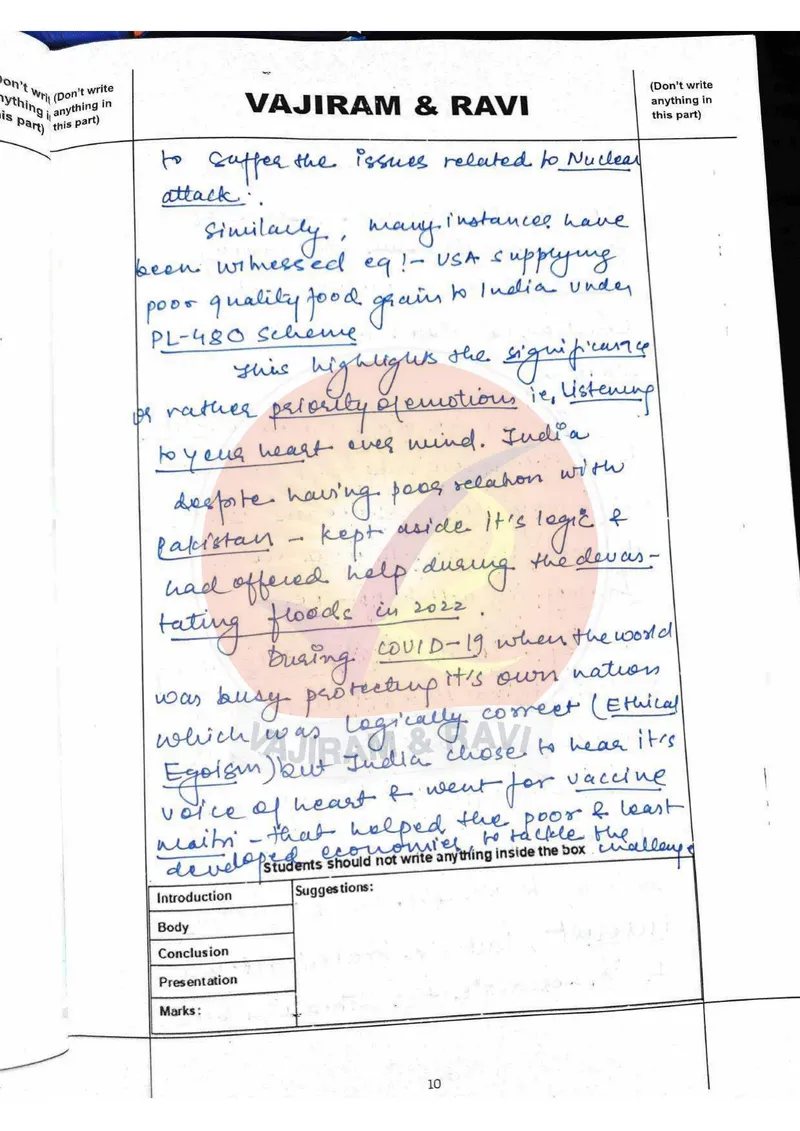
★Body points are not abstract — almost every numbered point is fused to a real 'eg:-' instance: she defends national interest in 2b with the Pathankot strike, Panchsheel, Operation Sankalp and Turkey earthquake relief, and illustrates 'mind over heart' in 3a with the US atomic bombing of Japan, PL-480, and COVID Vaccine Maitri -> Attach a current-affairs or policy example to each point you make; example-density is what separates a topper's ethics answer from a generic one.
★The attitude answer (4a) is anchored by a hand-drawn flowchart — Belief/Value system (core & peripheral) -> Attitude (branched into Positive/Negative) -> Behaviour — turning an abstract definition into a visual the examiner can grade at a glance -> When a question hinges on how concepts relate (attitude vs behaviour, belief->action), draw the causal chain rather than describing it in prose.
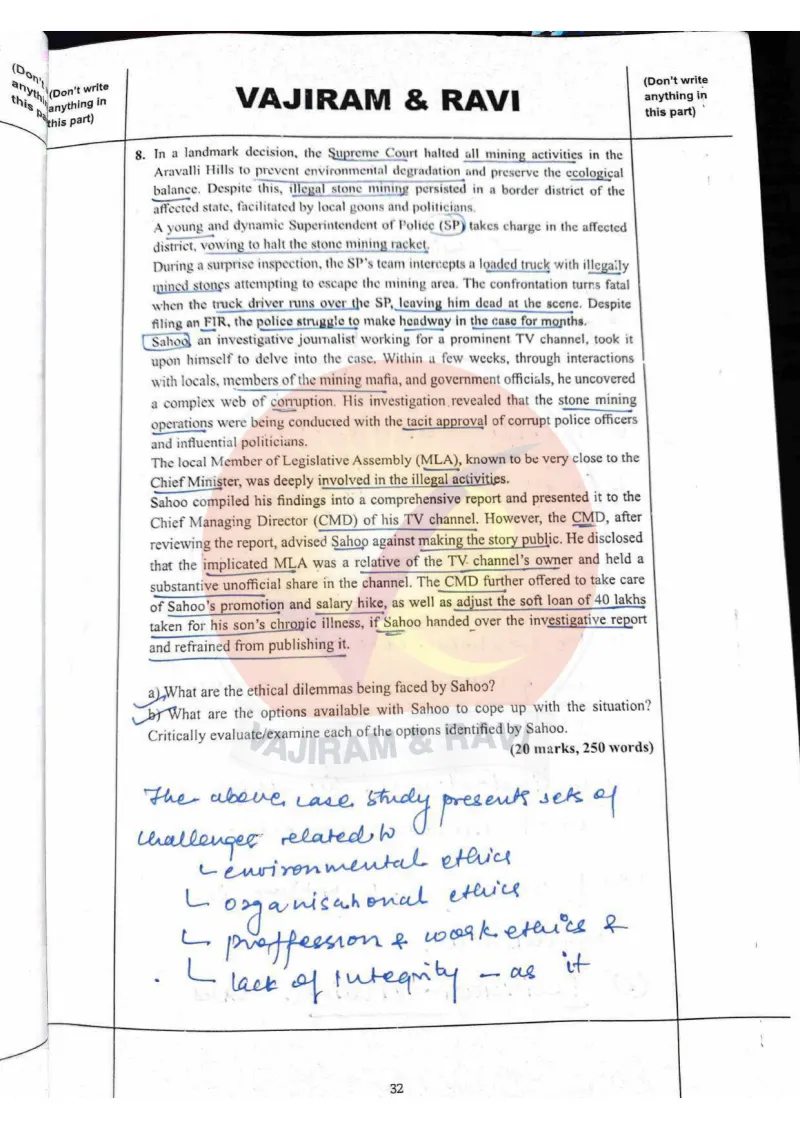
★Section-B case studies follow one rigid, repeatable template: framing line -> stakeholder bubble/spider diagram (e.g. Q7 maps DCP Aakash, SI Shipra, DIG Samar, Dinesh, public; Q8 maps SP, journalist Sahoo, MLA, channel owner, environment, society) -> numbered ethical issues -> each option weighed in a two-column Positive vs Negative layout (Q8, Q9, Q10) -> chosen option with reasons -> way forward -> Internalise one such case-study skeleton so that under time pressure you only fill content into a structure you never have to invent on the spot.
Questions attempted: Differentiate moral absolutism from ethical pluralism, with examples; Ethical implications of using generative AI in creative industries; How citizen charters enhance transparency and combat corruption in public institutions, and 16 more below.
Questions attempted in this booklet (19)+
1a.Differentiate moral absolutism from ethical pluralism, with examples
1b.Ethical implications of using generative AI in creative industries
2a.How citizen charters enhance transparency and combat corruption in public institutions
2b.Key teachings of Thiruvalluvar and their present-day relevance
3a.Quotation: 'In a conflict between the heart and the brain, follow your heart' — Swami Vivekananda
3b.Quotation: 'To see what is right and not do it is the want of courage' — Confucius
3c.Quotation: 'Our prime purpose in this life is to help others; if you can't help them, at least don't hurt them' — Dalai Lama
4a.Attitude shapes perceptions/intentions while behaviour is its tangible real-world expression — Discuss
4b.Emotional intelligence in high-stress environments — impact on resilience and decision-making
5a.Ethical concerns of developed nations setting climate targets for developing countries without adequate finance
5b.Moral consequences of misusing benefits meant for weaker sections, and how to prevent it
6a.Role of conscience in upholding personal integrity and fostering moral responsibility
6b.Resolving ethical dilemmas where organisational policy conflicts with personal moral principles
8.Case study: Aravalli illegal stone mining, SP killed, journalist Sahoo bribed by CMD to suppress report; ethical dilemmas + options
9.Case study: financial influencer endorsing Digital PayTech stock that crashes; moral values, ethical issues, options
10.Case study: strategic disinvestment of State Public Sector Bank, union head offered a bribe; ethical issues, options, steps to improve banking sector
11.Case study: Anil Gupta appointing son Rohan as CEO (nepotism) damaging ABC Industries; ethical issues, revival action, corporate-governance steps
12.Case study: Ms. Radhika, RTE, death of Dalit student Rani from caste-based assault; ethical issues, guiding values, navigating caste discrimination
World Economic Forum; Industrial Revolution 4.0 (1b)
2nd ARC — basis for citizen-charter benefits (2a)
Jan Soochna Portal, Rajasthan (2a)
Thiruvalluvar / Thirukkural; gifting of Thirukkural to G20 summit guests (2b)
Pathankot air strike — national-interest justification (2b)
Israel–Gaza humanitarian crisis — moral muteness of superpowers (2b)
Panchsheel / peaceful coexistence (2b)
Operation Sankalp (2b)
India's earthquake relief to Turkey (2b)
US atomic bombing of Japan in WWII — 'mind over heart' (3a)
PL-480 scheme — US foodgrain supply to India (3a)
COVID-19 Vaccine Maitri — India aiding poorer economies (3a)
Quotes the candidate used
'Sunlight is the best disinfectant' — opening of 2a (transparency)
'Knowledge without integrity is sin, while integrity without knowledge is hollow' — opening of 3a
'There are no victors in war' — used in 3b
'If you can't feed a hundred, just feed one... do small things with great love' — Mother Teresa, opening of 3c
'We must act as if our house is on fire, because it is' — attributed to Greta Thunberg, opening of 5a
'There is a court above the court of law, i.e., the court of conscience' — attributed to Gandhi, opening of 6a
A Thiruvalluvar / Thirukkural couplet on falsehood being acceptable only when it serves the common good — quoted in 2b (exact wording OCR-garbled)
'Sabka Saath, Sabka Vikas' — closing line of 5b
How it’s written: Highly templated, point-driven answers with strong word-limit discipline (each answer fits its allotted box/page). Section-A pattern: (1) a hook opener — either a quotation (Gandhi, Greta Thunberg, Thiruvalluvar, Mother Teresa) or a report/authority/data point (IPCC 6th AR, World Economic Forum, 2nd ARC); (2) a one-…
Diagrams & visuals: Hand-drawn flowchart in 4a: Belief / Value system (core & peripheral belief) → Attitude (branched into Positive and Negative) → Behaviour; Stakeholder bubble/spider diagrams in the Section-B case studies (e.g., Q7: DCP Aakash, SI Shipra, DIG Samar, Dinesh, public/society; Q8: SP, journalist Sahoo, MLA, channel owner, environment, society); Two-column 'Positive impact / Negative impact' layout used to evaluate each option in the case studies (Q8, Q9, Q10); No maps and no formal data tables observed
Evaluator: The Vajiram & Ravi evaluation template is present — a cover-sheet parameter grid (Language & Articulation, Structure & Presentation, Conceptual clarity & Content, Number of questions attempted; scale Excellent / Very Good / Good / Averag…
▸Covers every GS paper twice, so you can compare how her presentation evolved across tests of the same paper.
▸These are clean (unmarked) fair copies — the value is in seeing how an AIR 1 frames intros, builds tightly point-wise bodies and uses diagrams within the word limit.
How many Shakti Dubey answer copies can I download here?+
This page links to 8 of Shakti Dubey's mains answer copies (GS1, GS2, GS3 and Ethics (GS4)) as free PDFs, from the UnlockIAS topper-copy archive. Each opens in Google Drive — no sign-up or payment.
What rank did Shakti Dubey get and in which year?+
Shakti Dubey secured AIR 1 in UPSC CSE 2024.
Are Shakti Dubey's answer copies evaluated with marks?+
These are Shakti Dubey's test-series mains booklets. Most are clean (unmarked) fair copies — their value is in the actual answers: the questions attempted, the examples and quotations used, and how the answers are structured, which we summarise on this page. A few topper copies in the wider library do carry the evaluator's qualitative feedback.
What can I learn from Shakti Dubey's answer copies?+
Decode the pattern, don't copy the content. For example, in Shakti Dubey's copies: definition-first discipline: she literally opens almost every answer by defining the keyword before arguing — a clean, repeatable intro template. Read a copy, then write the same question yourself and compare structure, example density and conclusion quality.
Are these Shakti Dubey copies really free?+
Yes — every PDF on this page is free to view and download. UnlockIAS hosts this index for free educational use; credit for each booklet belongs to the candidate and the evaluating test series.
Studying Shakti Dubey's copies shows you the target; the Sherlocking Mains programme trains you to hit it — daily answer writing with AWE Bot evaluation and mentorship. Or get one Mains answer evaluated free.