
Devdarshdeep Singh — MGP answer copy (GS paper)
What’s inside this copy
- ▸Every answer opens with a one-line definition or a hard statistic on the keyword (often underlined), then almost always places a labelled diagram, flowchart or two-column table before the prose body.
- ▸Exceptionally data-dense and source-anchored: top 1% own 40.5% of wealth (Oxfam 'Survival of the Richest' 2023), per-capita income rank 149/194, 51% of cropped area rainfed, MSME export share fell 31% to 26% post-COVID, fiscal deficit ~8% breaching the FRBM escape clause.
- ▸Uses committees as evidence almost reflexively — Kelkar, Narasimham, Nachiket Mor, NK Singh, Shanta Kumar, T. Haque and Baba Kalyani committees each appear in the relevant answer.
- ▸Scheme recall is wide and precisely matched to topic: PM-KUSUM, GOBARdhan, Sagarmala/Bharatmala, ZED, MIDH, CHAMAN, Operation Greens, PMFME, SAMARTH, A-TUFS, National Technical Textiles Mission.
- ▸Q10 features a hand-drawn map of India marking the 'zones of divergence' between cropping patterns and agro-climatic zones — a strong, exam-friendly value-add.
- ▸Conclusions consistently land on a government vision or slogan — 'Atmanirbhar Bharat', 'Amrit Kaal', 'USD 5 trillion economy on the lines of Asian Tigers', 'Krishi Shakti & Annapurna Bharat' — giving each answer a crisp forward-looking close.
What to learn from this copy
- ★He frames the question's demand with a purpose-built visual BEFORE writing prose — a 'Virtuous Cycle' box-and-arrow diagram (savings -> investment -> infrastructure -> linkages -> export-led growth) for Q1, an allocate->analyse->measure->reallocate cycle for the outcome-budget Q3, and a pros-vs-cons two-column table labelled 'true' vs 'untrue' for whether MSP needs legal backing (Q19). -> Don't bolt a diagram on as decoration; design one that literally maps the answer's logic, and place it up front so the examiner sees your structure before reading a word.
- ★Q10's hand-drawn map of India marking 'zones of divergence' (Deccan black-soil, delta, semi-arid) pins the cropping-vs-agro-climatic mismatch to actual regions, and he anchors it with hyper-specific facts elsewhere — sugarcane needing ~120 cm/yr water, 51% of cropped area rainfed, Punjab's wheat-rice groundwater depletion, weeds Echinochloa/Parthenium. -> For geography/agriculture answers, a labelled India map that locates the problem spatially is a high-value differentiator far stronger than generic listing.
- ★Every intro leads with a hard, sourced statistic on the exact keyword rather than a vague definition — Q4 opens on Oxfam 'Survival of the Richest' 2023 (top 1% own 40.5% of wealth) set against 36 crore in poverty vs 103+ unicorns, and cites per-capita income rank 149/194 (UNDP) and Global Hunger Index 2023. -> Open with one report-attributed number that quantifies the problem; it instantly signals command of current data and sets a sharper frame than a textbook definition.
- ★He uses named committees as reflexive evidence, each matched to its exact topic — Kelkar (PPP, Q5), Narasimham and Nachiket Mor (banking/LPG, Q12), T. Haque (farm subsidy, Q8), Baba Kalyani on EEZs (exports, Q13), plus a model APMC Act citation (Q9). -> Build a topic-tagged stock of committee names so you can drop the right one as proof; it converts opinion into authority cheaply.
- ★Conclusions consistently close on a concrete government vision or scheme-slogan tied to the topic rather than a flat summary — 'Atmanirbhar Bharat', 'Amrit Kaal for Amrit Peedhi' (Q11 textiles), 'USD 5 trillion economy on the lines of Asian Tigers' (Q13 exports), and forward schemes like PM-KUSUM, GOBARdhan, Sagarmala/Bharatmala precisely matched to each answer. -> End forward-looking with a specific, on-topic policy anchor so the answer lands optimistic and solution-oriented instead of trailing off.
Questions attempted: Infrastructure investment as a precursor to socio-economic transformation vs. not marginalising safety (Comment) — 10 marks; Whether low Female Labour Force Participation Rate gives a correct picture of 'working women' in India — 10 marks; Outcome budgeting — advantages, disadvantages and status in India — 10 marks, and 17 more below.
Questions attempted in this booklet (20)+
- 1.Infrastructure investment as a precursor to socio-economic transformation vs. not marginalising safety (Comment) — 10 marks
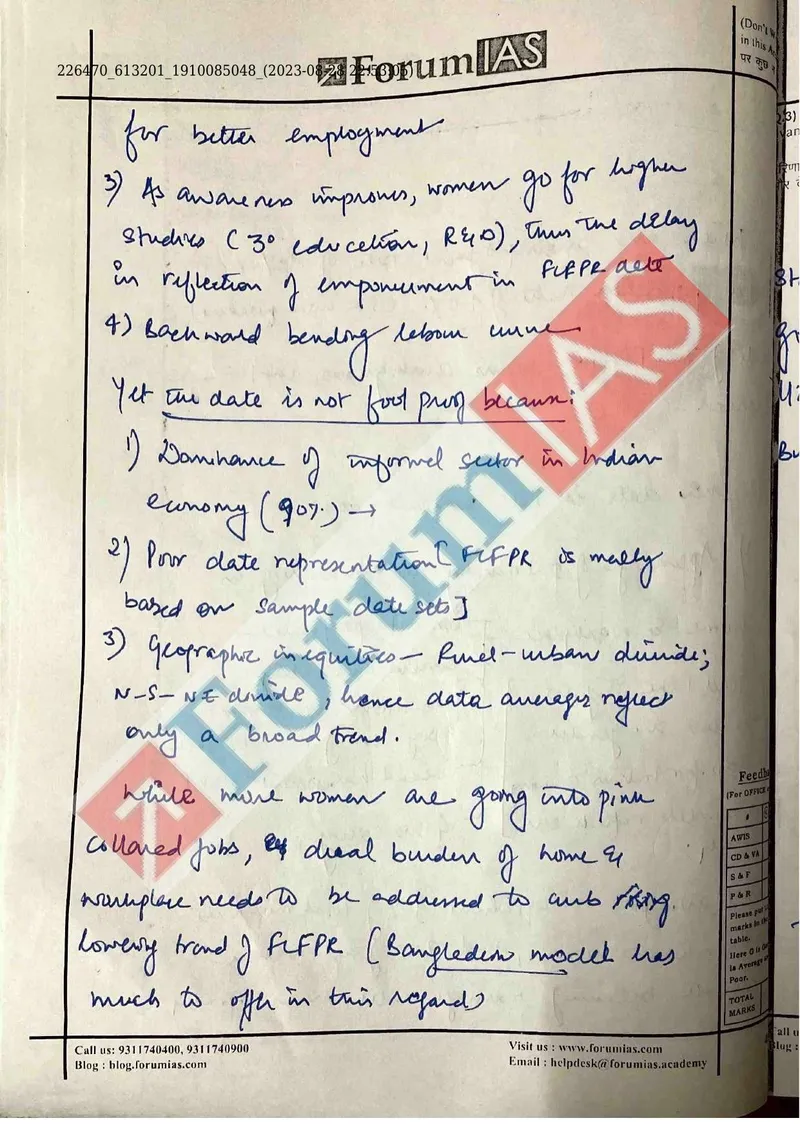
- 2.Whether low Female Labour Force Participation Rate gives a correct picture of 'working women' in India — 10 marks
- 3.Outcome budgeting — advantages, disadvantages and status in India — 10 marks
- 4.Inclusive growth — meaning; is economic growth alone sufficient — 10 marks
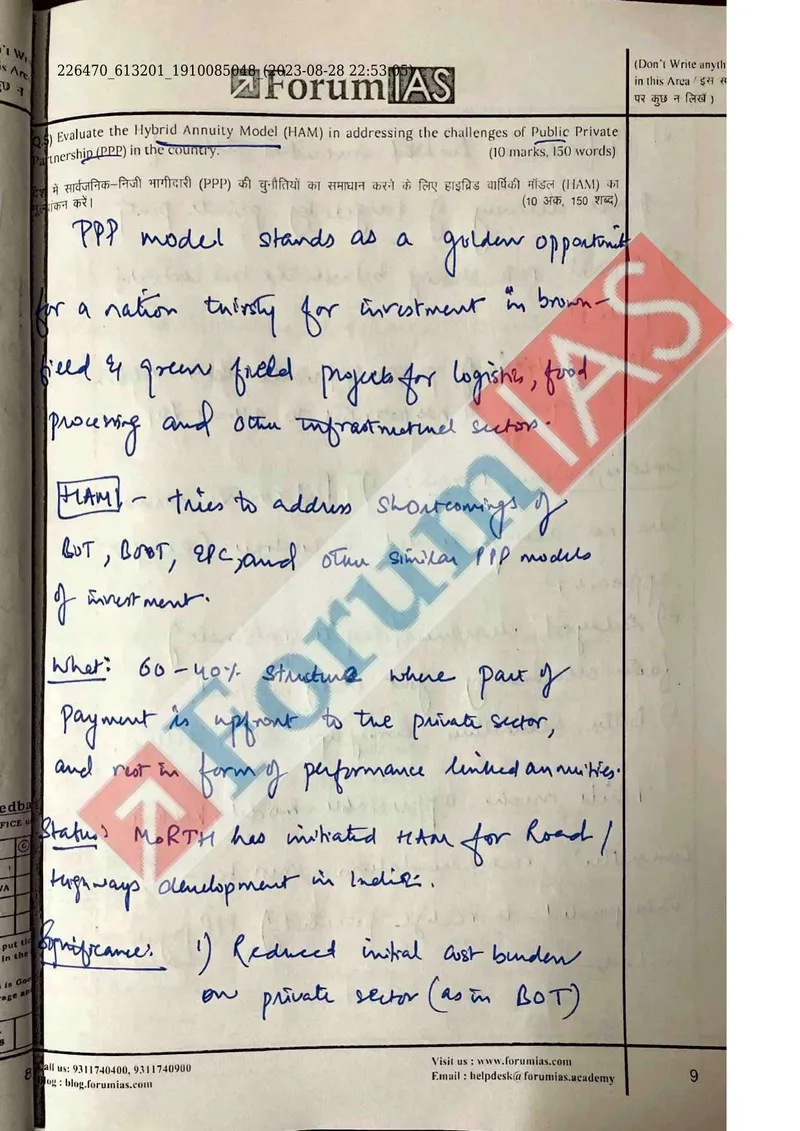
- 5.Hybrid Annuity Model (HAM) in addressing PPP challenges — 10 marks
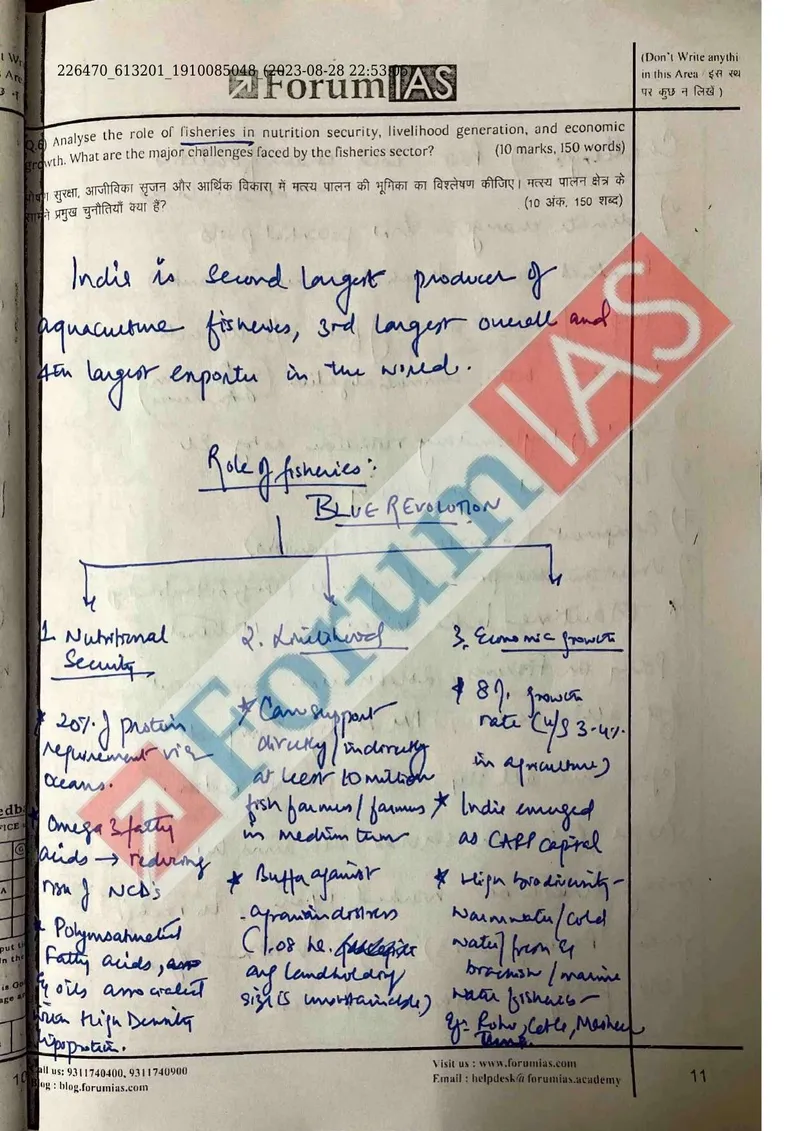
- 6.Role of fisheries in nutrition security, livelihood, economic growth + challenges — 10 marks
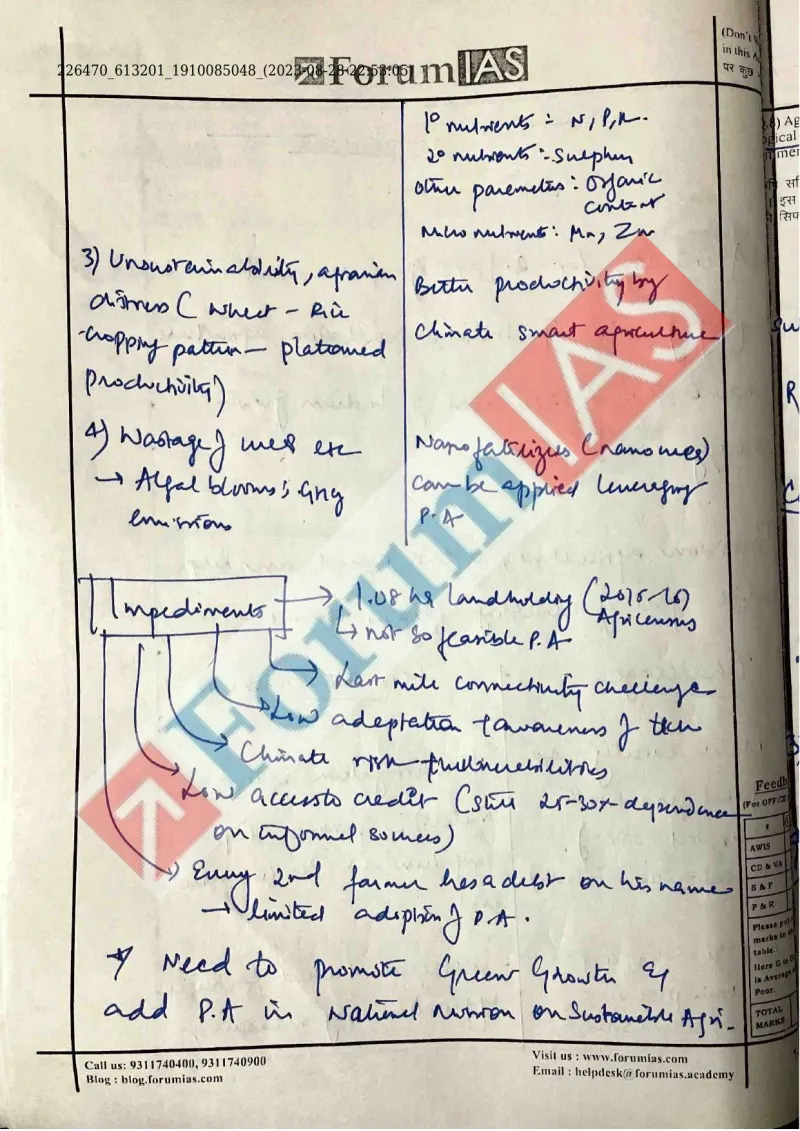
- 7.Precision agriculture as panacea for farm-sector challenges; impediments to adoption — 10 marks
- 8.Farm-subsidy regime — economic/ecological issues + rationalisation measures — 10 marks
- 9.APMCs — utility despite flaws + agri-marketing reforms — 10 marks
- 10.Cropping pattern not concurring with agro-climatic reality — unintended consequences (Comment) — 10 marks
- 11.Textile sector — opportunities & challenges in context of jobless growth — 15 marks
- 12.LPG (Liberalisation, Privatisation, Globalisation) — meaning + sector-wise effects — 15 marks
- 13.Merchandise exports crossing USD 400 bn (2021-22) — reasons + reforms — 15 marks
- 14.New GDP computation methodology (2015) — advantages + limitations of GDP as development measure — 15 marks
- 15.Global polycrisis & India's macroeconomic resilience to global shocks — 15 marks
- 16.Increasing emphasis on horticulture — reasons + evaluation of govt measures — 15 marks
- 17.Millets — potential to address nutrition/environment/farm-income but low adoption (Analyse) — 15 marks
- 18.PDS and FCI reforms as 'two sides of the same coin' — 15 marks
- 19.MSP — rationale, issues, and whether legal backing is necessary & sufficient — 15 marks
- 20.Food Processing Industry (FPI) linking unorganised farming with formal industry to advance rural economy — 15 marks
Examples, data & evidence used
- Q1: National Infrastructure Pipeline (~Rs 111 lakh crore); Budget 2023-24 capex (~Rs 10 lakh crore); Balasore train accident; Biparjoy cyclone; 'virtuous cycle' of savings-investment-infrastructure
- Q2: '98 years to close the gender gap' for the Indian economy; 52 crore workers; ~70% of migrants are women / 20% of women migrate for marriage; informal sector ~90%; Bangladesh model; backward-bending labour curve; pink-collar jobs
- Q3: Constitutional article cited for the Annual Financial Statement/Budget (read as Art. 112 — see confidence note); Nirbhaya fund; Child Labour fund; health spend ~2.1% of GDP; MGNREGA; Amartya Sen's Capability Approach; Line/Outcome/Zero-Based Budgeting
- Q4: Oxfam 'Survival of the Richest' 2023 (top 1% own 40.5% of wealth); 36 crore in poverty vs 103+ unicorns & 9 firms in Fortune 500; NITI Aayog MPI; Global Hunger Index 2023; UNDP HDR (19% wasted, 35% stunted children; per-capita income rank 149/194); Gandhian Trusteeship; SEBI ESG norms; CSR; PSL norms; Scandinavian model; GPDPs; Mahila Samman Saving Certificate; Eklavya Model Residential Schools; 'Sabka Saath Sabka Vikas'
- Q5: BOT/BOOT/EPC models; MoRTH; Swiss Challenge; Kelkar Committee; FDI attraction via PPP
- Q6: Blue Revolution; India 2nd-largest aquaculture / 3rd-largest overall / 4th-largest exporter; Omega-3 & NCDs; 1.08 ha average landholding; 'CARP capital'; Rohu/Catla/Mackerel/Tuna; Katchatheevu (Sri Lanka); Peruvian anchovies; EU SPS restrictions; cyanide fishing/bottom trawling; Maritime India Vision 2030; PM Matsya Sampada Yojana; Geneva Package 2023 (WTO); IUU fishing
- Q7: Agriculture ~18% of GVA, 50% of population; 4% of global groundwater but 25% of global extraction; N:P:K = 40:4:1; 'Per drop more crop'; nano urea; 1.08 ha landholding (2015-16 Agri Census); tensiometers/drip irrigation; National Mission on Sustainable Agriculture; Climate Smart Agriculture
- Q8: Farm subsidies ~2.3% of GDP; Budget 2023 (7 paise of every rupee to subsidies); T. Haque Committee; sugarcane in Marathwada / Samba rice in Kaveri delta; DBT; nutrient-based subsidy; PM-KUSUM (solar pumps); GOBARdhan (biofuels); 'Amrit Kaal'
- Q9: e-NAM; Arhatiyas; Arhat/Tulai/Palledari charges; NITI Aayog model APMC Act; future contracts; ~30% food wastage of perishables
- Q10: ~16 agro-climatic zones; sugarcane water need ~120 cm/yr; 51% area rainfed; Punjab wheat-rice groundwater depletion; stubble burning; weeds Echinochloa & Parthenium; Prosopis Juliflora (Jand); salinity/alkalinity/sodicity
- Q11: India Skills Report 2023 (50% not employable); employment elasticity ~0.1; services 50% GVA / 22% employment vs Brazil; EU-Vietnam FTA / BTIA; POWERTEX India; Solar charkha; SAMARTH; A-TUFS; KVIC; Silk Board; National Technical Textiles Mission; Batik/Ikat/Sujni/Phulkari; 'Amrit Kaal for Amrit Peedhi'; Atmanirbhar Bharat
- Q12: License Raj; 1991 crisis (15 days' forex)/IMF package; PVN Rao govt; FDI 74% (insurance) & 100% (renewables); Narasimham Committee; Nachiket Mor Committee; SFBs & Payment banks; New Industrial Policy 1991; FERA to FEMA; Competition Commission of India; 'Round Tripping'; 'global village'
- Q13: USD 400 bn merchandise exports (~3% global share); Foreign Trade Policy 2015-20; MEIS; ICEGATE/e-Sanchit; Sagarmala/Bharatmala/Diamond corridor; ZED scheme; MSME ~29% of exports; Mudra Yojana; One District One Product; World Bank LPI 38th rank; waterways 0.5% vs roads 53% (Netherlands 42% / USA 8% waterways); Baba Kalyani Committee (EEZs); Mercosur/Caribbean; Gati Shakti; National Logistics Policy; National Policy on Agri Exports 2018; USD 5 trillion economy; Asian Tigers
- Q14: GDP base year 2011-12; GDP at market prices; international accounting standards; GNH of Bhutan; informal sector ~80%; black economy (dark web/hawala/money laundering); 6.8% growth 2023-24
Quotes the candidate used
- No attributed thinker quotations are used. The candidate instead deploys slogan/report phrases in quotation marks, e.g. 'Per drop more crop' (Q7), 'Survival of the Richest' (Oxfam report title, Q4), 'Sabka Saath Sabka Vikas' (Q4), 'Amrit Kaal for Amrit Peedhi' (Q11), 'global village' (Q12, Q15). Named thinkers appear as concepts rather than quotes: Amartya Sen's Capability Approach (Q3) and Gandhian Trusteeship model (Q4).
How it’s written: Highly templated, presentation-first approach. Standard pattern per answer: (1) definition/data-led intro, usually with the question keyword underlined; (2) a labelled box-and-arrow diagram or two-column table to frame the answer; (3) numbered points, each with bracketed examples and sub-arrows; (4) underlined funct…
Diagrams & visuals: Box-and-arrow cycle diagrams: 'Virtuous Cycle' (savings to investment to infrastructure to linkages to export-led growth) in Q1; outcome-budget cycle (allocate to objectives to analyse delivery to measure and reallocate) in Q3; MSP 'Rationale' radial diagram in Q19; FPI backward/forward-linkage chain in Q20; Tree/hierarchy diagram: 'Blue Revolution' branching into nutrition/livelihood/economic-growth in Q6; millet-varieties diagram (Jowar/Bajra/Ragi/Kodo/Proso) in Q17; Two-column tables: Challenge vs How-PA-can-help (Q7); Govt Measures vs Evaluation (Q16); Ethics/Regulation matrix (Q4); pros ('true') vs cons ('untrue') of MSP legal backing (Q19); Central-concept flowcharts with radiating arrows: 'Concerns' (Q9), 'Measures' (Q8), 'Impediments' (Q7), polycrisis chain (Q15), 'Opportunities' for textiles (Q11); Hand-drawn MAP of India in Q10 labelled 'zones of divergence' marking sugarcane/rice/coarse-grain mismatch regions (Deccan black-soil, delta, semi-arid); Triangle diagram in Q15 (Make in India / Digital India / National Monetization Pipeline)
Evaluator: No examiner marks or comments are filled in on this copy.