
Aditya Srivastava — Topper copy archive GS copy
What’s inside this copy
- ▸Identity confirmed genuine: cover sheet names Aditya Srivastava (Reg 0834009), GS Paper-II, medium English, dated 26/8/23, IISE Lucknow; all 56 pages are one continuous copy by the same hand — no misassembly, interleaving or mislabelling.
- ▸This is a VisionIAS 'Abhyaas' Mains MOCK booklet (visionias.in footer; 'upscpdf.com' watermark), not the real CSE-2023 paper; subject is GS2 and all 20 questions are attempted.
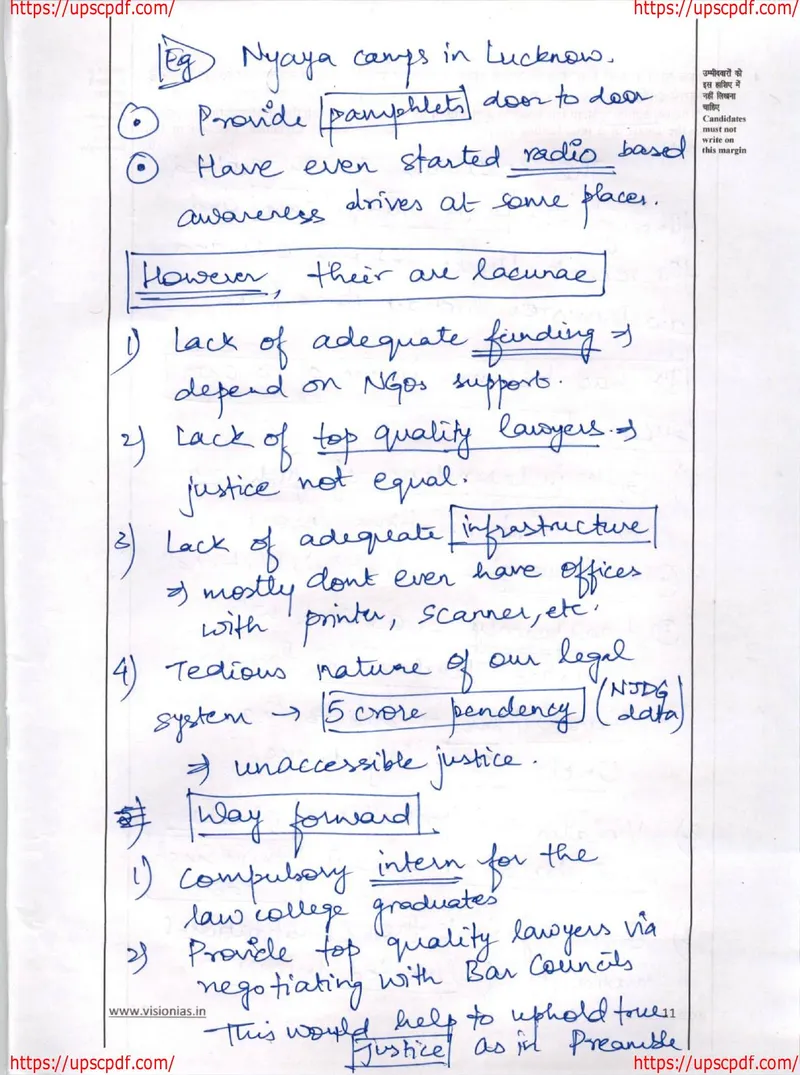
- ▸Answers are heavily templated: boxed thesis lines, underlined keywords, 'Eg ▷' example tags, and frequent mind-maps, two-column tables and one health data-table.
- ▸Example- and case-law-dense and current: Google Rs 1330 cr CCI fine; Hijab/Shirur Mutt/Sabarimala/Shayara Bano; NALSA; GE414 engine; Red Echo cyberattack; German minister using UPI.
- ▸Data/report literacy throughout: PLFS, ILO Global Wage Report, NSSO, WHO norms, Bhore/Bajaj and NK Saxena Committees, Census 2011 — with specific figures.
- ▸Most answers close with a 'Way ahead' plus an SDG link and a signature slogan ('minimum government maximum governance', 'atmanirbhar Bharat', 'digital vishwaguru').
What to learn from this copy
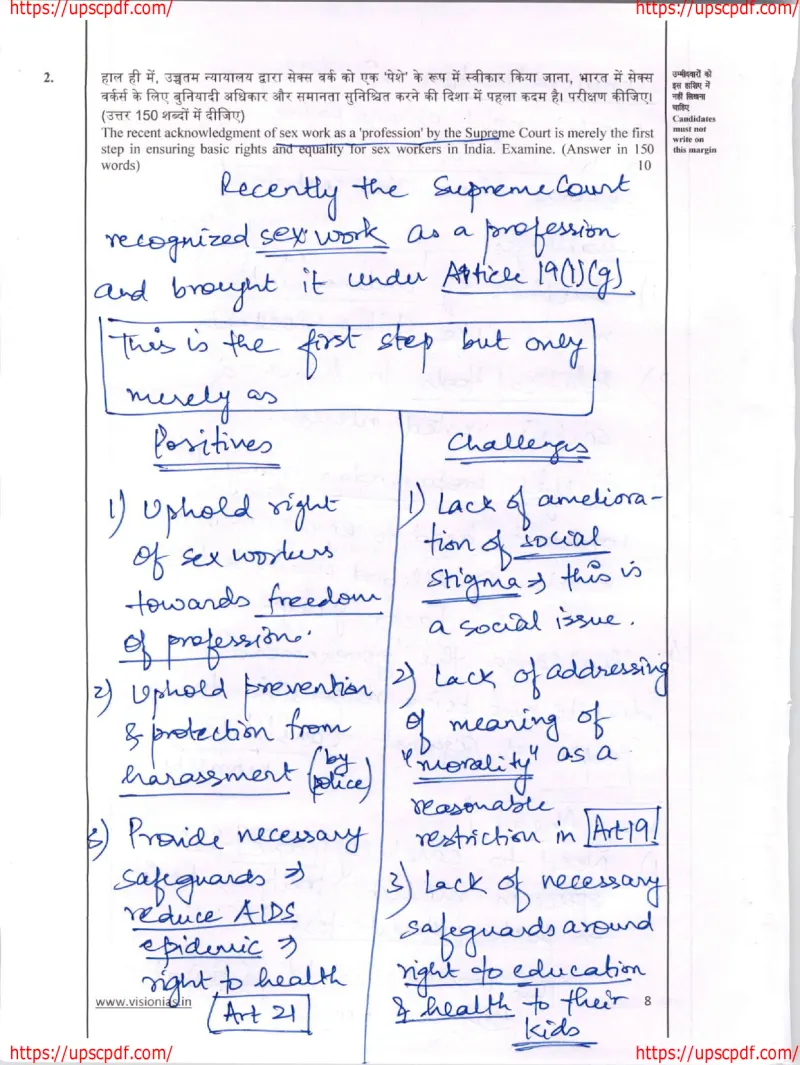
- ★Every intro is anchored to a specific Constitutional provision matched to the question — e.g. framing sex-work rights via Art 21, legal aid via Art 39A, female labour-force participation via Art 41 — rather than a generic definition -> open with the exact Article/clause that gives the topic constitutional teeth, so the examiner sees you locate the issue in the Constitution within the first two lines.
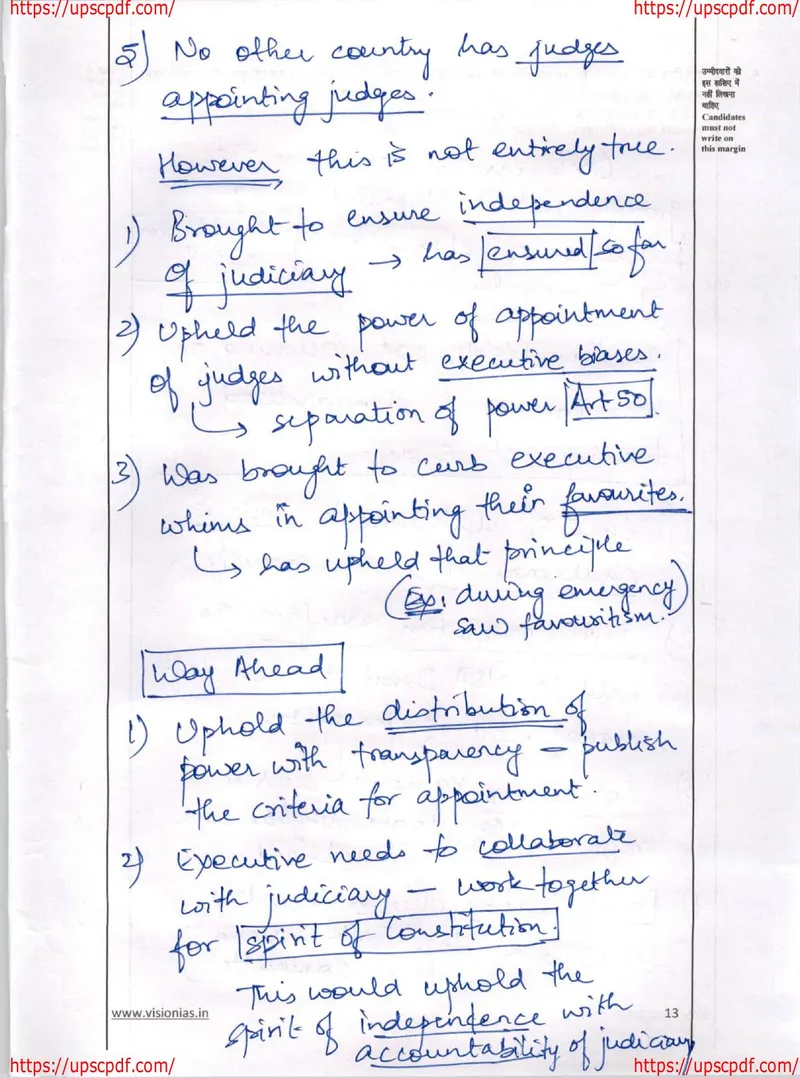
- ★He converts each directive into a single BOXED thesis line that directly answers the verb — 'It has become victim of its own success' for the collegium (Q4) and 'They have delivered' / 'However largely inadequate' as paired boxes for Institutions of Eminence (Q15) -> give the evaluator your verdict in one visually isolated sentence up front, so your stance on 'examine'/'critically analyse' is unmissable.
- ★Arguments are carried by named, current case law and hard instances, not assertions — Google's Rs 1330 cr CCI fine (Q11); Hijab, Shirur Mutt, Sabarimala and Shayara Bano stacked under the essential-practices doctrine (Q13); NALSA for transgender rights (Q18) -> stockpile 3-4 landmark cases per static topic and deploy them as evidence so each claim lands with an authority behind it.
- ★He pairs reports with specific figures — ILO Global Wage Report (~30% wage gap) and PLFS for the female-participation gap (Q7), Census 2011's ~49 lakh transgender population (Q18) -> attach a named report plus a number to data-driven topics; the precise figure signals genuine reading far more than a vague 'studies show'.
- ★He humanises abstract policy with one vivid concrete image — 'a German minister buying vegetables via UPI' to open Digital Public Infrastructure (Q16) -> lead a tech/governance answer with a single memorable real-world snapshot that makes the scale of impact tangible before the analysis begins.
- ★Most answers close with a structured 'Way ahead' linked to a relevant SDG -> end forward-looking and solution-oriented, tying the topic to a global development target so the conclusion adds value instead of merely restating the intro.
Questions attempted: How environmental pressure groups enhance public participation and responsiveness in India's environmental policies; SC recognition of sex work as a 'profession' as only a first step toward rights and equality for sex workers; Role of District Legal Services Authorities (DLSAs) in free legal aid and legal awareness, and 17 more below.
Questions attempted in this booklet (20)+
- 1.How environmental pressure groups enhance public participation and responsiveness in India's environmental policies
- 2.SC recognition of sex work as a 'profession' as only a first step toward rights and equality for sex workers
- 3.Role of District Legal Services Authorities (DLSAs) in free legal aid and legal awareness
- 4.Collegium system as a 'victim of its own success' and questions over its legitimacy
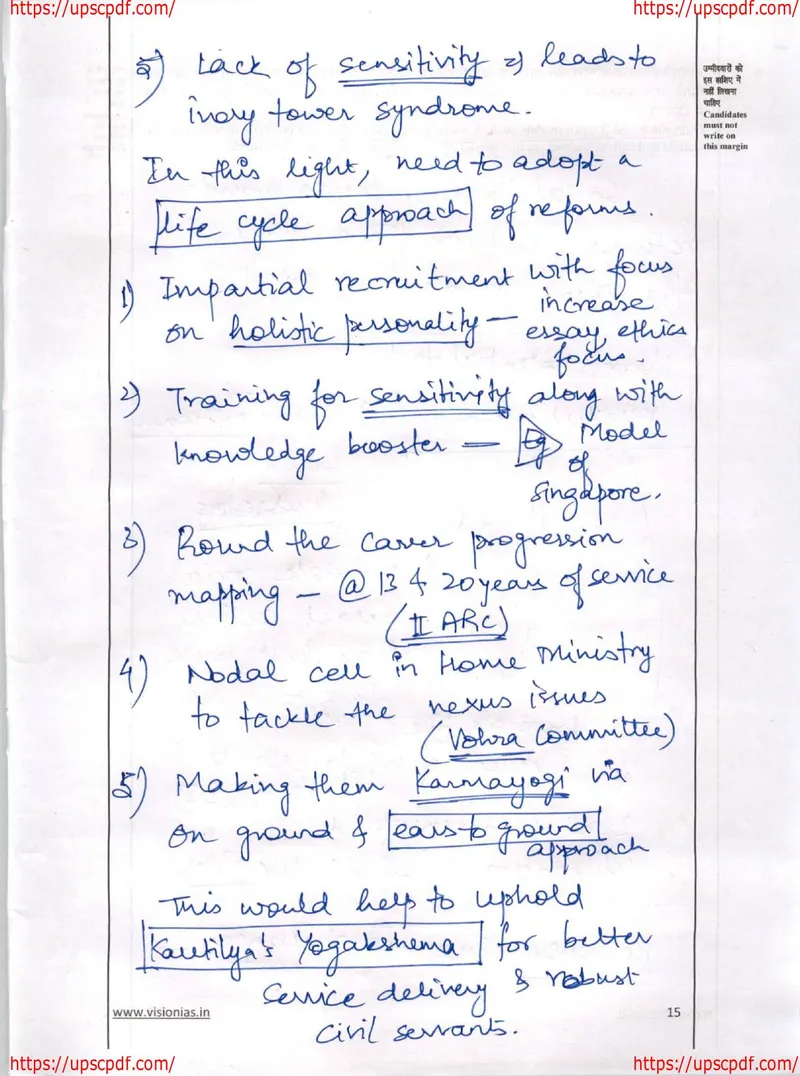
- 5.Civil services reforms must go beyond recruitment and standardised training
- 6.Outcome-based finance / Social Impact Bonds to catalyse socio-economic impact at scale
- 7.Gap between female graduates and female labour-force participation in India
- 8.Civil Registration System (CRS) as essential to socio-economic planning; recent revamp
- 9.Reform of the IMF / global financial architecture
- 10.India-West Asia geoeconomics (UPI, de-dollarisation, I2U2, Abraham Accords)
- 11.Competition Commission of India (CCI) and regulation of big-tech / digital markets
- 12.Paid news as an electoral offence / threat to free and fair elections
- 13.Doctrine of Essentiality / essential religious practices (Article 25)
- 14.Limiting the size of government (EAC-PM) — minimum government, maximum governance
- 15.Institutions of Eminence (IoE) scheme — performance and inadequacies
- 16.Digital Public Infrastructure (DPI) — Aadhaar/UPI/JAM, gaps and way ahead
- 17.Right to health — infrastructure, financial and social gaps
- 18.Third gender / transgender rights, exclusion and remedies
- 19.SCO and strained India-China / India-Pakistan ties
- 20.iCET India-US Initiative on Critical and Emerging Technology
Examples, data & evidence used
- Narmada Bachao Andolan; Aarey forest group (petitions); Greenpeace reports (Q1)
- Justice Tahilramani transfer; Bhim Singh case; 'Uncle Judge syndrome' (Q4)
- Book 'Why Nations Fail' attributed to James Robinson; Pooja Singhal case, Jharkhand; NK Saxena Committee; NSA Doval on fifth-generation warfare (Q5)
- #MeToo movement; Chandra Mohanty 'domestication of women' theory; ILO Global Wage Report (~30% wage gap); PLFS data (Q7)
- Google Rs 1330 cr CCI fine; Amazon; Jio; Vodafone; ONDC; Maggi/MSG; Birla Committee (Q11)
- Abhiram Singh case; Resurgence India case; Bihar 2020 (35 paid-news cases); Lokniti-CSDS (Q12)
- Hijab case; Shirur Mutt case; Nikhil Soni case; Sabarimala (Indu Malhotra); Ismail Faruqui case; Shayara Bano / Triple Talaq (Q13)
- IIT Kanpur reportedly left out of IoE list (Q15)
- German minister buying vegetables via UPI; YONO SBI; JAM trinity / DBT; CBDC; Common Service Centres (Q16)
- Mohalla Clinics, Delhi; Barefoot doctors of China; Live Love Laugh campaign; SCARF mobile vans; Bhore/Bajaj Committee (Q17)
- NALSA case; Swadhar Greh model (Gujarat); Karnataka Women Development Council; Census 2011 (~49 lakh transgender) (Q18)
- SCO admission of Iran; Chabahar-Zahedan; TAPI pipeline; Kazakhstan uranium; INSTC; RATS; CPEC (Q19)
- PM Modi state visit to US; INDUS X; GE414 jet-engine deal; GPS denial during Kargil war; Red Echo cyberattack on Mumbai power grid (Q20)
- UAE-UPI linkage; I2U2; Abraham Accords; Saudi Vision 2030; Emaar mall Srinagar; OPEC ~65% oil (Q10)
Quotes the candidate used
- Book reference: 'Why Nations Fail' — written as 'by James Robinson' (Q5); flagged: the book is actually co-authored by Daron Acemoglu and James Robinson
- 'Feminization U hypothesis' attributed to the Economic Survey (Q7)
- 'Domestication of women' theory attributed to Chandra Mohanty (Q7)
- Aadhaar / Jan Dhan described as recognised by the IMF 'as a wonder' (Q16)
- Candidate's own signature closing slogans (not external quotes): 'minimum government, maximum governance', 'sabka saath sabka vikas', 'atmanirbhar Bharat', 'digital vishwaguru', 'swasth rajneeti, surakshit Bharat', 'enabler not disabler', 'third gender become third citizens', 'best of both worlds via strategic autonomy'
How it’s written: Consistent, drilled template across all 20 answers: (1) a 2-3 line intro giving a definition/context, often anchoring to a Constitutional Article (e.g., Art 19(1)(b), 19(1)(g), 21, 38, 39A, 41); (2) a BOXED one-line thesis/directive statement (e.g., "It has become victim of its own success", "They have delivered");…
Diagrams & visuals: Q2: two-column comparison table (Positives | Challenges); Q6: radial mind-map — 'Have potential to revolutionize' branching to outcome-based budgeting, social impact over targets, welfare-state values (Art 38), fiscal discipline; Q9: two mind-maps on IMF reform / global financial order; Q11: mind-map on CCI / digital-market regulation; Q15: boxed structures ('They have delivered' vs 'However largely inadequate'); Q16: structured/boxed layout for DPI components
Evaluator: No examiner marks or comments are filled in on this copy.