
Shubham Raghuvanshi — Topper copy archive GS copy
What’s inside this copy
- ▸Cover confirms candidate Shubham Raghuvanshi, but the booklet is a 2019 VisionIAS Abhyaas Mains GS Paper-IV (Ethics) mock - NOT the actual UPSC CSE-2024 paper implied by the brief.
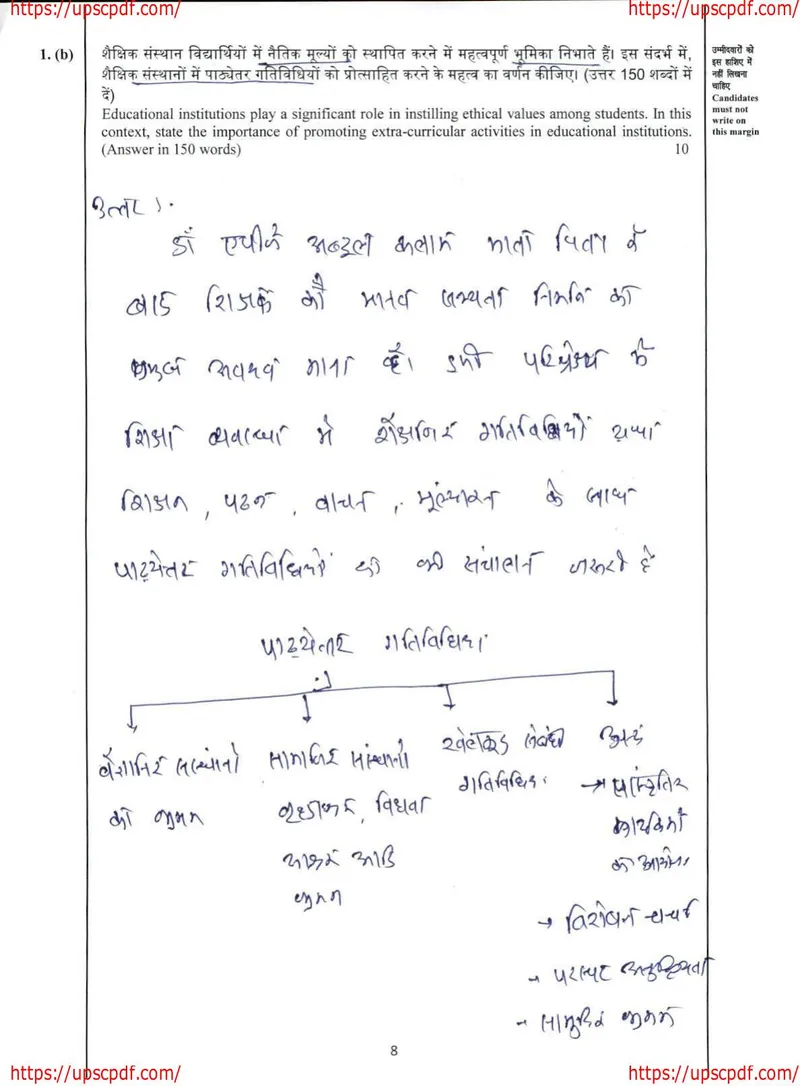
- ▸Signature style: nearly every theory answer is anchored on a hand-drawn branching tree diagram plus underlined keyword sub-headers - strong visual structuring.
- ▸Solid ethics example bank: APJ Abdul Kalam, E. Sreedharan, TN Seshan, Konkan Railway, Companies Act 2013 CSR, Gandhi's 'need not greed'.
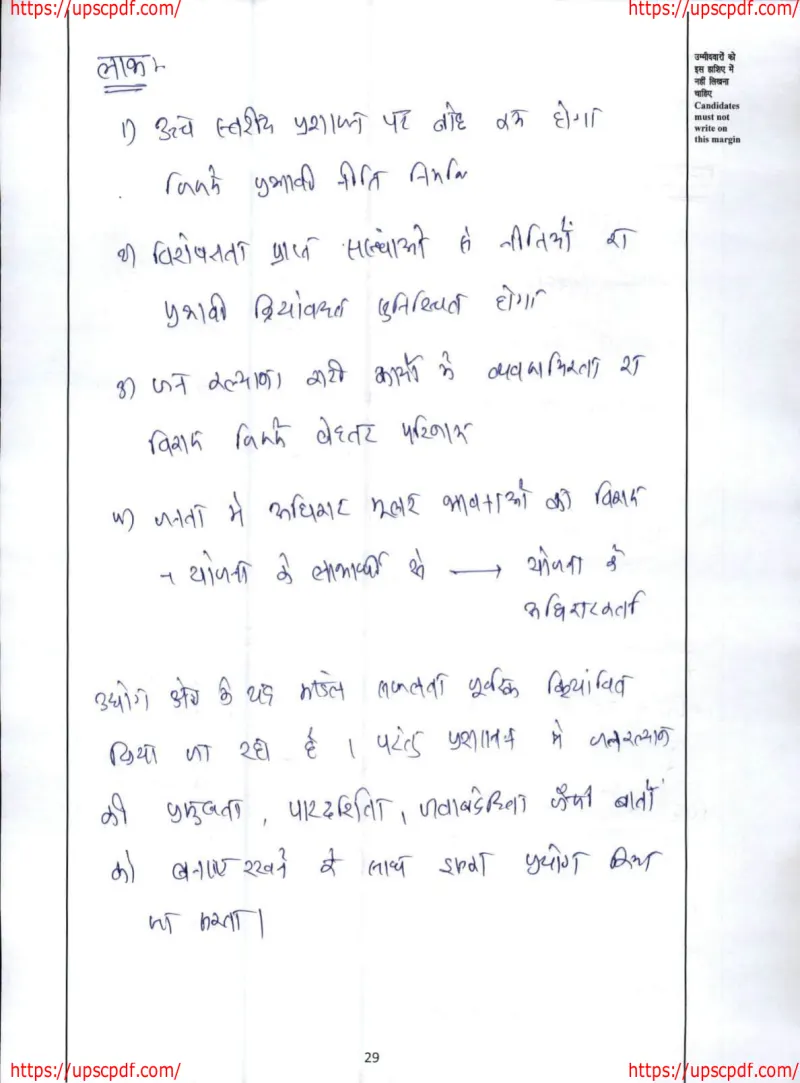
- ▸MISASSEMBLED FILE: PDF pages 25-58 are a different booklet (VisionIAS code 1433, 'Page 23-56 of 56') in clearly neater handwriting with NO name page - Q7 (compassion), Q8(a) professionalism, Q8(b) nishkama karma and case studies (reservation, public-figure statements, coal mining). Cannot be attributed to Shubham; flagged.
- ▸Shubham's own 1451 booklet pages 25-58 are absent (spliced out), so only Q1(a)-Q5(b) and a surviving tail (pp.59-61) of his later answers are present.
- ▸Copy is completely unevaluated - no marks, ticks or examiner remarks anywhere.
What to learn from this copy
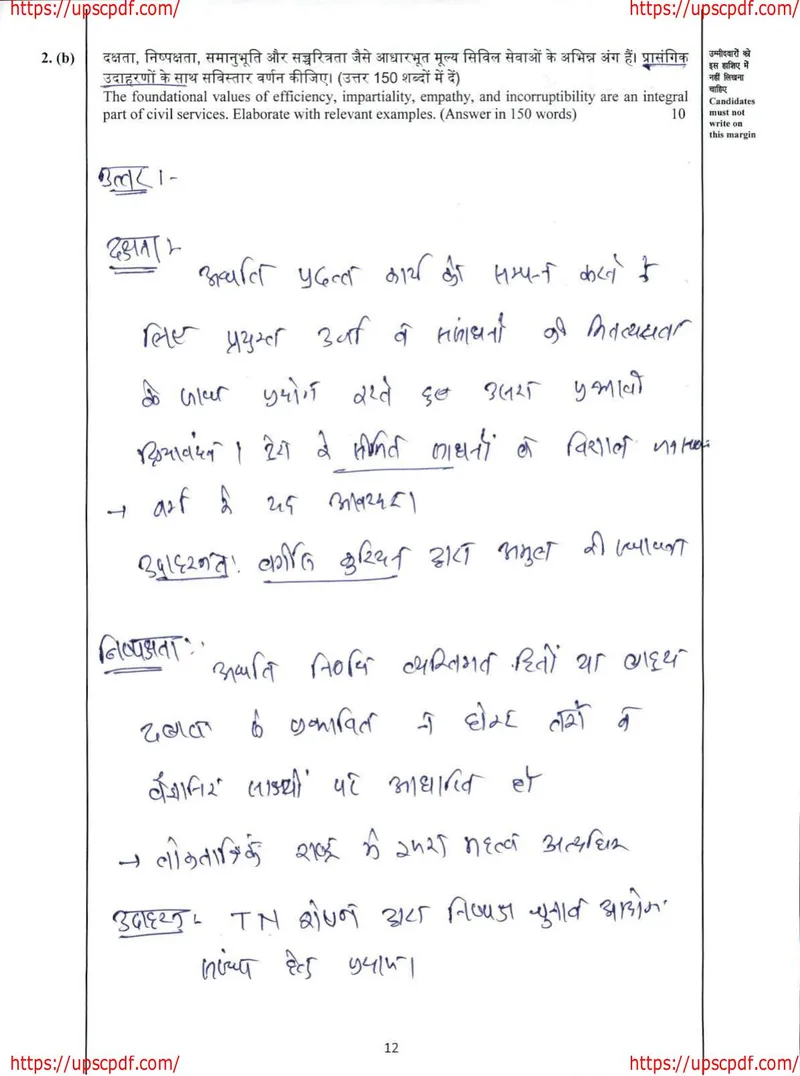
- ★He matched each abstract value to a named, concrete exemplar instead of generic praise — E. Sreedharan / Konkan Railway for 'efficiency' and TN Seshan / electoral reforms for 'impartiality' in Q2(b) on foundational civil-service values -> for ethics answers, pre-load a specific person+achievement for every standard value so each claim lands on a verifiable real case, not a platitude.
- ★On a question whose framing tempts vague hand-wringing, he supplied the exact named governance framework — answering 'Citizen's Charters alone cannot improve service quality' (Q5a) through the Sevottam Model, and grounding remedies in RTI, e-governance and mobile grievance apps -> when a question implies a known administrative model exists, name it and use it as your analytical spine; the precise framework signals depth a generic discussion cannot.
- ★He brought his own relevant quotation rather than only leaning on question-provided ones — introducing Gandhi's 'earth can fulfil our needs but not our greed' (p.59) inside the environmental-ethics / differentiated-responsibility answer -> a candidate-chosen quote that fits the exact theme shows wider reading; place it where it reinforces your argument (developed-vs-developing duty), not as decoration.
- ★He converted classification-heavy theory into hand-drawn branching tree diagrams instead of prose lists — e.g. IR approaches split into realist / middle-path / idealist in Q3(a), and intolerance mapped into caste / religious / gender / marginalised (Naxals, Dalits, LGBT) in Q4(a) -> when a concept has natural sub-categories, a labelled tree both organises your own thinking and lets the examiner see coverage at a glance; reserve it for genuinely taxonomic content, not every answer.
- ★He kept a disciplined, repeatable answer template across the whole paper — short definitional intro, body built on underlined keyword sub-headers (दक्षता, निष्पक्षता, पारस्परिकता) with arrow-led bullets and a numbered 'महत्व' list, then a closing line -> a consistent skeleton lets you write fast under time pressure and guarantees structure; build one reusable template so you spend thinking time on content, not layout.
Questions attempted: Doctrine of Double Effect - 'It is morally permissible to perform an action in pursuit of a good end in full knowledge it may also bring bad results.' Critically examine.; Role of educational institutions / extra-curricular activities in instilling ethical values; Public service ethos as the element distinguishing a public-service career from other jobs, and 8 more below.
Questions attempted in this booklet (11)+
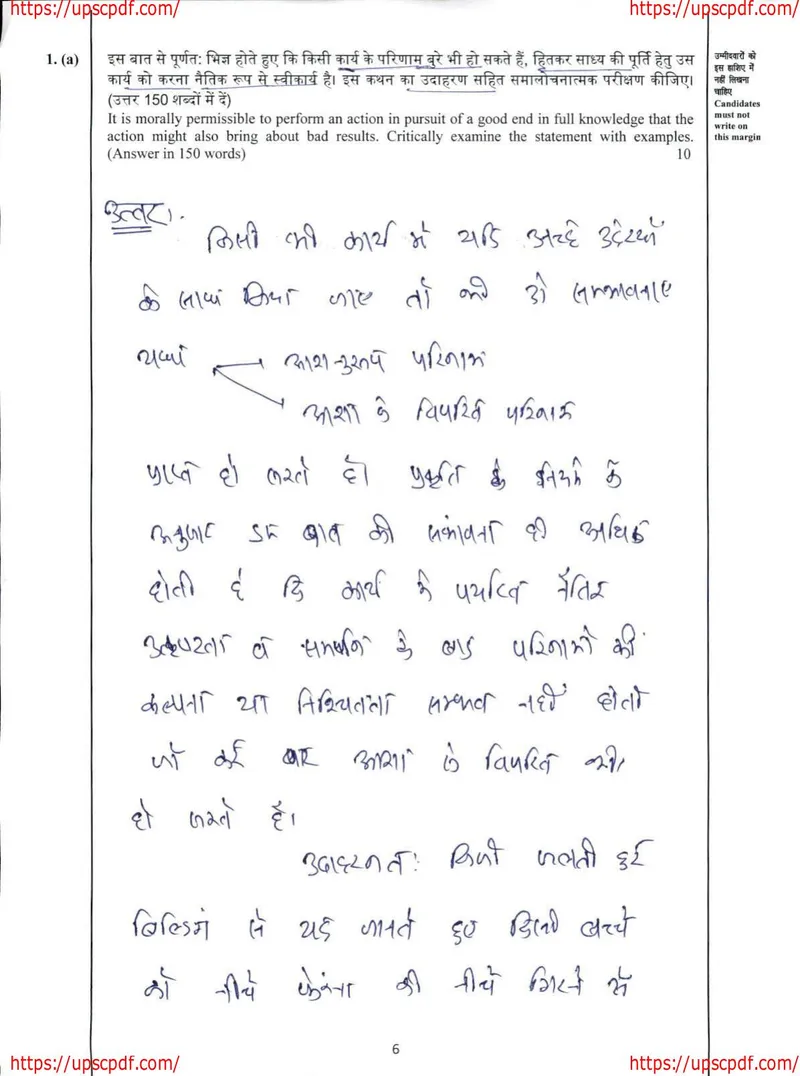
- 1(a).Doctrine of Double Effect - 'It is morally permissible to perform an action in pursuit of a good end in full knowledge it may also bring bad results.' Critically examine.
- 1(b).Role of educational institutions / extra-curricular activities in instilling ethical values
- 2(a).Public service ethos as the element distinguishing a public-service career from other jobs
- 2(b).Foundational values - efficiency, impartiality, empathy, incorruptibility in civil services (with examples)
- 3(a).Foreign policy guided by national interest vs scope for ethics in international relations
- 3(b).CSR and whether 'business ethics is an oxymoron' (cites Companies Act 2013)
- 4(a).Mahatma Gandhi quote - 'Intolerance is itself a form of violence and an obstacle to a true democratic spirit'
- 4(b).Albert Einstein quote - 'Try not to become a man of success but rather a man of value'
- 5(a).Citizen's Charters alone cannot improve service quality - discuss via the Sevottam Model
- 5(b).Social capital and its relationship with good governance
- later answer (pp.59-61, q-no in missing pages).Differentiated responsibility of developed vs developing nations / environmental ethics - cites Gandhi's 'need not greed'
Examples, data & evidence used
- Dr APJ Abdul Kalam (teachers/values) - Q1(b)
- E. Sreedharan and TN Seshan as model public servants - Q2(a)/(b)
- Konkan Railway (efficiency) - Q2(b)
- TN Seshan / electoral reforms for impartiality - Q2(b)
- India's foreign policy as guided by national interest - Q3(a)
- Companies Act 2013 mandating CSR - Q3(b)
- Gun-violence/shooting in the US and Tamil Nadu instances (intolerance) - Q4(a)
- RTI, e-governance and mobile apps as charter-grievance remedies - Q5(a)
- Bonded labour/rehabilitation and coal-mining dilemmas (NOTE: appear in the flagged 1433 booklet, NOT attributed to Shubham)
Quotes the candidate used
- Mahatma Gandhi - 'Intolerance is itself a form of violence...' (question-provided quote in Q4a, engaged by candidate)
- Albert Einstein - 'Try not to become a man of success but rather a man of value' (question-provided quote in Q4b)
- Mahatma Gandhi - paraphrased 'nature/earth can fulfil our needs but not our greed' (candidate-introduced, p.59)
- Dr APJ Abdul Kalam - referenced on the role of teachers (Q1b)
How it’s written: Consistent template: writes 'उत्तर' heading, a short definitional intro, a body built around branching tree/flow diagrams and underlined keyword sub-headers (e.g. दक्षता, निष्पक्षता, पारस्परिकता), arrow-led bullets and numbered lists for 'महत्व'/significance, and a closing line; each answer is terminated with a hand…
Diagrams & visuals: Tree diagram of extra-curricular activities branching into scientific/academic, social-service, voluntary, cultural - Q1(b); Tree diagram of IR approaches: realist / middle-path / idealist - Q3(a); Tree diagram of intolerance types: caste / religious / gender / marginalised groups (Naxals, Dalits, LGBT) - Q4(a); Tree diagram of social capital: mutual trust / network / shared cooperation / interdependence - Q5(b); Small flow arrow in Q1(a) distinguishing 'expected result' vs 'result contrary to expectation'; No geographical maps used
Evaluator: No examiner marks or comments are filled in on this copy.