
Vikas — Vajiram & Ravi GS Paper 4 (Ethics) copy
What’s inside this copy
- ▸Topper model copy with all 12 questions (13 Section-A parts + 6 case studies) fully attempted; no question left blank
- ▸Every answer is quote-anchored — Musk, Vivekananda, Camus, Gandhi, Guterres, Ambedkar, Einstein, Confucius, Dalai Lama all deployed
- ▸Strikingly current examples: 'All eyes on Rafah' AI image, Rashmika Mandanna/Tendulkar deepfakes, SP Surender Bishnoi's Aravalli mining death, SEBI finfluencer 'Endorsement Know-Hows'
- ▸Case studies follow a clean Merit/Demerit two-column evaluation before a reasoned 'I would choose...' verdict
- ▸Strong administrative-ethics vocabulary: CBDR, Polluter Pays, Sevottam, ARC-II, DBT, Nishkam Karma, constitutional morality, Viksit Bharat @2047
- ▸No marks or evaluator comments anywhere — boxes and rubric left entirely blank (unevaluated copy)
What to learn from this copy
- ★Vikas pairs each ethics concept with a strikingly *current* concrete instance instead of textbook stock examples — 'All eyes on Rafah' AI-generated image for gen-AI's social utility, the Rashmika Mandanna/Sachin Tendulkar/PM Modi deepfakes for betting-app fraud, SEBI's 'Endorsement Know-Hows' guidelines in the finfluencer case, and SP Surender Bishnoi's real Aravalli sand-mafia death in Case 8 -> Mine the last 12-18 months of news for one named, verifiable example per ethics theme; a 2024-25 instance signals you actually follow ethics-in-action and instantly out-scores a generic 'a corrupt officer' illustration.
- ★He opens answers with a tight quote-hook matched to the exact theme — Elon Musk's 'AI is far more dangerous than a nuclear bomb' to launch the gen-AI question, Guterres' 'Earth has passed from global warming to global boiling' for the climate-finance question, and Gandhi's 'in matters of conscience, the law of majority has no place' for the conscience answer -> Bank 8-10 thinker quotes you can deploy as theme-specific intros (Musk for tech, Guterres for climate, Gandhi/Kant for conscience-duty); a quote that names the precise dilemma beats a decorative one parachuted in.
- ★In every case study (Q7-Q11) he runs a clean two-column Merit/Demerit evaluation of each option *before* committing to a reasoned 'I would choose...' verdict, rather than jumping straight to a conclusion -> In case studies, visibly weigh each option's pros and cons in a comparison layout first, then justify your choice — the examiner rewards the structured reasoning trail, not just the 'right' final answer.
- ★His administrative-ethics vocabulary is precise and loaded: in the climate answer alone he deploys CBDR, Polluter Pays, Just Transition, New Collective Quantified Goal, India's ~2.6 tonnes per-capita figure and the Brandt Line; the welfare-corruption answer cites the ARC-II definition, Kant's Categorical Imperative, DBT, Meghalaya's social-audit law and Nishkam Karma -> Build a per-topic terminology kit (the exact frameworks, one statistic, one Indian-thinker concept) so each answer reads like an informed practitioner's, not a layperson's — specificity of vocabulary is itself a scoring signal.
- ★He grounds Indian-administration answers in named role models tied to the exact virtue under discussion — T.N. Seshan's 'zero deficiency' and E. Sreedharan the 'Metro Man' for integrity/efficiency, Lal Bahadur Shastri's resignation after a rail accident for accountability, and Dhoni 'Captain Cool'/Modi motivating ISRO after Chandrayaan-2 for emotional intelligence under stress -> Keep a roster of real administrators and figures slotted to specific ethical qualities so you can substantiate abstract claims with a person who embodied them, which makes the answer concrete and memorable.
Questions attempted: Differentiate moral absolutism from ethical pluralism (with examples); Ethical implications of generative AI in creative industries; Citizen charters for transparency & combating corruption, and 16 more below.
Questions attempted in this booklet (19)+
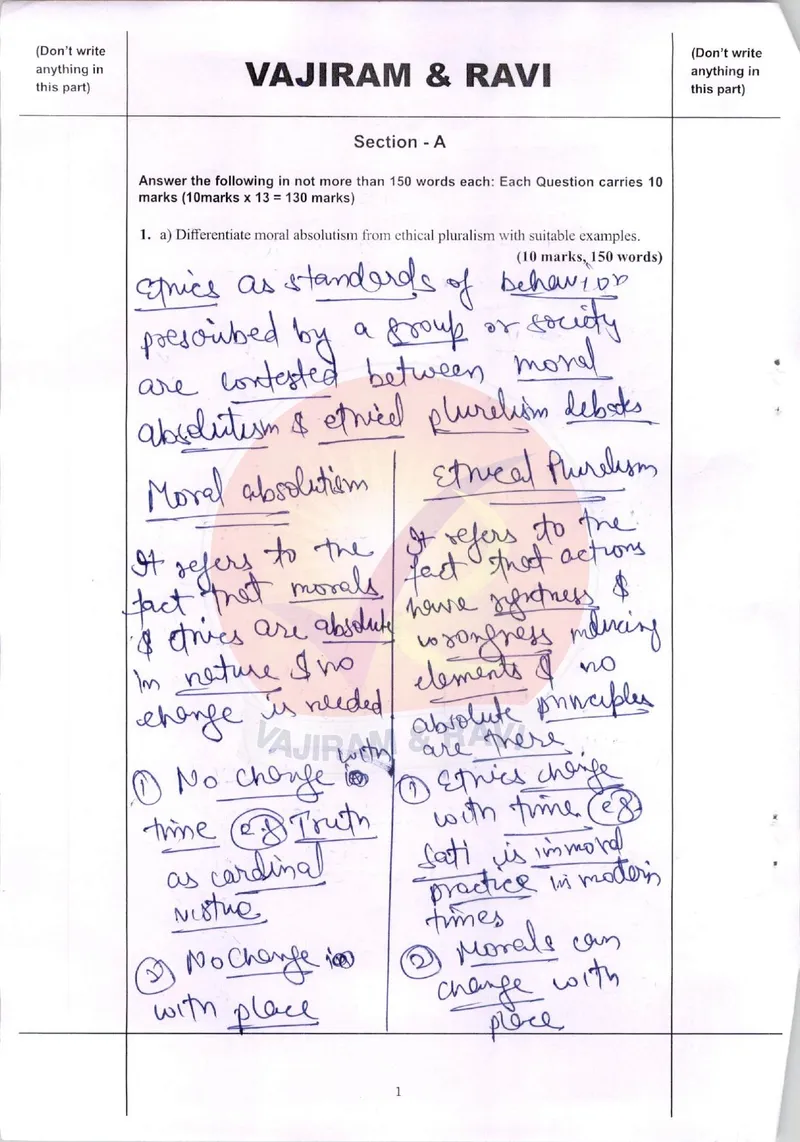
- 1a.Differentiate moral absolutism from ethical pluralism (with examples)
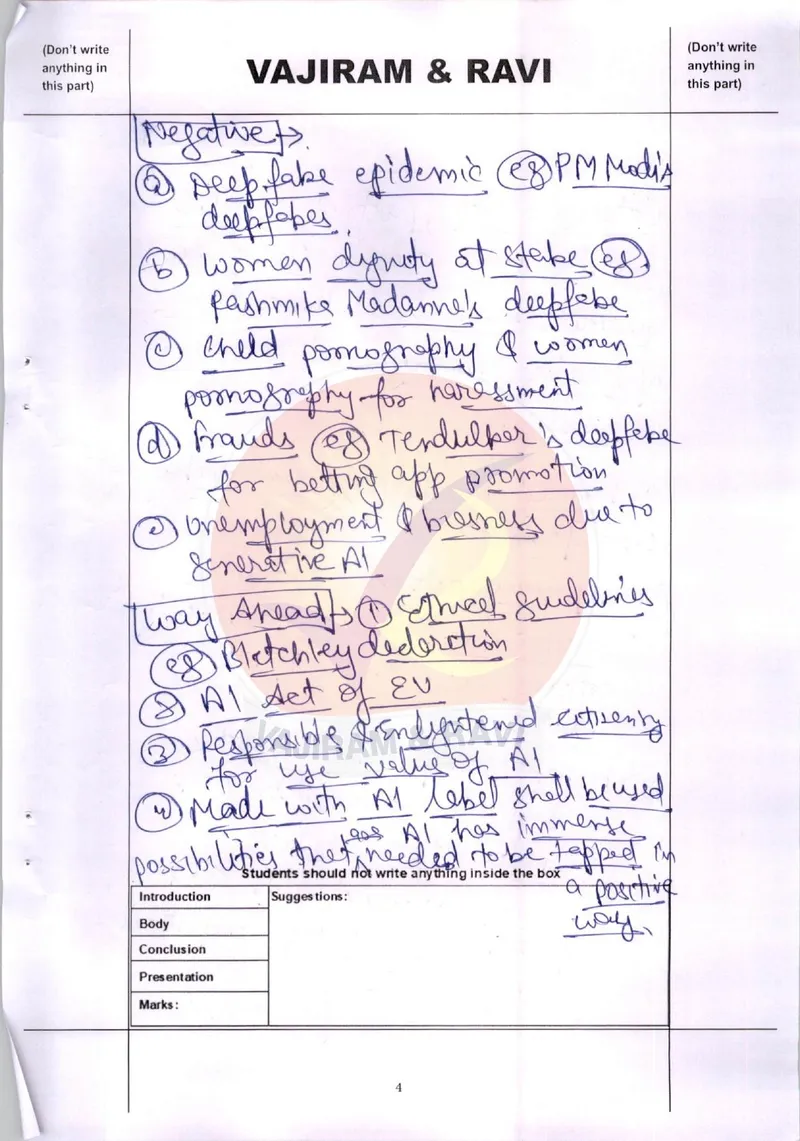
- 1b.Ethical implications of generative AI in creative industries
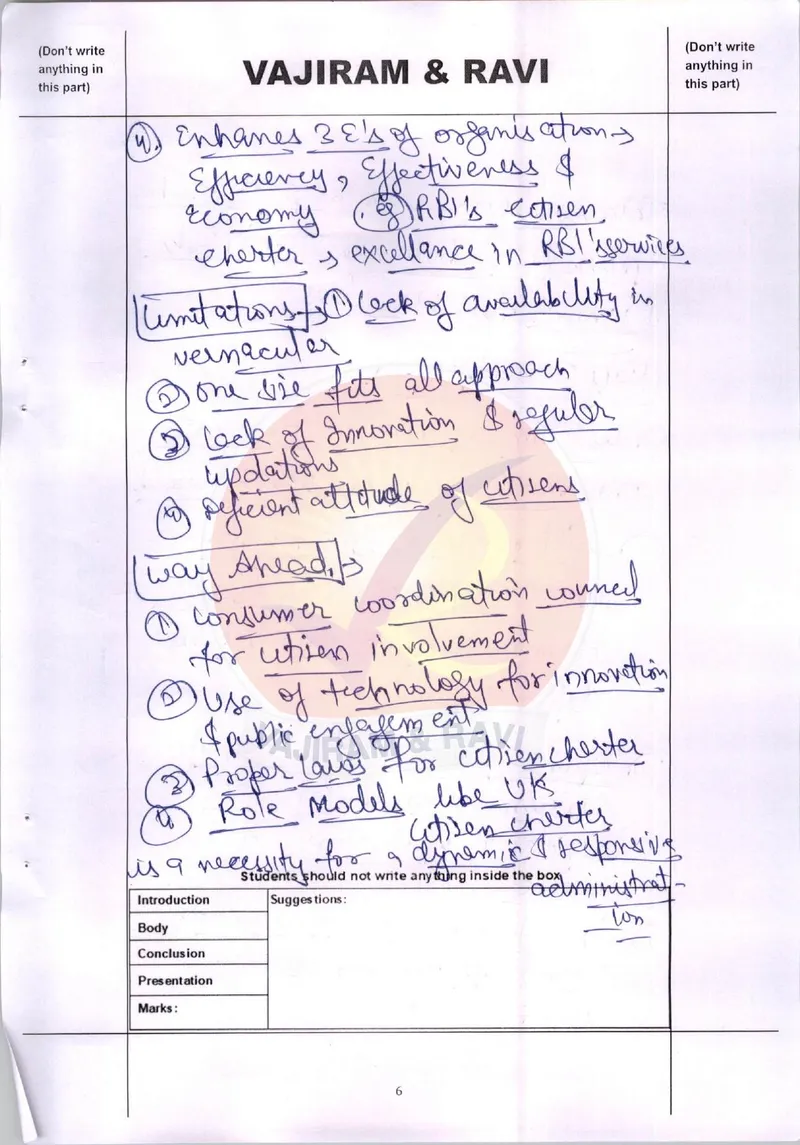
- 2a.Citizen charters for transparency & combating corruption
- 2b.Key teachings of Thiruvalluvar and their present-day relevance
- 3a.Quote: 'In a conflict between heart and brain, follow your heart' (Vivekananda)
- 3b.Quote: 'To see what is right and not do it is the want of courage' (Confucius)
- 3c.Quote: 'Our prime purpose is to help others... at least don't hurt them' (Dalai Lama)
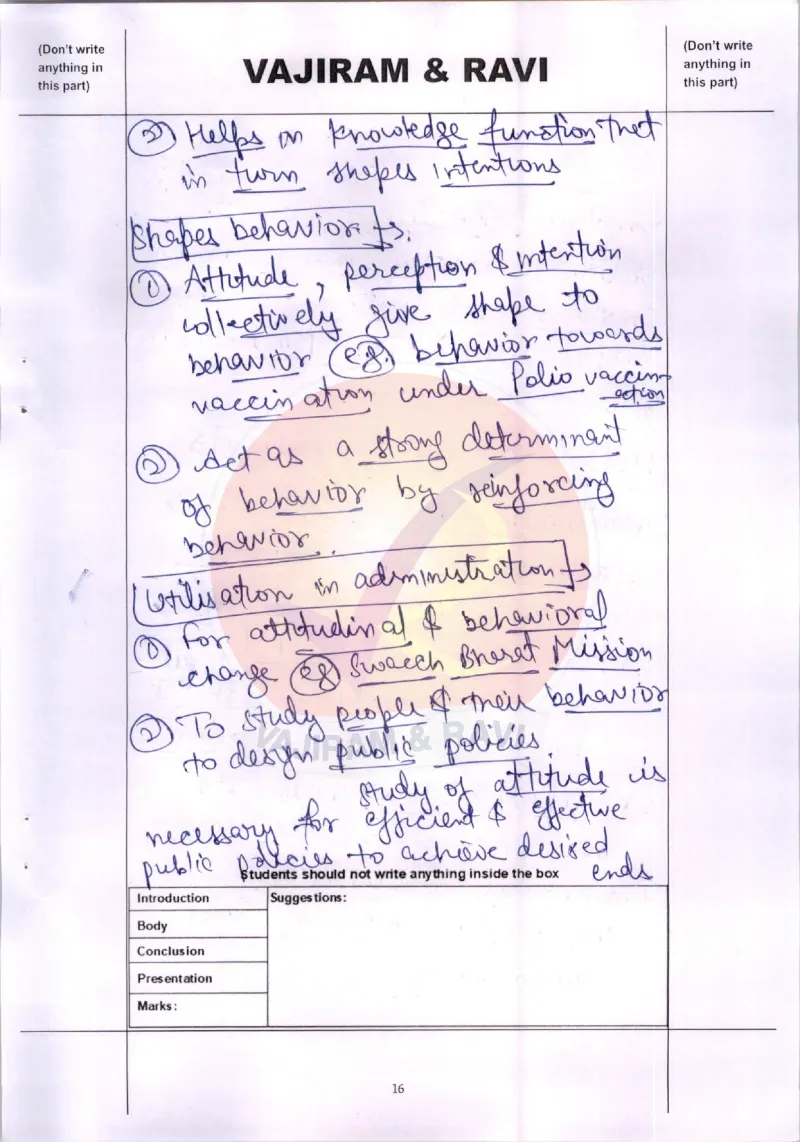
- 4a.Attitude shapes perception/intention; behaviour as its tangible expression
- 4b.Emotional intelligence in high-stress environments — resilience & decision-making
- 5a.Ethics of developed nations setting climate targets without adequate finance
- 5b.Misuse of welfare benefits for weaker sections — moral consequences & prevention
- 6a.Role of conscience in personal integrity & moral responsibility
- 6b.Ethical dilemmas: organisational policy vs personal moral principles
- 7.Case: DCP Aakash/SI Shipra favouritism, anonymous email scandal, police discipline
- 8.Case: Aravalli illegal mining; journalist Sahoo bribed to suppress investigative report
- 9.Case: financial influencer endorsing Digital PayTech stocks (finfluencer ethics)
- 10.Case: strategic disinvestment of State PSB; union leader offered bribe
- 11.Case: Anil Gupta appoints son Rohan as CEO (nepotism, corporate governance)
- 12.Case: Ms. Radhika, RTE, death of Dalit student Rani (caste discrimination in schools)
Examples, data & evidence used
- Sati as an immoral practice in modern times (moral change over time)
- Marijuana seen as legal/ethical in the West (moral pluralism by place)
- 'All eyes on Rafah' AI-generated image (social utility of gen-AI content)
- Deepfakes: PM Modi, Rashmika Mandanna, Sachin Tendulkar (betting-app promotion fraud)
- Bletchley Declaration on AI; 'Made with AI' labelling
- Sevottam model; citizen charters of NTPC, Hyderabad Municipal Corporation (compensation), RBI; UK as role model
- Thiruvalluvar / Thirukkural teachings; Nuh riots (communal context)
- T.N. Seshan ('zero deficiency'); E. Sreedharan ('Metro Man of India'); Lal Bahadur Shastri's resignation after a rail accident
- Gandhi: 'Golden Mean', conscience as highest court, Talisman, withdrawal of civil disobedience after violence; Aristotle (courage as a cardinal virtue); Bhishma as role model
- Daniel Goleman (Emotional Intelligence/EQ); PM Modi motivating ISRO after Chandrayaan-2; M.S. Dhoni 'Captain Cool'; Balakot strikes; Covid warriors
- Climate: Antonio Guterres 'global boiling', CBDR, historical responsibility, Brandt Line, IPCC, per-capita emissions (India ~2.6 tonnes), New Collective Quantified Goal, Polluter Pays, Just Transition, COP/UNFCCC, greenwashing
- Corruption/welfare: ARC-II definition, Kant's Categorical Imperative, Direct Benefit Transfer, MGNREGA Aadhaar-enabled payments, social audit & Meghalaya's social audit law, Article 21/POSH Act, Gita's Nishkam Karma, constitutional morality
- Case 8: SP Surender Bishnoi killed by sand-mafia truck in Aravalli (real incident); Einstein attribution on cowardice
- Case 9: UPI revolution, 'finfluencers', SEBI 'Endorsement Know-Hows' guidelines
Quotes the candidate used
- 'AI is far more dangerous than a nuclear bomb' — Elon Musk (Q1b intro)
- 'In a conflict between the heart and the brain, follow your heart' — Swami Vivekananda (Q3a, question quote)
- 'To see what is right and not do it is the want of courage' — Confucius (Q3b, question quote)
- 'Our prime purpose in this life is to help others. And if you can't help them, at least don't hurt them' — Dalai Lama (Q3c, question quote)
- 'A person without morals & ethics is like a beast unleashed upon this world' — attributed to Albert Camus (Q3a)
- 'Knowledge/intelligence without character is a sin' — Gandhi (Q3a)
- 'In matters of conscience, the law of majority has no place as it is the highest court' — Gandhi (Q6a intro)
- 'Earth has passed from global warming to global boiling' — Antonio Guterres (Q5a intro)
How it’s written: Consistent, disciplined structure across all answers. 10-markers open with a one-line definition or a quote-hook, then a clearly sub-headed body (e.g. 'Positives/Negatives', 'Enhance transparency', 'Limitations', 'Way ahead') with circled numbered points and circled 'eg' examples, closing with a one-line forward-loo…
Diagrams & visuals: No formal diagrams, flowcharts or maps drawn; Two-column comparison table for Q1a (moral absolutism vs ethical pluralism); Two-column Merit/Demerit option-evaluation layouts in case studies (Q7-Q11)
Evaluator: No examiner marks or comments are filled in on this copy.