
Sandeep Badad — Vajiram & Ravi GS Paper 4 (Ethics) copy
What’s inside this copy
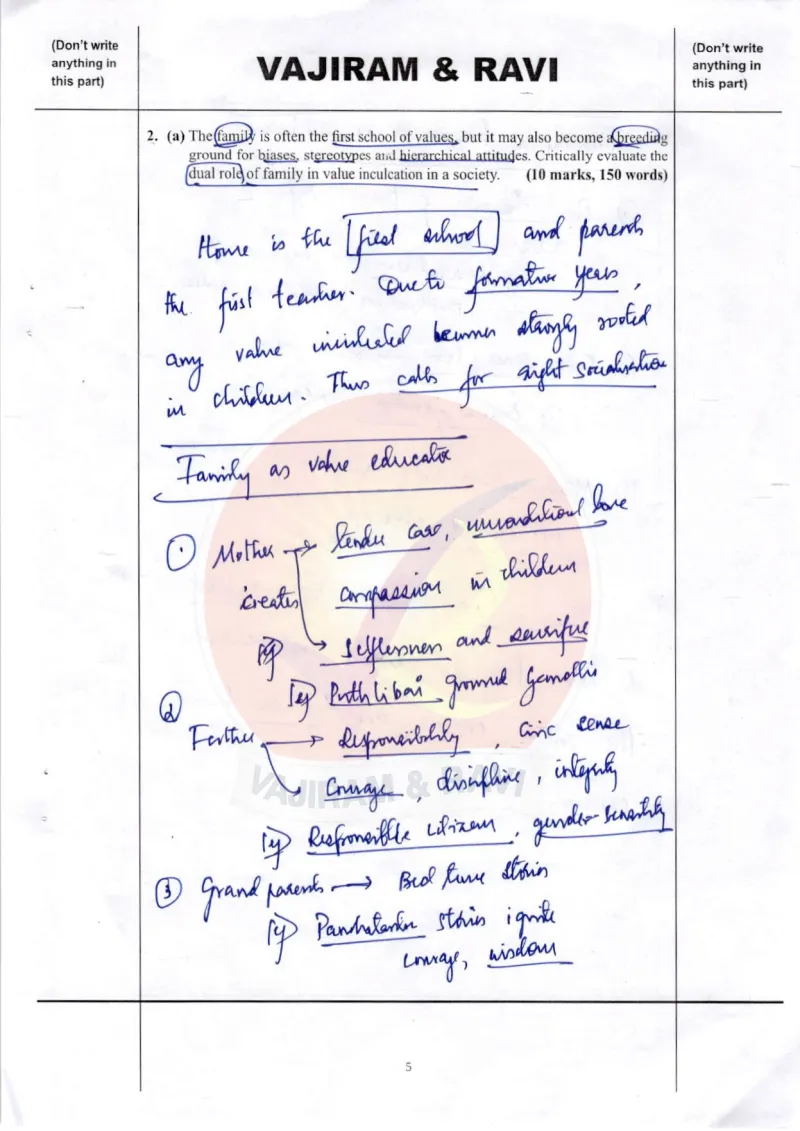
- ▸Authentic Sandeep Badad (AIR-82) copy — handwritten cover 'Sandeep Badad', Admin No 25VR101489, Vajiram & Ravi Sure Shot FLT-2025 Test-8 (GS-4); single consistent hand throughout, matching the PDF metadata (UNCK_SSTS_FLT_2025_T8_SANDEEP_BADAD).
- ▸Attempted 11 of 12 questions — Section A Q1–Q6 and case studies Q7–Q11; the final case study Q12 (Solar Energy Park vs heritage/ecology) was left completely blank.
- ▸Strikingly example-dense — nearly every point carries an 'eg': M.S. Dhoni (2007 WC), E. Sreedharan, Satyendra Dubey, Operation Sindoor, c-Vigil, MGNREGA social audit, Namami Gange, Amrit Sarovar, NCRB dowry data.
- ▸Anchored in ethical theory — Rawls, Kantian imperative, utilitarianism, doctrine of double effect, Nishkama karma, Buddha's 'akusala kamma', Nolan principles.
- ▸Highly visual presentation — merit/demerit 'lens' diagrams, branching flowcharts, boxed keywords and heavy underlining; case studies take a clear, reasoned stand.
- ▸Liberal quote usage — Gandhi ('Glory lies in the attempt', 'science without humanity is sin'), MLK ('injustice anywhere...'), 'Jal hai to kal hai', plus self-coined lines.
What to learn from this copy
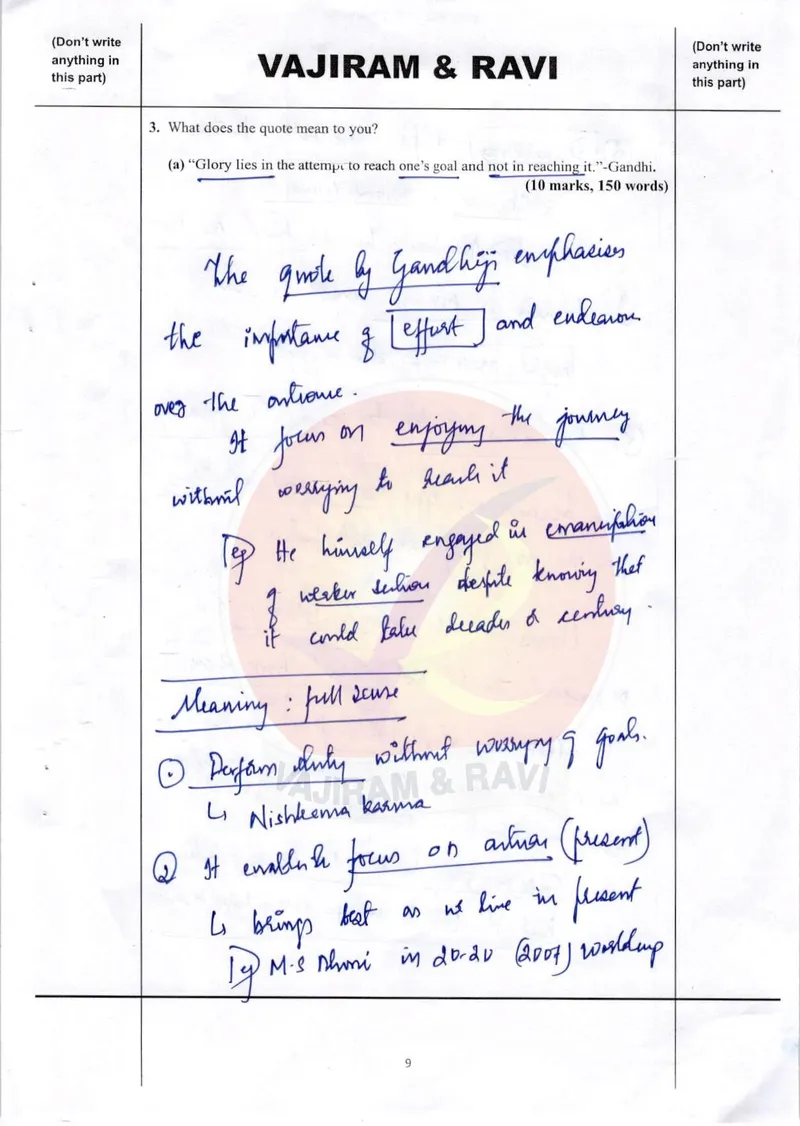
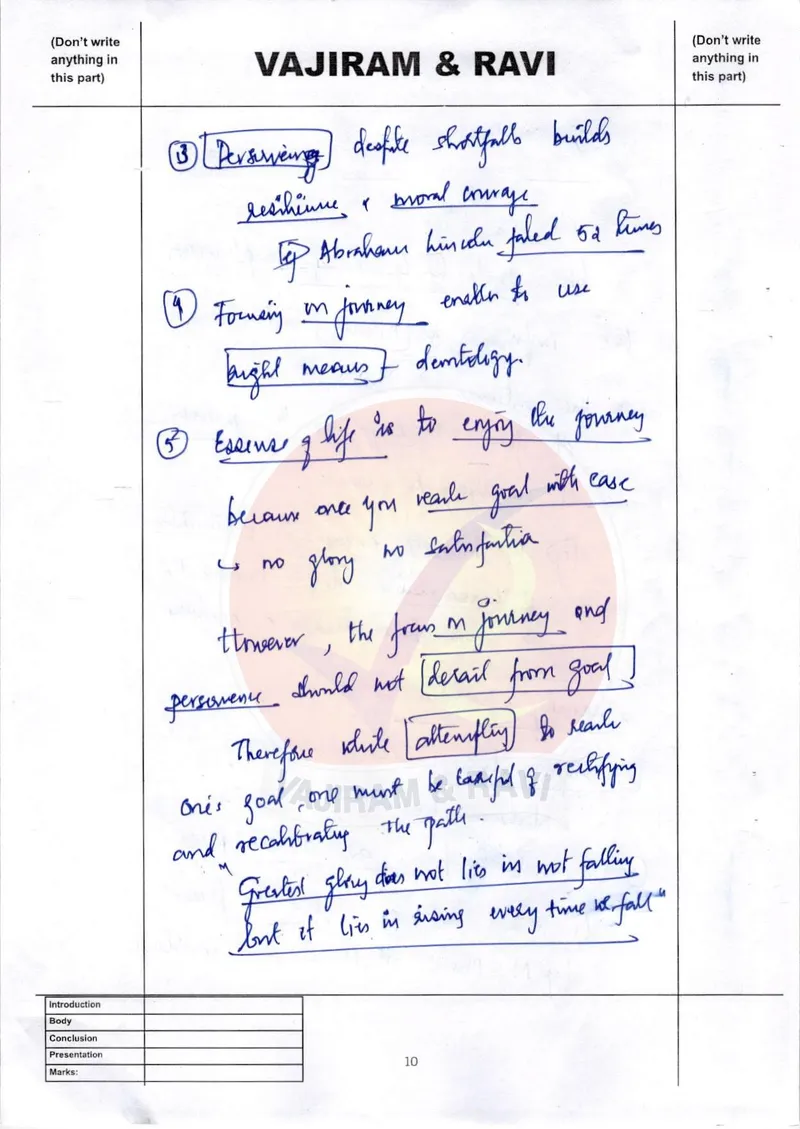
- ★On the Gandhi quote question (Q3, 'Glory lies in the attempt to reach one's goal and not in reaching it'), Badad fused a scriptural anchor (Nishkama karma/Gita's 'perform duty without worrying about the goal') with a vivid pop-culture proof (M.S. Dhoni's focus on action in the 2007 T20 World Cup) and a counter-example of failure (the bystander effect in road accidents) -> when you 'unpack a quote', stack a philosophical root + one concrete real-world success + one failure case so the abstract idea is demonstrated from multiple angles rather than just paraphrased.
- ★He matched specific named exemplars to specific demands instead of recycling one hero everywhere: E. Sreedharan + Delhi Metro to show ethical AND technical competence together (Q5b), Satyendra Dubey/whistleblower protection in the corruption answers, Davinder Singh and Rawls' 'treating the weakest specially is not discrimination' for impartiality-vs-compassion (Q2b) -> build a tagged mental bank where each example is filed against the exact concept it proves, so you deploy the right illustration for the right sub-part rather than a generic all-purpose name.
- ★In the case studies (Q7 Kulkarni's scholarship-fund diversion, Q9 Neha's ex-gratia, Q10 dowry) he drew merit/demerit 'lens' schematics and took a clear reasoned stand under headings like 'Course of Action' and 'Ethical dilemmas' rather than hedging -> in ethics case studies, lay out the options visually with a stakeholder/merit-demerit weighing AND then commit to a decision, because examiners reward a defensible verdict over a balanced non-answer.
- ★He grounded administrative answers in cited governance machinery, not vague reform-talk: c-Vigil (ECI), MGNREGA social audit, Gram Sabha and Mission Karmayogi for participative vigilance (Q4b/Q8), and Nolan Committee principles + Operation Sindoor (emotional intelligence) for public-service ethics (Q5b) -> back every ethical prescription with a real, nameable scheme/committee so 'transparency' and 'accountability' read as concrete mechanisms an officer can actually invoke.
- ★He triaged time deliberately, fully answering 11 of 12 (Q1-Q11) and leaving the final case study Q12 completely blank rather than thinning every answer -> in a tight ethics paper it is better to write fewer answers well and abandon one entirely than to dilute all of them; protect depth on attempted questions instead of spreading effort to half-finish the last.
Questions attempted: Nature of ethics — how it differs from yet overlaps with morality, religion, law and values (explain with examples); Dual role of the family as the first school of values yet a breeding ground for biases/stereotypes; Reconciling objectivity/impartiality with compassion and empathy in governance, and 12 more below.
Questions attempted in this booklet (15)+
- Q1.Nature of ethics — how it differs from yet overlaps with morality, religion, law and values (explain with examples)
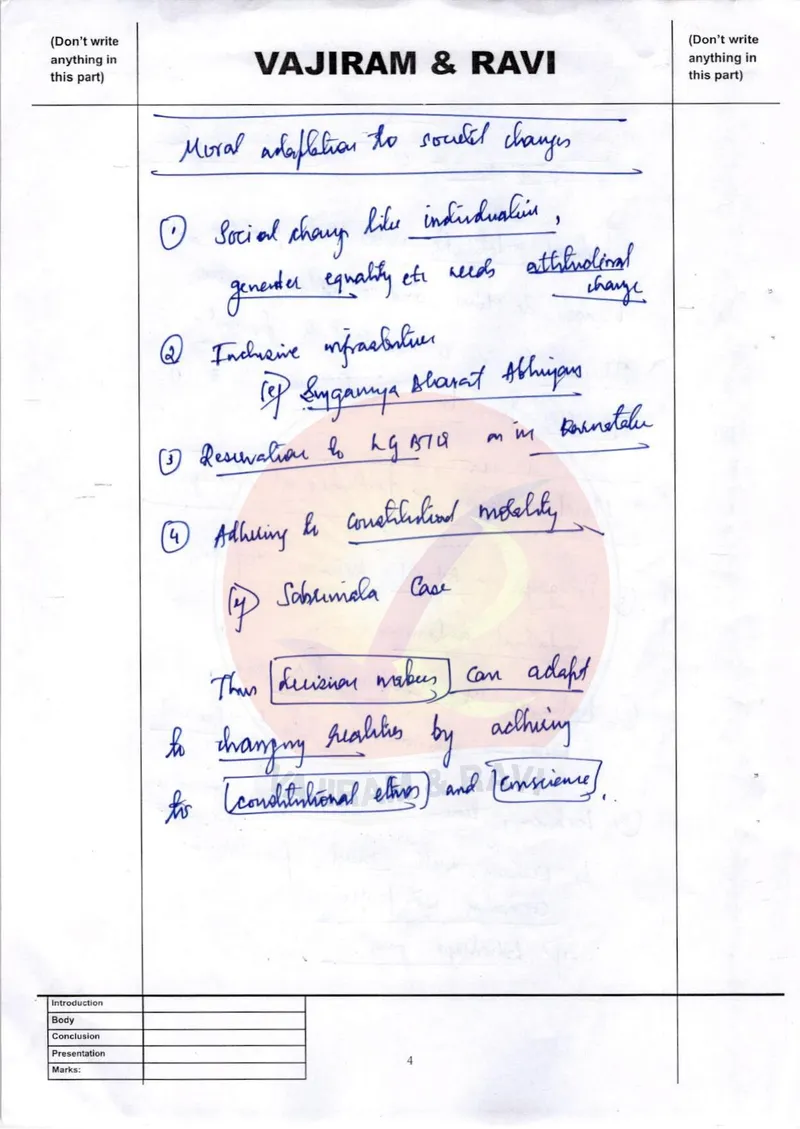
- Q2(a).Dual role of the family as the first school of values yet a breeding ground for biases/stereotypes
- Q2(b).Reconciling objectivity/impartiality with compassion and empathy in governance
- Q3.'What does the quote mean to you?' — Gandhi's 'Glory lies in the attempt to reach one's goal and not in reaching it,' plus a quote on justice/duty
- Q4(a).How NEP 2020 restores the ethical/holistic purpose of education beyond mere employability
- Q4(b).Combating corruption through participative vigilance and transparency (exact prompt partly illegible; answer covers social audit, c-Vigil, Gram Sabha)
- Q5(a).Whether the separation of private and public ethics is difficult and may be counterproductive
- Q5(b).'Ethical competence is as essential as technical competence in public service' — examine with examples
- Q6(a).'A well-developed conscience is the foundation of ethical governance' — discuss with examples
- Q6(b).Ethical defensibility of pursuing space-mission prestige while everyday injustices (hunger, women's safety) remain unresolved
- Q7 (case study).Priya/Arjun — Mr Kulkarni's diversion of dormant scholarship funds for staff emergencies, with an external audit looming
- Q8 (case study).Rajesh, IAS — whistleblowing on corruption and protecting whistleblowers
- Q9 (case study).Neha (DM) — ex-gratia for a deceased garbage-truck driver (Rajiv); compassion vs rules
- Q10 (case study).Aarav — dowry harassment; legal and social mechanisms to address it
- Q11 (case study).Ananya (SDM), Neelgram — dam breach, flooding, water rationing, illegal borewells and farmer unrest
Examples, data & evidence used
- Nishkama karma / 'perform duty without worrying about the goal' (Gita) — Q3
- M.S. Dhoni in the 2007 (T20) World Cup — focus on action/present — Q3
- Martin Luther King — 'Injustice anywhere is a threat to justice everywhere' (attributed by candidate) — Q3
- Bystander effect in road accidents (apathy / moral bankruptcy) — Q3
- Rawls' principle of justice — treating the weakest specially is not discrimination — Q2(b)
- Davinder Singh case — impartiality / creamy layer — Q2(b)
- Uniform Civil Code — balancing diverse laws with constitutional morality — Q2(b)
- NEP 2020 — vocational education till grade VIII, multidisciplinary higher education, value development through sports, 'Pledge' in schools — Q4(a)
- Nolan Committee principles of public life — Q5(b)
- Mission Karmayogi — building holistic ethical competency — Q5(b)/Q8
- E. Sreedharan — Delhi Metro (ethical + technical competence) — Q5(b)
- Operation Sindoor — need for emotional intelligence — Q5(b)
- Social audit in MGNREGA — Q4(b)/Q8
- c-Vigil app, Election Commission of India — Q4(b)
Quotes the candidate used
- 'Glory lies in the attempt to reach one's goal and not in reaching it.' — Gandhi (Q3 prompt, analysed by candidate)
- 'Injustice anywhere is a threat to justice everywhere.' — attributed by candidate to Martin Luther King (Q3)
- 'Science without humanity is sin.' — Gandhi (Q6b)
- 'Justice delayed is justice denied.' (Q5b/Q7)
- 'Jal hai to kal hai' / 'Water is life' (Q11 conclusion)
- 'Beti is not Paraya Dhan' and 'Nari tu Narayani' (Q10)
- 'Dowry is not just a crime but corruption of human relationship...' (candidate's own line, Q10)
- 'Governance of the people, for the people' (Q9 conclusion)
How it’s written: Every answer follows a clear introduction–body–conclusion arc with explicit sub-headings (e.g. 'Ethics is not morality', 'Family as value education', 'Ethically defensible / Undefensible', 'Course of Action', 'Ethical dilemmas', 'Ethical dimensions'). The candidate writes in dense numbered points (1,2,3...) with arr…
Diagrams & visuals: Merit–demerit 'lens/leaf' schematic diagrams in the case studies (Q7, Q9, Q10); Tree/branching flow diagrams and arrow-linked flowcharts (e.g. Q8, Q11); Boxed keywords and key terms with heavy underlining for emphasis throughout; No maps used
Evaluator: No examiner marks or comments are filled in on this copy.