
Tejasvi Deshpande — InsightsIAS Essay copy
EssayPDF · 4.3 MB
What’s inside this copy
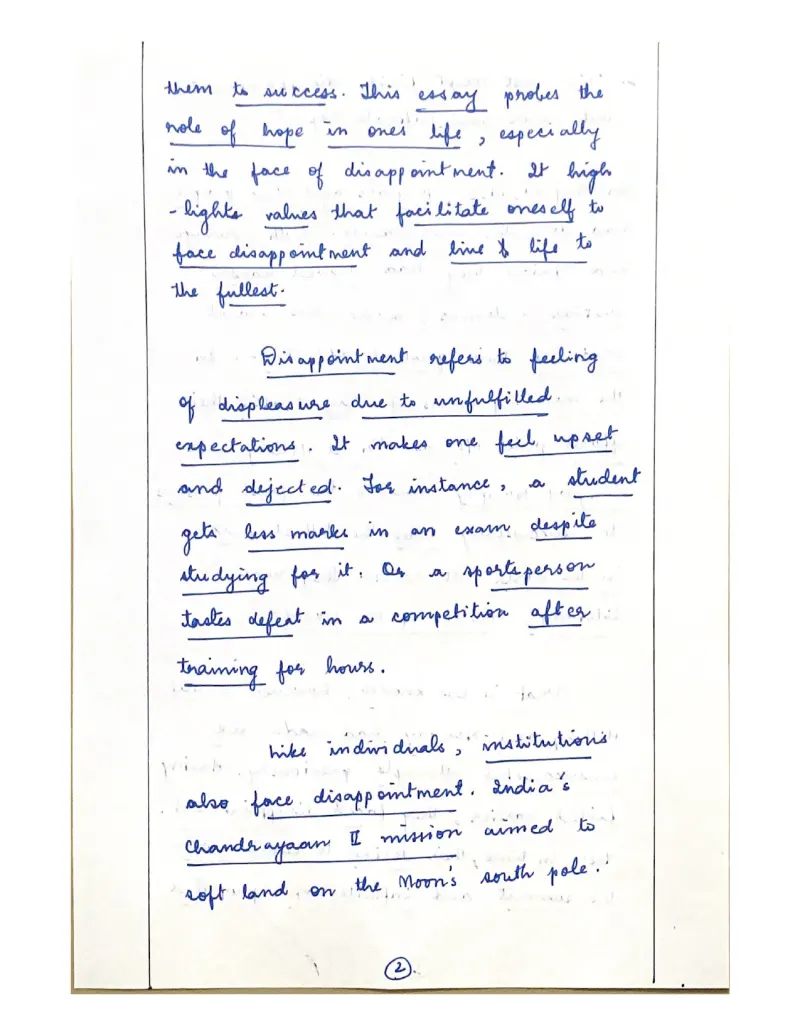
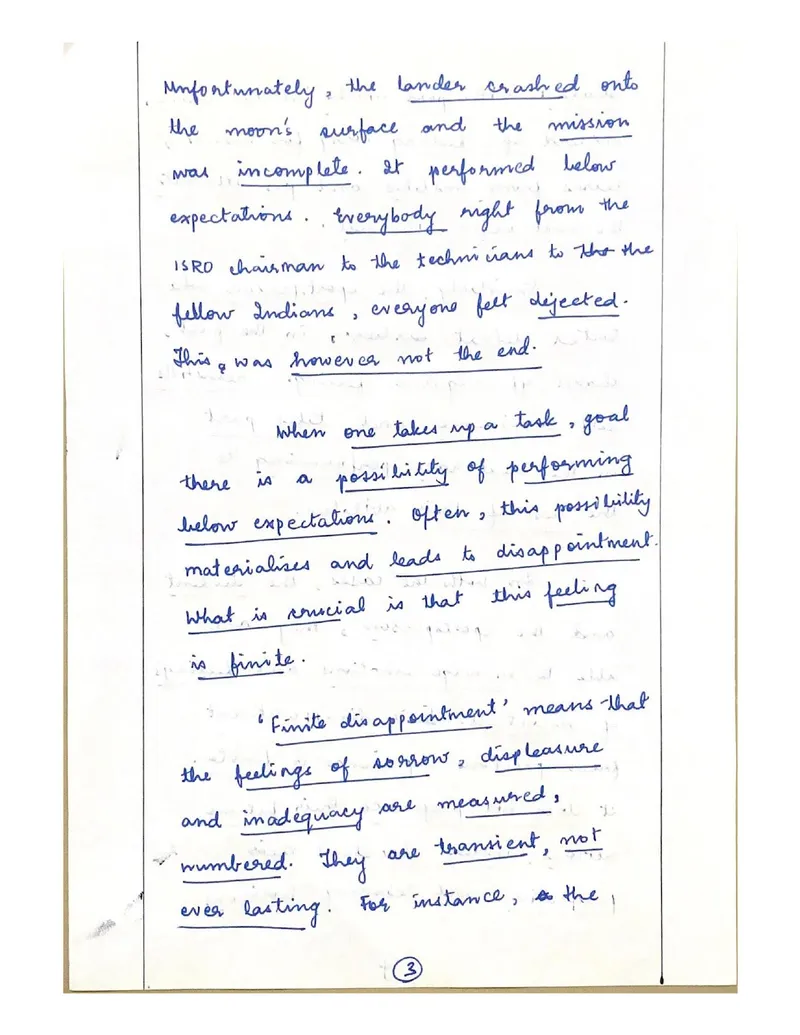
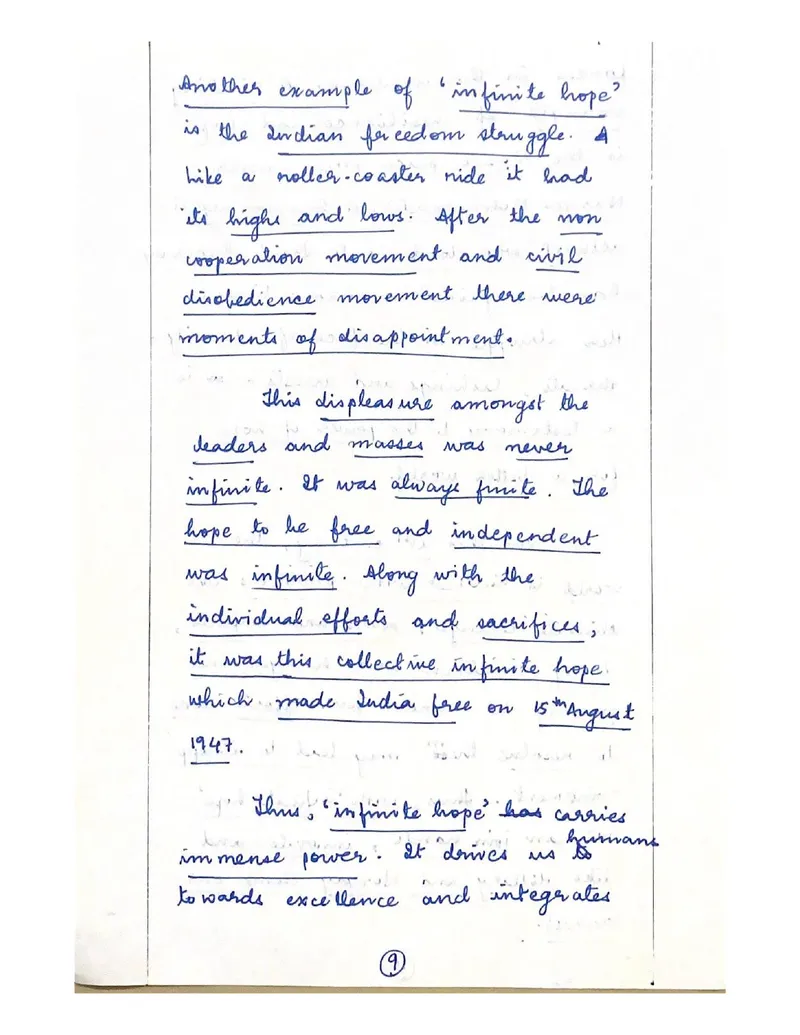
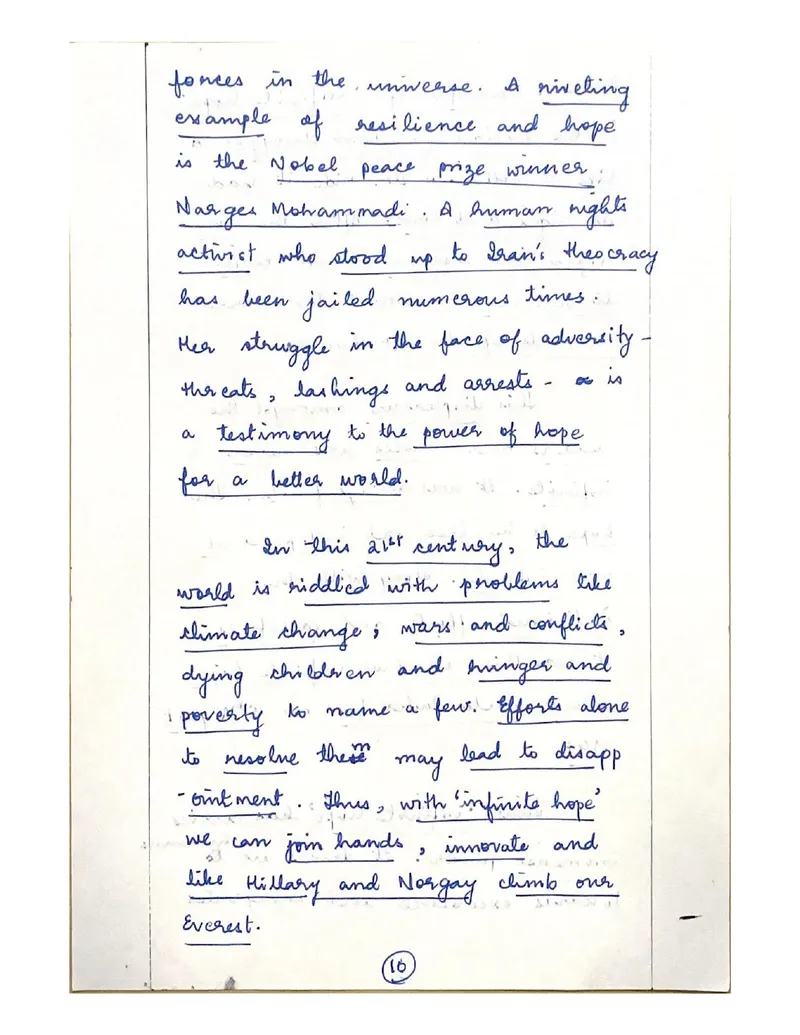
- ▸Single essay (Topic 1, the MLK 'finite disappointment / infinite hope' theme) across 10 neatly handwritten blue-ink pages — highly legible cursive
- ▸Memorable framing device: opens with Hillary & Tenzing Norgay's 1953 Everest summit after six failures and closes urging readers to 'climb our Everest'
- ▸Strong conceptual scaffolding — cleanly separates 'finite disappointment' from 'infinite hope' along a 'failures can make or break a person' axis
- ▸Wide, well-chosen example bank spanning science (Chandrayaan-2/3), sport (Yuvraj, Arunima), art (Van Gogh), history (freedom struggle) and current affairs (Narges Mohammadi)
- ▸Adds tonal range with a Charlie Chaplin quote on tragedy vs comedy of perspective
- ▸Disciplined structure: examples scale up from individual to institutional to national to global; one idea per paragraph, keywords self-underlined
What to learn from this copy
- ★Bookended the whole essay with one image: opens on Edmund Hillary and Tenzing Norgay summiting Everest on 29 May 1953 after six failed attempts, then closes by urging the reader to 'climb our Everest' -> a single concrete anecdote used as both hook and callback gives an essay a memorable frame and a sense of closure, far stronger than separate, unrelated intro/conclusion devices.
- ★Used paired failure-then-success cases that map directly onto the prompt's two halves: the Chandrayaan-2 lander crash (ISRO dejected, mission below expectations) followed by Chandrayaan-3's first soft landing near the Moon's south pole, illustrating exactly 'finite disappointment' giving way to renewed hope -> pick examples that embody the precise contrast the topic asks about, rather than examples that are merely 'inspiring' in general.
- ★Deliberately escalated the example bank from individual to institutional to national to global — Yuvraj Singh and Arunima Sinha (personal), ISRO/Chandrayaan (institutional), the freedom struggle ending 15 August 1947 (national), Narges Mohammadi's repeated jailing (global) -> ordering examples along a widening scale of scope turns a list into an argument that builds, instead of a flat collection of anecdotes.
- ★Built explicit conceptual scaffolding by defining terms in sequence — 'disappointment', then 'finite disappointment', then the danger of 'infinite disappointment' (losing hope) — and reinforced the danger side with Van Gogh's self-criticism, mental illness and suicide as a cautionary case -> dissecting the key phrase into sub-concepts and supplying a counter-example for the negative pole shows genuine engagement with the quote rather than just agreeing with it.
- ★Varied the register with a Charlie Chaplin line, properly attributed — 'Life is a tragedy when seen in close up, [but] a comedy in long shot' -> a well-placed, correctly-credited quote on shifting perspective adds tonal range and reinforces the theme without padding.
Questions attempted: Essay: "We must accept finite disappointment, but never lose infinite hope." (the Martin Luther King Jr. line given as the prompt) — on the role of hope in facing disappointment.
Questions attempted in this booklet (1)+
- 1.Essay: "We must accept finite disappointment, but never lose infinite hope." (the Martin Luther King Jr. line given as the prompt) — on the role of hope in facing disappointment
Examples, data & evidence used
- Edmund Hillary & Tenzing Norgay summiting Mt Everest on 29 May 1953 after six unsuccessful attempts (opening hook + closing callback)
- Generic illustrations: a student scoring poorly despite studying; a sportsperson losing after long training
- Chandrayaan-2 lander crash (mission below expectations, ISRO dejected) followed by Chandrayaan-3 success — first soft landing near the Moon's south pole
- Van Gogh — artist's self-criticism leading to mental illness and suicide (cautionary 'infinite disappointment' case)
- Yuvraj Singh — cricketer diagnosed with cancer at career peak who recovered
- Arunima Sinha — pushed from a train, lost a leg, became first female amputee to climb Everest
- Indian freedom struggle — Non-Cooperation & Civil Disobedience movements; collective infinite hope leading to independence on 15 August 1947
- Narges Mohammadi — Nobel Peace Prize-winning Iranian human-rights activist jailed repeatedly
Quotes the candidate used
- Prompt/theme quote (unattributed in text, originally Martin Luther King Jr.): 'We must accept finite disappointment, but never lose infinite hope.'
- Charlie Chaplin (author named): 'Life is a tragedy when seen in close up, [but] a comedy in long shot.'
How it’s written: Classic linear essay. Anecdotal hook (Hillary/Norgay 1953) then explicit thesis stating the essay 'probes the role of hope... in the face of disappointment.' Defines terms in sequence — 'disappointment', then 'finite disappointment', then the danger of 'infinite disappointment' (loss of hope) — before pivoting to th…
Diagrams & visuals: None — no diagrams, flowcharts, tables or maps anywhere; pure prose
Evaluator: No examiner marks or comments are filled in on this copy.