
Madhavi R — InsightsIAS GS Paper 4 (Ethics) copy
What’s inside this copy
- ▸Complete GS-4 attempt — all six Section-A items (including the three quote questions) and all six Section-B case studies attempted; nothing left blank.
- ▸Copy is unevaluated: index table, the Very Good/Good/Average/Bad parameter grid and the examiner-observation fields are all empty; no marks or comments anywhere.
- ▸Strong contemporary-example reflex — Russia-Ukraine, SIDS submersion, Taliban, China-Taiwan, Shreya Singhal, Puttaswamy, Srikrishna committee, Cyber Dome Kerala.
- ▸Consistent self-underlining of ethics keywords (honesty, integrity, probity, transparency) in the candidate's own blue pen.
- ▸Two diagrams in Q5b — a CAB (Cognition-Affection-Behaviour) model plus a sources-of-attitude flow chart.
- ▸Personalised value answers — Q4a (dropping a stranger at night after sharing live location) and Q9 (grandparents' Ramayana-Mahabharata stories).
What to learn from this copy
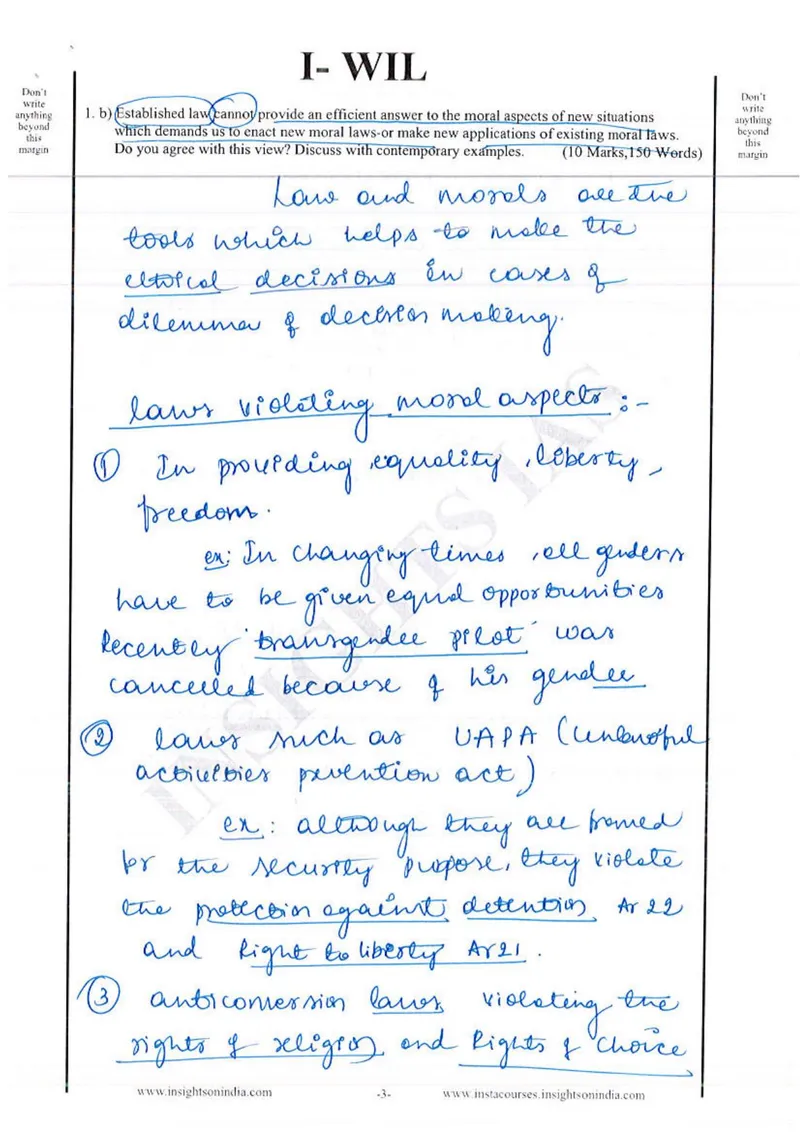
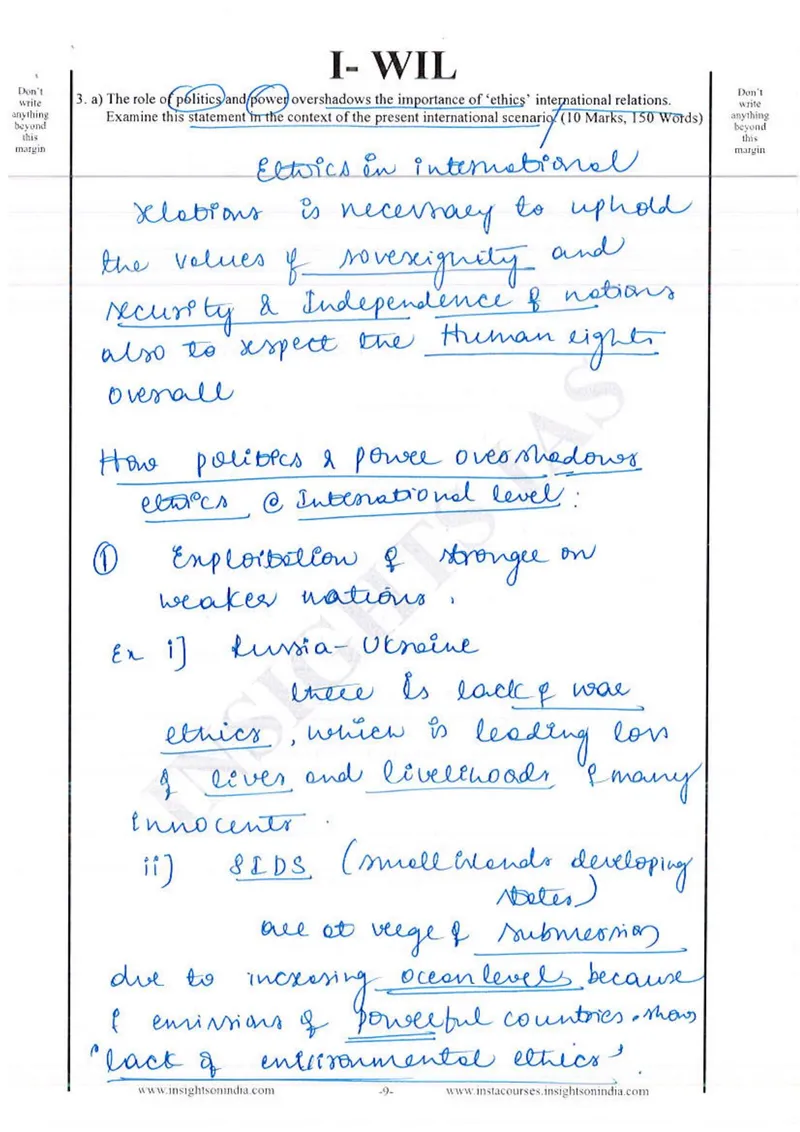
- ★She wrapped abstract ethics prompts in hard current affairs instead of textbook theory — Q3a (politics/power overshadowing ethics in IR) was answered with Russia-Ukraine loss of lives, SIDS facing submersion, China-Taiwan, and Taliban's violation of women's rights, while Q1b (law vs morals) cited Article 377 decriminalisation, a cancelled transgender 'priest' appointment, UAPA clashing with Art 21/22, and anti-conversion/abortion laws -> stock real-world cases pinned to each specific clause of the question turn a vague ethics answer into a concrete, gradeable one; build a small bank of dated examples you can map onto recurring GS-4 themes.
- ★For the law-vs-morals question (Q1b) she didn't just list examples, she landed the precise legal hooks — Shreya Singhal, Puttaswamy, Srikrishna committee, SC/ST Prevention of Atrocities Act, Prohibition of Manual Scavenging Act, and named constitutional articles (Art 21, 22) -> citing the exact case/Act/Article rather than 'a Supreme Court judgment' signals genuine command and is the difference between a generic and an authoritative ethics answer.
- ★Q5b (how attitudes form) carried two purpose-built diagrams — a CAB (Cognition-Affection-Behaviour) model and a separate sources-of-attitude flow chart (family, friends, teachers, conscience, values/morals/laws, past experiences feeding into attitude) -> diagrams in GS-4 work only when they encode an actual model or causal flow the prose can't show as fast; reserve them for conceptual questions (attitude, foundational values) rather than decorating every answer.
- ★She personalised the value/conscience answers with her own life rather than hypotheticals — Q4a used dropping a stranger home at night after sharing her live location, and Q9 used grandparents narrating Ramayana-Mahabharata stories -> a specific, slightly vulnerable personal anecdote is what makes a conscience/values answer read as lived rather than memorised; keep one or two genuine episodes ready for the 'personal example' prompts.
- ★She delivered a complete GS-4 attempt with nothing blank — all three quote questions (Plato, Aristotle, Einstein) and all six case studies done — and her case studies followed a consistent intro -> options with merits/demerits -> course-of-action template (clearest in Q8 and Q12, where she explicitly chose the honest/probity option) -> finishing the full paper inside word limits with a repeatable case-study skeleton is itself a scoring discipline; a fixed structure lets you move fast under time pressure instead of reinventing the format per case.
Questions attempted: Ethical choices in 4 situations: exaggerating resume experience, downloading music/movies (piracy), taking office supplies home, overstating a product to make a sale (10m/150w); Whether established law cannot answer moral aspects of new situations / need for new moral laws — law vs morals with contemporary examples (10m/150w); 'Sheelam param bhushanam' (Character is the highest virtue) in a civil servant's life — LBSNAA motto (10m/150w), and 16 more below.
Questions attempted in this booklet (19)+
- 1(a).Ethical choices in 4 situations: exaggerating resume experience, downloading music/movies (piracy), taking office supplies home, overstating a product to make a sale (10m/150w)
- 1(b).Whether established law cannot answer moral aspects of new situations / need for new moral laws — law vs morals with contemporary examples (10m/150w)
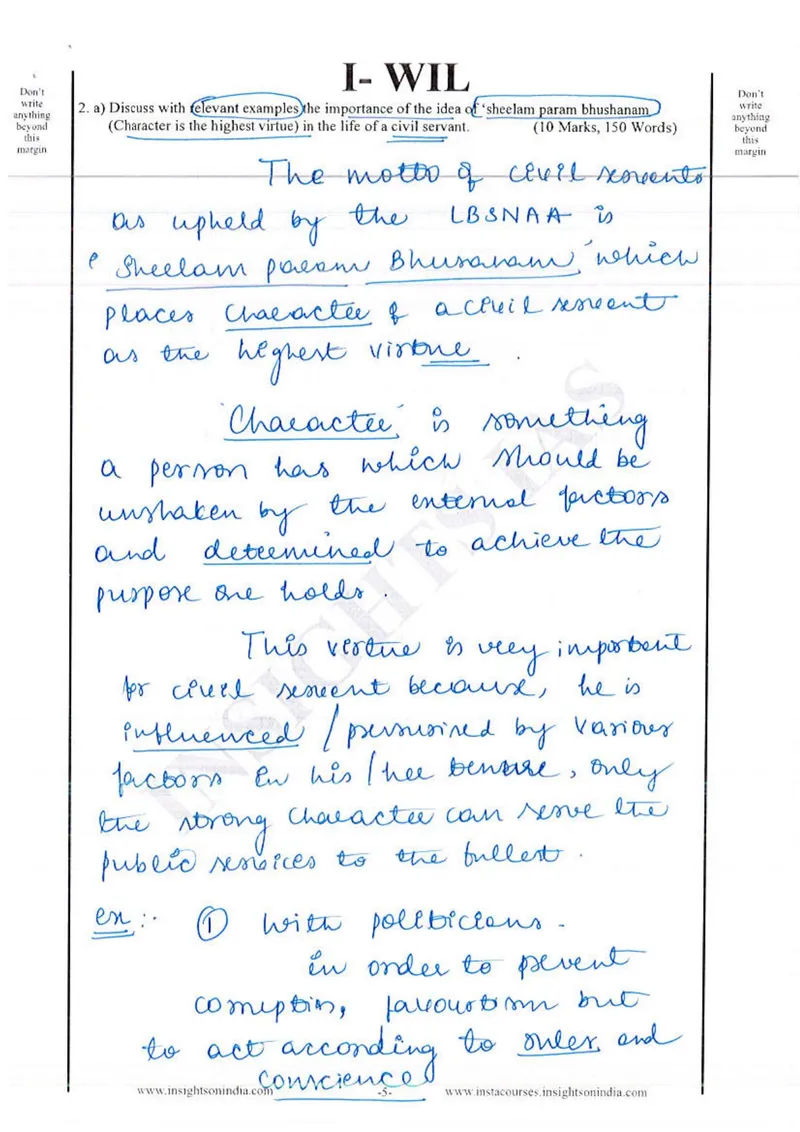
- 2(a).'Sheelam param bhushanam' (Character is the highest virtue) in a civil servant's life — LBSNAA motto (10m/150w)
- 2(b).Transparency and citizen participation as mechanisms for public ethics and accountability (10m/150w)
- 3(a).Politics and power overshadowing ethics in international relations (10m/150w)
- 3(b).Impact of ethical behaviour in the modern workplace and ethical climate aiding employee retention (10m/150w)
- 4(a).Role of conscience in ethical decision-making, with a personal-life example (10m/150w)
- 4(b).Rabindranath Tagore's concept of nationalism (10m/150w) — answer is brief/thin, ~1 page, trails off
- 5(a).Civil servants' commitment to improving policy-making and service-delivery abilities of the state (10m/150w)
- 5(b).How attitudes are formed and the role of attitude in influencing behaviour/actions — includes CAB model diagram (10m/150w)
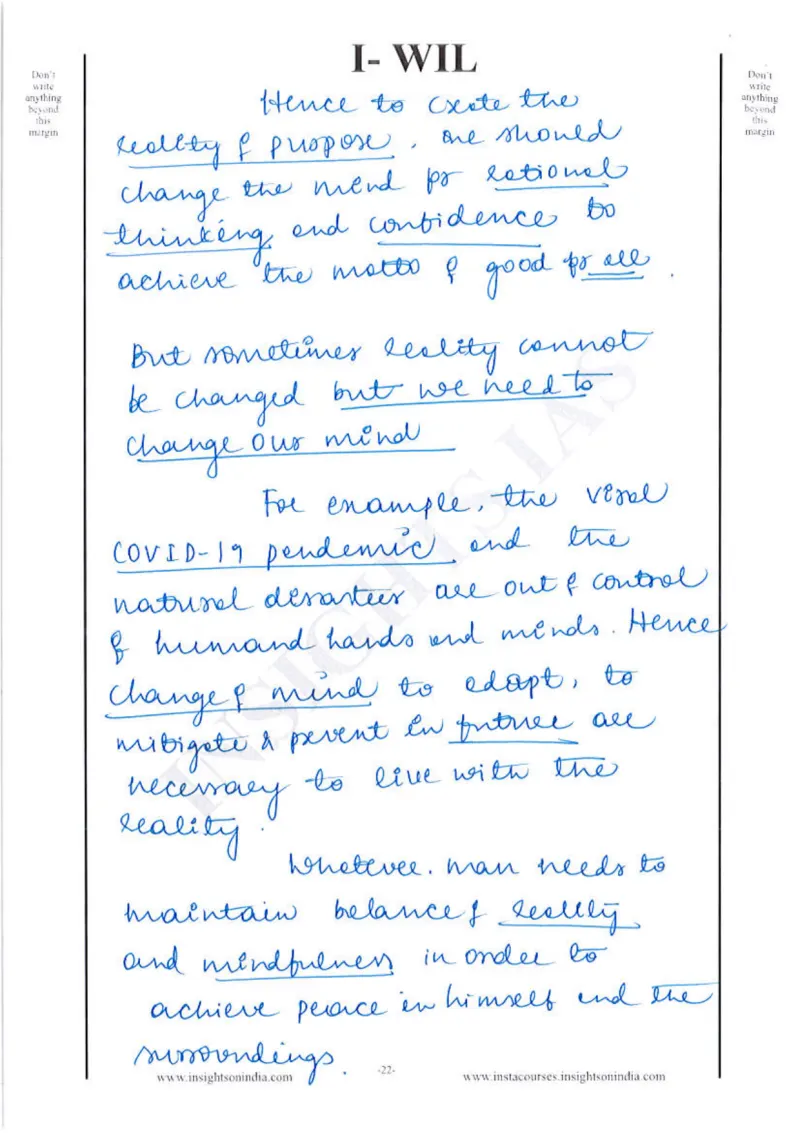
- 6(a).Quote interpretation — Plato: 'Reality is created by the mind; we can change reality by changing our mind' (10m/150w)
- 6(b).Quote interpretation — Aristotle: 'It is the mark of an educated mind to entertain a thought without accepting it' (10m/150w)
- 6(c).Quote interpretation — Albert Einstein: 'Anyone who doesn't take truth seriously in small matters cannot be trusted in large ones either' (10m/150w)
- 7.Case study — Nari-shakti / low women participation in STEM; as Secretary, Dept of Science, suggest measures (20m/250w)
- 8.Case study — CEO of struggling film company; controversy over minority-religion lead actor and social-media boycott; options/merits-demerits/course of action (20m/250w)
- 9.Case study — Ramesh in a joint family; rational views vs parents' superstitions; role of grandparents and steps for healthy upbringing of kids (20m/250w)
- 10.Case study — young IPS officer heading a special cyber-crime cell; priorities/strategy and reasons cyber-criminals thrive (20m/250w)
- 11.Case study — Dalit boy beaten by upper-caste teacher and dies; ethical issues and why caste discrimination persists after 75 years (20m/250w)
- 12.Case study — Manjula vs political pressure / Company X; probity in governance, two options with merits-demerits, chooses the honest option (20m/250w) — present but appears with some pages out of sequence in the scan
Examples, data & evidence used
- Russia-Ukraine war — lack of ethics causing loss of lives and livelihoods (Q3a)
- SIDS (Small Island Developing States) facing submersion from rising ocean levels — environmental ethics (Q3a)
- China's attitude towards Taiwan (Q3a)
- Taliban rule — violation of women's rights/justice/liberty (Q3a)
- Article 377 decriminalisation as moral law catching up with changing times (Q1b)
- Transgender 'priest' appointment cancelled due to gender (Q1b)
- UAPA conflicting with Art 22 (protection against detention) and Art 21 (Q1b)
- Anti-conversion laws and abortion rights vs right to reproduction (Q1b)
- SC/ST Prevention of Atrocities Act and Prohibition of Manual Scavenging Act (Q1b, Q11)
- RTI, Social Audit, Citizen's Charter (Q2b)
- 2nd ARC recommendations (Q5a)
- Book 'The Secret' / law of attraction (Q6a, Plato quote)
- NEP 2020 and scientific temperament; Fundamental Duty Art 51A (Q6b)
- COVID-19 pandemic and natural disasters as realities to adapt to (Q6a)
Quotes the candidate used
- Plato — 'Reality is created by the mind; we can change the reality by changing our mind.' (Q6a prompt, interpreted)
- Aristotle — 'It is the mark of an educated mind to be able to entertain a thought without accepting it.' (Q6b prompt, interpreted)
- Albert Einstein — 'Anyone who doesn't take truth seriously in small matters cannot be trusted in large ones either.' (Q6c prompt, interpreted)
- Dr B.R. Ambedkar — paraphrased: 'I measure the progress of society by the progress achieved by women' (cited by candidate in Q7)
How it’s written: Answers in legible blue-ink cursive, written within word limits. Sub-parts clearly labelled (a)/(b)/(1)/(2) with arrow (↳) bullets. Case studies follow a consistent intro → options with merits/demerits → course-of-action structure (clearest in Q8 and Q12). Heavy self-underlining of ethics keywords (honesty, integrit…
Diagrams & visuals: Q5b — CAB model diagram (Cognition–Affection–Behaviour) for attitude; Q5b — sources-of-attitude flow diagram (family, friends/neighbours, teachers, conscience, values/morals/laws, past experiences feeding into attitude); No maps used
Evaluator: No examiner marks or comments are filled in on this copy.