
Kanishak Aggarwal — Sure Shot evaluated copy
What’s inside this copy
- ▸Disciplined intro-body-conclusion across all answers — underlined sub-headers, numbered arrow-points, and a 'Thus/Hence' closer every time
- ▸Strong diagram habit: flow charts for savings, bond-market potential, VGF and DPI, plus a hand-drawn India map for Tier-II/III pollution
- ▸Current-affairs density: NCB Mundra drug seizure, AIIMS cyber attack, Tesla FDI, IN-SPACe/NSIL, Swayam Prabha, ADB
- ▸Economy answers anchored in data: fiscal deficit ~6.5% and debt-to-GDP ~60% (boxed), 15th FC under NK Singh, repeated Economic Survey citations
- ▸Links issues to theory/thinkers: Lewisian model, Ricardian equivalence, Adam Smith, cobweb phenomenon
- ▸Two-sided treatment where asked — splits structural vs regulatory (bonds) and benefits vs fiscal costs vs alternatives (MSP)
What to learn from this copy
- ★He converts abstract economics demands into named theory anchors -> tie 'Missing Middle' to the Lewisian model and 'dwarfism', household-savings decline to Ricardian equivalence, the MSP debate to Adam Smith, and pulses price-volatility to the cobweb phenomenon. Lesson: keep one signature thinker/model per economy theme ready so a 10-marker instantly reads as analytical rather than descriptive.
- ★He hard-codes specific numbers into economy answers instead of vague qualifiers -> e.g. Q12 boxes 'fiscal deficit ~6.5% of GDP and debt-to-GDP ~60%', Q14 cites 'small/marginal farmers ~89%' and the Economic Survey's '1 SD rise in certainty raises investment ~11%', and Q5 uses '~$50bn agri exports'. Lesson: memorise 2-3 exact figures (with the source, here repeatedly the Economic Survey/RBI) per static-economy topic and present them visibly, even boxed, so the data is impossible to miss.
- ★He answers two-sided demands by literally splitting the body into the demanded buckets -> Q3 carves 'Structural challenges' vs 'Regulatory challenges' for the corporate bond market, and Q14 separates benefits vs fiscal costs vs 'Alternatives to MSP' (price-deficiency payment, contract farming, eNAM). Lesson: when a question pairs concepts or asks for alternatives, make your underlined sub-headings mirror those exact words so the examiner sees you addressed every part.
- ★He uses purpose-built diagrams that carry argument, not decoration -> a hand-drawn India map marking Jaipur/Noida/Patna/Nashik labelled 'Tier II & III cities with high pollution' (Q7), a 'financially infeasible -> VGF -> socially desirable' mini-flow that captures the whole VGF rationale in one line (Q4), and a DPI flow naming CoWIN/Aadhaar/UPI/DigiLocker (Q15). Lesson: design a diagram that visually states the answer's core mechanism or examples, and give it a captioned 'Fig -' label.
- ★He packs concrete, recent, named current-affairs hooks rather than generic mentions -> 'NCB drug seizure at Mundra', 'AIIMS cyber attack', 'Tesla FDI', 'IN-SPACe/NSIL', 'Swayam Prabha', 'pigeon pea imported from Nigeria', 'Golden Triangle'. Lesson: stock each GS theme with a handful of specific, dateable instances and exact scheme names so every point lands as evidence, not assertion.
Questions attempted: ‘Missing Middle’ in India’s industrial ecosystem and its effect on growth/employment (10m, 150w); Decline in household savings — causes and strategies to strengthen savings behaviour (10m, 150w); Underdeveloped corporate bond market — structural and regulatory challenges (10m, 150w), and 11 more below.
Questions attempted in this booklet (14)+
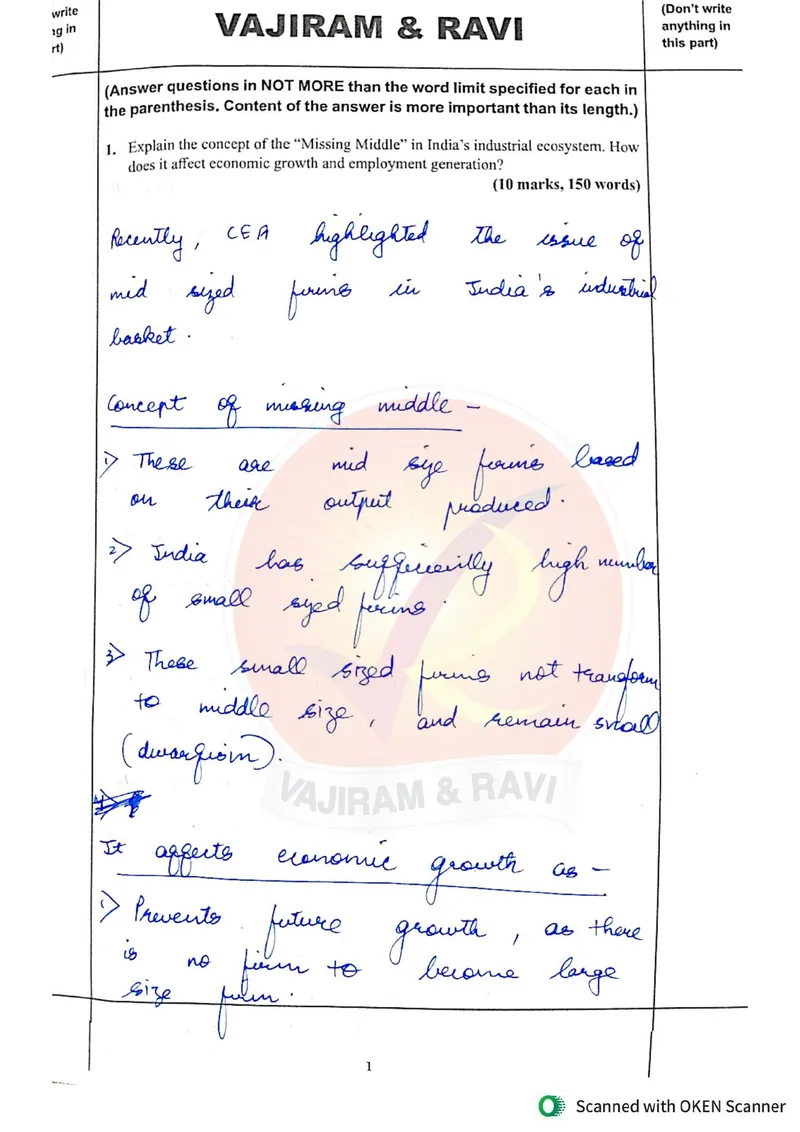
- Q1.‘Missing Middle’ in India’s industrial ecosystem and its effect on growth/employment (10m, 150w)
- Q2.Decline in household savings — causes and strategies to strengthen savings behaviour (10m, 150w)
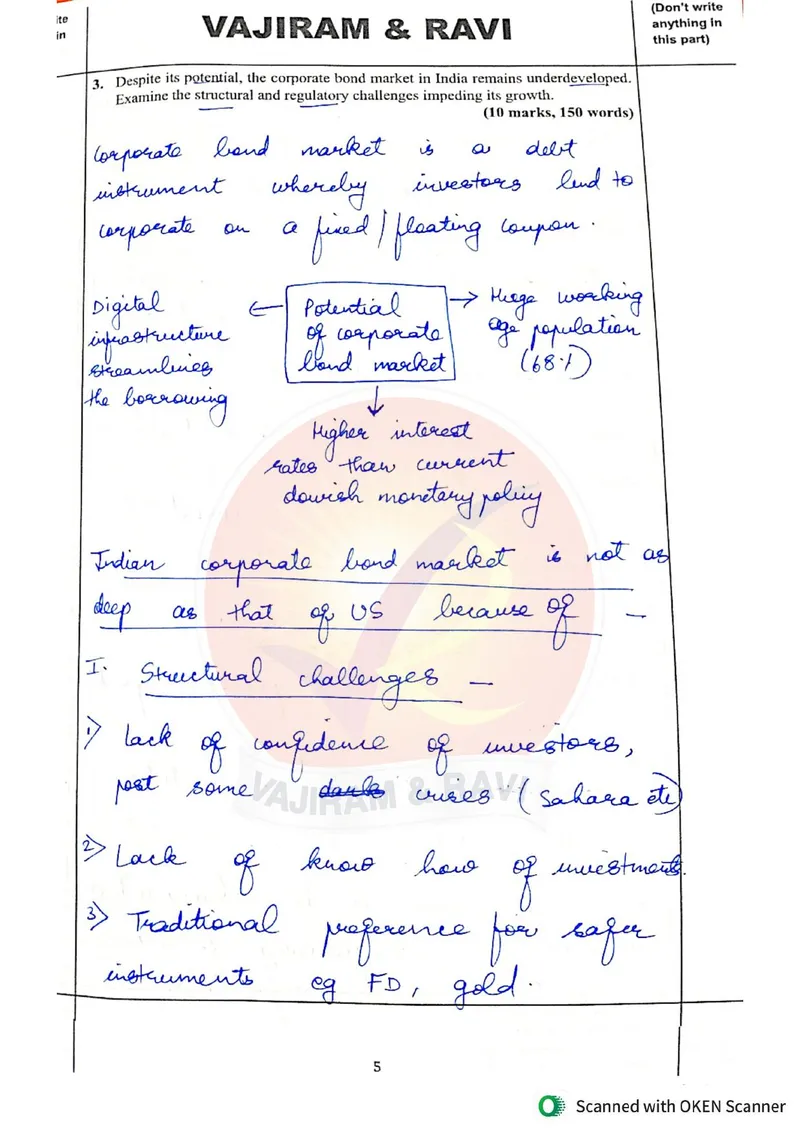
- Q3.Underdeveloped corporate bond market — structural and regulatory challenges (10m, 150w)
- Q4.Viability Gap Funding to promote renewable energy projects (Budget 2025) (10m, 150w)
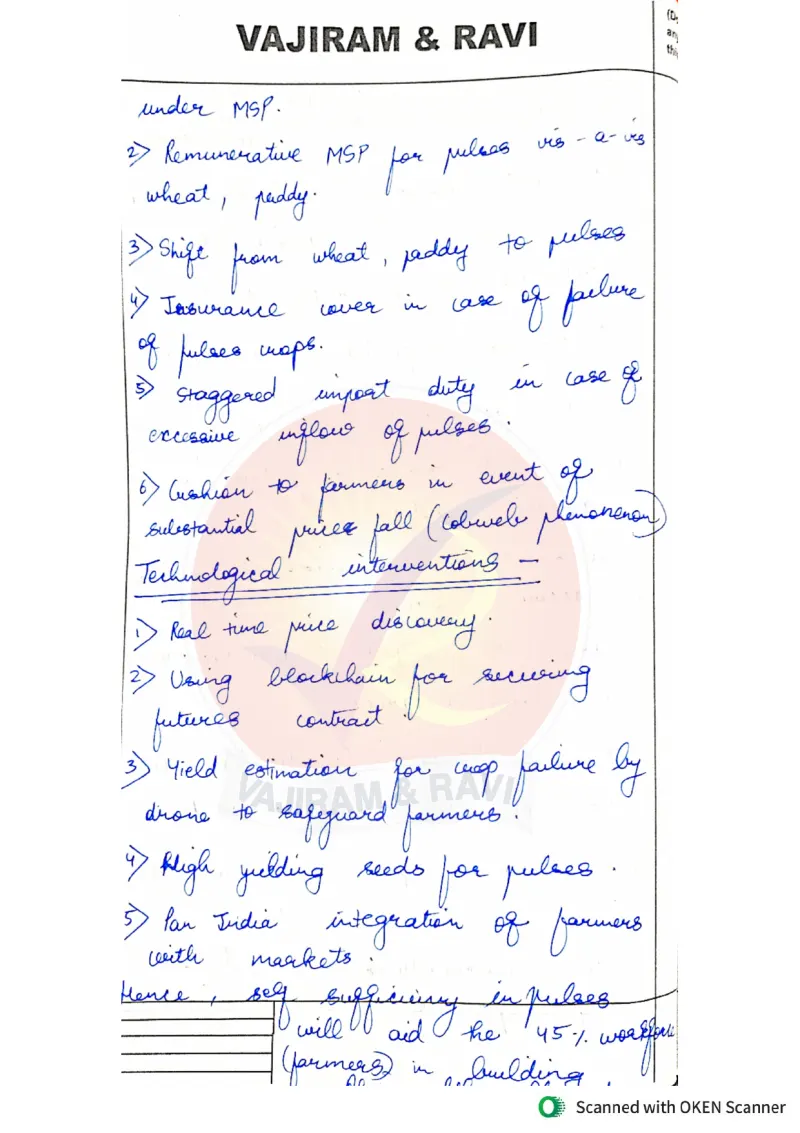
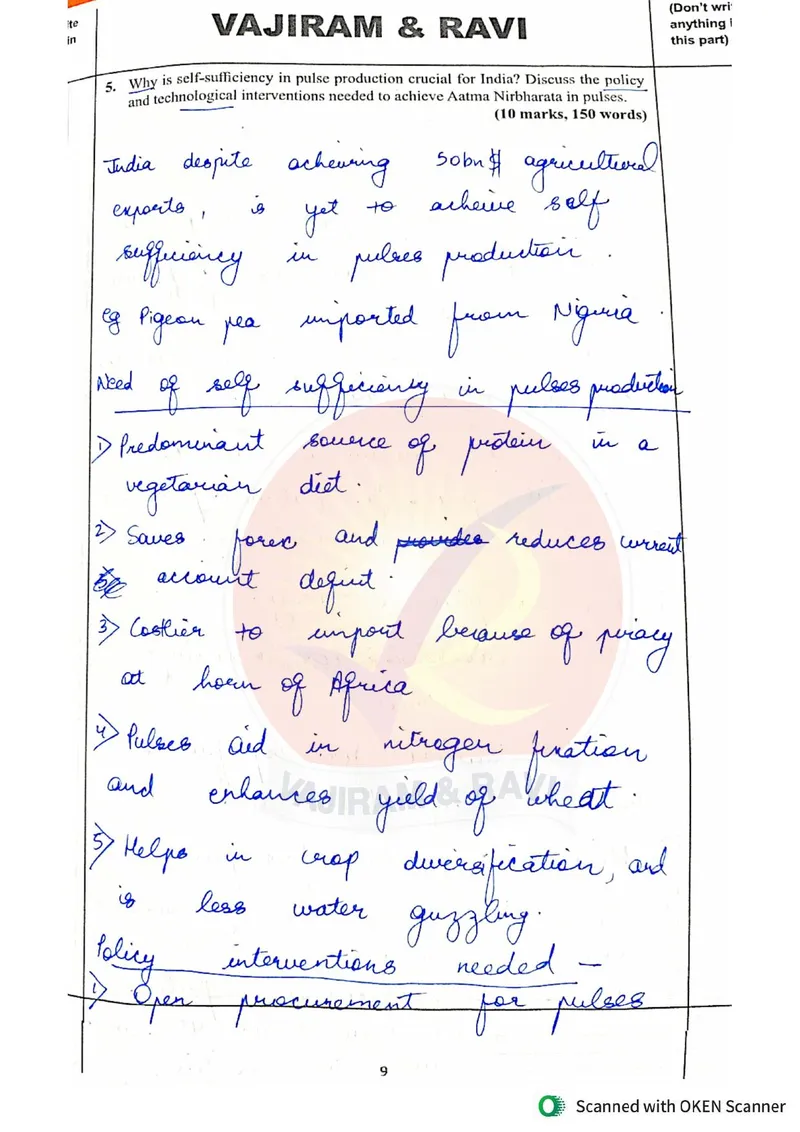
- Q5.Self-sufficiency in pulses — policy and technological interventions (Aatma Nirbharata) (10m, 150w)
- Q6.Space-based solutions for developmental challenges in rural India (10m, 150w)
- Q7.Urbanization patterns and rising PM 2.5 in Tier-II/III cities; mitigation and govt initiatives (10m, 150w)
- Q9.Artificial Neural Networks — concept and applications across fields (10m, 150w)
- Q10.Internal security shaped by external and transnational dynamics (10m, 150w)
- Q11.Tariff rationalization trade-offs in Union Budget 2025-26 (15m, 250w)
- Q12.Shift from fiscal-deficit targeting to debt-to-GDP as fiscal anchor (15m, 250w)
- Q13.Food processing formalization via PLI scheme and PM-FME (15m, 250w)
- Q14.Legal guarantee to MSP — fiscal/economic concerns and viable alternatives (15m, 250w)
- Q15.Digital Public Infrastructure to lead global climate action (15m, 250w)
Examples, data & evidence used
- Q1: CEA flagging mid-sized firms, ‘dwarfism’, Lewisian model, demographic dividend, Economic Survey
- Q2: RBI report on household savings, fintech startups, RBI Retail Direct scheme, Ricardian equivalence
- Q3: Sahara crisis (loss of investor confidence), FD/gold preference, SEBI/RBI/CBDT multiplicity
- Q4: Budget 2025 solar/wind/nuclear push; Asian Development Bank as multilateral financier
- Q5: ~$50bn agri exports, pigeon pea imported from Nigeria, piracy at Horn of Africa, cobweb phenomenon, blockchain futures contracts, drone yield estimation
- Q6: NSIL and IN-SPACe (private space players), Swayam Prabha (e-learning), Krishi Mitras, SHGs
- Q7: UN projection India 35% urbanised by 2035; Jaipur/Noida/Patna/Nashik; National Clean Air Programme; E20 fuel blending; vehicle scrappage policy; London model; green hydrogen/CNG
- Q9: ChatGPT, Gemini Pro 2.5, DeepSeek; decrypting Indus Valley script; cancer drug discovery; India AI mission
- Q10: China backing Maoists/naxalites; ULFA (Myanmar); Greater Nagalim; counterfeit currency from Nepal; Afghanistan narco-terrorism; Golden Triangle; NCB drug seizure at Mundra; AIIMS cyber attack
- Q11: inverted duty in textiles, Tesla FDI, Make in India, Australia’s mechanized dairy, FTAs/BITs, steel import surge
- Q12: fiscal deficit ~6.5% of GDP and debt-to-GDP ~60% (boxed); G20 practice; FRBM Act; 15th Finance Commission under NK Singh; Economic Survey ‘debt dynamics’
- Q13: food processing ~2 lakh cr of GDP (sunrise sector); PLI scheme; PM-FME; ICOR
- Q14: small/marginal farmers ~89%; 1 SD rise in certainty raises investment ~11% (Economic Survey); Adam Smith; CAG — <30% farmers aware of MSP; PM-KISAN; eNAM; Gramin Haats; price-deficiency payment; contract farming
- Q15: CoWIN, Aadhaar, UPI, DigiLocker as DPI; carbon-credit exchange on lines of UPI; blockchain carbon-credit records; geospatial emissions portal
How it’s written: Highly consistent template across every answer: brief context intro, then underlined sub-headings (e.g. ‘Concept of missing middle’, ‘Causes of recent decline’, ‘Strategies…’, ‘Structural challenges’ / ‘Regulatory challenges’, ‘Alternatives to MSP’), followed by numbered arrow-bullet points, and a ‘Thus/Hence…’ one-…
Diagrams & visuals: Q2: small flow diagram of ‘Household savings’ branching to Gold / Deposits in Banks / Immovable property; Q3: flow diagram of ‘Potential of corporate bond market’ (digital infrastructure, working-age population 68%, higher interest rates vs dovish policy); Q4: mini flow ‘financially infeasible → VGF → socially desirable’; Q7: hand-drawn MAP of India marking Jaipur, Noida, Patna, Nashik — labelled ‘Fig - Tier II & III cities with high pollution’; Q9: hand-drawn neural-network diagram (nodes/layers labelled Stage 0 / Stage 1 / Stage 3); Q15: DPI diagram with CoWIN, Aadhaar, UPI, DigiLocker — labelled ‘Fig - Example of DPI’
Evaluator: No examiner marks or comments are filled in on this copy.