
Aakash Om Trivedi — Vajiram & Ravi GS copy
GS Paper 4 · EthicsPDF · 63.9 MB
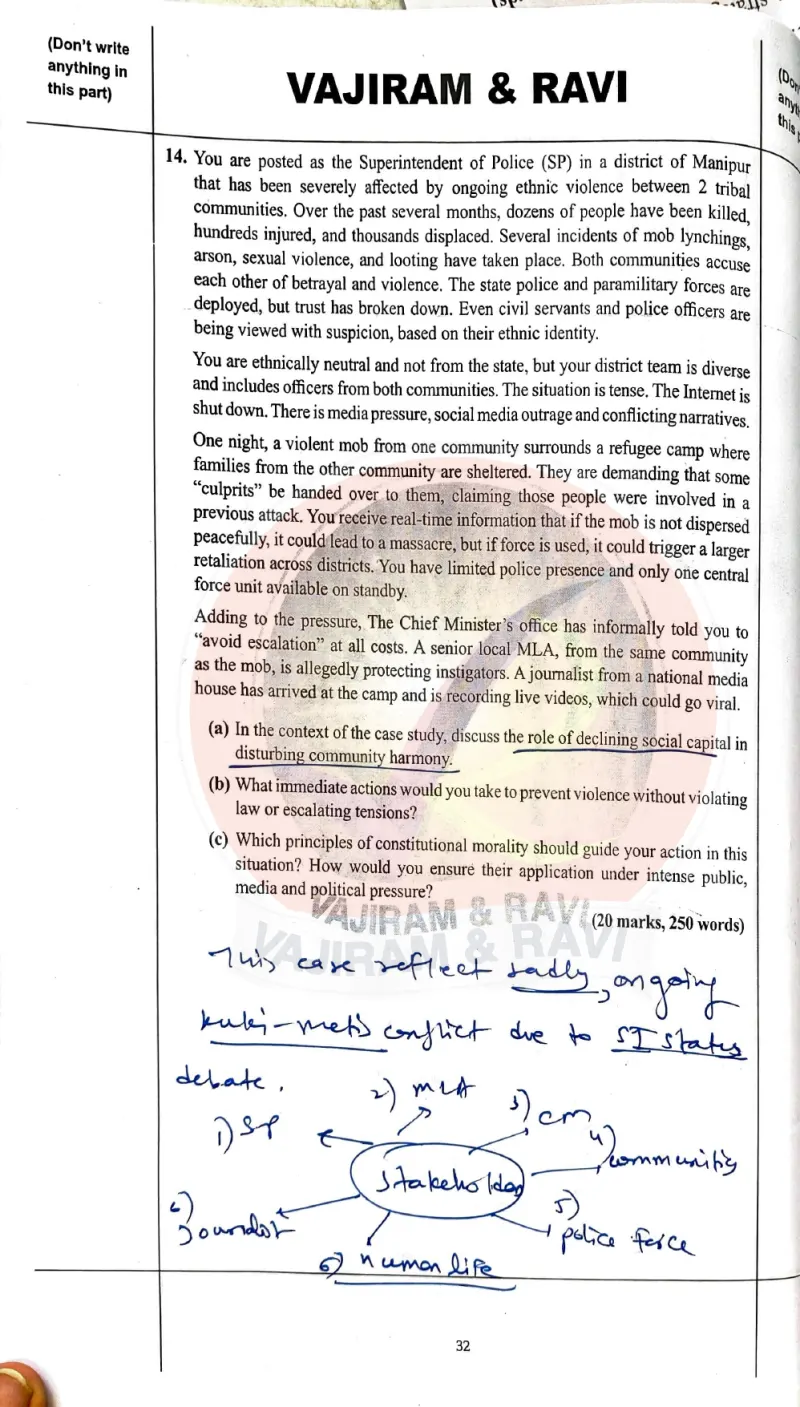
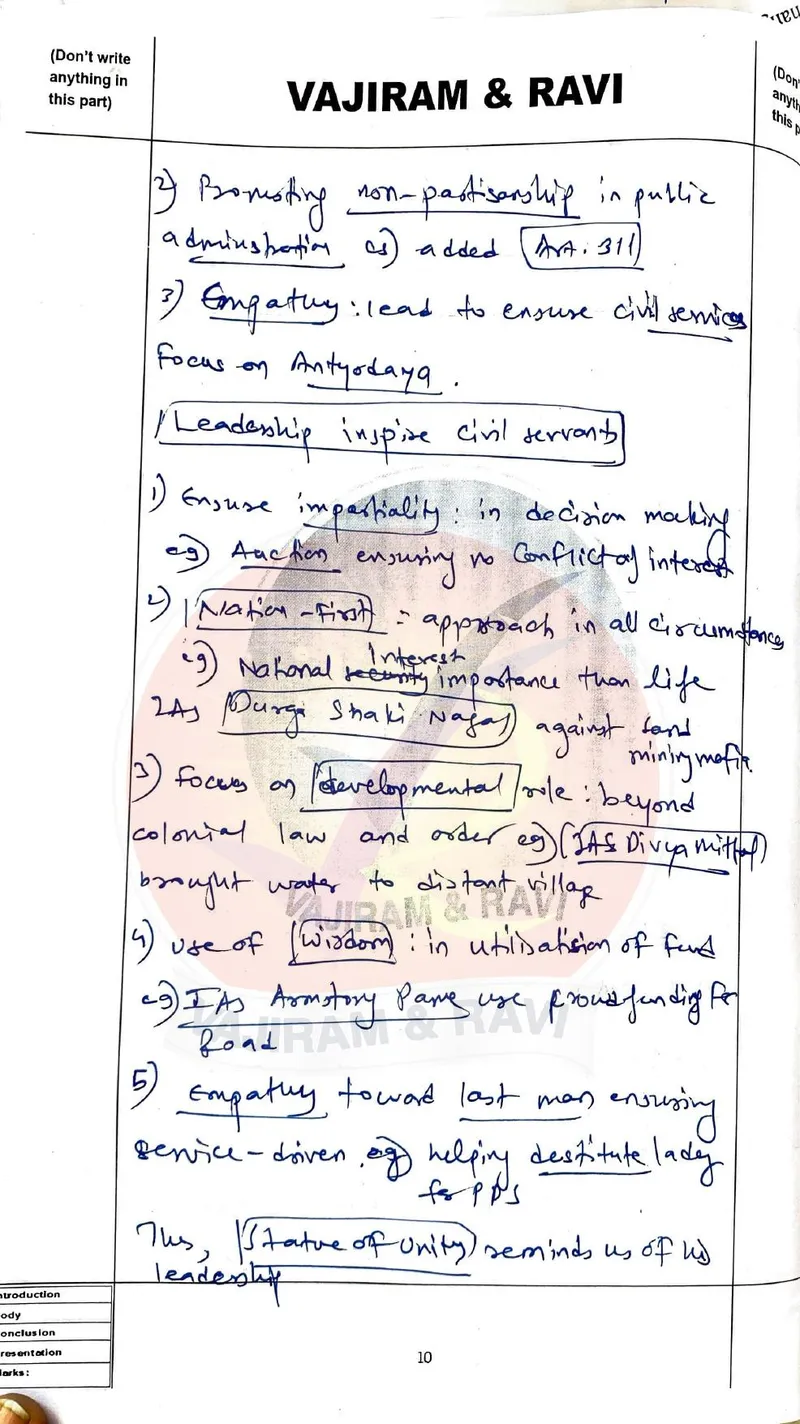
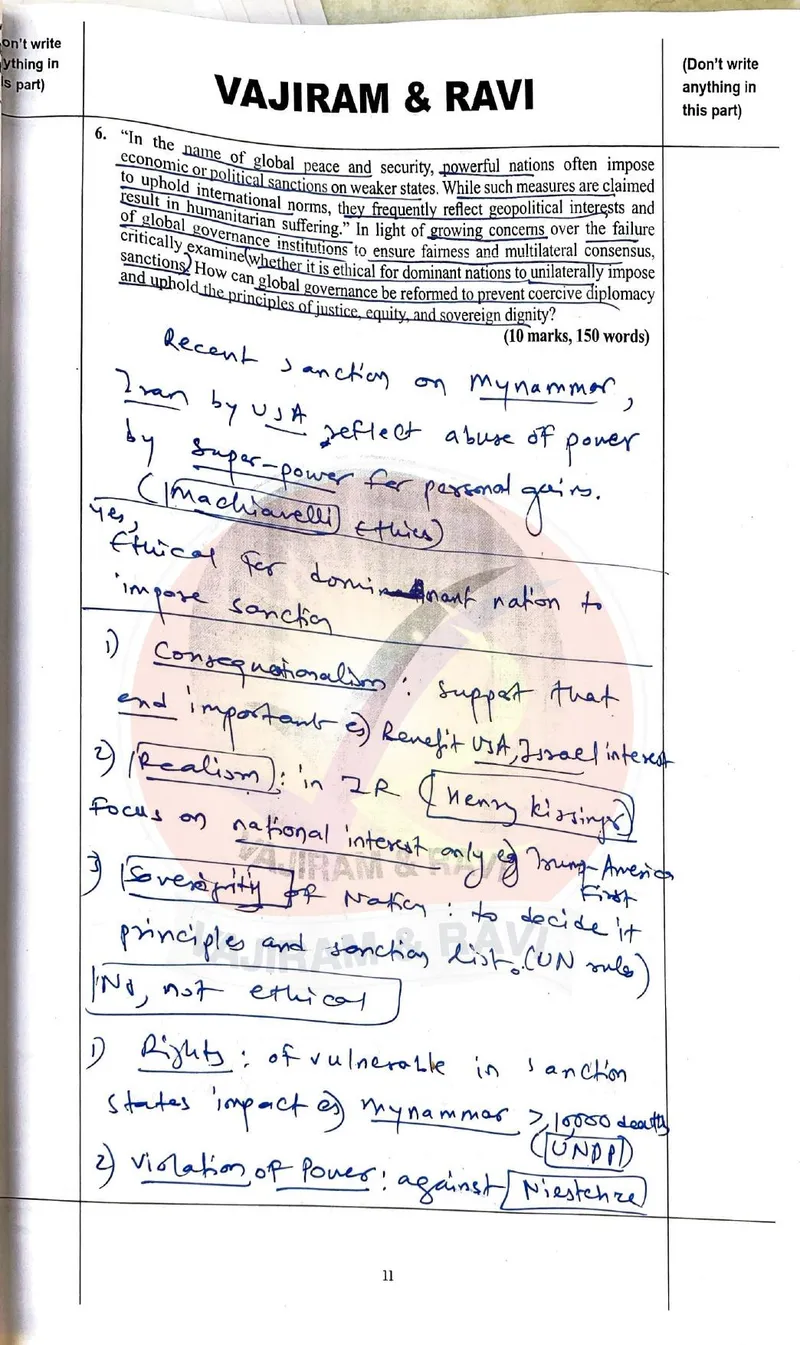
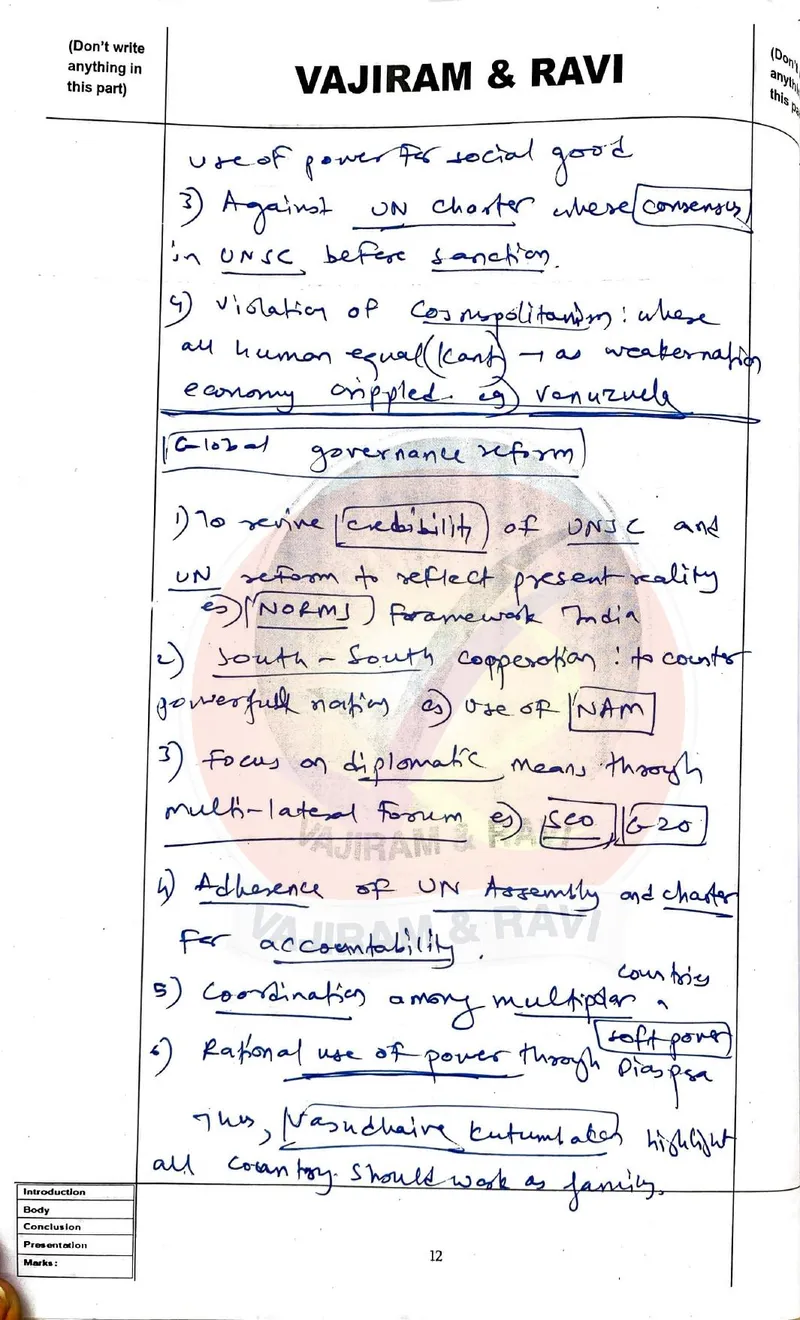
What’s inside this copy
- ▸Single consistent hand throughout — Aakash (Om) Trivedi's Vajiram & Ravi 'Ethics Full Length Test-1' (GS Paper IV); cover marks AIR-73, UPSC CSE 2025.
- ▸Strong visual answer-craft: circled point-numbers, boxed value-keywords, underlining, two-column tables and at least four hand-drawn diagrams (governance triangle, Freedom-vs-Regulation Venn, RTI vs Social Audit).
- ▸Heavy data/scheme anchoring: BCG hybrid-work stat, Economic Survey 2024-25 investor growth, CIC pendency >5000, Give It Up, Izzat Ghar, Mission Karmayogi, Startup India.
- ▸Quotes and thinkers woven in: 'Ethics in business begins where compliance ends', 'with great power comes great responsibility', Apad dharma, Richard Branson, Weber's charismatic leadership.
- ▸Memorable taglines close most answers: 'corruption mukt Bharat', 'safe public/digital spaces', '3P — planet, people & profit', rules-based to roles-based bureaucracy.
- ▸Two questions left blank — Q11 (international funding) and Q16 (heatwave / power-cut DM case study).
What to learn from this copy
- ★In the nudge question (Q7) Trivedi didn't define nudge abstractly — he stacked concrete Indian instances: the 'fly in urinals' disgust trick, the 'selfie with daughter' campaign, CBSE sugar boards, plus 'Give It Up' LPG subsidy, Amitabh Bachchan in Swachh Bharat as an authority nudge, and the 'Izzat Ghar' toilet slogan -> Build a personal bank of named, real campaigns for each Ethics keyword so you can illustrate a concept with 3-4 specific examples instead of one generic line.
- ★He anchored answers in hard, recent data and named schemes rather than vague assertions: 'As per BCG, more than 30% of leading IT firms employ hybrid work' with Article 21/42 and Zoho (Q9); Economic Survey 2024-25 retail-investor growth and SEBI finfluencer registration (Q15); CIC pendency >5000 cases, MKSS, SSAAT, Meghalaya pension restored via social audit (Q10) -> Pin every claim to a figure, an article, or a named body/scheme — the specificity is what separates a topper's body from a textbook restatement.
- ★He wove thinker-quotes precisely into the relevant case, not as decoration: 'Ethics in business begins where compliance ends' and 'with great power comes great responsibility' to frame Gandhian trusteeship in the EduNow PPP case (Q13), and the Apad dharma line 'At times of crisis, morality is in survival' in the Bharatam Alloy privatisation dilemma (Q14) -> Match each quotation to the exact ethical tension of the question; a quote earns marks only when it directly carries the argument.
- ★His visual answer-craft is heavily structured and question-specific: a two-column persuasion-vs-social-influence table (Q7), an RTI-vs-Social-Audit diagram plus table (Q10), a governance triangle for the ed-tech case (Q13), merit/demerit tables (Q14), and a Freedom-of-expression vs Regulation Venn diagram for the finfluencer case (Q15), alongside circled point-numbers and boxed value-keywords -> Choose the visual form to fit the demand — a Venn for competing rights, a triangle for stakeholder governance, a two-column table for compare-and-contrast — rather than dropping in a generic diagram.
- ★He closed answers with short, memorable taglines tied to the topic: 'corruption mukt Bharat', '3P — pro planet, people & profit' (Q13), 'safe public/digital spaces', and 'rules-based to roles-based bureaucracy' -> End on a crisp, value-loaded phrase that compresses your conclusion into something the evaluator remembers.
Questions attempted: Bio-ethics / ethical concerns in biotechnology; Social capital; Integrity vs objectivity, and 13 more below.
Questions attempted in this booklet (16)+
- Q1.Bio-ethics / ethical concerns in biotechnology
- Q2.Social capital
- Q3.Integrity vs objectivity
- Q4.Ethics in Public-Private Partnership (PPP)
- Q5.Explain three quotations — (a) Gandhi, (b) Swami Vivekananda, (c) Kant
- Q6.Use of surplus funds of religious institutions
- Q7.Persuasion vs social influence (two-column table)
- Q8.Public service delivery & socio-cultural factors
- Q9.Ethical implications of hybrid work models
- Q10.Social audits & the RTI Act (diagram + table)
- Q12.Case study: DRM, railway platform stampede
- Q13.Case study: EduNow ed-tech startup / NSGB compliance (governance-triangle diagram)
- Q14.Case study: Bharatam Alloy Ltd (BAL) PSU CMD — privatisation vs contract workers
- Q15.Case study: finfluencers / SEBI (Freedom-of-expression vs Regulation Venn diagram)
- Q17.Case study: workplace mental health (Aparna/Arjun/Meena)
- Q18 (apparent).Case study: caste discrimination in a school — appears on duplicate-numbered end pages, same hand (see confidenceNote)
Examples, data & evidence used
- Nudge: 'fly in urinals' creating disgust; 'selfie with daughter' campaign; CBSE sugar boards (Q7)
- 'Give It Up' LPG-subsidy campaign; Amitabh Bachchan in Swachh Bharat (authority); 'Izzat Ghar' toilet slogan (Q7)
- Intro anecdote 'rats in a Bihar hospital'; 'chalta hai' attitude; Abhishek Prakash (UP IAS officer corruption case) (Q8)
- Reforms cited: Social Audit, PIL, citizen score card, Sevottam Framework, CPGRAMS, IRCTC Twitter grievance reform (Q8)
- 'As per BCG, more than 30% of leading IT firms employ hybrid work'; Article 21 (right to privacy), Article 42; company example Zoho (Q9)
- MKSS, SSAAT (social-audit body), Meghalaya pension restored after social audit, Himachal simplified process, CIC >5000 cases pending (Q10)
- Independent directors, internal/external audits, Startup India Mission, Gandhian trusteeship; conclusion '3P — pro planet, people & profit' (Q13)
- Economic Survey 2024-25 — rise in retail investors / digital investment space (figure cited by candidate); SEBI registration of finfluencers; YouTube 'financial advice' thumbnail label (Q15)
- Mission Karmayogi, EI module of DoPT, CAPF mental-health counselling, Delhi Police counselling (Q17)
- Caste case (Q18 apparent): reading Ambedkar, NCERT anti-discrimination module, Awakened Citizen Program (Ramakrishna Mission), Panchayat leaders, Sabarimala case / constitutional morality
Quotes the candidate used
- 'Ethics in business begins where compliance ends' (Q13)
- 'With great power comes great responsibility' — used to frame Gandhian trusteeship (Q13)
- Richard Branson — quoted in the hybrid-work answer (exact wording not fully legible) (Q9)
- 'At times of crisis, morality is in survival' — Apad dharma (Q14)
- Q5 set quotations the candidate was asked to explain: Gandhi, Swami Vivekananda, Immanuel Kant
- Reference to Max Weber's 'charismatic leadership' (Q18 apparent)
How it’s written: Vajiram & Ravi printed answer booklet(s). Section A = 10-mark/150-word questions Q1-Q11; Section B = 250-word multi-part (a-d) case studies Q12 onward. The writing is highly structured: numbered/circled points, boxed keywords, underlining, frequent two-column tables and 3-4 hand-drawn diagrams. Introductions use rea…
Diagrams & visuals: Q7 table; Q10 diagram+table; Q13 governance triangle; Q14 merit/demerit tables; Q15 Freedom-of-expression vs Regulation Venn; pervasive circled numbering and boxed keywords
Evaluator: No examiner marks or comments are filled in on this copy.