
Hassan Khan — NextIAS GS Paper 4 (Ethics) copy
What’s inside this copy
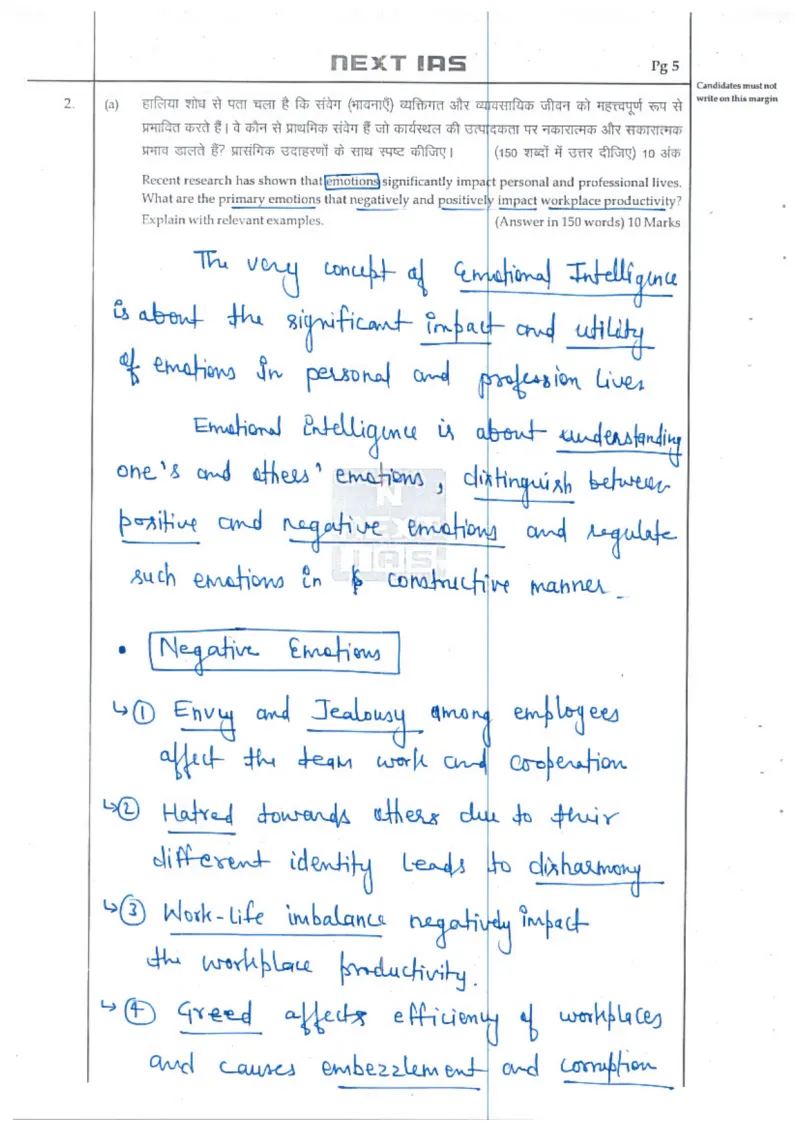
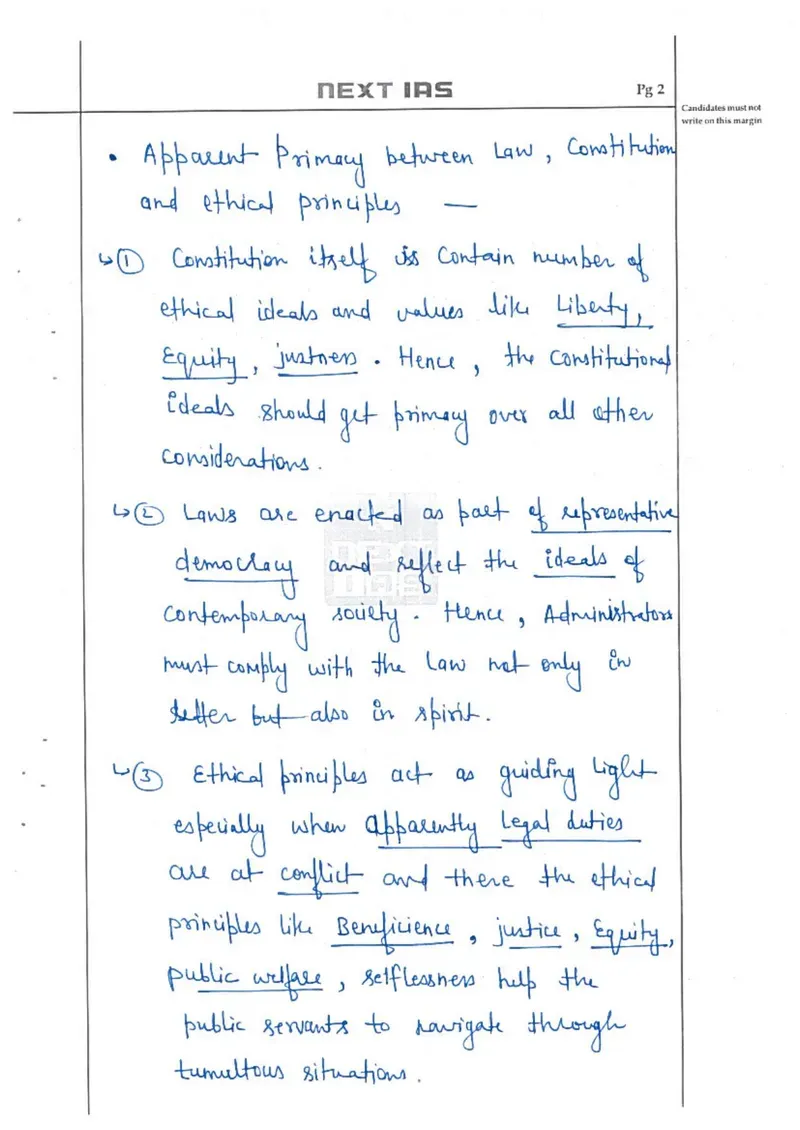
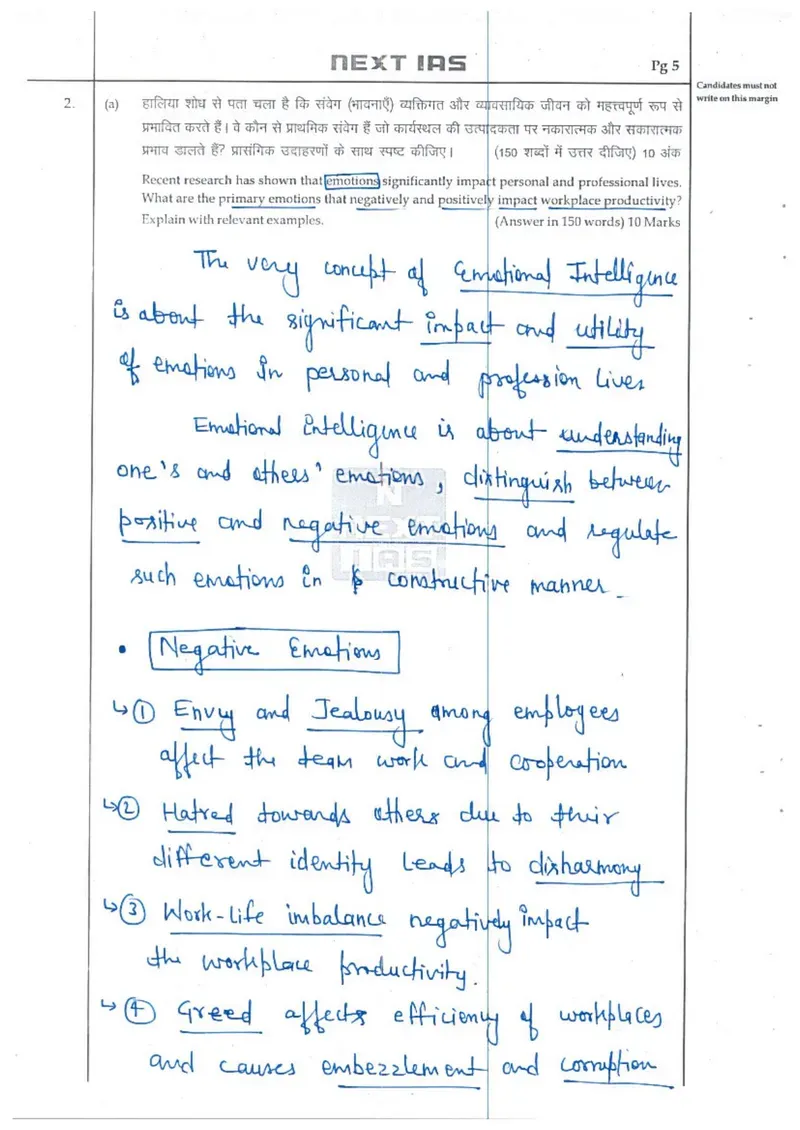
- ▸Genuine, very neat blue-ink handwriting with key terms consistently underlined — fully legible throughout
- ▸Ungraded copy: the examiner marks table, grand total, evaluator code and signature are all blank, with no ticks or marginal comments anywhere
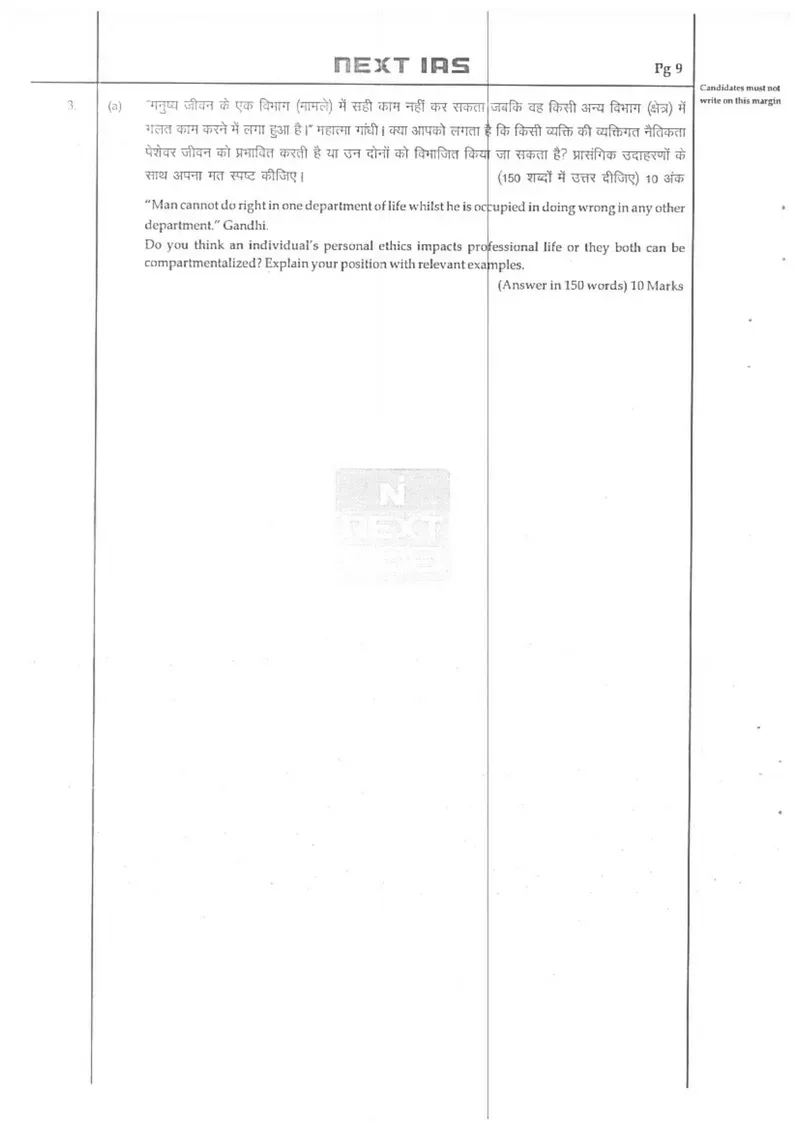
- ▸Selective attempt in Section A — only 5 of 13 sub-parts answered (1a, 2a, 5b, 6a, 6b); all quotation parts (Q4a-c) plus 1b, 2b, 3a, 3b, 5a left blank (verified blank on page images)
- ▸Skipped case study Q10 (GAMA defence/foreign-policy ethics) and instead answered Q11 (Sharma pharma case) inside Q10's answer space, clearly labelling it 'Q-11'
- ▸Strong, repeatable case-study template: stakeholder map, value-conflict list, option-wise advantage/disadvantage weighing, then a stated chosen course of action
- ▸Rich administration examples woven in — Operation Sulaimani (Prashant Nair), K.S. Puttaswamy (2017), PM SVANidhi/PM Awas for rehabilitation, IB & NITI Aayog reports on environment-vs-development
What to learn from this copy
- ★He runs every case study (Q7 municipal-officer slum clearance, Q9 fraudulent EIA report, Q11 Sharma pharma overcharging) through one identical four-step scaffold: a stakeholder map, a value-conflict list, an option-wise advantage/disadvantage weighing, then a clearly stated chosen course of action -> Build ONE repeatable case-study template you can execute under time pressure, so structure is automatic and you spend thinking time on content, not layout.
- ★His examples are matched to the exact phrasing of the question rather than dropped in generically: for Q6a on 'mixing persuasion with a little force,' he cites Athar Aamir (IAS) running a Rajasthan child-marriage drive that paired awareness with the threat of legal action; for Q5b on civic engagement he cites Prashant Nair's Operation Sulaimani -> Pick administrative examples that literally enact the question's keyword, not famous officers you happen to know — relevance to the precise demand beats fame.
- ★In the Q8 data-privacy case (merging govt datasets to catch welfare fraud) he anchors the answer in K.S. Puttaswamy (2017) right-to-privacy plus the principle of maleficence ('first do no harm') and proportionality, rather than arguing on gut feeling -> Tie ethics-case judgements to a named landmark verdict and a named ethical principle so your conclusion reads as reasoned, not opinionated.
- ★He converts an abstract verdict into a visual in Q12, sketching an overlapping Venn of 'Lawful' + 'Ethical' + 'Profit' meeting at 'Ideal Corporate Practice,' and uses a quasi-tabular option-wise advantage/disadvantage layout in Q9 -> Use a small diagram or table to compress a multi-factor judgement the examiner can grasp in one glance, instead of a long paragraph.
Questions attempted: Primacy among Constitution, laws and ethical principles for a public servant; Primary positive/negative emotions affecting workplace productivity (Emotional Intelligence); Civic engagement mechanisms for ensuring ethics in governance, and 7 more below.
Questions attempted in this booklet (10)+
- 1(a).Primacy among Constitution, laws and ethical principles for a public servant
- 2(a).Primary positive/negative emotions affecting workplace productivity (Emotional Intelligence)
- 5(b).Civic engagement mechanisms for ensuring ethics in governance
- 6(a).Mixing persuasion with a little force in social-transformation schemes (Beti Bachao Beti Padhao)
- 6(b).Whether moral/ethical power earns respect in foreign policy without military/financial muscle (brief, appears incomplete)
- 7.Case study: clearing slums/sidewalk dwellers — impartiality vs empathy (municipal officer)
- 8.Case study: welfare-fraud detection by merging govt datasets vs citizens' data privacy
- 9.Case study: fraudulent EIA report in mining — duty/whistleblowing vs hierarchy
- 11.Case study: Mr. Sharma pharma firm overcharging govt hospitals — report fraud vs risk of blacklisting (written in Q10's answer space, labelled 'Q-11')
- 12.Case study: Rashmi's anti-child-marriage NGO vs workers' union — corporate social responsibility
Examples, data & evidence used
- K.S. Puttaswamy case (2017) — right to privacy / Aadhaar use in welfare (Q8)
- Beti Bachao Beti Padhao scheme (Q6a)
- PM SVANidhi (Q7)
- PM Awas Yojana (Q7)
- RTI Act 2005 (Q5b)
- Prashant Nair (IAS) — Operation Sulaimani (Q5b)
- Athar Aamir (IAS) — Rajasthan child-marriage drive mixing awareness with threat of legal action (Q6a)
- Kant's Categorical Imperative (Q11)
- Utilitarian maxim 'greatest good of greatest number' (Q7, Q8)
- Principle of maleficence / 'first do no harm' & proportionality (Q8)
- Social Contract (Q5b, Q7)
- SDG 11 — sustainable/inclusive cities (Q7)
- Intelligence Bureau report on NGOs/environmental activism hampering development (Q9)
- NITI Aayog report citing SC environmental verdicts causing economic loss (Q9)
Quotes the candidate used
- Candidate did not embed attributed quotations in his attempted answers. He invoked the utilitarian maxim 'greatest good of greatest number' and 'first do no harm' (maleficence) as principles, without naming authors. (The Gandhi and other quotations printed in the paper belong to Q3(a)/Q4, which were left blank.)
How it’s written: Neat, fully legible blue-ink hand. Heavy use of arrow/sub-bullets (the OCR shows them as down-arrows and small circled numbers) with liberal underlining of key terms (e.g., 'ethical administration', 'impartiality', 'emotional intelligence', 'Greatest good of greatest number'). Case studies follow a disciplined scaff…
Diagrams & visuals: Stakeholder maps/lists drawn in the case studies (e.g., Q7: municipal officer/me, industrial units, city dwellers, slum & sidewalk dwellers; Q11: Sharma & CEO, three corrupt staff, company, employees, public, state government); A small overlapping/Venn-style sketch in Q12 linking 'Lawful' + 'Ethical' + 'Profit' as the 'Ideal Corporate Practice'; Option-wise advantage/disadvantage layout used as a quasi-tabular structure in Q9 (no formal charts or maps elsewhere)
Evaluator: No examiner marks or comments are filled in on this copy.