
Puru Dubey — Vajiram & Ravi GS copy
What’s inside this copy
- ▸Confirmed as Puru Dubey's genuine copy — Vajiram & Ravi 'General Studies / Ethics Full Length Test' (GS Paper IV), UPSC CSE 2025 AIR-86, 250 marks, 17 compulsory questions, submitted 31/07/2025.
- ▸Attempted 15 of 17: all of Section A except Q11, plus Section-B case studies Q12-Q15 and Q17; Q11 (international funding ethics) is left fully blank and Q16 (DM heatwave power-cuts) is unattempted in what is scanned.
- ▸Copy is entirely UNEVALUATED — the cover marks grid, the mentor-feedback rubric and every per-answer Introduction/Body/Conclusion/Presentation/Marks box are blank; no ticks, scores or comments anywhere.
- ▸Answers are strongly visual — comparison tables, Venn diagrams, flowcharts, box diagrams and even a governance line-graph recur throughout (no geographic maps).
- ▸Almost every point is anchored to a specific, current, named example (CRISPR/designer-baby, SSAAT-MGNREGA, IMA vs UOI, EY suicide case, L&T 70-hour remark, Meghalaya social audit).
- ▸Quote-rich scaffolding: opens or closes answers with Putnam, Aristotle, Thiruvalluvar, Kant, Gandhi and Richard Branson.
What to learn from this copy
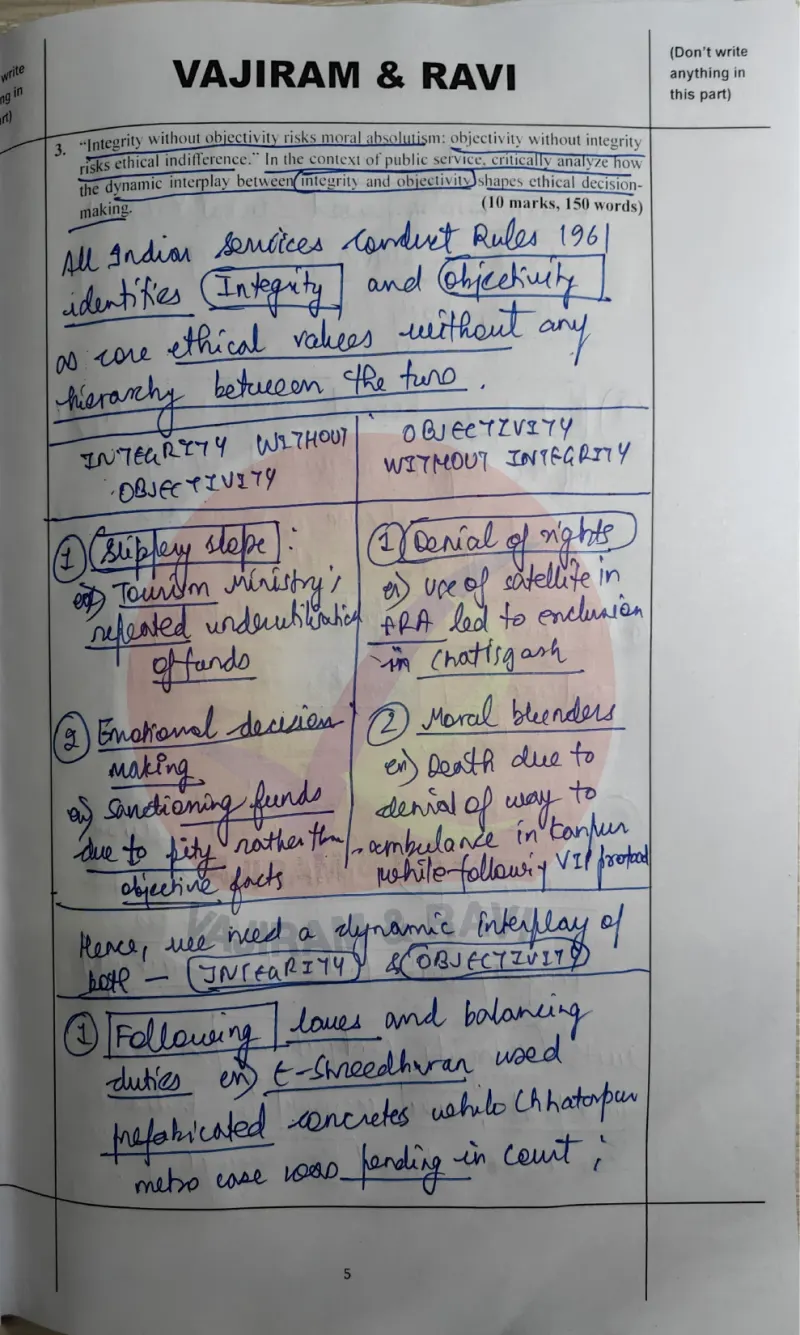
- ★For the 'dynamic interplay between integrity and objectivity' question (Q3), Dubey didn't define the two terms separately — he built a two-column comparison table contrasting 'Integrity without objectivity' vs 'Objectivity without integrity', turning an abstract relationship prompt into a visible analysis of what happens when each is missing -> when a question asks how two values interact, show the failure modes of having one without the other in a side-by-side table rather than listing definitions.
- ★Almost every body point is welded to a specific, named, current instance rather than a generic claim: SSAAT exposing MGNREGA corruption (Q2), IMA vs UOI on the right to health plus Articles 25/26/30 (Q6), the Meghalaya social audit that surfaced pension gaps and absentee teachers (Q10), and the L&T CEO 70-hour-week remark alongside the EY young-employee suicide case (Q9) -> for each argument, attach one precise, recent, named example (a scheme, court case, official, or news event) — concrete instances are what make an ethics point look informed rather than rehearsed.
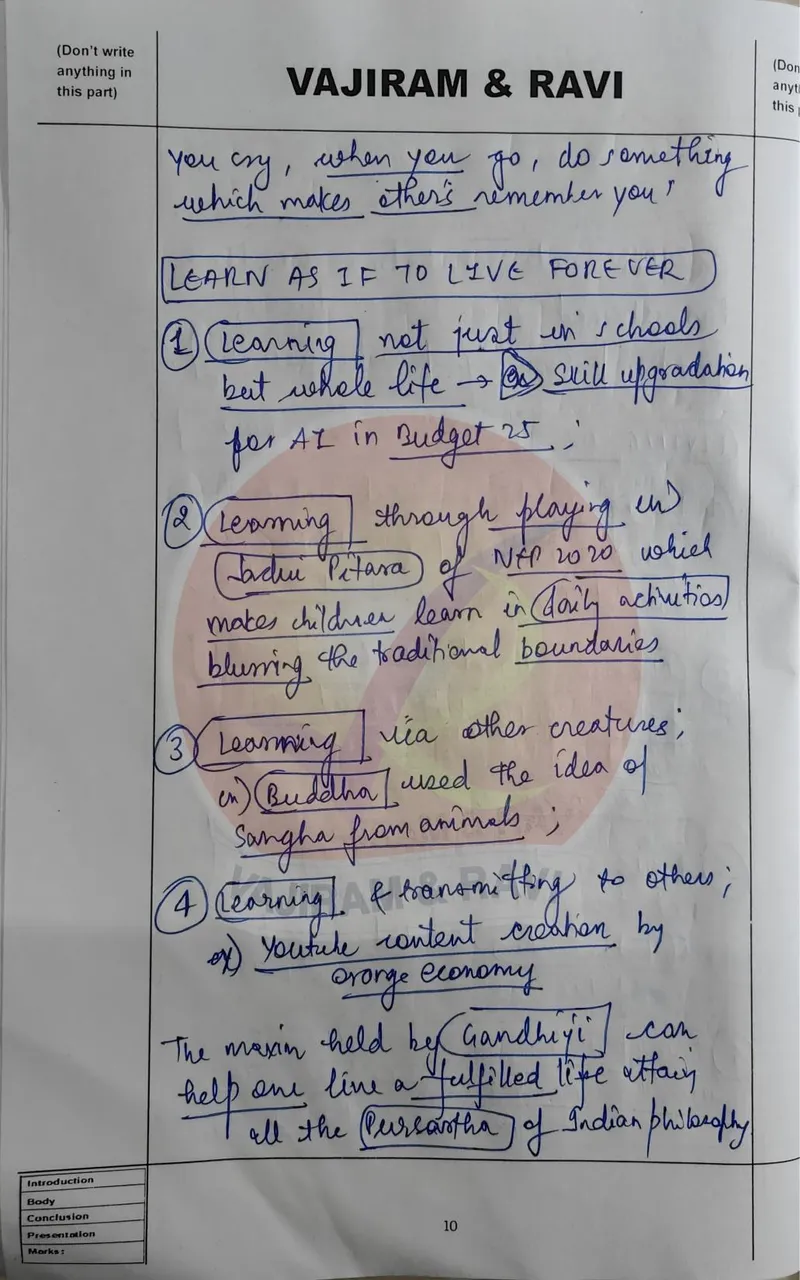
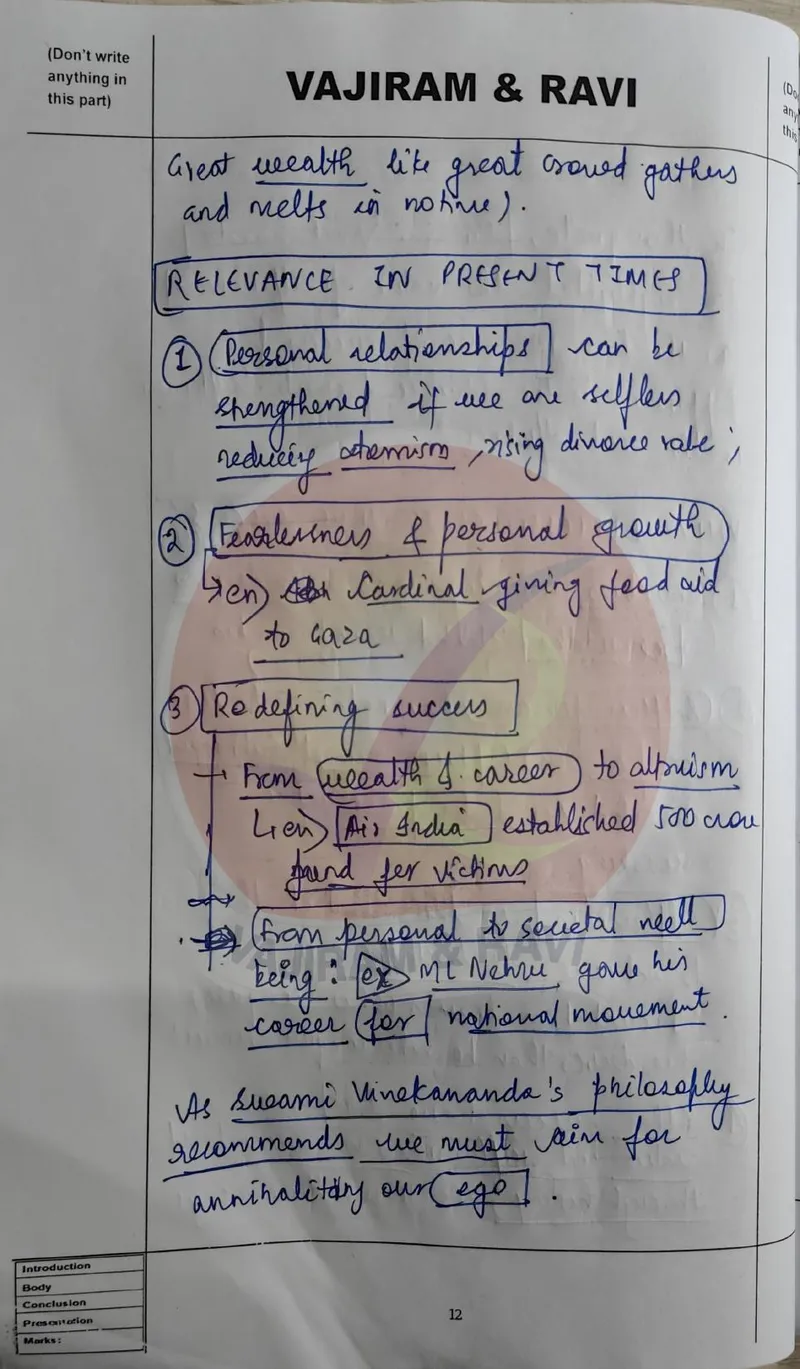
- ★On the three-thinkers quotation question (Q5), Dubey went past the Gandhi/Vivekananda/Kant prompts and brought in his own reinforcing material — a Kabir couplet on living so the world remembers you, the Chinese proverb 'selflessness is the real selfishness', Aristotle on conquering desires, and Thiruvalluvar on wealth gathering and melting -> in quote-based answers, layer additional cross-cultural thinkers that echo the prompt's idea, so each explanation is enriched by corroborating voices instead of just paraphrasing the given line.
- ★He closed the biotech/bioethics answer (Q1) by invoking Gandhi's 'science without humanity' from the seven social sins, and led the social-capital answer (Q2) with Putnam's 'social capital is the sum total moral fibre of any society' plus a Venn diagram (economic + human + social capital) -> bookend technical/governance answers with a thinker's line that names the underlying ethical principle, so a factual answer is framed by an ethical anchor at intro or conclusion.
- ★The answers convert content into the right visual form per question type — a box diagram of 'Ethical Challenges' (designer babies, terminator genes) in Q1, Positives-vs-Negatives tables across ethical/constitutional/socio-cultural dimensions in Q6, a Persuasion-vs-Social-influence table by technique/nature/example in Q7, and way-forward arrow/tree diagrams in Q4 and Q8 -> match the diagram to the demand of the question (comparison -> table, multi-dimensional analysis -> dimension grid, solutions -> way-forward tree) instead of inserting one generic figure.
Questions attempted: Bioethics & advances in biotechnology (healing vs enhancement); Social capital in ethical governance, community resilience & citizen participation; Dynamic interplay between integrity and objectivity in public service, and 12 more below.
Questions attempted in this booklet (15)+
- Q1.Bioethics & advances in biotechnology (healing vs enhancement)
- Q2.Social capital in ethical governance, community resilience & citizen participation
- Q3.Dynamic interplay between integrity and objectivity in public service
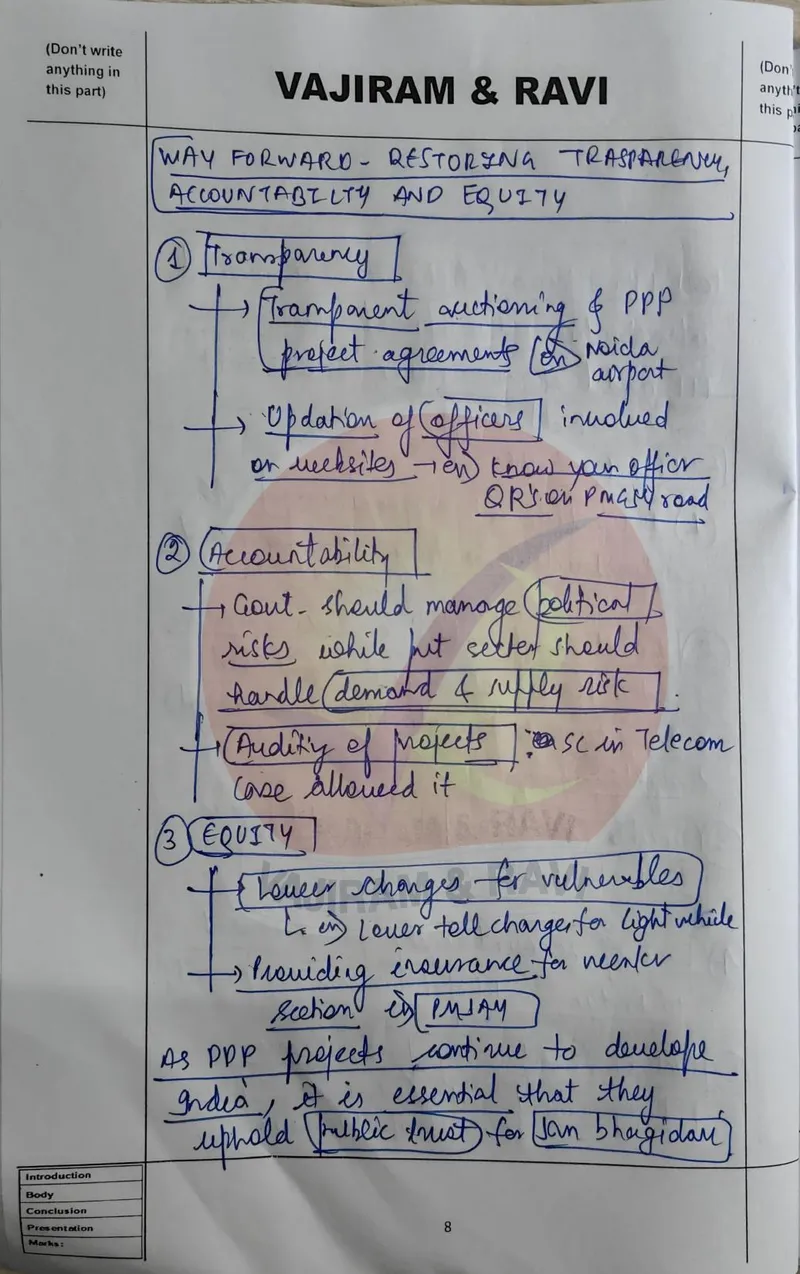
- Q4.Ethical issues in Public-Private Partnerships (transparency, accountability, equity)
- Q5.Meaning of three thinkers' quotations (Gandhi, Vivekananda, Kant)
- Q6.Using surplus funds of religious institutions for public welfare (ethical/constitutional/socio-cultural)
- Q7.Persuasion vs social influence for ethical behavioural change
- Q8.Socio-cultural factors perpetuating poor public-service delivery; culturally responsive policy
- Q9.Workplace ethics of hybrid/remote work models
- Q10.Social audits & RTI as instruments of participatory ethics
- Q12.Case study: railway-stampede crisis as Divisional Railway Manager
- Q13.Case study: ed-tech startup governance failure & employee suicide (Chief Compliance Commissioner)
- Q14.Case study: PSU furnace blast / loss-making PSU revival vs privatisation (CMD)
- Q15.Case study: regulating finfluencers & pump-and-dump (SEBI/Ministry of Finance)
- Q17.Case study: workplace mental health, hustle culture & the 'silent epidemic'
Examples, data & evidence used
- CRISPR-Cas9 gene editing; Chinese researcher's 'designer baby' case (jailed) (Q1)
- Bt cotton field trials; Johnson & Johnson withdrawing faulty transplants; Covishield thrombocytopenia disclosure; PPV&FR Act farmer benefit-sharing (Q1)
- Gini index 0.82; only 5% of workforce trained; SSAAT exposing MGNREGA corruption; Sikh gurudwara langars in COVID-19; Parsi community in ECI 'Chunav ka Parv'; 'Malinya Muktham Nava Keralam' (Kozhikode 75% door-to-door collection) (Q2)
- All India Services Conduct Rules 1968; E. Sreedharan; HC Gupta acquitted by Supreme Court in coal case; Yashwant Verma case judicial investigation; 'Karmayogi' (Q3)
- Xaxa Committee on tribal land acquisition; Tata power project failure in Gujarat; Noida airport PPP auction; PM-JAY (Q4)
- Ratan Tata donating during COVID-19; Nazakat Ahmed Shah saving lives in Pahalgam; Jadui Pitara of NEP 2020; Captain Sumeet Sabharwal diverting Air India plane; Vikram Batra in Kargil; Mission LiFE; Paryushan Parva (Q5)
- Ramakrishna Mission hospitals in hilly regions; IMA vs UOI (right to health); Articles 25/26/30 and 38/39 (Q6)
- 'Give it up' LPG-subsidy campaign; Amitabh Bachchan / Swachh Bharat 'Izzat Ghar'; CBSE sugar boards (Q7)
- Rats in Bihar hospital; Abhishek Prakash UP IAS corruption case; Sevottam / CPGRAMS; removal of red lights on official vehicles (Q8)
- BCG report on hybrid work; Ernst & Young young-employee suicide case (name uncertain); L&T CEO 70-hour-week remark; Zoho vacations; Article 21 / Article 42 (Q9)
- MKSS Jan Sunwai in Rajasthan; Meghalaya social audit (pension gaps, absentee teachers); CIC >5000 pending cases; Himachal Pradesh simplified RTI (Q10)
- Economic Survey 2024-25 (13.2% rise in investors) (Q15); Startup India Mission & Gandhian trusteeship (Q13); Mission Karmayogi & DOPT EI module (Q17)
Quotes the candidate used
- Mahatma Gandhi — 'Live as if you were to die tomorrow. Learn as if you were to live forever.' (Q5 prompt) and reference to 'science without humanity' (seven social sins) in Q1 conclusion
- Robert Putnam — 'social capital is the sum total moral fibre of any society' (Q2)
- Kabir — couplet on living so the world remembers you (Q5)
- Swami Vivekananda — 'the perfectly unselfish person is the most successful' (Q5 prompt)
- Chinese proverb — 'selflessness is the real selfishness' (Q5)
- Aristotle — 'I count him braver who conquers his desires than he who conquers his enemies' (Q5)
- Thiruvalluvar — great wealth, like a great crowd, gathers and melts (Q5)
- Immanuel Kant — 'Morality is... how we may make ourselves worthy of happiness' (Q5 prompt)
How it’s written: Standard UPSC Ethics format. Section A = ten 10-mark/150-word theory questions (Q1-Q10); Section B = seven 20-mark/250-word case studies (Q11-Q17). For every answer the candidate writes a short underlined introduction (often with a topical hook), a heavily structured body using boxed/circled headers, numbered points…
Diagrams & visuals: Q1: box diagram of 'Ethical Challenges' (fetal embryo in vaccines, designer babies, terminator genes); Q2: Venn diagram (elements of democracy = economic + human + social capital); Q3: two-column comparison table (Integrity without objectivity vs Objectivity without integrity); Q6: two-column Positives vs Negatives table across ethical/constitutional/socio-cultural dimensions; Q7: two-column table (Persuasion vs Social influence by technique, nature, example); Q8 & Q4: way-forward tree/arrow diagrams
Evaluator: No examiner marks or comments are filled in on this copy.