
Harshita Goyal — PSIR optional Test 02
What’s inside this copy
- ▸Complete attempt of all five required questions (Q1, Q2, Q4, Q5, Q7 = 250 marks) in neat, uniform cursive English.
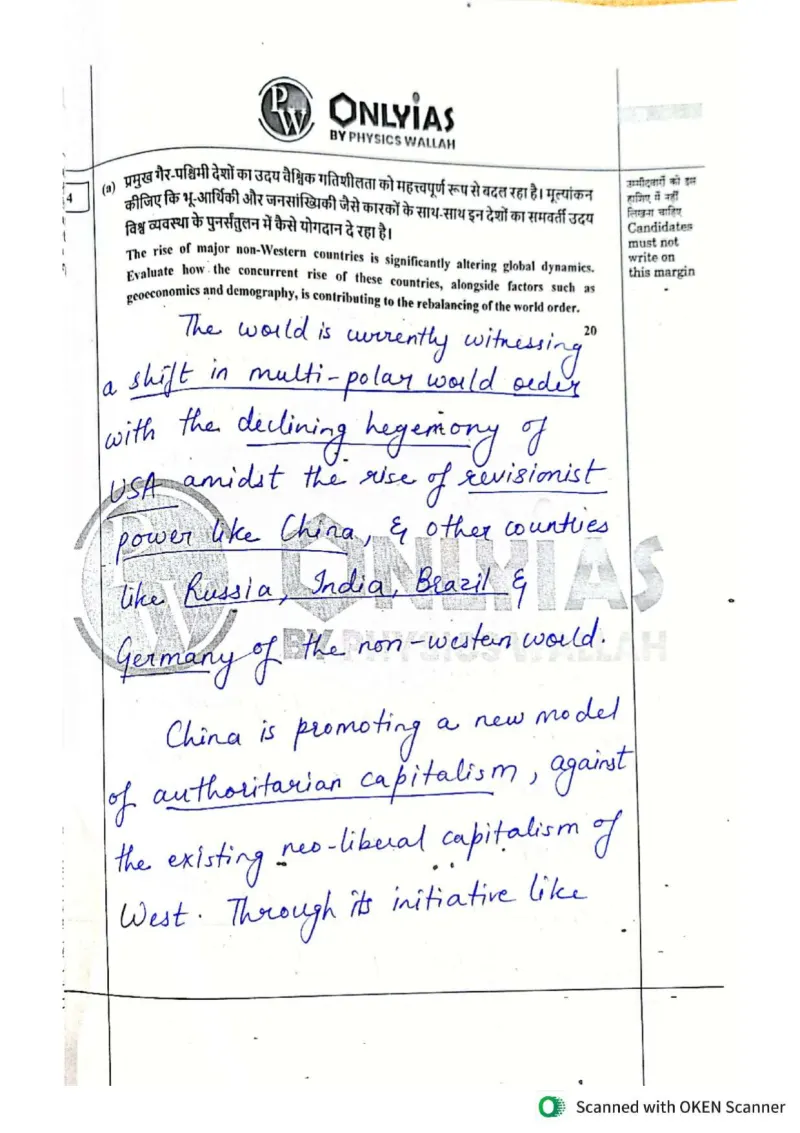
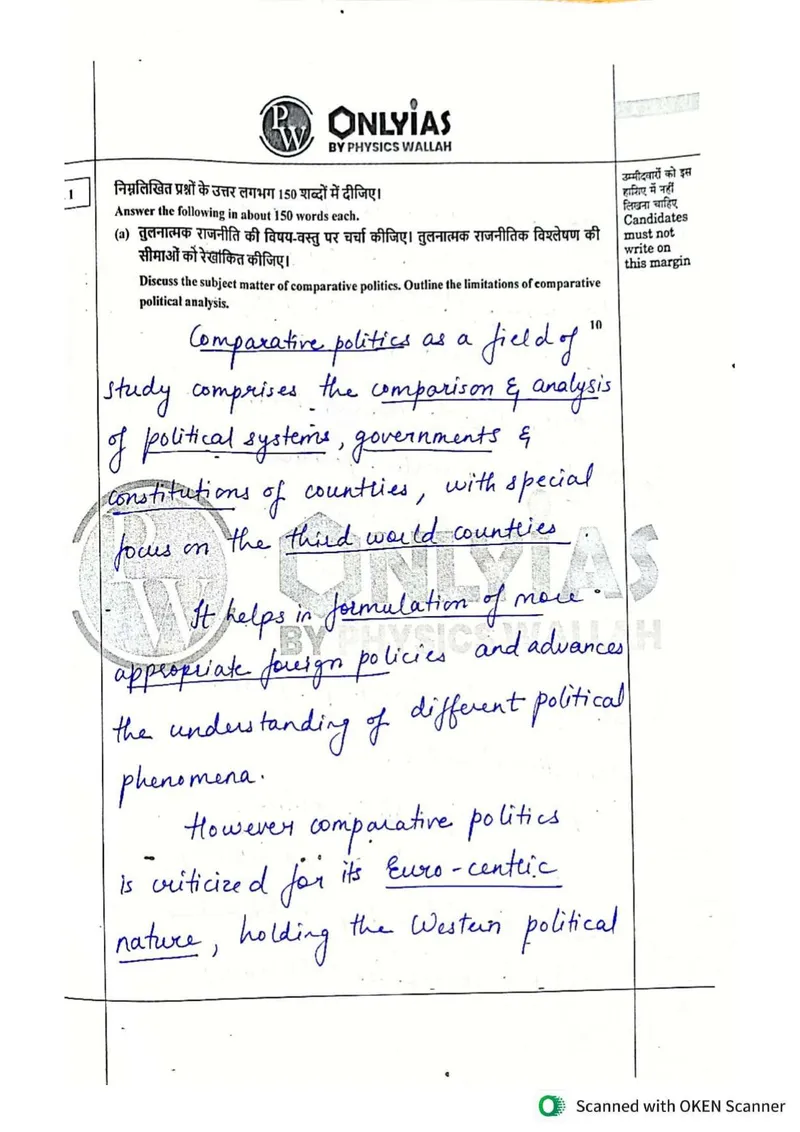
- ▸Heavily scholar-anchored: Kautilya, Marx, Waltz, Mearsheimer, Keohane & Nye, McLuhan, Locke, Huntington, Kanchan Chandra and Joseph Nye woven across answers.
- ▸Sharp quote game — Wilson's institutions 'convert the jungle of anarchy into a zoo', Waltz's nuclear 'Weapons of Peace', Varshney's 'compassionate globalism', Menon's 'frugal diplomacy'.
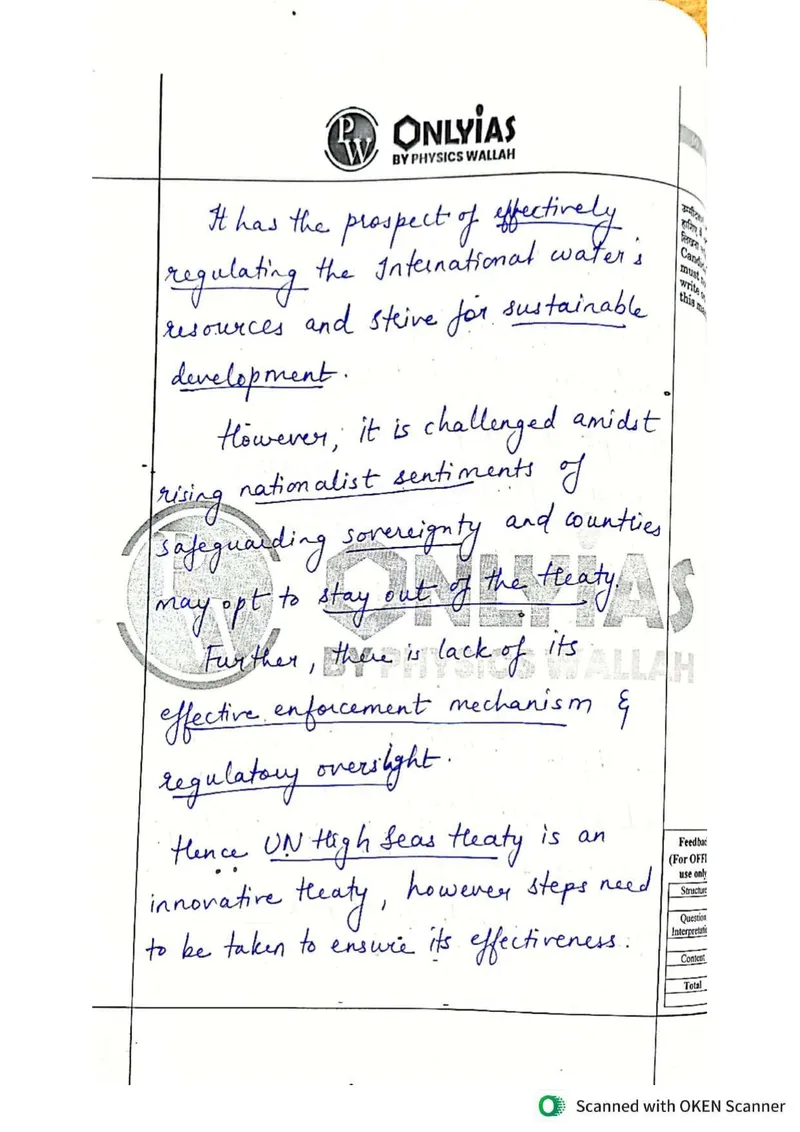
- ▸Current-affairs dense: PGII vs BRI, High Seas Treaty, BRICS Plus (Johannesburg), Sheikh Hasina's fall, Katchatheevu, Global Biofuels Alliance.
- ▸Signature structure — underlined keywords, 'Eg' examples, and balanced, forward-looking conclusions ('NAM 2.0', preserve democracy's health).
- ▸Recurring Indian foreign-policy framing: Vasudhaiva Kutumbakam, Vishwa Guru, SAGAR, Net Security Provider.
What to learn from this copy
- ★She deploys ONE signature thinker-quote that directly encodes the answer's core claim rather than sprinkling names: Woodrow Wilson's institutions 'convert the jungle of anarchy into a zoo' opens the idealism/institutional-liberalism question (2a), and Kenneth Waltz's nuclear 'Weapons of Peace' anchors the minimum-deterrence answer (4b). -> Memorise a small bank of theme-defining quotes and place the one that literally states your argument, instead of decorating with random scholar names.
- ★For the abstract jargon term 'glocalisation' (2b) she gave the McDonald's 'Aloo Tikki burger' as the illustration -- one vivid, instantly recognisable commercial example. -> When a question turns on a piece of theory-jargon, ground it immediately with a single everyday/commercial 'Eg' the examiner can picture, instead of staying at the level of definitions.
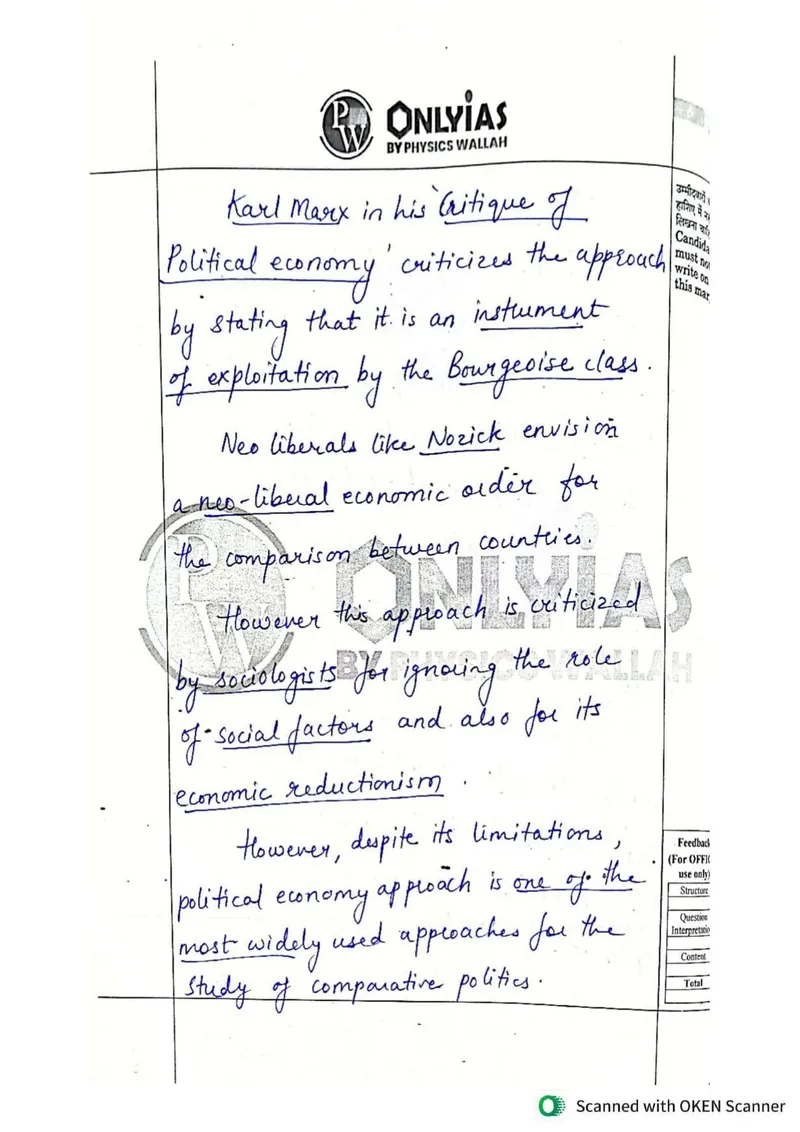
- ★On the political-economy-approach question (1b) she opened by citing Kautilya's Arthashastra as 'the first work on political economy', and across her India FP answers she reuses civilisational framing -- Vasudhaiva Kutumbakam, Vishwa Guru, SAGAR, Net Security Provider. -> Front a Western-theory or IR question with an Indian-rooted anchor; it shows originality and lets you carry a consistent framing vocabulary across multiple answers.
- ★For the 'why protest movements are short-lived / organisational shortcomings' question (2c) she stacked cases across geographies -- Anna Andolan, the Farmers' protest (with Section 144 / police repression), the Yellow Vest movement and Black Lives Matter -- so each illustrates a different facet of the demand. -> Build a multi-case answer where Indian AND global examples each prove a distinct sub-point, rather than one example repeated.
- ★Her current affairs are welded to the exact directive of the question, not bolted on: Katchatheevu island is the case for 'how domestic factors affect foreign policy' (5d), Sheikh Hasina's fall drives the India-Bangladesh crisis answer (7b), and PGII-vs-BRI structures 1(c). She then closes forward-looking with a coined label like 'NAM 2.0' for non-alignment (7a). -> Choose the single contemporary case that IS the question's demand, and end with a crisp named future-direction rather than a generic summary.
Questions attempted: Subject matter of comparative politics & limitations of comparative political analysis; Political economy approach to the comparative analysis of politics; Potential of G7's PGII as an alternative to China's BRI, and 16 more below.
Questions attempted in this booklet (19)+
- 1(a).Subject matter of comparative politics & limitations of comparative political analysis
- 1(b).Political economy approach to the comparative analysis of politics
- 1(c).Potential of G7's PGII as an alternative to China's BRI
- 1(d).Prospects and challenges of the High Seas Treaty (BBNJ)
- 1(e).Role of the International Maritime Organisation (IMO)
- 2(a).Core assumptions of idealism in IR; relevance of institutional liberalism to peacebuilding (20 marks)
- 2(b).Glocalisation for sustainable development in the post-COVID world (15 marks)
- 2(c).Short-lived nature of social/protest movements; organisational & strategic shortcomings (15 marks)
- 4(a).Rise of non-Western powers, geoeconomics & demography rebalancing the world order (20 marks)
- 4(b).Concept of 'minimum deterrence', strategic stability & nuclear disarmament (15 marks)
- 4(c).Democratic backsliding vs enduring popularity of representative democracy (15 marks)
- 5(a).Significance of economic diplomacy in India
- 5(b).Why the Global Biofuels Alliance is critical for India
- 5(c).Role of soft power and cultural diplomacy in India's foreign policy
- 5(d).How domestic factors affect foreign policy — Katchatheevu island controversy
- 5(e).India's potential role in UN peacekeeping and peacebuilding
- 7(a).Non-alignment — colonial/philosophical roots and pragmatic geopolitical applications (20 marks)
- 7(b).India-Bangladesh relations and implications of the recent crisis (15 marks)
- 7(c).Recent US-India defence developments and Indo-Pacific regional security (15 marks)
Examples, data & evidence used
- Kautilya's Arthashastra cited as the first work on political economy
- McDonald's introducing the 'Aloo Tikki' burger to adapt to Indian tastes (glocalisation)
- Anna Andolan (anti-corruption movement) as a social movement
- Farmers' protest against farm laws; withdrawal of Farm Laws; Section 144 / police repression
- Yellow Vest movement and Black Lives Matter (USA social movements)
- Maldives elections mobilised on anti-India ideology over development manifestos
- BRICS expansion to 'BRICS Plus' at the Johannesburg summit
- Russia-Ukraine War and Israel-Palestine conflict — institutions failed to prevent them
- UNFCCC on climate change and WTO preserving liberal trade consensus
- Iran pursuing nuclear deterrence; Russia's withdrawal from disarmament; China raising warheads; US nuclear triad revival; India-Pakistan arms race
- Cold War — nuclear weapons prevented direct US-USSR war
- FTAs with UAE, Australia and EFTA; BIMSTEC, Kaladan Multimodal project, IMT Trilateral Highway, INSTC; Connect Central Asia and Act East policy
- Global Biofuels Alliance (G20); USA and Brazil as top biofuel producers; National Biofuels Policy 2018
- Diwali celebrations in USA, Bollywood in African countries, Ayurveda, International Yoga Day (UN), ICCR Chairs of Indian Studies
Quotes the candidate used
- Woodrow Wilson (Fourteen Points) — institutions 'convert the jungle of anarchy into a zoo'
- Kenneth Waltz — nuclear weapons as 'Weapons of Peace'
- Kenneth Waltz & John Mearsheimer — neo-realist critique of liberal institutions
- Robert Keohane & Joseph Nye — 'complex interdependence'
- Marshall McLuhan — 'global village'
- Ashutosh Varshney — 'compassionate globalism'
- Kanchan Chandra — 'patronage-based politics'
- John Locke — concept of representative democracy
How it’s written: Bilingual printed questions (Hindi + English); all answers written in English in neat, consistent blue cursive. Every answer follows a disciplined introduction -> multi-point body -> conclusion arc. Key terms and thinker names are underlined for emphasis. Margin rule respected throughout ('Candidates must not write…
Diagrams & visuals: None observed — answers are entirely prose; no diagrams, maps, flowcharts or tables drawn on any rendered page or in the OCR text.
Evaluator: No examiner marks or comments are filled in on this copy.