
Deepali Mahto — NextIAS GS Paper 4 (Ethics) copy
What’s inside this copy
- ▸Genuine NextIAS 'Ethics Enhancer Test 2024' (EE2401, Test 01) full GS4 paper by Deepali Mahto — all 12 questions attempted in English across a ~52-page booklet
- ▸Exceptionally example-dense: Ashok Khemka's 36 transfers, Armstrong Pame, Kiran Bedi, Oscar Schindler, Byju's, J&J baby powder, NEET cheating, Rashmika Mandanna deepfake, ADR v UoI electoral bonds
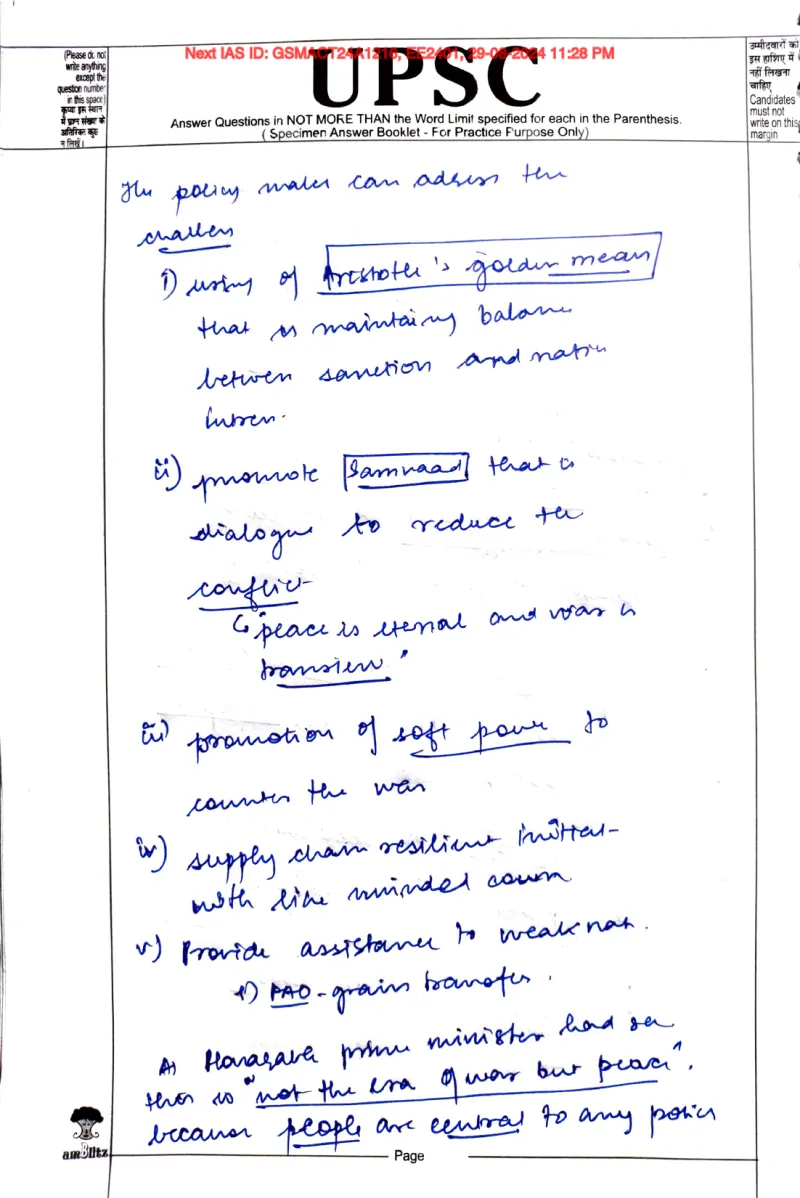
- ▸Quote-led throughout: Gandhi (court of conscience), MLK (injustice in health), Voltaire, Vivekananda (treatment of women), 'this is not the era of war'
- ▸Polished case-study craft: stakeholder web/triangle diagrams, ethical-issue mapping, merit-demerit option tables, decisive 'my course of action' + way forward
- ▸Data-anchored answers: NCRB 44% cybercrime rise, Central Water Board 53% stressed districts, World Bank 40% jobs / 66.66M women-hours, SDG-1
- ▸Balanced ethical reasoning — repeatedly weighs deontological vs utilitarian lenses (Nishkam Karma, Kant's imperative, Aristotle's golden mean)
What to learn from this copy
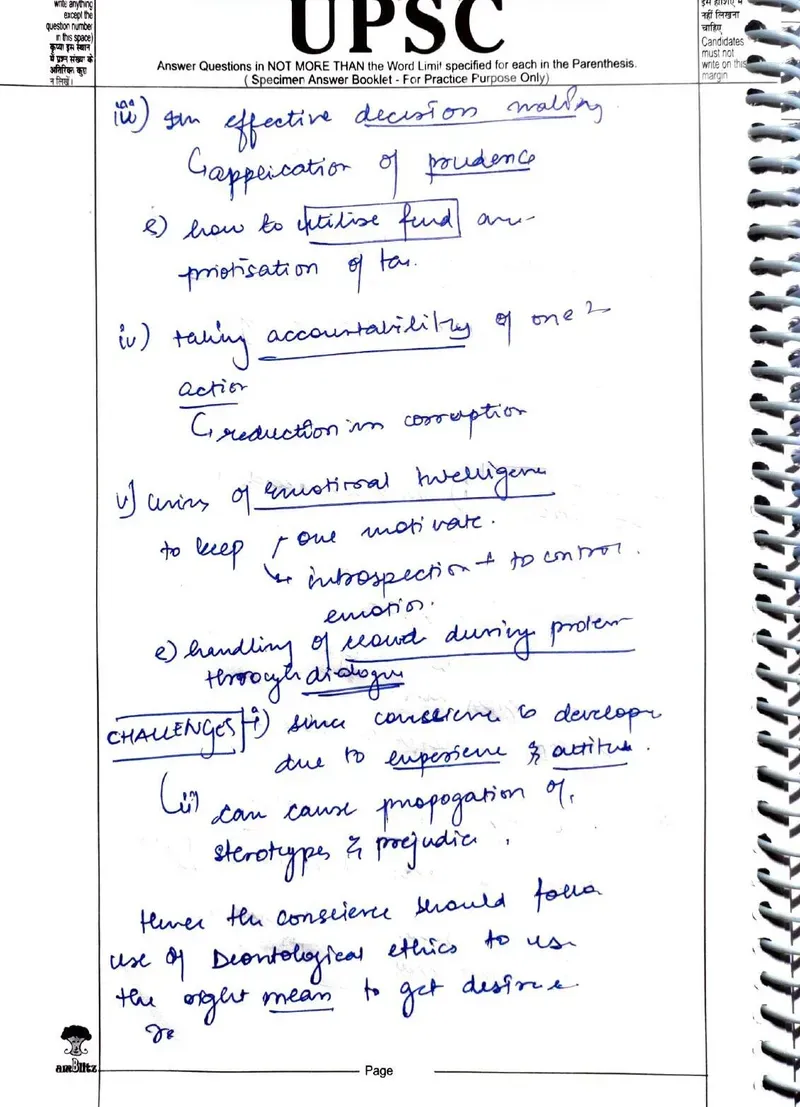
- ★She matched each quote to the exact topic rather than scattering generic ones: Gandhi's 'there is a higher court of justice than the court of law, and that is the court of conscience' for the conscience question (Q1b), MLK's 'injustice in health is the most shocking and inhuman' for empathy in healthcare delivery (Q3b), and Voltaire's 'I may not agree with what you say but I will defend your right to say it' for moral relativism/tolerance (Q6c). -> Don't memorise quotes for show; map a specific quote to the specific demand of the question so it does analytical work, not decoration.
- ★Every case study (Q7-Q12) opened with a stakeholder diagram naming all parties before any decision was taken — e.g. Q7's web of CEO, Beta investor, Mr Mehta, vendor, competitor and society at large, and Q8's DDO, village community, teacher, poor family and government. -> In case studies, visually surface the full stakeholder set first; it forces you to weigh every affected interest before committing to 'my course of action' and prevents tunnel-vision answers.
- ★She anchored ethics answers in hard data instead of vague assertions: NCRB's 44% rise in cybercrime (Q9, insurance mis-selling), Central Water Board's 53% stressed districts (Q10, water scarcity), and the World Bank figures of 40% of jobs / 66.66M women-hours (Q12, witchcraft/women's safety). -> Even in a 'philosophical' paper like Ethics, a precise statistic converts an opinion into an evidence-backed argument and signals current-affairs grounding.
- ★She deliberately ran both ethical lenses against each other rather than picking one — weighing utilitarian vs deontological reasoning on the economic-sanctions dilemma (Q5b), and threading Nishkam Karma, Kant's categorical imperative and Aristotle's golden mean through the action-and-consequences questions (Q6b). -> Show the examiner you can hold competing moral frameworks in tension and then resolve them; balanced reasoning beats a one-sided verdict in Ethics.
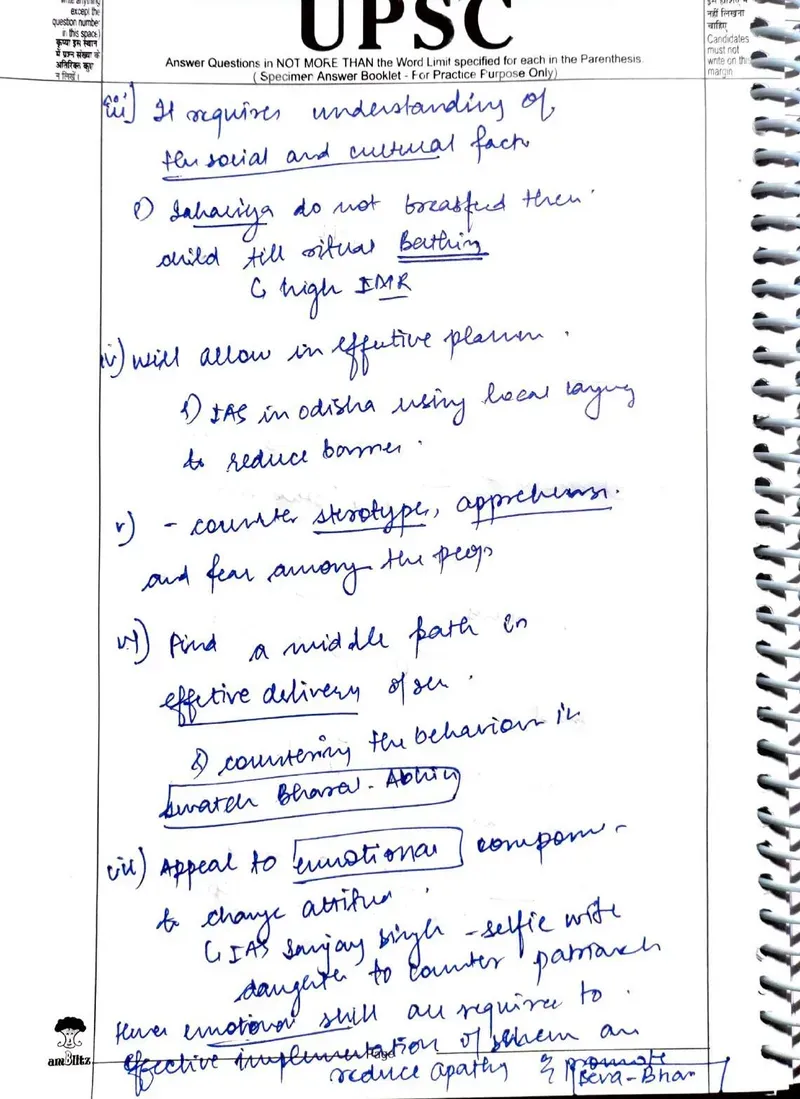
- ★Her examples were specific and lesser-used, not the tired textbook set: Ashok Khemka's 36 transfers for integrity, Armstrong Pame's self-funded Manipur road, IAS Sanjay Singh's selfie with his daughter to counter patriarchy, and the Saharia tribe's breastfeeding-ritual delay linked to high IMR. -> Build a stock of precise, named, verifiable examples (person + specific act) — they're far more persuasive than generic 'an honest officer once...' illustrations.
- ★Theory answers followed a consistent, examiner-friendly skeleton: open by unpacking the prompt/quote or a definition, develop a sub-pointed (i, ii, iii) body with examples, and close with a 'Hence...' line tied back to a thinker — with key terms boxed and keywords underlined throughout. -> A repeatable structure plus visual signposting lets an evaluator find your argument fast under time pressure; standardise your own template so quality holds across all 12 answers.
Questions attempted: Public service values vs administrative ethics — relationship & application (trust, transparency, accountability); Conscience as a guiding light for the public servant; deontology to use right means; Good governance: public administration vs corporate sector (comparison table), and 16 more below.
Questions attempted in this booklet (19)+
- 1(a).Public service values vs administrative ethics — relationship & application (trust, transparency, accountability)
- 1(b).Conscience as a guiding light for the public servant; deontology to use right means
- 2(a).Good governance: public administration vs corporate sector (comparison table)
- 2(b).Ethical principles in government procurement (open tender/GeM, quality standards, social audit)
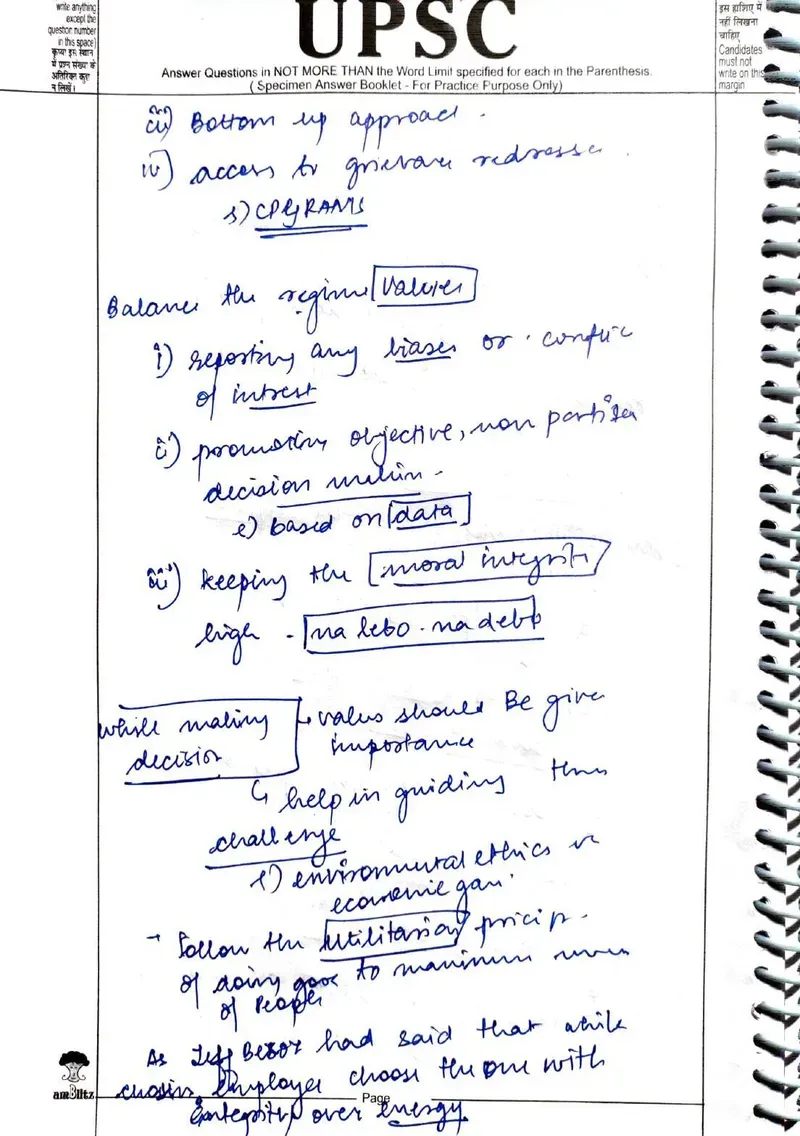
- 3(a).Civil-servant decision-making: balancing official obligation, stakeholder interest, regional values
- 3(b).Emotional skills (empathy, compassion) in healthcare/welfare delivery
- 4(a).Civil servant's political & moral attitude — positive and negative manifestations
- 4(b).Means vs ends / 'motive is irrelevant to action' — when motive matters in judging morality
- 5(a).Jain philosophy and its contemporary relevance (Ahimsa, Satya, Aparigraha, Brahmacharya)
- 5(b).Ethical dilemma of economic sanctions (Russia-Ukraine; utilitarian vs deontological)
- 6(a).'War begins in the mind' — war and peace as products of the mind
- 6(b).Action and its consequences — just means, Nishkam Karma, Kantian imperative
- 6(c).Moral relativism / context-dependent ethics and tolerance
- 7.Case study: corporate stock-price inflation / overvaluation (Beta company, Mr Mehta) — stakeholder & decision analysis
- 8.Case study: diversion of mid-day-meal foodgrain to feed a starving family (rule vs humanity)
- 9.Case study: cyber fraud / insurance mis-selling to low-literacy villagers
- 10.Case study: water scarcity / denial of basic amenity, tanker cartel & politician collusion
- 11.Case study: accountability for a fatal accident at a defence-tech firm (Aqua Tech) as ethics officer; also AI ethical issues (deepfakes, jobs, data privacy)
- 12.Case study: witchcraft accusations against women (Odisha anti-witchcraft law); under-reporting & women's safety
Examples, data & evidence used
- Ashok Khemka (36 transfers) — integrity/anti-corruption
- AI tool to combat malnutrition
- RTI Act Section 8 / suo-moto disclosure
- ADR v Union of India — electoral bonds struck down
- Gandhi's trusteeship model
- Coca-Cola / PepsiCo formula-leak (integrity)
- GeM portal — public procurement
- Social audit of PDS in Odisha
- Jal Jeevan Mission (tender to family member, Bihar; implementation in letter & spirit)
- CPGRAMS
- Saharia tribe — breastfeeding ritual delay & high IMR
- IAS Sanjay Singh — selfie with daughter to counter patriarchy
- IAS Armstrong Pame — road construction (Manipur)
- IPS Kiran Bedi — prison reform
Quotes the candidate used
- Gandhi: 'there is a higher court of justice than the court of law, and that is the court of conscience' (Q1b)
- Jeff Bezos: choose the employee with integrity over energy (Q3a)
- Martin Luther King Jr.: 'Of all forms of inequality, injustice in health is the most shocking and inhuman' (Q3b)
- 'Sheelam Param Bhushanam' — character is the highest virtue (Q4a)
- 'Peace is eternal and war is transient' (Q5b)
- PM (to Putin): 'this is not the era of war' (Q5b)
- 'War begins in the minds of men' — UNESCO-style prompt quote (Q6a)
- Voltaire: 'I may not agree with what you say but I will defend your right to say it' (Q6c)
How it’s written: Highly structured, exam-ready format. Theory answers open with a definition or by unpacking the prompt/quote, develop a numbered/sub-pointed body (i, ii, iii with sub-examples), and close with a 'Hence...' line, usually anchored to a thinker or quote. Candidate consistently boxes key terms and underlines keywords fo…
Diagrams & visuals: Q2: two-column comparison table — good governance in public administration vs corporate; Q3(a): small triangle/relationship diagram linking official obligation, stakeholder interest, regional values; Q7: stakeholder web diagram (Stakeholder -> CEO, investor of Beta, Mr Mehta, vendor, competitor, society at large); Q8: stakeholder diagram (DDO, village community, teacher, poor family, government); Q10: stakeholder diagram (society at large, politician, caste, junior engineer, people); Q11: stakeholder bracket diagram (Aqua Tech firm, operation officer who died, project leader, ethics committee, society/government)
Evaluator: No examiner marks or comments are filled in on this copy.