
Vibhor Bhardwaj — Essay copy
Essay
What’s inside this copy
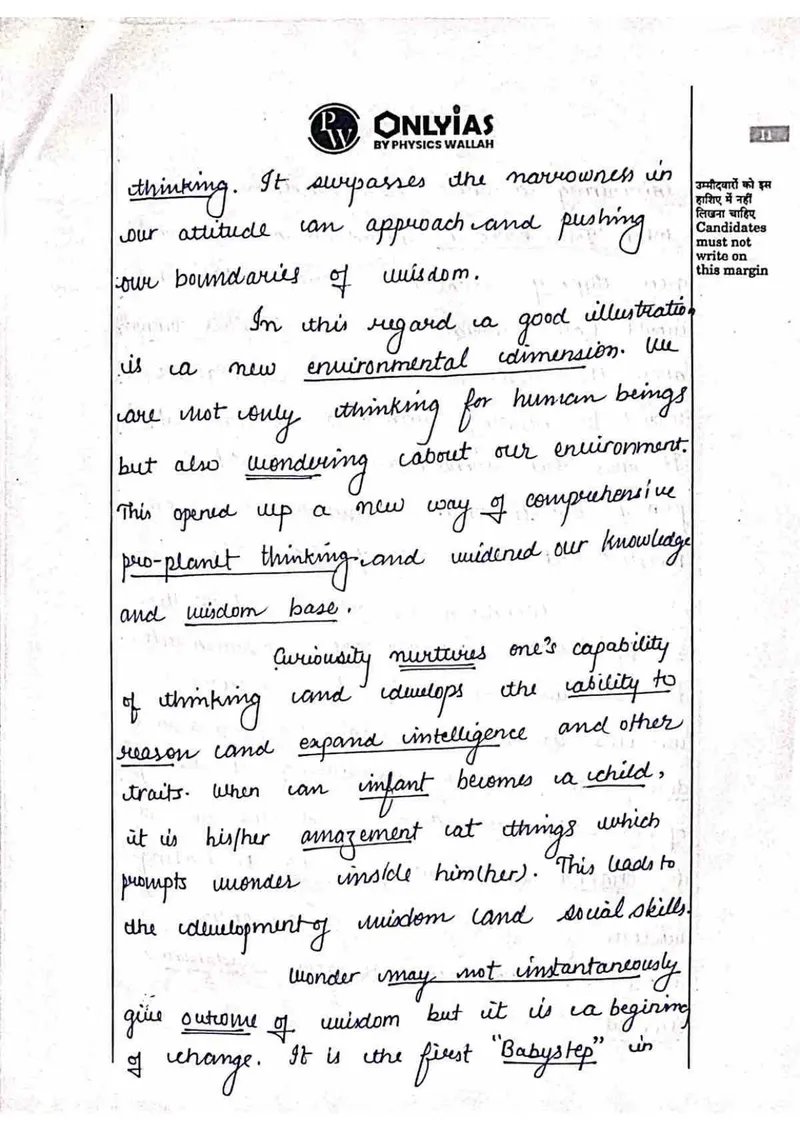
- ▸Two essays attempted — Section A 'Wonder is the beginning of wisdom' and Section B 'Our greatest ability as humans is not to change the world but to change ourselves' — each chosen via a checkmark.
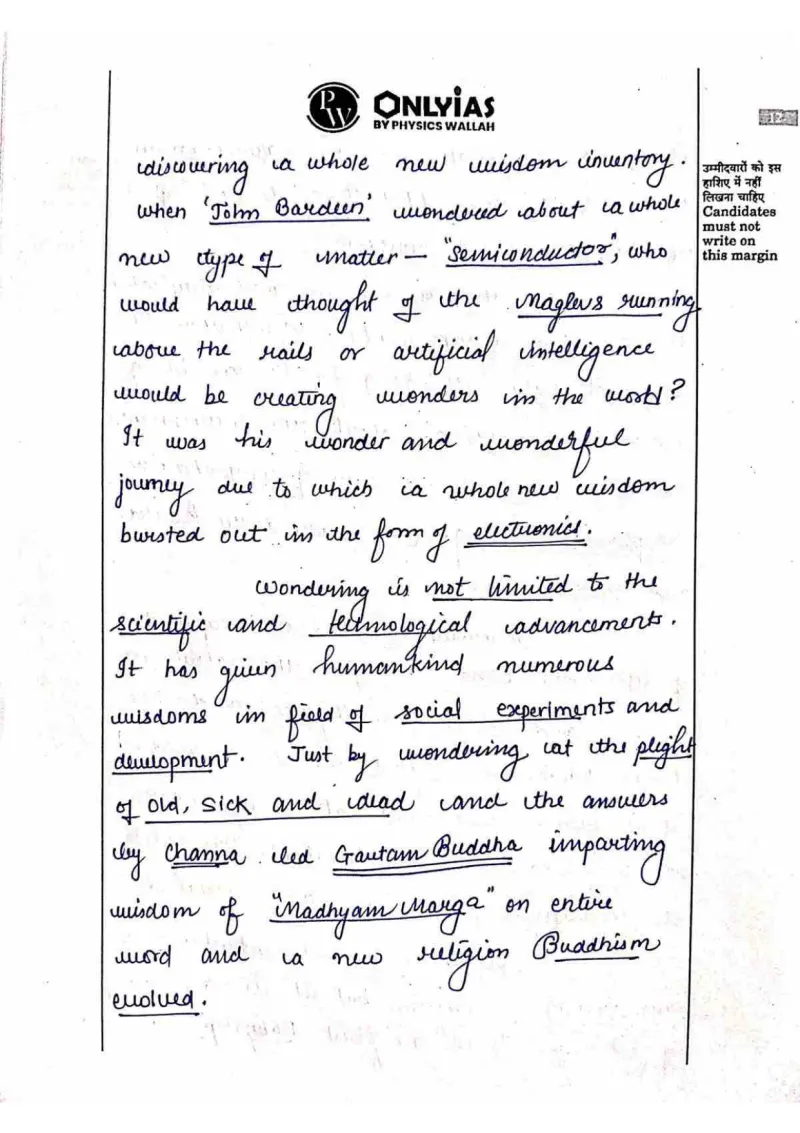
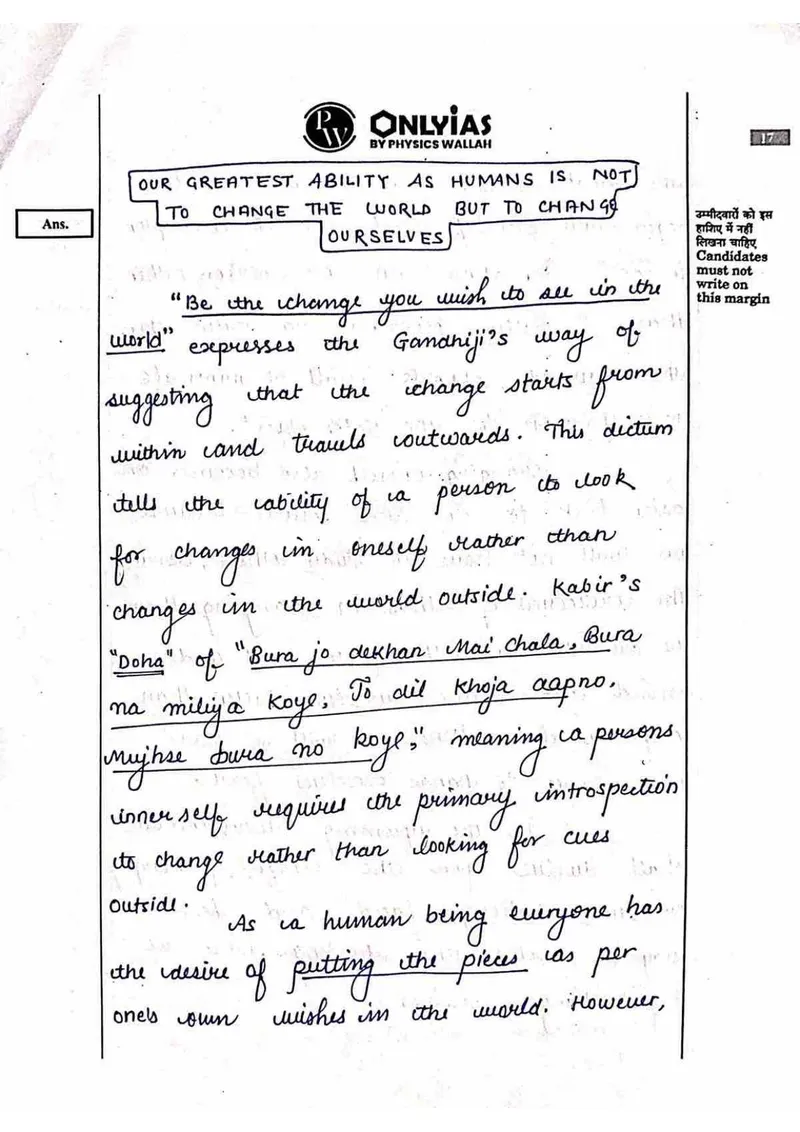
- ▸Both essays are anecdote-led: Faraday's curiosity opens Essay 1; Gandhi plus a Kabir doha opens Essay 2.
- ▸Wide multi-domain example bank — science (Faraday, Edison, Kepler, NASA spinoffs, Bardeen), history (fall of Constantinople, Magellan, Ashoka's Kalinga) and reformers (Baba Amte, Raja Ram Mohan Roy, Princess Diana).
- ▸Quotations frame and close paragraphs — Socrates, Aristotle, Gandhi, a Kabir doha and a closing dictum on making a difference.
- ▸Clear signposting — boxed titles, an explicit roadmap paragraph (benefits/challenges/ways), 'Firstly/Secondly/Thirdly' enumeration and underlined keywords.
- ▸A ~10-point handwritten rough outline precedes Essay 2 (printed page 15).
What to learn from this copy
- ★Both essays open with a concrete anecdote rather than a definition — Essay 1 ('Wonder is the beginning of wisdom') starts with Michael Faraday's curiosity, and Essay 2 ('change ourselves') opens with Gandhi plus the Kabir doha 'Bura jo dekhan main chala... Jo dil khoja aapno, mujhse bura na koye.' -> Open an essay with a person and a moment that already embodies the theme, so the introduction shows the idea in action instead of merely stating it.
- ★The quotations are chosen to mirror the exact prompt, not just decorate it: Socrates' 'the more I know, the more I get to know that I do not know' is placed in the wonder/wisdom essay, and the Kabir doha about looking into one's own heart ('Jo dil khoja aapno') anchors the 'change ourselves' essay. -> Pick quotes that restate the question's core idea in different words — a theme-matched quote doubles as a thesis; a generic 'inspiring' quote adds nothing.
- ★Examples are carried through to their downstream consequence rather than just named — Faraday's electromagnetic induction is linked forward to the bullet train/maglev, and the fall of Constantinople is traced to the search for a sea route to India and the eventual discovery of America. -> Don't stop at dropping a name; build a short cause-and-effect chain (discovery -> application -> impact) so each example argues the point instead of decorating it.
- ★Essay 2 contains an explicit roadmap paragraph that previews benefits, challenges and ways, then delivers them with 'Firstly/Secondly/Thirdly' enumeration and underlined keywords. -> Plant a one-line signpost early that tells the examiner the three things your body will cover, then deliver in that exact order — it makes a long prose essay navigable without turning it into bullet points.
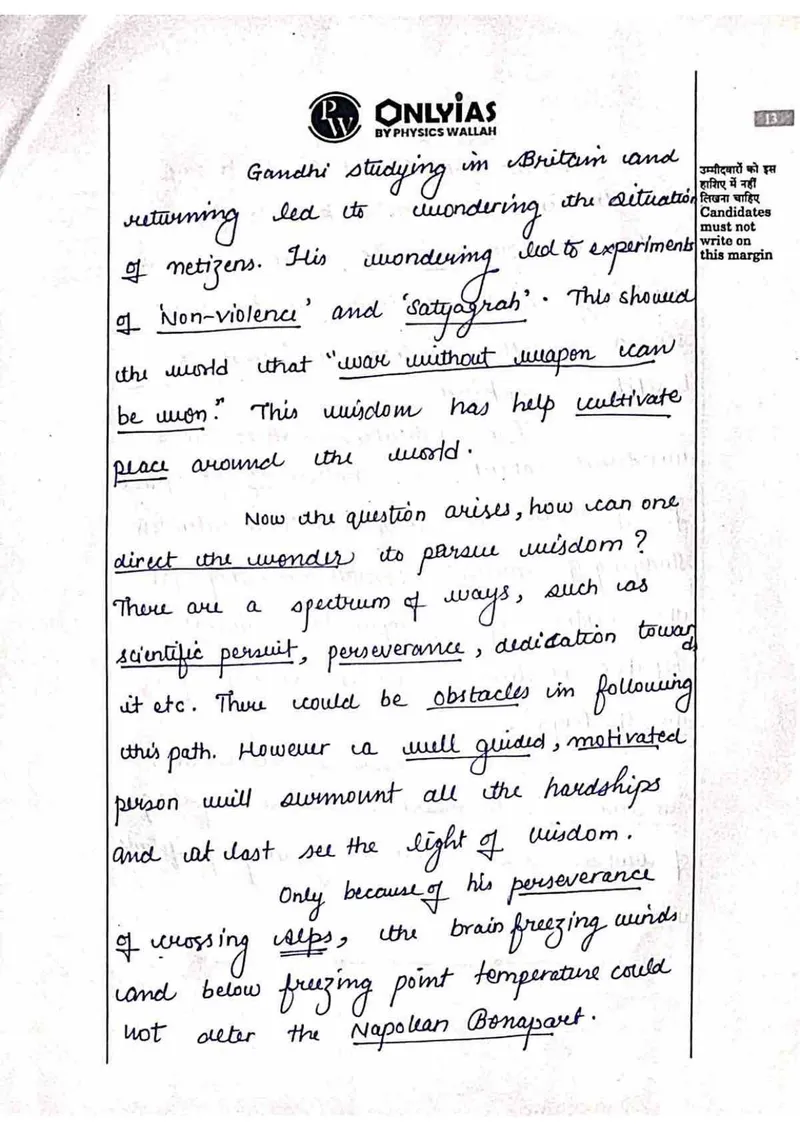
- ★The example bank is deliberately spread across domains — science (Faraday, Edison, Kepler, NASA spinoffs, Bardeen), exploration/history (Magellan, fall of Constantinople, Napoleon crossing the Alps) and social reformers (Baba Amte, Raja Ram Mohan Roy, Valmiki) — rather than clustering in one field. -> Stock 3-4 distinct domains of examples per theme so consecutive paragraphs feel multi-dimensional and you never lean on the same kind of evidence twice.
Questions attempted: Wonder is the beginning of wisdom (essay selected via checkmark); Our greatest ability as humans is not to change the world but to change ourselves (essay selected via checkmark).
Questions attempted in this booklet (2)+
- Section A.Wonder is the beginning of wisdom (essay selected via checkmark)
- Section B.Our greatest ability as humans is not to change the world but to change ourselves (essay selected via checkmark)
Examples, data & evidence used
- Michael Faraday — electromagnetic induction (linked to bullet train / maglev)
- Thomas Edison — invention of the electric bulb (candidate first wrote 'Einstein', struck it out, corrected to 'Edison')
- Fall of Constantinople prompting the search for a sea route to India and the discovery of America
- Kepler vs the Church's geocentric view
- Magellan's circumnavigation of the globe
- NASA spinoff technologies (memory foam, phone cameras)
- John Bardeen — semiconductor
- Gautam Buddha — Channa, the Madhyam Marg (Middle Path)
- Mahatma Gandhi — Satyagraha
- Napoleon crossing the Alps
- The makers of the Indian Constitution
- Valmiki (formerly Ratnakar)
- Baba Amte — work with leprosy patients
- Raja Ram Mohan Roy — abolition of Sati
Quotes the candidate used
- Socrates — 'the more I know, the more I get to know that I do not know'
- 'Necessity is the mother of invention'
- 'Veer Bhogya Vasundhara' (the earth is for the brave)
- Aristotle's counsel to Alexander — 'Go and See'
- Gandhi — 'Be the change you wish to see in the world'
- Kabir doha — 'Bura jo dekhan main chala, Bura na miliya koye; Jo dil khoja aapno, Mujhse bura na koye'
- 'Someone is sitting in the shade today because someone planted a tree a long time ago' (unattributed in the copy)
- 'We, the People'
How it’s written: Two essays, each opening with a boxed, centred title. Both are anecdote-led: Essay 1 ('Wonder is the beginning of wisdom') opens with Faraday's curiosity; Essay 2 ('change ourselves') opens with Gandhi and a Kabir doha. Essay 2 has an explicit roadmap/signpost paragraph laying out benefits, challenges and ways. Bodi…
Diagrams & visuals: None — both essays are prose-only. The page-15 rough work is a numbered text outline, not a diagram, table or map.
Evaluator: No examiner marks or comments are filled in on this copy.