
Yashvi Jain — NextIAS Essay copy
What’s inside this copy
- ▸Two complete essays, one per section: Section A on 'Competition is the law of the jungle, but cooperation is the law of civilization' (topic 4, circled in the margin) and Section B on 'The road to success and the road to failure are almost exactly the same' (topic 6).
- ▸Exceptionally example-dense, ranging across history (Partition, Akbar's abolition of Jaziya, Kalinga War), economy (India's 5th-largest GDP, 1991 LPG reforms, Viksit Bharat 2047) and pop culture (Harry Potter, Soorarai Pottru, IPL).
- ▸Rich, attributed quote bank — Gandhi, Aristotle (Nicomachean Ethics), Robert Frost, Edison, Charles Dickens and Swami Vivekananda.
- ▸Both essays rewrite the chosen topic verbatim at the top and use boxed/underlined sub-headings to organise the argument (e.g., 'COMPETITION VS COOPERATION', 'FAILURE & SUCCESS: TWO SIDES OF THE SAME COIN').
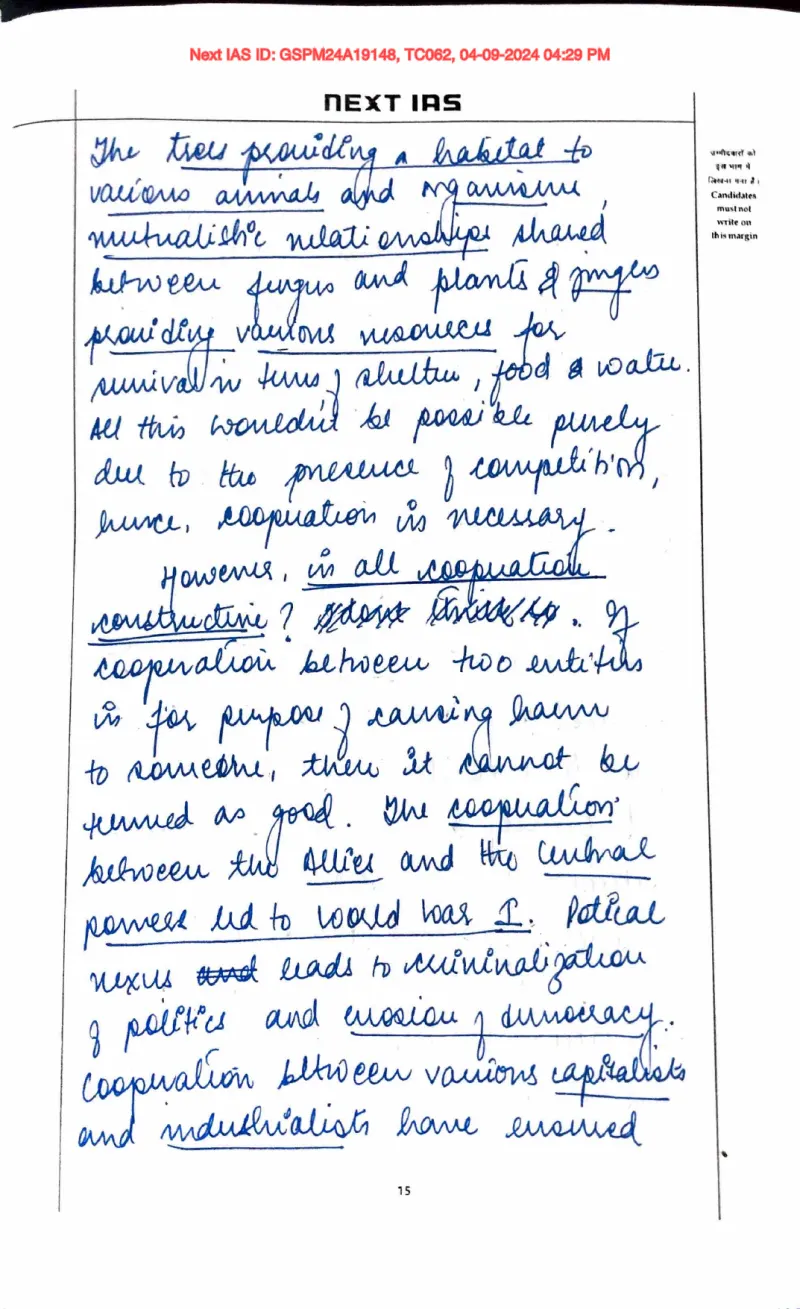
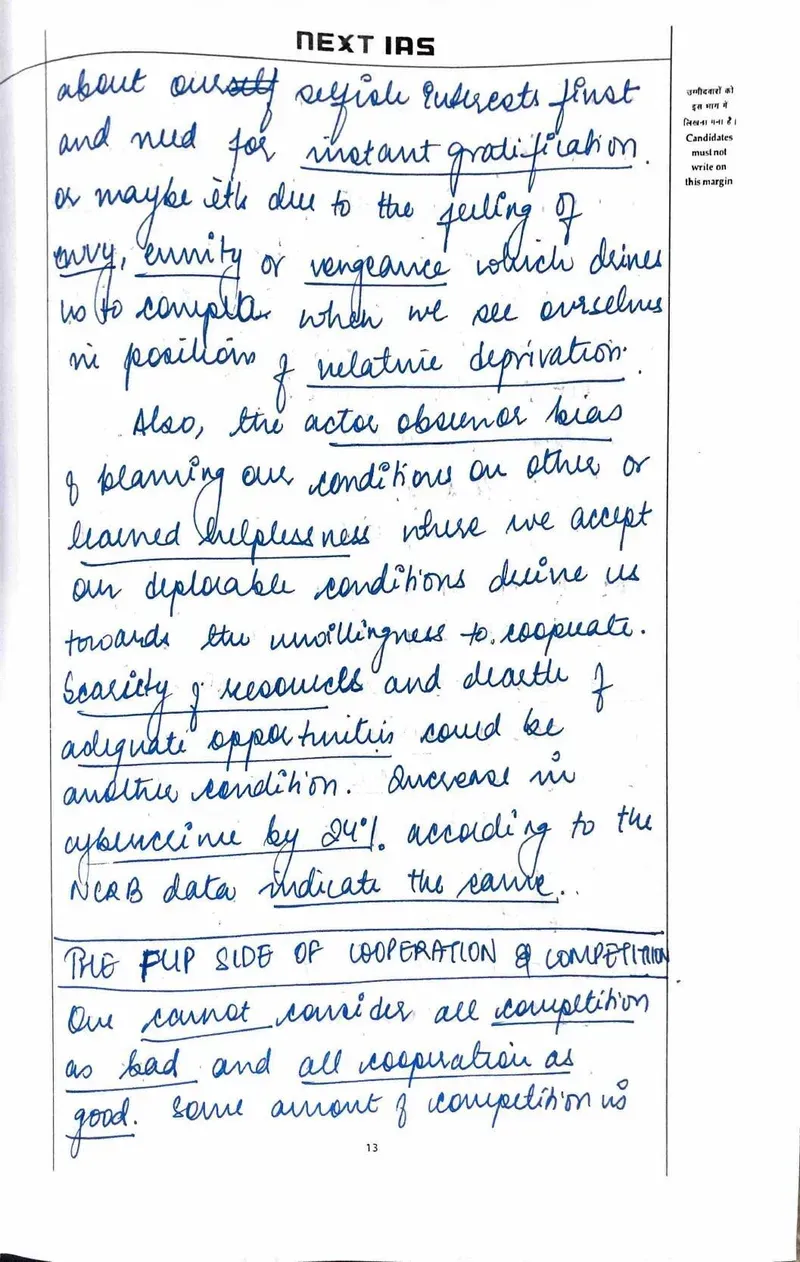
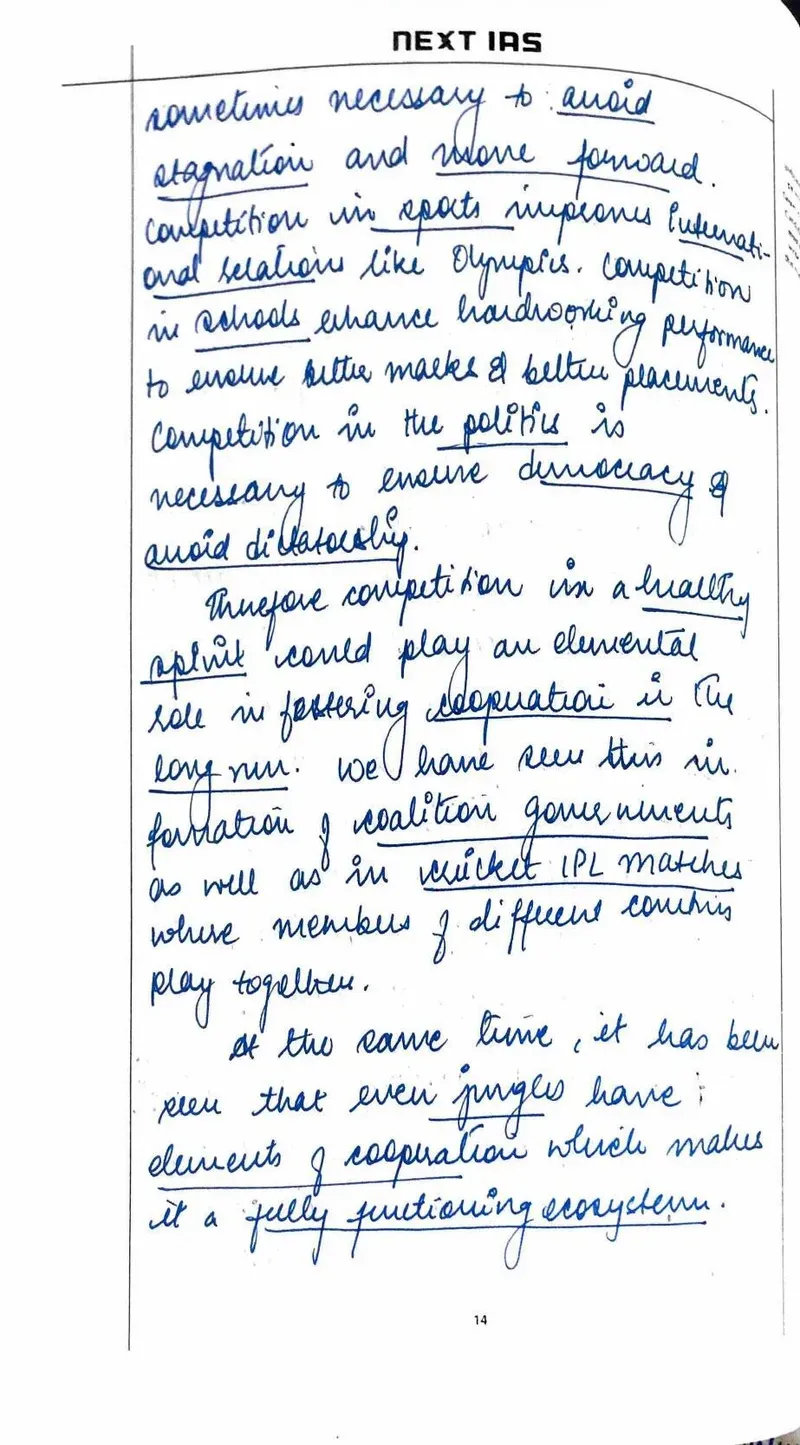
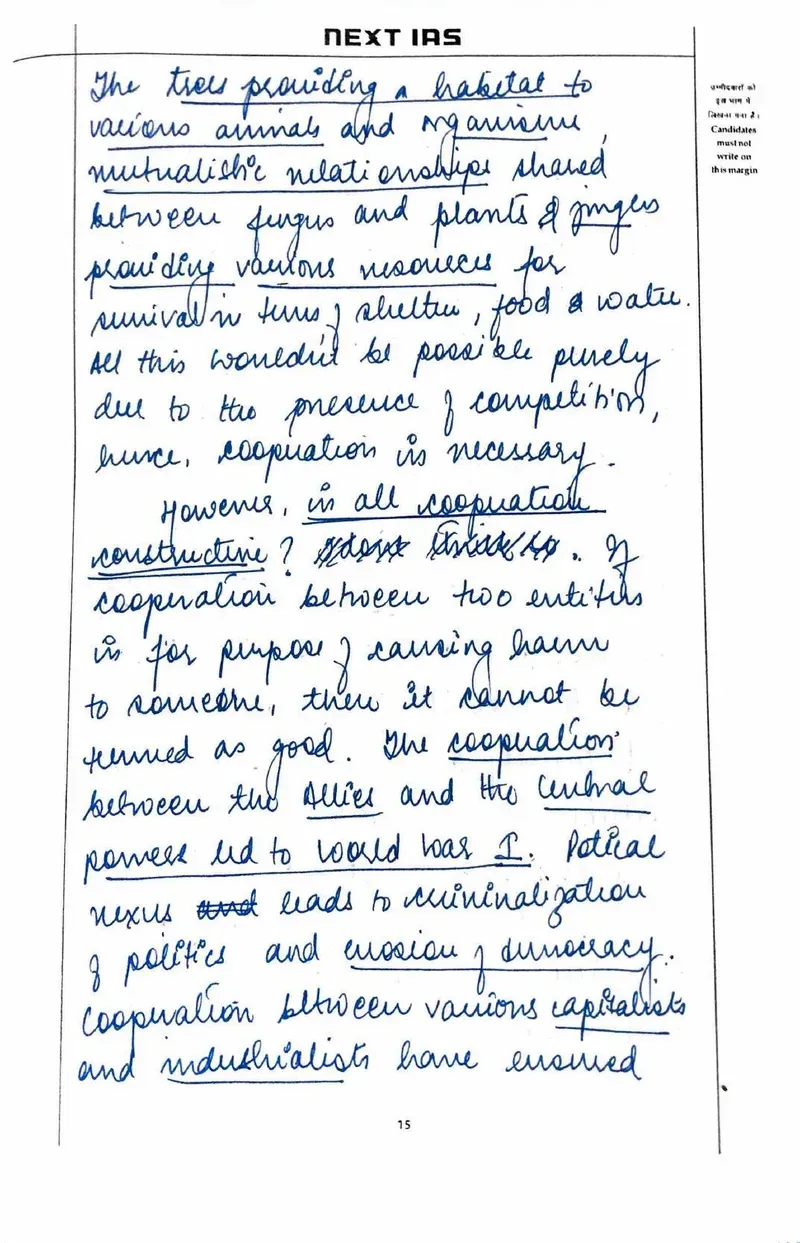
- ▸Section A runs a genuine dialectic — it argues cooperation's value, then a 'flip side' (Allied–Central powers cooperation leading to WWI/II, political nexus enabling criminalisation) before synthesising toward 'healthy competition plus cooperation'.
- ▸Section B is role-model heavy — J.K. Rowling (rejected by 12 publishers), E. Sreedharan, M.S. Dhoni, Vineeta Singh (SUGAR Cosmetics) and para-athletes — to argue attitude and sustained effort separate success from failure.
What to learn from this copy
- ★Section A doesn't just defend cooperation — it runs a real dialectic: it argues cooperation's value, then explicitly turns to a 'flip side' (Allied–Central powers cooperation that fed into WWI/WWII; the political–criminal nexus enabling criminalisation of politics) before synthesising toward 'healthy competition PLUS cooperation' rather than picking a side. -> On a 'X vs Y' essay topic, build in a counter-section that shows your favoured value can also do harm, then resolve it; the examiner sees balance and original thinking, not a one-sided sermon.
- ★She spreads evidence deliberately across disjoint domains for the same argument — history (Akbar abolishing Jaziya, the Kalinga War's '140,000 soldiers'), economy (India's 5th-largest GDP, 1991 LPG reforms, Viksit Bharat 2047) and pop culture/sport (Harry Potter, IPL, Olympics) — instead of stacking three examples from one field. -> Pull each major sub-point's illustration from a different domain; range signals breadth and stops the essay reading like a history or current-affairs answer in disguise.
- ★Section B is anchored in concrete failure-to-success arcs with the specific friction named — J.K. Rowling as a single mother who quit her job and was 'rejected by 12 publishers' before 7 novels, plus E. Sreedharan, M.S. Dhoni and Vineeta Singh (SUGAR Cosmetics) — to argue attitude and sustained effort, not luck, separate the two roads. -> When using role models, carry the specific obstacle and number (the 12 rejections), not just the famous name; the detail is what proves your thesis that success and failure share the same road.
- ★The quote bank is both attributed and topic-matched, not decorative — Robert Frost's 'I took the road less travelled… that has made all the difference' and Edison's 'I didn't fail 1000 times but I learnt 1000 ways that didn't work' land precisely on the success/failure topic, while Gandhi's 'if we aren't practicing peace & cooperation, we are nothing short of savages' anchors the competition/cooperation essay. -> Keep a small bank of quotes tied to each likely theme and deploy the one that restates your exact argument; a quote that mirrors the topic line earns its place, a generic inspirational one doesn't.
- ★She rewrites the chosen topic verbatim at the top and structures argument visually through boxed/underlined sub-headings like 'COMPETITION VS COOPERATION' and 'FAILURE & SUCCESS: TWO SIDES OF THE SAME COIN', using heavy keyword underlining to guide a fast-reading examiner through continuous prose (no diagrams used). -> In an essay where diagrams are inappropriate, create navigability with named, boxed section headings that echo the topic — the examiner can map your argument in seconds without you breaking into bullet points.
Questions attempted: Competition is the law of the jungle, but cooperation is the law of civilization; The road to success and the road to failure are almost exactly the same.
Questions attempted in this booklet (2)+
- Section A / Q.4.Competition is the law of the jungle, but cooperation is the law of civilization
- Section B / Q.6.The road to success and the road to failure are almost exactly the same
Examples, data & evidence used
- 1947 Indian Independence Act / Partition; India today the 5th-largest GDP, fastest-growing economy and 'largest democracy'
- Pakistan's post-Partition economic & political instability despite inheriting fertile lands, trade routes and waterways
- Early Vedic period framed as prosperous due to absence of varna hierarchy and derogatory practices against women
- Charles Darwin — natural selection and 'survival of the fittest' to explain competition in the jungle (prey/predator)
- Akbar — abolition of Jaziya as Hindu–Muslim cooperation that sustained a prosperous empire
- Kalinga War — death of 'more than 140,000 soldiers'
- Multilateral cooperation groupings: G20, ASEAN, BIMSTEC
- Holocaust / 'mass genocide of the Jews' cited as destructive competition
- NCRB data cited for a '24% increase in absenteeism' (attribution as written by candidate)
- Cooperation in IPL cricket and coalition governments; competition in Olympics and schools
- Gautam Buddha — the 'middle path' and moderation
- Viksit Bharat by 2047 and Atmanirbhar Bharat
- 1991 economic crisis and LPG reforms as India's turn from failure to success
- J.K. Rowling — single mother, quit her job, rejected by 12 publishers, wrote 7 Harry Potter novels that became the films
Quotes the candidate used
- 'There is no true victory in war as both the sides lose' (candidate's framing, re: Kalinga War)
- Gandhiji — 'if we aren't practicing peace & cooperation, we are nothing short of savages'
- Charles Darwin — 'survival of the fittest'
- Charles Dickens — 'It was the best of times, it was the worst of times… it was the winter of darkness, it was the summer of hope' (attributed to Dickens in Section B)
- Aristotle (Nicomachean Ethics) — 'what is good for a man?'
- 'Try, try and try again till you succeed'
- Robert Frost — 'I took the road less travelled by and that has made all the difference'
- Thomas Alva Edison — 'I didn't fail 1000 times but I learnt 1000 ways that didn't work'
How it’s written: 28-page QCA booklet, single candidate throughout (no interleaving/misassembly). Cover (p.1) confirms 'YASHVI JAIN', NextIAS Roll GSPM24A19148, Test Code TC-062, exam centre 'Online', ESSAY-Test 2, CSE 2024. p.2 marks grid and p.4/p.5 evaluator rubric tables are blank. Section A (booklet pp.7–18): essay on topic 4 'C…
Diagrams & visuals: None visible — both essays are continuous prose. No diagrams, flowcharts, maps or tables drawn; structure is conveyed only through boxed/underlined sub-headings and heavy keyword underlining.
Evaluator: No examiner marks or comments are filled in on this copy.