
Srushti Deshmukh — answer booklet 19
What’s inside this copy
- ▸Opens nearly every answer by defining the term through a named sociologist (Bierstedt for objectivity, Keith Hart for informal work, Yogendra Singh for development, Wilbert Moore for social change) before building the body
- ▸Extremely theorist-dense: a single 150-word note on objectivity marshals Bierstedt, Dilthey, Myrdal, Weber and the Oscar Lewis–Redfield Mexican-village clash, plus the Hawthorne effect and Beteille's dalit-homes fieldwork
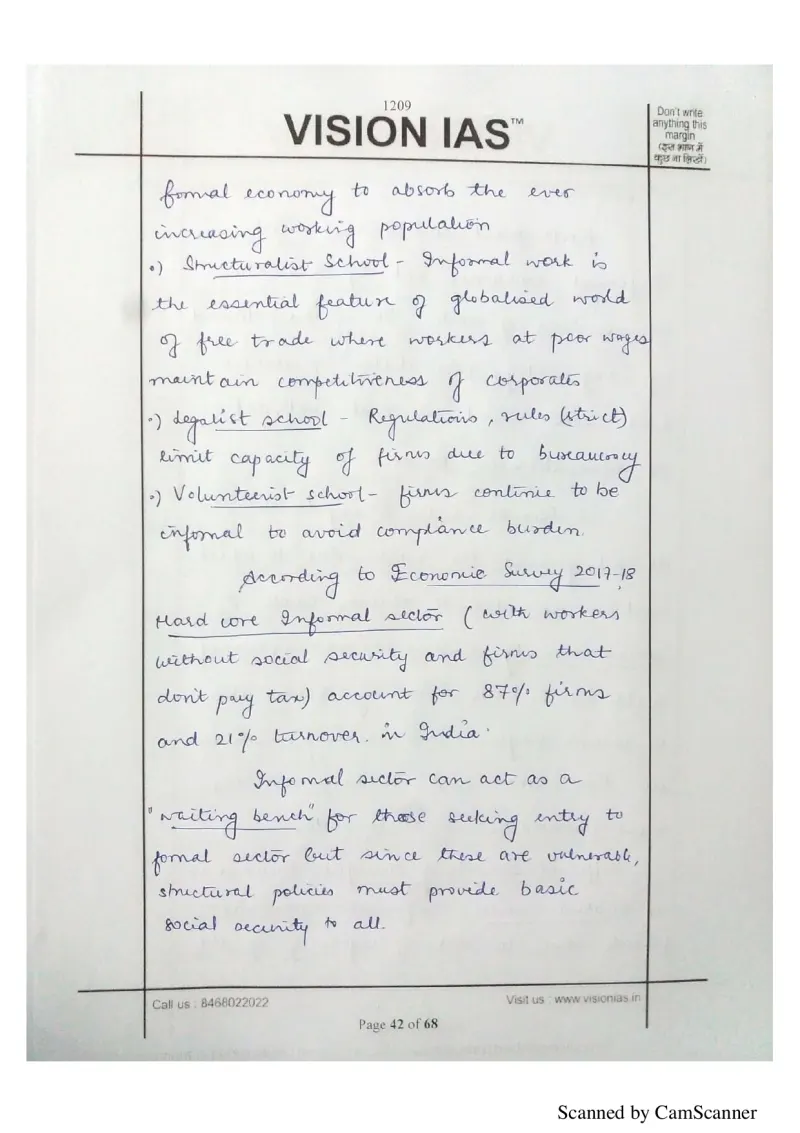
- ▸Backs arguments with hard data — Economic Survey 2017-18 (informal sector = 87% of firms, 21% of turnover) and women's land figures (55% agri-labourers, only 12.8% land owned)
- ▸Uses five hand-drawn visuals to break the prose: Gold's observation grid, a Sociology⇄Common-Sense loop, a Social-Change mind-map, Parsons' evolutionary-stages ladder, and a Core–Periphery exchange diagram
- ▸Anchors points with memorable coinages/book-titles — Giddens' 'a job for life is a thing of the past', Sennett's 'Corrosion of Character', Hochschild's 'Second Shift', Handy's 'Empty Raincoat', Venkatesh's 'Gang Leader for a Day'
- ▸Closes every answer with a synthesising 'Hence...' conclusion that takes a balanced stance (religion as one factor in a 'multi-causal' explanation; gender equality an 'elusive goal' needing male sensitisation)
What to learn from this copy
- ★Srushti opens nearly every answer by defining the term through a NAMED sociologist before building the body — Bierstedt for objectivity, Keith Hart (who literally coined 'informal sector') for informal work, Yogendra Singh for development, Wilbert Moore for social change -> Don't open with a dictionary definition; anchor the intro to the specific theorist who owns that concept, which instantly signals you're answering from the discipline, not common sense.
- ★She packs a single 150-word, 10-mark note on objectivity with Bierstedt, Dilthey, Myrdal and Weber AND two killer field illustrations — Oscar Lewis vs Robert Redfield interpreting the SAME Mexican village differently, and Andre Beteille being barred from dalit homes (plus the Hawthorne effect) -> In optional papers, density wins: convert abstract claims into named empirical clashes/studies so even a short note shows command of the literature rather than just naming '-isms'.
- ★She backs the work/gender arguments with hard, sourced data — Economic Survey 2017-18 (informal sector = 87% of firms but 21% of turnover) and women = 55% of agricultural labourers yet only 12.8% of land owned -> Carry 2-3 precise, attributed statistics per theme; a cited figure like '12.8% of land owned by women' proves 'feminization ≠ equality' far harder than an assertion.
- ★She anchors points to memorable book-titles and coinages used as compact arguments — Giddens' 'a job for life is a thing of the past', Sennett's 'Corrosion of Character', Hochschild's 'Second Shift'/double burden, Handy's 'Empty Raincoat' and 'Portfolio Workers', Venkatesh's 'Gang Leader for a Day' -> Build a stock of evocative, attributable phrases; one well-placed coinage like 'Second Shift' does the work of a paragraph and reads as scholarship, not jargon.
- ★She uses hand-drawn visuals tailored to each question's logic, not decoration — Raymond Gold's 2x2 participant-observation grid for Q1(e), a Sociology⇄Common-Sense loop with four named arrows for Q4(c), Parsons' Primitive→Archaic→Historical→Seed Bed→Modern stage-ladder for Q8(a), and a Core–Semi-Periphery–Periphery exchange diagram with 'High Consumption Goods' out / 'Cheap Labour & Raw Materials' back for Q8(c) -> Match the diagram form to the content (typology=2x2, relationship=loop, evolution=ladder, exchange=flow) so the visual encodes the actual argument.
- ★She closes every answer with a synthesising 'Hence...' line that takes a balanced, qualified stance — religion as just ONE factor in a 'multi-causal' explanation of change, gender equality as an 'elusive goal' needing male sensitisation -> End with a deliberate verdict that resolves the debate rather than trailing off; the qualified-balance conclusion is what converts a listed answer into an evaluated one.
Questions attempted: "Emergence of sociology was not merely a coincidence" — Comment (short note, 10); Post-modernity in sociology (short note, 10); Objectivity as a sociological goal (short note, 10), and 16 more below.
Questions attempted in this booklet (19)+
- 1(a)."Emergence of sociology was not merely a coincidence" — Comment (short note, 10)
- 1(b).Post-modernity in sociology (short note, 10)
- 1(c).Objectivity as a sociological goal (short note, 10)
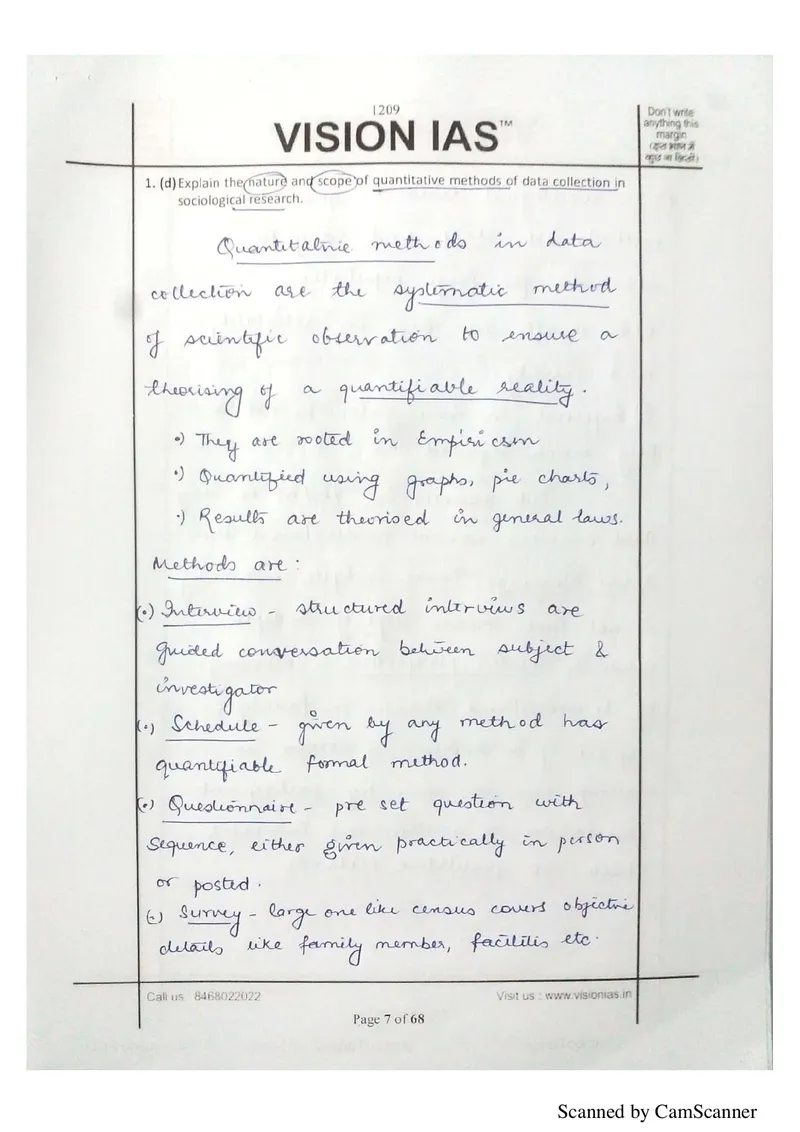
- 1(d).Nature and scope of quantitative methods of data collection (short note, 10)
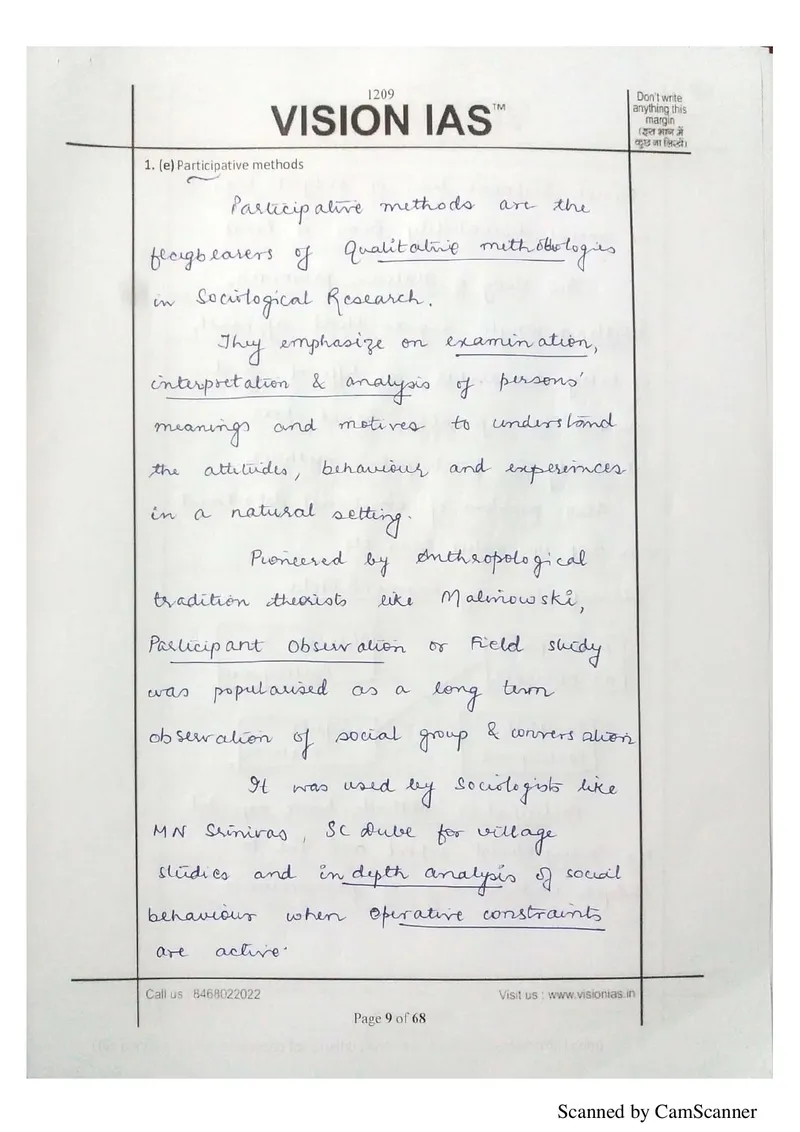
- 1(e).Participative methods (short note, 10)
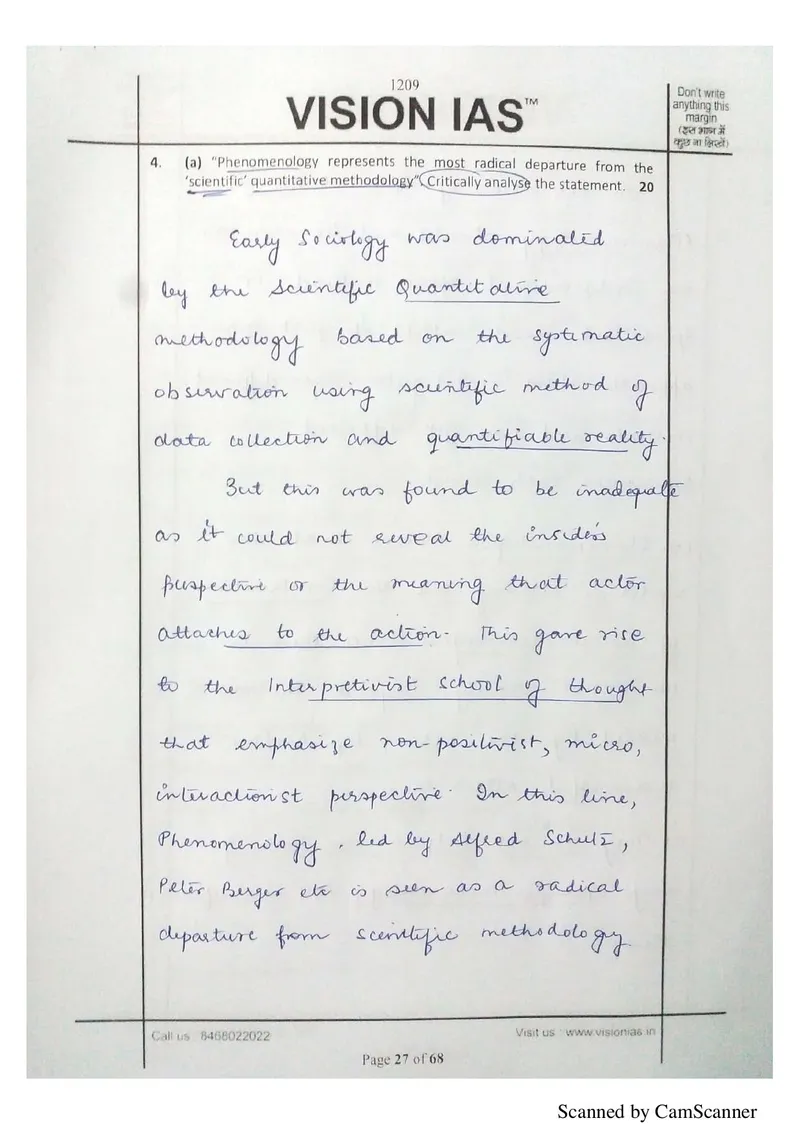
- 4(a)."Phenomenology represents the most radical departure from the scientific quantitative methodology" — critically analyse (20)
- 4(b).Methodological pluralism / ways multi-strategy research can be used (20)
- 4(c)."Sociology and common sense share a complimentary relationship" — Comment (10)
- 5(a).Work in feudal societies (short note, 10)
- 5(b).Critically assess the 'cultural lag' theory of social change (short note, 10)
- 5(c).Correlation between Residency and Lines of Descent (short note, 10)
- 5(d).Informal organization of work (short note, 10)
- 5(e).Social change and development (short note, 10)
- 7(a).Social organization of work, how it is changing in contemporary society, implications (20)
- 7(b).Feminization of work and why it does not mean gender equality is achieved (20)
- 7(c).Evaluate Max Weber's 'theory of religion' as a factor of social change (10)
- 8(a).Is social change evolutionary or revolutionary? — Marxian and Parsonian ideas (20)
- 8(b)."Technology is the key to understanding social change today" — critically analyse (20)
- 8(c).Critically examine 'dependency theory' of underdevelopment (10)
Examples, data & evidence used
- Founders/positivism: Comte (Theological-Metaphysical-Positivist; rise of sociology after French Revolution), Durkheim, Herbert Spencer (Social Darwinism), L.H. Morgan
- Methodology thinkers: Robert Bierstedt (definition of objectivity), William Dilthey, Gunnar Myrdal (value-laden inquiry), Max Weber (Verstehen, Ideal types, no objective science of society), Oscar Lewis & Robert Redfield (same Mexican village, different interpretations), Andre Beteille (not allowed to visit dalit homes), Hawthorne effect, response/social-desirability bias
- Qualitative/field: Malinowski, M.N. Srinivas, S.C. Dube (village studies), William Whyte (study of Italian prisoners), Raymond Gold (typology of participant observation), Sudhir Venkatesh ('Gang Leader for a Day')
- Post-modernism/phenomenology: Anthony Giddens (Structuration), Alan Bryman (purposive sociology), Alfred Schutz, Peter Berger, Gabriel Farina (quote attribution — spelling uncertain), Ray Pawson (qual-quant divide a "60's hangover")
- Social change/work: W.F. Ogburn & Nimkoff (cultural lag), Wilbert Moore (definition of social change), Dipankar Gupta ('Mistaken Modernity'), Kathleen Gough (Nayar community — matrilineal/matrilocal), Keith Hart (coined 'informal' sector), Yogendra Singh (development as planned change), Charles Handy ('The Empty Raincoat', Portfolio Workers), Andre Gorz ('non class of non workers'), Richard Sennett ('Corrosion of Character'), Arlie Hochschild ('Second Shift'/double burden)
- Theory of social change: Talcott Parsons (Evolutionary Universals; structural differentiation; stages Primitive→Archaic→Historical→Seed Bed→Modern with examples Australian Aborigines, Mesopotamian/Egyptian, Indian/Chinese, Greece/Israel, American society), Pitirim Sorokin (cyclical/cultural mentality), Karl Marx ('class in itself' to 'class for itself', false consciousness, bourgeoisation/proletarianisation/pauperisation)
- Technology & development: Weber's 'Protestant Ethic and the Spirit of Capitalism' (Calvinism, this-worldly asceticism, predestination), Robert Blauner (technology drives alienation), Frank Hull et al (spelling uncertain), George Ritzer (McDonaldisation), Andre Gunder Frank (dependency; underdevelopment vs undevelopment), Amartya Sen, Emmanuel Wallerstein (World System theory), Rudolph & Rudolph ('Bullock Capitalists')
- Indian/contemporary examples & schemes: Green Revolution (hybrid seeds, biotech, pesticides), DBT/e-transfer of wages-scholarships-subsidy curbing leakages & rent-seeking, SECC/Census survey, Khap dictum banning girls' phone use, honour killings, inter-caste marriage, feminisation of agriculture, BPOs/software MNCs, telemedicine/tele-education
- Data points: Economic Survey 2017-18 — hard-core informal sector = 87% of firms and 21% of turnover in India; women = 55% of agricultural labourers, only 28% own cultivators, only 12.8% of land owned by women
- Concepts coined/used: 'Pink collarisation', occupational segregation, ancillarisation, Core–Semi-Periphery–Periphery, neocolonial device, multi-causal explanation; no court cases or constitutional articles cited (it is an optional paper)
Quotes the candidate used
- "A job for life is a thing of the past" — attributed to Anthony Giddens
- "non class of non workers" — attributed to Andre Gorz
- White-collar workers experience "alienation" in office cubicles and "prostitution of personality" — attributed to Peter Berger
- "Corrosion of Character" — Richard Sennett (concept/book used to sum up changing work)
- "Second Shift" / 'double burden' — Arlie Hochschild
- "The Empty Raincoat" and 'Portfolio Workers' — Charles Handy
- "Gang Leader for a Day" — Sudhir Venkatesh (participant-observation study)
- "Mistaken Modernity" — Dipankar Gupta
How it’s written: Intro: short contextual/definitional opener, usually pinned to a named thinker, then a clear thesis line. Body: organised into dot/bullet points (small 'o' markers) and occasional all-caps sub-headings (e.g., 'OBJECTIVITY is unachievable' vs 'OBJECTIVITY not desirable'; informal-work 'schools' — Dualist/Structuralis…
Diagrams & visuals: Raymond Gold's 2x2 typology of participant observation drawn as four labelled boxes with crossing lines (Participant-as-Observer, Observer-as-Participant, Complete Participant, Complete Observer) — Q1(e); Cyclical/loop diagram of Sociology ⇄ Common Sense with four labelled arrows: 'Corrects Stereotypes', 'Enriches Vocab', 'Challenges Conclusion', 'Provides Raw Ideas' — Q4(c); Spider/mind-map of 'Social Change' branching into Evolutionary (Comte, Morgan, Parsons-Evolutionary Universals), Cultural (Sorokin-cyclical), Revolutionary (Marx) — Q8(a); Vertical ladder/flow diagram of Parsons' evolutionary stages: Primitive → Archaic → Historical → Seed Bed → Modern, each with an example society — Q8(a); Core – Semi-Periphery – Periphery exchange diagram with arrows 'High Consumption Goods' (out) and 'Cheap Labour and Raw Materials' (back) — Q8(c) dependency theory
Evaluator: No examiner marks or comments are filled in on this copy.