
Ravish Mittal — DrishtiIAS Essay copy
What’s inside this copy
- ▸Two-essay Essay booklet (Section A + Section B), cover confirms Ravish Mittal, English medium, Karol Bagh, Drishti Mentorship Mains-2023, dated 28/08/23 — pages are internally consistent, no misassembly detected
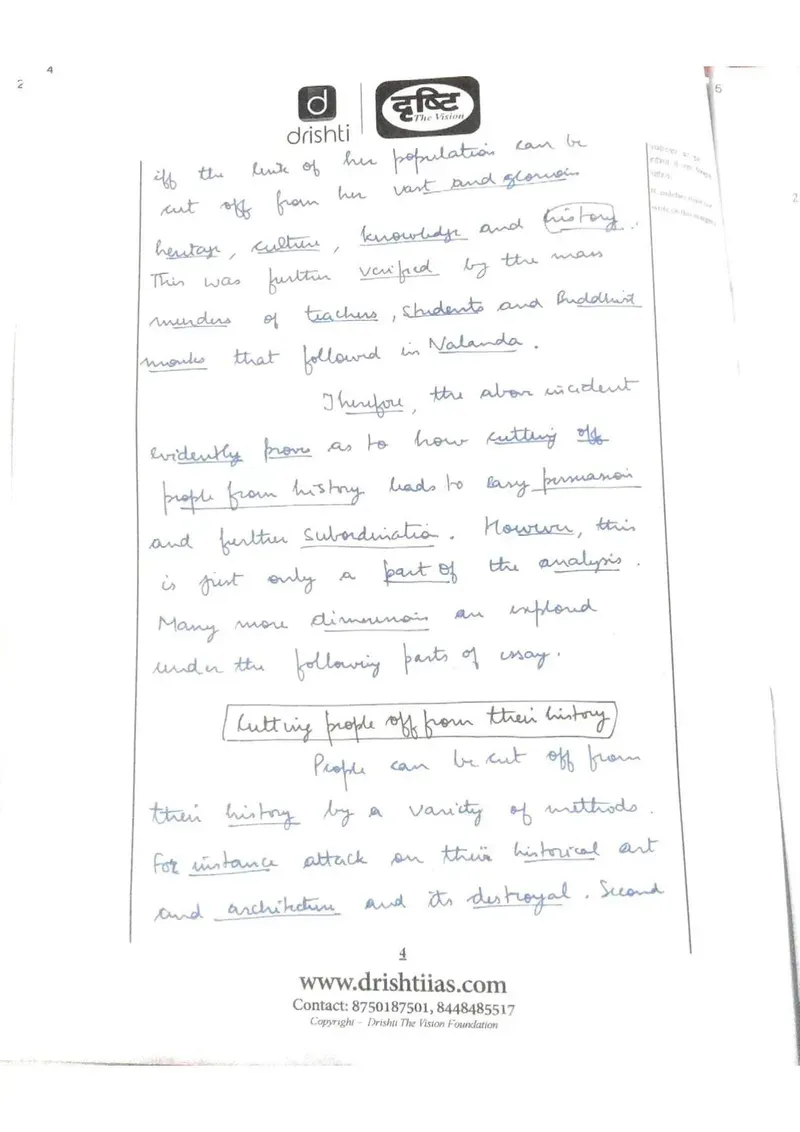
- ▸Section A opens strong with a vivid Bakhtyar Khalji / Nalanda destruction anecdote framing the whole 'history as a tool of subjugation' thesis
- ▸Examples are deeply India-rooted: British education policy, caste-based knowledge denial, Max Mueller's Aryan Invasion Theory, the Panipat/Babur textbook framing, and the decline of craftsmen
- ▸Both essays deliberately build an 'other side of the coin' counter-section before concluding, showing balanced, non-one-sided argumentation
- ▸Section B structures the climate case as a descending ladder — international (Paris/Kyoto pull-outs) -> national -> society -> family/individual
- ▸Memorable framing devices throughout: the sparrow-and-farmer parable, the 'Abracadabra' magic-wand metaphor, and a Marx 'tragedy then farce' quotation
What to learn from this copy
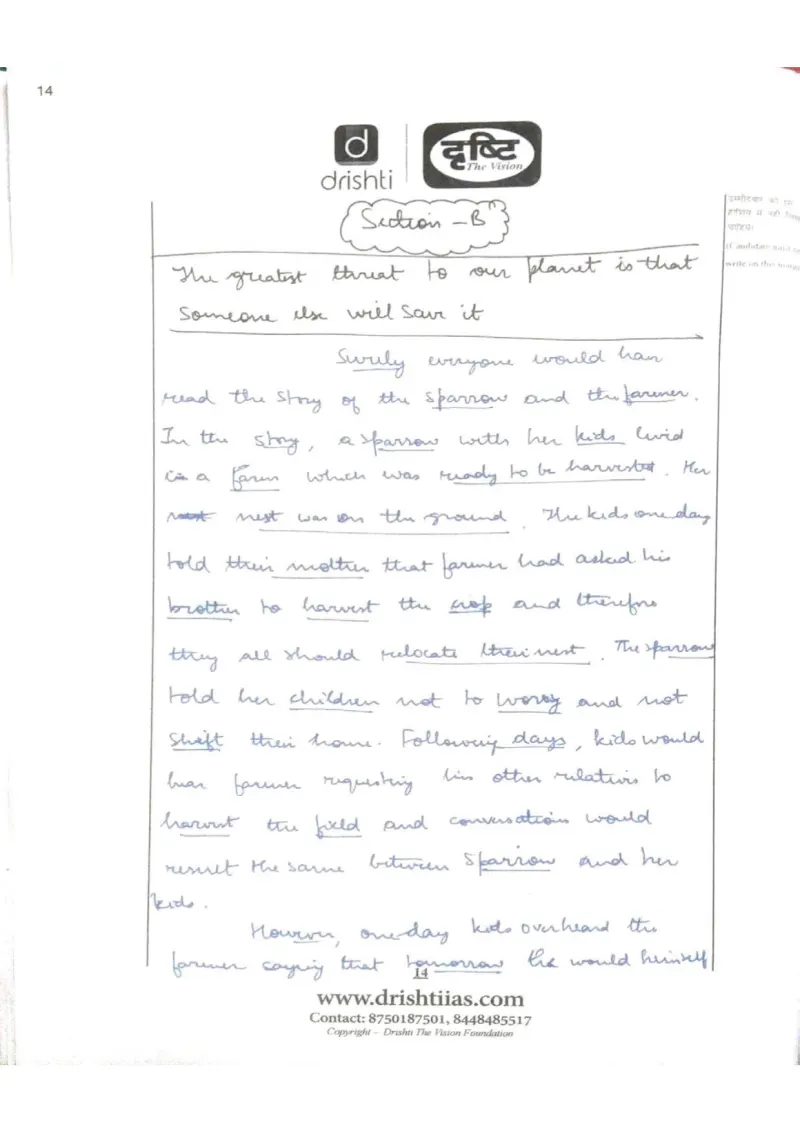
- ★Both essays open on a concrete narrative hook instead of a definition — Section A starts with the Bakhtyar Khalji / Nalanda destruction anecdote (and the live debate over whether he mistook it for a garrison or deliberately targeted Indian culture), and Section B opens with the sparrow-and-farmer parable -> open an abstract prompt with a specific story or image that already embodies your thesis, so the reader meets the argument as a scene, not a textbook line.
- ★Section A proves 'history as a tool of subjugation' through a dense chain of India-rooted, multi-domain evidence — British education policy, caste-based denial of knowledge (tied to the rebirth/karma persuasion), Max Mueller's Aryan Invasion Theory, the 'red carpet laid to invite Babur' textbook framing of Panipat, and the engineered decline of craftsmen -> stack varied, civilisation-specific examples across education, religion, economy and historiography rather than repeating one type, so a single claim is shown operating at many levels.
- ★Section B organises the climate argument as a descending ladder — international (USA/Russia/Canada missing Kyoto, Paris pull-outs) down to national, then society, then family/individual (plastic dumping, wasting fuel to show off vehicles) -> give a sprawling theme like environmental inaction a clear scalar spine so every paragraph has an obvious place and the essay reads as deliberately structured, not a list of points.
- ★Each essay builds an explicit 'other side of the coin' counter-section before the conclusion — and Section B even widens the lens to non-human threats (WMDs, volcanoes, meteor showers, solar storms, tsunamis) before returning to human inaction -> dedicate a named section to the opposing view so the final position reads as a reasoned judgement rather than a one-sided assertion.
- ★Memorable framing devices carry the argument — the 'Abracadabra' magic-wand metaphor to mock the fantasy that someone else will fix the climate, and a Marx 'history repeats itself, first as tragedy, then as a farce' quotation deployed to make a point -> use one or two sharp metaphors/quotations as load-bearing devices that compress the thesis, not as decoration.
Questions attempted: "If you can cut people off from their history, then they can easily be persuaded." — essay on how severing people/societies/nations from their history enables persuasion and subjugation; "The greatest threat to our planet is that someone else will save it." — essay on environmental inaction and the danger of expecting someone else to save the Earth.
Questions attempted in this booklet (2)+
- Section A."If you can cut people off from their history, then they can easily be persuaded." — essay on how severing people/societies/nations from their history enables persuasion and subjugation
- Section B."The greatest threat to our planet is that someone else will save it." — essay on environmental inaction and the danger of expecting someone else to save the Earth
Examples, data & evidence used
- Bakhtyar Khalji (commander under Muhammad Ghori) destroying Nalanda University on his march to conquer Bengal; the debate over whether he mistook it for a military garrison vs. a deliberate plan to subdue Indian culture (also names Vikramshila)
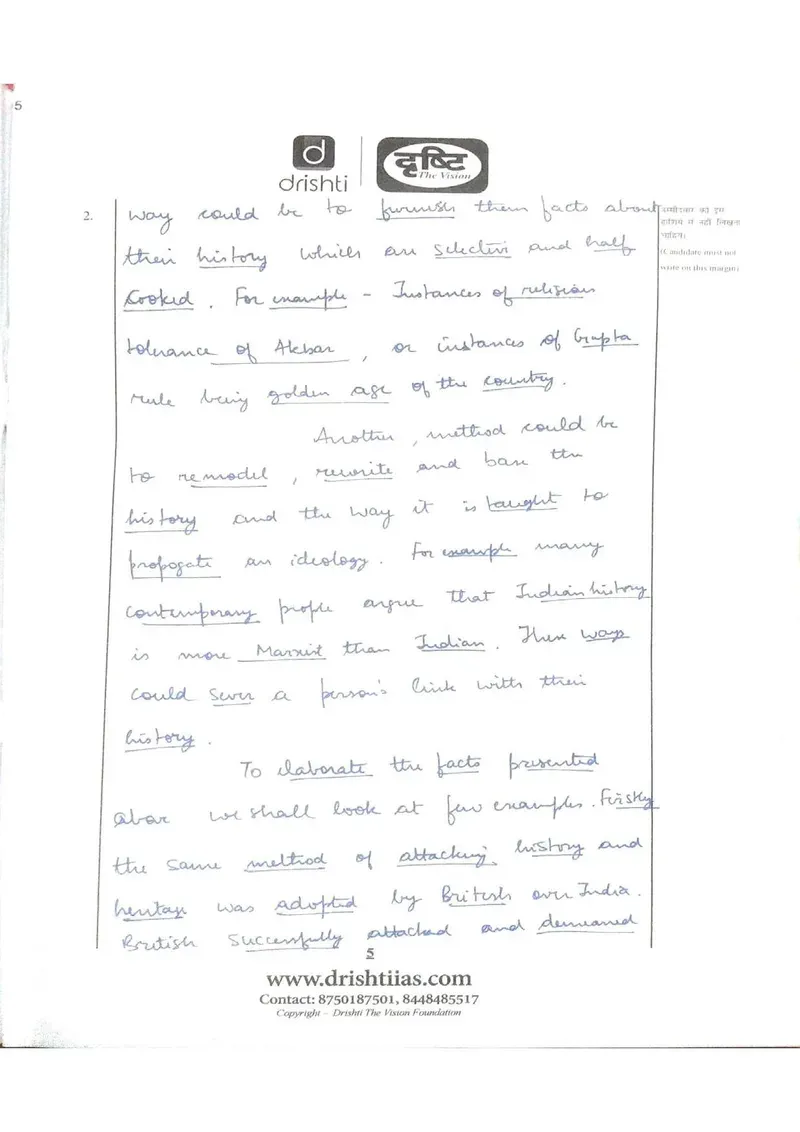
- British attacking India's history, education tradition and indigenous methods of life, then enforcing British education and sciences
- Caste system: upper castes keeping lower castes away from their history and knowledge to subordinate them (with the rebirth/karma persuasion to keep them serving)
- Max Mueller's Aryan Invasion Theory as a misinterpretation that led Indians to believe Aryans were outsiders
- British severing Indian craftsmen/artisans from their craft via biased policies, persuading people that machine-made goods were better
- School textbook framing of the 1st Battle of Panipat / Babur — portraying Indian rulers as weaker ("red carpet laid to invite Babur") while omitting that many Indian rulers defeated and resisted him
- "White Man's Burden" / European supremacy / Indian way of life as barbaric and backward as ideas easily sold once history was cut off
- Selective half-facts: tolerance of Akbar and Gupta rule as a golden age; claim that Indian history is taught as "more Marxist than Indian"
- The sparrow and the farmer parable (Section B intro) on self-reliance vs. depending on others
- USA, Russia, Canada failing Kyoto targets / pulling out of the Paris Agreement (international-level inaction)
- Developed vs Developing dichotomy at national level; modern society wasting resources vs traditional society's co-existence with nature; family/individual-level plastic dumping and wasting fuel to show off vehicles
- Other (non-human) planetary threats: weapons of mass destruction, volcanic eruptions, earthquakes, meteor showers, solar storms, tsunami, nuclear bomb, pollution
- "Abracadabra" / magic-wand metaphor to dismiss the fantasy that someone else will fix the climate
Quotes the candidate used
- "If you can cut people off from their history, then they can easily be persuaded." — Section-A essay prompt; no author attributed in the copy
- "History repeats itself, first as tragedy, then as a farce." — attributed to Marx in the copy
- "The greatest threat to our planet is that someone else will save it." — Section-B essay prompt; author not visible in the copy
How it’s written: Both essays follow a disciplined, mirror-image structure: a hook introduction (a historical anecdote for A, a parable for B), a multi-part thesis body with explicit sub-headings, a dedicated counter-argument section, and a synthesising conclusion. Section A: intro (Khalji/Nalanda) -> "Cutting people off from their h…
Evaluator: No examiner marks or comments are filled in on this copy.