Loading...
FREE CONTENTVIDEOSFILES
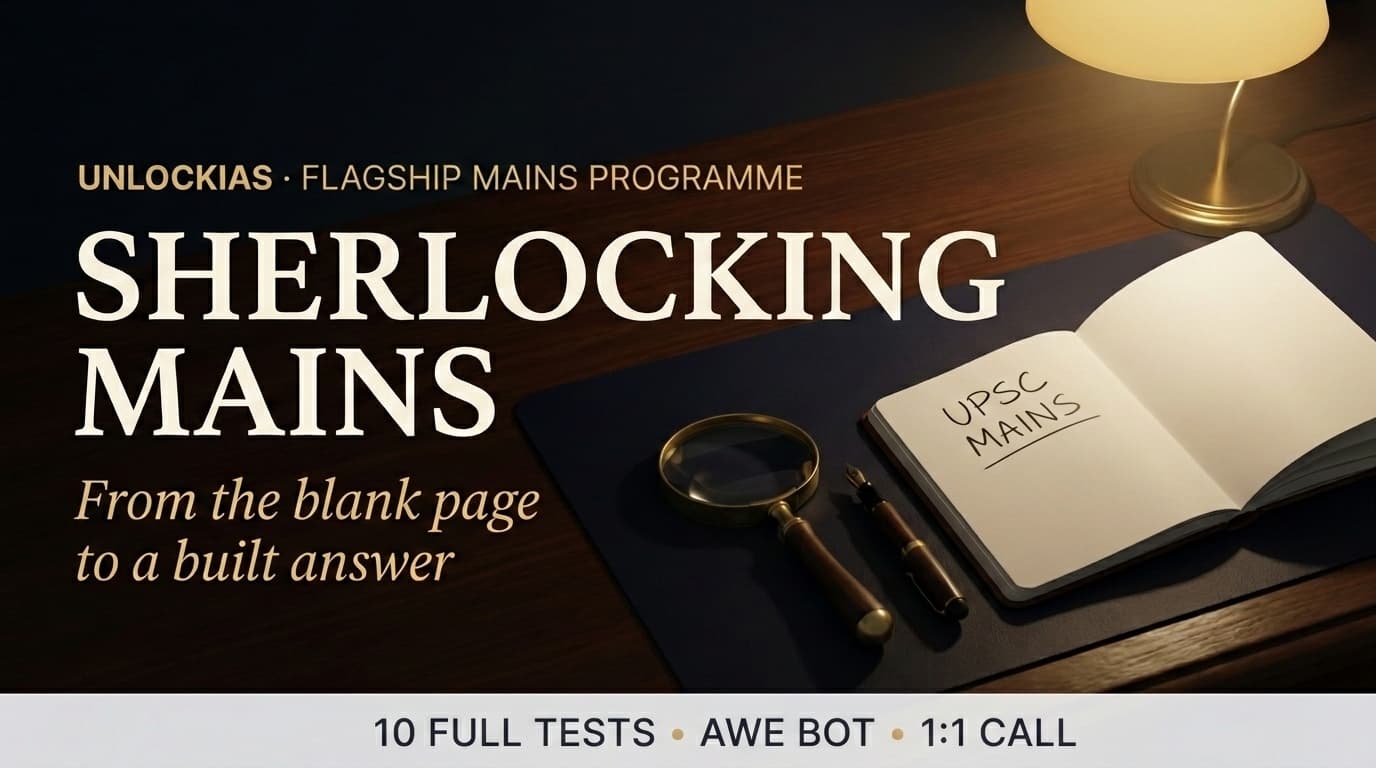
Sherlocking Mains Comprehensive Module
From the blank page to a built answer
by UnlockIAS3,377+ students across all courses9 Courses
Popular
1 Year
100+ Materials
81 Videos
49 Files
You Pay
₹24,999₹57,997
56% OFF — Save ₹32,998Course Price₹57,997
Platform Fee₹10
Discount-₹32,998
Total₹24,999
You'll be redirected to the UnlockIAS app for payment
81
Videos · 75+ hrs
158
DAW Questions
4
DAW Essays
10
Full-length Tests
16
SPARK Labs
20
Doubt-cum-Mindset
5,000
Marks You Write
1:1
Call With Neil Sir
About this course
The UnlockIAS Flagship Mains Programme — one complete system that takes you from the blank page to a built answer. Mains decides your rank, and it is the one thing no one trains you for: knowing your syllabus is not the same as scoring on it, and the bridge is a built answer. This module works on your answers every single day until building one is a reflex you trust under pressure. It runs on the Sherlocking SPARK method across GS1–GS4 and the Essay — Decode the question with 81 videos and 13 years of decoded PYQs, Drill it through 158 daily-answer-writing questions and 4 essays, and Deploy it across 10 full-length tests — with every answer scored by the in-house AWE engine and Neil Sir live the whole way through SPARK Labs, Doubt-cum-Mindset sessions and a personal 1-to-1 call.
Built and taught by Neil Sir — HCS 2021, Rank 93.
How it works
One plan, decode to deploy. Five parts, one system, each feeding the next: Decode tells you what to write, Drill builds the reflex on the questions you decoded, Deploy proves it under the clock, and the AWE engine runs under all of it so tomorrow’s answer beats today’s.
Decode
See the answer inside the question
Drill
Write it daily, get it corrected
Deploy
Prove it under the clock
The SPARK method
One method, learned once and used on every question the exam can set.
S
Sherlock the question
P
Probe the dimensions
A
Arrange the structure
R
Reason the argument
K
Kickstart the pen
What's included
- Sherlocking GS1–4 video course — 81 videos, 75+ hours, every PYQ from 2013–2025 decoded against the syllabus
- Daily Answer Writing — 158 GS questions + 4 full Essays = 2,500 marks of guided writing, on an 8-week day-by-day timetable
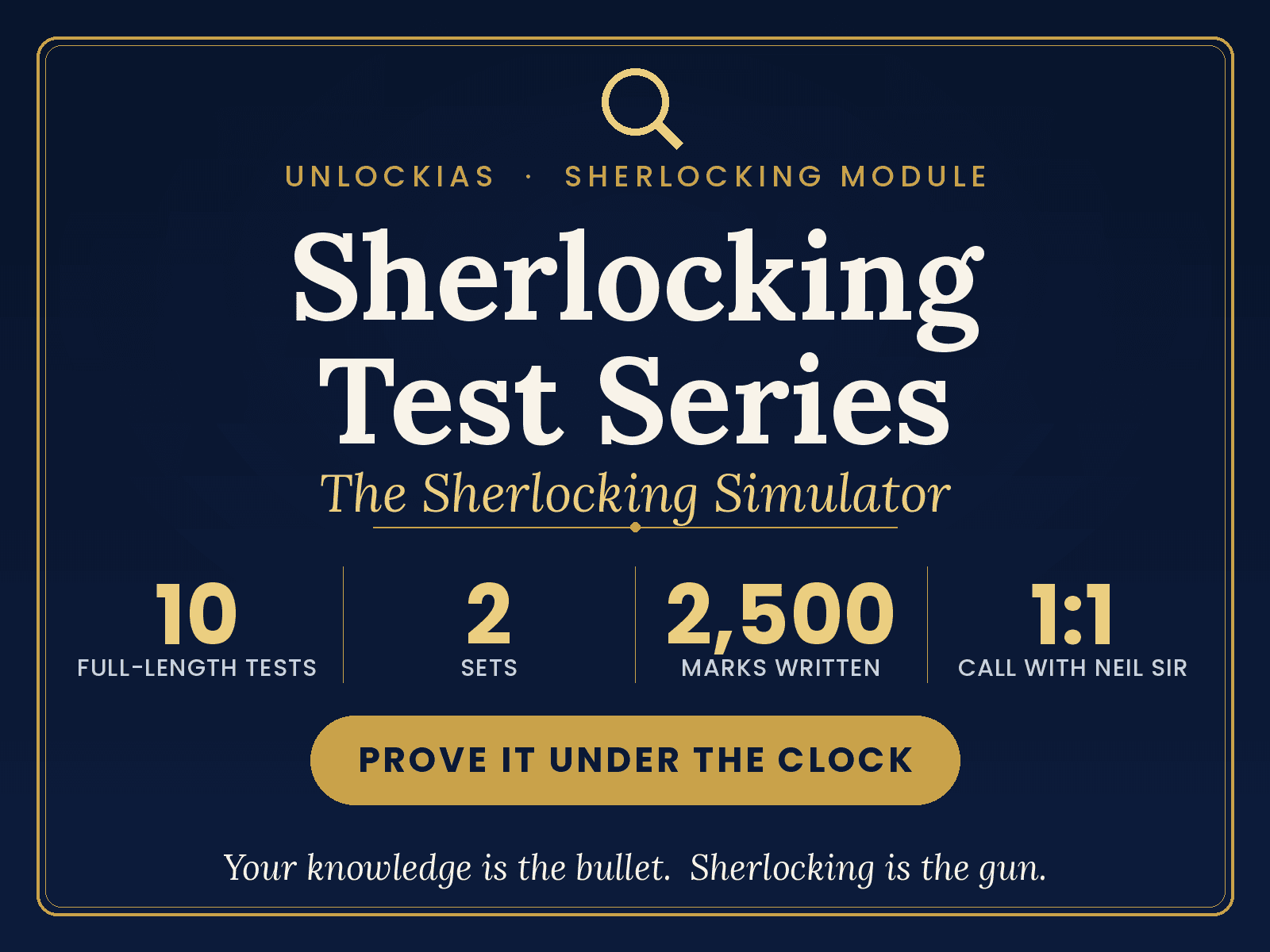
- Sherlocking Test Series — 10 full-length, fully-timed tests in 2 sets, with deployable model answers and weak-subject diagnostics
- The UnlockIAS AWE engine — every answer returned dimension by dimension, with the value-add it was missing
- 16 SPARK Labs + 20 Doubt-cum-Mindset sessions live with Neil Sir
- A personal 1-to-1 call with Neil Sir
Decode — the GS1–4 video course
81 videos · 75+ hours · GS1 to GS4 + Essay
- Art of Answer Writing masters (3): how a 10-marker and a 15-marker are really built
- Neil Sir’s own handwritten answers to the 2021–25 papers (1), and how to mine them for structure and content
- Syllabus Parsing (14): the syllabus turned into a cheatsheet — what to read and the angle to read it for
- PYQ Mapping (22): 13 years of papers (2013–2025) parsed against the syllabus, the exact fodder to keep, and how much you can stop studying
- Endgame walkthroughs 2021–23 (12, handwritten): whole recent papers solved question by question
- GS-wise PYQ + Endgame 2024–25 (4, handwritten): the latest two years, paper by paper
- Studying Ethics + Case Study Analysis (5): the distinct way GS4 must be read, where every keyword is a hint
- Analysing a Successful Aspirant’s Script (14): real topper copies taken apart, the formula to decode any copy
Drill — Daily Answer Writing (DAW)
158 GS questions + 4 Essays · 2,500 marks · 8 weeks
- One fresh question every working day — a real past-year theme twisted just enough that recall fails and reason has to work
- The QCAB (question-cum-answer booklet): write in the real space and format of the hall, not on loose sheets
- The Sherlocking Answer Blueprint: the build that walks you through the question cracked open, dimensions probed, structure arranged and argument reasoned — you learn the move, not the output
- Every answer stopped one step short, the final cut left to you — so the method wires itself into memory as a reflex
- Balanced to a full 500 marks of writing per GS paper, with 4 essays adding 500 more
Deploy — the Sherlocking Test Series
10 full-length tests · 2 sets · 2,500 marks
- Ten full-length, fully-timed papers on the real exam pattern — learn which question to attempt first and when to move on
- Set 1: Essay and GS1–GS4 as single papers, spaced out, each followed by weak-subject diagnostics
- Set 2: the same five in the real Mains shape — Essay on Day 1, GS1+GS2 on Day 2, GS3+GS4 on Day 3 — the full dress rehearsal
- A deployable model answer for every test, written to the limits and ready to use as-is
- Set on the themes most likely to be asked, so you get ancillary insight plus a fair share of direct hits
Live with Neil Sir
SPARK Labs · Doubt-cum-Mindset · 1-to-1
- 16 SPARK Labs — live brainstorming on the very DAW questions you write
- 20 Doubt-cum-Mindset sessions to keep doubts cleared and nerve intact
- A personal 1-to-1 call with Neil Sir, yours to use at the moment it helps most
The curriculum
Foundations (4)
- Art of Answer Writing, Master 11h 5min
- Art of Answer Writing, Master 246min
- Art of Answer Writing, Master 328min
- How to use the 2021–25 Answers (handwritten)6min
Syllabus Parsing (14)
- GS1 Art and Culture56min
- GS1 Modern + Post-Independence53min
- GS1 World History23min
- GS1 Society1h 10min
- GS1 Geography50min
- GS1/3 Disaster Management24min
- GS1/3 Geography + Environment36min
- GS2 Polity49min
- GS2 International Relations43min
- GS2 Social Justice47min
- GS3 Economy1h 11min
- GS3 Science and Technology27min
- GS3 Internal Security47min
- GS4 Ethics, Master1h 6min
PYQ Mapping (22)
- GS1 Art and Culture53min
- GS1 Modern Indian History1h 33min
- GS1 Post-Independence History34min
- GS1 World History44min
- GS1 Society2h 12min
- GS1 Geography 1/346min
- GS1 Geography 2/346min
- GS1 Geography 3/335min
- GS2 Polity3h 2min
- GS2 Social Justice2h 36min
- GS2 International Relations1h 26min
- GS3 Economy3h 1min
- GS3 Environment44min
- GS3 Disaster Management31min
- GS3 Science and Technology1h 1min
- GS3 Internal Security1h 24min
- Ethics Basics19min
- Ethics Values1h 28min
- Ethics Attitude27min
- Ethics Emotional Intelligence30min
- Ethics Applied58min
- Ethics Probity31min
Studying Ethics + Case Studies (5)
- Studying Ethics, Master59min
- Case Study Analysis 2013–20161h 38min
- Case Study Analysis 2017–20201h 53min
- Case Study Analysis 2021–20231h 53min
- Answer Writing for Ethics (Supplementary)43min
Sherlocking Essay masterclass (6)
- Essay Video 131min
- Essay Video 237min
- Essay Video 338min
- Essay Video 425min
- Essay Video 535min
- Essay Video 639min
Endgame walkthroughs & topper scripts (30)
Whole recent papers solved end to end (handwritten), plus real topper copies taken apart.
- Endgame walkthroughs 2021–23 — GS1 to GS4, handwritten12 videos
- GS-wise PYQ + Endgame 2024–25 — GS1 to GS4, handwritten4 videos
- Analysing a Successful Aspirant’s Script — GS1 to GS414 videos
The 8-week writing plan
A real question every working day, mapped to the week it is written, with difficulty and load building through each week — 158 GS questions and 4 essays, balanced to a full 500 marks of writing per GS paper.
| Week | Focus | Questions | Marks |
|---|---|---|---|
| Week 1 | Polity (GS2) | 18 GS + 1 Essay | 350 |
| Week 2 | History and Art & Culture (GS1) | 14 GS + 1 Essay | 300 |
| Week 3 | Geography, Environment & Disaster Mgmt (GS1, GS3) | 22 GS | 275 |
| Week 4 | Economy, Agriculture & Science-Tech (GS3) | 24 GS | 300 |
| Week 5 | Ethics theory (GS4) | 16 GS + 1 Essay | 285 |
| Week 6 | Ethics theory & Case Studies (GS4) | 22 GS | 340 |
| Week 7 | International Relations & Internal Security (GS2, GS3) | 17 GS + 1 Essay | 340 |
| Week 8 | Society, Governance & Social Justice (GS1, GS2) | 25 GS | 310 |
The test schedule
Ten full-length, fully-timed papers in two sets — five spaced single papers with weak-subject diagnostics, then five in the real Mains shape as a full dress rehearsal.
| # | Test | Set | Format |
|---|---|---|---|
| 1 | Essay | Set 1 | Single full-length paper |
| 2 | GS1 | Set 1 | Single full-length paper |
| 3 | GS2 | Set 1 | Single full-length paper |
| 4 | GS3 | Set 1 | Single full-length paper |
| 5 | GS4 | Set 1 | Single full-length paper, then weak-subject diagnostics |
| 6 | Essay | Set 2 | Real Mains format, Day 1 |
| 7 | GS1 | Set 2 | Real Mains format, Day 2 morning |
| 8 | GS2 | Set 2 | Real Mains format, Day 2 afternoon |
| 9 | GS3 | Set 2 | Real Mains format, Day 3 morning |
| 10 | GS4 | Set 2 | Real Mains format, Day 3 afternoon |
Evaluation
The UnlockIAS AWE engine
Answer Writing Evaluation, built in-house on how Neil Sir grades to the UPSC rubric. It does far more than score: every answer you write — in DAW and in the tests — comes back in minutes with exactly where the marks leaked, dimension by dimension, plus the value-add it was missing — the fodder, the examples and the qualified content that turn a flat answer into a topper’s.
Who it's for
- Aspirants who have done the reading but freeze at the blank sheet — knowledge that has not yet become marks on paper
- Serious candidates chasing a rank: Prelims opens the door, Mains decides who walks out with one
- Anyone who wants daily answer-writing with real evaluation, not just a library of videos to watch
- Both pacings: go Mains-first and finish the cycle by December, or run it alongside Prelims prep and again after Prelims
Frequently asked questions
What is the Sherlocking Mains Comprehensive Module?
It is the UnlockIAS Flagship Mains Programme — one complete system for UPSC Civil Services Mains covering GS1 to GS4 and the Essay. It combines an 81-video course (75+ hours) that decodes 13 years of past papers, a Daily Answer Writing module of 158 GS questions and 4 essays, a 10-paper full-length test series, the in-house AWE evaluation engine, and live mentorship from Neil Sir. The goal is to take you from a blank page to a built answer you can write under exam pressure.
What is the Sherlocking SPARK method?
SPARK is the single method taught throughout the programme, learned once and used on every question the exam can set. It stands for Sherlock the question, Probe the dimensions, Arrange the structure, Reason the argument, and Kickstart the pen. Around it the course runs a Decode → Drill → Deploy cycle: decode the answer hidden in the question, drill it daily, and deploy it under the clock.
How many videos and hours of content are included?
The video course has 81 videos totalling more than 75 hours. It spans Art of Answer Writing masters, Syllabus Parsing (14), PYQ Mapping (22), Endgame walkthroughs, GS-wise PYQ and Endgame for 2024–25, Studying Ethics and Case Studies, a 6-part Essay masterclass, and a 14-part Analysing a Successful Aspirant’s Script series — every paper from 2013 to 2025 parsed against the syllabus.
What is Daily Answer Writing (DAW) and how is it structured?
DAW is the daily practice engine: 158 GS questions and 4 essays — 2,500 marks of writing — mapped to an 8-week, day-by-day timetable that builds difficulty and load each week. Each question comes with a question-cum-answer booklet (QCAB) and a Sherlocking Answer Blueprint, and every answer is returned by the AWE engine. The cycle is balanced to a full 500 marks of writing per GS paper.
What is the UnlockIAS AWE engine?
AWE (Answer Writing Evaluation) is a proprietary engine built in-house on how Neil Sir grades to the UPSC rubric. Every answer you write — in DAW and in the tests — comes back in minutes showing exactly where the marks leaked, dimension by dimension, plus the value-add it was missing: the fodder, examples and qualified content that turn a flat answer into a topper’s.
How many full-length tests are there?
Ten full-length, fully-timed tests in two sets. Set 1 runs Essay and GS1–GS4 as five spaced single papers, each followed by weak-subject diagnostics. Set 2 repeats the five in the real Mains shape — Essay on Day 1, GS1 and GS2 on Day 2, GS3 and GS4 on Day 3 — as a full dress rehearsal. Every test has a deployable model answer and is graded by the AWE engine.
Do I get personal mentorship from Neil Sir?
Yes. Neil Sir (HCS 2021, Rank 93) runs the programme live: 16 SPARK Labs of guided brainstorming on the very questions you write, 20 Doubt-cum-Mindset sessions, and a personal 1-to-1 call bundled with the programme.
Can I do this course alongside my Prelims preparation?
Yes — it is built to be paced two ways. You can go Mains-first and finish the full cycle by December, or run it alongside your Prelims prep and again after Prelims. The question bank, the answer blueprints and the AWE evaluation are available whenever you write.