
Aayushi Bansal — Vajiram & Ravi GS Paper 4 (Ethics) copy
What’s inside this copy
- ▸Near-complete paper: legible answers for essentially all questions Q1-Q17, with every case study (Q12,13,15,16,17) answered fully across parts a/b/c.
- ▸Exceptional, specific example bank — Anne Sullivan & Helen Keller, Jijabai-Shivaji, Copernicus, Vidyasagar, Baba Amte, T.N. Seshan, Umakant Umrao's Dewas pond model, Divya Devarajan.
- ▸Consistently closes answers on a value-laden maxim (Yogakshema, Vasudhaiva Kutumbakam, eudaimonia, Nari Shakti, Ek Bharat Shreshtha Bharat) — strong ethical 'signature' endings.
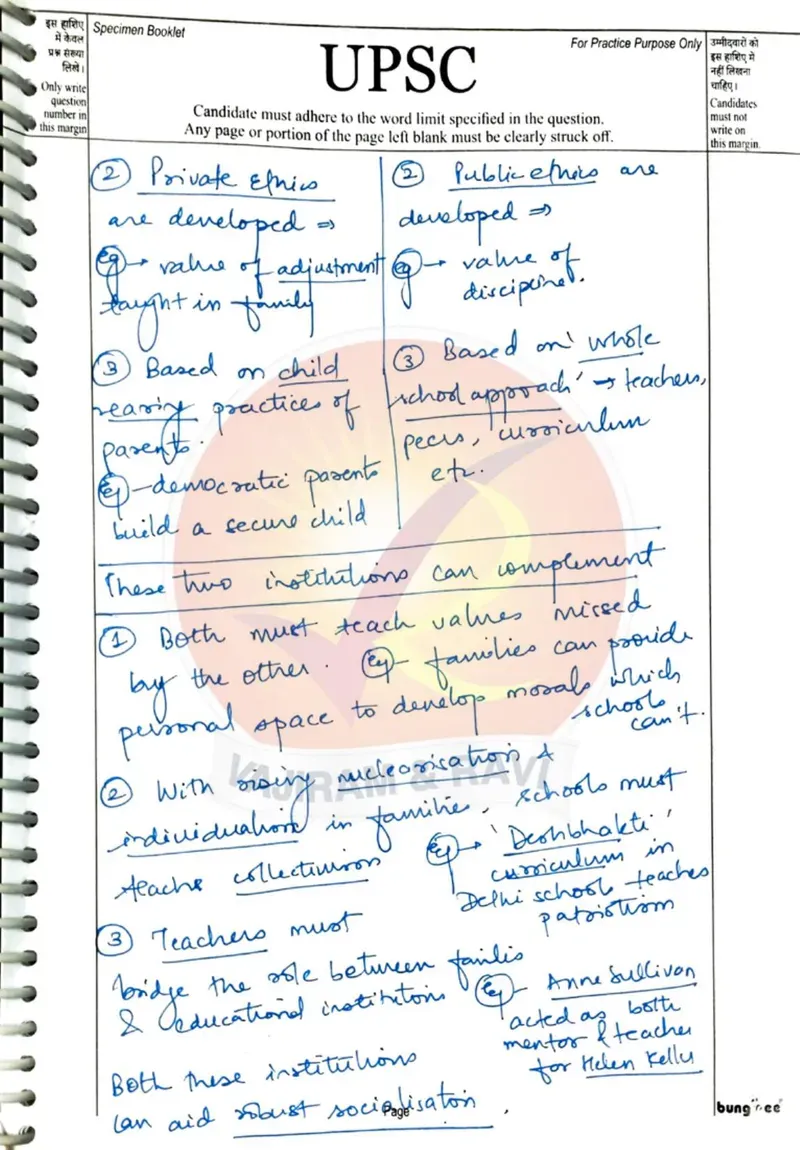
- ▸Disciplined use of two-column comparison tables (family vs education, impartiality vs neutrality, private vs public life) to structure compare/contrast questions.
- ▸Case studies lead with an enumerated 'ethical issues' list, then stepwise action, then short-term-vs-long-term justification; Q12 explicitly splits cognitive vs affective dimensions.
- ▸Anchors arguments in concrete legal/governance hooks — K.C. Puttaswamy & Article 21, DPDP Act, FutureSkills Prime, CPGRAMS, DBT, RTI, mandamus writ.
What to learn from this copy
- ★She pairs almost every abstract ethics point with a precise, named example rather than a vague reference -- e.g. Anne Sullivan mentoring Helen Keller and Jijabai teaching values to Shivaji for value-inculcation (Q2), Copernicus defending heliocentrism and Vidyasagar's widow-remarriage campaign for courage-under-controversy (Q6b/6c), and Baba Amte empathising with leprosy patients for empathy (Q7). Lesson: build a stocked, named example bank so each ethical claim lands on a concrete person/event instead of a generic platitude.
- ★She closes answers on a deliberate value-laden maxim that fits the question -- 'Yogakshema' for the welfare-state accountability answer (Q5), 'Vasudhaiva Kutumbakam' for global inequality (Q8), Aristotelian 'eudaimonia' for the AI-policy answer (Q14), 'Nari Shakti' for women's participation (Q13). Lesson: a short, topic-matched maxim as your last line gives Ethics answers a memorable 'signature' ending -- but pick one that actually maps to the question, not a stock phrase.
- ★She structures every compare/contrast question as a two-column table -- Family vs Educational institution (Q2), Impartiality vs Neutrality (Q10), character in private vs public life (Q4). Lesson: when a question literally asks you to compare/contrast or distinguish, a two-column table is the fastest way to make the contrast unmissable to an examiner skimming the page.
- ★Her case-study answers follow a fixed, examiner-friendly skeleton: an enumerated 'ethical issues' list first, then stepwise action, then a short-term-vs-long-term justification -- and Q12 (Kerala landslides) explicitly splits the cognitive vs affective dimensions. Lesson: a repeatable case-study template (issues -> stakeholders/action -> short- vs long-term) lets you answer all five case studies (Q12,13,15,16,17) fully and consistently under time pressure.
- ★She grounds ethics arguments in specific legal and governance hooks rather than leaving them theoretical -- K.C. Puttaswamy & Article 21 and the DPDP Act for the AI-privacy answer (Q14), DBT/RTI/mandamus writ for accountability-vs-efficiency (Q5), CPGRAMS and Citizen Charters like LIC/IRCTC for governance (Q1/Q5). Lesson: tying an ethical point to a real judgment, Act or scheme turns it from opinion into a defensible, administration-aware answer.
Questions attempted: Short notes: (i) Intellectual integrity in administrative decision-making; (ii) Citizen Charter in good governance; Compare/contrast roles of family vs educational institutions in value inculcation; how they complement each other; Tolerance and diversity — importance for governance; how civil servants foster tolerance/inclusivity, and 15 more below.
Questions attempted in this booklet (18)+
- 1.Short notes: (i) Intellectual integrity in administrative decision-making; (ii) Citizen Charter in good governance
- 2.Compare/contrast roles of family vs educational institutions in value inculcation; how they complement each other
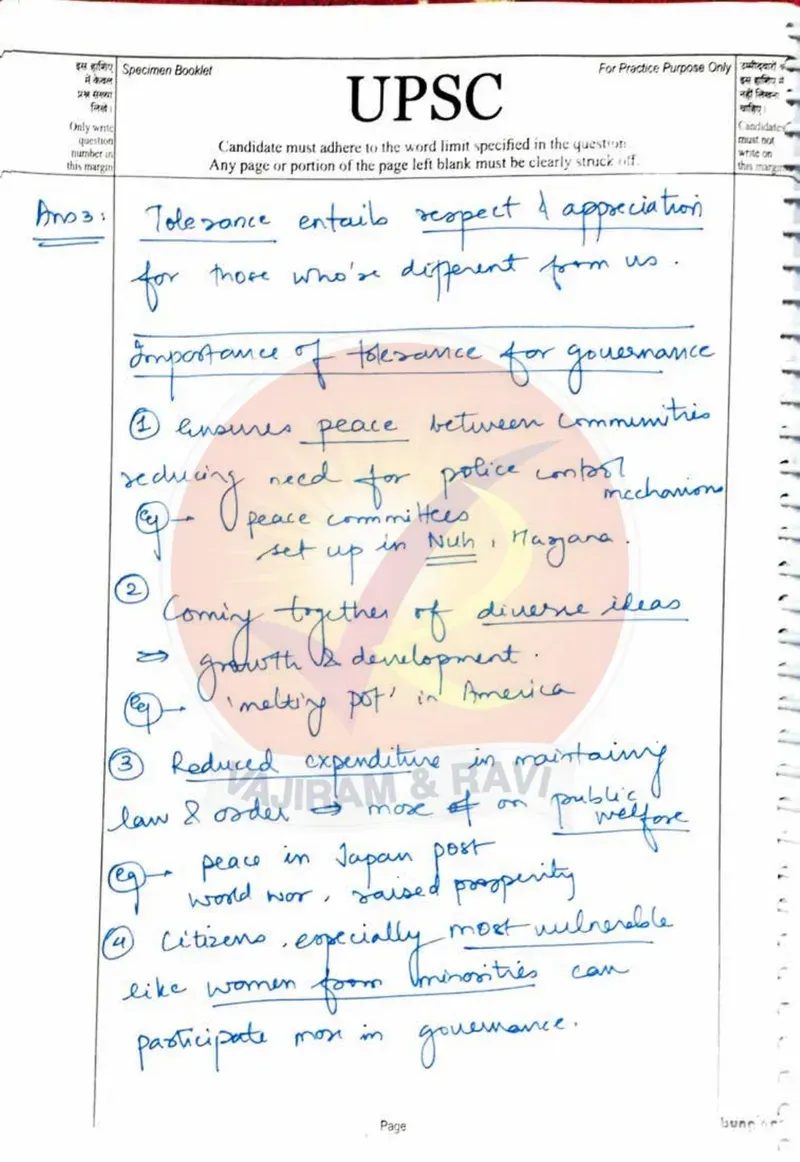
- 3.Tolerance and diversity — importance for governance; how civil servants foster tolerance/inclusivity
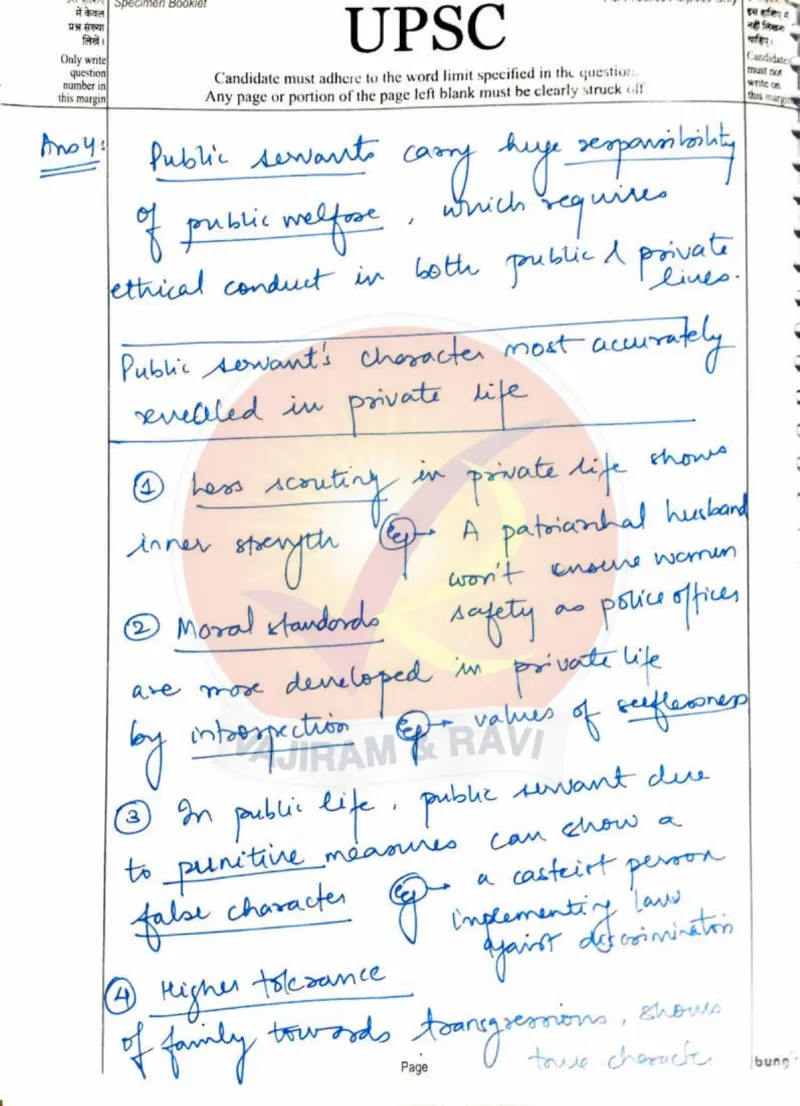
- 4.'Character revealed in private life, not public persona' — critical exam re public servants' ethical conduct
- 5.Accountability mechanisms vs bureaucratic delays/efficiency; can a balance be struck
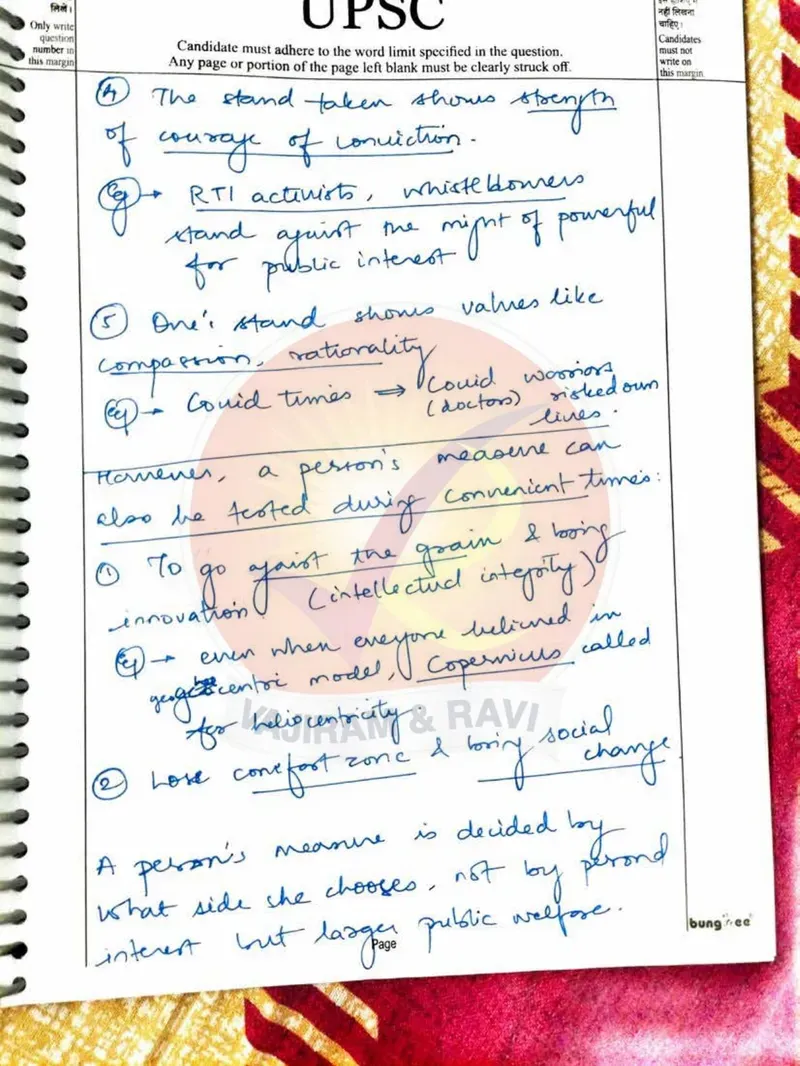
- 6b.MLK Jr quote — measure of a person at times of challenge/controversy
- 6c.Gandhi quote — 'In matters of conscience, the law of the majority has no place'
- 7.Empathy and emotionally intelligent civil servants improving governance/service delivery
- 8.Ethical implications of widening rich-poor nation gap; moral obligation of developed countries
- 9.Environmental ethics — responsibilities of individuals, corporations, governments to future generations
- 10.Impartiality vs neutrality in the civil service
- 11.Relevance of Bhagavad Gita teachings for ethical conduct in contemporary public service
- 12.Case study (a/b/c): Kerala landslides — District Collector; relief, transparency, community empowerment, relocation vs cultural attachment
- 13.Case study (a/b/c): Women's participation in SHGs/village councils; engaging men; institutional/policy changes
- 14.Formulate a comprehensive national AI policy framework — jobs, privacy, bias, accountability, black-box
- 15.Case study (a/b/c): GoodLife Pharma 'Revivol' — concealed fatal side-effects, complicit superior, whistleblowing
- 16.Case study (a/b/c): SDM rural subdivision — lethargy, bribery, favoritism, improving work culture
- 17.Case study (a/b/c): CPWD Chief Architect harassing junior Seema; retaining her and completing project
Examples, data & evidence used
- LIC charter and IRCTC charter (Citizen Charter / Q1)
- Jijabai teaching values to Shivaji; Aristotle tutoring Alexander; Gokhale as role-model teacher for Gandhi (Q2)
- Anne Sullivan as mentor/teacher to Helen Keller (Q2)
- Deshbhakti curriculum in Delhi schools (Q2)
- Nuh, Haryana peace committees for police-community contact (Q3 tolerance)
- 'Melting pot' of America; post-WWII Japan prosperity; Ek Bharat Shreshtha Bharat (Q3)
- IAS officer making own tea in a plastic cup (integrity); Divya Devarajan serving tribals (Q4)
- DBT reducing approval delays; RTI speeding implementation; mandamus writ / judicial accountability (Q5)
- Raja Ram Mohan Roy vs sati; Copernicus championing heliocentrism vs geocentric model; RTI activists/whistleblowers; Covid 'warrior' doctors (Q6b MLK)
- Vidyasagar's campaign for widow remarriage; defence lawyer giving fair representation; land acquisition for a hospital (Q6c conscience)
- Baba Amte empathising with leprosy patients; a collector cleaning a toilet to spread awareness; Accessible India Campaign; DBT (Q7 empathy)
- China's debt-trap diplomacy; Sri Lanka protests over high inflation (Q8 inequality)
- IPCC report (~1.1°C rise since pre-industrial); Body Shop cruelty-free products; Narayana Murthy 'people + planet + profit'; solar parks in India (Q9)
- Weberian bureaucracy framing (Q10 impartiality vs neutrality)
Quotes the candidate used
- 'Yoga Karmasu Kaushalam' — Bhagavad Gita (excellence in work) [Q11]
- 'Nishkaam Karma' — Bhagavad Gita (selfless/detached action) [Q11]
- 'Sthithprajna' — Bhagavad Gita (equanimity) [Q11]
- 'Vasudhaiva Kutumbakam' [Q8]
- 'Yogakshema' (welfare state) [Q5]
- 'Eudaimonia' — Aristotelian flourishing [Q14]
- 'Ek Bharat Shreshtha Bharat' [Q3]
- 'Nari Shakti' [Q13]
How it’s written: Highly structured, point-wise/bullet format throughout. Each Section-A answer opens with a one-line definition/conceptual framing, develops numbered/bulleted points each anchored to a concrete example, and closes on a value-laden maxim (Yogakshema, Vasudhaiva Kutumbakam, eudaimonia, Ek Bharat Shreshtha Bharat, Nari…
Diagrams & visuals: Two-column comparison table — Family vs Educational institution (Q2); Two-column comparison table — Impartiality vs Neutrality (Q10); Two-column contrast — character in private life vs public life (Q4); No maps or flowcharts discernible in the text layer
Evaluator: No examiner marks or comments are filled in on this copy.