
Laxman Meena — DrishtiIAS Essay copy
What’s inside this copy
- ▸Scored 80/250 overall — Section A (Courage, topic 4) 41, Section B (Liberty, topic 8) 39; both essays fully attempted.
- ▸Evaluator praised simple/clear language, a rich and insightful introduction, and commendable presentation.
- ▸Core critique: essay 'lacks diversification' — failed to break the theme into dimensions ('Why resist fear? How to cultivate courage?') and lacked structure/paragraph headings.
- ▸Strong philosophy scaffolding — Plato's cardinal virtues, Aristotle's golden mean, Bhagavad Gita, and Rousseau's Social Contract.
- ▸Broad example bank: Gandhi, Edward Snowden, Mira Bai, Helen Keller, Durga Shakti Nagpal, backed by NCRB and scam/politics data.
- ▸Candidate's own rough mind-maps and self-doubts ('how to maintain flow? Is grammar okay?') are visible inside the booklet.
What to learn from this copy
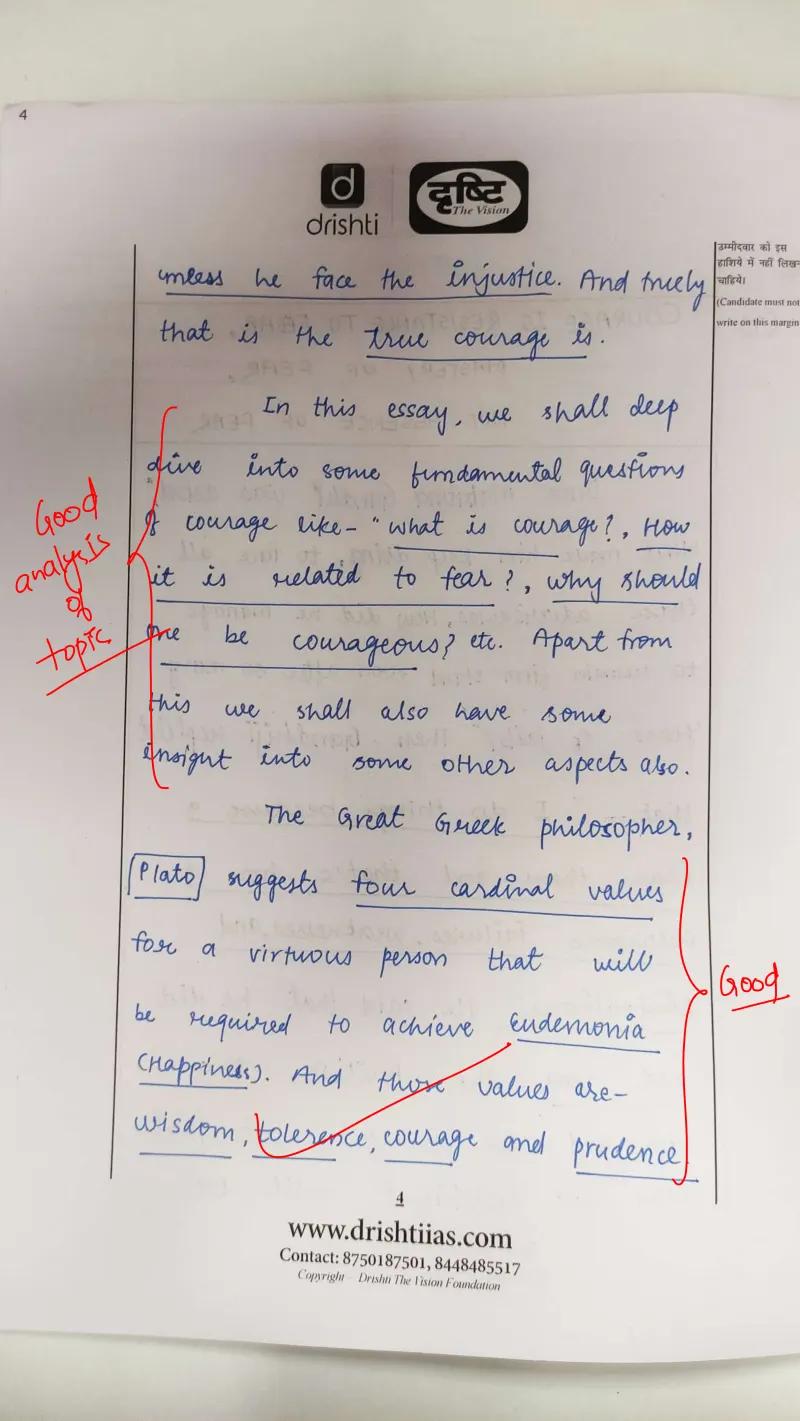
- ★Both essays open with a concrete hook and then immediately set a roadmap of questions to answer — Section A starts with a Gandhi anecdote on not fearing the British/jails, then poses 'what is courage? how is it related to fear?' The evaluator explicitly praised this as a 'rich and insightful introduction' -> open with a specific anecdote, then state the 2-3 questions the essay will explore so the reader knows your direction from line one.
- ★Builds a genuine philosophy scaffold by pairing Western and Indian thought rather than name-dropping — Plato's four cardinal virtues (wisdom, tolerance, courage, prudence) for Eudaimonia, Aristotle's courage as 'the golden mean between cowardice and recklessness', the Bhagavad Gita on standing against injustice, and Rousseau ('Man is everywhere in chains'). The evaluator credited this depth -> anchor an abstract essay theme in a precise conceptual definition (e.g. Aristotle's golden mean) and cross it with Indian philosophy for breadth.
- ★Backs illustrative personalities with hard data instead of leaving examples anecdotal — Gandhi, Edward Snowden, Mira Bai, Helen Keller and Durga Shakti Nagpal (vs the sand mafia) are reinforced with NCRB's '86 women raped every day' and '43% of MPs with criminal charges in the 17th Lok Sabha' -> alternate human stories with a verifiable statistic so each section carries both emotional and evidentiary weight.
- ★Kept the language simple and clear throughout (the evaluator's words) and fully attempted both essays under time — Section A 41/125 and Section B 39/125 -> in the essay paper, finishing both essays with readable, jargon-free prose is itself a scoring foundation; clarity and completion are not optional.
Questions attempted: "Courage is resistance to fear, mastery of fear, not absence of fear" (original quote by Mark Twain; written as the title, unattributed in copy); "The worst thing is not that the world is unfree, but that people have unlearned their liberty" (original quote by Milan Kundera; unattributed in copy); Both essays combined, out of 250.
Questions attempted in this booklet (3)+
- Section-A (Essay Topic No. 4)."Courage is resistance to fear, mastery of fear, not absence of fear" (original quote by Mark Twain; written as the title, unattributed in copy)
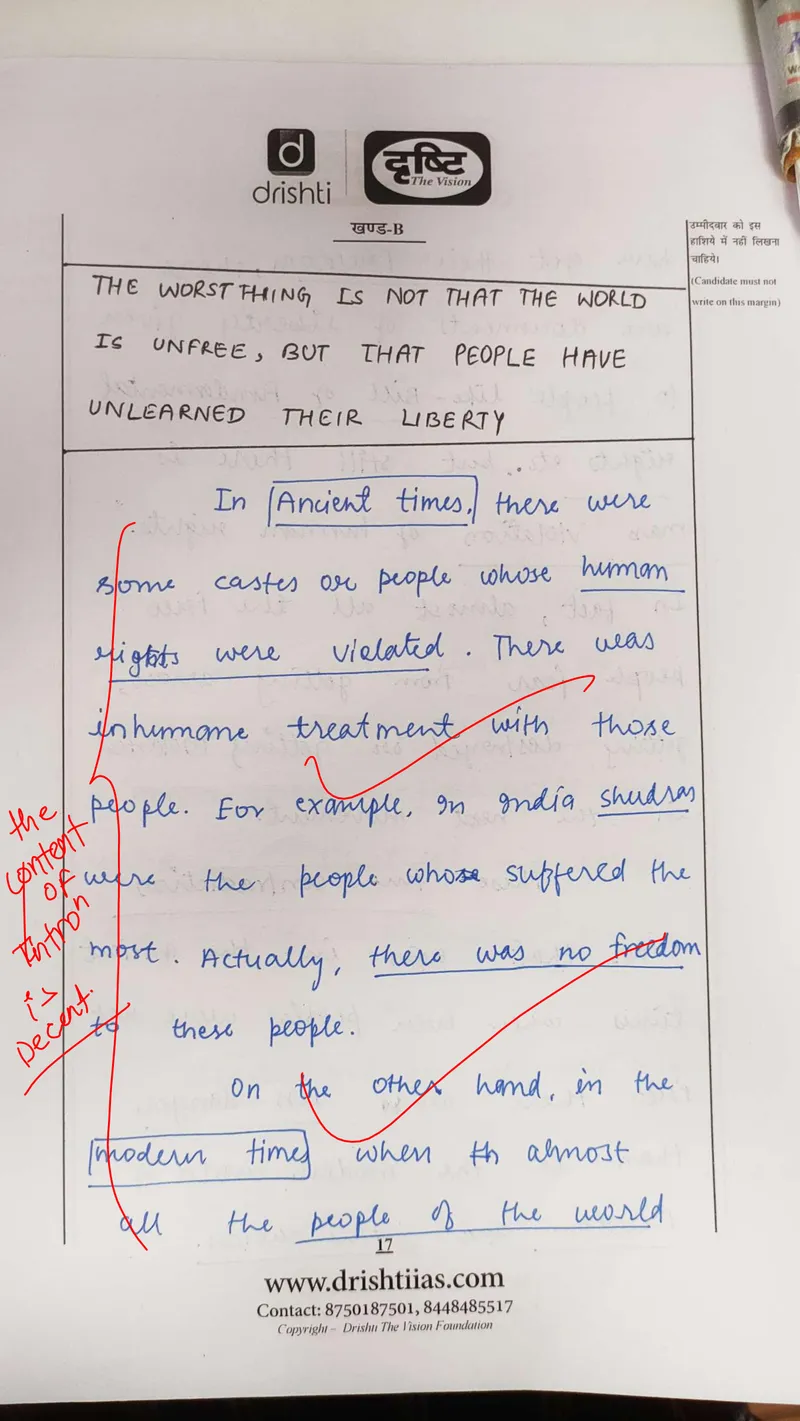
- Section-B (Essay Topic No. 8)."The worst thing is not that the world is unfree, but that people have unlearned their liberty" (original quote by Milan Kundera; unattributed in copy)
- Grand Total.Both essays combined, out of 250
Examples, data & evidence used
- Mahatma Gandhi — opening anecdote on not fearing the British / jails (Section A)
- Plato — four cardinal virtues (wisdom, tolerance, courage, prudence) for Eudaimonia
- Aristotle — courage as the golden mean between cowardice and recklessness
- Bhagavad Gita — standing against injustice as courage
- Ram (Ramayana) and Pandavas (Mahabharata) as courageous figures
- Edward Snowden — whistleblowing on US NSA cyber espionage
- Mira Bai (Bhakti saint) — overcoming fear of social custom
- Helen Keller (disabled girl) — overcoming inferiority complex
- Start-ups / entrepreneurship — growth requires risk-taking
- Durga Shakti Nagpal (IAS) — standing against the sand mafia
- 43% of MPs with criminal charges in 17th Lok Sabha — criminalisation of politics
- NCRB — 86 women raped every day in India (Section A)
- 2G scam, Ponzi schemes, tax havens — economic threats
- Turkey earthquake — disaster (un)preparedness
Quotes the candidate used
- "Courage is resistance to fear, mastery of fear, not absence of fear" — Section-A topic line (Mark Twain originally; not attributed by candidate)
- Mahatma Gandhi: "I do things because I do not fear them and that's how I overcome failures, weaknesses and limitations" (attributed to Gandhi; rough notes also reference 'My Experiments with Truth')
- "If you want to win, defeat yourself" — given as a 'famous saying' (no author written)
- "The world will not be destroyed by the evil, but by those good people who remain silent during evil" — given as 'a saying' (no author written; popularly attributed to Einstein)
- "The worst thing is not that the world is unfree, but that people have unlearned their liberty" — Section-B topic line (Milan Kundera originally; not attributed by candidate)
- "Man is everywhere in chains" — attributed in copy to 'a famous western scholar' (unnamed; Rousseau)
- Hindi couplet: "Jaaki ladki sundar dekhi, taa pe jaaye dhari talwar" — on mistreatment of girls (no author)
- Hindi saying: "Bhatke hue insaan shaam ko ghar aa jaaye toh wah bhatka hua nahi mana jata" (no author)
How it’s written: Standard essay prose, no sub-headings within the body (the evaluator specifically flagged this). Each essay opens with an anecdote/quote hook, states a roadmap of questions to explore ("what is courage?, how is it related to fear?"), builds a philosophy scaffold (Greek + Indian thought), then layers contemporary exa…
Diagrams & visuals: No formal diagrams, flowcharts or maps within the evaluated essay body; Rough mind-map / brainstorming planning notes present on interleaved rough-work pages (candidate's own pre-writing, e.g. arrow-linked keywords: Gandhi, Plato cardinal values, Aristotle golden mean, Snowden, Durga Shakti Nagpal) — not part of the marked essay
Evaluator: Detailed handwritten feedback in red plus marks. MARKS: Section-A (topic 4) = 41, Section-B (topic 8) = 39, Grand Total = 80/250; Evaluator signature present (name illegible, in red); Reviewer signature blank. FEEDBACK PAGE — "Dear stude…