
Rishabh Bhatt — MGP answer copy (GS Paper 2)
What’s inside this copy
- ▸Complete attempt - all 20 questions answered in full within a single 53-page booklet (10-markers ~1.5-2 pages, 15-markers ~2-3 pages).
- ▸Relentless example habit: almost every sub-point is anchored by an 'eg ->' (Faraizi/Eka movements, Joshimath NTPC tunnel, Reasi lithium, Cyclone Biparjoy, Sanjida Khatun's 'Grasshoppers').
- ▸Strong visual answer-writing: a labelled Dravida-temple sketch, a world seismic-belt map, Earth-Moon-Sun tide diagrams and several spider/flow charts.
- ▸Tight, repeatable template: boxed 1-2 line intro, boxed/underlined directional sub-headings (Causes/Consequences/Solutions, Similarities/Differences), numbered body, one-line forward-looking conclusion.
- ▸Cites authority for weight - Pratap Bhanu Mehta, Supreme Court 'way of life', Lancet, ISRO, Economic Survey, Census 2011.
- ▸The copy is UNEVALUATED - every per-question Feedback grid (AWIS/CD&VA/S&F/P&R), the marks columns, and the 'Examiner's Remarks' page are all blank; no ticks or score anywhere.
What to learn from this copy
- ★Almost every sub-point is anchored with a concrete 'eg ->' rather than a generic claim: Q2 names Faraizi, Eka, Indigo, Tebhaga, Pagalpanthis and Mappila movements instead of just saying 'peasant movements'; Q5 cites Joshimath's NTPC tunnel; Q15 cites the Reasi (J&K) lithium reserve and the South American 'lithium triangle'. -> Don't state a point and move on; immediately bolt a specific named instance onto it so the examiner sees you actually know the topic, not just the template.
- ★He answers in the question's own direction-words as boxed/underlined sub-headings: Q2 splits into 'Similarities/Differences' (because the demand was 'compare & contrast'), and CSP-type answers run 'Causes/Consequences/Solutions'. -> Lift the directive verb from the question (compare, examine, causes-and-measures) and turn it into your literal headings, so the structure visibly mirrors the demand and you can't drift off-question.
- ★Diagrams carry actual content, not decoration: Q11's hand-drawn Dravida temple is labelled with its real parts (Gopuram, Mandapa, Amalaka, Shikhara, Vimana), and Q16 draws a world map marking the named seismic belts (Circum-Pacific, Mid-Atlantic, Continental) plus a fault-block diagram labelling epicentre/focus/hypocentre. -> When you draw, label it with the technical terms the answer needs to earn marks for; a sketch that names parts or maps locations is worth far more than a generic bubble chart.
- ★He borrows authority to add weight to value-laden GS1 society/culture answers: Q9 attributes the minority-appeasement critique to scholar Pratap Bhanu Mehta, Q8 backs 'Hinduism as a way of life' to the Supreme Court, and quantified claims like ISRO's '30% land degraded' (Q13) and 'top 10% holds >90% wealth' (Q10) are sourced rather than asserted. -> On opinion-heavy topics, attach a named scholar, court ruling or institutional data point to your stance so it reads as informed analysis instead of personal opinion.
- ★He converts vague magnitude into hard figures: Q13 contrasts the actual NPK ratio (8:4:1 vs the ideal 4:2:1), Q6 cites '13 monsoon deficits in last 18 years', and Q15 notes 'China controls 50% supply'. -> Replace words like 'many', 'rising', 'imbalanced' with a specific ratio, count or percentage you've memorised; one precise number signals depth more than a paragraph of adjectives.
Questions attempted: Industrial Revolution in Britain - role of democracy & rule of law over coal/iron/inventions; Compare & contrast character of 19th vs 20th century peasant movements in India; Civil Disobedience Movement - unique place in India's freedom struggle (extent, reach, revolutionary zeal), and 17 more below.
Questions attempted in this booklet (20)+
- 1.Industrial Revolution in Britain - role of democracy & rule of law over coal/iron/inventions
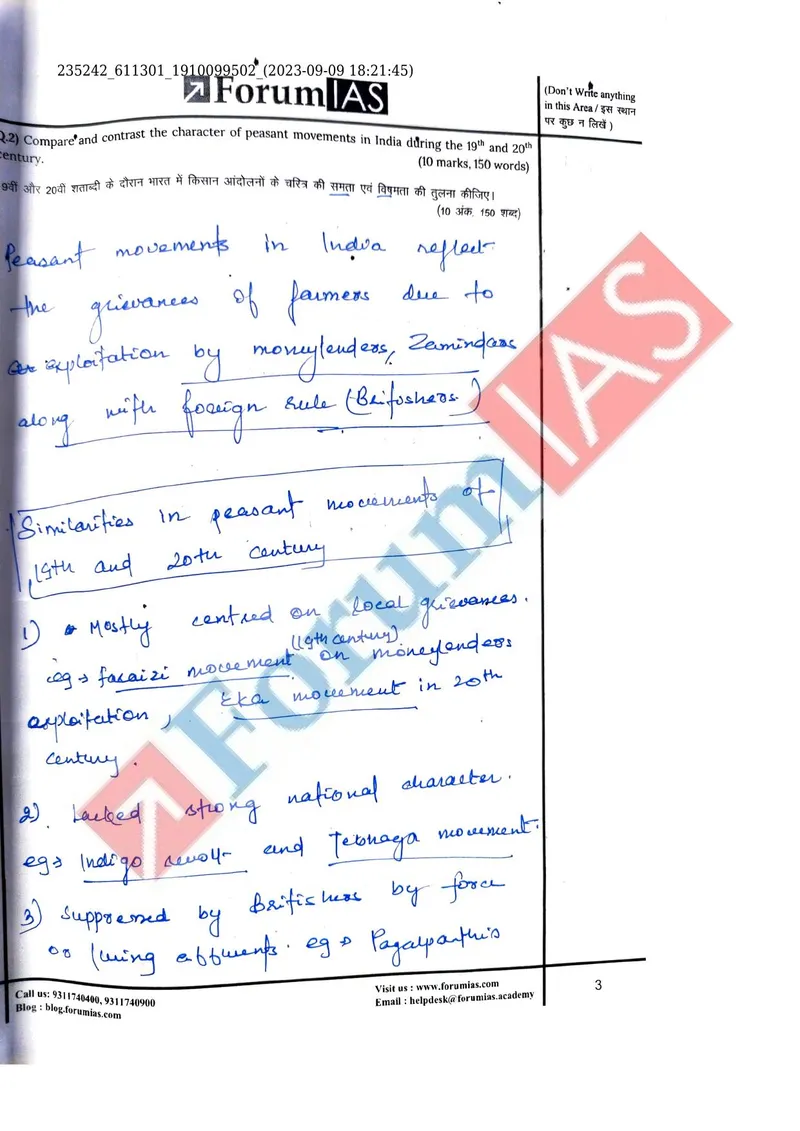
- 2.Compare & contrast character of 19th vs 20th century peasant movements in India
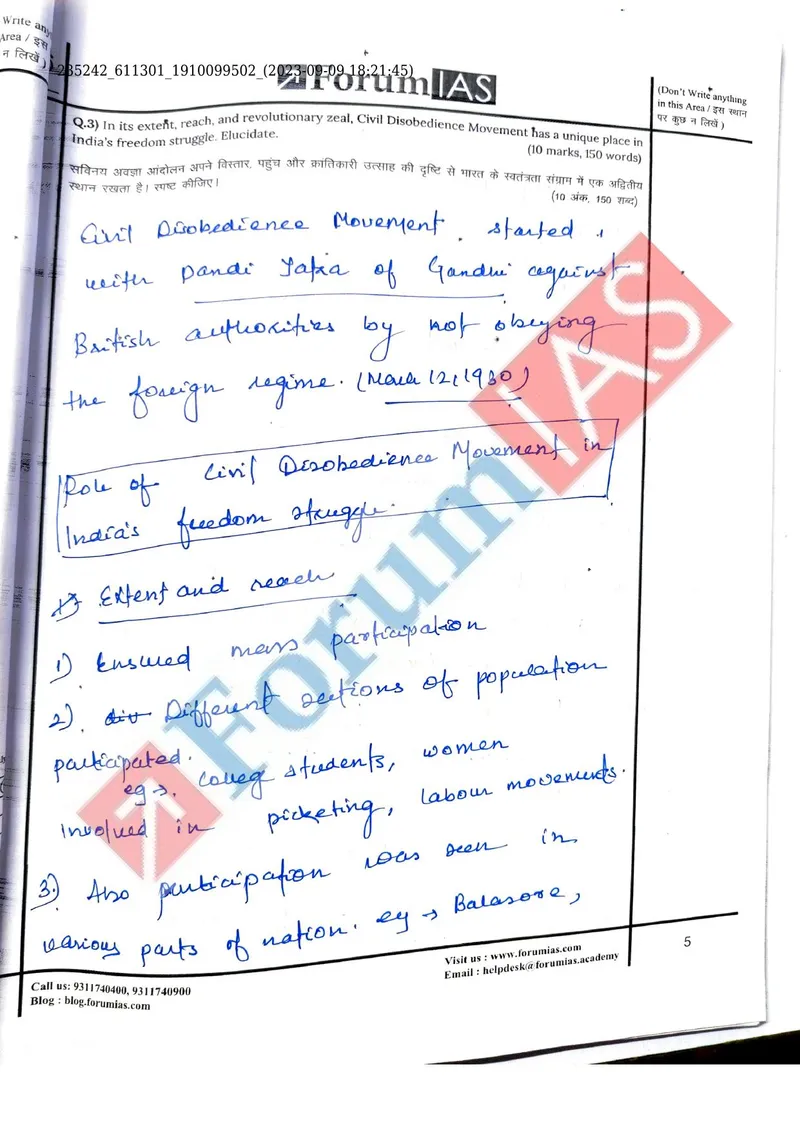
- 3.Civil Disobedience Movement - unique place in India's freedom struggle (extent, reach, revolutionary zeal)
- 4.Vaishnavism & Shaivism in medieval India as local traditions + universal ideals
- 5.Land subsidence - reasons (natural/anthropogenic) and measures (note: answer conflates with landslides)
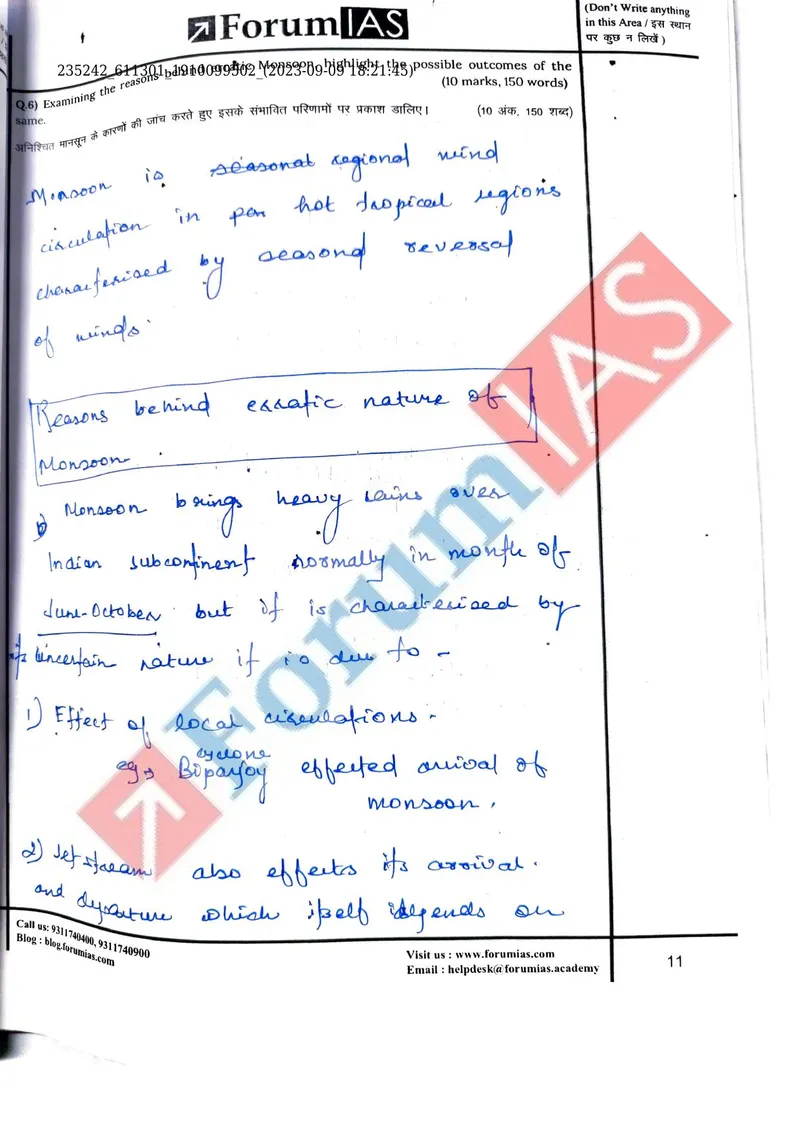
- 6.Erratic/uncertain monsoon - reasons and possible outcomes
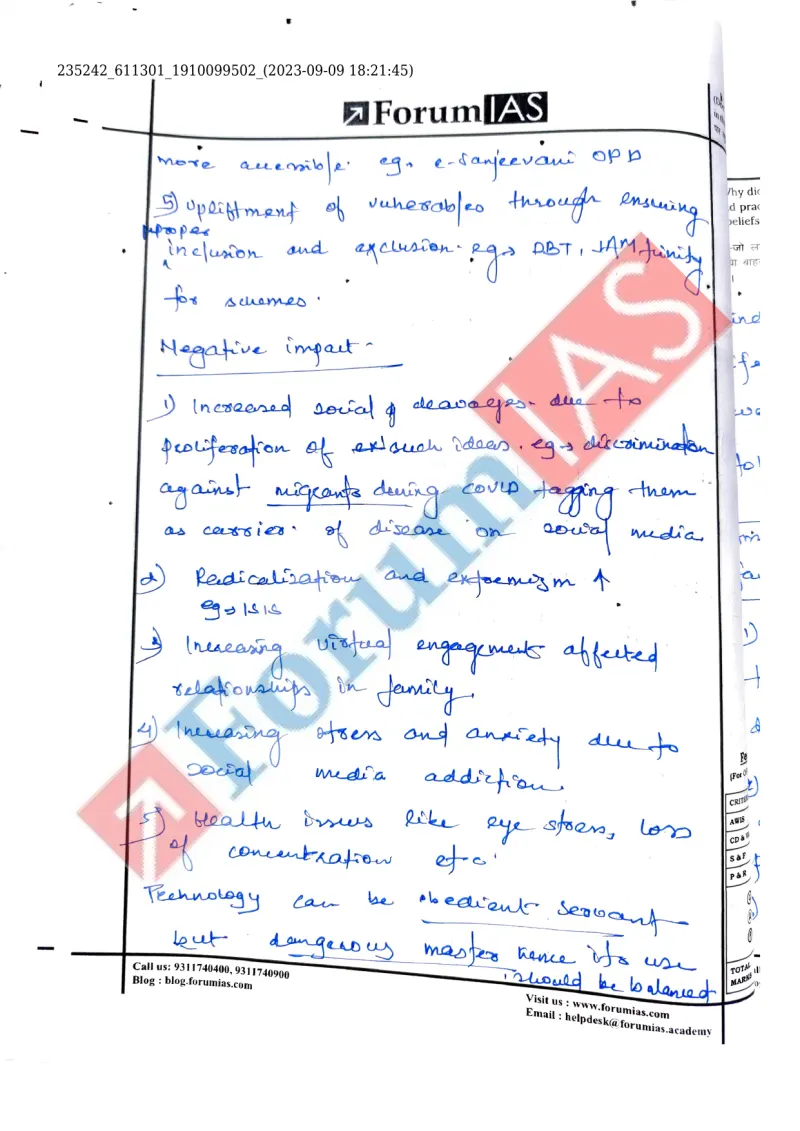
- 7.Impact of new technologies on Indian society (positive/negative)
- 8.Why Hinduism assimilated diverse faiths but failed to assimilate Islamic cultural practices
- 9.Western vs Indian secularism; criticism of minority appeasement
- 10.Globalisation in India - positive socio-economic outcomes vs widening haves/have-nots gap
- 11.Dravidian temple architecture - Pallavas to imperial Cholas (15 marks)
- 12.Pre-independence women's movements led by men; post-independence women-led movements (15 marks)
- 13.Salinity ingress - causes, consequences and solutions (15 marks)
- 14.Factors hackling urban mass transport; measures for robust paradigm (15 marks)
- 15.Economic & strategic significance of lithium (Reasi reserves) vs socio-ecological impacts (15 marks)
- 16.Mechanism & occurrence of earthquakes; vulnerability of regions, with map (15 marks)
- 17.Types of tides & significance; how tides differ from waves (15 marks)
- 18.Evolutionary changes in marriage & family; role of state and market (15 marks)
- 19.Spurt in child marriages - reasons, consequences, steps beyond legal realms (15 marks)
- 20.Reasons behind regional sentiments & cultural assertiveness; link to separatism (15 marks)
Examples, data & evidence used
- Q2: Faraizi movement, Eka movement, Indigo revolt, Tebhaga movement, Pagalpanthis, Malabar (Mappila) movement, All India Kisan Sabha, Nehru
- Q3: Dandi Yatra (12 March 1930), Balasore, Tuticorin, Sholapur, Dharasana, Khudai Khidmatgars (NWFP), Gandhi-Irwin Pact, Purna Swaraj 1929
- Q4: Sant Tukaram, Chaitanya (Bengal), Lingayat female saints/Akka Mahadevi, Nayanars, Shankardeva (Assamese), Bihu dance, Nath Sampradaya
- Q5: Joshimath (NTPC tunnel), Himachal, Delhi, Mishra Committee
- Q6: Cyclone Biparjoy, El Nino, jet stream, '13 monsoon deficits in last 18 years'
- Q7: e-Sanjeevani OPD, DBT/JAM trinity, astro apps & digital payments on Rakshabandhan, COVID-era migrant discrimination, ISIS
- Q8: Kushana coins bearing Shiva, Shakas/Parthians/Sungas, Sufi urs & murshid-pir, Aurangzeb/Ghaznavi temple destruction, Sai Baba of Maharashtra, dargah visits
- Q9: Pratap Bhanu Mehta, France & USA models, Sarva Dharma Sambhava, Articles 25/26/27/30/14, Gandhi, 'salad bowl' model
- Q10: DBT, 'top 10% holds >90% wealth', ISIS, tribal community ownership
- Q11: Mamallapuram, Kailasanatha & Shore temples, Rajasimha/Mahendravarman/Narasimha, Brihadeshwara temple (Rajaraja Chola), Airavatesvara temple, Hampi (Vijayanagara), Madurai (Pandya), Hoysala Somnatheswara temple
- Q12: Raja Ram Mohan Roy, Ishwarchandra Vidyasagar, Derozio, Vishnu Shastri, B.M. Malabari, Annie Besant, Sarojini Naidu, Chipko, 'Towards Equality' report, Dowry Act, Domestic Violence Act, LFPR 33%, NCRB
- Q13: NPK ratio 8:4:1 vs 4:2:1, ISRO (30% land degraded), gypsum, M-sand, ZBNF, micro/drip irrigation (10 mha)
- Q14: Ahluwalia Committee, DRTC Delhi, SPVs for smart cities, 4 As, '40% population urban by 2040', Finance Commission tied grants
- Q15: Reasi (J&K), Geological Survey of India, South America 'lithium triangle', Advanced Chemical Cells, Minerals Security Partnership, China controls 50% supply, Panchamrit, Red Hangul deer
Quotes the candidate used
- Q7 (no author given): 'Technology can be obedient servant but dangerous master, hence its use should be balanced.'
- Q8: Hinduism described as a 'way of life (Supreme Court)' - attributed to the Supreme Court.
- Q9: Pratap Bhanu Mehta cited as saying the Indian model of secularism promotes minority appeasement (paraphrase, scholar attributed).
How it’s written: Highly templated and consistent across all 20 answers, written in legible blue cursive. Each answer opens with a 1-2 sentence definition/context (often boxed or underlined), then a boxed or underlined directional heading that mirrors the question's demand (e.g., 'Similarities/Differences in peasant movements', 'Caus…
Diagrams & visuals: Q6: spider/bubble diagram with 'Outcomes' at centre and radiating effects; Q8: flowchart (boxed 'Failure to assimilate Islamic practices' with arrows to causes); Q10: two branching flow diagrams - positive outcomes and negative outcomes of globalisation; Q11: labelled hand-drawn Dravida temple sketch (Gopuram, Mandapa, Amalaka, Shikhara, Vimana); Q14: '4 As' branching diagram (Accessibility, Availability, Affordability, Awareness); Q16: hand-drawn world MAP marking Circum-Pacific, Mid-Atlantic and Continental seismic belts; plus a fault-block diagram (epicentre/focus/hypocentre) and wave-type boxes
Evaluator: No examiner marks or comments are filled in on this copy.