
Aakash Garg — DrishtiIAS GS Paper 4 (Ethics) copy
What’s inside this copy
- ▸Complete attempt — all 12 questions answered, copy runs continuously pages 1-58 (then rough-work pages), no question skipped
- ▸Genuine Aakash Garg copy: cover 'Name: Aakash Garg', Medium English, UPSC Roll 0833621 — single candidate throughout, no interleaving or mislabelled pages
- ▸Quote-and-example heavy: C.S. Lewis on integrity, Gandhi and Rawls on means-ends, Vasudhaiva Kutumbakam, plus Satyendra Dubey, T.N. Seshan, Rafale case, Vaccine Maitri, MGNREGA social audit
- ▸Every answer is tightly structured — short intro, headed/numbered body, one-line conclusion; case studies consistently open with a stakeholder list
- ▸Each case study explicitly commits to a 'best course of action' rather than hedging (e.g., Sonia should disclose and seek formal inquiry; Ravi should disclose maximum info to avoid panic)
- ▸Evaluator marks grid and feedback rubric are blank in this scan — no scores, ticks or comments to report
What to learn from this copy
- ★On every Section-A 10-marker Aakash opens with a one-line definition/context of the key term, then a clearly headed body split into lettered (a,b,c) or Positive/Negative buckets, and closes with a one-line conclusion -> for Ethics, a predictable intro-definition + headed-contrast-body + crisp-conclusion skeleton lets the examiner find your demand-fulfilment instantly; build one reusable template and run every 10-marker through it.
- ★He doesn't just name thinkers, he pairs them as a debate: on means-ends (Q2a) he sets Gandhi ('both means and ends ought to be pure') against Rawls's 'pure procedural justice' (pure means make ends pure automatically), and backs probity (Q1b) with C.S. Lewis's 'Integrity is doing the right thing even when no one is watching' -> pre-load 2-3 quotable lines per core Ethics theme and deploy them as contrasting positions, not decoration, so the answer reads as reasoned argument.
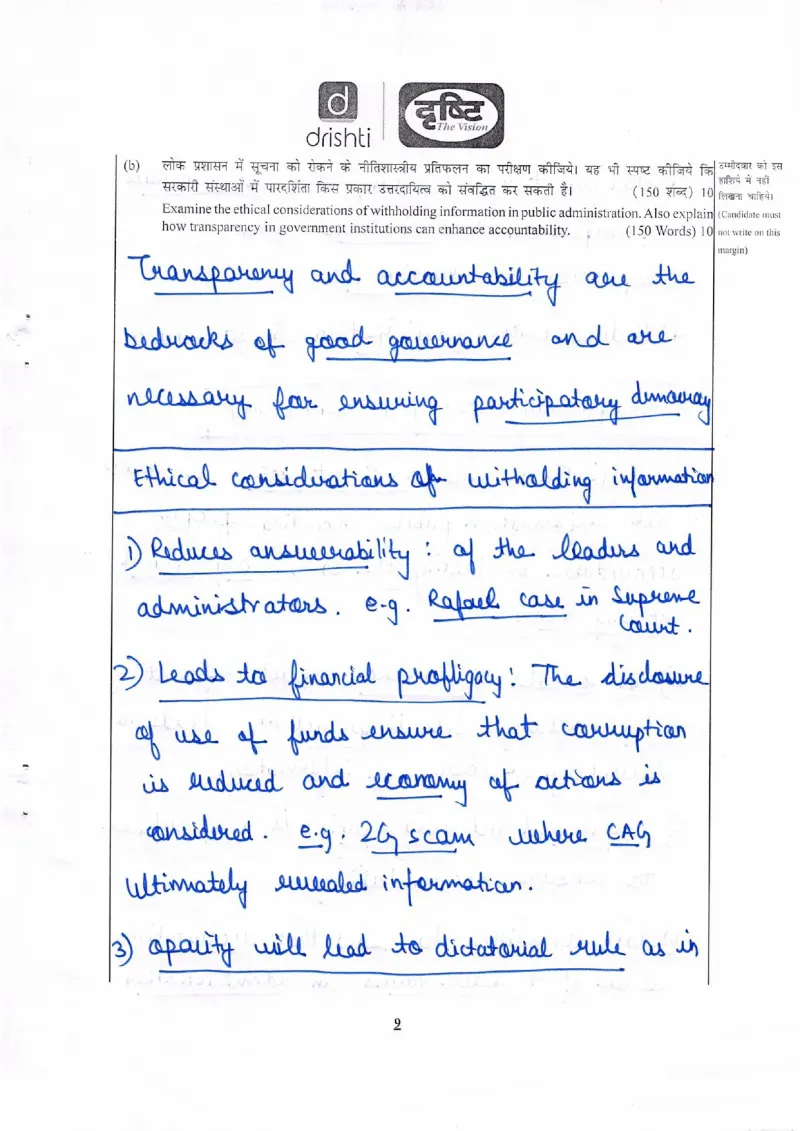
- ★His examples are concrete, current and verifiable rather than vague: Satyendra Dubey exposing road-contract corruption (probity), T.N. Seshan and the Nolan Committee (ethics in public life), the Rafale/2G/Adarsh cases and RTI Act 2005 (transparency), and India's Vaccine Maitri to Nepal/Sri Lanka/Maldives (vaccine diplomacy) -> stock a small bank of named real-world instances mapped to standard Ethics demands so abstract concepts always land with a specific, factual peg.
- ★Every case study (Q7-Q12, 20 marks each) consistently opens with a stakeholder list, then explicitly commits to a single 'best course of action' instead of hedging, e.g. Sonia Patel should disclose and seek a formal inquiry, and Collector Ravi Kumar should disclose maximum information to avoid panic -> in case studies, identify stakeholders up front and take a clear, defensible decision; evaluators reward a candidate who chooses and justifies over one who lists options and sits on the fence.
- ★He localises Western/abstract frameworks into Indian ethical vocabulary, e.g. answering Plato's justice (Q6b) with the written relation 'Justice = Wisdom/Prudence + Courage' and tying it to Jan Dhan/Swachh Bharat, and answering Kofi Annan on tolerance (Q3c) with Langar, Vasudhaiva Kutumbakam and Sarva Dharma Sambhav -> translate philosophical prompts into a simple equation or Indian example so a dense theory question becomes readable and rooted.
Questions attempted: How persuasion impacts public opinion and fosters social change (150 words / max 10); Difference between probity and integrity with examples; measures to ensure probity in governance (max 10); Means shape the outcome, so ends cannot justify the means — discuss with examples (max 10), and 16 more below.
Questions attempted in this booklet (19)+
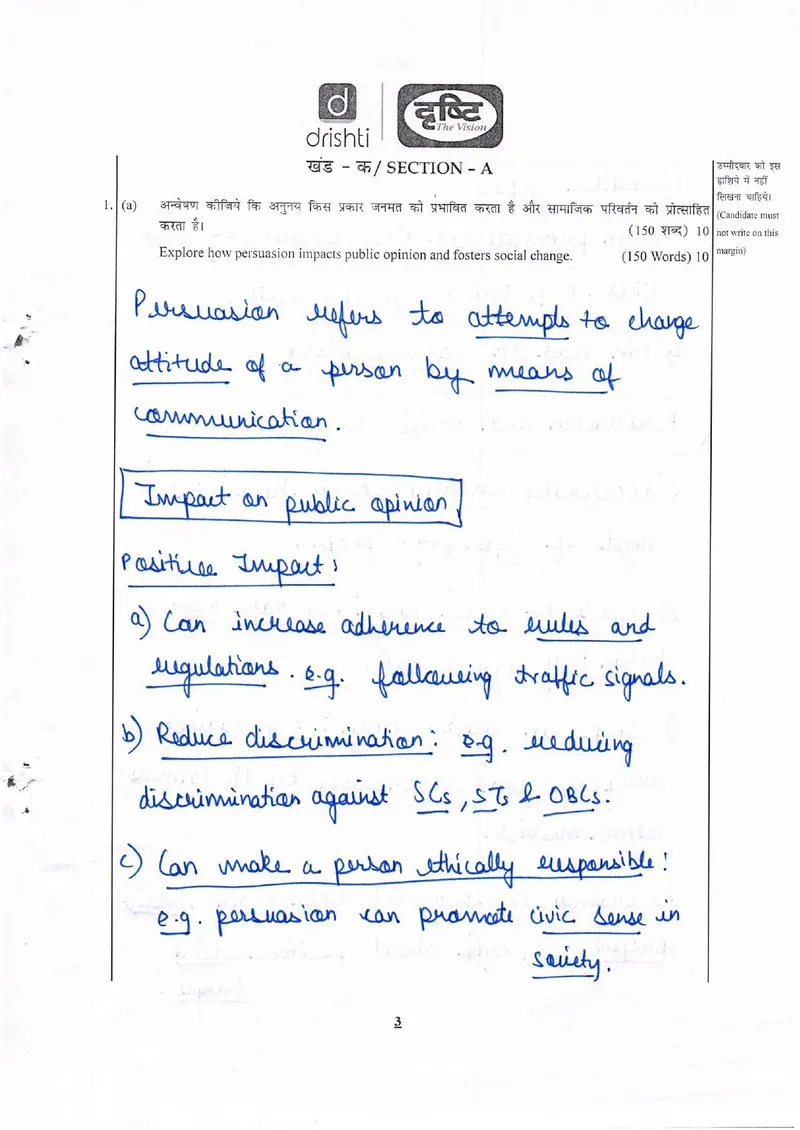
- 1(a).How persuasion impacts public opinion and fosters social change (150 words / max 10)
- 1(b).Difference between probity and integrity with examples; measures to ensure probity in governance (max 10)
- 2(a).Means shape the outcome, so ends cannot justify the means — discuss with examples (max 10)
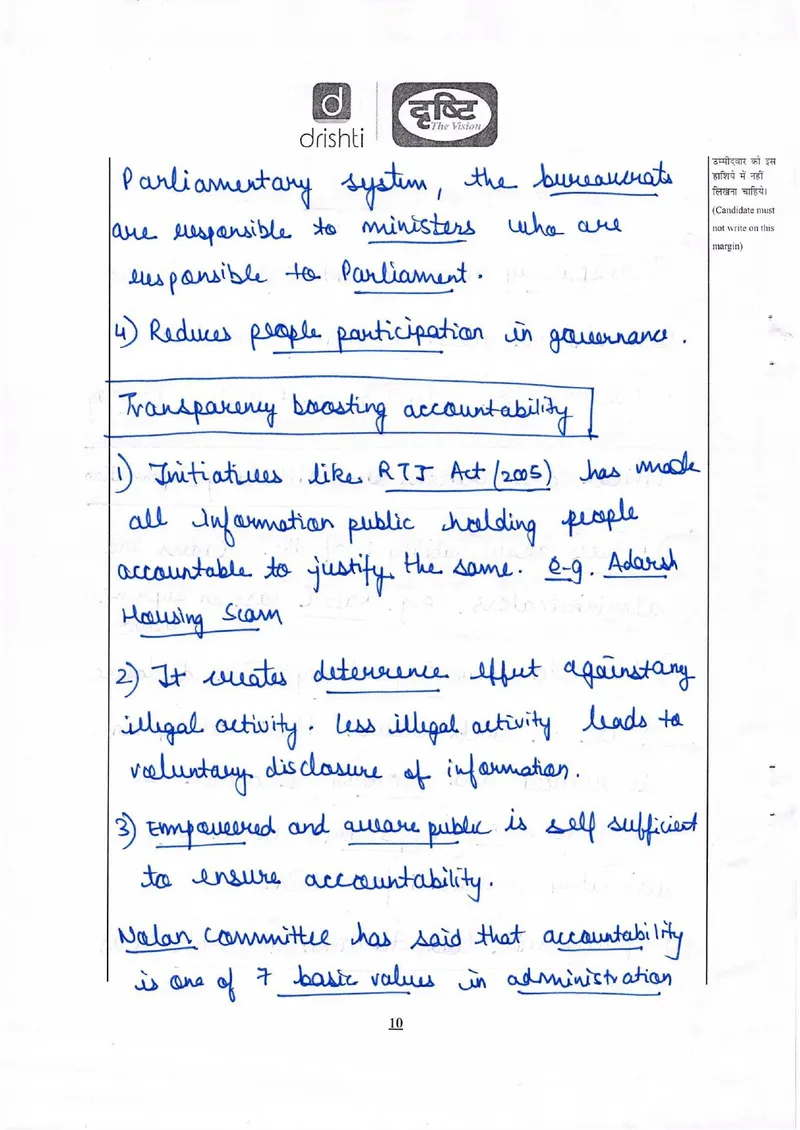
- 2(b).Ethical considerations of withholding information in public administration; transparency enhancing accountability (max 10)
- 3(a).Quotation — Henry Paulson: nothing more important than ethics in every area of society (max 10)
- 3(b).Quotation — Rabindranath Tagore: love is not a mere impulse, it must contain truth, which is law (max 10)
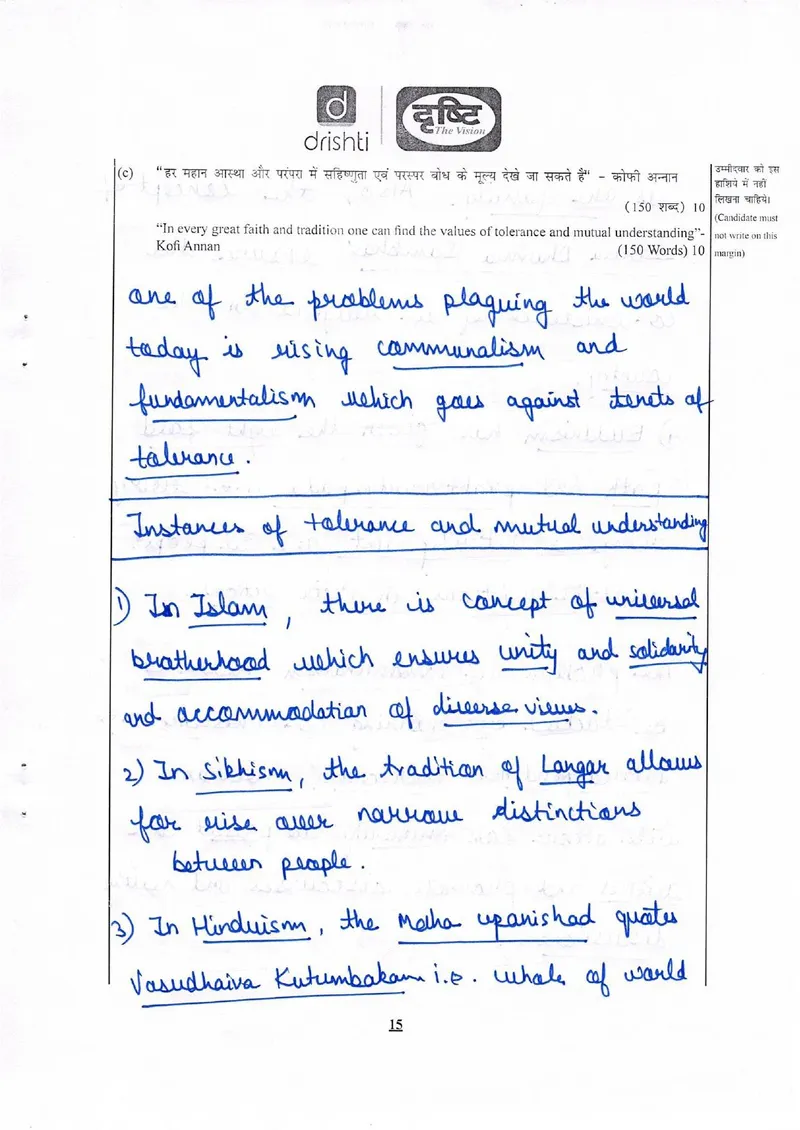
- 3(c).Quotation — Kofi Annan: every great faith holds values of tolerance and mutual understanding (max 10)
- 4(a).Role of ethics in the application of international aid to less developed nations (max 10)
- 4(b).Key ethical challenges in the workplace; effect on organizational culture and employee morale; strategies to foster an ethics culture (max 10)
- 5(a).Vaccine diplomacy; ethics of prioritizing domestic vaccine distribution over sharing during a pandemic (max 10)
- 5(b).Major teachings of Adi Shankaracharya and their relevance to current social/ethical challenges (max 10)
- 6(a).SEBI Chief allegations / corporate ethics — role of regulatory bodies in upholding ethical standards and trust (max 10)
- 6(b).Plato's Republic — justice as a virtue of people and of institutions; comment (max 10)
- 7.Case study — Apex Tutorials misleading JEE coaching advertisement / CCPA action; ethics of omission, regulator role, rebuilding trust (max 20)
- 8.Case study — Sonia Patel, PIO, RTI dilemma over disclosing adverse environmental impact assessment; stakeholders, principles, options (max 20)
- 9.Case study — HealthInnovate Inc. experimental drug / compassionate-use access; ethical principles and fair access criteria (max 20)
- 10.Case study — Ravi Kumar, District Collector, flood disaster management; evacuation priority, disclosure vs panic, relief and recovery (max 20)
- 11.Case study — Ganganagar stray-dog bite; Mayor's dilemma between public health and animal welfare; guiding principles (max 20)
- 12.Case study — PMGSY Suryavilla road embezzlement by contractor Vikram Joshi; role of social audit and contractor's ethical responsibilities (max 20)
Examples, data & evidence used
- Following traffic signals; reducing discrimination against SC/ST/OBC; betting advertisements (persuasion impacts)
- LGBTQIA+ rights; Raja Ram Mohan Roy against sati; anti-drug/alcohol disclaimers before movies (social change)
- Satyendra Dubey uncovering corruption in road contracts (probity)
- Ethics paper in the Civil Services exam as a recruitment-stage probity measure
- Subhas Chandra Bose justifying violence; Krishna advising Arjun in the Mahabharata; cheating in a World Cup match (means-ends)
- Rafale case in the Supreme Court; 2G scam; Adarsh housing scam; RTI Act 2005 (withholding information / transparency)
- Nolan Committee — accountability as a core value; former CEC T.N. Seshan (ethics in public life)
- Islam's universal brotherhood; Sikhism's Langar; Hindu 'Vasudhaiva Kutumbakam' and Sarva Dharma Sambhav; Buddhist Eightfold Path and Pratityasamutpada (tolerance — Kofi Annan)
- IMF conditionalities impinging on Sri Lanka / African nations' sovereignty; NGOs and Kudankulam Nuclear Plant; climate finance by historical emitters (international aid ethics)
- India's Vaccine Maitri initiative to Nepal, Sri Lanka, Maldives, Pacific Island States during COVID-19 (vaccine diplomacy)
- Adi Shankaracharya's Advaita Vedanta / non-dualism (Advaitavada)
- SEBI, Competition Commission of India, TRAI, ESG framework; 'minimum government, maximum governance' (regulatory bodies)
- PM Modi's Jan Dhan Yojana and Swachh Bharat Abhiyan (Plato — wisdom in governance)
- Gandhi's seven sins — 'Commerce/Business without morality' (Apex Tutorials case)
Quotes the candidate used
- Henry Paulson — 'In just about every area of society, there's nothing more important than ethics' (Q3a prompt quotation)
- Rabindranath Tagore — 'Love is not a mere impulse, it must contain truth, which is law' (Q3b prompt quotation)
- Kofi Annan — 'In every great faith and tradition one can find the values of tolerance and mutual understanding' (Q3c prompt quotation)
- C.S. Lewis — 'Integrity is doing the right thing even when no one is watching' (cited in Q1b)
- Gandhi — both means and ends ought to be pure (Q2a)
- John Rawls — pure procedural justice: pure means make ends pure automatically (Q2a)
- 'Vasudhaiva Kutumbakam' attributed to the Maha Upanishad (Q3c)
How it’s written: Highly templated, examiner-friendly format throughout. Section A 10-markers each open with a one-line definition/context of the key term, then a clearly headed body broken into lettered (a, b, c) or numbered (1, 2, 3) sub-points — often split into Positive/Negative or contrasting buckets — and close with a crisp one…
Diagrams & visuals: No conventional diagrams, flowcharts or maps in the text layer; the only visual structuring is a written relation in Q6(b) Plato answer: 'Justice = Wisdom/Prudence + Courage'
Evaluator: No examiner marks or comments are filled in on this copy.