The essay paper swings selections more than any GS paper — and the fastest way to improve is reading how rank holders actually wrote under exam pressure. This collection brings together 84 essay booklets, and for several of them a page-by-page breakdown of the essay topics, examples, quotations and structure used — including Shubham Kumar (AIR 1, CSE 2020), Vibhor Bhardwaj (AIR 19) and Devesh Chaturvedi.
What’s inside these essay copies
Shubham Kumar — Essay booklet (test 1456)
EssayPDF · 5.2 MB
What’s inside this copy
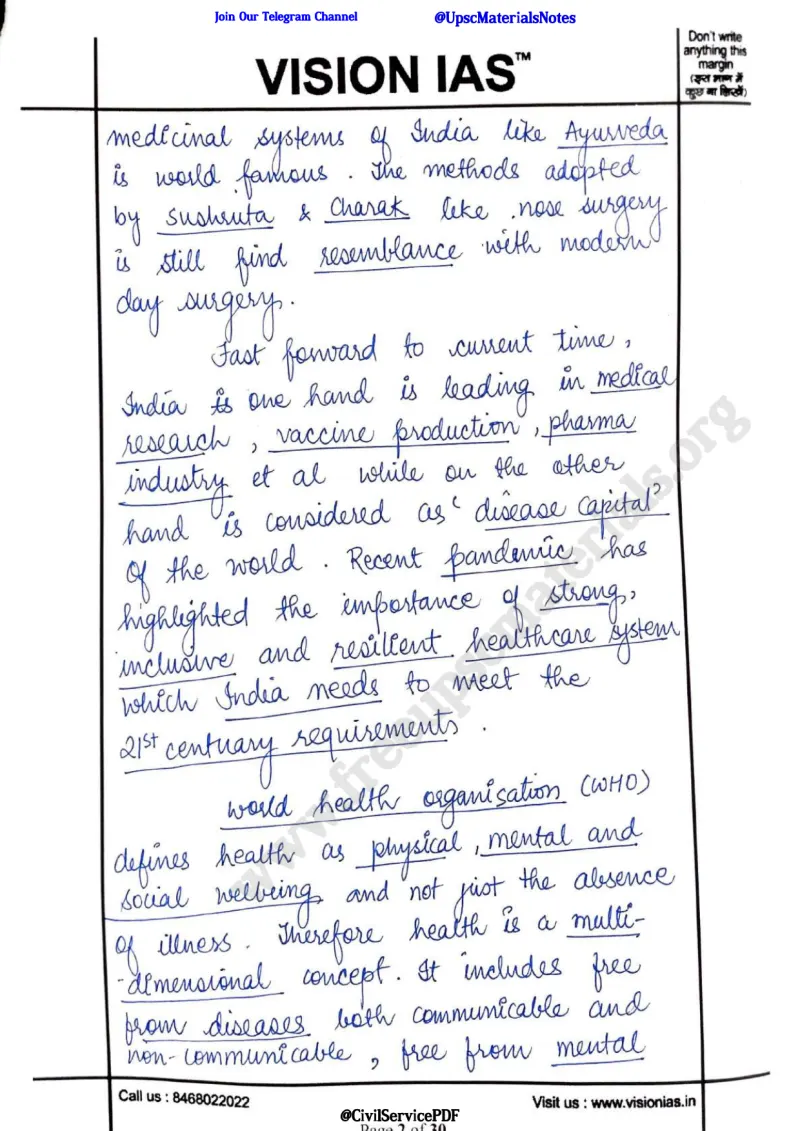
▸Opens the health essay with a sweeping historical hook - Bubonic plague to Spanish flu to COVID-19 - framing health as a recurring civilisational threat
▸Anchors arguments in definitions: cites the WHO 'physical, mental and social wellbeing' definition before calling health multi-dimensional
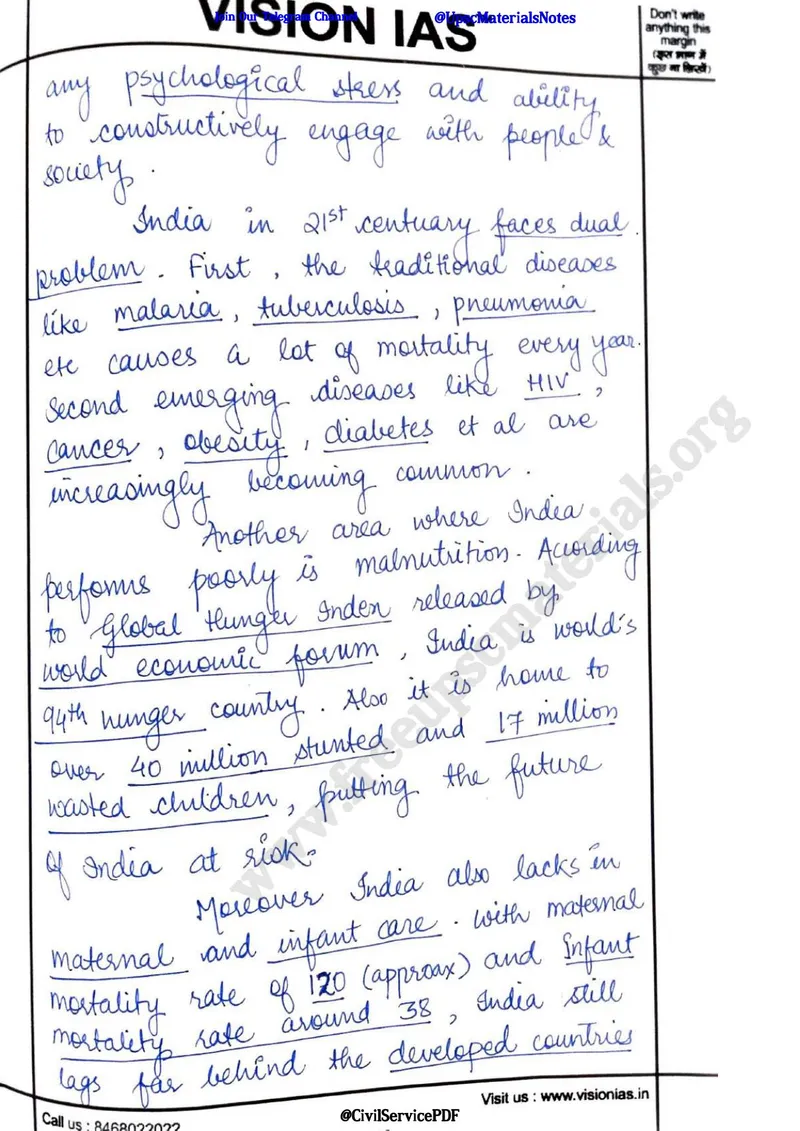
▸Data-backed throughout - Global Hunger Index rank, ~40 million stunted/17 million wasted children, maternal and infant mortality rates, doctor-to-patient ratio
▸Both essays are built from a detailed handwritten mind-map (intro/body/conclusion plus boxed sector-wise angles) visible on the rough-work sheets before the prose
▸The army-of-principles essay sweeps across social, political, economic, international, judicial, legal, ethical, technological and sports angles, each looped back to the theme
▸Closes each essay on a marquee quote - Victor Hugo for health, A.P.J. Abdul Kalam's 'righteousness to peace in the world' ladder for principles
What to learn from this copy
★Shubham opens the health essay with a chronological civilisational hook — Bubonic plague (14th c., ~a third of humanity) -> Spanish flu (~50 million dead) -> COVID-19 — to frame health as a recurring threat across eras before narrowing to India. -> Build your intro as a short historical escalation that ends at the present-day relevance of the prompt, so the reader feels the topic's weight before you state your thesis.
★He anchors the abstract word 'health' in an authoritative definition first — quoting the WHO ('physical, mental and social wellbeing, not merely absence of illness') — and only then argues health is multi-dimensional. -> When an essay turns on a contested/abstract keyword, define it via a credible source up front; the rest of the essay then has a fixed yardstick to argue against.
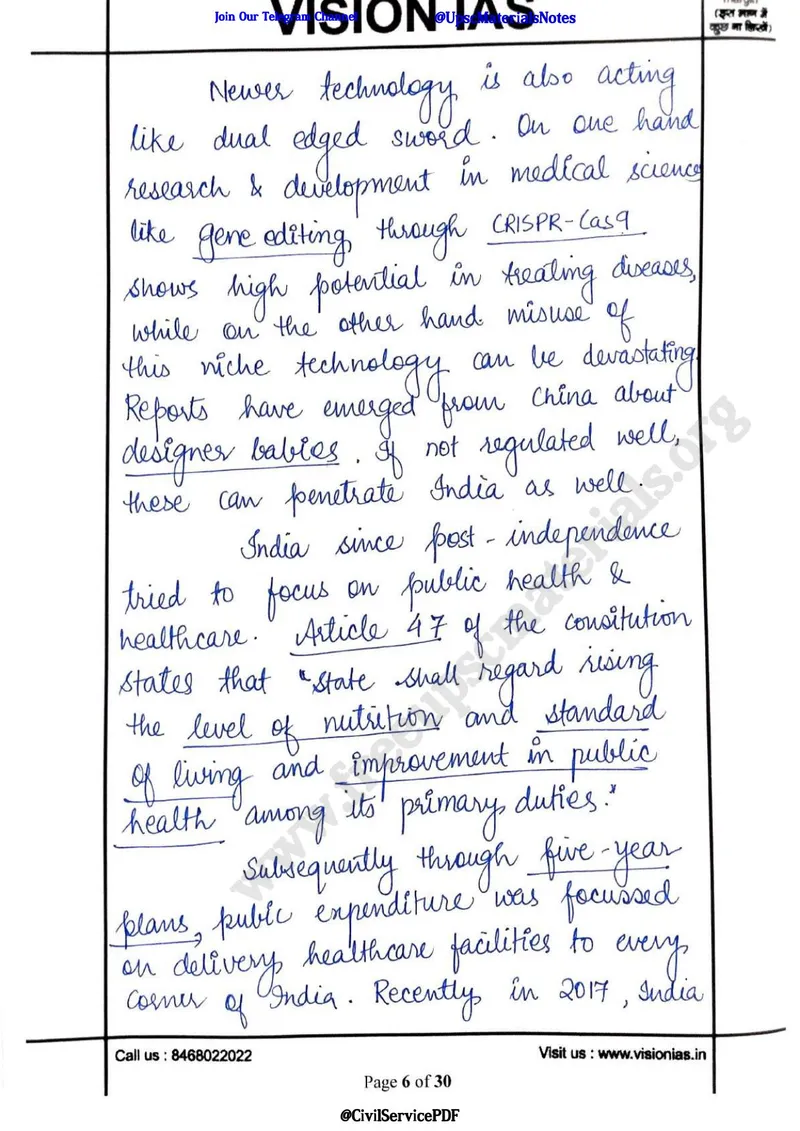
★The body is saturated with concrete India-specific data rather than adjectives: Global Hunger Index rank 94, ~40 million stunted and ~17 million wasted children, maternal mortality ~120, infant mortality ~38, doctor-to-patient ratio ~32 per lakh, plus Article 47 as the constitutional hook. -> Convert claims like 'India's health is weak' into a stacked set of named statistics and the relevant Article — specificity is what separates a topper essay from generic prose.
★Before writing, he made a detailed handwritten mind-map for each essay (visible on the rough sheets) with explicit Intro/Body/Conclusion blocks and boxed sector-wise angles — social, political, economic, international, judicial, legal, ethical, technological, sports — joined by arrows. -> Spend the first minutes drawing a multi-dimensional planning map; the 'boxed angles' method guarantees the essay covers every sphere and reads as deliberately structured, not stream-of-consciousness.
★For the abstract 'army of principles' essay he forces the theme through that same set of distinct sectoral lenses, each looped back to the central idea, so a philosophical quote becomes a 360-degree argument. -> For quote/abstract essays, don't stay philosophical — systematically test the statement across society, politics, economy, law, ethics, technology etc., tying each back to the line.
★Each essay closes on a marquee quotation that mirrors its theme — Victor Hugo's 'no greater force than the idea whose time has come' for health, and Kalam's 'righteousness in the heart... peace in the world' ladder for principles. -> End on a memorized, theme-matched quote that resolves your argument rather than a flat summary; the right closing line leaves the examiner with your thesis in elevated form.
Questions attempted: "A health system to meet 21st century needs in India"; "An army of principles can penetrate where an army of soldiers cannot".
Questions attempted in this booklet (2)+
Section A - Essay 4."A health system to meet 21st century needs in India"
Section B - Essay 5."An army of principles can penetrate where an army of soldiers cannot"
Examples, data & evidence used
Essay 1 (Health) - Bubonic plague (14th century, killed ~one-third of humanity)
Essay 1 - Spanish flu (~50 million deaths)
Essay 1 - COVID-19 / current global pandemic
Essay 1 - WHO definition of health (physical, mental and social wellbeing, not merely absence of illness)
Essay 1 - Ayurveda; Sushruta and Charaka (nose surgery resembling modern surgery)
Essay 1 - Global Hunger Index (India ranked 94th, per World Economic Forum)
Essay 1 - ~40 million stunted and ~17 million wasted children
Essay 1 - Maternal mortality ~120 and infant mortality ~38
Essay 1 - Doctor-to-patient ratio ~32 per lakh population
Essay 1 - Blue Whale challenge (mental health risk to children)
Essay 1 - CRISPR-Cas9 gene editing; 'designer babies' reports from China
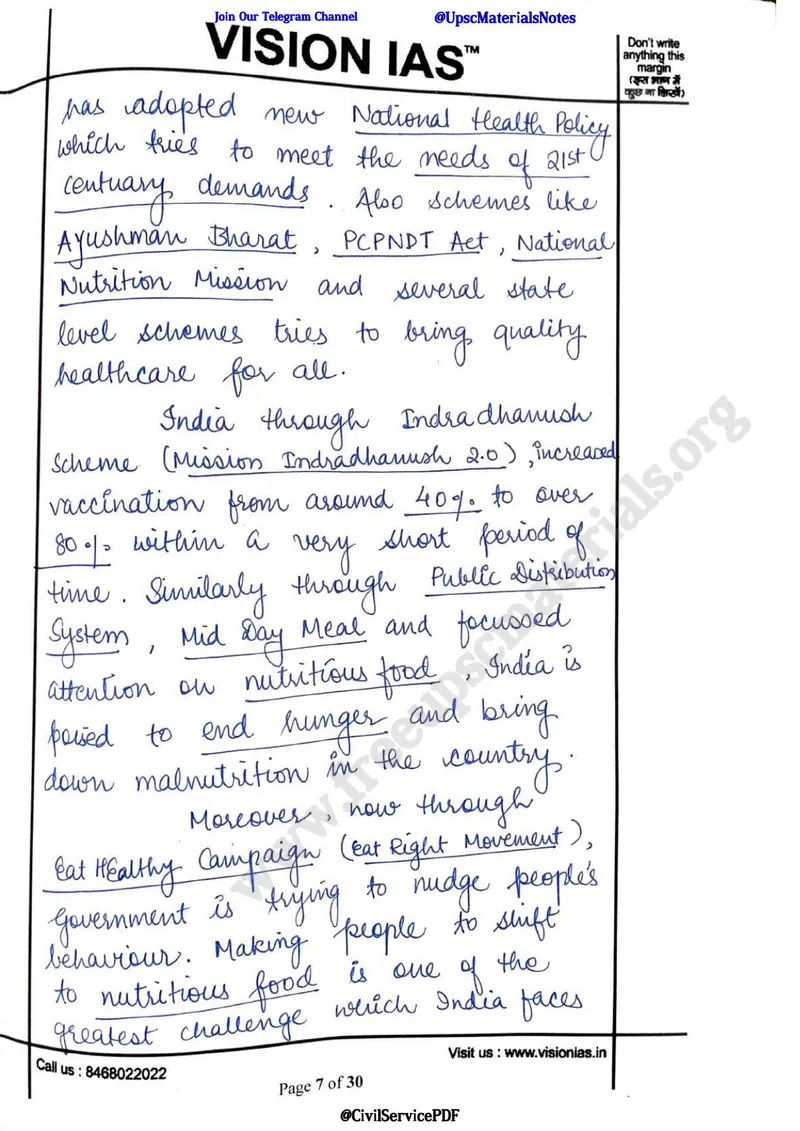
Essay 1 - Article 47 of the Constitution (raising nutrition, standard of living, public health)
Essay 1 - Five-Year Plans
Quotes the candidate used
Victor Hugo: 'There is no greater force than the idea whose time has come.' (closes Essay 1)
Nelson Mandela: 'Education is the most powerful weapon which you can use to change the world.' (Essay 2)
A.P.J. Abdul Kalam: 'Where there is righteousness in the heart, there is beauty in the character. When there is beauty in the character, there is harmony in the home. When there is harmony in the home, there is order in the nation. When there is order in the nation, there is peace in the world.' (closes Essay 2)
How it’s written: Two full-length prose essays, each running roughly half of the 30-page booklet, balanced in length. Each essay is preceded/accompanied by a detailed handwritten PLANNING sheet (mind-map/outline) at the back of the booklet, with explicit Intro / Body / Conclusion blocks and boxed sector-wise sub-themes joined by arro…
Diagrams & visuals: No formal diagrams, flowcharts, maps or tables within the essay bodies (both are continuous prose); Detailed handwritten mind-map / outline planning sheets for both essays - boxed sub-themes (social, political, economic, international, judicial, legal, ethical, technological, sports angles) linked by arrows, with Intro/Body/Conclusion structure
Evaluator: No examiner marks or comments are filled in on this copy.
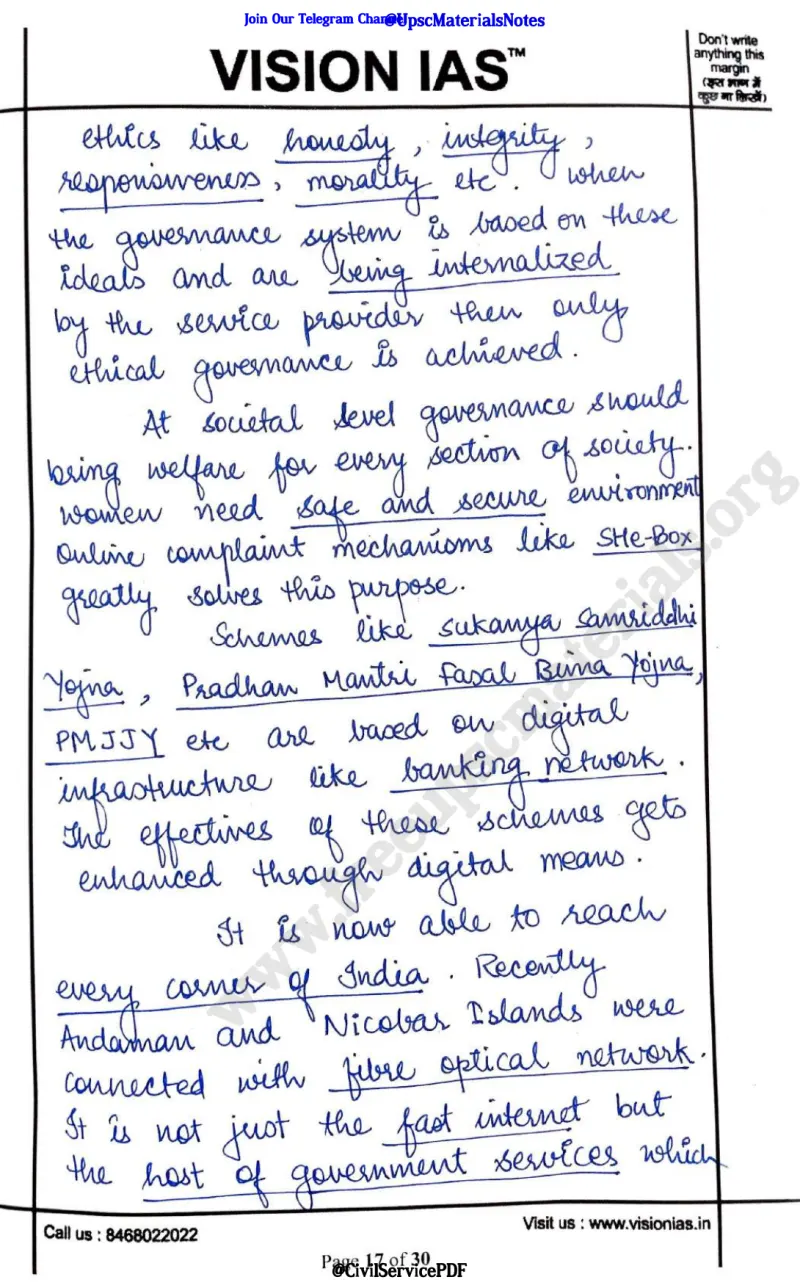
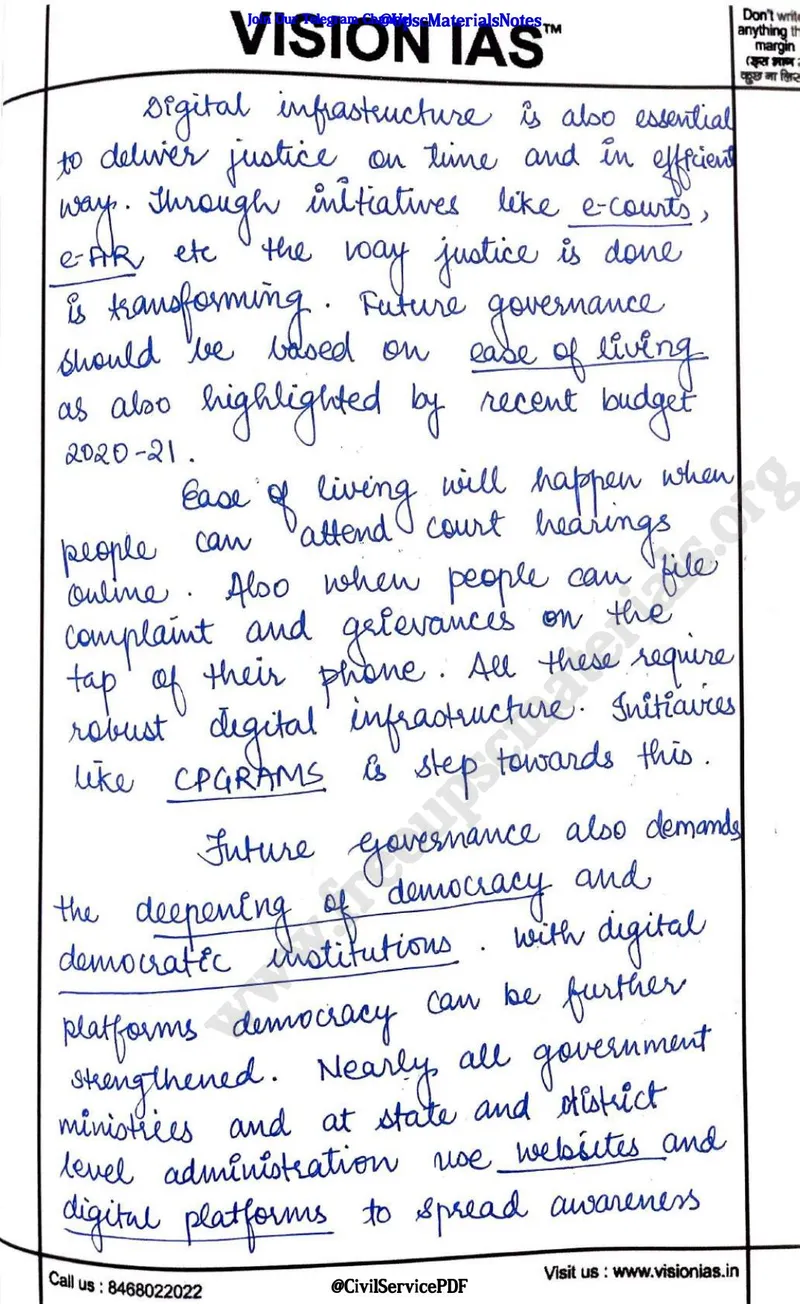
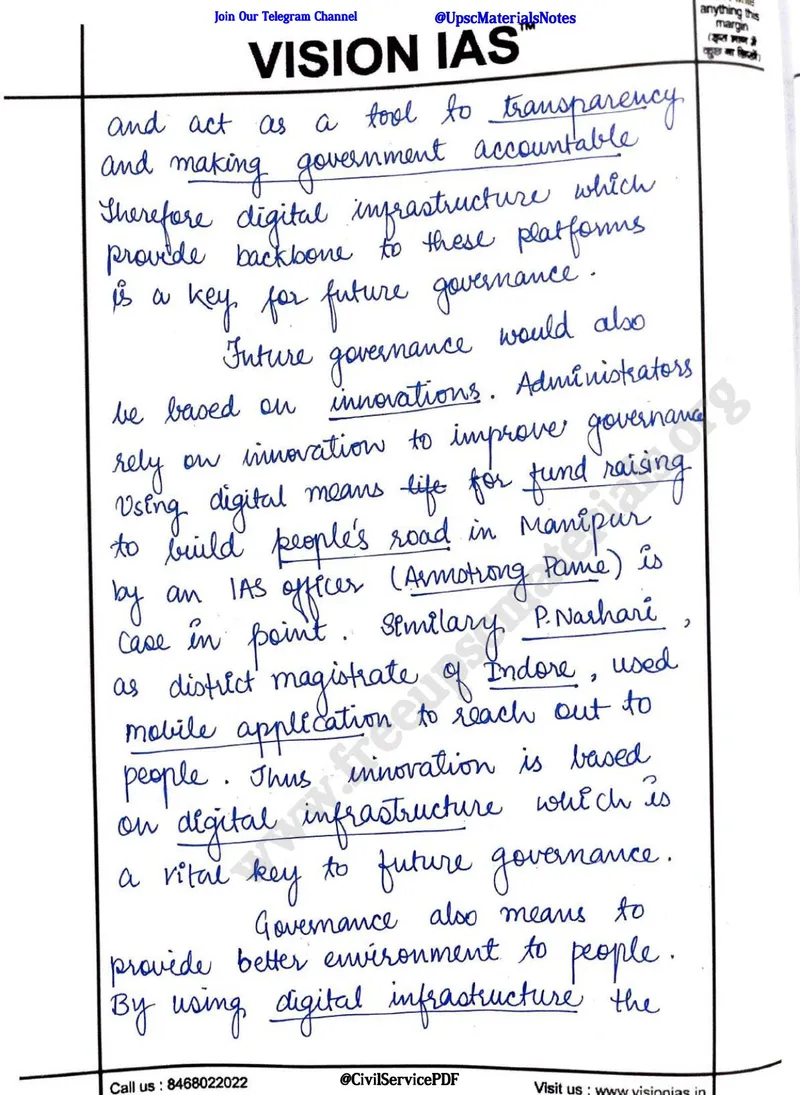
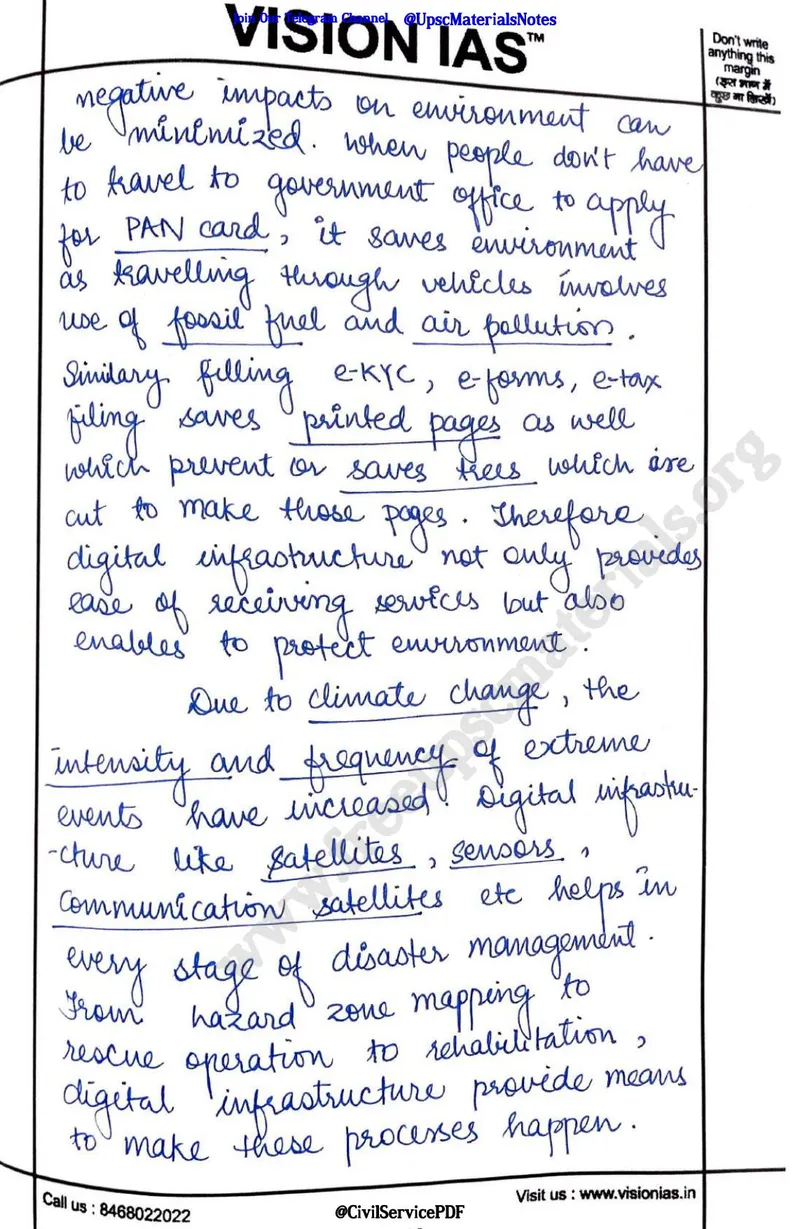
▸AIR 1 Shubham Kumar's VisionIAS essay copy contains two full essays — 'Some things you learn best in calm, and some in storm' and 'Digital Infrastructure is key for future-ready governance.'
▸The calm/storm essay opens with twin parables — Buddha's enlightenment under the peepal tree (calm) and Ashoka's awakening after the Kalinga war (storm) — a story-led hook.
▸He grounds the argument in concrete Indian milestones: Hindu Succession Act 1956 and the Mahalanobis model (calm) versus RTI 2005, Lokpal 2013 and the crisis-born 1991 LPG reforms (storm).
▸The governance essay opens with a Kautilya/Arthashastra quote on the ruler's welfare lying in his subjects' welfare, then maps digital governance across society, economy, justice, democracy and disaster management.
▸Each essay is preceded by a detailed branching mind-map plan — the digital-governance plan alone spans two pages, from schemes (She-Box, PM Fasal Bima, TRIFED) and platforms (PRAGATI, Mission Karmayogi, DBT, eNAM) to challenges (digital divide, 5G imports, surveillance state, data security).
▸He closes with Socrates — 'An unexamined life is not worth living' — linking learning to self-examination, yoga and conscience.
What to learn from this copy
★He opens the calm/storm essay with twin parables that physically embody the two halves of the topic - Buddha attaining enlightenment under the peepal tree after ~40 days of meditation (calm) set directly against Ashoka's awakening after the bloody Kalinga war (storm) -> when a topic has a binary in it, hook the reader with one concrete story for EACH pole in the very first lines, so your introduction itself demonstrates the dichotomy instead of just stating it.
★He proves abstract claims with paired, contrasting Indian milestones rather than vague assertions: calm-phase law-making (Hindu Succession Act 1956, Mahalanobis model) deliberately set against crisis-born change (RTI 2005, Lokpal 2013, the 1991 LPG reforms triggered by the balance-of-payments crisis) -> build your body around matched example-pairs that sit on opposite sides of your argument; the contrast does the analytical work and shows range across history, economy and law.
★He drives a single thread across multiple dimensions in a fixed escalating order - individual -> institutional (ISRO's first satellite-launch failure as a learning) -> economic -> health/education -> international (World Bank, IMF, UN born after wars) -> environmental (Rio 1992) -> nations that failed to learn (fall of USSR, break-up of Pakistan) -> climb deliberately from the personal to the national-to-global scale so the essay visibly widens; including counter-cases of failure-to-learn shows you can argue the negative side too.
★He anchors the governance essay in authority by opening on the Kautilya/Arthashastra line that the ruler's welfare lies in his subjects' welfare, and closes the calm/storm essay on Socrates' 'An unexamined life is not worth living' linking learning to self-examination and conscience -> bookend an essay with a substantive, on-point quotation (an ancient Indian source to open, a philosophical one to close) so the argument is framed by ideas, not decoration.
★Before writing, he made a two-page branching mind-map plan (booklet pages 29-30): a hub-and-spoke flowchart fanning Governance into Historical/Social/Economic/Political/Constitutional/Environmental branches, with sub-nodes for Women/Tribal/Children/Health/Disaster, stocked with ready specifics (She-Box, PM Fasal Bima, PRAGATI, Mission Karmayogi, DBT, eNAM) and a numbered 1-7 Challenges list plus Way Forward and Conclusion nodes -> invest the first minutes in a visual brainstorm that pre-loads concrete schemes and a challenges-to-way-forward arc, so the prose flows in one structured pass instead of drifting.
Questions attempted: "There are some things you learn best in calm, and some in storm" — learning across calm vs crisis phases (individual, institutional, national, international); "Digital Infrastructure is key for future-ready governance" — digital infra as backbone of good/ethical governance, with challenges and way forward.
Questions attempted in this booklet (2)+
Section A, Q3."There are some things you learn best in calm, and some in storm" — learning across calm vs crisis phases (individual, institutional, national, international)
Section B, Q7."Digital Infrastructure is key for future-ready governance" — digital infra as backbone of good/ethical governance, with challenges and way forward
Examples, data & evidence used
Kautilya / Arthashastra — concept of governance (welfare of subjects)
Buddha — enlightenment under peepal tree after ~40 days of meditation (calm)
Ashoka — transformation after the Kalinga war, turn to path of Dhamma (storm)
Gandhi — 'Struggle-Truce-Struggle' method; Non-Cooperation, Salt Satyagraha, Quit India movements
Hindu Succession Act 1956; Prevention of Atrocities Act 1989 (calm-phase legislation)
Mahalanobis model — rapid industrialisation / core industries (1950s)
1991 LPG reforms — liberalisation & privatisation, end of License Raj, balance-of-payments crisis
IITs, AIIMS, IIMs and 3-tier health infrastructure; COVID-19 driving tele-education & tele-medicine
ISRO — first satellite launch failure as a learning that shaped later success
World Bank & IMF (Bretton Woods agreement); United Nations — institutions born after wars/conflicts/Cold War
Rio Summit 1992 (environmental governance)
Fall of USSR and break-up of Pakistan — nations that failed to learn from history
She-Box (online complaint mechanism for women)
Quotes the candidate used
Kautilya (Arthashastra): "In the happiness of his subjects lies the King's happiness; in their welfare his welfare. He shall not consider as good only that which pleases him but treat as beneficial to him whatever pleases his subjects."
Socrates: "An unexamined life is not worth living."
"Life itself is the greatest teacher of all" (used as 'As rightly said' — no author attributed)
How it’s written: Both essays follow a disciplined, multi-dimensional structure. The calm/storm essay opens with twin parables (Buddha = calm, Ashoka = storm), defines 'learning', then moves through individual → institutional (ISRO) → economic → health/education → international → environmental dimensions, addresses why some people/na…
Diagrams & visuals: Two-page branching mind-map / brainstorm plan for the digital-governance essay (booklet pages 29-30): hub-and-spoke flowchart with arrows branching Governance into Historical/Social/Economic/Political/Constitutional/Environmental, sub-branches for Women, Tribal, Children, Health, International, Disaster, a numbered Challenges list (1-7) and a Way Forward + Conclusion node; No in-text diagrams within the essay bodies themselves — the essays are continuous prose; the diagrammatic content is confined to the pre-writing planning pages
Evaluator: No examiner marks or comments are filled in on this copy.
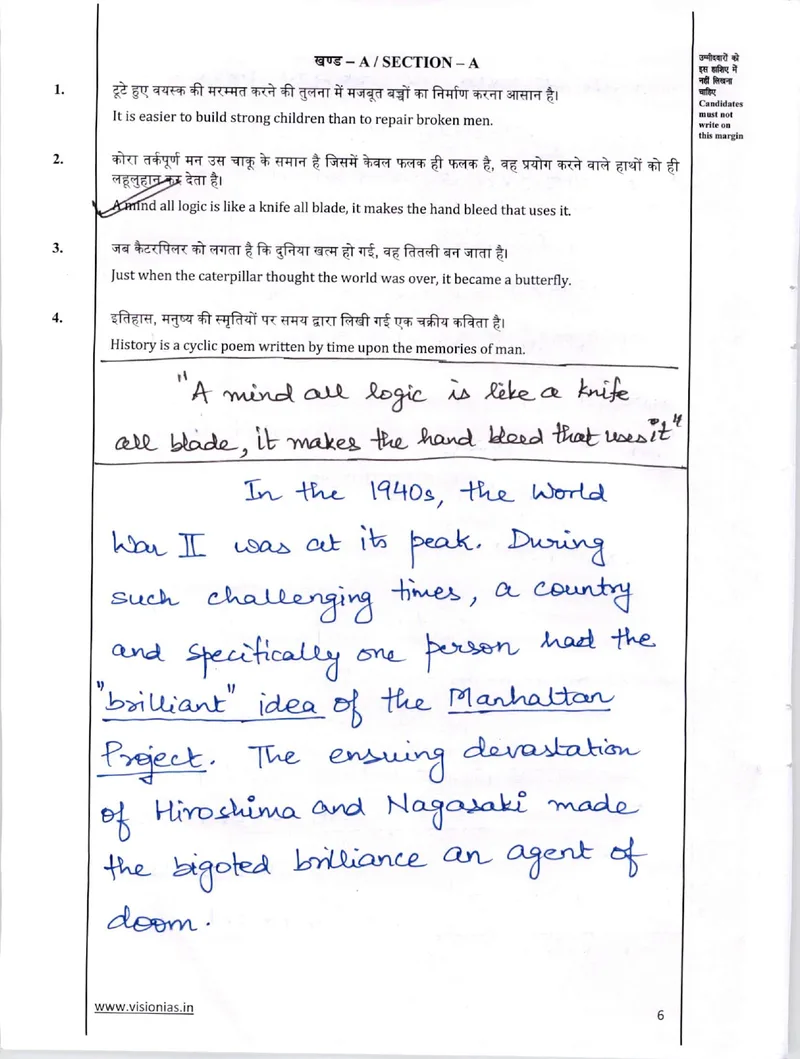
▸Chose Section A topic 2 — 'A mind all logic is like a knife all blade, it makes the hand bleed that uses it'
▸Opens straight into a historical anecdote — World War II and the Manhattan Project — rather than an abstract definition of logic versus emotion
▸Frames the atomic bomb as the 'brilliant' idea whose 'bigoted brilliance' at Hiroshima and Nagasaki became 'an agent of doom', setting logic-without-conscience as the essay's spine
▸Underlines keywords ('brilliant', 'Manhattan Project') in the same blue ink to guide the examiner's eye
▸Written in the actual UPSC QCA format under a three-hour, ~1000–1200-word-per-essay constraint; the candidate scored 117/250 in Essay in CSE 2023
What to learn from this copy
★Opens the essay with a single sustained historical case — WWII and the Manhattan Project — instead of a dictionary-style definition of 'logic'. -> A concrete, high-stakes story as the hook lets an abstract prompt land immediately; pick one vivid episode that already embodies the clash you will argue.
★Turns the example into the argument: the 'brilliant' idea whose devastation became 'an agent of doom' IS the thesis that logic without conscience is self-harming. -> Engineer your opening example so it carries your core claim, not just colour; the hook and the thesis should be the same image.
★Uses deliberate underlining of keywords to spotlight the essay's spine for a fast-reading examiner. -> Consistent, purposeful emphasis of your key terms helps a time-pressed evaluator catch your argument on a single pass.
Questions attempted: A mind all logic is like a knife all blade, it makes the hand bleed that uses it.
Questions attempted in this booklet (1)+
Section A, topic 2.A mind all logic is like a knife all blade, it makes the hand bleed that uses it
Examples, data & evidence used
World War II and the Manhattan Project — 'one person had the brilliant idea', whose 'bigoted brilliance' at Hiroshima and Nagasaki became 'an agent of doom' — opening the case that logic without conscience is destructive
How it’s written: Anecdote-led. Opens on the WWII / Manhattan Project story to dramatise 'a mind all logic': the 'brilliant' but conscience-free idea whose devastation at Hiroshima and Nagasaki turned brilliance into 'an agent of doom'. Keywords ('brilliant', 'Manhattan Project') are underlined in the same blue ink for emphasis.
Evaluator: VisionIAS Abhyaas Mains practice booklet (Test Code 2488, written 25 Aug 2023). The evaluation / macro-feedback page is left blank — no examiner marks or comments are filled in.
Read from the copy: the Section A essay opening ('A mind all logic…'). The booklet also contains a second essay from Section B, which is not transcribed here.
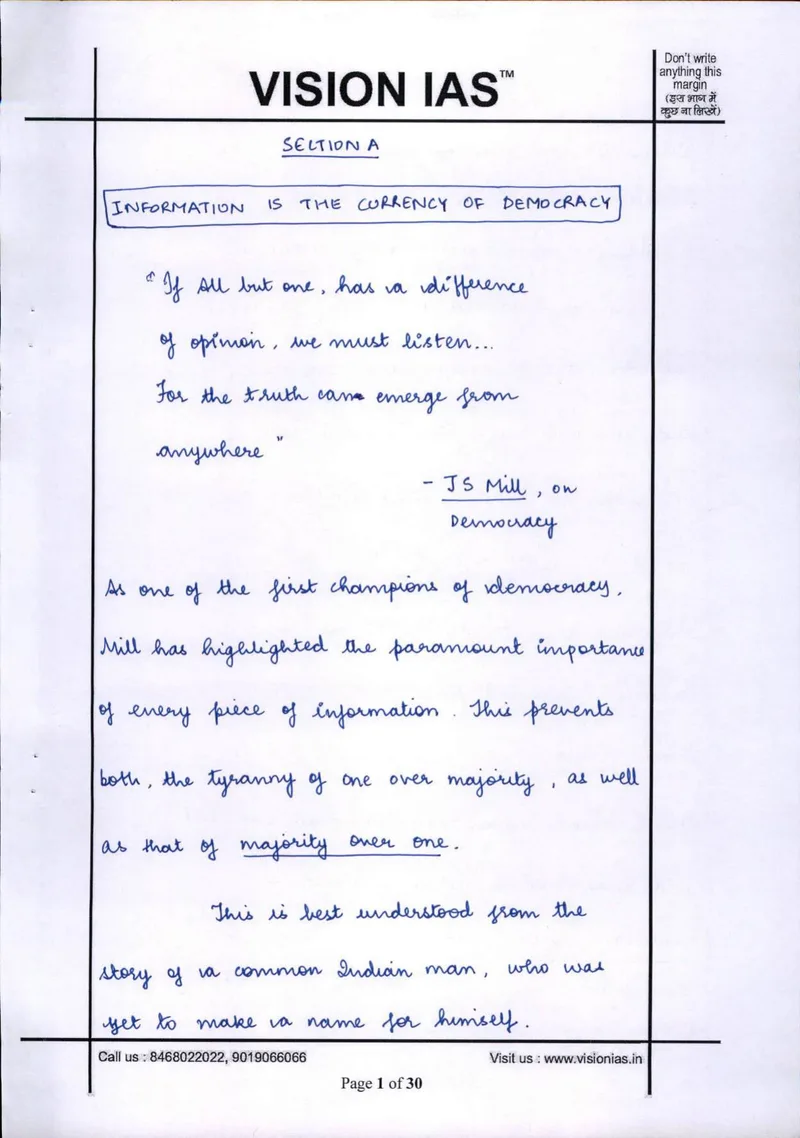
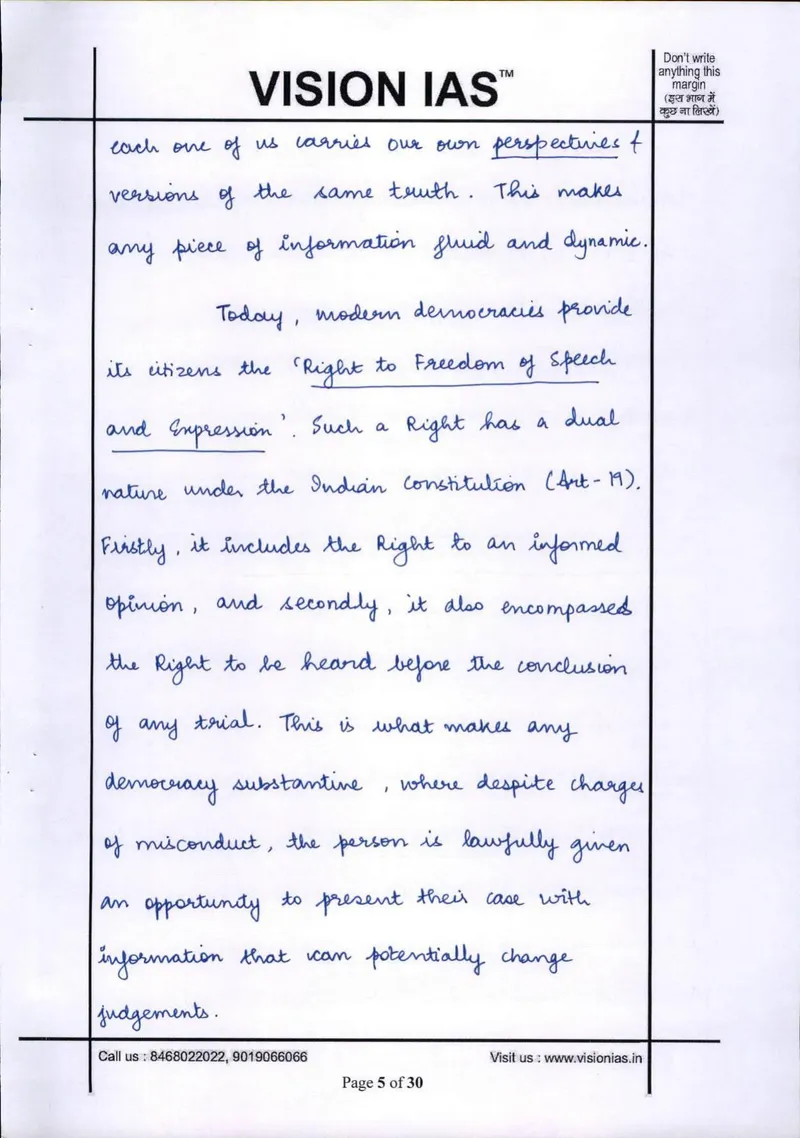
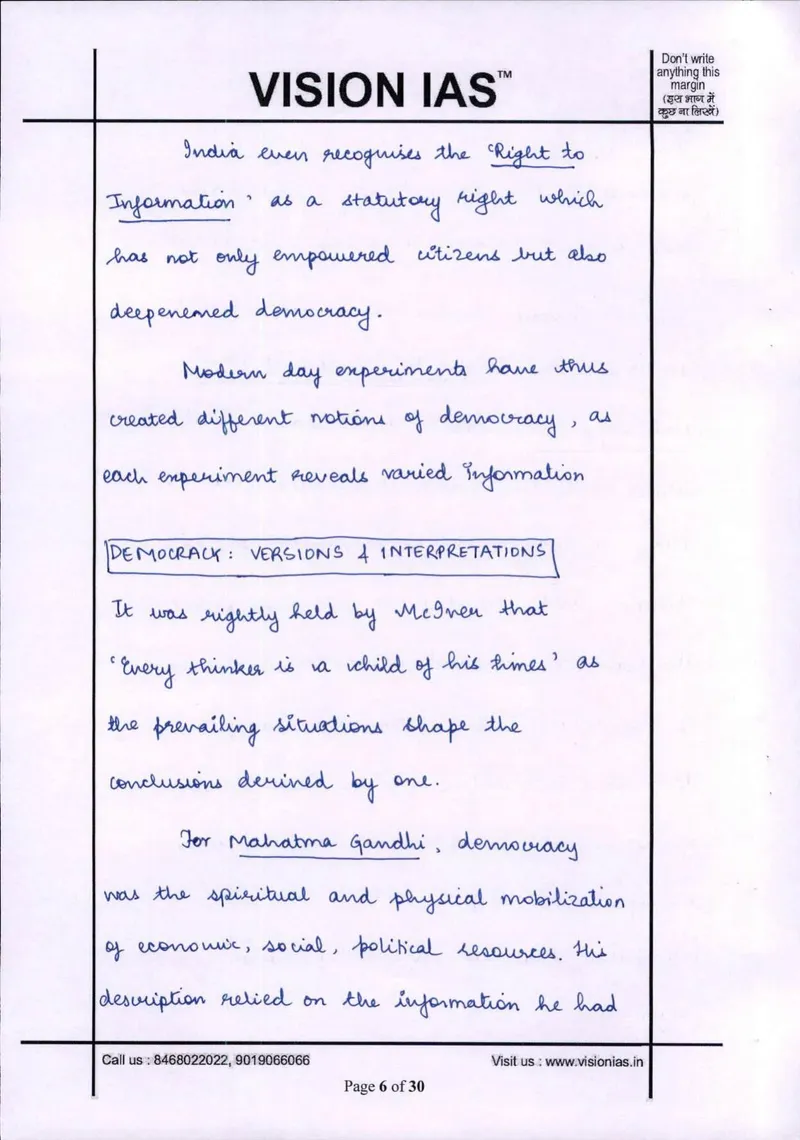
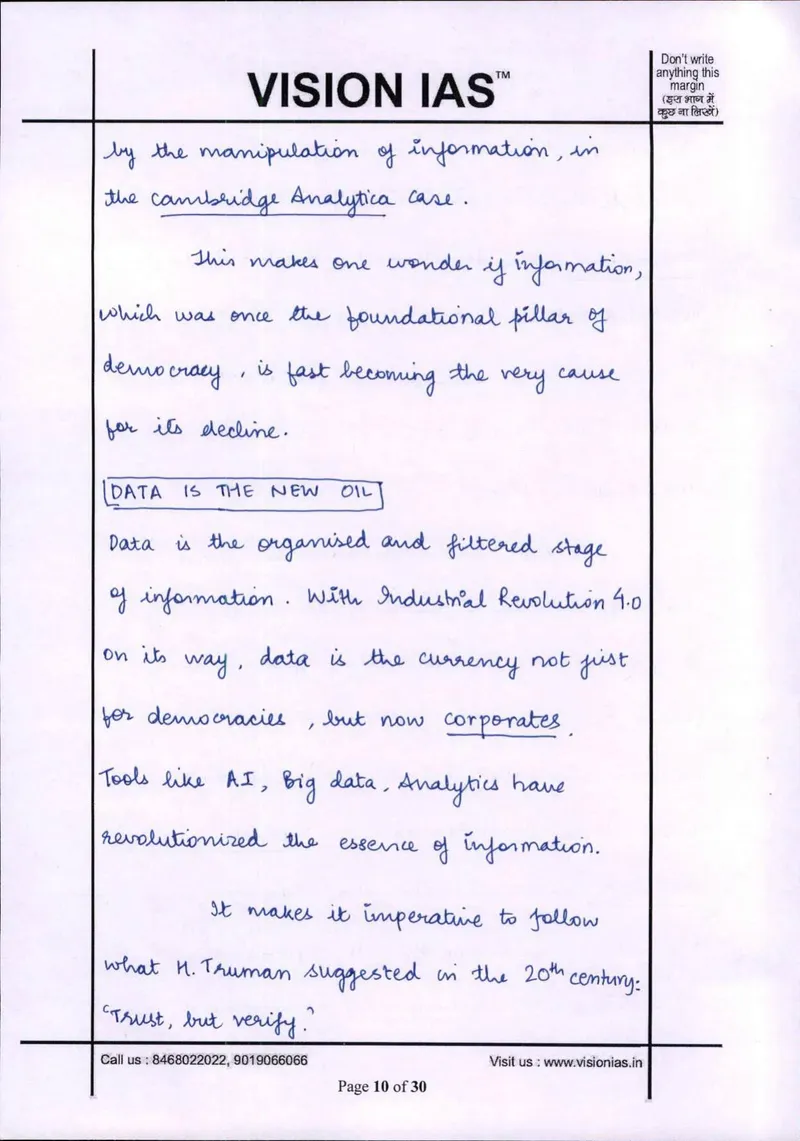
▸Section A essay titled 'Information is the currency of democracy'
▸Opens with a J.S. Mill epigraph — 'If all but one has a difference of opinion, we must listen… for the truth can emerge from anywhere' — and frames the thesis that information guards against both 'the tyranny of one over majority' AND 'that of majority over one'
▸Grounds the abstract claim in one sustained story: Raghuram Rajan, whose 'Fault Lines' foresaw the 2008 crash but whose warnings were 'discarded as bearish paranoia'
▸Widens to India's own dialogic tradition — Amartya Sen's 'The Argumentative Indian', the Gargi–Yajnavalkya debate in the Chandogya Upanishad, Buddhist Sabhas and Samitis, and Jain Anekantvada
▸Consistent underlining of key terms guides the examiner through the argument; Ishita scored 137/250 in Essay in CSE 2022
What to learn from this copy
★Frames an abstract prompt with a precise, quotable thesis in the first paragraph — information prevents the tyranny of one over the majority AND of the majority over one. -> State a sharp, two-sided thesis early; examiners reward a clear central claim they can track, and a balanced formulation signals nuance.
★Proves the thesis through ONE developed case (Raghuram Rajan / 'Fault Lines' / 2008) rather than a list of names. -> A single example carried across cause, consequence and outcome is more persuasive than many shallow references; show the mechanism.
★Roots a modern, Western-flavoured argument in indigenous Indian sources — Amartya Sen, Upanishadic debate, Buddhist assemblies, Anekantvada. -> Anchoring your point in Indian intellectual tradition adds originality and cultural depth that generic essays miss.
Questions attempted: Information is the currency of democracy.
Questions attempted in this booklet (1)+
Section A.Information is the currency of democracy
Examples, data & evidence used
Raghuram Rajan and his book 'Fault Lines' — the 'common Indian man' who forewarned the 2008 Global Financial Crisis but whose warnings were 'discarded as bearish paranoia' until Western banks fell 'like dominoes'
Amartya Sen's 'The Argumentative Indian' on India's democratic roots — the Gargi–Yajnavalkya debates in the Chandogya Upanishad and the Buddhist Sabhas and Samitis
Anekantvada (Jainism) as the doctrine of plural, many-sided truth
Quotes the candidate used
J.S. Mill (on Democracy): 'If all but one has a difference of opinion, we must listen… for the truth can emerge from anywhere'
How it’s written: Quote-led. Opens with a boxed title 'Information is the currency of democracy' and a J.S. Mill epigraph, then states the thesis that information prevents 'both the tyranny of one over majority, as well as that of majority over one'. Develops via one sustained narrative (Raghuram Rajan / the 2008 crisis) before widening to India's own argumentative, dialogic tradition (Amartya Sen, Upanishadic debate, Buddhist assemblies, Anekantvada). Key terms underlined throughout.
Evaluator: VisionIAS essay evaluation booklet. No examiner marks are visible on the pages read.
Read: the Section A essay ('Information is the currency of democracy') — title page and first four written pages of this booklet (one of a three-part file set for this topper's essay).
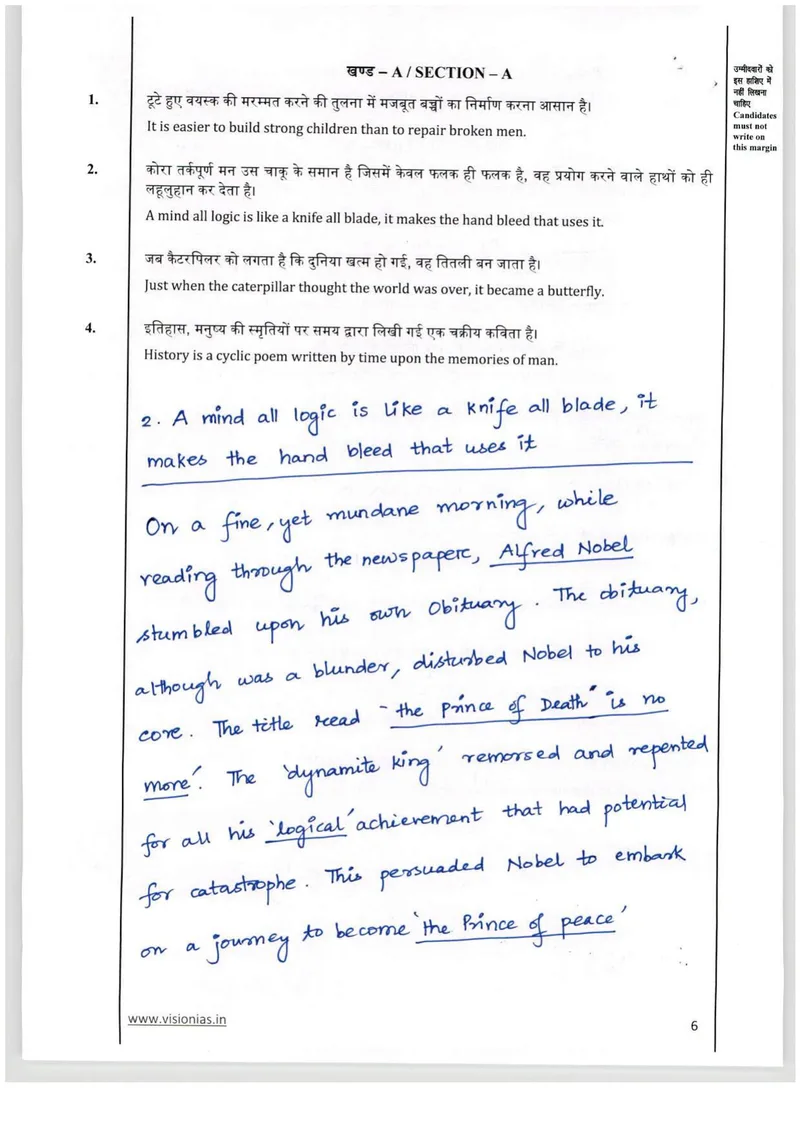
▸Chose the same Section A topic 2 as AIR 1 Aditya Srivastava — 'A mind all logic is like a knife all blade…' — but with a completely different opening
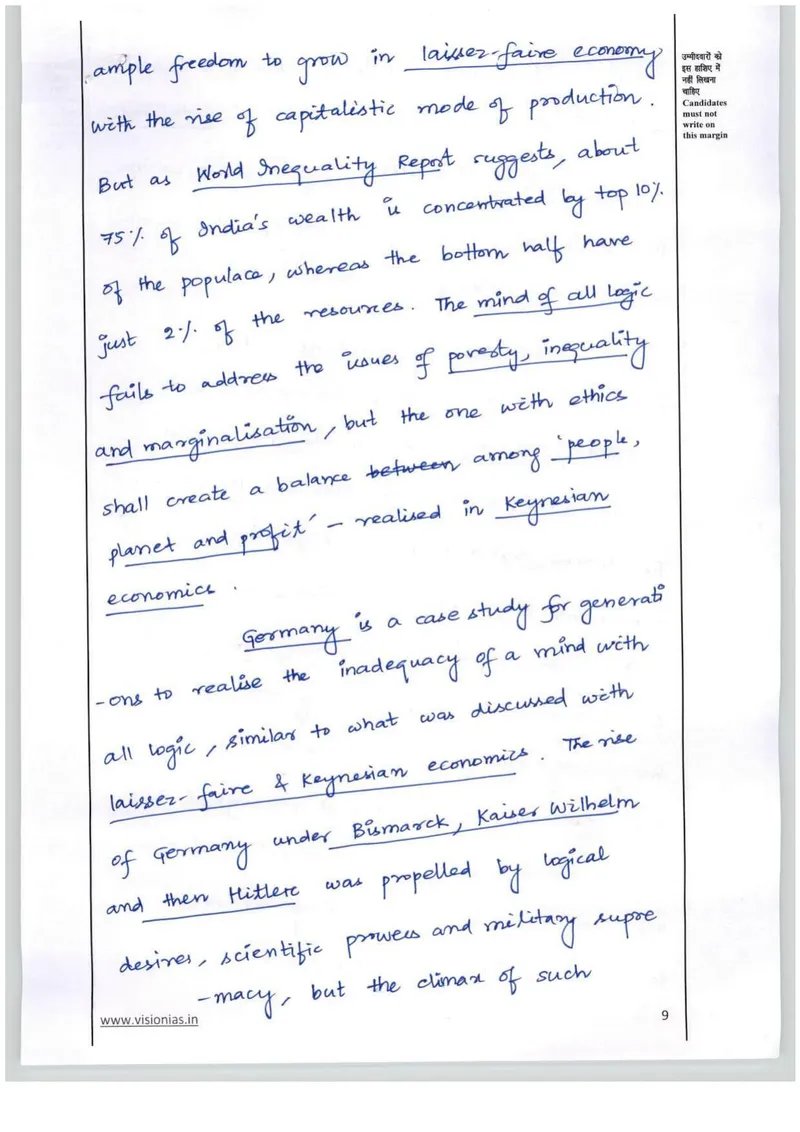
▸Opens with the Alfred Nobel obituary anecdote: Nobel reads his own premature death notice branding him 'the Prince of Death' and repents his 'logical' inventions 'that had potential for catastrophe'
▸Uses Nobel's turn from 'Prince of Death' to 'Prince of peace' as the device for logic redeemed by conscience
▸Underlines the key proper nouns and phrases in blue ink for emphasis
▸Same VisionIAS Test 2488 essay paper as Aditya Srivastava — a like-for-like comparison of two toppers on one prompt; Animesh scored 133/250 in Essay in CSE 2023
What to learn from this copy
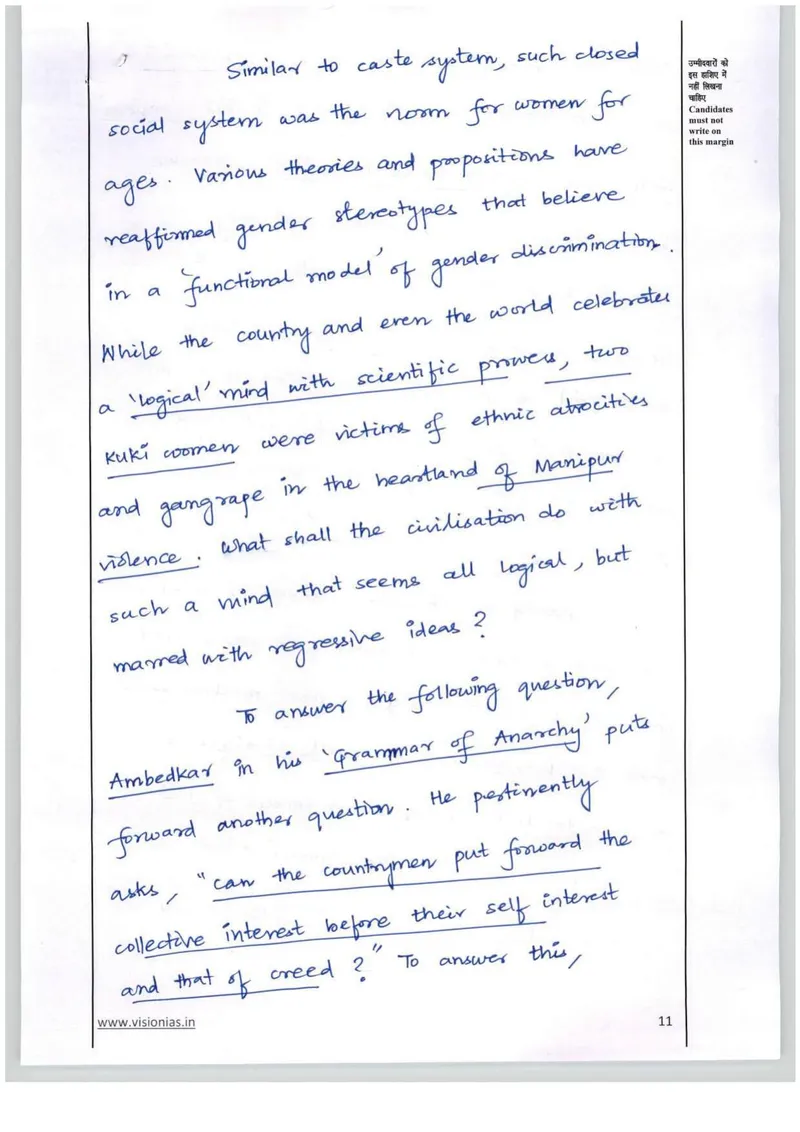
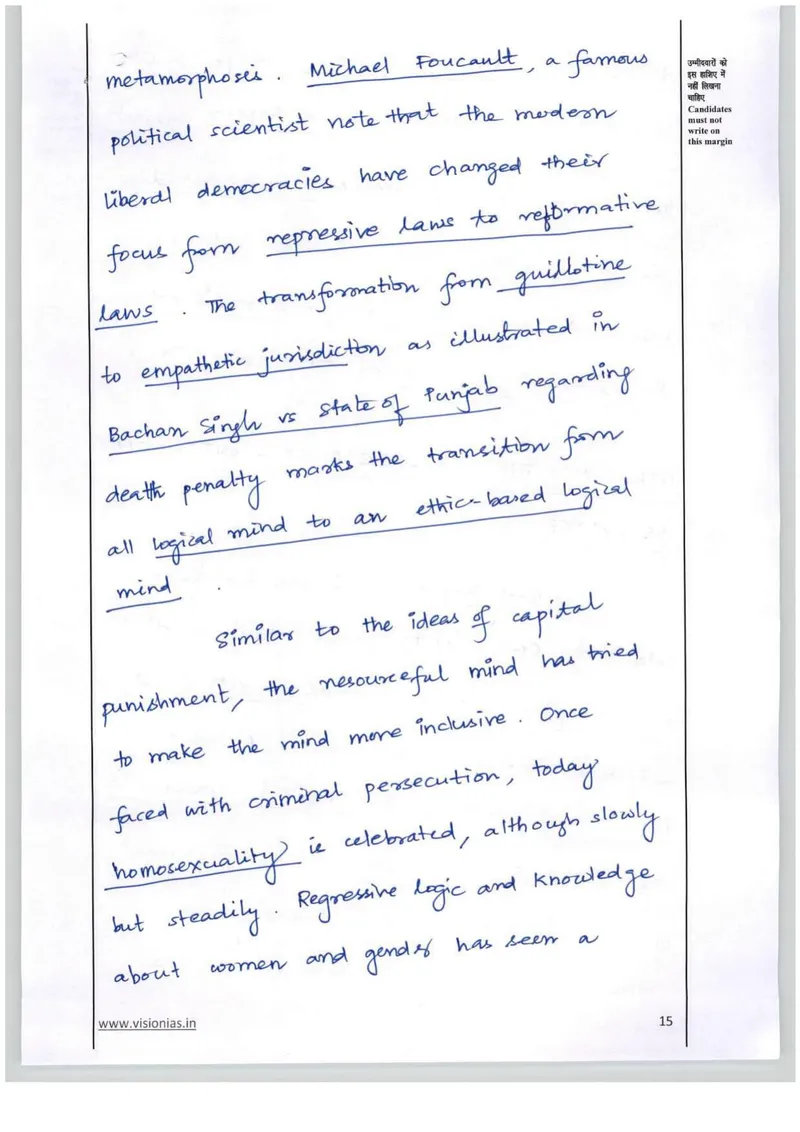
★Answers the identical prompt as the AIR 1 copy but opens on a totally different story (Alfred Nobel, not the Manhattan Project). -> There is no single 'correct' example for a philosophical essay; a well-chosen, well-developed anecdote of your own beats a 'standard' one, and originality of illustration is itself a differentiator.
★Picks an anecdote with a built-in arc — Nobel moving from 'Prince of Death' to 'Prince of peace' — so the hook already contains the essay's resolution. -> Choose an opening story that travels from problem to redemption; it lets you preview your synthesis in the very first paragraph.
★Underlines the pivotal phrases so the transformation is unmissable on a quick read. -> Emphasis markup should fall on the words that carry your argument's turning point, not be used decoratively.
Questions attempted: A mind all logic is like a knife all blade, it makes the hand bleed that uses it.
Questions attempted in this booklet (1)+
Section A, topic 2.A mind all logic is like a knife all blade, it makes the hand bleed that uses it
Examples, data & evidence used
Alfred Nobel reading his own premature obituary ('the Prince of Death is no more') — the 'dynamite king' repenting his 'logical' achievements 'that had potential for catastrophe' and resolving to become 'the Prince of peace' (the founding impulse of the Nobel Peace Prize)
How it’s written: Anecdote-led. Opens on the Alfred Nobel obituary story — Nobel confronting his legacy as the 'Prince of Death' and turning toward peace — to dramatise the same prompt Aditya Srivastava answered. Keywords ('Alfred Nobel', 'the Prince of Death', 'logical', 'the Prince of peace') are underlined.
Evaluator: VisionIAS Abhyaas Mains practice booklet (Test Code 2488). Evaluation page blank — no examiner marks or comments.
Read: the Section A essay opening. The booklet also contains a Section B essay, not transcribed here.
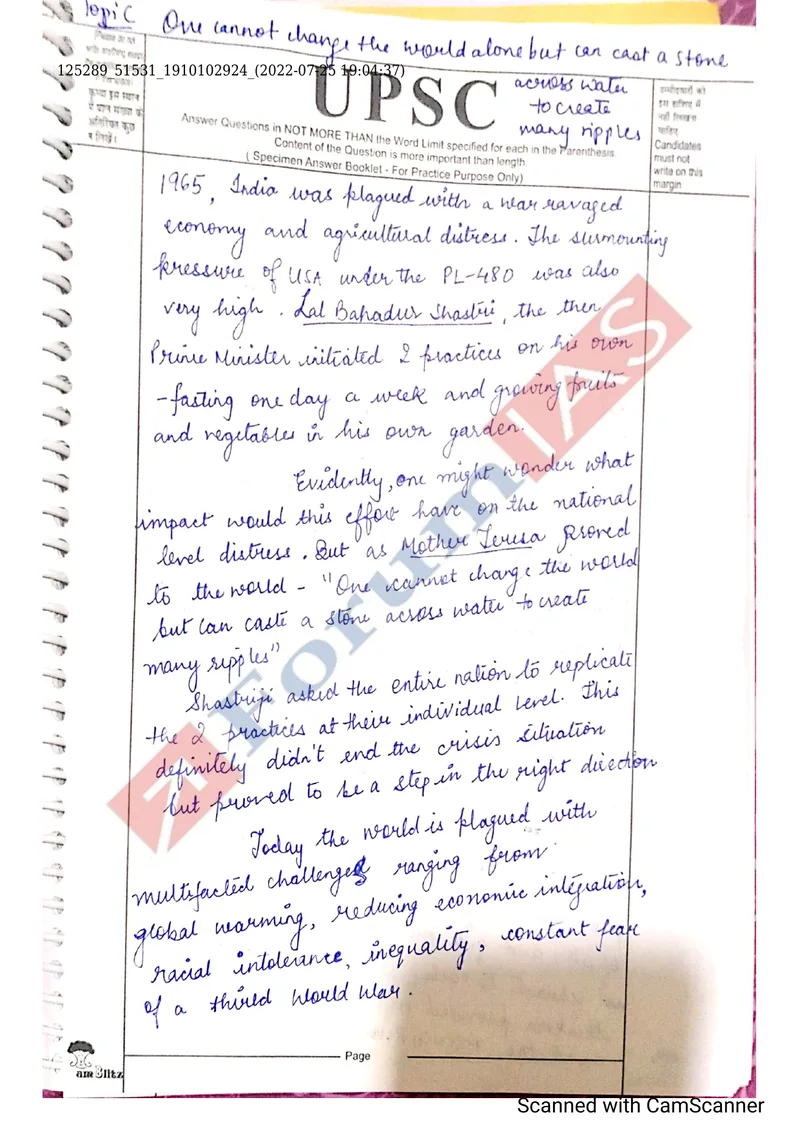
▸Essay topic — 'One cannot change the world alone but can cast a stone across water to create many ripples' (a Mother Teresa line)
▸Opens with Lal Bahadur Shastri in 1965: amid PL-480 pressure and agricultural distress he fasted one day a week and grew vegetables at home, then asked the nation to follow — 'a step in the right direction' rather than an instant fix
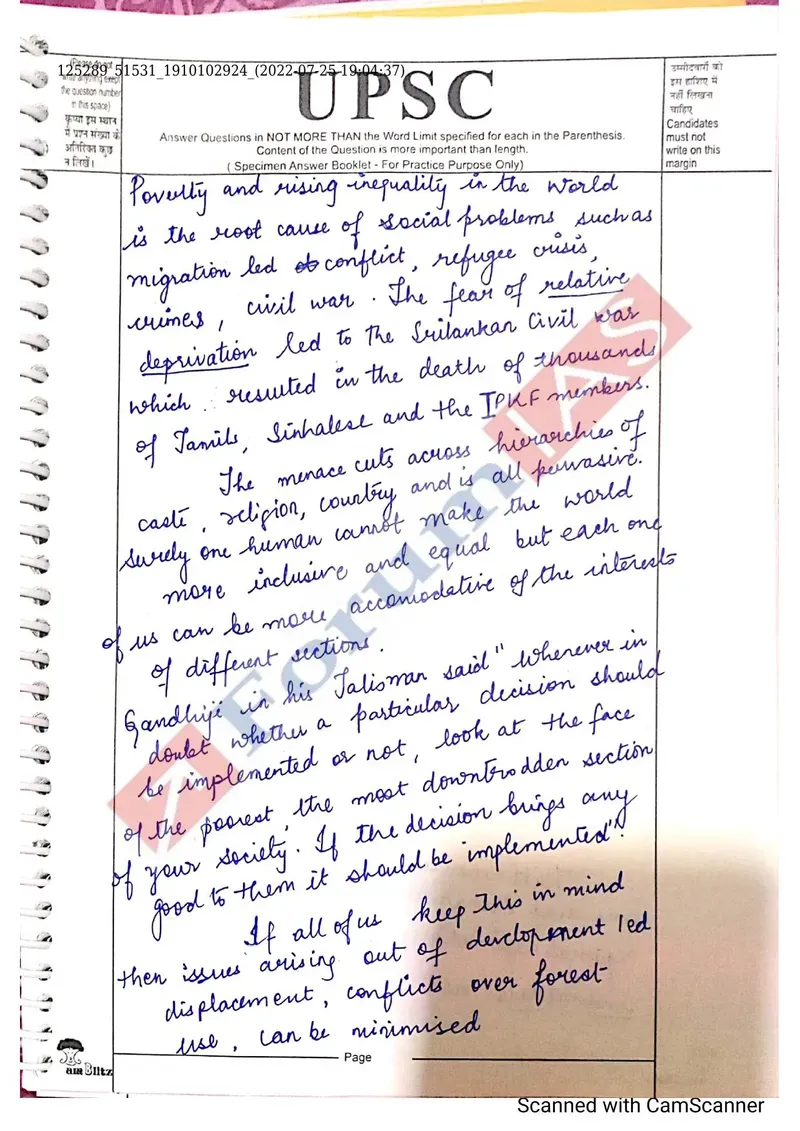
▸Builds the 'ripples' thesis through women who took the first step against patriarchy — Rupan Bajaj (case against a 'supercop'), Bhanwari Devi (→ Vishakha guidelines), Nirbhaya (→ POSH Act, IPC 375, fast-track courts)
▸Explicitly acknowledges that first steps meet 'initial failures, retaliation and oppression' but should not demotivate one
▸Underlines the key figures to anchor each 'ripple'; Garima scored 131/250 in Essay in CSE 2022
What to learn from this copy
★Illustrates an abstract 'small acts, big ripples' prompt with a chain of concrete, verifiable cases (Shastri, Rupan Bajaj, Bhanwari Devi, Nirbhaya) rather than generalities. -> Stack a few well-sourced, causally-linked examples — each showing an individual act that produced institutional change — to make an abstract thesis undeniable.
★Pairs a historical-administrative example (Shastri) with social-justice ones (women's-rights milestones) to show the idea works across domains. -> Draw examples from different fields (governance, society, law) so the essay reads as a universal principle, not a one-domain point.
★Names the real cost of taking the first step — 'initial failures, retaliation and oppression' — instead of romanticising it. -> Acknowledging the difficulty and setbacks of change makes an inspirational essay credible rather than naive.
Questions attempted: One cannot change the world alone but can cast a stone across water to create many ripples.
Questions attempted in this booklet (1)+
Section (topic C).One cannot change the world alone but can cast a stone across water to create many ripples
Examples, data & evidence used
Lal Bahadur Shastri (1965) — amid a war-ravaged economy, PL-480 pressure from the USA and agricultural distress, fasting one day a week and growing vegetables in his own garden, then asking the nation to replicate it
Rupan Bajaj — the IAS officer who filed a sexual-harassment case against a 'supercop', was 'threatened, ridiculed and initially lost the case' but ultimately won in the Supreme Court
Bhanwari Devi — whose case led to the Vishakha guidelines
Nirbhaya — leading to fast-track courts, stringent IPC Section 375 provisions and the POSH Act
Quotes the candidate used
Mother Teresa: 'One cannot change the world but can cast a stone across water to create many ripples'
How it’s written: Example-driven. Opens on Lal Bahadur Shastri's individual gesture during the 1965 crisis (fasting plus a kitchen garden) as the 'one small step / ripple', tied to the Mother Teresa quote, then argues small individual acts compound into national and institutional change — illustrated through women who broke patriarchal barriers (Rupan Bajaj, Bhanwari Devi → Vishakha, Nirbhaya → POSH Act). Key names underlined.
Evaluator: ForumIAS UPSC specimen practice booklet (Jul 2022). No examiner marks are visible on the pages read.
Read: the essay title and first three written pages.
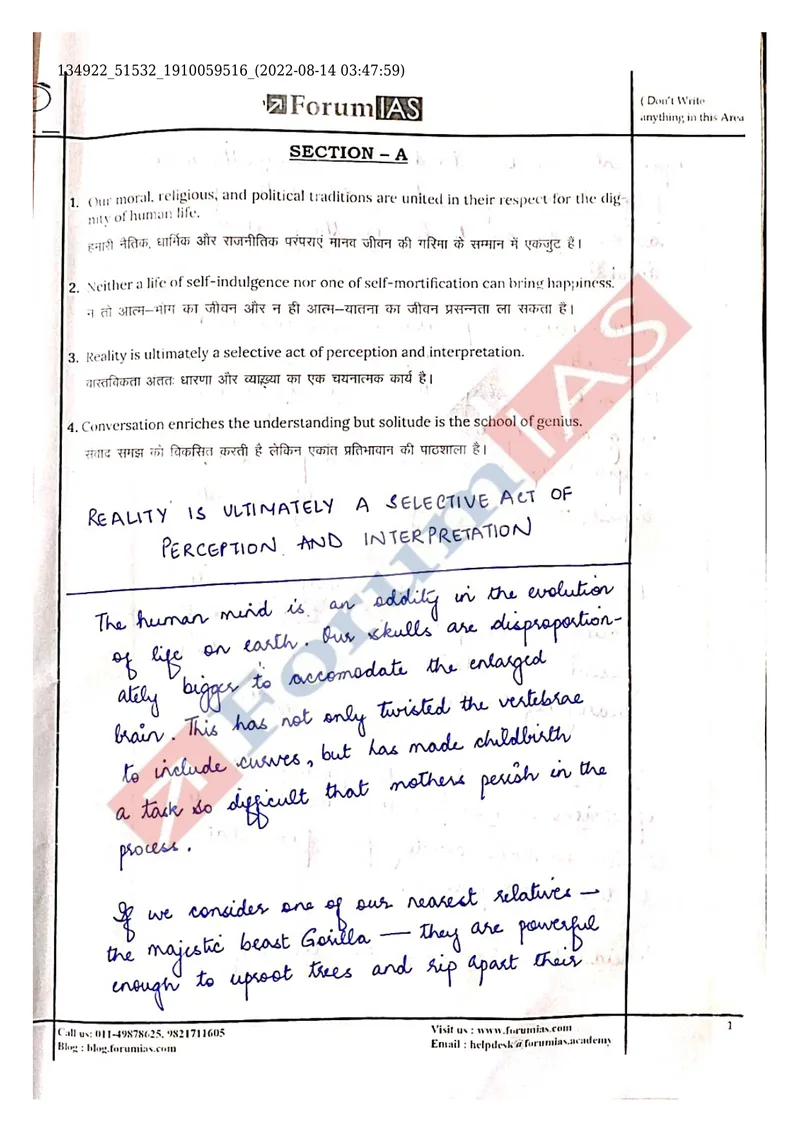
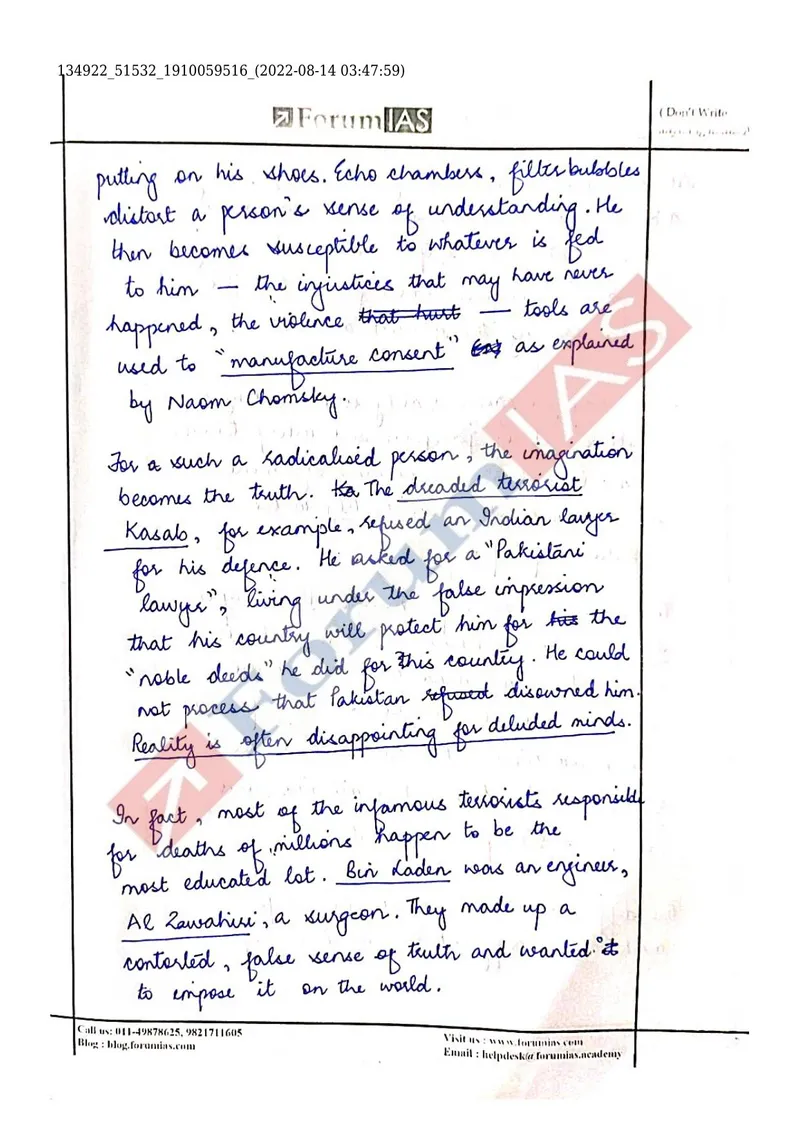
▸Chose Section A topic 3 — 'Reality is ultimately a selective act of perception and interpretation'
▸Opens on an evolutionary paradox: the outsized human brain that makes childbirth perilous, yet lets 'meek, fragile Homo sapiens' rule the planet through awareness
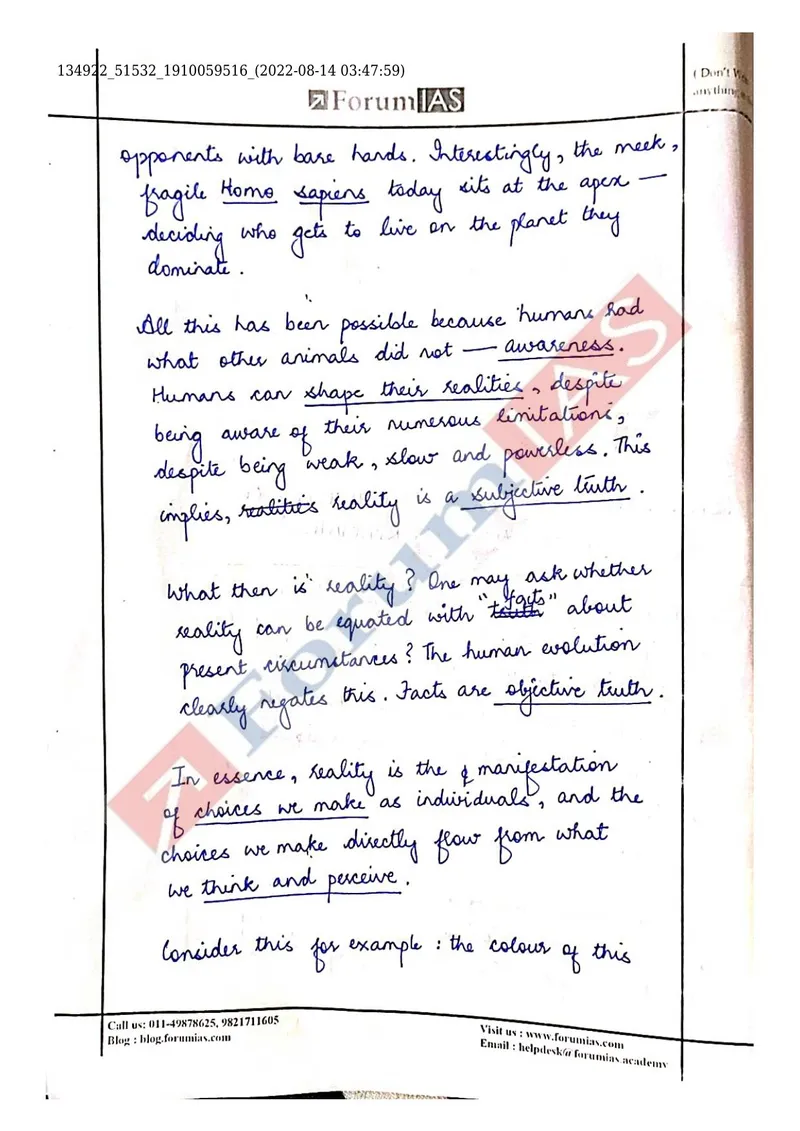
▸Draws the essay's core distinction — 'reality is a subjective truth' versus 'facts are objective truth' — and defines reality as 'the manifestation of choices we make as individuals'
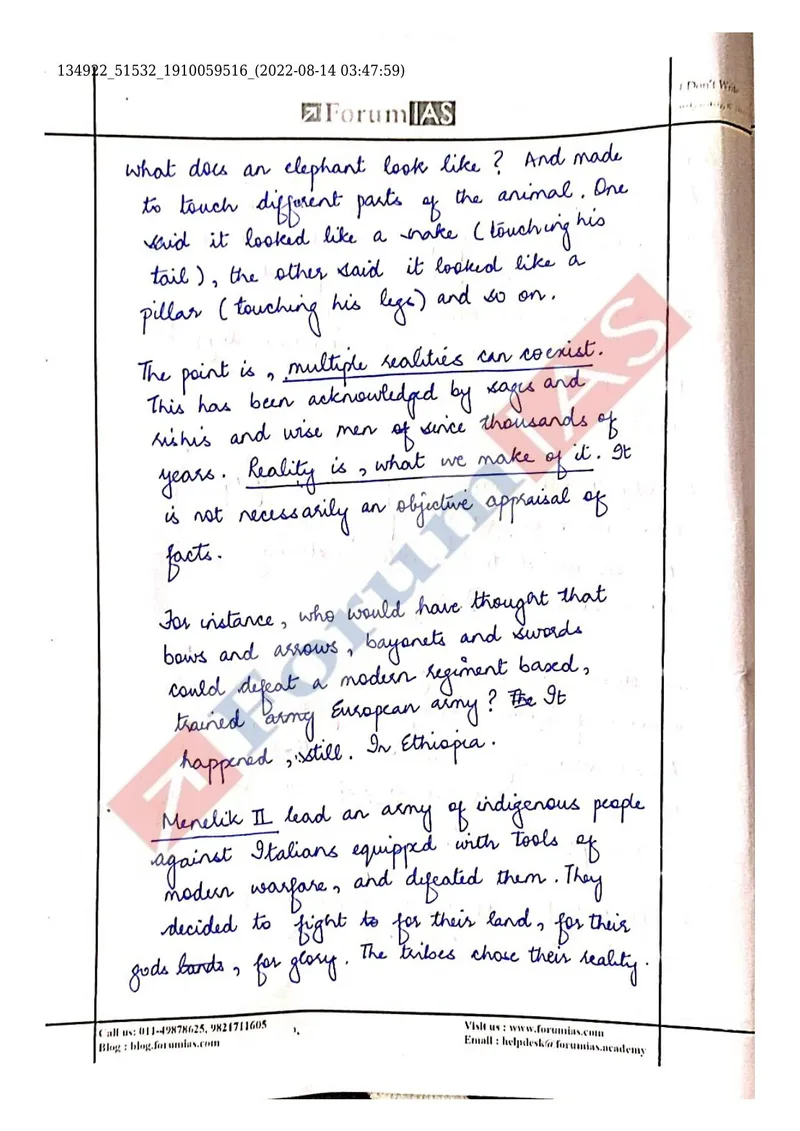
▸Supports it with Jain Anekantvada ('multiple realities can coexist… all are but a part of truth') and the blind-men-and-the-elephant fable
▸Uses the everyday perception-of-colour example ('is the ink objectively blue?') to make the abstract point concrete; Smriti scored 145/250 in Essay in CSE 2022
What to learn from this copy
★Opens a philosophy-of-perception essay with hard evolutionary biology (skull size, childbirth, the gorilla) before turning to abstraction. -> A grounded, almost scientific hook earns credibility for an otherwise abstract topic; lead with the concrete, then rise to the philosophical.
★Pins the whole essay on one crisp binary — subjective reality versus objective fact — and defines its terms explicitly. -> Define your key terms early and hold the distinction throughout; a philosophical essay lives or dies on conceptual clarity.
★Layers Indian philosophy (Anekantvada) and a familiar fable (blind men and the elephant) onto the argument. -> Pairing a classical doctrine with an instantly-recognisable story makes an abstract claim both authoritative and memorable.
Questions attempted: Reality is ultimately a selective act of perception and interpretation.
Questions attempted in this booklet (1)+
Section A, topic 3.Reality is ultimately a selective act of perception and interpretation
Examples, data & evidence used
The human-evolution paradox — the disproportionately large human skull and brain that twists the vertebrae and makes childbirth perilous, yet lets 'meek, fragile Homo sapiens' sit 'at the apex' through awareness
The gorilla — powerful enough to 'uproot trees', contrasted with humans who dominate through awareness rather than strength
Anekantvada (Jainism) — 'multiple realities can coexist and all are but a part of truth'
The fable of the blind men and the elephant, illustrating partial, perspective-bound perception
The perception of colour ('the colour of this ink is blue — is that the objective fact?') to separate subjective reality from objective fact
How it’s written: Definitional-contrast essay. Opens on the evolutionary paradox of the human mind to argue that dominance comes from AWARENESS, hence 'reality is a subjective truth' while 'facts are objective truth'. Defines reality as 'the manifestation of choices we make as individuals' flowing from what we think and perceive, then supports it with Jain Anekantvada, the blind-men-and-the-elephant fable, and the perception-of-colour example. Key terms underlined.
Evaluator: ForumIAS practice booklet (Aug 2022). No examiner marks are visible on the pages read.
Read: the Section A essay title and first three written pages.
▸Both essays open with a story-style hook — Gandhi's 'what could challenge the mighty British Empire? Salt' and Adi Shankara being taught humility by Lord Shiva disguised as a Chandala — before stating an explicit roadmap of the questions the essay will tackle.
▸The body is built as an enumerated chain ('Firstly... Secondly... Lastly'), with almost every point anchored to a concrete real-world example, giving very high example density.
▸Examples span an unusually wide canvas: Chanakya, Churchill/WWII, Five Year Plans, Michael Phelps, Chandrayaan, Murlikant Petkar, Raja Ram Mohan Roy and Mission LiFE in a single essay.
▸Deliberately builds a counter-view — strategic thinking doesn't always succeed because of luck/external factors (2022 World Cup final loss) — before moving to the way-forward, showing balance.
▸Each essay closes by linking the abstract theme to contemporary governance and global issues (climate change, UNSC reform) and signs off on a crisp slogan-style line ('Think strategically, act decisively').
▸Liberal use of Sanskrit shlokas and thinker quotes (Vidya dadati Vinayam, Vinayam dadati patram, Maslow, Kalam, Vivekananda, Bhagavad Gita) woven into the argument.
What to learn from this copy
★Both essays open with a narrative hook BEFORE the thesis - the strategy essay starts with 'what could challenge the mighty British Empire? Salt' (Gandhi/Dandi), the humility essay with Adi Shankara being taught humility by Lord Shiva disguised as a Chandala near Asi Ghat - and each hook is immediately followed by an explicit roadmap paragraph listing the questions the essay will tackle ('we will analyse... then ask why people don't think strategically... and whether thinking alone is enough'). -> Earn the examiner's attention with a concrete story in the first lines, then signpost your structure in one sentence so the reader knows exactly where the essay is going.
★Almost every enumerated body point (Firstly/Secondly/.../Lastly) is anchored to a named, concrete example, and the examples are drawn from a deliberately wide canvas in a single essay - Chanakya (Sam, Daam, Dand, Bhed to make Chandragupta a chakravarti), Churchill drawing the USA into WWII, the Five Year Plans, Michael Phelps, Chandrayaan's soft-landing focus, Para-swimmer Murlikant Petkar, and Raja Ram Mohan Roy using British courts to ban Sati. -> Don't repeat the same two or three stock examples; build a personal example-bank spanning history, polity, sport, science and reform so each abstract point lands on a fresh, specific illustration.
★The strategy essay deliberately builds a counter-view before the way-forward - it argues strategic thinking does NOT always succeed because of luck/external factors, citing India planning each match yet losing the 2022 World Cup final. -> Pre-empt the obvious objection to your own thesis with a concrete counter-example; this 'yes, but...' move signals balance and lifts an essay above one-sided cheerleading.
★Each essay closes by pulling the abstract theme into contemporary governance and global issues - Mission LiFE and mindful consumption, climate change, UNSC reform - and then signs off on a crisp slogan-style line ('Think strategically, act decisively'). -> Land the conclusion in the present-day policy world rather than vague platitudes, and end on one memorable, quotable line that crystallises the whole argument.
★In the humility essay the argument is carried by a chain of paired Sanskrit shlokas - 'Vidya dadati Vinayam' (education gives humility) leading into 'Vinayam dadati patram' (humility gives worthiness) - reinforced by a paraphrased Gita line that the arrogant 'become a servant of their arrogance and ultimately fail.' -> Use a short, accurately-paired quotation or shloka as a logical link in the chain (cause -> effect), not as decorative filler dropped at random.
Questions attempted: Essay: "Strategic thinking is the bridge between dreams and achievement."; Essay: "Life is a long lesson in humility.".
Questions attempted in this booklet (2)+
Q4 (Section-A).Essay: "Strategic thinking is the bridge between dreams and achievement."
Q5 (Section-B).Essay: "Life is a long lesson in humility."
Examples, data & evidence used
Gandhiji — Salt Satyagraha / Dandi March, reaching Dandi coast with 78 delegates and breaking the salt law (weaponising salt as a basic necessity)
Chanakya — dethroned Dhanananda and made Chandragupta Maurya a chakravarti samrat using Sam, Daam, Dand, Bhed
Churchill — strategically coordinating the Allies and drawing the USA in during World War II to prevail over the Nazis
India's post-independence Five Year Plans — incremental approach to development and poverty elimination
Michael Phelps (written 'Michael Phillips') — Olympic swimmer, daily target of hours in water, won ~22 Olympic gold medals
Raja Ram Mohan Roy — campaign against Sati, strategically used the British legal system to enforce a legal ban
Chandrayaan mission — scientists identifying the soft-landing moment as the priority/vulnerability area, leading to success
Murlikant Petkar (written 'Muulikant Petkau') — Padma Shri, Paralympics swimming champion despite losing his legs in the 1971 war
Duryodhana (Mahabharata) — lack of foresightedness; would have given 5 villages had he thought strategically
Kota — recent suicide of a young girl before attempting the JEE exam (self-doubt / fear of failure)
2022 World Cup — Indian cricket team planned each match strategically yet lost the final due to circumstances/luck (counter-view)
Mission LiFE — cited in conclusion for mindful consumption / fighting climate change
UNSC reforms (written 'UNBC') and climate change — cited as contemporary domains needing strategic thinking
Adi Shankara / Adi Shankaracharya — Chandala near Asi Ghat who was Lord Shiva in disguise; led him to compose 'Manisha Panchakam'
Quotes the candidate used
"When laws are unjust, civil disobedience becomes a duty" (in the Gandhi / salt-law passage; no author named)
"Dreams are [not what you see in sleep but] those that should not let one sleep" — attributed to APJ Abdul Kalam
"Arise and stop not till the dreams are achieved" — attributed to Swami Vivekananda
"Move away, I need to perform my daily ritual" — attributed to Adi Shankara
Bhagavad Gita / Shri Krishna (paraphrased): a person who won't be humble would eventually become a servant of his arrogance and ultimately fail
How it’s written: Anecdote-first introductions (a narrative hook), immediately followed by an explicit roadmap paragraph ('In this essay we will analyse... then ask why people don't think strategically... and whether thinking alone is enough'). Body organised as enumerated points (Firstly/Secondly/.../Lastly), each tied to a named ex…
Diagrams & visuals: The essays themselves are pure prose — no charts, tables or maps drawn within the answer body; Rough-work pages (printed pp. 29-30) contain hand-drawn mind-maps / spider diagrams: boxed central concepts ('Humility', 'Need', 'Life without humility', 'Arrogance', 'Strategic thinking') with arrows branching out to sub-points and examples; Rough-work also has a question-based skeleton (D1-D4) and an example-bank list for both essays; (Marks-detail table and Evaluator's-feedback grids are pre-printed booklet forms, not candidate-drawn)
Evaluator: No examiner marks or comments are filled in on this copy.
▸Both essays hook the reader with a concrete human story before analysis — Riya, the slum schoolgirl whose flooded home symbolises unplanned urbanisation; Sushant Singh Rajput for loneliness
▸Strong counter-view in Section-B reframes loneliness as 'a breeding ground of creativity', citing Newton conceiving gravity and Anne Frank realising her potential
▸Coined, quotable lines: cities as 'islands of prosperity within oceans of poverty' and tech life giving 'shelter without warmth, food without taste, life without meaning'
▸Broad example bank spanning history (Indus Valley), governance (Indore, Smart Cities), disasters (Chennai, Dwarka, Delhi seismic) and society (Gujarat/Muzaffarnagar riots)
▸Neat, legible blue-ink cursive with disciplined underlining of keywords for emphasis
▸Copy is UNEVALUATED — no marks, ticks, or examiner feedback recorded on any page
What to learn from this copy
★Both essays open with a concrete human story before any analysis: Section-A starts with 'Riya', a first-standard slum girl who dreams of becoming an Air Force commander, whose mechanic father's home is washed away in floods, and Section-B opens on Sushant Singh Rajput's suicide -> Earn the examiner's attention in the first paragraph with one specific, named human scene that embodies the theme, then pivot to argument — don't open with a textbook definition.
★On 'urbanisation without planning', she anchors the ideal in history before diagnosing failure — Indus Valley's planned cities, fortified settlements, standardised bricks and drainage — then contrasts live failures: Chennai floods from sewage mismanagement, Dwarka becoming a 'flooded city', Delhi's reactive seismic-zone approach -> Build an essay's example bank across registers (ancient history, current governance, recent disasters) so each body point rests on a different, verifiable instance rather than repeating one domain.
★She manufactures her own quotable lines instead of only borrowing them: cities as 'islands of prosperity within oceans of poverty', and tech life giving 'shelter without warmth, food without taste, life without meaning' -> Coin a few crisp, parallel-structured phrases of your own that compress the essay's thesis; original epigrammatic lines stick with an examiner more than another famous quotation.
★In Section-B she refuses a one-sided take on loneliness, reframing it as 'a breeding ground of creativity' with Newton conceiving gravity in isolation and Anne Frank realising her potential -> Deliberately build a strong counter-view section so the essay reads as balanced reasoning, not a one-directional rant — the dialectical turn shows maturity of thought.
★She brought structural discipline to the page itself: each chosen topic statement is hand-drawn in a box at the top, keywords are underlined for emphasis in neat blue cursive, and pages 30-32 hold mind-map planning notes -> Plan the essay on rough pages first and use light visual cues (boxed prompt, underlined keywords) so the script stays legible and the examiner can track your argument at a glance.
Questions attempted: Urbanisation without planning is a disaster in slow motion; The most terrible poverty is loneliness and the feeling of being unloved.
Questions attempted in this booklet (2)+
Section-A, Q.4.Urbanisation without planning is a disaster in slow motion
Section-B, Q.6.The most terrible poverty is loneliness and the feeling of being unloved
Examples, data & evidence used
Riya anecdote — first-standard girl dreaming of becoming an Air Force commander, father a roadside mechanic, home washed away in floods (Section-A opening hook)
'Dead people receive more flowers than the living ones, because regret is greater than gratitude.' — attributed to Anne Frank
Yuval Noah Harari (attributed/paraphrased) — humans survive because of their ability to forge relationships
How it’s written: Two-section format; candidate boxed each chosen topic statement at the top before writing. Both essays open with a vivid human narrative hook (Riya the slum schoolgirl for Section-A; Sushant Singh Rajput for Section-B) then pivot to analysis. Section-A flow: deeper meaning of urbanisation as a way of life -> problem…
Diagrams & visuals: No formal diagrams or maps in the essay body; Topic statements hand-drawn in boxes at the start of each essay; Rough-work pages (30-32) contain bullet/mind-map style planning notes, not illustrative diagrams
Evaluator: No examiner marks or comments are filled in on this copy.
▸Two essays attempted — Section A 'Wonder is the beginning of wisdom' and Section B 'Our greatest ability as humans is not to change the world but to change ourselves' — each chosen via a checkmark.
▸Both essays are anecdote-led: Faraday's curiosity opens Essay 1; Gandhi plus a Kabir doha opens Essay 2.
▸Wide multi-domain example bank — science (Faraday, Edison, Kepler, NASA spinoffs, Bardeen), history (fall of Constantinople, Magellan, Ashoka's Kalinga) and reformers (Baba Amte, Raja Ram Mohan Roy, Princess Diana).
▸Quotations frame and close paragraphs — Socrates, Aristotle, Gandhi, a Kabir doha and a closing dictum on making a difference.
▸Clear signposting — boxed titles, an explicit roadmap paragraph (benefits/challenges/ways), 'Firstly/Secondly/Thirdly' enumeration and underlined keywords.
★Both essays open with a concrete anecdote rather than a definition — Essay 1 ('Wonder is the beginning of wisdom') starts with Michael Faraday's curiosity, and Essay 2 ('change ourselves') opens with Gandhi plus the Kabir doha 'Bura jo dekhan main chala... Jo dil khoja aapno, mujhse bura na koye.' -> Open an essay with a person and a moment that already embodies the theme, so the introduction shows the idea in action instead of merely stating it.
★The quotations are chosen to mirror the exact prompt, not just decorate it: Socrates' 'the more I know, the more I get to know that I do not know' is placed in the wonder/wisdom essay, and the Kabir doha about looking into one's own heart ('Jo dil khoja aapno') anchors the 'change ourselves' essay. -> Pick quotes that restate the question's core idea in different words — a theme-matched quote doubles as a thesis; a generic 'inspiring' quote adds nothing.
★Examples are carried through to their downstream consequence rather than just named — Faraday's electromagnetic induction is linked forward to the bullet train/maglev, and the fall of Constantinople is traced to the search for a sea route to India and the eventual discovery of America. -> Don't stop at dropping a name; build a short cause-and-effect chain (discovery -> application -> impact) so each example argues the point instead of decorating it.
★Essay 2 contains an explicit roadmap paragraph that previews benefits, challenges and ways, then delivers them with 'Firstly/Secondly/Thirdly' enumeration and underlined keywords. -> Plant a one-line signpost early that tells the examiner the three things your body will cover, then deliver in that exact order — it makes a long prose essay navigable without turning it into bullet points.
★The example bank is deliberately spread across domains — science (Faraday, Edison, Kepler, NASA spinoffs, Bardeen), exploration/history (Magellan, fall of Constantinople, Napoleon crossing the Alps) and social reformers (Baba Amte, Raja Ram Mohan Roy, Valmiki) — rather than clustering in one field. -> Stock 3-4 distinct domains of examples per theme so consecutive paragraphs feel multi-dimensional and you never lean on the same kind of evidence twice.
Questions attempted: Wonder is the beginning of wisdom (essay selected via checkmark); Our greatest ability as humans is not to change the world but to change ourselves (essay selected via checkmark).
Questions attempted in this booklet (2)+
Section A.Wonder is the beginning of wisdom (essay selected via checkmark)
Section B.Our greatest ability as humans is not to change the world but to change ourselves (essay selected via checkmark)
Examples, data & evidence used
Michael Faraday — electromagnetic induction (linked to bullet train / maglev)
Thomas Edison — invention of the electric bulb (candidate first wrote 'Einstein', struck it out, corrected to 'Edison')
Fall of Constantinople prompting the search for a sea route to India and the discovery of America
Kepler vs the Church's geocentric view
Magellan's circumnavigation of the globe
NASA spinoff technologies (memory foam, phone cameras)
John Bardeen — semiconductor
Gautam Buddha — Channa, the Madhyam Marg (Middle Path)
Mahatma Gandhi — Satyagraha
Napoleon crossing the Alps
The makers of the Indian Constitution
Valmiki (formerly Ratnakar)
Baba Amte — work with leprosy patients
Raja Ram Mohan Roy — abolition of Sati
Quotes the candidate used
Socrates — 'the more I know, the more I get to know that I do not know'
'Necessity is the mother of invention'
'Veer Bhogya Vasundhara' (the earth is for the brave)
Aristotle's counsel to Alexander — 'Go and See'
Gandhi — 'Be the change you wish to see in the world'
Kabir doha — 'Bura jo dekhan main chala, Bura na miliya koye; Jo dil khoja aapno, Mujhse bura na koye'
'Someone is sitting in the shade today because someone planted a tree a long time ago' (unattributed in the copy)
'We, the People'
How it’s written: Two essays, each opening with a boxed, centred title. Both are anecdote-led: Essay 1 ('Wonder is the beginning of wisdom') opens with Faraday's curiosity; Essay 2 ('change ourselves') opens with Gandhi and a Kabir doha. Essay 2 has an explicit roadmap/signpost paragraph laying out benefits, challenges and ways. Bodi…
Diagrams & visuals: None — both essays are prose-only. The page-15 rough work is a numbered text outline, not a diagram, table or map.
Evaluator: No examiner marks or comments are filled in on this copy.
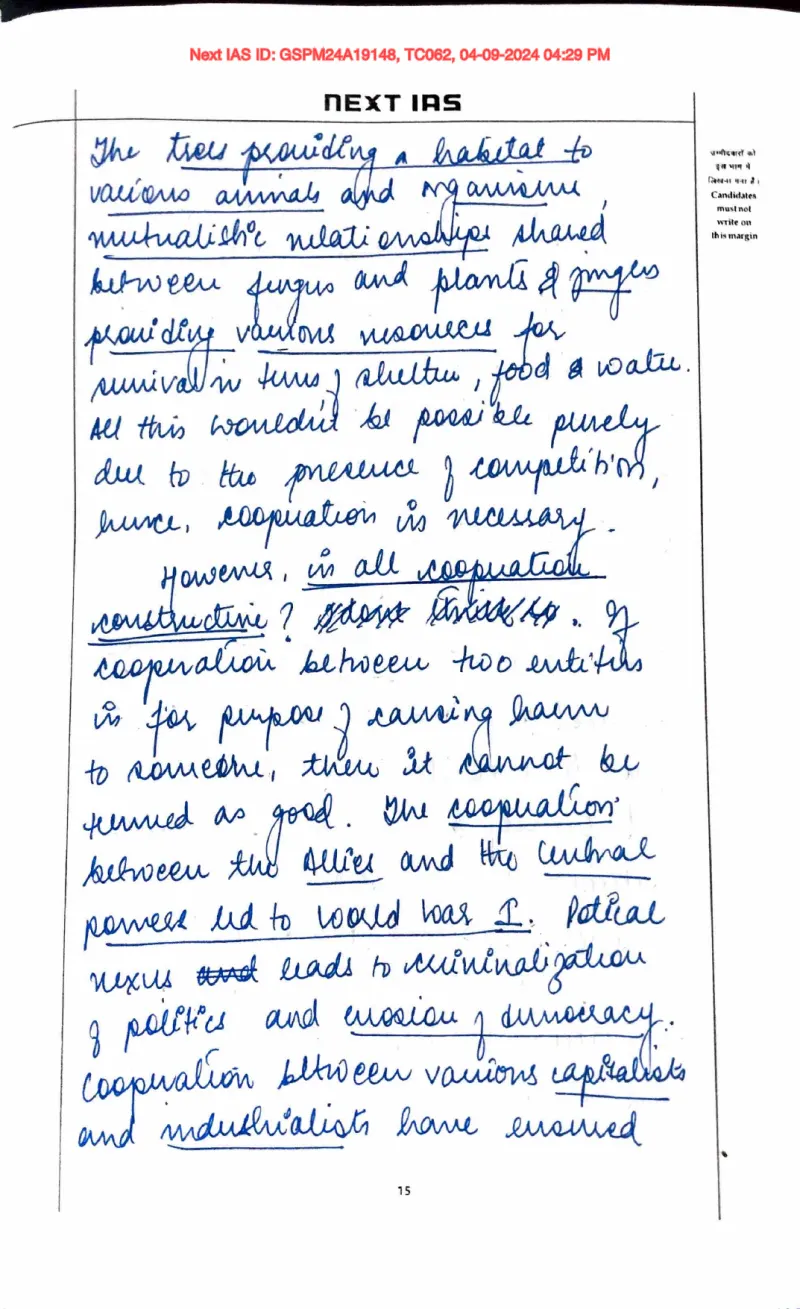
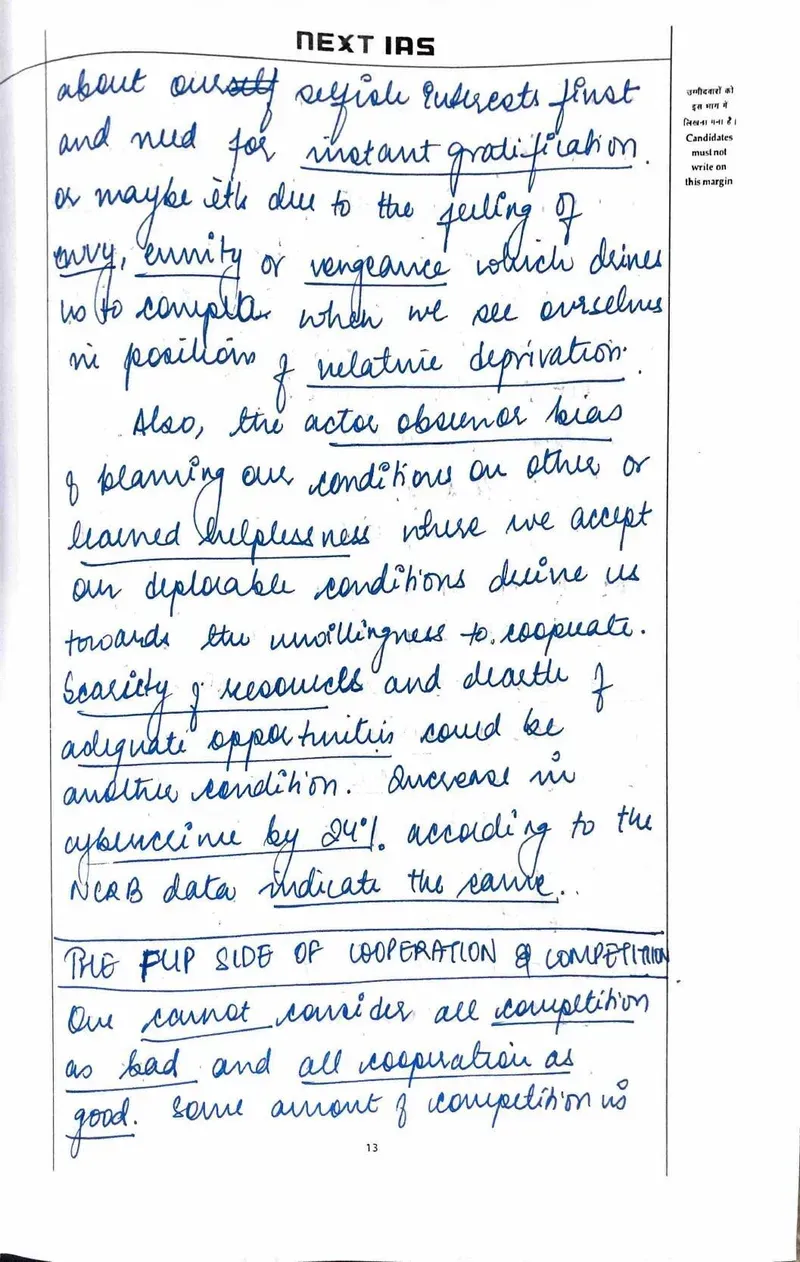
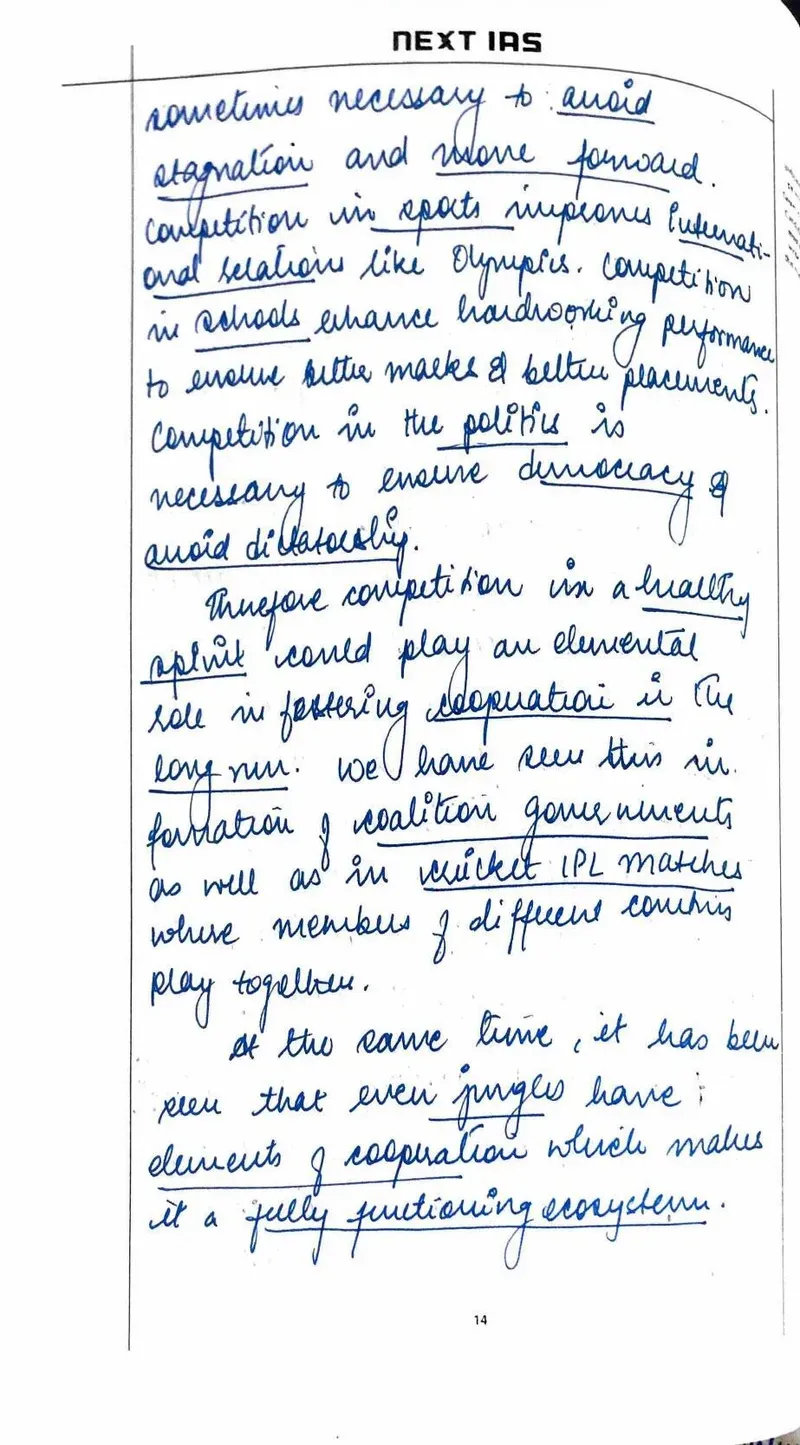
▸Two complete essays, one per section: Section A on 'Competition is the law of the jungle, but cooperation is the law of civilization' (topic 4, circled in the margin) and Section B on 'The road to success and the road to failure are almost exactly the same' (topic 6).
▸Exceptionally example-dense, ranging across history (Partition, Akbar's abolition of Jaziya, Kalinga War), economy (India's 5th-largest GDP, 1991 LPG reforms, Viksit Bharat 2047) and pop culture (Harry Potter, Soorarai Pottru, IPL).
▸Rich, attributed quote bank — Gandhi, Aristotle (Nicomachean Ethics), Robert Frost, Edison, Charles Dickens and Swami Vivekananda.
▸Both essays rewrite the chosen topic verbatim at the top and use boxed/underlined sub-headings to organise the argument (e.g., 'COMPETITION VS COOPERATION', 'FAILURE & SUCCESS: TWO SIDES OF THE SAME COIN').
▸Section A runs a genuine dialectic — it argues cooperation's value, then a 'flip side' (Allied–Central powers cooperation leading to WWI/II, political nexus enabling criminalisation) before synthesising toward 'healthy competition plus cooperation'.
▸Section B is role-model heavy — J.K. Rowling (rejected by 12 publishers), E. Sreedharan, M.S. Dhoni, Vineeta Singh (SUGAR Cosmetics) and para-athletes — to argue attitude and sustained effort separate success from failure.
What to learn from this copy
★Section A doesn't just defend cooperation — it runs a real dialectic: it argues cooperation's value, then explicitly turns to a 'flip side' (Allied–Central powers cooperation that fed into WWI/WWII; the political–criminal nexus enabling criminalisation of politics) before synthesising toward 'healthy competition PLUS cooperation' rather than picking a side. -> On a 'X vs Y' essay topic, build in a counter-section that shows your favoured value can also do harm, then resolve it; the examiner sees balance and original thinking, not a one-sided sermon.
★She spreads evidence deliberately across disjoint domains for the same argument — history (Akbar abolishing Jaziya, the Kalinga War's '140,000 soldiers'), economy (India's 5th-largest GDP, 1991 LPG reforms, Viksit Bharat 2047) and pop culture/sport (Harry Potter, IPL, Olympics) — instead of stacking three examples from one field. -> Pull each major sub-point's illustration from a different domain; range signals breadth and stops the essay reading like a history or current-affairs answer in disguise.
★Section B is anchored in concrete failure-to-success arcs with the specific friction named — J.K. Rowling as a single mother who quit her job and was 'rejected by 12 publishers' before 7 novels, plus E. Sreedharan, M.S. Dhoni and Vineeta Singh (SUGAR Cosmetics) — to argue attitude and sustained effort, not luck, separate the two roads. -> When using role models, carry the specific obstacle and number (the 12 rejections), not just the famous name; the detail is what proves your thesis that success and failure share the same road.
★The quote bank is both attributed and topic-matched, not decorative — Robert Frost's 'I took the road less travelled… that has made all the difference' and Edison's 'I didn't fail 1000 times but I learnt 1000 ways that didn't work' land precisely on the success/failure topic, while Gandhi's 'if we aren't practicing peace & cooperation, we are nothing short of savages' anchors the competition/cooperation essay. -> Keep a small bank of quotes tied to each likely theme and deploy the one that restates your exact argument; a quote that mirrors the topic line earns its place, a generic inspirational one doesn't.
★She rewrites the chosen topic verbatim at the top and structures argument visually through boxed/underlined sub-headings like 'COMPETITION VS COOPERATION' and 'FAILURE & SUCCESS: TWO SIDES OF THE SAME COIN', using heavy keyword underlining to guide a fast-reading examiner through continuous prose (no diagrams used). -> In an essay where diagrams are inappropriate, create navigability with named, boxed section headings that echo the topic — the examiner can map your argument in seconds without you breaking into bullet points.
Questions attempted: Competition is the law of the jungle, but cooperation is the law of civilization; The road to success and the road to failure are almost exactly the same.
Questions attempted in this booklet (2)+
Section A / Q.4.Competition is the law of the jungle, but cooperation is the law of civilization
Section B / Q.6.The road to success and the road to failure are almost exactly the same
Examples, data & evidence used
1947 Indian Independence Act / Partition; India today the 5th-largest GDP, fastest-growing economy and 'largest democracy'
Pakistan's post-Partition economic & political instability despite inheriting fertile lands, trade routes and waterways
Early Vedic period framed as prosperous due to absence of varna hierarchy and derogatory practices against women
Charles Darwin — natural selection and 'survival of the fittest' to explain competition in the jungle (prey/predator)
Akbar — abolition of Jaziya as Hindu–Muslim cooperation that sustained a prosperous empire
Kalinga War — death of 'more than 140,000 soldiers'
Holocaust / 'mass genocide of the Jews' cited as destructive competition
NCRB data cited for a '24% increase in absenteeism' (attribution as written by candidate)
Cooperation in IPL cricket and coalition governments; competition in Olympics and schools
Gautam Buddha — the 'middle path' and moderation
Viksit Bharat by 2047 and Atmanirbhar Bharat
1991 economic crisis and LPG reforms as India's turn from failure to success
J.K. Rowling — single mother, quit her job, rejected by 12 publishers, wrote 7 Harry Potter novels that became the films
Quotes the candidate used
'There is no true victory in war as both the sides lose' (candidate's framing, re: Kalinga War)
Gandhiji — 'if we aren't practicing peace & cooperation, we are nothing short of savages'
Charles Darwin — 'survival of the fittest'
Charles Dickens — 'It was the best of times, it was the worst of times… it was the winter of darkness, it was the summer of hope' (attributed to Dickens in Section B)
Aristotle (Nicomachean Ethics) — 'what is good for a man?'
'Try, try and try again till you succeed'
Robert Frost — 'I took the road less travelled by and that has made all the difference'
Thomas Alva Edison — 'I didn't fail 1000 times but I learnt 1000 ways that didn't work'
How it’s written: 28-page QCA booklet, single candidate throughout (no interleaving/misassembly). Cover (p.1) confirms 'YASHVI JAIN', NextIAS Roll GSPM24A19148, Test Code TC-062, exam centre 'Online', ESSAY-Test 2, CSE 2024. p.2 marks grid and p.4/p.5 evaluator rubric tables are blank. Section A (booklet pp.7–18): essay on topic 4 'C…
Diagrams & visuals: None visible — both essays are continuous prose. No diagrams, flowcharts, maps or tables drawn; structure is conveyed only through boxed/underlined sub-headings and heavy keyword underlining.
Evaluator: No examiner marks or comments are filled in on this copy.
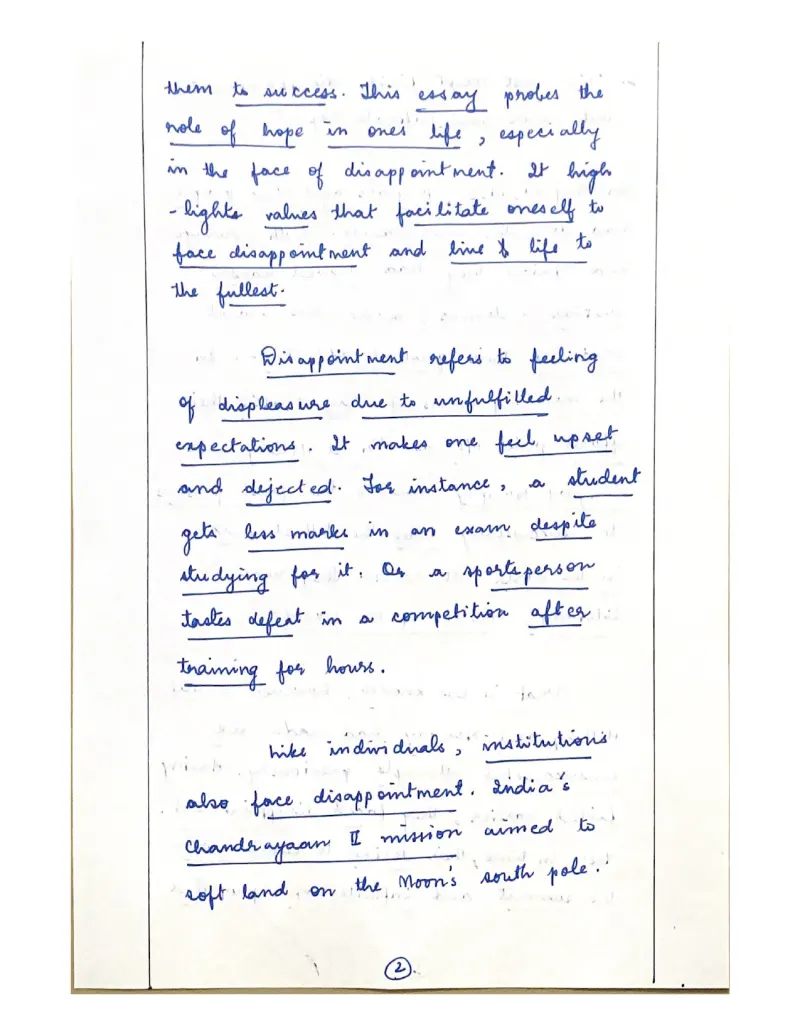
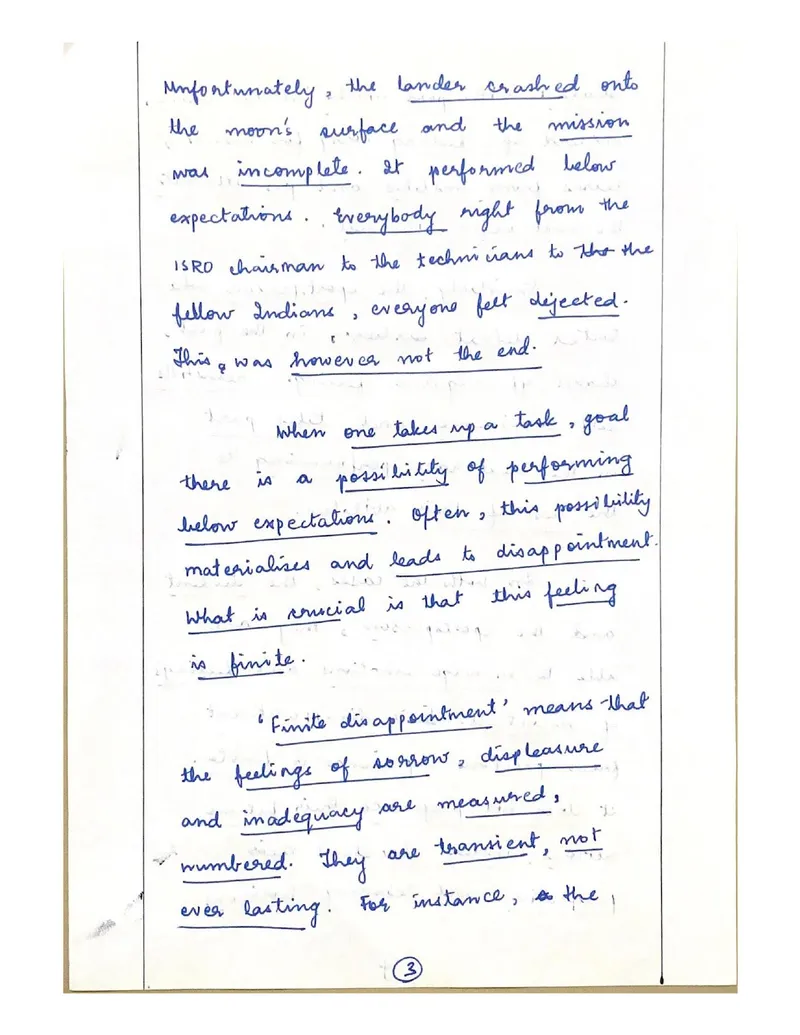
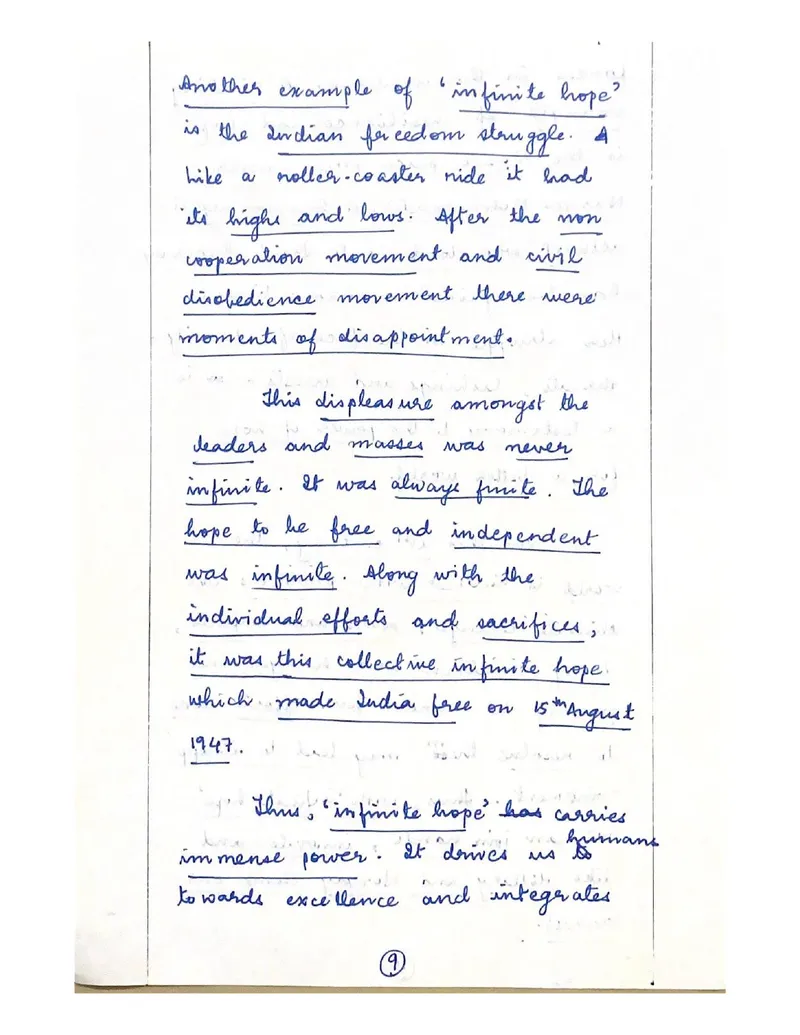
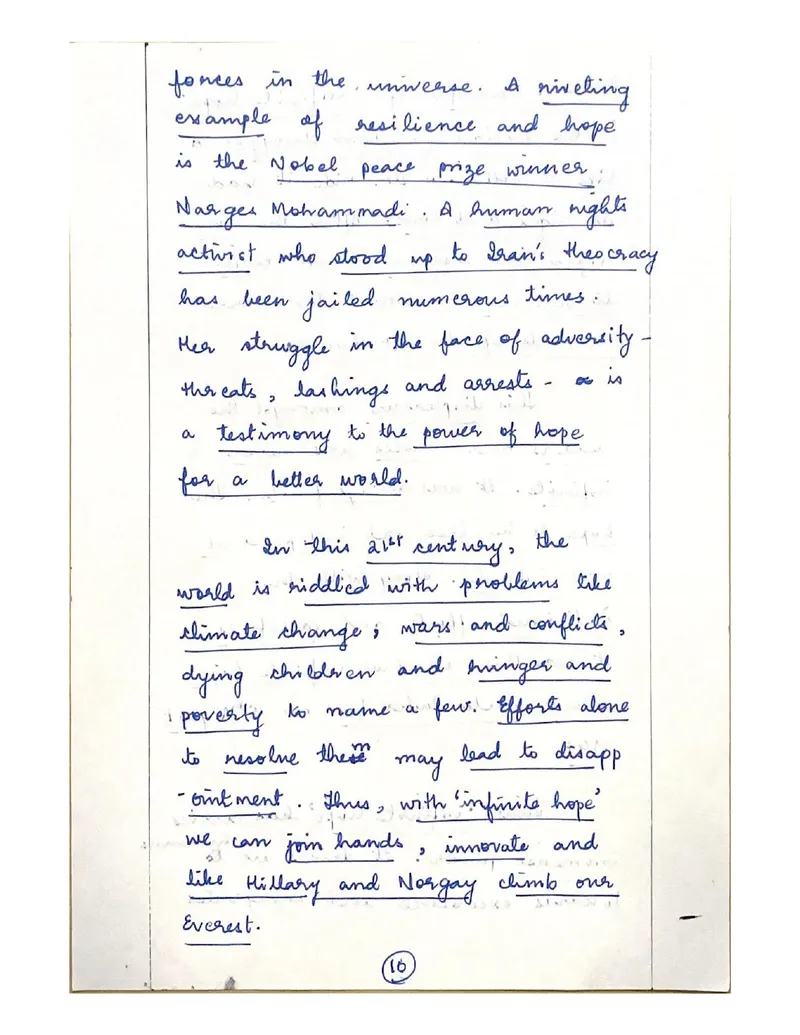
▸Memorable framing device: opens with Hillary & Tenzing Norgay's 1953 Everest summit after six failures and closes urging readers to 'climb our Everest'
▸Strong conceptual scaffolding — cleanly separates 'finite disappointment' from 'infinite hope' along a 'failures can make or break a person' axis
▸Wide, well-chosen example bank spanning science (Chandrayaan-2/3), sport (Yuvraj, Arunima), art (Van Gogh), history (freedom struggle) and current affairs (Narges Mohammadi)
▸Adds tonal range with a Charlie Chaplin quote on tragedy vs comedy of perspective
▸Disciplined structure: examples scale up from individual to institutional to national to global; one idea per paragraph, keywords self-underlined
What to learn from this copy
★Bookended the whole essay with one image: opens on Edmund Hillary and Tenzing Norgay summiting Everest on 29 May 1953 after six failed attempts, then closes by urging the reader to 'climb our Everest' -> a single concrete anecdote used as both hook and callback gives an essay a memorable frame and a sense of closure, far stronger than separate, unrelated intro/conclusion devices.
★Used paired failure-then-success cases that map directly onto the prompt's two halves: the Chandrayaan-2 lander crash (ISRO dejected, mission below expectations) followed by Chandrayaan-3's first soft landing near the Moon's south pole, illustrating exactly 'finite disappointment' giving way to renewed hope -> pick examples that embody the precise contrast the topic asks about, rather than examples that are merely 'inspiring' in general.
★Deliberately escalated the example bank from individual to institutional to national to global — Yuvraj Singh and Arunima Sinha (personal), ISRO/Chandrayaan (institutional), the freedom struggle ending 15 August 1947 (national), Narges Mohammadi's repeated jailing (global) -> ordering examples along a widening scale of scope turns a list into an argument that builds, instead of a flat collection of anecdotes.
★Built explicit conceptual scaffolding by defining terms in sequence — 'disappointment', then 'finite disappointment', then the danger of 'infinite disappointment' (losing hope) — and reinforced the danger side with Van Gogh's self-criticism, mental illness and suicide as a cautionary case -> dissecting the key phrase into sub-concepts and supplying a counter-example for the negative pole shows genuine engagement with the quote rather than just agreeing with it.
★Varied the register with a Charlie Chaplin line, properly attributed — 'Life is a tragedy when seen in close up, [but] a comedy in long shot' -> a well-placed, correctly-credited quote on shifting perspective adds tonal range and reinforces the theme without padding.
Questions attempted: Essay: "We must accept finite disappointment, but never lose infinite hope." (the Martin Luther King Jr. line given as the prompt) — on the role of hope in facing disappointment.
Questions attempted in this booklet (1)+
1.Essay: "We must accept finite disappointment, but never lose infinite hope." (the Martin Luther King Jr. line given as the prompt) — on the role of hope in facing disappointment
Examples, data & evidence used
Edmund Hillary & Tenzing Norgay summiting Mt Everest on 29 May 1953 after six unsuccessful attempts (opening hook + closing callback)
Generic illustrations: a student scoring poorly despite studying; a sportsperson losing after long training
Chandrayaan-2 lander crash (mission below expectations, ISRO dejected) followed by Chandrayaan-3 success — first soft landing near the Moon's south pole
Van Gogh — artist's self-criticism leading to mental illness and suicide (cautionary 'infinite disappointment' case)
Yuvraj Singh — cricketer diagnosed with cancer at career peak who recovered
Arunima Sinha — pushed from a train, lost a leg, became first female amputee to climb Everest
Indian freedom struggle — Non-Cooperation & Civil Disobedience movements; collective infinite hope leading to independence on 15 August 1947
Prompt/theme quote (unattributed in text, originally Martin Luther King Jr.): 'We must accept finite disappointment, but never lose infinite hope.'
Charlie Chaplin (author named): 'Life is a tragedy when seen in close up, [but] a comedy in long shot.'
How it’s written: Classic linear essay. Anecdotal hook (Hillary/Norgay 1953) then explicit thesis stating the essay 'probes the role of hope... in the face of disappointment.' Defines terms in sequence — 'disappointment', then 'finite disappointment', then the danger of 'infinite disappointment' (loss of hope) — before pivoting to th…
Diagrams & visuals: None — no diagrams, flowcharts, tables or maps anywhere; pure prose
Evaluator: No examiner marks or comments are filled in on this copy.
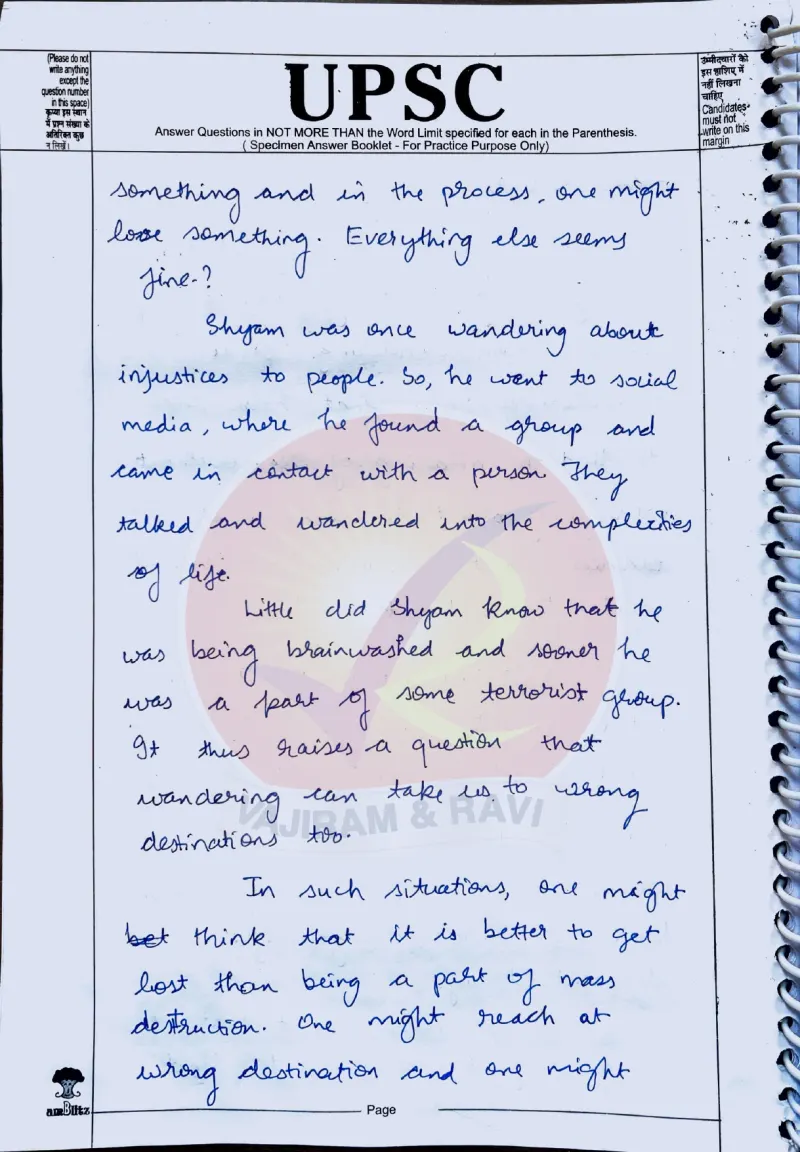
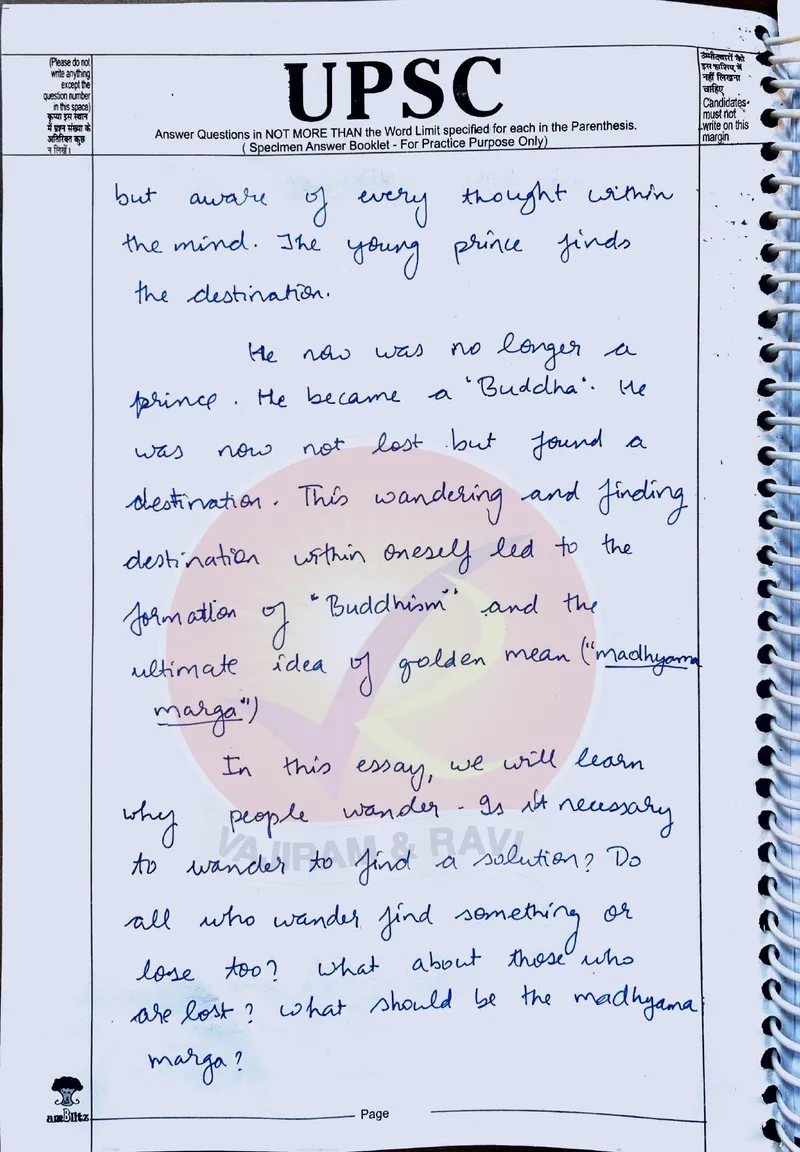
▸Opens Essay 1 by retelling Buddha's renunciation — the prince who 'was now not lost but found a destination', landing the Madhyama marga / golden-mean thesis
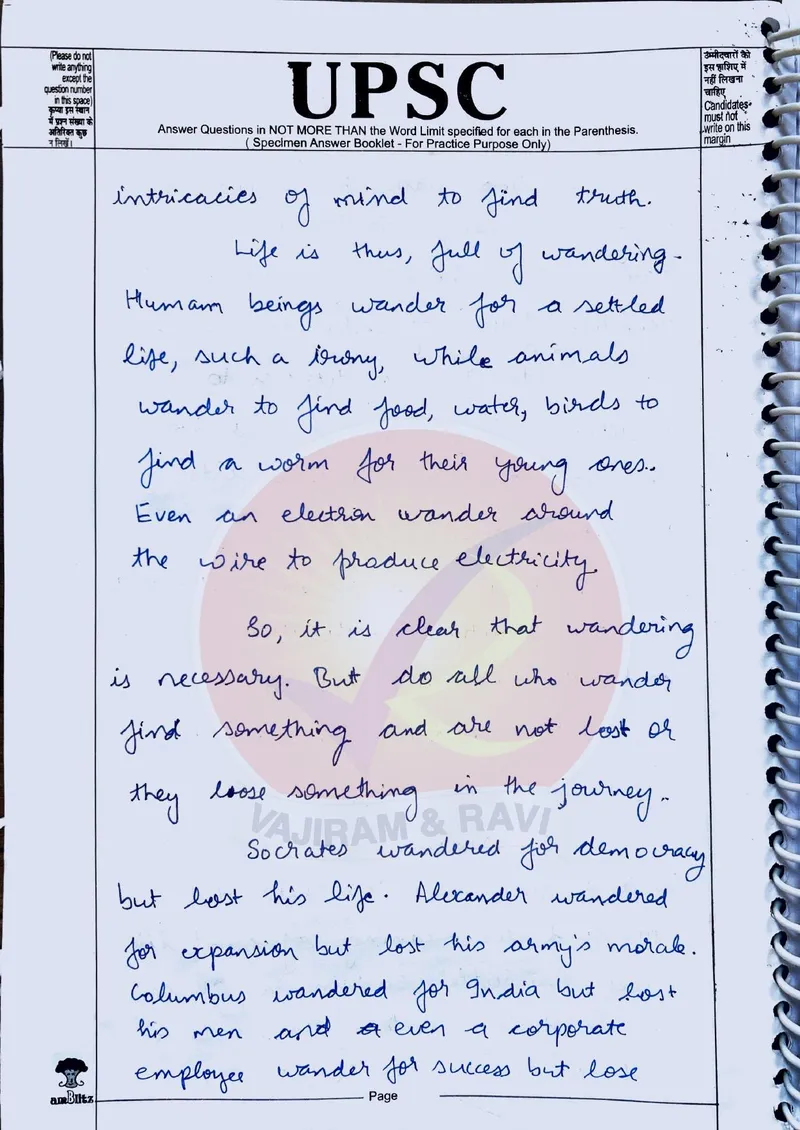
▸Builds a ladder of wanderers who paid a price: Socrates lost his life, Alexander his army's morale, Columbus sought India — turning the prompt into a cost-benefit meditation
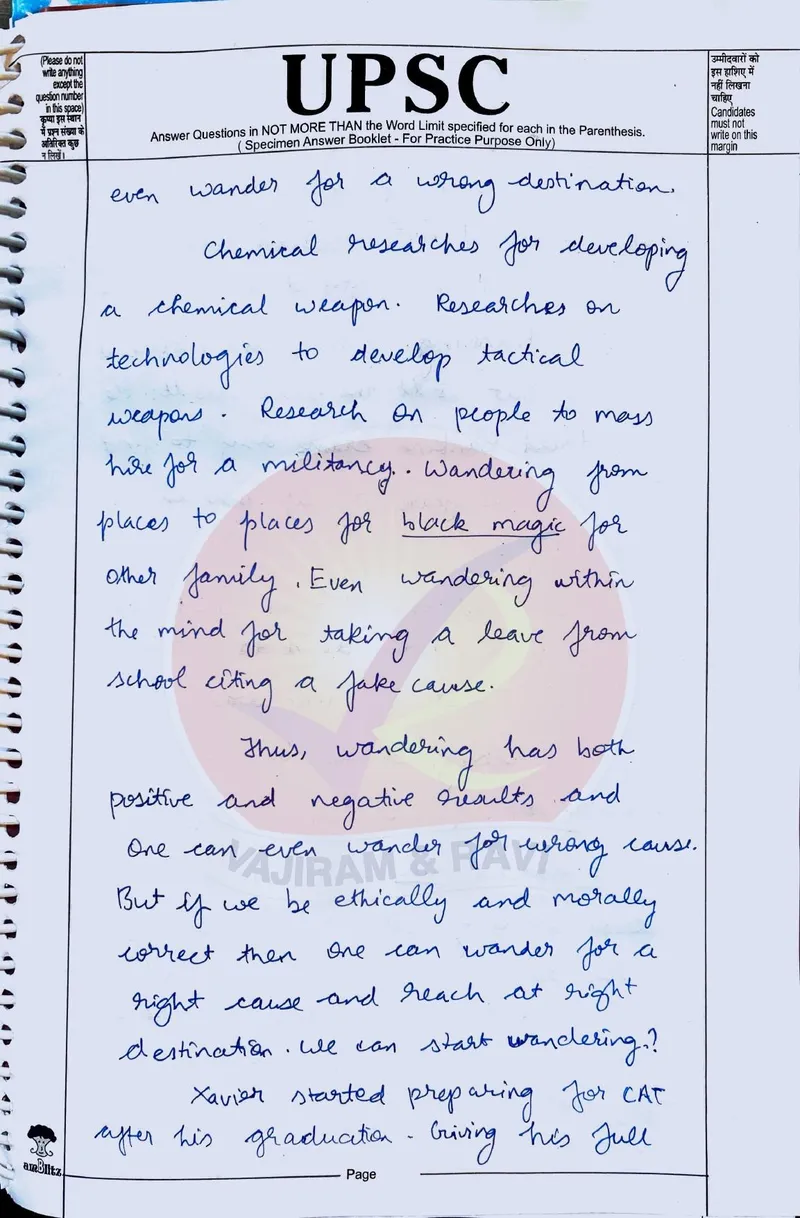
▸Uses living examples well: Kohli's retirement and Djokovic conceding to Alcaraz & Sinner illustrate 'knowing when to stop wandering and reroute'
▸Essay 2 is a tight cause-and-effect history arc: UK need-turns-to-greed → colonisation → World Wars → Pax Britannica to Pax Americana, framed with Hegemonic Stability Theory and Modelski's '100-year rule'
▸Shows nuance by arguing the counter-case — ruler-biased chronicles and human cognitive bias mean history can entrench status-quo conservatism
▸Lands a modern, India-positive conclusion: learn from the colonial past and the 1991 crisis but 'modify as per situations' using dialectics, reasoning and data-analytics — strategic autonomy, fastest-growing economy
What to learn from this copy
★Opens Essay 1 not with a definition but with Buddha's renunciation narrative, resolving it in one pivot line - the prince 'was now not lost but found a destination' - which directly births the Madhyama marga / golden-mean thesis -> Use a story whose ending IS your thesis: the anecdote should mechanically deliver your central argument, not just decorate the intro.
★Builds a deliberate 'ladder of wanderers who paid a price' - Socrates lost his life, Alexander lost his army's morale, Columbus was seeking India - turning 'Not all who wander are lost' into an explicit cost-benefit meditation rather than a one-sided celebration -> Stack examples that complicate the prompt; a graded series showing both gains and costs proves you have weighed the statement instead of merely agreeing with it.
★Reaches for contemporary, verifiable examples on a philosophical topic - Virat Kohli's retirement and Djokovic conceding to young Alcaraz & Sinner - to illustrate 'knowing when to stop wandering and reroute' -> Anchor abstract themes in current, checkable events; living examples signal awareness and freshness where most candidates default to the same historical stock.
★Structures Essay 2 as a single tight cause-and-effect arc (UK need-turns-to-greed -> colonisation -> World Wars -> Pax Britannica to Pax Americana) and names the academic scaffolding - Hegemonic Stability Theory and Modelski's '100-year rule' -> Drive a history/IR essay with one causal spine and label it with a recognised framework; the named theory raises analytical altitude above mere event-listing.
★Refuses a single verdict by arguing the counter-case - ruler-biased chronicles and human cognitive bias mean history can entrench status-quo conservatism - before landing an India-positive close (learn from the colonial past and 1991 crisis but 'modify as per situations' using dialectics and data-analytics) -> Build in a genuine counter-argument, then resolve it forward-looking; the dialectical turn plus a constructive, nation-grounded conclusion is what separates a balanced essay from a one-note one.
Questions attempted: Not all who wander are lost; The only thing we learn from history is that we learn nothing from history.
Questions attempted in this booklet (2)+
Essay 1.Not all who wander are lost
Essay 2.The only thing we learn from history is that we learn nothing from history
Examples, data & evidence used
Gautama Buddha — the young prince leaving home, penance/fasting, finding the 'golden mean' (Madhyama marga) and founding Buddhism
India's founding fathers / Constituent Assembly — partition, drafting the Constitution, world's largest surviving democracy
Plato — search for the just state; theory of the Philosopher King
Aristotle — eudaimonia (the good life); law given 'without passion'
Socrates — wandered for democracy but lost his life
Alexander — wandered for expansion but lost his army's morale
Columbus — wandered seeking India
Gandhiji — travelled across India to mobilise masses for the freedom struggle
Bhagavad Gita / Shri Krishna — act without attachment to results (Nishkama Karma)
Virat Kohli (retirement) and Novak Djokovic vs young blood Alcaraz & Sinner — knowing when to stop
Robert Frost's 'The Road Not Taken' — two roads diverging, taking the road less travelled
Sun Tzu — 'learn thy enemy'
Kautilya — building the Mauryan Empire
Pax Britannica to Pax Americana; USA's break from Britain; COVID-19 as a chance for global collaboration
Quotes the candidate used
Essay topic / leitmotif: 'Not all who wander are lost' (J.R.R. Tolkien — author not named in copy)
Essay topic: 'The only thing we learn from history is that we learn nothing from history' (Hegel — author not named in copy)
'A ship in harbour is safe, but that is not what it is made for' (John A. Shedd — author not named in copy)
'History repeats itself, first as a tragedy, second as a farce' (Marx — author not named in copy)
'Learn thy enemy' — attributed in copy to Sun Tzu
Bhagavad Gita / Shri Krishna paraphrase — work without expecting results (Krishna/Gita named in copy)
Paraphrase of Frost's 'The Road Not Taken' — 'I took the road less travelled and it changed all' (poet not named)
How it’s written: Both essays follow the same template: a narrative/anecdotal hook (Buddha's renunciation for E1; UK Industrial Revolution prosperity for E2), an explicit thesis-as-roadmap paragraph closing the intro (a string of guiding questions: 'why people wander... Do all who wander find something or lose too?... what should be…
Diagrams & visuals: None visible — both essays are continuous prose with no diagrams, flowcharts, tables or maps; only the student's own underlining of keywords/phrases for emphasis
Evaluator: No examiner marks or comments are filled in on this copy.
▸Signposts each essay with BOXED capitalised sub-headings — Essay 1: 'USHERING A TECHNOLOGICAL ERA', 'THE DEMONIC SIDE'; Essay 2: 'THE FLIP SIDE', 'A GOLDEN MEAN' — so the argument map is visible at a glance
▸Opens both essays with a pop-culture hook: Zuckerberg's 2015 crypto tweet for the crypto essay, and the Malayalam film 'The Great Indian Kitchen' for the needs-behaviour essay
▸Follows a clean dialectical flow every time — define the term, lay out merits, dedicate a section to the dark/flip side, then close with a balanced way-forward
▸Backs arguments with named, current evidence: El Salvador, Dogecoin's crash, McKinsey energy data, Joint Parliamentary Committee, SC Garg committee, Crypto Bill 2021
▸Anchors the humanities essay in thinkers — Malinowski's Theory of Needs, Maslow's hierarchy, Simone de Beauvoir's 'The Second Sex', Yuval Noah Harari's 'Homo Deus'
▸Lands solution-oriented conclusions — a 'robust framework' plus pilot projects and academia-industry linkage for crypto; an Ikigai-style 'golden mean' and Gandhian simple living for the needs essay
What to learn from this copy
★Devesh makes his argument map visible at a glance by signposting each essay with BOXED, capitalised sub-headings that literally name the dialectical turns — Essay 1 runs 'USHERING A TECHNOLOGICAL ERA' then 'THE DEMONIC SIDE'; Essay 2 runs 'THE FLIP SIDE' then 'A GOLDEN MEAN'. -> Don't bury your structure in prose: give each section a short, vivid heading that announces the shift (merit -> demerit -> synthesis) so an examiner can navigate the essay in seconds.
★He opens both essays with a concrete pop-culture hook rather than an abstract definition — Mark Zuckerberg's 2015 tweet on launching a Facebook cryptocurrency for the crypto essay, and the Malayalam film 'The Great Indian Kitchen' for the human-needs essay — then immediately follows with a roadmap line ('Today, we shall endeavour...' / 'In this essay – I shall analyze...'). -> Earn attention with a specific contemporary image in line one, then orient the reader with a one-sentence roadmap; the hook-then-map combo beats a cold dictionary opening.
★Every claim is pinned to named, checkable evidence rather than vague assertion: El Salvador legalising bitcoin, Dogecoin's crash, McKinsey's figure that a year of mining consumes as much energy as running London for over a month, the Joint Parliamentary Committee, SC Garg committee and Crypto Bill 2021. -> Stock a few precise, named data points and committees per theme so each paragraph rests on a specific fact, not adjectives — concreteness is what makes an argument feel authoritative.
★He anchors the abstract humanities essay ('Human needs dictate individual behaviour') in a spine of named thinkers — defining 'needs' early via Malinowski's Theory of Needs, then layering Maslow's hierarchy, Simone de Beauvoir's 'The Second Sex' and Harari's 'Homo Deus'. -> For a philosophical/abstract topic, define your key term through a thinker straight away and recruit 3-4 named frameworks as scaffolding; it converts a vague prompt into a structured, intellectually grounded argument.
★Both essays close with a solution-oriented synthesis instead of a flat summary — for crypto a 'robust framework' plus pilot projects and academia-industry linkage, and for needs an Ikigai-style 'golden mean' tied off with Gandhian simple living ('the rich must live simply so that the poor can simply live' / 'Saada jeevan, uccha vichar'). -> End by resolving the dialectic into a constructive way-forward and seal it with a fitting quote or maxim, so the conclusion adds a balanced verdict rather than repeating the body.
Questions attempted: Cryptocurrency – boon or bane?; Human needs dictate individual behaviour (candidate's title: 'Human Needs dictate Individual behavior').
Questions attempted in this booklet (2)+
Section A (Essay 1).Cryptocurrency – boon or bane?
Mark Zuckerberg's 2015 tweet on launching a cryptocurrency on Facebook (now Meta)
COVID-era tech culture references: WhiteHat Jr (junior coding), TikTok culture
Bitcoin origin story — a Japanese scientist/cryptographer angered by a bank house-mortgage (Satoshi Nakamoto implied, not named); 'digital jewellery box'; mining of bitcoin
Blockchain, digital wallet, cryptography, digital signature
Aviral Bhatnagar (called a 'crypto-legend of India') at World Economic Forum, Davos 2021
Microsoft, Siemens, Tesla accepting crypto payments; Ethereum and 'e-lira'
El Salvador legalising bitcoin
Fourth Industrial Revolution — 'trinity' of AI, blockchain and crypto
New Zealand introducing 'crypto-tokens' to help startups become unicorns
Elon Musk's tweet on pollution from data mining
McKinsey analysis — a year of mining consumes as much energy as running London for over a month
'McMillan's Internet fraud report' — over $25 billion in untraceable crypto transactions (as written by candidate)
Dogecoin volatility — $150 to $75,000 then to 1 cent (candidate's figures)
Quotes the candidate used
'Technology shall leave mankind useless, unless mankind makes technology useful' — attributed by the candidate to Yuval Noah Harari's 'Homo Deus' (closing of Essay 1)
Gandhiji — paraphrased: 'the rich must live simply so that the poor can simply live' (Essay 2)
Carl Sagan — 'technological capability development' (cited as his idea/phrase)
'Saada jeevan, uccha vichar' (Hindi maxim used in conclusion)
How it’s written: Both essays are tightly structured. Each opens with an anecdotal/contemporary hook, then a short roadmap paragraph stating what will be covered ('Today, we shall endeavour...' / 'In this essay – I shall analyze...'), then defines the key term early (crypto 'in layman terms'; needs via Malinowski). The body is split…
Diagrams & visuals: None — no diagrams, flowcharts, maps or tables. Visual structuring is done only with BOXED capitalised sub-headings and heavy underlining of keywords.
Evaluator: No examiner marks or comments are filled in on this copy.
▸Two complete essays attempted: Section A Topic 2 'Digital education – the future of learning' and Section B Topic 1 'Science without conscience is but the ruin of the soul.'
▸Essay 1 opens with Nelson Mandela ('Education is the most powerful weapon...') plus an explicit objective statement, and closes on 'a shining ray of hope for 1.3 billion Indians who will shape destiny of Nation.'
▸Strong data anchoring of the digital divide — NSSO (42% urban / 15% rural internet access) and Census 2011 (71% of homes have under two rooms).
▸Dense scheme/example bank: NEP, BharatNet, e-Vidya, National Digital Education Architecture, MOOCs, AR/VR, $5-trillion economy, Fourth Industrial Revolution.
▸Essay 2 balances science's harms (Manhattan Project, Hiroshima-Nagasaki, gene-edited babies, sex-selective abortion, drone terrorism) against its good (bandicoot robots, Green Revolution, Atoms for Peace, telemedicine).
▸Closes Essay 2 with Albert Einstein — 'Without Ethical Culture there is no salvation for humanity' — and the line 'science and conscience must come together so that soul is saved.'
What to learn from this copy
★She quantified the 'digital divide' instead of asserting it — citing NSSO (only 42% urban / 15% rural households have internet) and Census 2011 (71% of homes have under two rooms, so no study space) — turning a vague claim into evidence. -> In an abstract essay, attach a hard statistic to each social claim you make; one survey number does more work than a paragraph of adjectives.
★She bookended both essays with thinker quotes that frame the argument: Essay 1 opens on Mandela ('Education is the most powerful weapon...') and Essay 2 closes on Einstein ('Without Ethical Culture there is no salvation for humanity') tied to her own line 'science and conscience must come together so that soul is saved.' -> Save your strongest quotation for the conclusion and echo its phrasing in your final sentence, so the essay lands on a resonant, attributed note rather than a flat summary.
★On the quote-topic 'Science without conscience...', she built an explicit dialectic — science's harms (Manhattan Project, Hiroshima-Nagasaki, gene-edited babies, sex-selective ultrasound abortion, drone terrorism) set against its constructive use (bandicoot robots ending manual scavenging, Green Revolution, Kalam's 'Atoms for Peace') — and resolved it with conscience as the deciding variable. -> For a philosophical/quote essay, structure the body as 'good use vs misuse of the same tool', then resolve the tension; this directly answers the demand instead of just praising science.
★She stated her thesis openly with a signpost — 'In this essay, my objective is to emphasise...' — right after the opening hook in Essay 1. -> An explicit objective line early tells the examiner exactly what the essay will argue, preventing the 'where is this going' drift that sinks many essays.
★Essay 1's scheme bank was tightly on-topic, not decorative — NEP, BharatNet, e-Vidya, National Digital Education Architecture, National Knowledge Network, MOOCs, AR/VR — every example was a real lever for digital education, linked forward to the $5-trillion economy and Fourth Industrial Revolution. -> Stock your examples to the specific theme and chain them to a larger national goal, so the essay reads as informed policy argument rather than a list of buzzwords.
Questions attempted: Digital education - the future of learning (Topic 2, chosen with tick); Science without conscience is but the ruin of the soul (Topic 1, chosen with tick).
Questions attempted in this booklet (2)+
Section A (Essay 1).Digital education - the future of learning (Topic 2, chosen with tick)
Section B (Essay 2).Science without conscience is but the ruin of the soul (Topic 1, chosen with tick)
Examples, data & evidence used
Essay 1 — COVID-19 pandemic / lockdowns / school closures depriving children of Right to Education (Art 21A)
Essay 1 — Satellite internet for remote villages (attributed in copy to 'Starlink project of Facebook' — reported as written)
Essay 1 — MOOCs (Massive Open Online Courses) for skilling India's young demography
Essay 1 — AI, machine learning, Augmented Reality, Virtual Reality boosting digital learning; a Kochi-based start-up AR app (name unclear)
Essay 2 — Green Revolution (hybrid seeds, fertiliser, mechanisation) ending food-security dilemma but causing salination, land degradation, desertification, water crisis
Essay 2 — Drones used for terrorist attacks; gene-edited babies created by a Chinese scientist (ethical implications)
Essay 2 — APJ Abdul Kalam's support for atomic energy / 'Atoms for Peace' to solve the energy crisis
Quotes the candidate used
Nelson Mandela — 'Education is the most powerful weapon that you can use to change the world.' (Essay 1)
'Destiny of a Nation is shaped in classroom' — used as opening statement, no attribution given (Essay 1)
Mahatma Gandhi (paraphrased) — 'amassing of wealth without morality is sin' (Essay 2)
Albert Einstein — 'Without Ethical Culture there is no salvation for humanity' (Essay 2, closing)
How it’s written: Both essays follow a clear intro–body–conclusion arc and are written in continuous prose (no headings/sub-headings, no diagrams). Essay 1 opens with the Mandela quote plus a 'classroom shapes destiny' statement, states the objective explicitly ('In this essay, my objective is to emphasise...'), then moves through si…
Evaluator: No examiner marks or comments are filled in on this copy.
▸Two-essay Essay booklet (Section A + Section B), cover confirms Ravish Mittal, English medium, Karol Bagh, Drishti Mentorship Mains-2023, dated 28/08/23 — pages are internally consistent, no misassembly detected
▸Section A opens strong with a vivid Bakhtyar Khalji / Nalanda destruction anecdote framing the whole 'history as a tool of subjugation' thesis
▸Examples are deeply India-rooted: British education policy, caste-based knowledge denial, Max Mueller's Aryan Invasion Theory, the Panipat/Babur textbook framing, and the decline of craftsmen
▸Both essays deliberately build an 'other side of the coin' counter-section before concluding, showing balanced, non-one-sided argumentation
▸Section B structures the climate case as a descending ladder — international (Paris/Kyoto pull-outs) -> national -> society -> family/individual
▸Memorable framing devices throughout: the sparrow-and-farmer parable, the 'Abracadabra' magic-wand metaphor, and a Marx 'tragedy then farce' quotation
What to learn from this copy
★Both essays open on a concrete narrative hook instead of a definition — Section A starts with the Bakhtyar Khalji / Nalanda destruction anecdote (and the live debate over whether he mistook it for a garrison or deliberately targeted Indian culture), and Section B opens with the sparrow-and-farmer parable -> open an abstract prompt with a specific story or image that already embodies your thesis, so the reader meets the argument as a scene, not a textbook line.
★Section A proves 'history as a tool of subjugation' through a dense chain of India-rooted, multi-domain evidence — British education policy, caste-based denial of knowledge (tied to the rebirth/karma persuasion), Max Mueller's Aryan Invasion Theory, the 'red carpet laid to invite Babur' textbook framing of Panipat, and the engineered decline of craftsmen -> stack varied, civilisation-specific examples across education, religion, economy and historiography rather than repeating one type, so a single claim is shown operating at many levels.
★Section B organises the climate argument as a descending ladder — international (USA/Russia/Canada missing Kyoto, Paris pull-outs) down to national, then society, then family/individual (plastic dumping, wasting fuel to show off vehicles) -> give a sprawling theme like environmental inaction a clear scalar spine so every paragraph has an obvious place and the essay reads as deliberately structured, not a list of points.
★Each essay builds an explicit 'other side of the coin' counter-section before the conclusion — and Section B even widens the lens to non-human threats (WMDs, volcanoes, meteor showers, solar storms, tsunamis) before returning to human inaction -> dedicate a named section to the opposing view so the final position reads as a reasoned judgement rather than a one-sided assertion.
★Memorable framing devices carry the argument — the 'Abracadabra' magic-wand metaphor to mock the fantasy that someone else will fix the climate, and a Marx 'history repeats itself, first as tragedy, then as a farce' quotation deployed to make a point -> use one or two sharp metaphors/quotations as load-bearing devices that compress the thesis, not as decoration.
Questions attempted: "If you can cut people off from their history, then they can easily be persuaded." — essay on how severing people/societies/nations from their history enables persuasion and subjugation; "The greatest threat to our planet is that someone else will save it." — essay on environmental inaction and the danger of expecting someone else to save the Earth.
Questions attempted in this booklet (2)+
Section A."If you can cut people off from their history, then they can easily be persuaded." — essay on how severing people/societies/nations from their history enables persuasion and subjugation
Section B."The greatest threat to our planet is that someone else will save it." — essay on environmental inaction and the danger of expecting someone else to save the Earth
Examples, data & evidence used
Bakhtyar Khalji (commander under Muhammad Ghori) destroying Nalanda University on his march to conquer Bengal; the debate over whether he mistook it for a military garrison vs. a deliberate plan to subdue Indian culture (also names Vikramshila)
British attacking India's history, education tradition and indigenous methods of life, then enforcing British education and sciences
Caste system: upper castes keeping lower castes away from their history and knowledge to subordinate them (with the rebirth/karma persuasion to keep them serving)
Max Mueller's Aryan Invasion Theory as a misinterpretation that led Indians to believe Aryans were outsiders
British severing Indian craftsmen/artisans from their craft via biased policies, persuading people that machine-made goods were better
School textbook framing of the 1st Battle of Panipat / Babur — portraying Indian rulers as weaker ("red carpet laid to invite Babur") while omitting that many Indian rulers defeated and resisted him
"White Man's Burden" / European supremacy / Indian way of life as barbaric and backward as ideas easily sold once history was cut off
Selective half-facts: tolerance of Akbar and Gupta rule as a golden age; claim that Indian history is taught as "more Marxist than Indian"
The sparrow and the farmer parable (Section B intro) on self-reliance vs. depending on others
USA, Russia, Canada failing Kyoto targets / pulling out of the Paris Agreement (international-level inaction)
Developed vs Developing dichotomy at national level; modern society wasting resources vs traditional society's co-existence with nature; family/individual-level plastic dumping and wasting fuel to show off vehicles
Other (non-human) planetary threats: weapons of mass destruction, volcanic eruptions, earthquakes, meteor showers, solar storms, tsunami, nuclear bomb, pollution
"Abracadabra" / magic-wand metaphor to dismiss the fantasy that someone else will fix the climate
Quotes the candidate used
"If you can cut people off from their history, then they can easily be persuaded." — Section-A essay prompt; no author attributed in the copy
"History repeats itself, first as tragedy, then as a farce." — attributed to Marx in the copy
"The greatest threat to our planet is that someone else will save it." — Section-B essay prompt; author not visible in the copy
How it’s written: Both essays follow a disciplined, mirror-image structure: a hook introduction (a historical anecdote for A, a parable for B), a multi-part thesis body with explicit sub-headings, a dedicated counter-argument section, and a synthesising conclusion. Section A: intro (Khalji/Nalanda) -> "Cutting people off from their h…
Evaluator: No examiner marks or comments are filled in on this copy.
▸Cover confirms Arpit Kumar, 'Essay', Drishti Mentorship Programme (Mains)-2024 (Max 250); the entire evaluator marks table is left blank
▸Only Section A attempted: a ~10-page essay on 'The past is better guide to future than present'; Section B (Essay-2) is completely blank
▸Strong dialectical architecture with five bold underlined headers, resolving past vs present into a synthesis ('Collective Wisdom of Past and Present')
▸Eclectic, wide example bank — Russia-Ukraine/NATO, Oppenheimer's fission bomb, Freud's subconscious mind, Oxfam 77%-wealth stat, CRISPR, Shikhandi and Akbar's eunuch officials
▸Anchored by the Rigvedic shloka 'Aano Bhadra Kratavo Yantu Vishwatah' (linked to the PM) and a coined opening epigram on history
▸MISASSEMBLY FLAG: physical page 13 is a FOREIGN Physics Wallah / OnlyIAS GS answer on landslide disaster-management (Doppler/LIDAR, Hazard Zonation, Gadgil-Kasturirangan, eco-sensitive zones, 2nd ARC, Sendai Framework) with its own office-use feedback grid — NOT Drishti and NOT this Essay; it sits exactly where the essay's closing page should be
What to learn from this copy
★Arpit didn't just list pros and cons of 'past vs present' — he built a true dialectic, naming his stages as bold underlined headers like 'A Classic Case Study of Unlearned Past' (thesis) and 'Past - The Eternal Guide' (antithesis), then resolving them into an explicit synthesis 'Collective Wisdom of Past and Present.' -> On a 'X is better than Y' essay topic, don't pick a side flatly; stage thesis-antithesis-synthesis and give the resolution its own named section so the examiner sees you transcended the binary rather than just argued one half.
★He stocked one essay with examples from genuinely different domains rather than five history anecdotes — IR (Russia-Ukraine/Crimea, NATO encirclement, the 'security dilemma' and North Korea/Iran proliferation), hard science (CRISPR built on prior DNA/RNA knowledge, Oppenheimer's fission bomb as a 'Pandora's box'), psychology (Freud's subconscious and negative habits), economics (Oxfam's 'top 10% hold 77% of wealth'), and social history (Mahabharata's Shikhandi and Akbar's eunuch officials vs present-day transgender stigma). -> Range across disciplines, not just more examples in one field — each fresh domain demonstrates broader awareness and lets you re-prove the same thesis from a new angle so it never reads as one-note.
★He bookended the essay with India-rooted intellectual anchors and made them current: the Rigvedic shloka 'Aano Bhadra Kratavo Yantu Vishwatah' ('Let every noble thought come to us from all the sides') tied to the present-day PM and World Yoga Day/Vasudhaiva Kutumbakam, plus a closing line 'a guide can only show a person where he wishes to go.' -> Pull a classical or scriptural line into the intro/conclusion AND link it to a live contemporary reference — it shows the 'past guides present' thesis lived in your own framing, not just in your body paragraphs.
Questions attempted: The past is better guide to future than present — attempted, ~10 sides of writing (physical pp.3-12); Not attempted — Section-B 'Topic:' line left blank and all Section-B pages (pp.17-28) blank; no second essay written.
Questions attempted in this booklet (2)+
Section A (Essay-1).The past is better guide to future than present — attempted, ~10 sides of writing (physical pp.3-12)
Section B (Essay-2).Not attempted — Section-B 'Topic:' line left blank and all Section-B pages (pp.17-28) blank; no second essay written
Examples, data & evidence used
Russia-Ukraine war — annexation of Crimea and the 2021/2022 invasion of Ukraine; Europe misjudging Russia as weak by its 'present' situation
Ever-expanding NATO and continuous encirclement of Russia
Industrial Revolution and Industry 4.0 ('ER 4.0') needing to learn from past for equity-based development
Oxfam report — top 10% holding 77% of wealth (inequality critique of present)
COVID-19 pandemic compared to Europe's medieval Black Death; complacency from antimicrobial/vaccine development
CRISPR technology in the medical field built on existing DNA/RNA knowledge
Common But Differentiated Responsibilities and 'common future' on environmental degradation
Oppenheimer's fission-bomb experiment opening a 'Pandora's box' of outcomes
'Security dilemma' as a constant feature of international politics; nuclear proliferation by North Korea and Iran
Transgender acceptance across time — Mahabharata's Shikhandi and eunuch officials of Akbar vs present-day stigma
Aurobindo Ghosh — India as the world's spiritual civilisation; World Yoga Day and Vasudhaiva Kutumbakam linked to the past
Sigmund Freud's work on the 'subconscious mind' and negative habits
Détente phase of US-Russia restraint after the Cold War
A remote-village student empowered by the '5G domain'/digital technology of the present
Quotes the candidate used
Opening epigram: 'History has lot to offer to intelligent human and yet lot to conceal from repetitive fool' — no author attributed (appears coined/uncredited)
'Aano Bhadra Kratavo Yantu Vishwatah' (Rigvedic Sanskrit shloka) — rendered as 'Let every noble thought come to us from all the side'; candidate ties it to the 'honourable Prime Minister'
Conclusion line (on the displaced/offset final page): 'a guide can only show a person where he wishes to go' — attributed only as 'rightly said', author not legible
How it’s written: Single essay (Section A only). Intro pairs a coined history epigram with the topic, then a dialectical thesis-antithesis-synthesis built around five bold, underlined thematic headers: (1) 'A Classic Case Study of Unlearned Past', (2) 'Past - The Eternal Guide', (3) 'Present's Unability to Present a Future Paradox',…
Diagrams & visuals: None within the essay — the candidate relied on underlined headers and underlined keywords only; no diagrams, charts or maps in the Essay-1 answer
Evaluator: No examiner marks or comments are filled in on this copy.
▸Single essay on culture and the individual, opening with the Nehru-attributed line 'Culture is the widening of the mind and of the spirit.'
▸Anthropological hook (narrow birth canal, post-birth brain growth) earned the evaluator's 'well introduced to the topic.'
▸Unusually rich, multi-disciplinary example bank — Germany's R&D culture, Stalinist USSR, Muria/Gond/Ho youth dormitories, Galileo, Newton-Leibniz, Orwell's 1984.
▸Sociology woven in well: Talcott Parsons' 'recurrent barbarian invasion' and the superorganic view of culture.
▸Keyword underlining and tight interlinking drew repeated praise ('Interlinking is good', 'You have underlined the keywords').
▸Synthesising conclusion — 'both culture and the individual influence each other' — rated 'appealing and gives a sense of completion.'
What to learn from this copy
★Opened the culture essay not with a definition but with an anthropological hook -- the narrow human birth canal forcing post-birth brain development, proving behaviour is learned not innate -- which earned the evaluator's verbatim 'well introduced to the topic.' -> Hook an abstract essay (here, 'culture') with a concrete, slightly counter-intuitive fact that *demonstrates* your thesis, instead of stating it; it buys evaluator goodwill in the first paragraph.
★Built an unusually wide, cross-disciplinary example bank to argue both sides -- Germany's R&D culture (>3% GDP), Stalinist USSR and Orwell's '1984' ('Freedom is slavery. Ignorance is strength.') for culture-as-narrowing, vs Galileo, the simultaneous Newton-Leibniz calculus, and 6th c. BC philosophers (Buddha, Charvaka, Mahavira) for culture-as-widening. -> Stock examples from genuinely different domains (economics, history, science, literature) and deliberately deploy them on *opposite* sides of the question, so the essay reads as balanced argument rather than one-sided assertion.
★Reached for less-common, India-rooted illustrations -- the Muria, Gond and Ho tribal youth dormitories, the Gurukul-vs-modern-education contrast, and the menstrual-health/sex taboo silence -- rather than only textbook names. -> A couple of fresh, specific examples that most candidates won't use differentiate a copy more than another quote from a famous thinker.
★Wove sociology in as analytical scaffolding, not name-dropping -- Talcott Parsons' 'recurrent barbarian invasion' framing of a child's birth and the superorganic view of culture -- which the evaluator marked 'Defined well' and 'Explanation of culture is excellent.' -> Use a named theoretical concept to *explain a mechanism* (how each new generation is enculturated), so the discipline does argumentative work instead of decorating the page.
★Closed by explicitly synthesising the two-way relationship -- 'both culture and the individual influence each other' -- which the evaluator rated 'appealing and gives a sense of completion,' and the body's tight cross-referencing drew 'Interlinking is good.' -> End by resolving the question's tension into a single integrative statement that loops back to your thesis; a conclusion that synthesises (not summarises) is what reads as 'complete.'
Questions attempted: Culture and the individual — does culture widen the mind/spirit or narrow worldview; how culture and the individual shape each other.
Questions attempted in this booklet (1)+
Essay (single, unnumbered).Culture and the individual — does culture widen the mind/spirit or narrow worldview; how culture and the individual shape each other
Examples, data & evidence used
Human birth canal / post-birth brain development (culture is learned)
Germany — peer learning + >3% GDP on R&D
USSR under Stalin — conformist society
Indian Gurukul vs modern competitive education
Sex taboo and menstrual-health silence in Indian society
Muria, Gond, Ho tribes — youth dormitories
Galileo vs the Church
Witch stereotypes defining anti-social conduct
6th c. BC philosophers — Buddha, Charvaka, Mahavira, Greek scholars
Newton & Leibniz — calculus invented simultaneously
Lord Buddha — equality, non-violence
Pride movement / transgender rights
Fascist Germany, Italy, Stalinist Russia
Hindu pluralism vs caste system
Quotes the candidate used
'Culture is the widening of the mind and of the spirit.' — opening/title line; evaluator notes it is by Jawaharlal Nehru (candidate did not attribute it in text)
George Orwell, '1984': 'Freedom is slavery. Ignorance is strength.'
Talcott Parsons (sociologist) — birth of a child in society as a 'recurrent barbarian invasion' (concept/paraphrase, author named)
How it’s written: Opens with the Nehru-attributed title quote, then an anthropological hook (birth canal, post-birth brain development, learned behaviour) before defining culture as a "system of values, beliefs, customs, mores, arts" citing anthropologists. Uses an explicit interior sub-heading ("Culture – Broadening horizon or narro…
Diagrams & visuals: none visible
Evaluator: Heavily annotated in red — running margin comments plus dense keyword underlining and a final feedback box. Praise (verbatim): "well introduced to the topic", "Interlinking is good", "Defined well", "Explanation of culture is excellent",…
▸Scored 86/250 overall (47 in Section A on patience/time, 39 in Section B on democracy) in the Drishti Mains-2023 mentorship test
▸Signature technique: argues every theme across a tidy ladder of individual → societal → organisational → national → global levels
▸Rich, current example bank — 1971 War/Manekshaw, Galwan 2020, Taliban engagement, RBI repo management, Pew 2017 data, Panchamrit
▸Builds genuine balance: both essays carry a dedicated counter-section (patience can backlash; uniformity is sometimes required)
▸Uses capitalised question-headings as navigation, keeping a long handwritten essay readable and examiner-friendly
▸Closes each essay with a concrete way-forward rather than a generic summary
What to learn from this copy
★Pairs a positive and negative instance of the SAME theme to argue causally, not just name-drop: in Essay A she uses Gen. Manekshaw asking Indira Gandhi for three months to prepare before the 1971 war (patience -> victory) AND the 2020 Galwan clashes framed as impatient/impulsive behaviour. -> For abstract-quote essays, mine each example as evidence for or against the thesis; a matched pro/anti pair proves the idea better than a list of unconnected achievements.
★Runs every theme up a fixed ladder — individual -> societal -> organisational -> national -> global (e.g. Essay A moves from Edison's perseverance to RBI's phased repo-rate inflation management to India's calibrated Taliban/Russia-Ukraine stance). -> Keep one reusable scaffold of widening scales so a single abstract prompt instantly yields breadth across dimensions instead of a one-note argument.
★Builds a deliberate counter-section in BOTH essays rather than arguing one-sidedly: 'patience can backlash' in Essay A and 'why uniformity is sometimes required' in Essay B. -> A dedicated antithesis block signals balanced, non-dogmatic thinking — examiners reward the essay that argues against itself before resolving.
★Grounds the democracy essay in genealogy plus one hard statistic: opens with Cleisthenes founding democracy in Athens and the Demos+Kratos etymology, traces Magna Carta and Social Contract thinkers (Hobbes/Locke/Montesquieu), then anchors with Pew 2017 data (57% of 167 surveyed countries are democracies). -> Trace a concept from its origin and back the claim with one precise figure; etymology-to-data depth beats vague generalities.
★Uses capitalised headings that restate the question as navigation ('EMBRACING DIVERSITY: WHY AND HOW?', 'CULTURE OF DIALOGUE AND COMPROMISE') and closes each essay with a concrete way-forward instead of a generic summary. -> Mirror the prompt's own words in your sub-headings so a long handwritten essay stays examiner-friendly and visibly on-topic, and end on actionable resolution.
Questions attempted: Patience and time grow the seed that blossoms into wisdom; Democracy is not about uniformity; it is about embracing diversity and fostering a culture of dialogue and compromise.
Questions attempted in this booklet (2)+
Section A – Topic 4.Patience and time grow the seed that blossoms into wisdom
Section B – Topic 7.Democracy is not about uniformity; it is about embracing diversity and fostering a culture of dialogue and compromise
Examples, data & evidence used
Essay A: 1971 India-Pakistan War — Gen. Sam Manekshaw advising Indira Gandhi to give the army three months to prepare, leading to victory
Essay A: Thomas Edison inventing the bulb on his ~1000th attempt (perseverance)
Essay A: Indian National Movement — Moderates' prayer-and-petition approach; Gandhiji's Satyagraha / non-violence
Essay A: COVID-19 Economic Package and RBI inflation management via phased repo-rate tweaking
Essay A: India's calibrated Afghanistan/Taliban engagement (shift from 'Afghan-led, owned' to engaged) and neutral stance on Russia-Ukraine war
Essay A: District Magistrate of Noida (Suhas) listening to residents; India's Panchamrit and EU carbon-neutral-by-2050 commitment; 'March Run' year-end spending as a negative example
Essay B: Magna Carta (13th-century England) as early surrender of monarchical power
Essay B: 2017 Pew Research — 57% of 167 countries surveyed adopted a democratic model
Essay B: Hobbes, Locke (Social Contract), Montesquieu (Separation of Powers); French Revolution ideals of liberty, equality, fraternity
Essay B: 73rd & 74th Constitutional Amendment Acts (Panchayati Raj / Urban Local Bodies); NITI Aayog and 7th Schedule; Universal Adult Franchise
Essay B: Indian reservation (SC/ST/Women/EWS/Disabled) vs American race-based affirmative action
Essay B: Inter-State Councils, Zonal Councils, River Water Boards; Karnataka-Maharashtra (Belgaum) border & Cauvery water disputes
Quotes the candidate used
'Time heals everything' (used as a common saying; no author attributed)
'Time and tide waits for none' (proverb; no author attributed)
'Better late than never' (in rough-work notes; no author attributed)
Pluralist Theory of power referenced via Raymond Aron in Essay B (cited as a thinker, not a direct quote)
How it’s written: Both essays follow a clear intro–body–conclusion arc with capitalised sub-headings as signposts. Essay A uses headings such as 'HOW TIME CONDITIONS THE SEED TO BLOSSOM' and 'INSTANCES OF BLOSSOMING WISDOM'; Essay B uses 'EMBRACING DIVERSITY: WHY AND HOW?', 'CULTURE OF DIALOGUE AND COMPROMISE', 'WHY UNIFORMITY IS NOT…
Diagrams & visuals: None clearly visible in the text layer — both pieces are prose essays carried by capitalised sub-headings rather than figures; the appended rough-work pages contain only outline flow-arrows and bracketed planning notes, not formal diagrams or maps
Evaluator: Marks clearly written on the cover sheet: Section A (Topic 4) = 47, Section B (Topic 7) = 39, Grand Total = 86/250. A printed six-point Drishti feedback rubric is on the cover (1. Context, 2. Introduction, 3. Content, 4. Language/Flow, 5…
▸Scored 80/250 overall — Section A (Courage, topic 4) 41, Section B (Liberty, topic 8) 39; both essays fully attempted.
▸Evaluator praised simple/clear language, a rich and insightful introduction, and commendable presentation.
▸Core critique: essay 'lacks diversification' — failed to break the theme into dimensions ('Why resist fear? How to cultivate courage?') and lacked structure/paragraph headings.
▸Strong philosophy scaffolding — Plato's cardinal virtues, Aristotle's golden mean, Bhagavad Gita, and Rousseau's Social Contract.
▸Broad example bank: Gandhi, Edward Snowden, Mira Bai, Helen Keller, Durga Shakti Nagpal, backed by NCRB and scam/politics data.
▸Candidate's own rough mind-maps and self-doubts ('how to maintain flow? Is grammar okay?') are visible inside the booklet.
What to learn from this copy
★Both essays open with a concrete hook and then immediately set a roadmap of questions to answer — Section A starts with a Gandhi anecdote on not fearing the British/jails, then poses 'what is courage? how is it related to fear?' The evaluator explicitly praised this as a 'rich and insightful introduction' -> open with a specific anecdote, then state the 2-3 questions the essay will explore so the reader knows your direction from line one.
★Builds a genuine philosophy scaffold by pairing Western and Indian thought rather than name-dropping — Plato's four cardinal virtues (wisdom, tolerance, courage, prudence) for Eudaimonia, Aristotle's courage as 'the golden mean between cowardice and recklessness', the Bhagavad Gita on standing against injustice, and Rousseau ('Man is everywhere in chains'). The evaluator credited this depth -> anchor an abstract essay theme in a precise conceptual definition (e.g. Aristotle's golden mean) and cross it with Indian philosophy for breadth.
★Backs illustrative personalities with hard data instead of leaving examples anecdotal — Gandhi, Edward Snowden, Mira Bai, Helen Keller and Durga Shakti Nagpal (vs the sand mafia) are reinforced with NCRB's '86 women raped every day' and '43% of MPs with criminal charges in the 17th Lok Sabha' -> alternate human stories with a verifiable statistic so each section carries both emotional and evidentiary weight.
★Kept the language simple and clear throughout (the evaluator's words) and fully attempted both essays under time — Section A 41/125 and Section B 39/125 -> in the essay paper, finishing both essays with readable, jargon-free prose is itself a scoring foundation; clarity and completion are not optional.
Questions attempted: "Courage is resistance to fear, mastery of fear, not absence of fear" (original quote by Mark Twain; written as the title, unattributed in copy); "The worst thing is not that the world is unfree, but that people have unlearned their liberty" (original quote by Milan Kundera; unattributed in copy); Both essays combined, out of 250.
Questions attempted in this booklet (3)+
Section-A (Essay Topic No. 4)."Courage is resistance to fear, mastery of fear, not absence of fear" (original quote by Mark Twain; written as the title, unattributed in copy)
Section-B (Essay Topic No. 8)."The worst thing is not that the world is unfree, but that people have unlearned their liberty" (original quote by Milan Kundera; unattributed in copy)
Grand Total.Both essays combined, out of 250
Examples, data & evidence used
Mahatma Gandhi — opening anecdote on not fearing the British / jails (Section A)
Plato — four cardinal virtues (wisdom, tolerance, courage, prudence) for Eudaimonia
Aristotle — courage as the golden mean between cowardice and recklessness
Bhagavad Gita — standing against injustice as courage
Ram (Ramayana) and Pandavas (Mahabharata) as courageous figures
Edward Snowden — whistleblowing on US NSA cyber espionage
Mira Bai (Bhakti saint) — overcoming fear of social custom
Helen Keller (disabled girl) — overcoming inferiority complex
"Courage is resistance to fear, mastery of fear, not absence of fear" — Section-A topic line (Mark Twain originally; not attributed by candidate)
Mahatma Gandhi: "I do things because I do not fear them and that's how I overcome failures, weaknesses and limitations" (attributed to Gandhi; rough notes also reference 'My Experiments with Truth')
"If you want to win, defeat yourself" — given as a 'famous saying' (no author written)
"The world will not be destroyed by the evil, but by those good people who remain silent during evil" — given as 'a saying' (no author written; popularly attributed to Einstein)
"The worst thing is not that the world is unfree, but that people have unlearned their liberty" — Section-B topic line (Milan Kundera originally; not attributed by candidate)
"Man is everywhere in chains" — attributed in copy to 'a famous western scholar' (unnamed; Rousseau)
Hindi couplet: "Jaaki ladki sundar dekhi, taa pe jaaye dhari talwar" — on mistreatment of girls (no author)
Hindi saying: "Bhatke hue insaan shaam ko ghar aa jaaye toh wah bhatka hua nahi mana jata" (no author)
How it’s written: Standard essay prose, no sub-headings within the body (the evaluator specifically flagged this). Each essay opens with an anecdote/quote hook, states a roadmap of questions to explore ("what is courage?, how is it related to fear?"), builds a philosophy scaffold (Greek + Indian thought), then layers contemporary exa…
Diagrams & visuals: No formal diagrams, flowcharts or maps within the evaluated essay body; Rough mind-map / brainstorming planning notes present on interleaved rough-work pages (candidate's own pre-writing, e.g. arrow-linked keywords: Gandhi, Plato cardinal values, Aristotle golden mean, Snowden, Durga Shakti Nagpal) — not part of the marked essay
Evaluator: Detailed handwritten feedback in red plus marks. MARKS: Section-A (topic 4) = 41, Section-B (topic 8) = 39, Grand Total = 80/250; Evaluator signature present (name illegible, in red); Reviewer signature blank. FEEDBACK PAGE — "Dear stude…
Openings that frame the whole essay. Shubham Kumar opens “A health system to meet 21st-century needs in India” with a 700-year historical arc — bubonic plague, Spanish flu, COVID-19 — before defining health via the WHO. One paragraph in, the examiner already knows the essay has range.
Multi-dimensional bodies. His rough-work pages (preserved at the end of the booklet) show a Social / Economic / Political / Environmental brainstorm grid with real schemes (e.g. SHe-Box) slotted under each head — built before writing a single line.
Anchored conclusions. Quotes from Kautilya to A.P.J. Abdul Kalam close the loop on the introduction instead of introducing new ideas.
This page collects evaluated essay booklets of rank holders — including Shubham Kumar (AIR 1, CSE 2020), Vibhor Bhardwaj (AIR 19, CSE 2024), Pakshal Secretry (Rank 8, 2025 collection) and Devesh Chaturvedi — and, for several of them, a faithful page-by-page breakdown of what each essay actually contains.
What essay topics did these toppers write on?+
Real topics from the copies on this page include “A health system to meet 21st-century needs in India” and “An army of principles can penetrate where an army of soldiers cannot” (Shubham Kumar), “Wonder is the beginning of wisdom” and “Our greatest ability is not to change the world but to change ourselves” (Vibhor Bhardwaj), “Strategic thinking is the bridge between dreams and achievement” and “Life is a long lesson in humility” (Pakshal Secretry), and “Cryptocurrency — boon or bane?” (Devesh Chaturvedi).
How should I use a topper’s essay copy?+
Don’t memorise the essay — study the scaffolding. Notice the opening hook (a historical sweep, an anecdote or a quotation), the explicit roadmap paragraph, the multi-dimensional body (social, political, economic, ethical angles), the example density, and the way the conclusion loops back to the introduction with a quote. Then write the same topic yourself and compare. Most copies also preserve the candidate’s rough-work mind-map — copy that planning habit.
Are these essay copies free to download?+
Yes. Every essay PDF here is free to view and download — no sign-up or payment. UnlockIAS hosts this index for free educational use; credit for each booklet belongs to the candidate and the evaluating test series.