
Shailputri — ForumIAS GS Paper 4 (Ethics) copy
What’s inside this copy
- ▸Cover confirms authorship - 'Name: Shailputri, Roll 1910092878, ForumIAS MGP + Cohort 13 Alternate, Sectional Test 6, 24/8/23' - genuine and continuous across all 51 pages.
- ▸This is a ForumIAS Ethics sectional MOCK copy, not the live UPSC CSE 2023 Mains script.
- ▸Diagram-heavy answer style - Venn diagrams, stakeholder mind-maps and flow charts deployed across both theory and case-study sections.
- ▸Quote-rich introductions drawing on Vivekananda, Tagore, Jefferson, Buddha, Kant, JRD Tata and Robin Sharma.
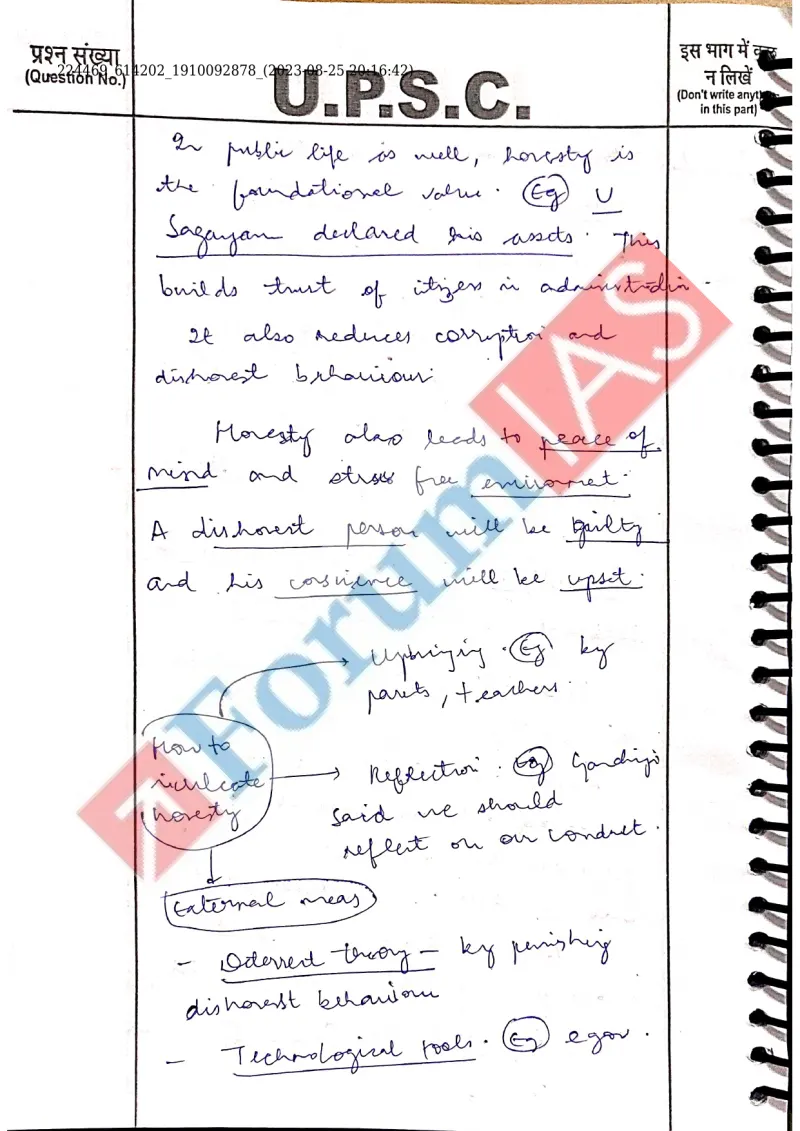
- ▸Strong, current example bank - Joshimath, Bihar hooch tragedy, Jan Soochna Portal, BRSR/ESG, U. Sagayam and the WEF 257-year wage-gap stat.
- ▸The examiner's right-hand margin ('Don't write anything in this part') is blank on every page - no marks, ticks or comments anywhere.
What to learn from this copy
- ★She matched each quote to the exact concept being tested rather than dropping a generic line: Buddha's 'When we control our emotions we control our life' opens the Emotional Intelligence answer (Q5a), Jefferson's 'Honesty is the first chapter in the book of wisdom' anchors the honesty quote (Q6a), and Kant's 'moral law within' frames the conscience question (Q6b). -> Choose a quote that literally restates the keyword of the question, so the introduction doubles as a thesis instead of decoration.
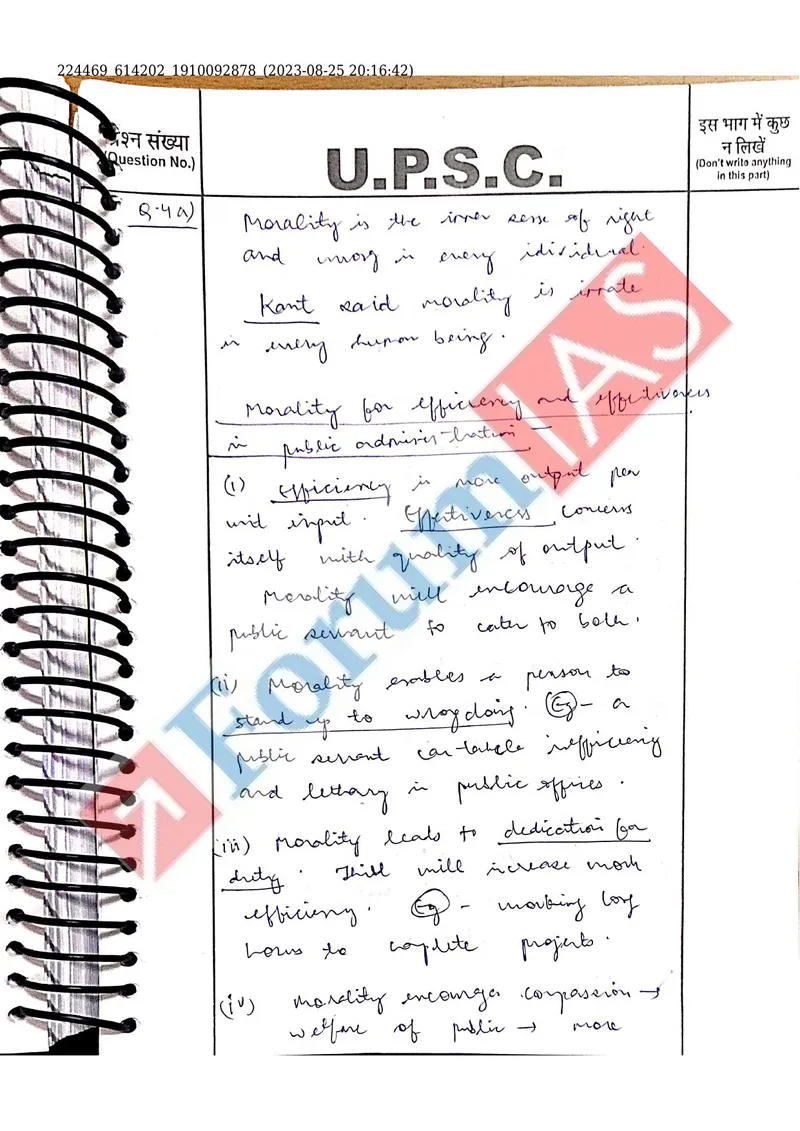
- ★She used Gautam Buddha's 'Madhyam Marg' / Middle Path as the analytical spine of Q4a to argue that moral rigidity hinders efficiency while morality aids it. -> A single well-chosen framework can resolve a 'balance these two ideas' question better than listing points for each side separately.
- ★She chose diagram forms that fit the underlying logic, not just any visual: a Venn diagram for the overlap of private/public/self ethics (Q1a), a two-side contrast diagram for leaders vs managers (Q2b), and flow maps for processes like inculcating Emotional Intelligence (Q5a). -> Let the relationship dictate the diagram - overlap means Venn, comparison means two columns, process means a flow map.
- ★She built a specific, current example bank mapped to each theme: Jan Soochna Portal (Rajasthan) and Marrivan/Mariappan IAS's CCTV-in-office for RTI/transparency, BRSR/ESG and JRD Tata 'agents of change' for corporate governance (Q5b), and Sevottam plus CVC integrity pacts for probity (Q1). -> Pre-load 2-3 concrete, name-able examples per Ethics sub-topic so you can substantiate claims instead of staying abstract.
- ★When she could not verify an author, she wrote the line 'Always do good - it will gratify half of humanity and astound the other half' as 'It is said' rather than inventing an attribution. -> Don't fabricate a quote's source; flagging an unattributed line is more credible than a confident wrong attribution.
Questions attempted: (a) Probity in governance + role of values; (b) Citizen's Charters as a tool of accountability; (a) Code of Conduct vs Code of Ethics; Accountability vs Responsibility; (b) Leaders vs Managers; (a) RTI Act 2005 - transparency/accountability and its challenges; (b) Article 44 UCC - reconciling legal principles with moral considerations, and 9 more below.
Questions attempted in this booklet (12)+
- Q1.(a) Probity in governance + role of values; (b) Citizen's Charters as a tool of accountability
- Q2.(a) Code of Conduct vs Code of Ethics; Accountability vs Responsibility; (b) Leaders vs Managers
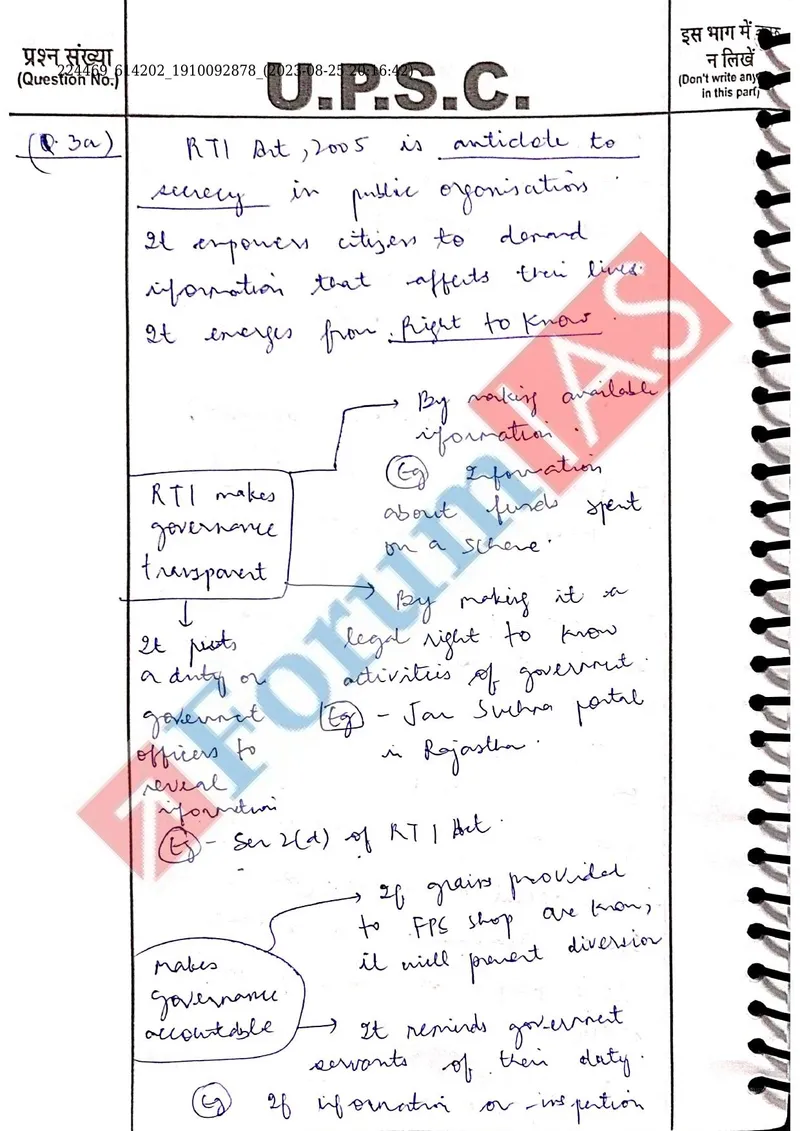
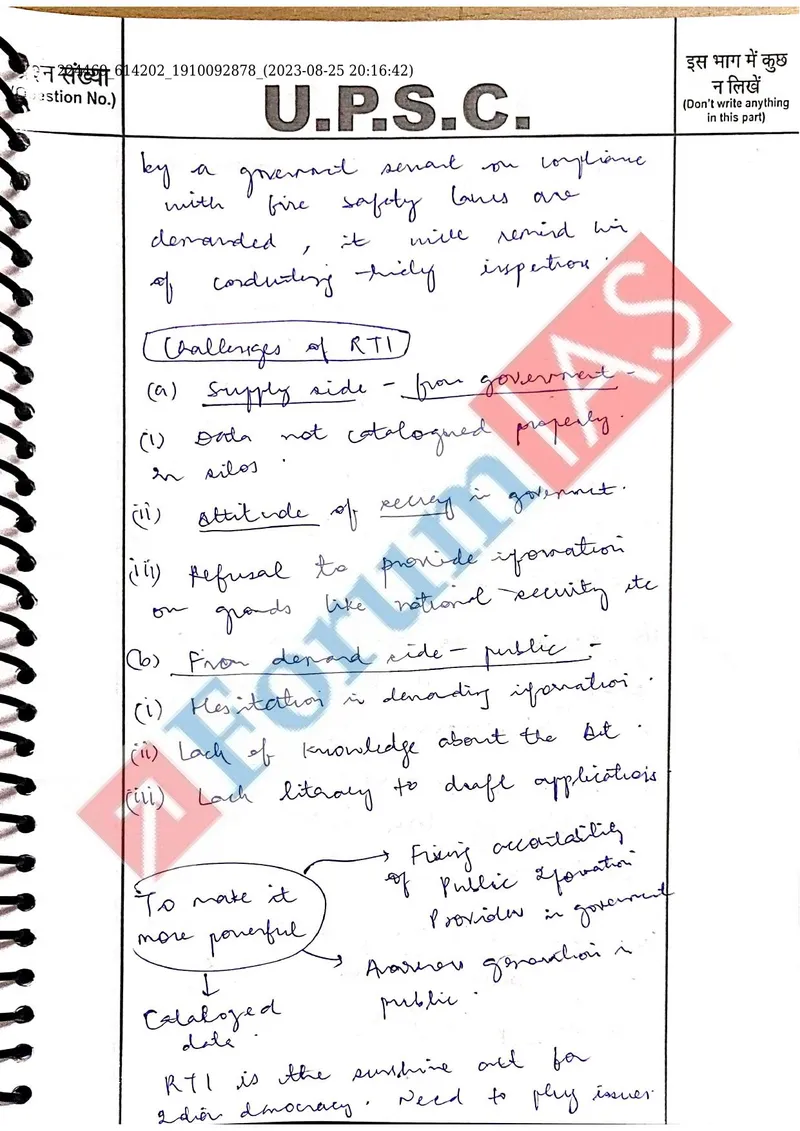
- Q3.(a) RTI Act 2005 - transparency/accountability and its challenges; (b) Article 44 UCC - reconciling legal principles with moral considerations
- Q4.(a) Morality for efficiency/effectiveness and moral rigidity as a hindrance (Madhyam Marg); (b) Transparency, accountability and fairness as cornerstones of good governance
- Q5.(a) Emotional Intelligence and ways to inculcate it; (b) Corporate governance and ESG/CSR/BRSR
- Q6.Quote-based: (a) Honesty; (b) conscience / moral law / doing good; (c) Change (Robin Sharma)
- Q7.Case study - Joshimath/Prachinmath (Uttarakhand) land subsidence; conflicting interests (environment vs development, national security vs sustainability), DM's steps and disaster avoidance
- Q8.Case study - Bihar hooch tragedy and DPSP (Part IV-A); Anjali (Jt. Secretary) - stakeholders and measures, with pros and cons
- Q9.Case study - Kamlesh; ethical dilemmas (integrity vs order of superior, honesty vs personal benefit, professional ethics vs personal morality, transparency vs corruption); options and referral to Anti-Corruption Dept
- Q10.Case study - Joseph (municipal commissioner) and fire-safety lapse at XYZ coaching; stakeholders, ethical concerns and advice
- Q11.Case study - honest govt servant facing a poor work culture; 2nd ARC report, course of action, Prevention of Corruption Act 1988
- Q12.Case study - Geetanjali/Varun/MD sexual-harassment matter; POSH Act, ICC enquiry and measures for a safer workplace
Examples, data & evidence used
- Civil Services (Conduct) Rules 1964
- Prevention of Corruption Act 1988 / Benami Property Act
- CVC integrity pacts
- Sevottam model (service delivery)
- ISRO work culture under Vikram Sarabhai
- Swachh Bharat Abhiyan / ODF (open-defecation-free)
- Jan Soochna Portal, Rajasthan
- Section 2(d) and Section 377 IPC / Victorian morality
- Unjust laws example - slavery laws / Nazi laws
- CCTV in office - Marrivan/Mariappan IAS, Bengaluru
- Gandhiji's Talisman
- APJ Abdul Kalam
- Book - 'The Power of Your Subconscious Mind'
- Vipassana training for Myanmar officers
Quotes the candidate used
- Swami Vivekananda - on private vs public ethics (Q1a)
- Rabindranath Tagore - we learn by reflecting on our experiences (Q1a and Q6b)
- Thomas Jefferson - 'Honesty is the first chapter in the book of wisdom / first virtue' (Q6a)
- Robin Sharma - 'Change is hard at the beginning, messy in the middle and gorgeous at the end' (Q6c)
- Gautam Buddha - 'When we control our emotions we control our life' (Q5a) and 'Madhyam Marg' / Middle Path (Q4a)
- Immanuel Kant - moral law within / morality is innate (Q6b)
- JRD Tata - corporates as 'agents of change' (Q5b)
- 'Always do good - it will gratify half of humanity and astound the other half' (written as 'It is said', no author attributed) (Q6b/c)
How it’s written: Highly structured, well-organised answers throughout. Each question is clearly labelled (Q1, Q2... and sub-parts (a)/(b)/(i)/(ii)) in the left 'Question No.' margin. Theory answers (Q1-Q6) typically open with a definition/quote-based introduction, use underlining of keywords for emphasis, and frequently deploy boxed…
Diagrams & visuals: Q1(a) Venn diagram - overlap of private / public / self ethics; Q1(b) flow/spider map on Citizen's Charters; Q2(b) diagram contrasting leaders and managers; Q3(a) map on RTI transparency/accountability; Q4(b) diagram on good-governance cornerstones; Q5(a) flow map on inculcating Emotional Intelligence
Evaluator: No examiner marks or comments are filled in on this copy.