
Komal Punia — Vajiram & Ravi GS Paper 4 (Ethics) copy
What’s inside this copy
- ▸Complete attempt - all 20 question-parts answered: Section-A Q1-Q6 (including the five-quote Q5 and five short-notes in Q6b) and all six 250-word case studies Q7-Q12.
- ▸Every theory answer opens with a crisp definition and closes with a quote or maxim (Socrates, Swami Vivekananda) - textbook intro-body-conclusion discipline.
- ▸Accurate, by-name use of ethical frameworks: Bentham's Utilitarianism, Rawls' Justice, Kant's Categorical Imperative, Gandhian Talisman and the 'Madhyam Marg' middle path.
- ▸Case studies are tightly scaffolded: stakeholder map -> ethical issues -> option-wise merit/demerit evaluation -> reasoned final choice -> relevant laws/schemes.
- ▸Wide, well-chosen example bank spanning history, current affairs, judgments and Indian schemes (Hitler's Germany, Viktor Frankl, S. Balaji vs Tamil Nadu freebies verdict, Amma Vodi, Mother Teresa, Sindhutai Sapkal, Dashrath Manjhi, Balasore rail tragedy, Kakodkar Committee).
- ▸Strong visual structuring via flow/tree diagrams, stakeholder maps and merit-demerit tables; no geographical maps.
What to learn from this copy
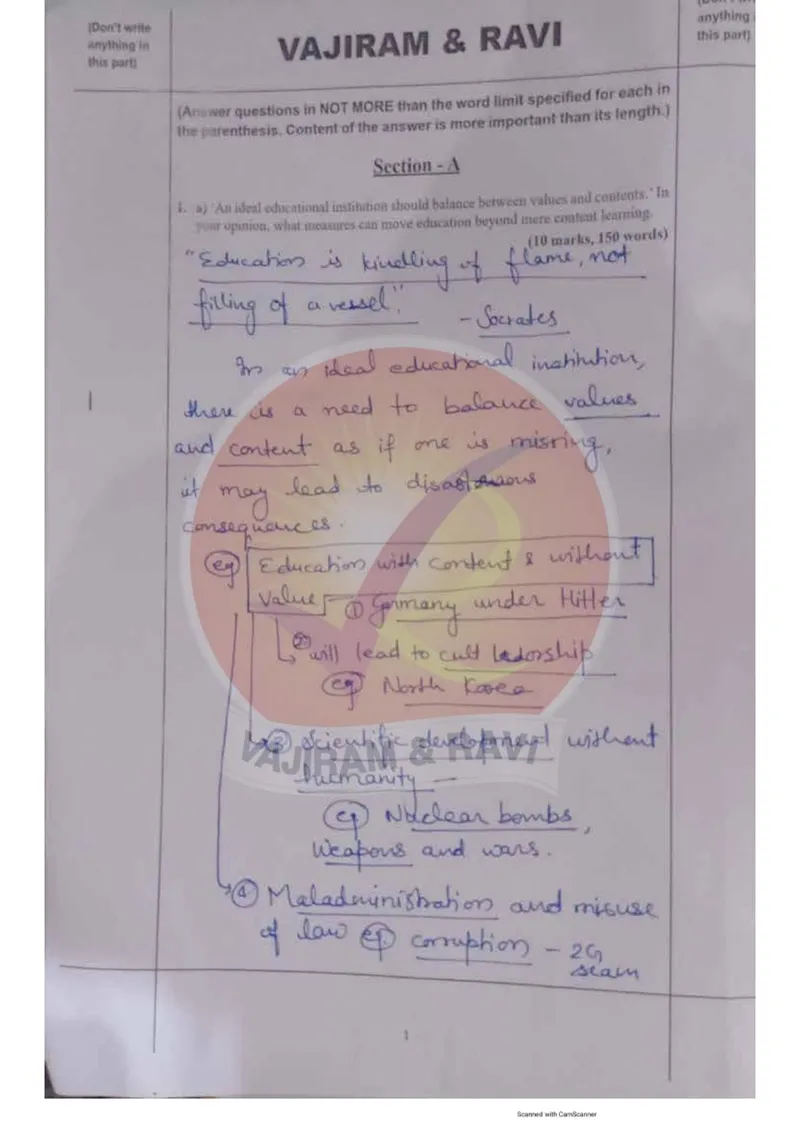
- ★She bookended every theory answer with a one-line definition open and a quotation close - e.g. opening Q1(a) with Socrates' 'Education is the kindling of a flame, not the filling of a vessel' and closing Q4(a) with Vivekananda's 'Truth doesn't pay homage to any society; society has to pay homage to truth or else perish' -> a fixed intro-body-conclusion template lets you start fast under time pressure and finish each answer with a memorable, examiner-pleasing line instead of trailing off.
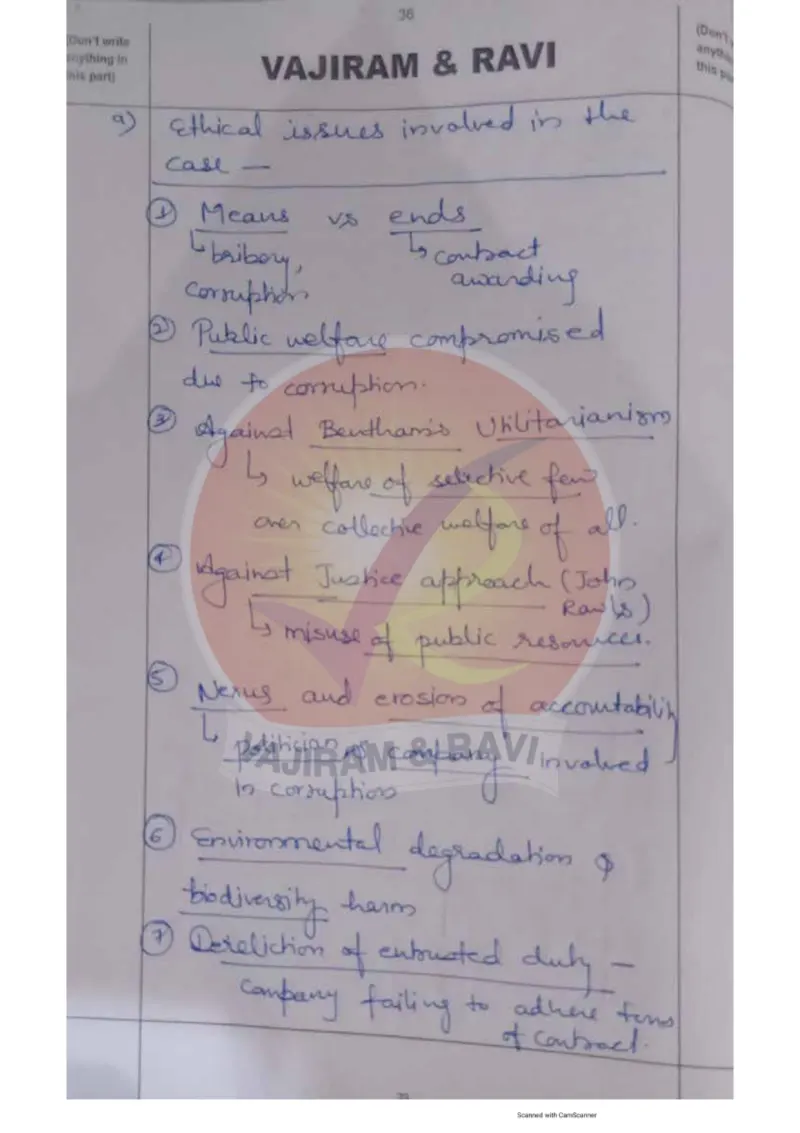
- ★She named ethical frameworks precisely rather than gesturing at them - Bentham's Utilitarianism, Rawls' Justice (and Veil of Ignorance), Kant's Categorical Imperative, Gandhi's Talisman and the Madhyam Marg middle path - applied to the right prompts (Talisman to Q4b's public-servant dilemma) -> in Ethics, attaching the correct thinker by name to a dilemma signals genuine command of the syllabus and beats vague 'one should do the right thing' reasoning.
- ★She gave every Section-B case study the same scaffold: stakeholder map drawn first, then ethical issues, then an option-wise merit/demerit table, then a reasoned final choice, then the relevant laws/schemes (NDPS Act, Juvenile Justice Act, PMLA 2002 for the Q7 drug-network case) -> a repeatable case-study skeleton ensures you never skip the option-evaluation or the legal/administrative grounding that distinguishes a top case answer.
- ★Her example bank was wide and deliberately matched to each prompt - Hitler's Germany and North Korea vs A.P.J. Abdul Kalam to contrast content-without-values for Q1(a), Viktor Frankl surviving the Holocaust through positive attitude for Q1(b), the S. Subramaniam Balaji vs State of Tamil Nadu freebies verdict alongside Amma Vodi for Q3, and Mother Teresa / Sindhutai Sapkal / Dashrath Manjhi for the quote questions -> build a stock of versatile illustrations spanning history, a Supreme Court judgment, current affairs and named Indian schemes so each abstract value lands on a concrete, verifiable anchor.
- ★She completed all 20 parts - the five-quote Q5, the five short-notes Q6(b), and all six 250-word case studies Q7-Q12 - with the same disciplined structure throughout -> in a paper with this many sub-parts, finishing every part is itself a major scoring lever, and a consistent template is what makes full completion possible within the time limit.
Questions attempted: Ideal institution balancing values & content; measures to move education beyond mere content learning; Attitude as a crucial factor in building an individual's social capital (agree/disagree); Emotional intelligence as primary in managing workplace conflicts, and 16 more below.
Questions attempted in this booklet (19)+
- Q1(a).Ideal institution balancing values & content; measures to move education beyond mere content learning
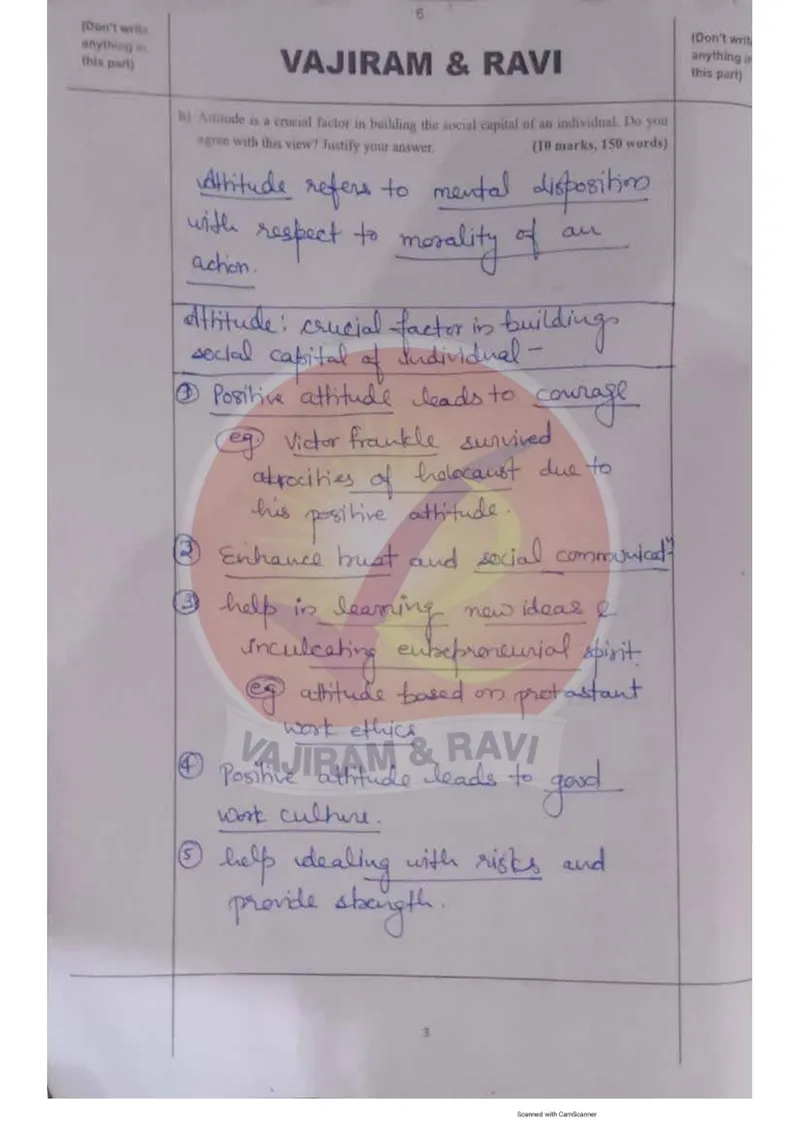
- Q1(b).Attitude as a crucial factor in building an individual's social capital (agree/disagree)
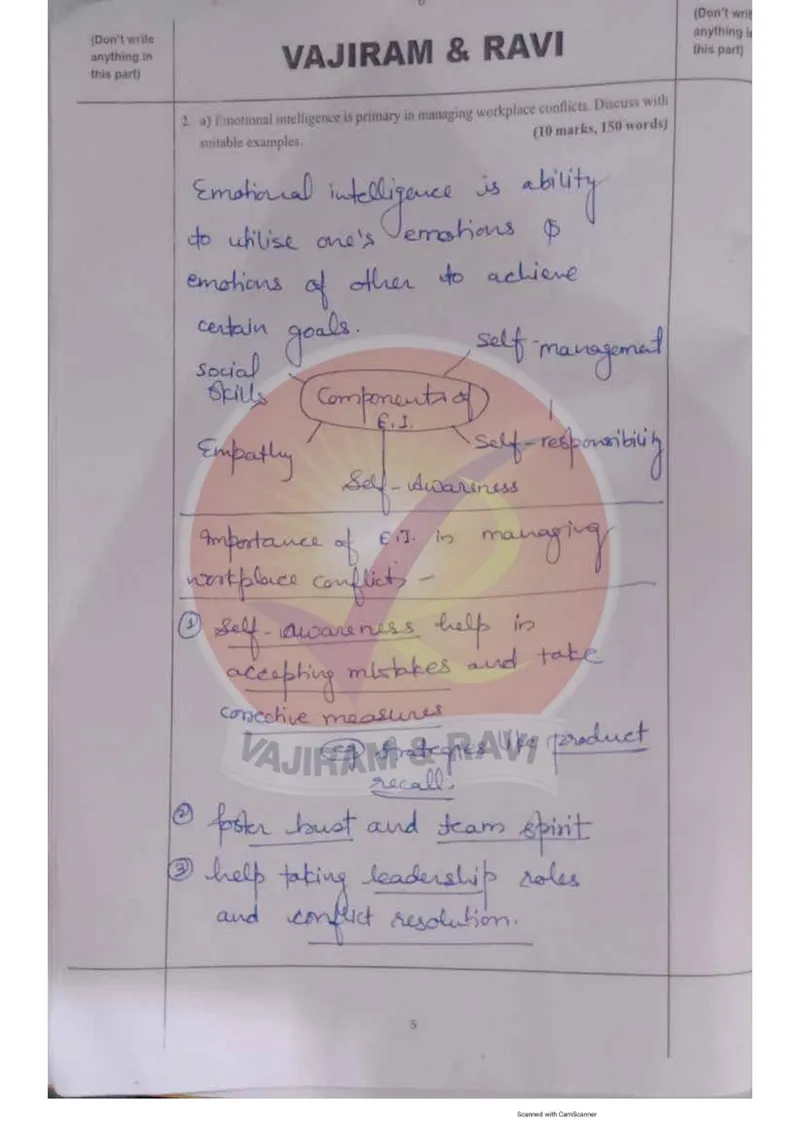
- Q2(a).Emotional intelligence as primary in managing workplace conflicts
- Q2(b).Panchsheel promoting ethical relations between countries amid mutual suspicion in bilateral conflicts
- Q3(a).Freebie culture: ethical issues of public funds used in populist measures for electoral gains
- Q3(b).Probity in governance as vital for socio-economic development
- Q4(a).Quote: 'Wisdom is attained when a person is always ready to accept the truth and renounce untruth'
- Q4(b).Application of Gandhi's Talisman in decision-making for public servants facing ethical dilemmas
- Q5(a).Quote: 'The highest result of education is tolerance' - Helen Keller
- Q5(b).Quote: 'Service rendered without joy helps neither the servant nor the served' - Mahatma Gandhi
- Q5(c).Quote: 'Faith is of no evil in the absence of strength; faith and strength both essential to accomplish any great work' - Vallabhbhai Patel
- Q6(a).Scope for corruption when accountability is fragile and division of power is ambiguous
- Q6(b).Short notes (30 words each): Non-Partisanship, Cognitive Dissonance, Veil of Ignorance, Moral Relativism, Social Influence
- Q7.Case study: Dr. Aanand, chemistry professor; campus drug network with UGC rep's son (Aditya) as lynchpin - dilemmas, options, anti-drug-abuse laws
- Q8.Case study: CEO, Smart Cities Mission; waste-management contractor (college friend) bribery/kickbacks - ethical issues and options
- Q9.Case study: Rekha, woman Sarpanch of Bhavanipuram; female infanticide, child marriage, maternal mortality - issues, options, course of action, govt laws/schemes
- Q10.Case study: IAS DM as Returning Officer for 18th Lok Sabha; minister's electoral malpractice and career inducements - dilemmas and options
- Q11.Case study: NDRF commandant; train derailment in Odisha (Balasore-like) rescue crisis - crisis handling and steps to avoid rail accidents
- Q12.Case study: Exam Controller; online recruitment-exam cheating mafia - ethical issues, response, pros/cons of online exams
Examples, data & evidence used
- Hitler's Germany / North Korea - content without values leading to cult leadership (Q1a)
- A.P.J. Abdul Kalam, 'Missile Man' with integrity - balance of content and values (Q1a)
- Viktor Frankl surviving Holocaust atrocities through positive attitude (Q1b)
- Mob lynching and harassment as outcomes of negative attitude (Q1b)
- SAARC dysfunction due to India-Pakistan conflict; India-China conflict from breach of trust (Q2b)
- India-Sri Lanka relations / doctrine of non-reciprocity; Buddhist circuits and India-Nepal cultural ties; Vasudhaiva Kutumbakam; China's debt-trap as unethical practice (Q2b)
- Supreme Court in S. Subramaniam Balaji vs State of Tamil Nadu on freebies disturbing the level playing field (Q3a)
- Loan waivers, irrational subsidies, electricity subsidies making DISCOMs debt-ridden (Q3a)
- Patwani (UP) public-grievance scheme; Amma Vodi (Andhra Pradesh) as compassionate administration (Q3b)
- Black Lives Matter movement and #MeToo - accepting truth, voicing against discrimination (Q4a)
- Israel-Hamas war as a result of intolerance; Gandhi's Nai Talim promoting non-violence; colonial 'divide and rule' education and Partition (Q5a)
- Mother Teresa and Sindhutai Sapkal (mother of orphans) - service rendered with joy (Q5b)
- Dashrath Manjhi carving a road through a mountain; Sardar Patel integrating India via persuasion and power - faith plus strength (Q5c)
- NDPS Act, Juvenile Justice Act, Prevention of Money Laundering Act 2002 (Q7 anti-drug-abuse laws)
Quotes the candidate used
- 'Education is the kindling of a flame, not the filling of a vessel' - Socrates (Q1a intro)
- 'Truth doesn't pay homage to any society; society has to pay homage to truth or else perish' - Swami Vivekananda (Q4a conclusion)
- 'The highest result of education is tolerance' - Helen Keller (Q5a; the question prompt, expounded)
- 'Service which is rendered without joy helps neither the servant nor the served' - Mahatma Gandhi (Q5b; the question prompt, expounded)
- 'Faith is of no evil in the absence of strength...' - Vallabhbhai Patel (Q5c; the question prompt, expounded)
- Proverb: 'Give a man a fish, feed him for a day; teach him how to fish, feed him for a lifetime' (Q3a, author not attributed)
- 'It is the mark of an educated mind to entertain a thought without accepting it' paraphrased in Q5a conclusion (author not written - commonly attributed to Aristotle; flagged as uncertain)
How it’s written: Highly disciplined, consistent template across all 20 parts. Theory answers (Section A) follow Introduction (almost always a one-line definition, e.g., attitude, emotional intelligence, probity, corruption 'per Transparency International', wisdom, faith) -> point-wise Body using circled/arrow bullets, sub-headings a…
Diagrams & visuals: Flow / tree diagrams to break down concepts (e.g., components of Emotional Intelligence; probity-in-governance outcomes); Stakeholder maps drawn at the start of each Section-B case study; Merit-demerit option tables/columns for evaluating case-study options; Boxed and underlined keywords / bracketed point-groupings for visual structure; No geographical maps used
Evaluator: No examiner marks or comments are filled in on this copy.