
Vandita — DrishtiIAS GS Paper 4 (Ethics) copy
What’s inside this copy
- ▸Confirmed genuine Vandita copy — Drishti IAS GS-4 Ethics test (Test-6), English medium, 14/8/24, Reg 2790, UPSC Roll 0803478; all 12 questions attempted.
- ▸Updates classic ethical thinkers with sharp contemporary hooks — Uyghurs in China, Kuki-Meitei Manipur, Abraham Accords, USA-Cuba — to make Mandela/Buddha/Tagore lessons current.
- ▸Anchors the EI section in Daniel Goleman, including the '80% career success from EQ, 20% from IQ' line.
- ▸Presentation-forward style: comparison tables, ABC-attitude model, and arrow 'equations' (e.g. Positive Attitude = Commitment + Dedication + Motivation + Perseverance → SUCCESS).
- ▸Case studies follow a disciplined template — issue framing → stakeholders → ethical issues → course of action / my decision.
- ▸Vivid persuasion examples: K.R. Narayanan shaking hands with HIV patients, PM Modi washing safai karmacharis' feet, Amitabh Bachchan's polio drive.
What to learn from this copy
- ★For the Q2a/Q3 quote-interpretation questions, Vandita pairs each classic thinker with a sharp current-affairs hook rather than abstract gloss -- Mandela's lesson on minority atrocities linked to Uyghurs in China, Buddha's anger/forgiveness quote to USA-Cuba relations, and Tagore's 'letting go' quote to the Kuki-Meitei Manipur conflict and the Abraham Accords -> in Ethics, prove you understand a thinker by mapping their idea onto a specific live event, not by restating the quote.
- ★She anchored the Emotional Intelligence answers (Q1a, Q2b) in a named authority and a concrete figure -- Daniel Goleman plus the '80% of career success comes from EQ, 20% from IQ' line -- instead of generic definitions -> attaching one credible thinker and a memorable statistic to a core concept signals real reading and makes the answer stick.
- ★Her persuasion/social-influence answer (Q4b) ran on three vivid, specific Indian examples -- President K.R. Narayanan shaking hands with HIV/AIDS patients, PM Modi washing safai karmacharis' feet, and Amitabh Bachchan's polio vaccination drive -> stock 'leading by example' claims become convincing only when backed by named, recognisable instances.
- ★She converted abstract ethics points into compact visual devices -- a two-column 'Lesson | Example-in-today's-time' table for Mandela (Q2a), the ABC (Cognition/Affection/Behaviour) model for attitude (Q4b), and arrow 'equations' like 'Positive Attitude = Commitment + Dedication + Motivation + Perseverance -> SUCCESS' (Q5b) -> structuring content as a table or equation forces clarity and lets the examiner grab your point in seconds.
- ★Across all six 20-mark case studies (Q7-Q12) she held a single disciplined template -- issue framing -> stakeholders (with a stakeholder map drawn for each) -> ethical issues -> course of action / my decision -> a repeatable case-study skeleton lets you cover every required element under time pressure without missing the stakeholder or decision component.
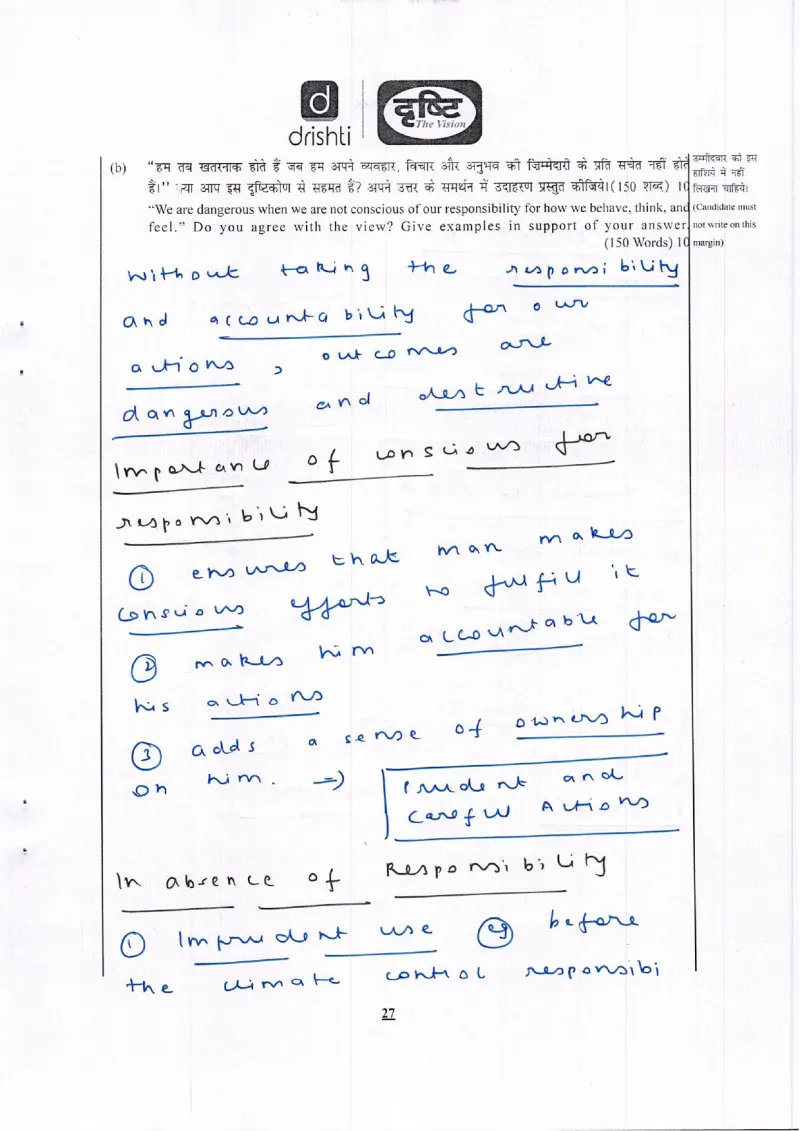
- ★She attempted all 12 questions (confirmed in the copy), including full case-study coverage Q7-Q12 -> completing the paper matters: leaving questions blank forfeits marks no amount of polish elsewhere can recover.
Questions attempted: What is Emotional Intelligence; comparison between EI and IQ/EQ; Difference between morals and ethics; contribution of ethics to professional life; Lessons from Nelson Mandela's life applied to present situations, with examples, and 16 more below.
Questions attempted in this booklet (19)+
- 1(a).What is Emotional Intelligence; comparison between EI and IQ/EQ
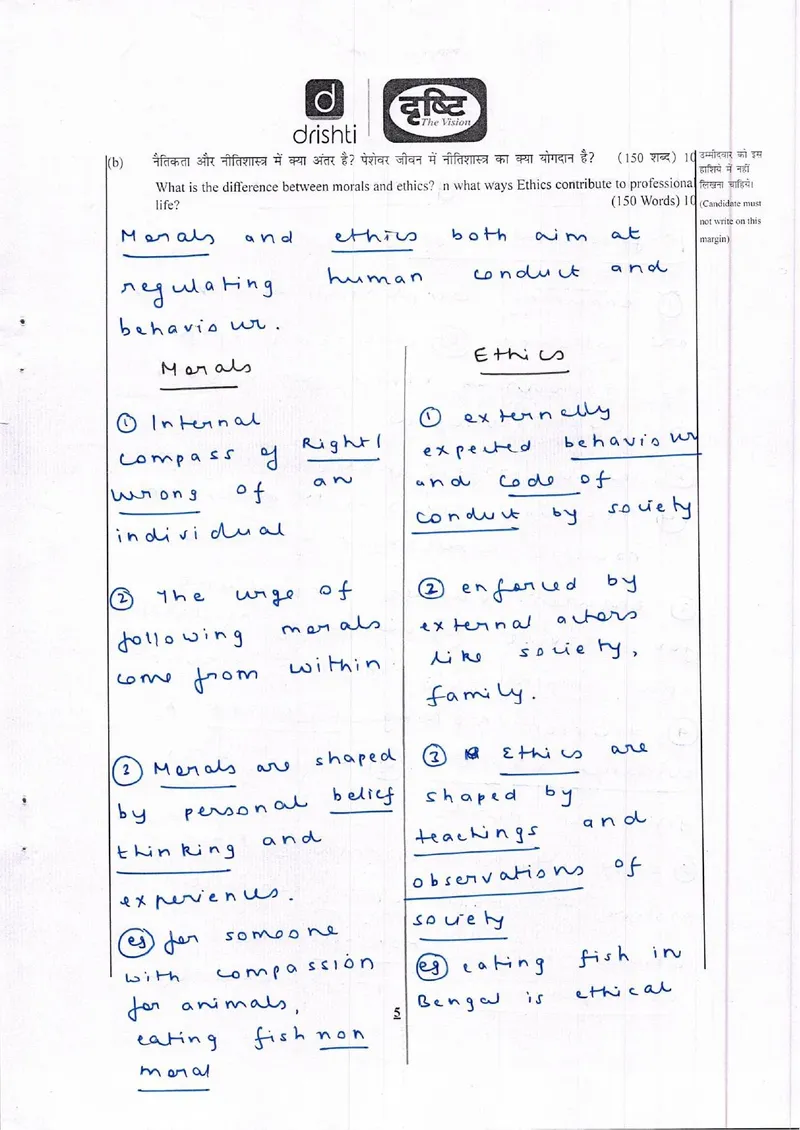
- 1(b).Difference between morals and ethics; contribution of ethics to professional life
- 2(a).Lessons from Nelson Mandela's life applied to present situations, with examples
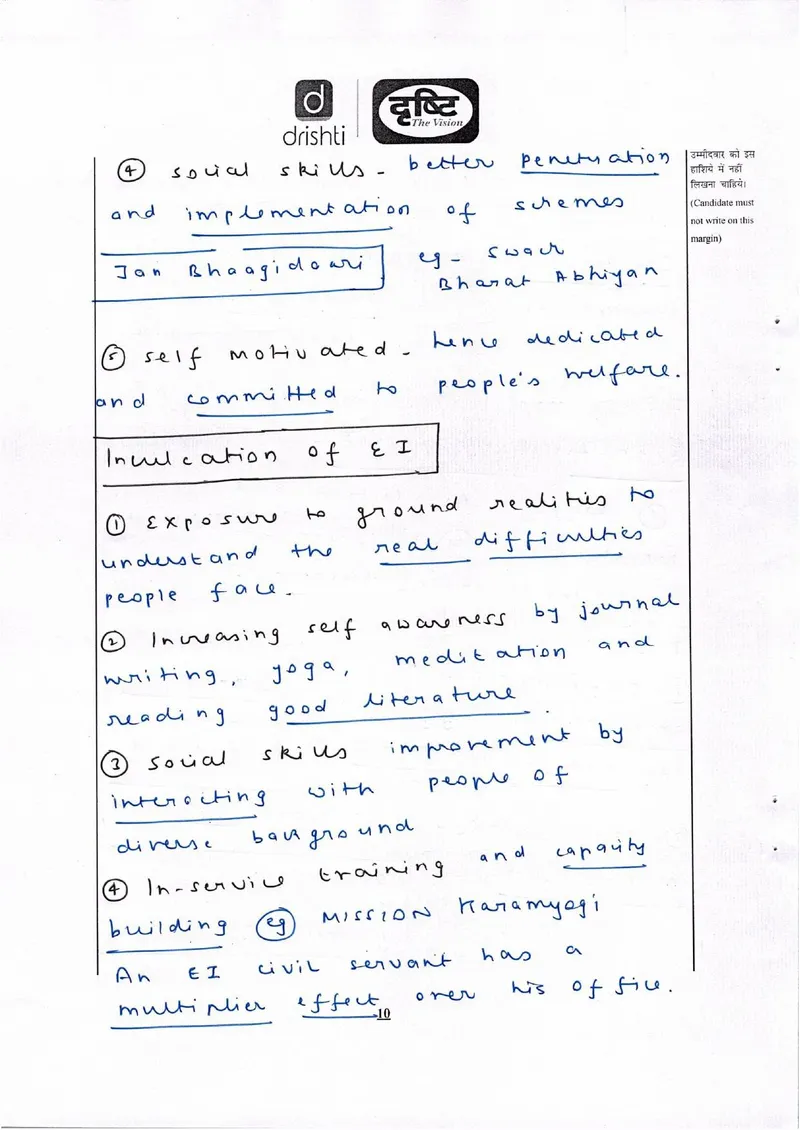
- 2(b).Significance of Emotional Intelligence for civil servants and ways to inculcate it
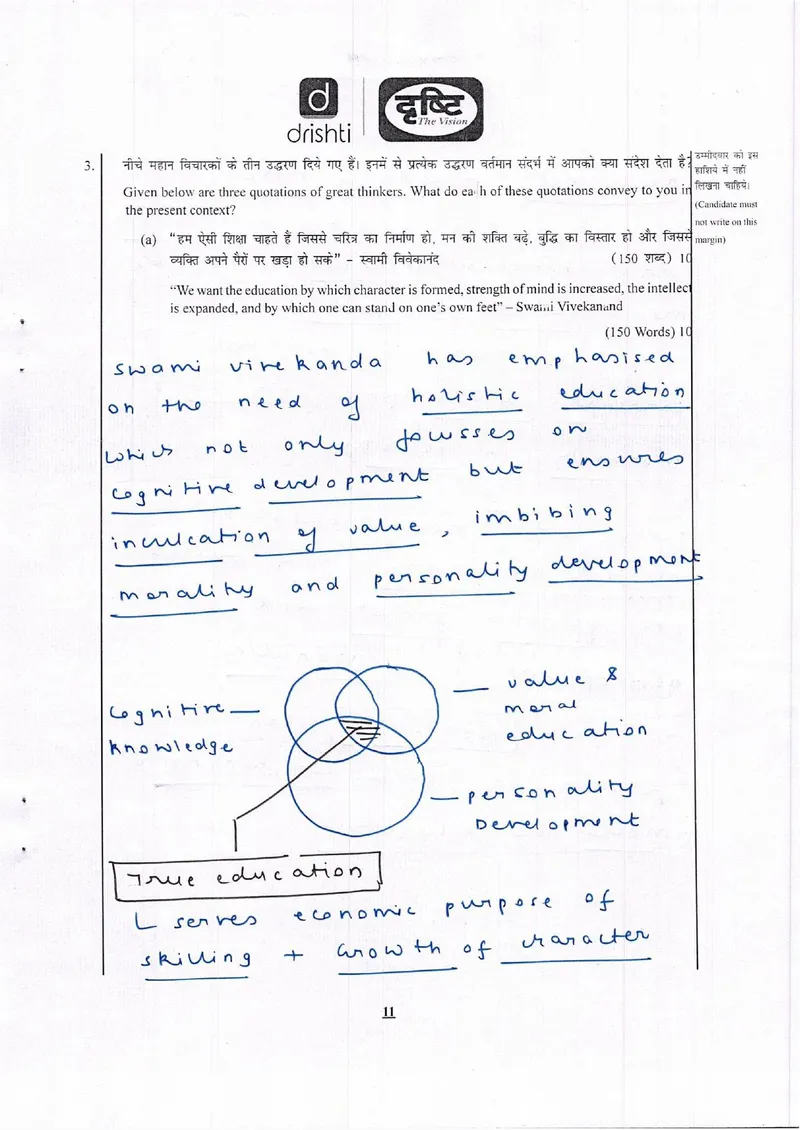
- 3(a).Swami Vivekananda quote on education forming character (interpretation)
- 3(b).Buddha quote on anger as grasping a hot coal (interpretation)
- 3(c).Rabindranath Tagore quote on crying over a lost sun / missing the stars (interpretation)
- 4(a).Role of family and society in inculcating values
- 4(b).What constitutes attitude; how persuasion and social influence foster positive attitude
- 5(a).Ethical issues in (i) Abortion (ii) Euthanasia (iii) Death Penalty
- 5(b).Vivekananda 'Never say no' quote — role of positive attitude in decision-making
- 6(a).Impact of Artificial Intelligence on individuals' ethical decision-making (brief/partial answer)
- 6(b).'We are dangerous when not conscious of our responsibility' — agree/disagree with examples
- 7.Case study: wedding planner; groom's father allegedly exploits cook's daughter; bride offers hush money
- 8.Case study: Assistant Professor; fiancée's grandmother isolated/neglected; problems of senior citizens
- 9.Case study: live-in relationship, false rape allegation, State Commission for Women chairperson; live-in vs Indian culture
- 10.Case study: Bihar Acute Encephalitis outbreak; biased media coverage; CMO; media's social responsibility
- 11.Case study: District Magistrate in underdeveloped region; bureaucratic/political hurdles; EI for civil servant
- 12.Case study: homeless shelter NIMBY resistance, caste prejudice; strategies and stakeholder responsibilities
Examples, data & evidence used
- Daniel Goleman — EI definition and '80% of career success from EQ, 20% from IQ' (Q1a)
- Eating fish in Bengal — moral vs ethical distinction (Q1b)
- Hippocrates / Hippocratic oath for doctors — ethics in professional life (Q1b)
- Uyghur/Muslim community in China — Mandela lesson on minority atrocities (Q2a)
- China–India geopolitical conflict; climate change & developed-vs-developing nation commitment; migrants' rehabilitation (Q2a)
- Swachh Bharat Abhiyan — social skills / persuasion (Q2b, Q4b)
- Mission Karmayogi — in-service training/capacity building for EI (Q2b)
- NEP 2020 — relevance of Vivekananda's holistic-education quote (Q3a)
- USA–Cuba relations — Buddha forgiveness/anger quote (Q3b)
- NEET exam failure — Tagore 'move on' quote (Q3c)
- Kuki–Meitei conflict, Manipur; Abraham Accords — Tagore letting-go quote (Q3c)
- President K.R. Narayanan shaking hands with HIV/AIDS patients — persuasion (Q4b)
- Amitabh Bachchan polio vaccination drive; PM Modi washing safai karmacharis' feet — social influence (Q4b)
- Dhirubhai Ambani — positive attitude / risk appetite (Q5b)
Quotes the candidate used
- Daniel Goleman — paraphrased EI definition cited by candidate (Q1a)
- Swami Vivekananda — 'We want the education by which character is formed...' (Q3a prompt)
- Gautama Buddha — 'Holding on to anger is like grasping a hot coal...' (Q3b prompt)
- Rabindranath Tagore — 'If you cry because the sun has gone out of your life, your tears will prevent you from seeing the stars.' (Q3c prompt)
- Swami Vivekananda — 'Never say no, never say I cannot, for you are infinite...' (Q5b prompt)
- 'We are dangerous when we are not conscious of our responsibility for how we behave, think, and feel.' — author not stated in paper (Q6b prompt)
How it’s written: Standard Drishti QCA booklet, pages numbered ~1–60. Section A = Q1–Q6 (twelve 10-mark sub-parts, 150 words each); Section B = Q7–Q12 (six 20-mark case studies, 250 words each); pages 59–60 are blank rough-work sheets. Answers are point-/bullet-driven with clear sub-headings (e.g. 'Significance of EI', 'Inculcation o…
Diagrams & visuals: Two-column comparison table: Emotional Intelligence vs IQ (Q1a); Lesson | Example-in-today's-time two-column layout (Q2a, Mandela); ABC model of attitude — Cognition / Affection / Behaviour (Q4b); Flow/arrow diagrams and 'equations', e.g. 'Positive Attitude = Commitment + Dedication + Motivation + Perseverance → SUCCESS' and anger→negative-outcome chains (Q3b, Q5b); Stakeholder maps drawn for each Section-B case study (Q7–Q12); No geographical maps (Ethics paper)
Evaluator: No evaluator marks or written comments captured. The "To be filled by Evaluator only" marks grid and the six-parameter feedback rubric (Context/Introduction/Content/Language-Flow/Conclusion/Presentation Proficiency) are present as the pr…