
Akansh Dhull — NextIAS GS copy
What’s inside this copy
- ▸Genuine and correctly attributed: Akansh Dhull (Roll MT23 KTRA 004), NextIAS MTS Rapid Test-1 GS Paper-I, dated 19/08/2023, Online; cover note 'This Copy is from 2023 Mains'.
- ▸Neat, fluent blue-ink handwriting that is highly legible throughout; disciplined intro–body–conclusion with boxed/underlined headers and numbered points.
- ▸Attempted 17 of 20 — strategically left blank the three most technical physical-geography questions (Q4 temperature distribution, Q7 seismic/Earth interior, Q14 ocean-floor features).
- ▸Heavy, specific evidence density: reports and data (Sachar Committee, Niti Aayog 66%, NCAER 5%, UNFPA 68%, IMD 99%-of-LPA), schemes (Operation Flood, Parvatmala) and live current affairs (Balasore/Coromandel tragedy, Joshimath, Nuh violence, IIT-B Darshan Solanki).
- ▸Two clear hand-drawn diagrams in the monsoon answer (Q17): a jet-stream/Mascarene-High map and an El Niño/Walker-circulation schematic.
- ▸Answers close with forward-looking conclusions and routinely cite constitutional articles (Art 14/17/19/25) and SDGs (11/12/13).
What to learn from this copy
- ★Strategic selective attempt — answered 17 of 20 and deliberately left blank exactly the three most technical physical-geography questions (Q4 temperature distribution, Q7 seismic/Earth interior, Q14 ocean-floor features) -> In a choice paper, consciously drop the handful of high-risk technical questions and reinvest that time writing dense, evidenced answers on topics you can dominate, rather than attempting everything thinly.
- ★Answered the exact directive of Q1 ('owes EQUALLY to North and South') by balancing the sources — North via Shankaracharya's four Maths, Upanishads and Shad Darshanas, and South via Alvar saints, Basavanna/Lingayat and Kanchipuram as 'Second Kashi' -> When a question builds in a balance ('equally', 'North and South'), structure your examples so both sides are visibly and roughly evenly covered, instead of defaulting to the more familiar half.
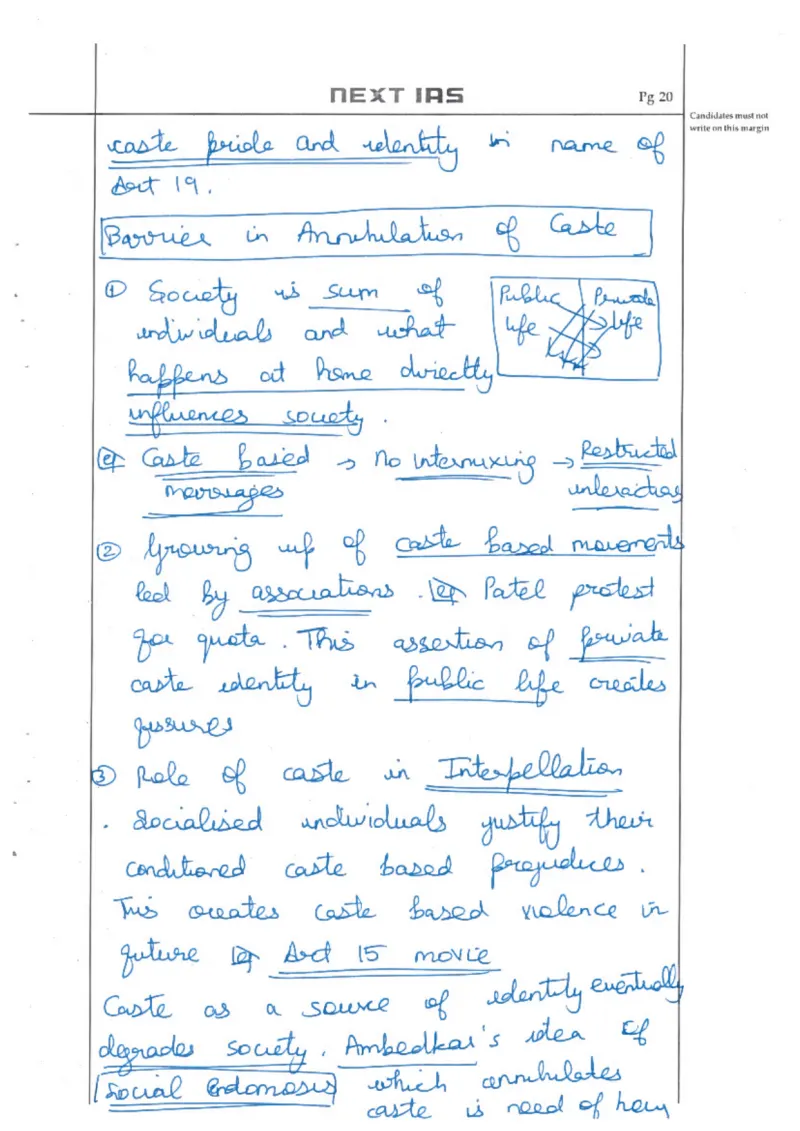
- ★Anchored abstract GS1 themes in named live incidents and exact figures — Q10 (caste / public-private dichotomy) cited Darshan Solanki's IIT-Bombay death, NCAER ~5% inter-caste marriages and Art 17; Q8 (demographic transition) used the Balasore/Coromandel tragedy, UNFPA 68% working-age, delimitation after 2026 and 15th Finance Commission devolution -> Convert every conceptual question into specific current-affairs hooks and precise data points (committee/report names, percentages) so a sociology/history theme reads as evidenced analysis, not opinion.
- ★Closed answers with a short, on-theme quotation rather than a generic summary — Q9 (cultural unity) ends on a Ravidas equality couplet, and Q11 (Indo-Pak/China relations) deploys the diplomacy aphorism 'You can't change your neighbours' -> Reserve a relevant, topic-specific quote for the conclusion so the final line crystallises your argument instead of merely restating it.
- ★Drew two distinct labelled mechanism diagrams inside the single Q17 monsoon answer — a jet-stream/Mascarene-High wind-flow map (Tibet, Tropical Easterly Jet, Trade Winds) AND a separate El Nino/Walker-circulation schematic showing pressure cells weakening/strengthening -> For physical-geography process questions, draw the actual working mechanism with named components (not a decorative outline map), and use more than one diagram when the topic genuinely has separate mechanisms to explain.
Questions attempted: Indian philosophical thought owes equally to North and South India — Elucidate; 19th-c. social reform impulse as a response to colonial rule — Examine; Russian Revolution: factors, consequences & influence on Indian national movement, and 14 more below.
Questions attempted in this booklet (17)+
- 1.Indian philosophical thought owes equally to North and South India — Elucidate
- 2.19th-c. social reform impulse as a response to colonial rule — Examine
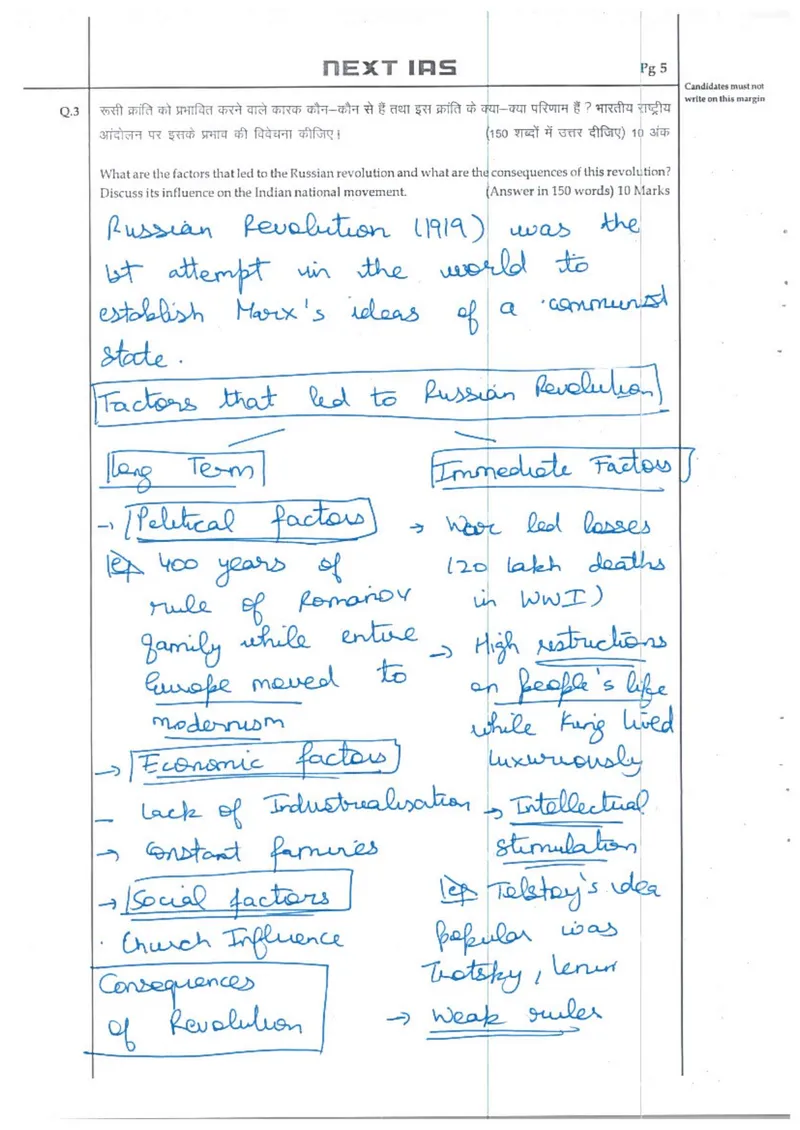
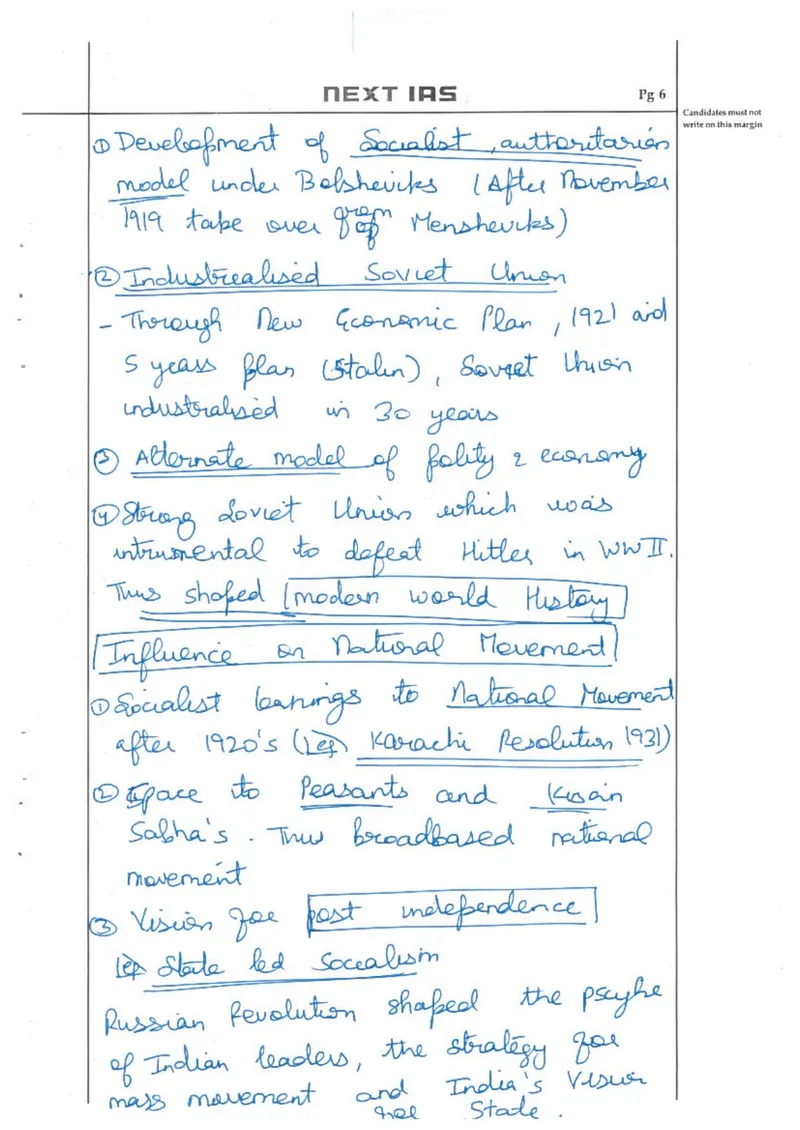
- 3.Russian Revolution: factors, consequences & influence on Indian national movement
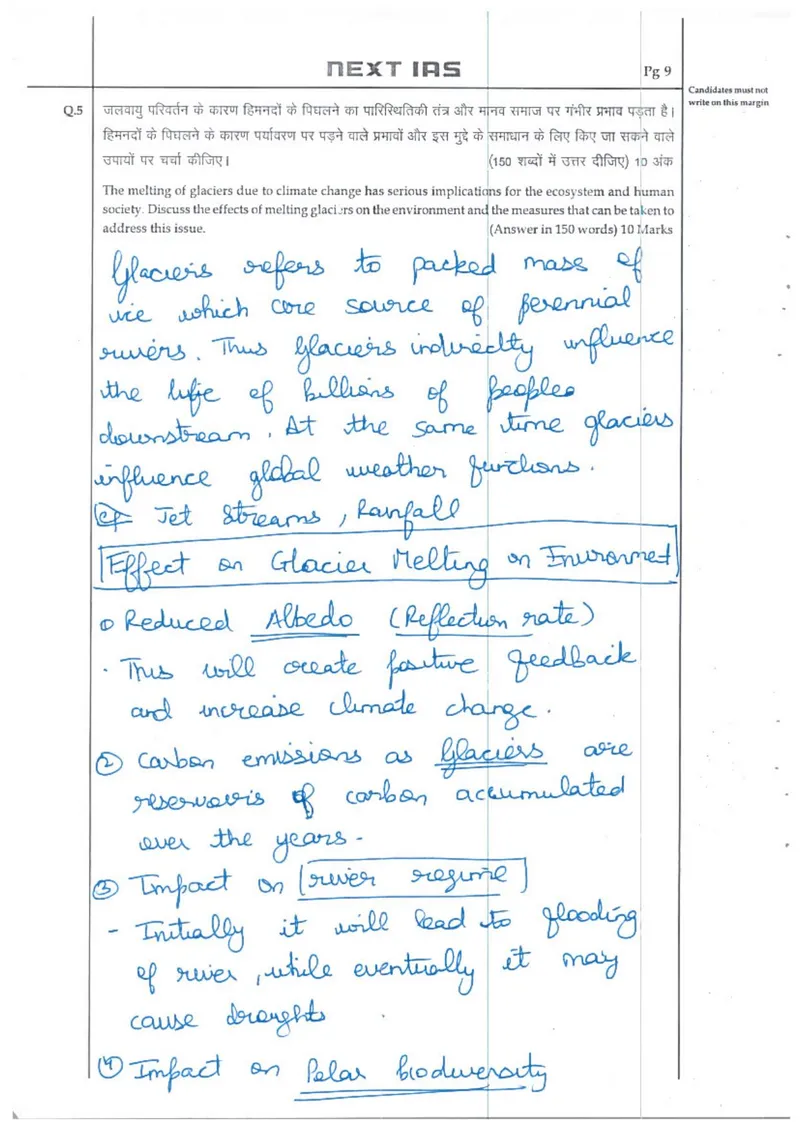
- 5.Melting glaciers — environmental effects and remedial measures
- 6.White Revolution's regional success in western India — factors
- 8.Differential demographic transition across states as a double-edged sword
- 9.Factors contributing to India's cultural unity amid diversity
- 10.Public/private dichotomy as barrier to annihilation of caste — Justify
- 11.Indo-Pak & Indo-China wars: causes and impact on bilateral relations
- 12.Battle of Buxar vs Plassey — which was more important for the British
- 13.Sanskrit literature & the Gupta age as a high watermark — Discuss
- 15.Rare earth elements: distribution, uses, environmental impact of extraction
- 16.Hill-state tourism exceeding ecological carrying capacity
- 17.Indian monsoon: oceanic & atmospheric factors (with diagrams)
- 18.Why traditions impede change; scope of social legislation vs old customs
- 19.Slums as a result of lopsided/vested urban policies — Analyse
- 20.Communalism, economic deprivation and social exclusion — Comment
Examples, data & evidence used
- Rig Veda, Upanishads, Shad Darshanas, Charvaka school, Ajivika (Q1)
- Shankaracharya 'Aham Brahmasmi' & the four Maths (Jagannath–Kedarnath–Dwarka) (Q1/Q9)
- Alvar saints, Basavanna & Lingayat community; Kanchipuram as 'Second Kashi'; St Thomas; Kanishka/Central Asia (Q1)
- Abolition of Sati 1829; Swami Vivekananda's Vedanta & 'Back to the Vedas'; Vidyasagar widow remarriage; 'Indian Renaissance' (Q2)
- Russian Revolution 1917; Romanov dynasty; WWI losses; Tolstoy; Lenin & Trotsky; New Economic Policy; Stalin's Five-Year Plan (Q3)
- Karachi Resolution 1931; Kisan Sabhas; 1971 Indo-Soviet Treaty of Peace & Friendship (Q3/Q11)
- Operation Flood; Dr Verghese Kurien; AMUL; Ashok Dalwai 70:30 income-doubling (Q6)
- IPCC; Karakoram Anomaly; net-zero by 2050; 1.5°C target; SDG 13 (Q5)
- Balasore train tragedy / Coromandel Express; TFR<2 in South; UNFPA 68% working-age; delimitation after 2026; 15th Finance Commission devolution; Art 14 (Q8)
- Ganga-Jamuni Tehzeeb; Agastya crossing the Vindhyas; Kashi-Kanchi & Kashi-Tamil Sangamam; Tribal Panchsheel; linguistic reorganisation; Ravidas couplet (Q9)
- Art 17; NCAER ~5% inter-caste marriages; Darshan Solanki (IIT-Bombay) death; Jat Sabha/Gurjar Sabha; Patel quota protest; Ambedkar's 'annihilation of caste'/social endosmosis (Q10)
- 1948 tribal invasion; Instrument of Accession; 1971 East Pakistan war; 1999 Kargil; Panchsheel 1958; 1962 war; LAC; Dalai Lama asylum; Gujral doctrine/Neighbourhood-First; NAM; IPKF Sri Lanka (Q11)
- Battle of Plassey 1757 (Mir Jafar, Diwani, Dastak); Battle of Buxar 1764; Shah Alam II; Treaty of Allahabad 1765; Dual Government (Nizamat & Diwani); subsidiary alliance (Q12)
- Panini's Ashtadhyayi; Laukik Sanskrit; Amarsimha; Samudragupta patronage; Devichandraguptam; Rudradaman inscription; Vijayanagara (Q13)
Quotes the candidate used
- Ravidas couplet on equality used to close Q9 (cultural unity) — 'Sabhko ek samaan...' (attributed to Ravidas; exact wording partly reconstructed from OCR)
- 'You can't change your neighbours' — diplomacy aphorism in Q11 (no author attributed)
- Nehru's characterisation of India-China ties as a 'once-in-a-century' partnership, paraphrased in Q11
- Candidate's own Latin tag 'primus inter pares' for Sanskrit in Q13
How it’s written: Consistent intro–body–conclusion across all attempts. Each answer opens with a one-line definition or a striking factual/current-affairs hook, then boxed or underlined sub-headings (e.g., 'Causes', 'Impact', 'Measures') with numbered points marked (1)(2)(3) / circled numerals, arrows and indentation for sub-points,…
Diagrams & visuals: Q17: hand-drawn Indian-monsoon schematic — Western Jet Stream, Tibet, Tropical Easterly Jet Stream, Mascarene High, Trade Winds and Equator with wind-flow arrows; Q17: El Niño / Walker-circulation schematic — India, Australia and South America with High/Low pressure cells and trade winds ('strengthen in La Niña / weaken in El Niño')
Evaluator: No examiner marks or comments are filled in on this copy.