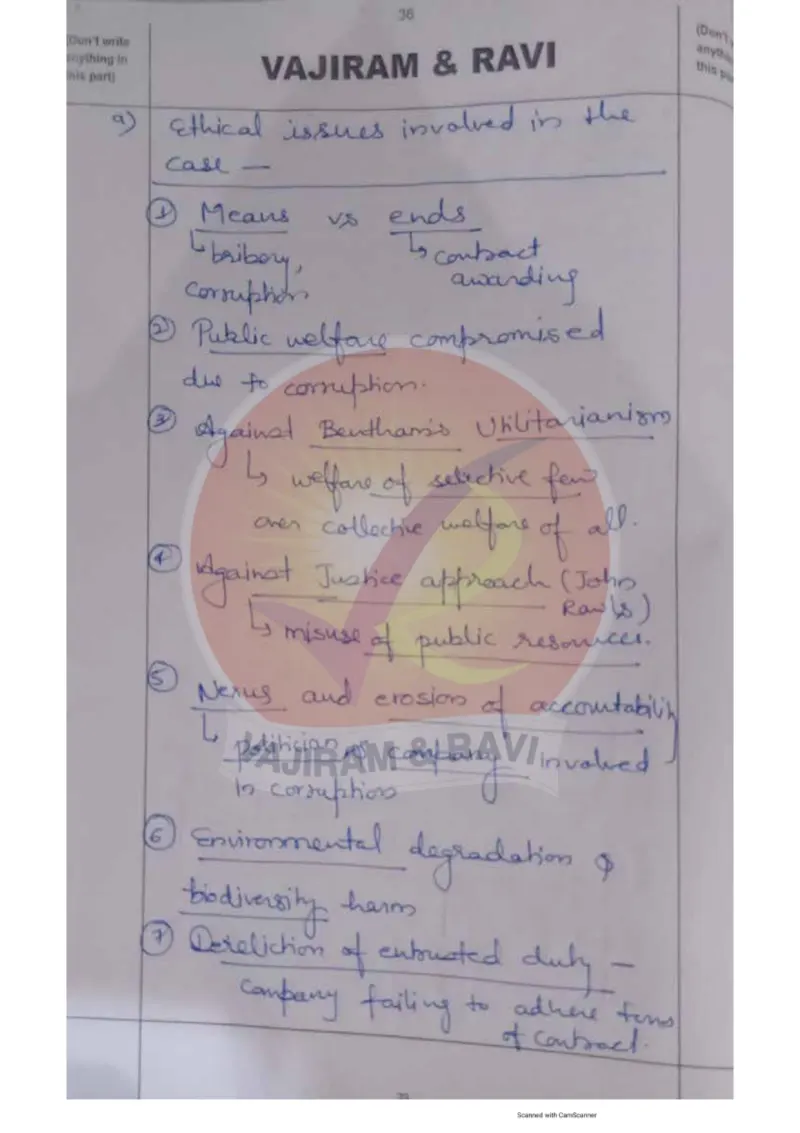
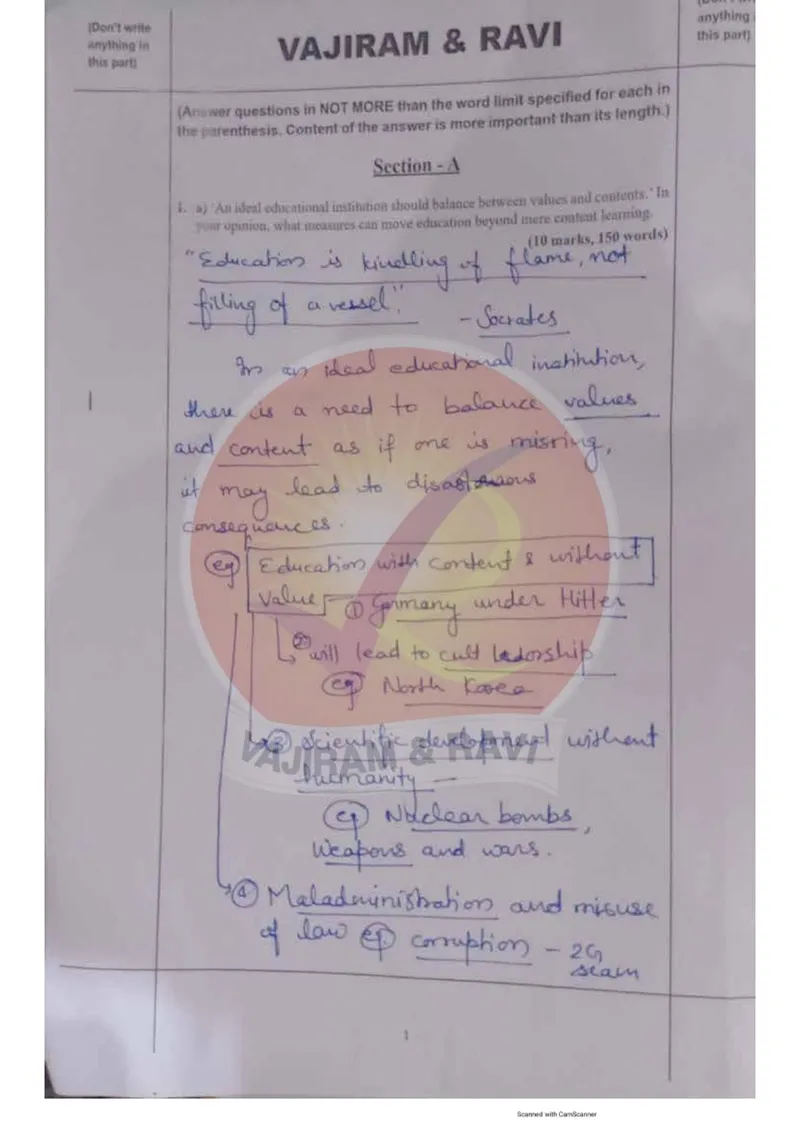
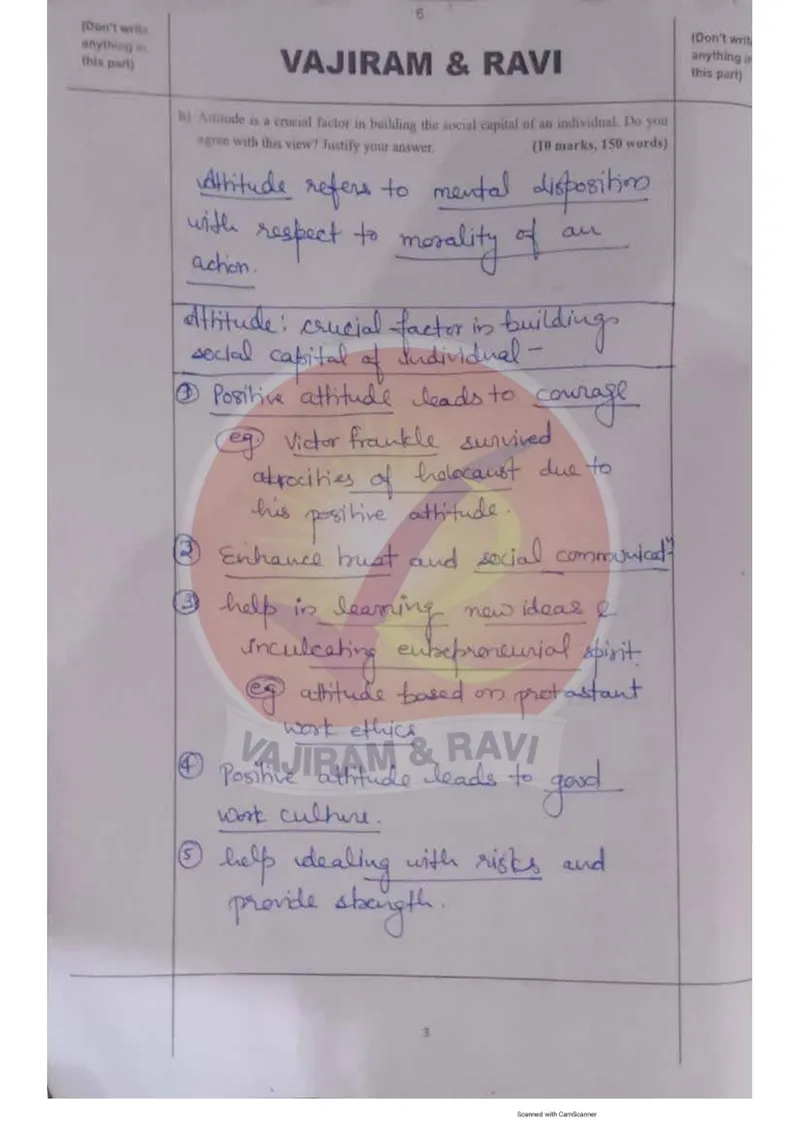
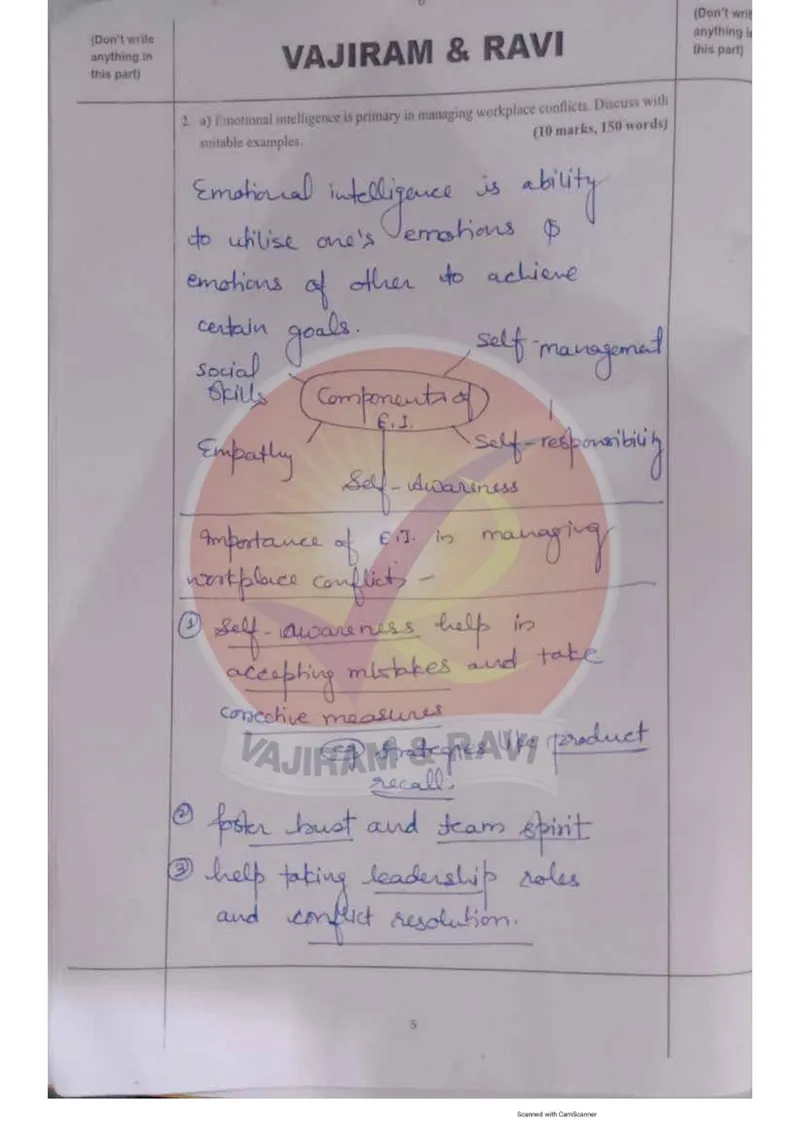
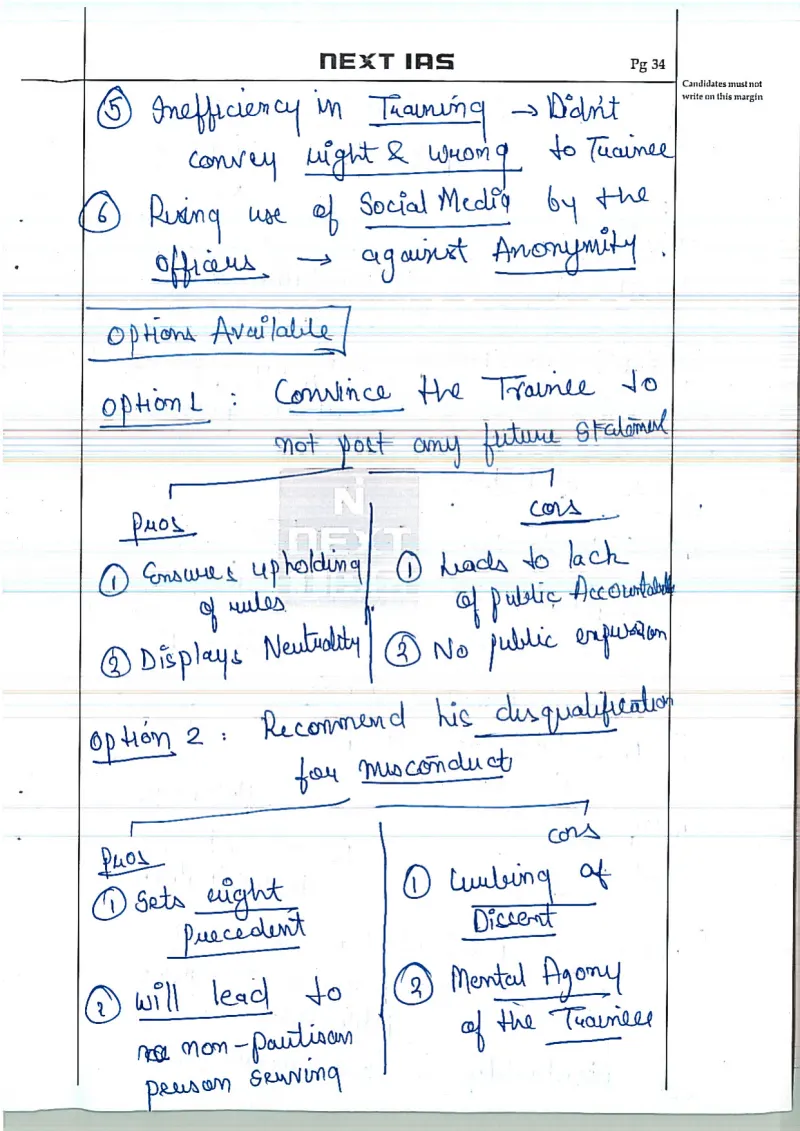
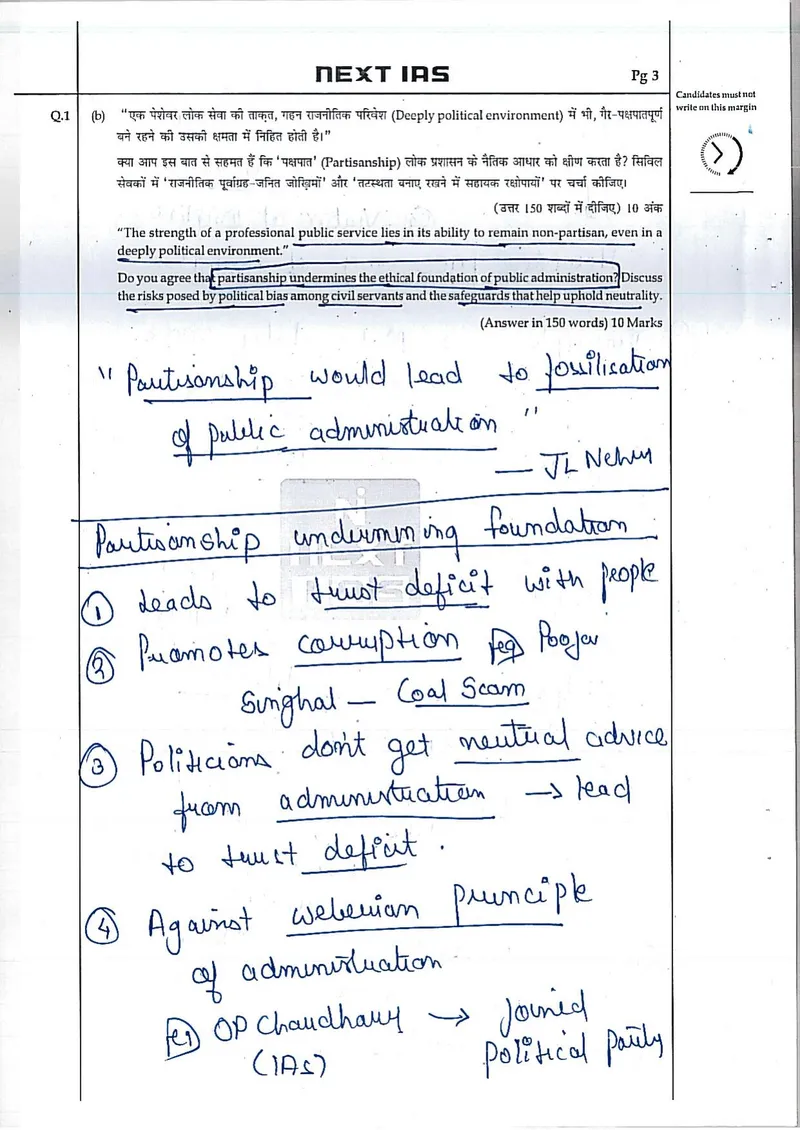
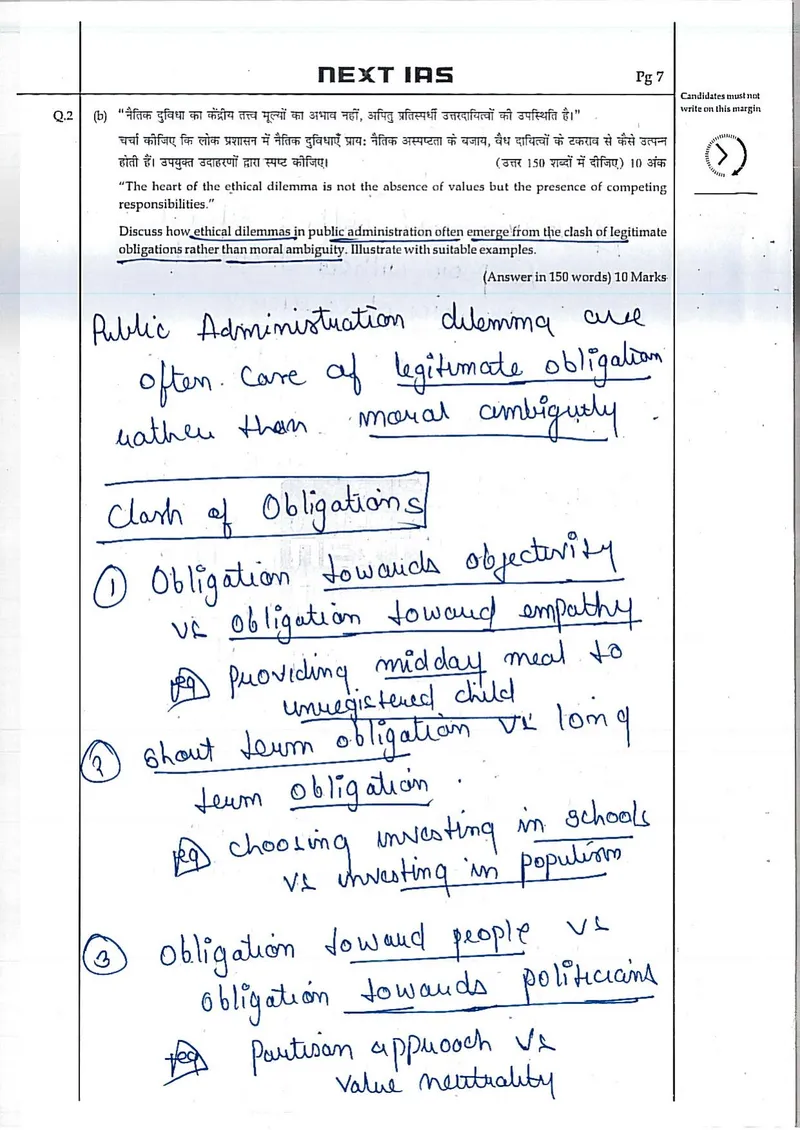
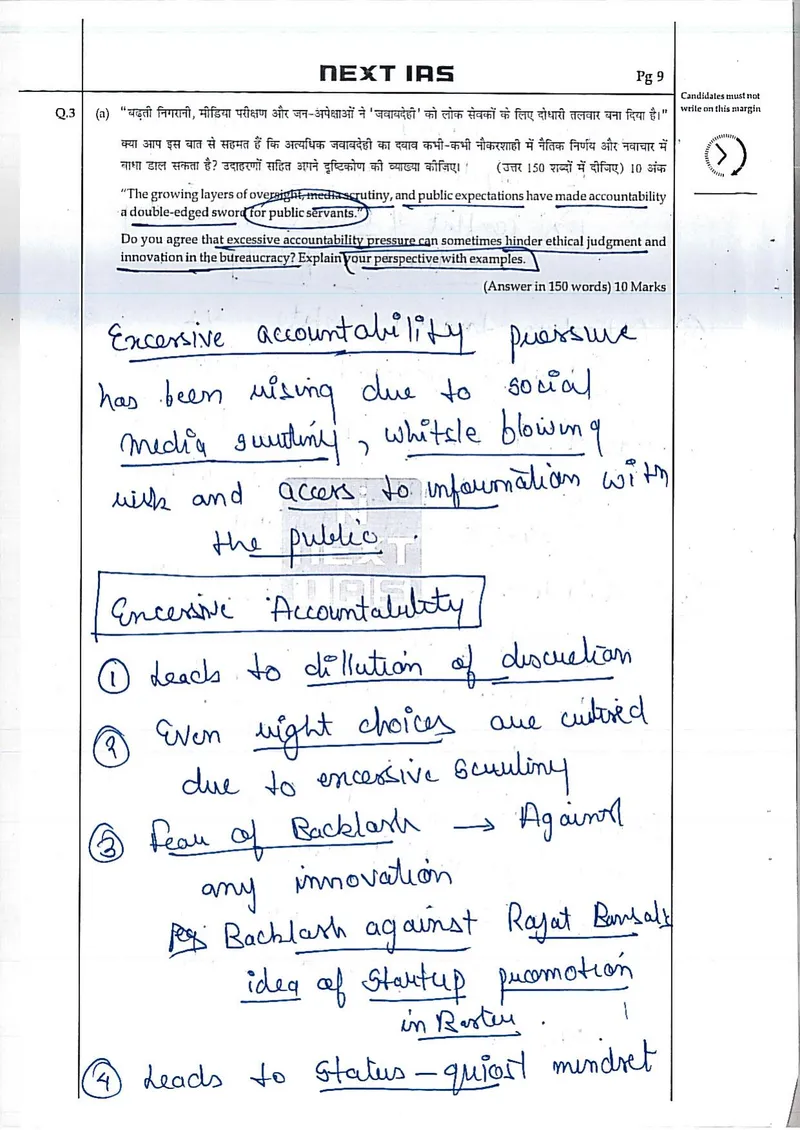
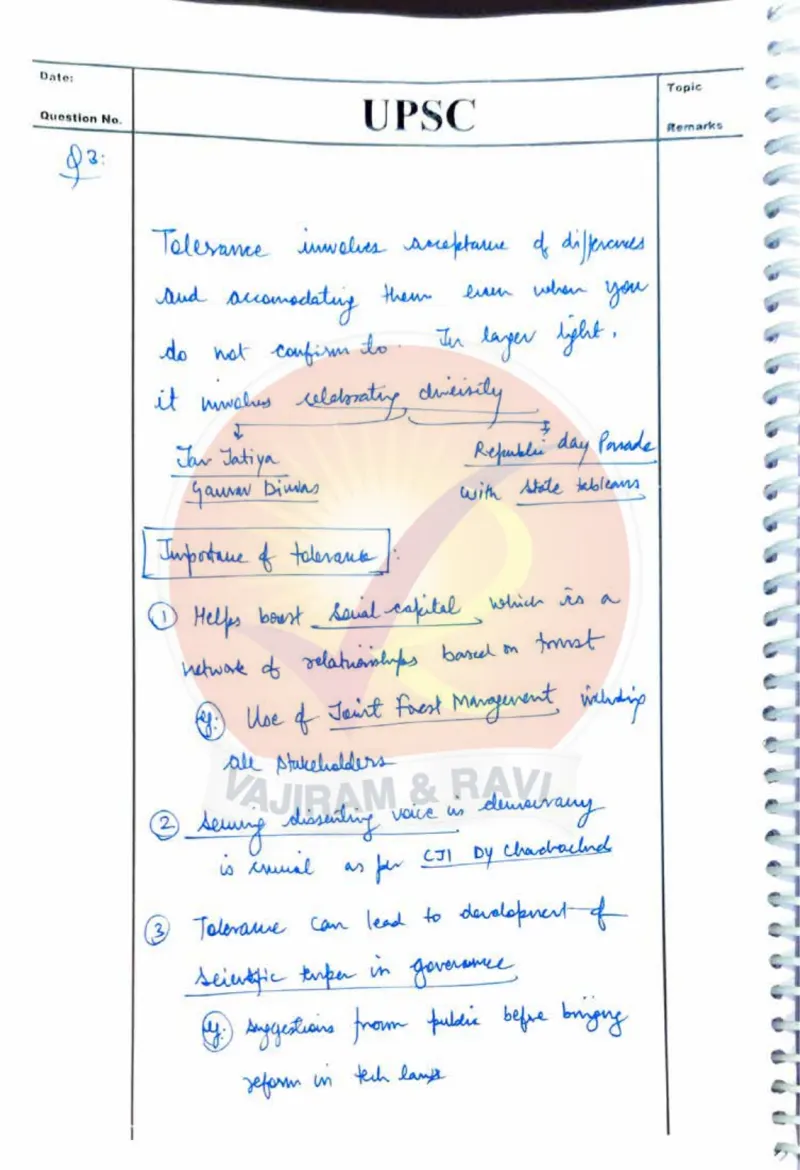
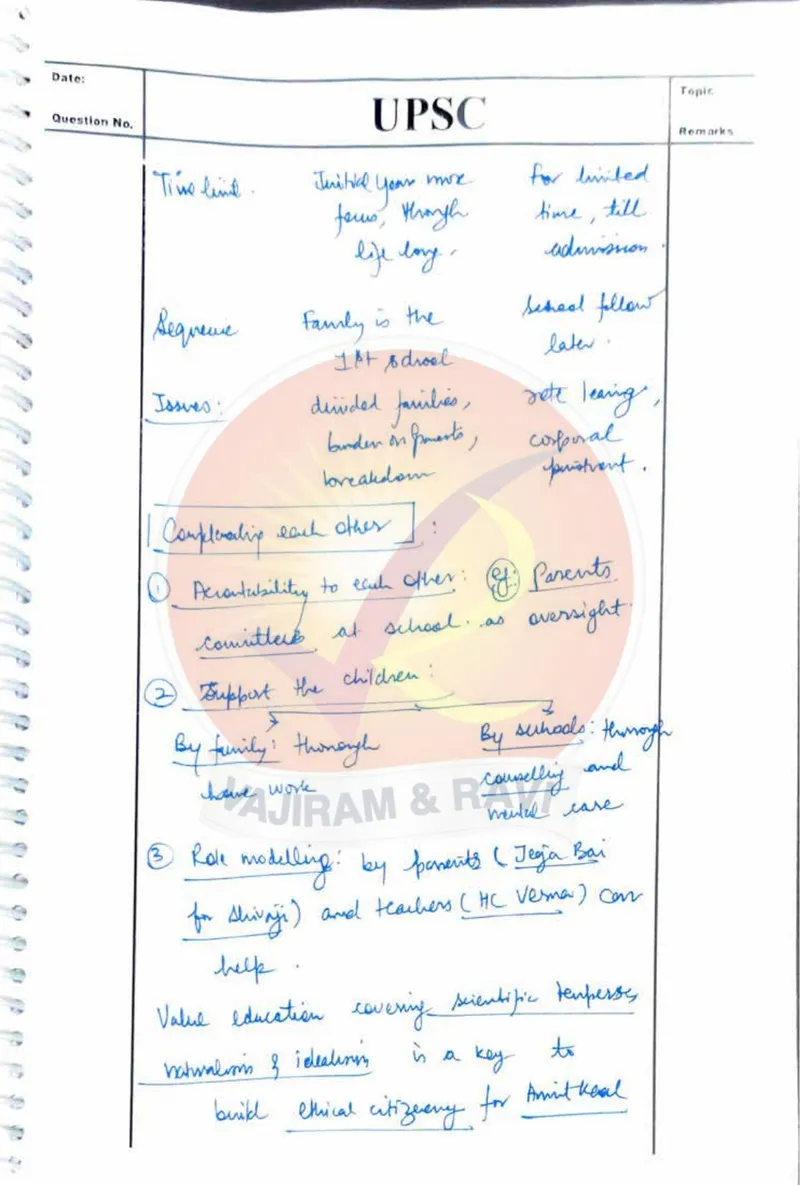
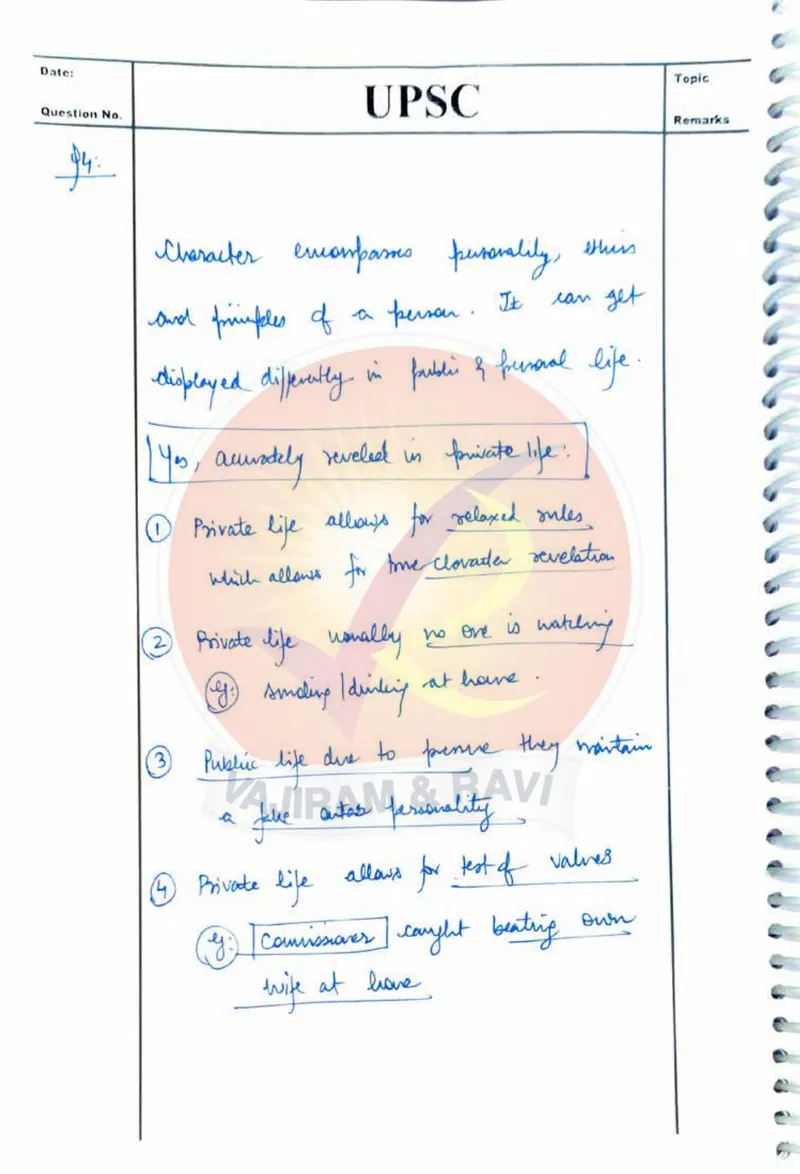
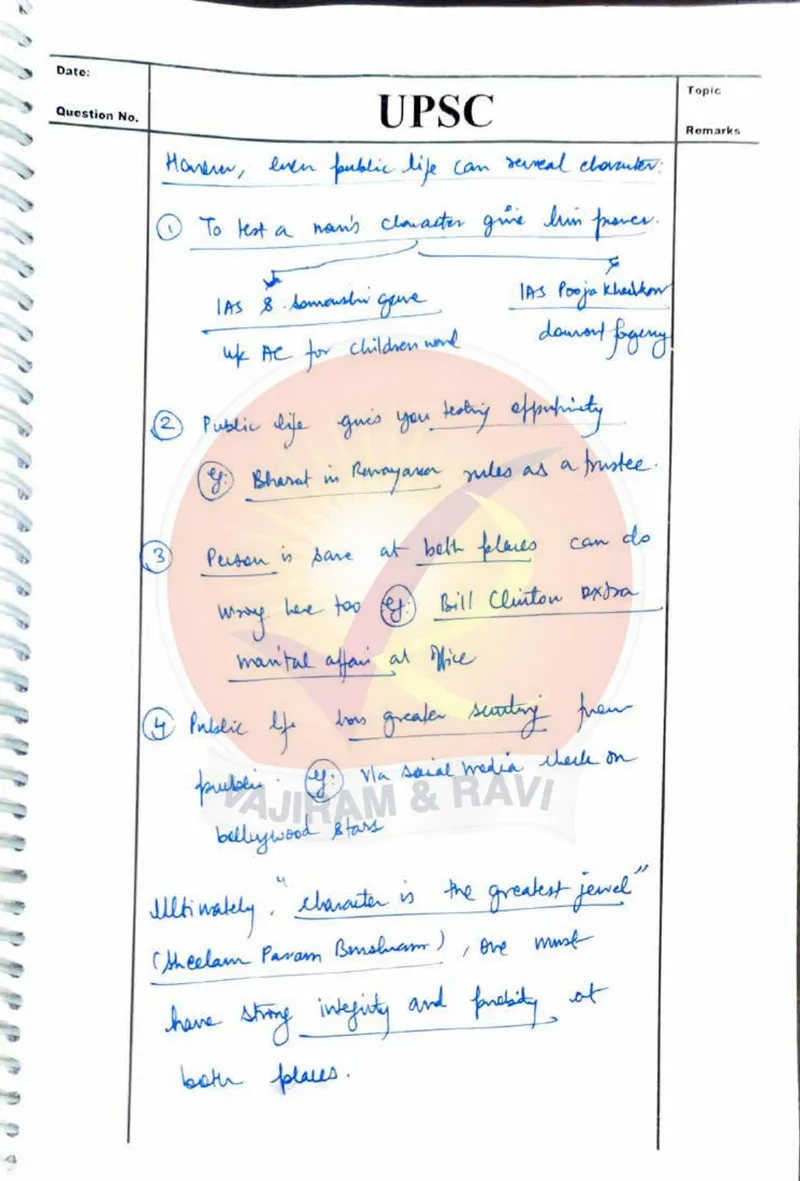
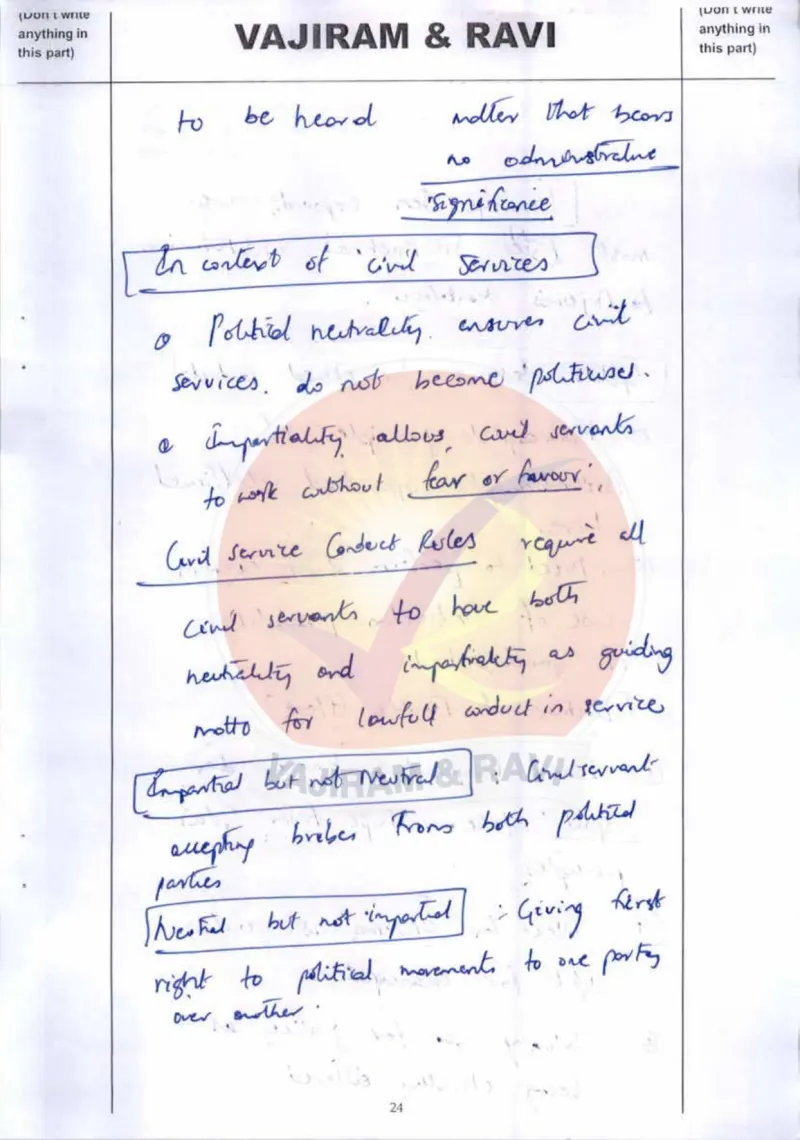
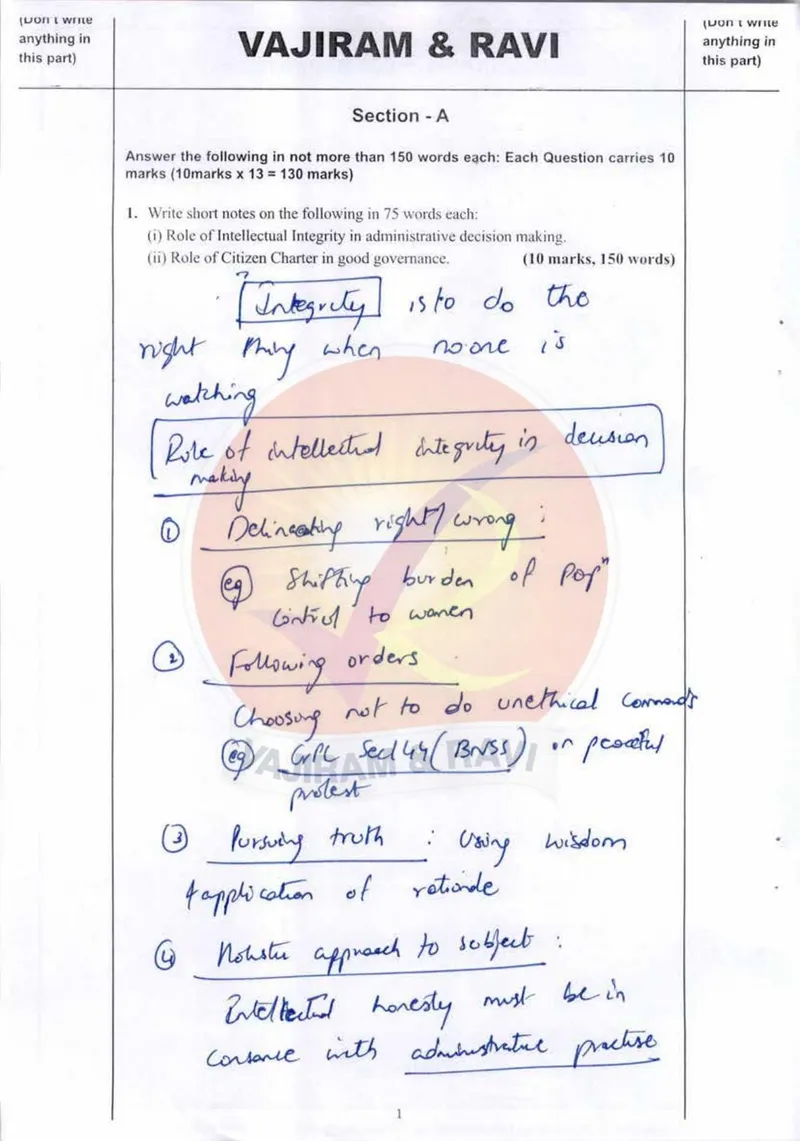
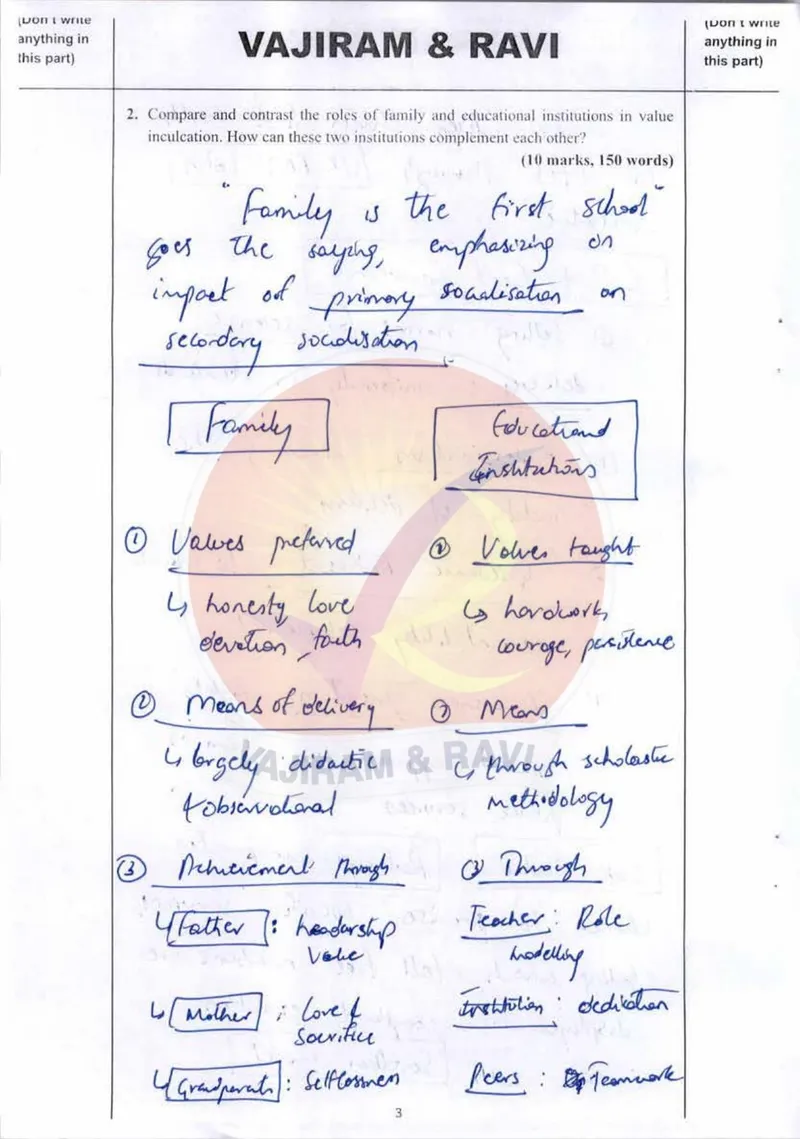
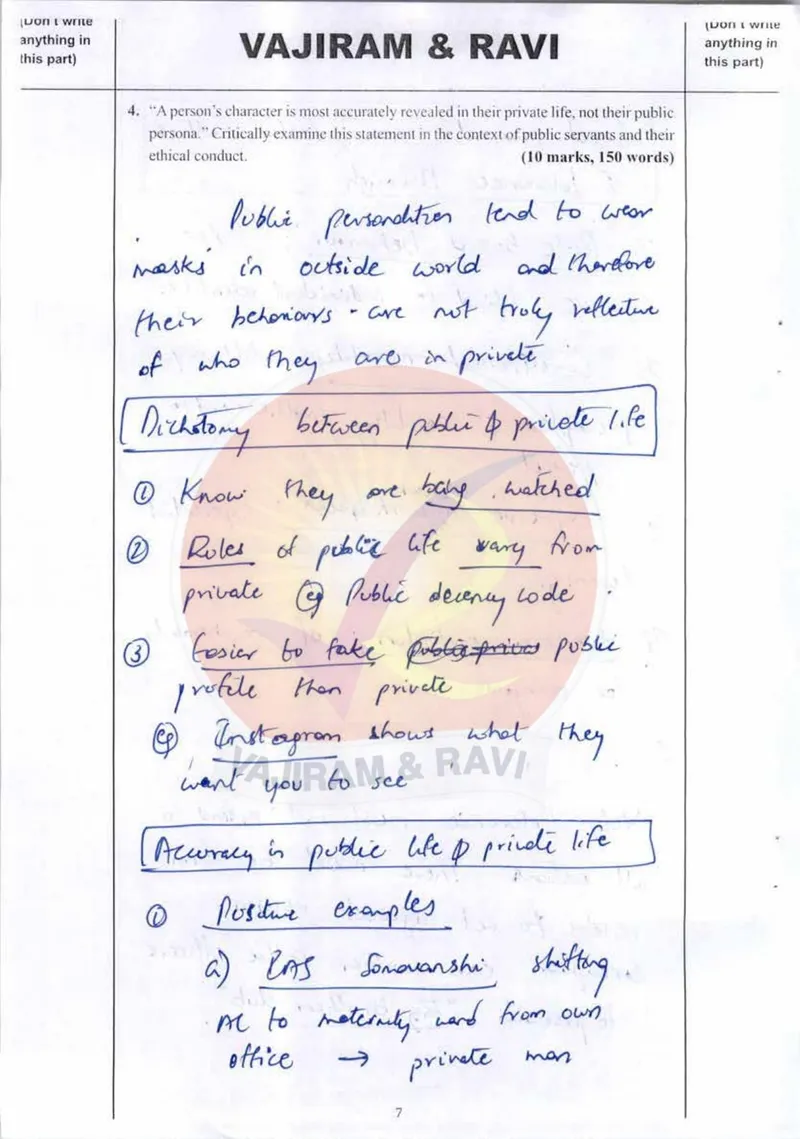
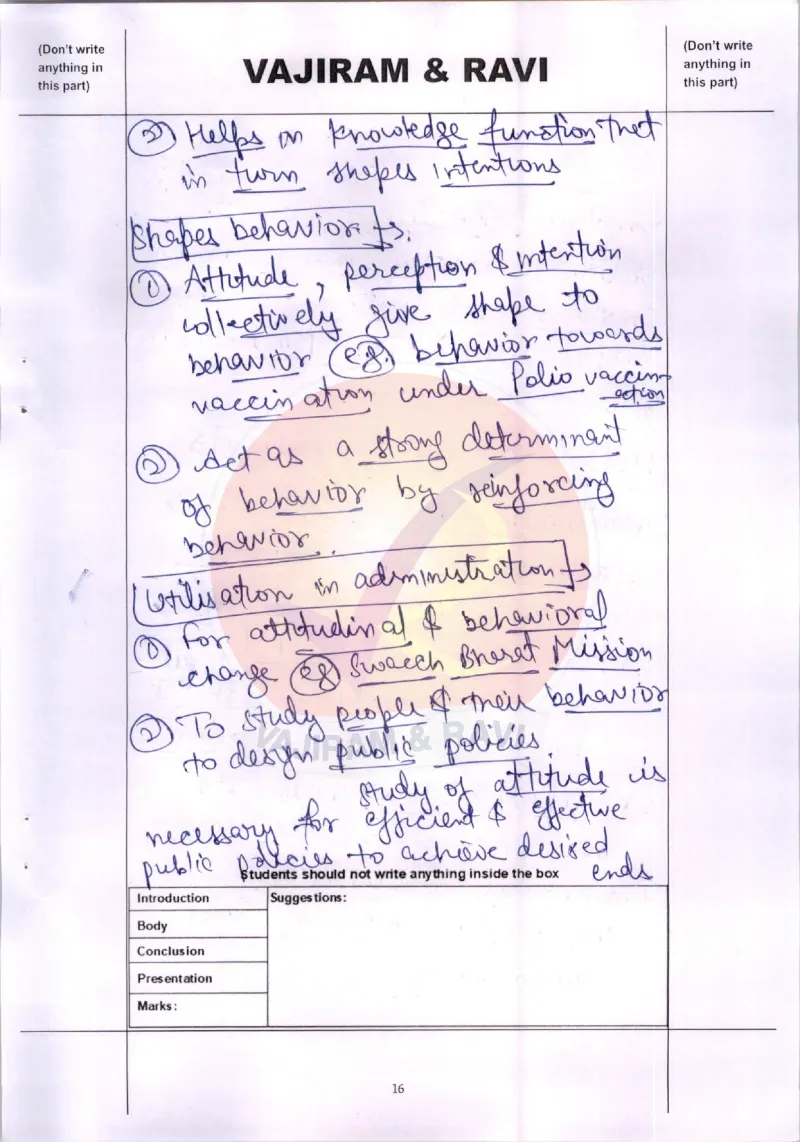
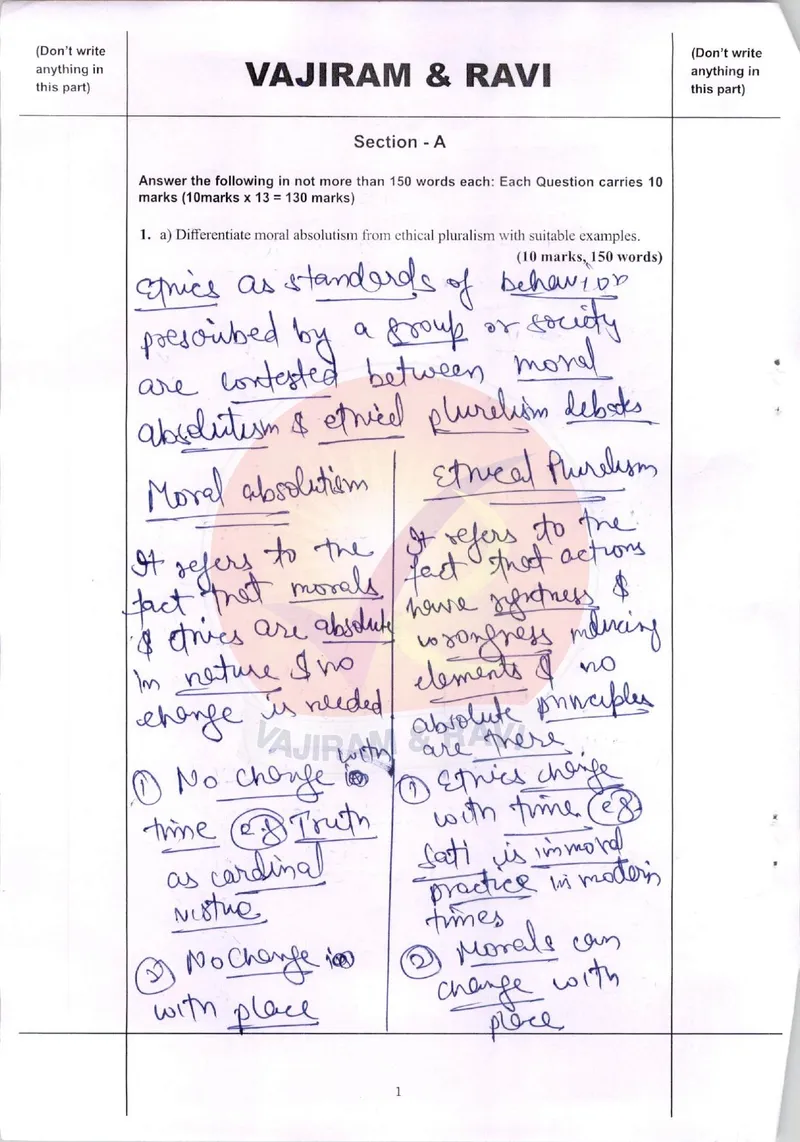
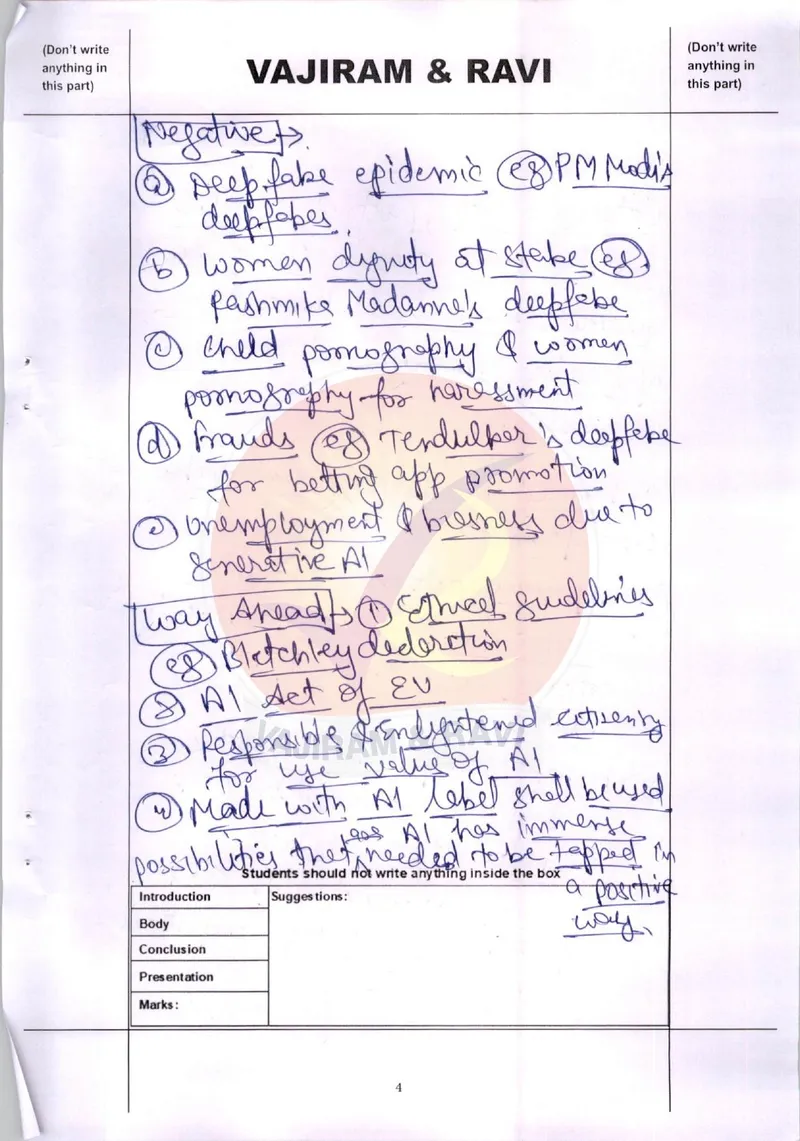
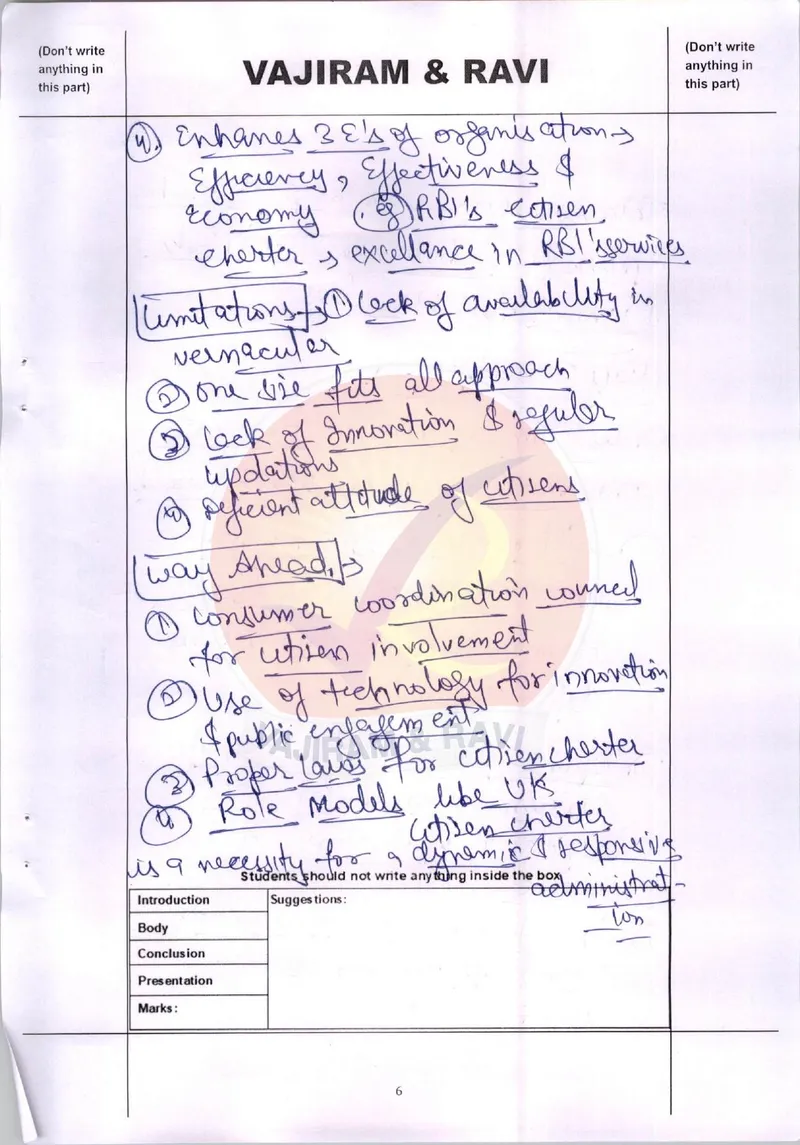
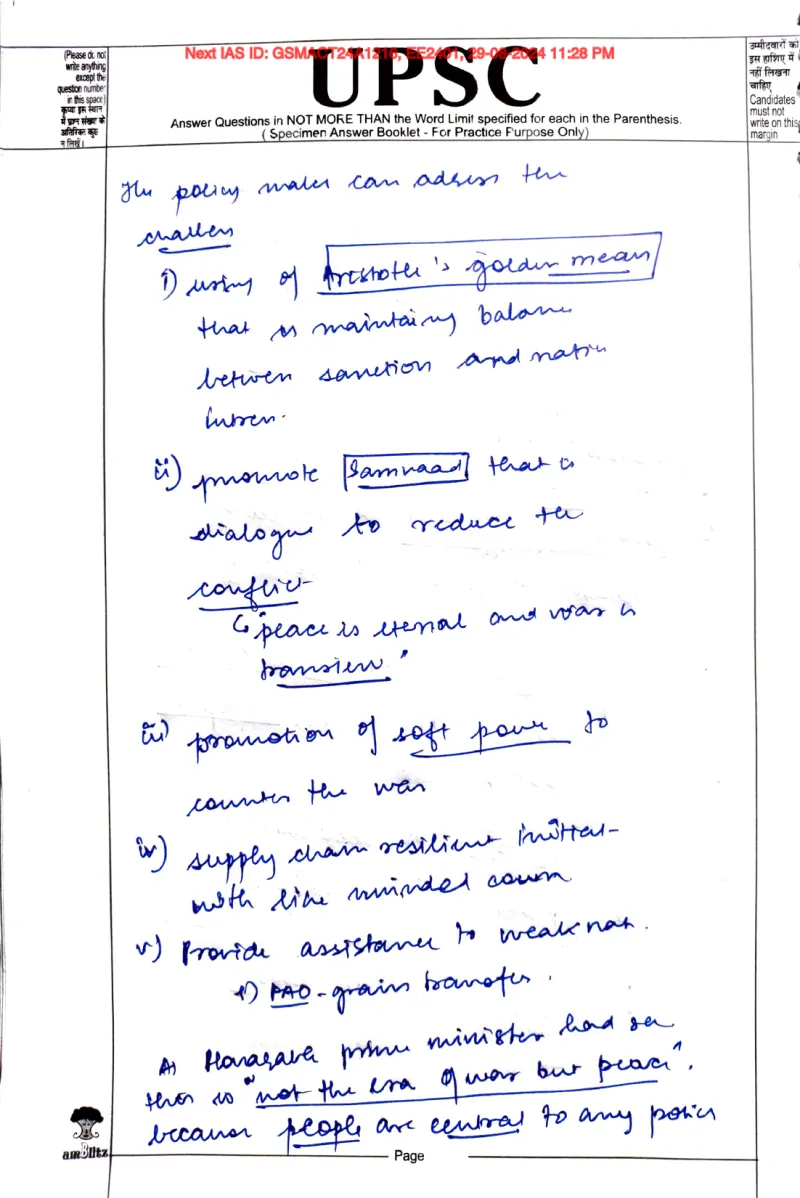
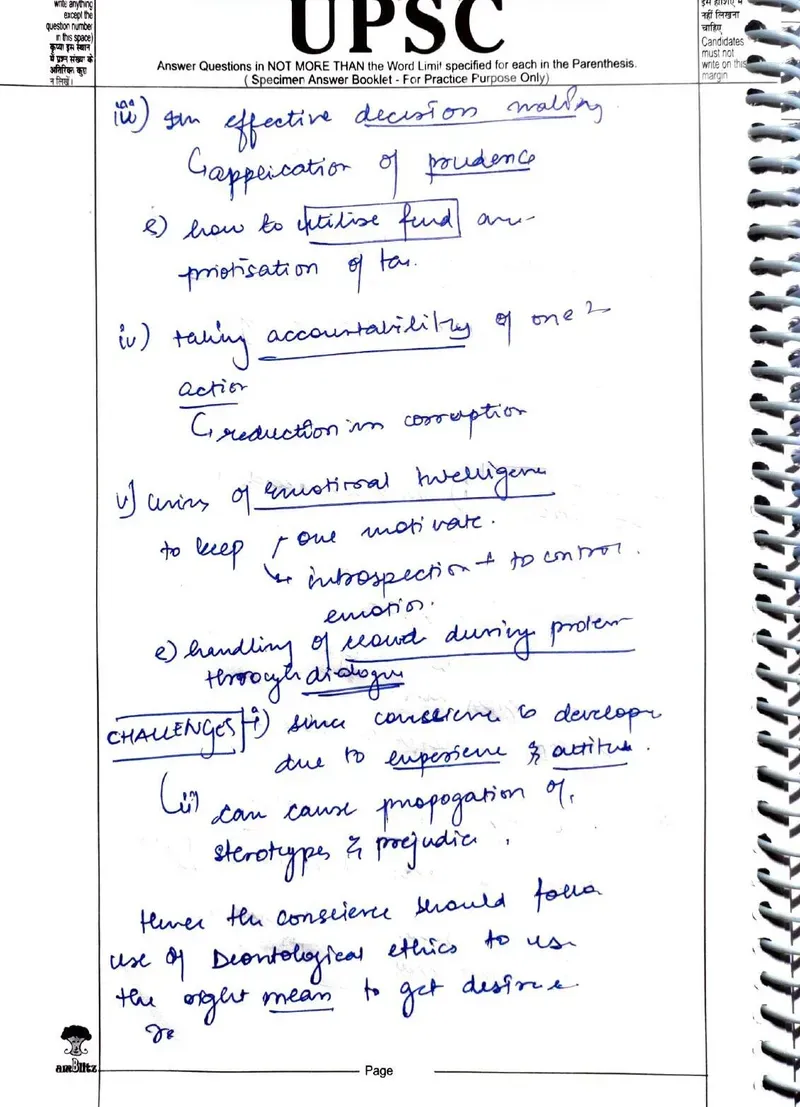
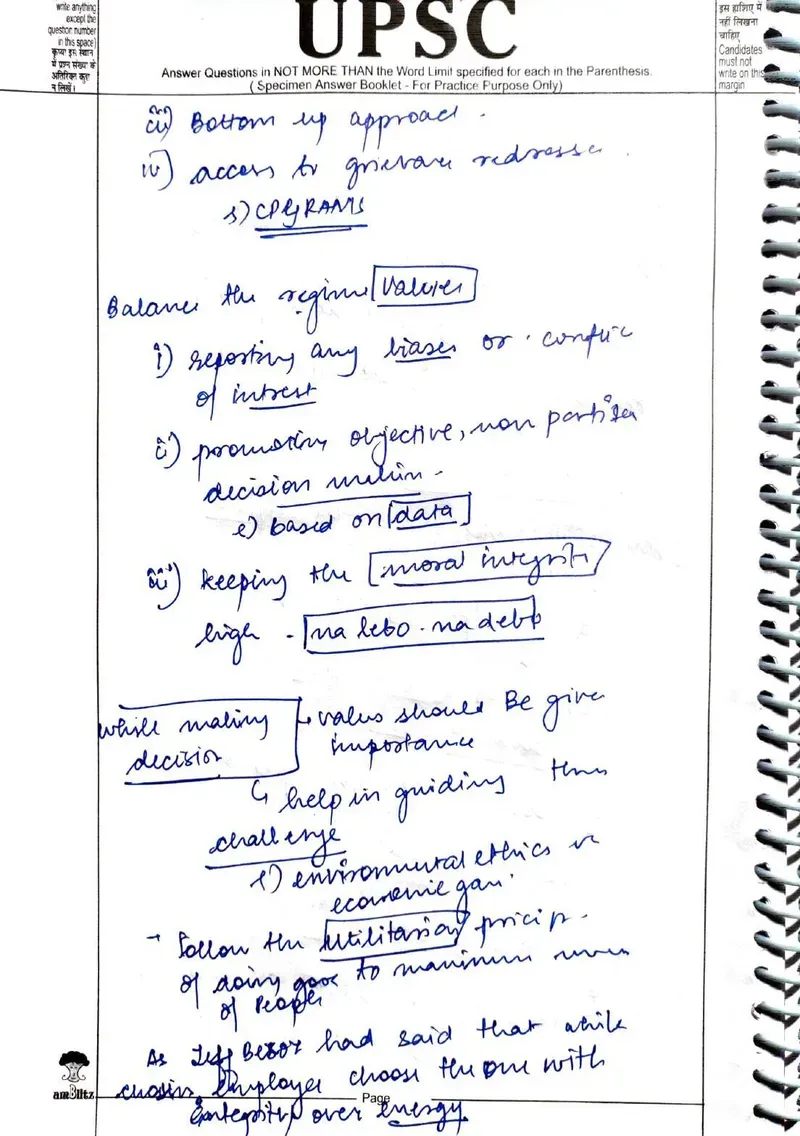
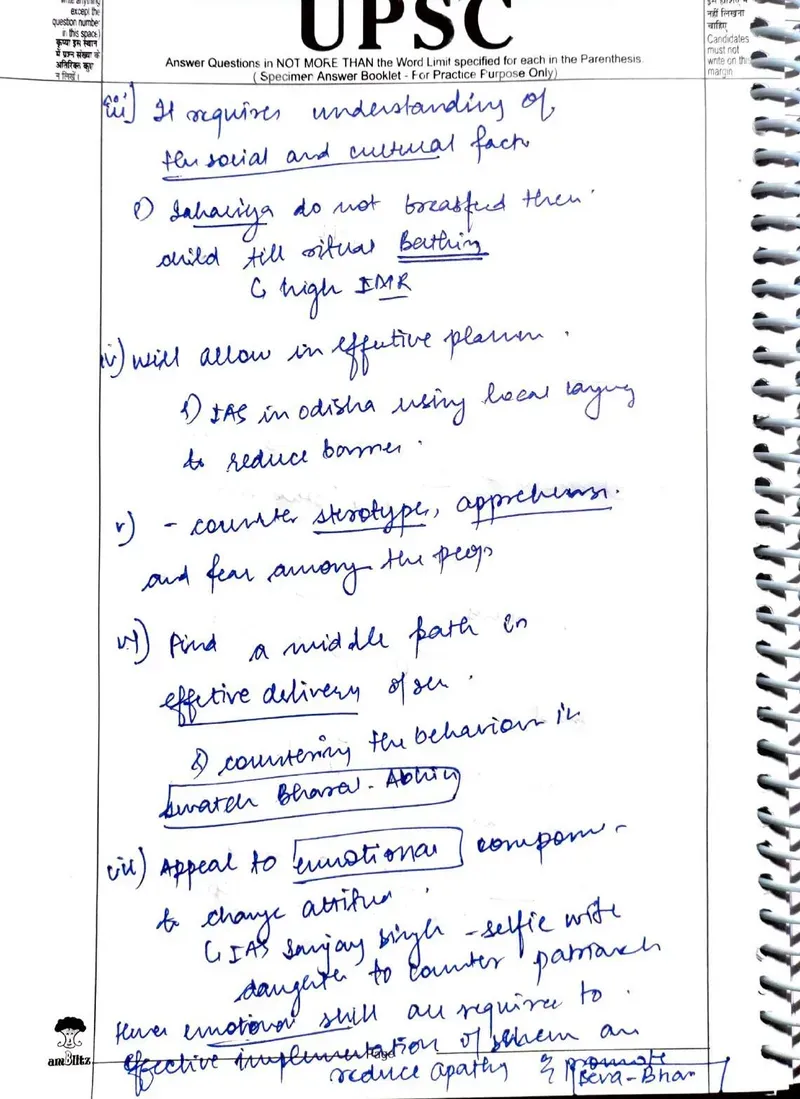
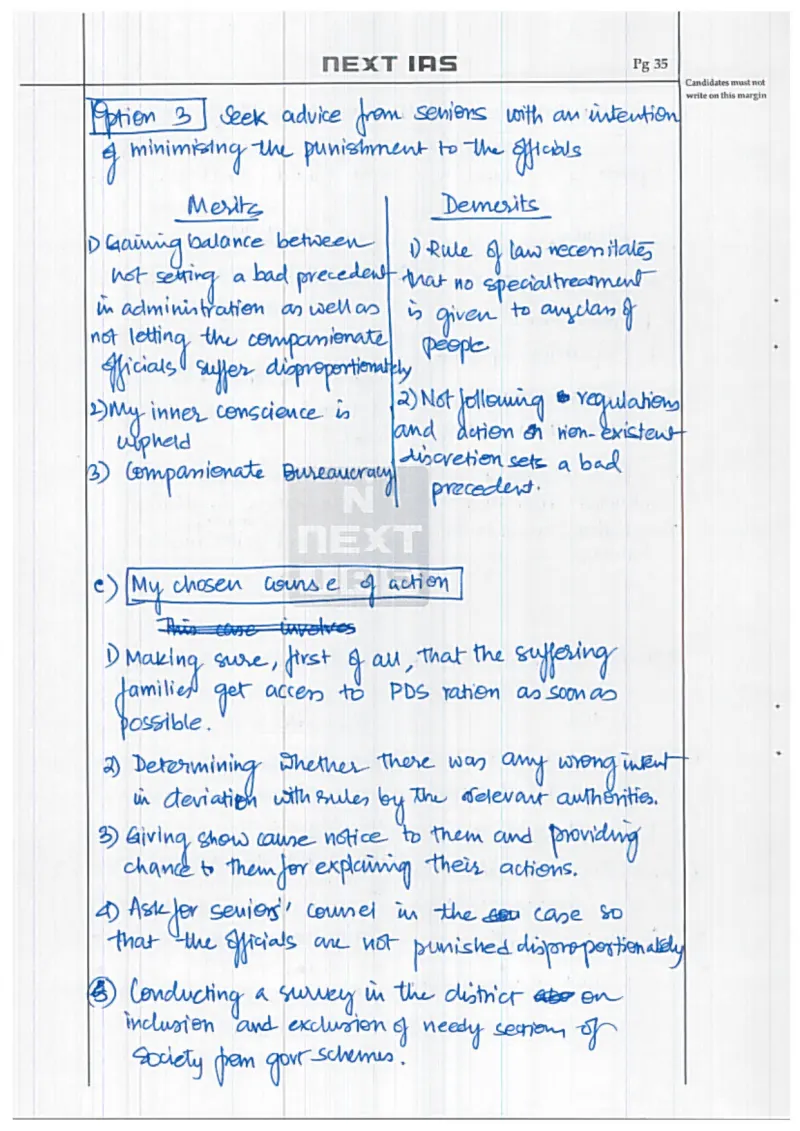
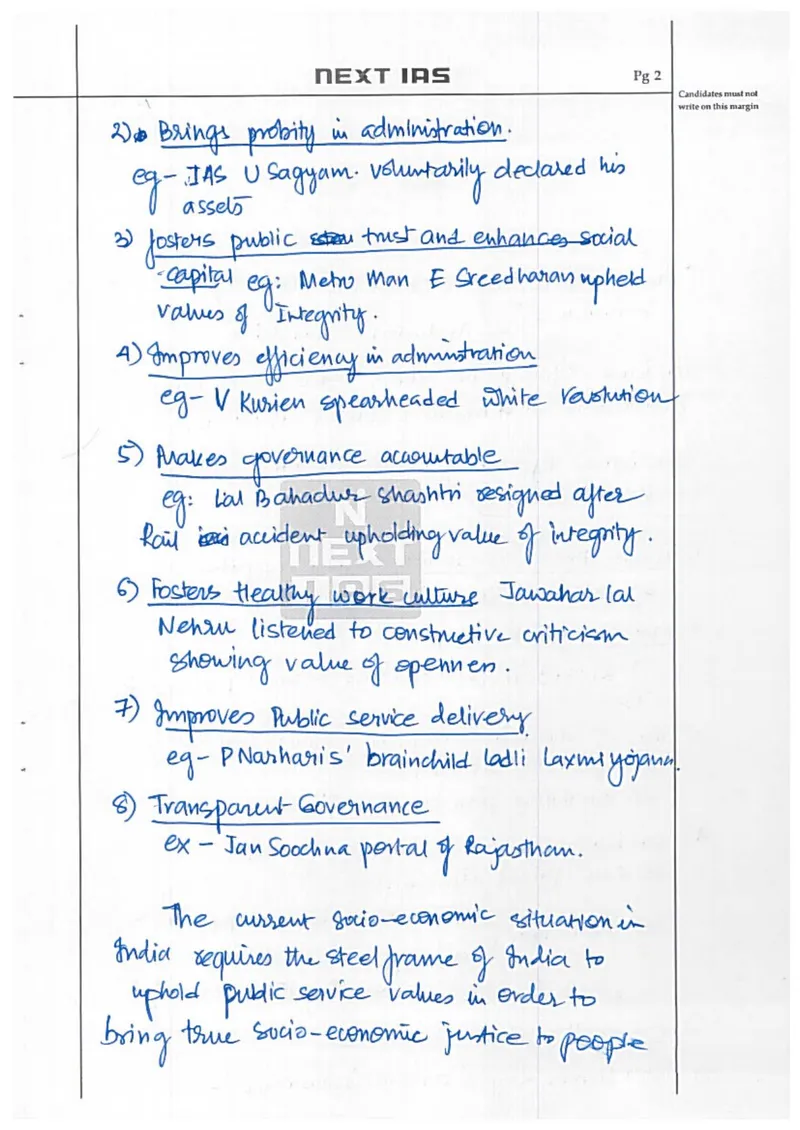
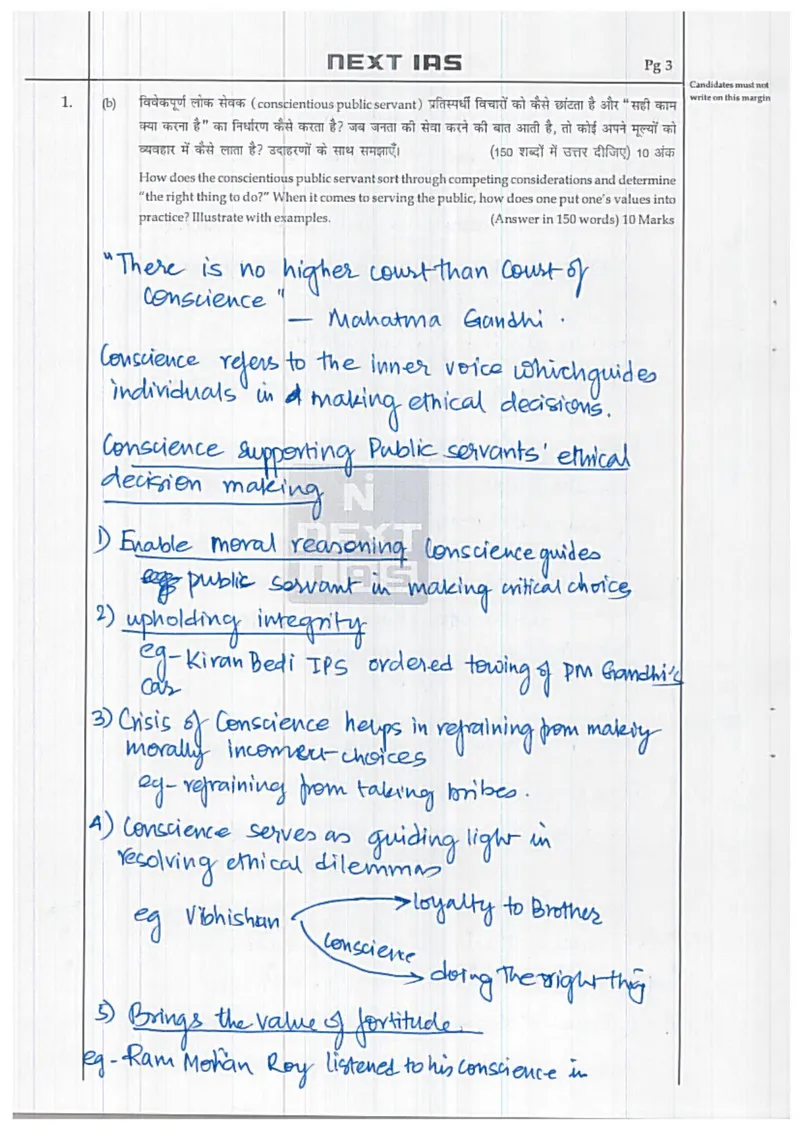
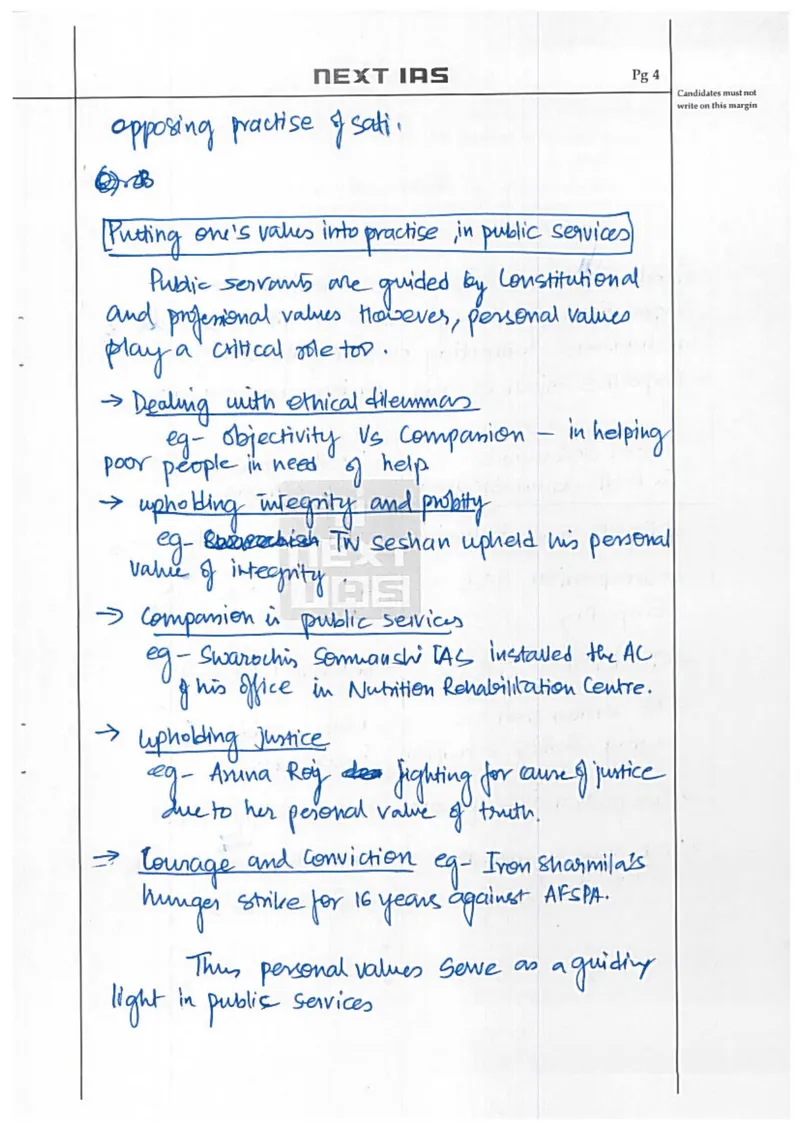
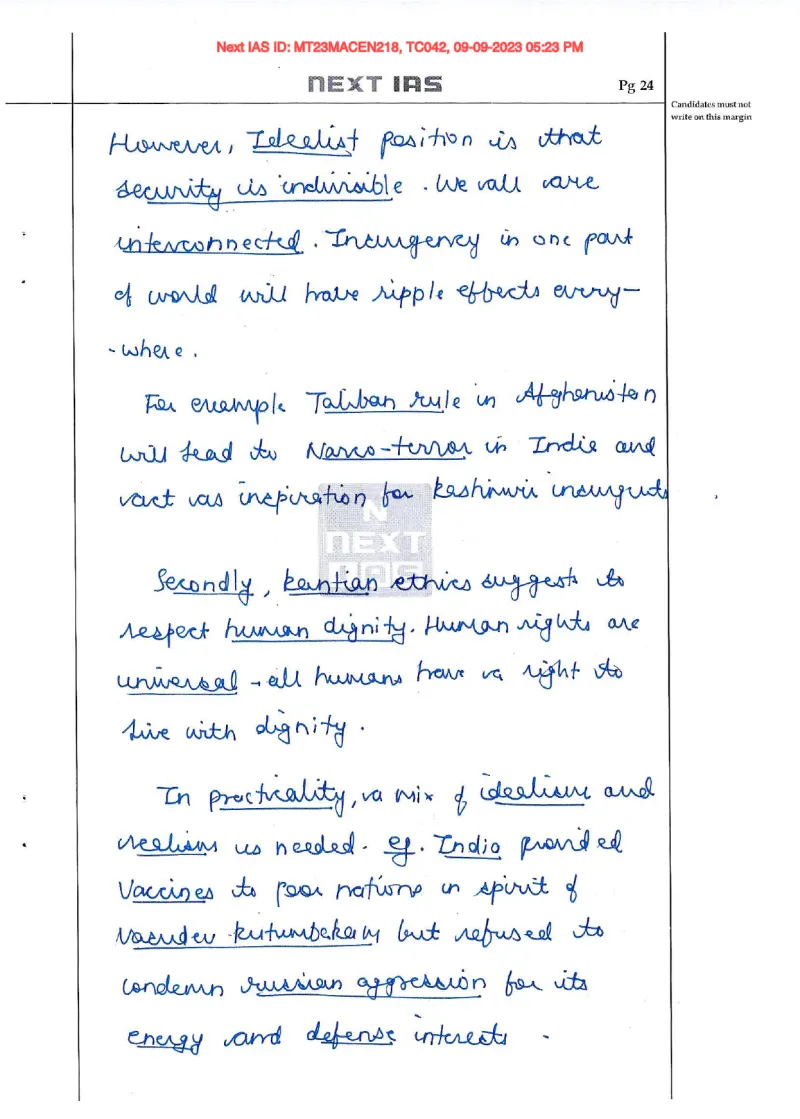
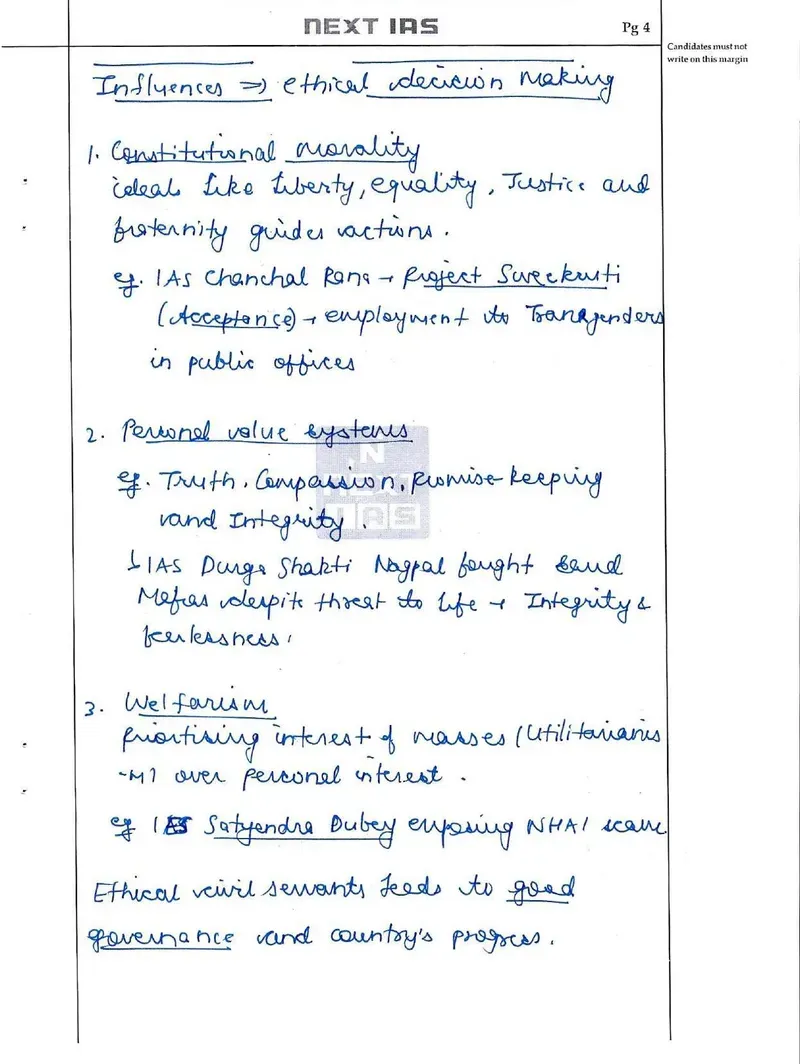
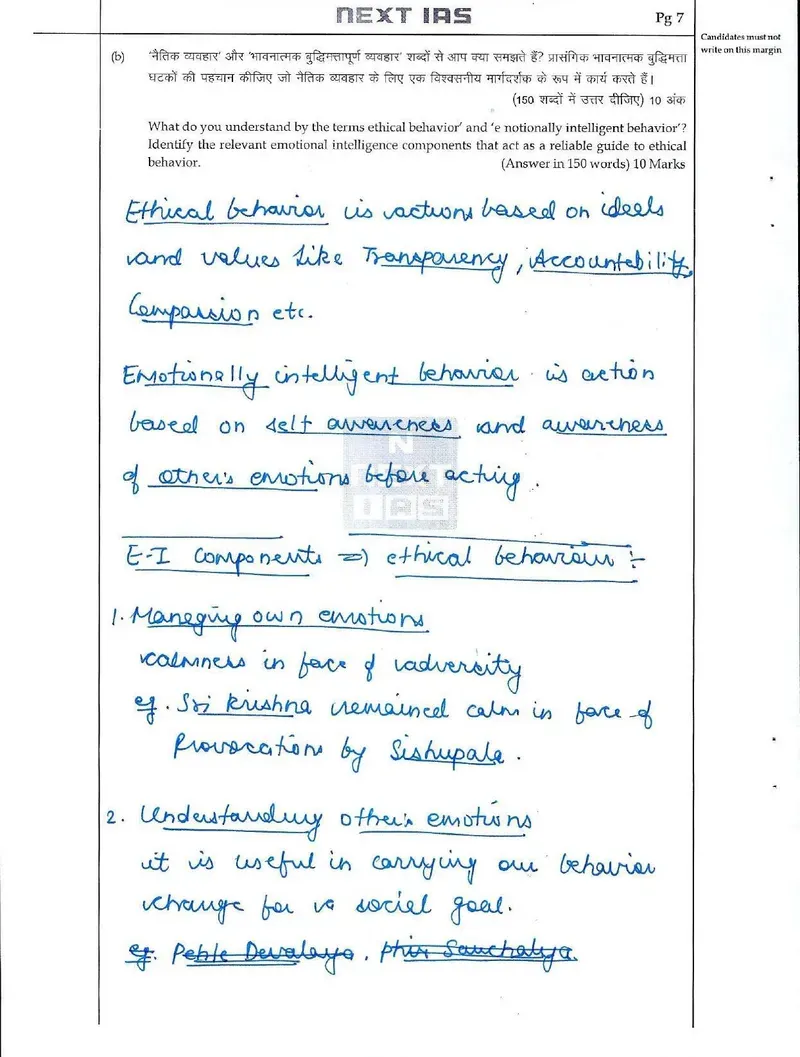
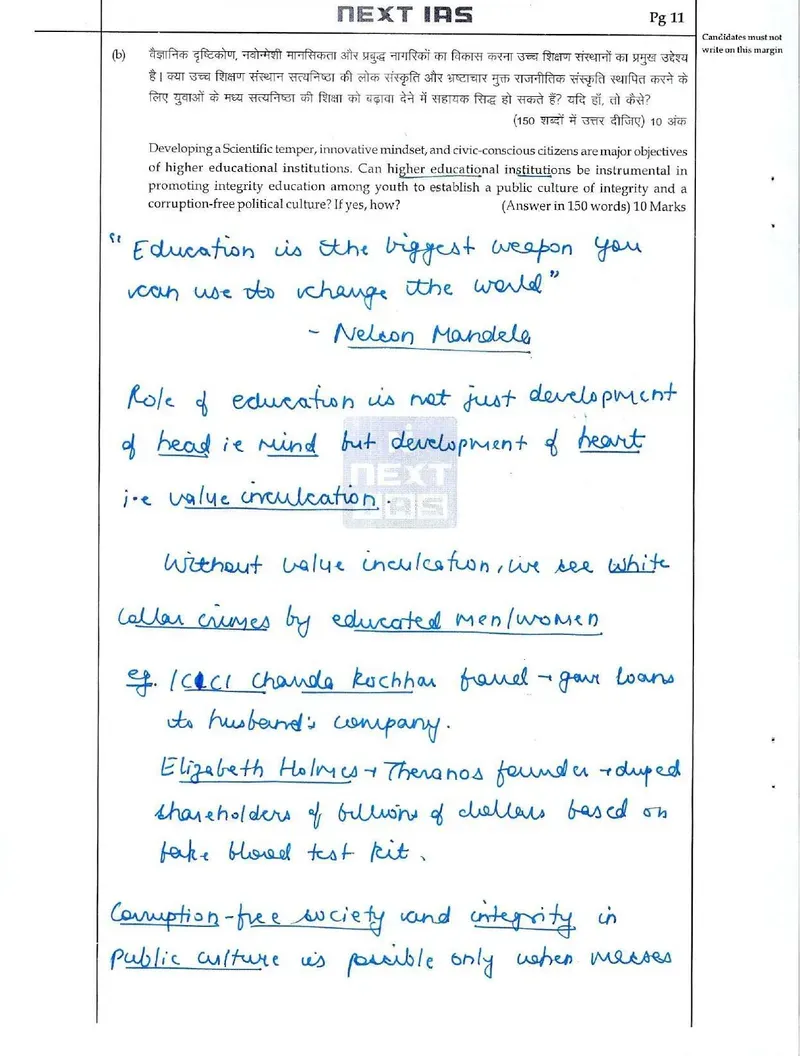
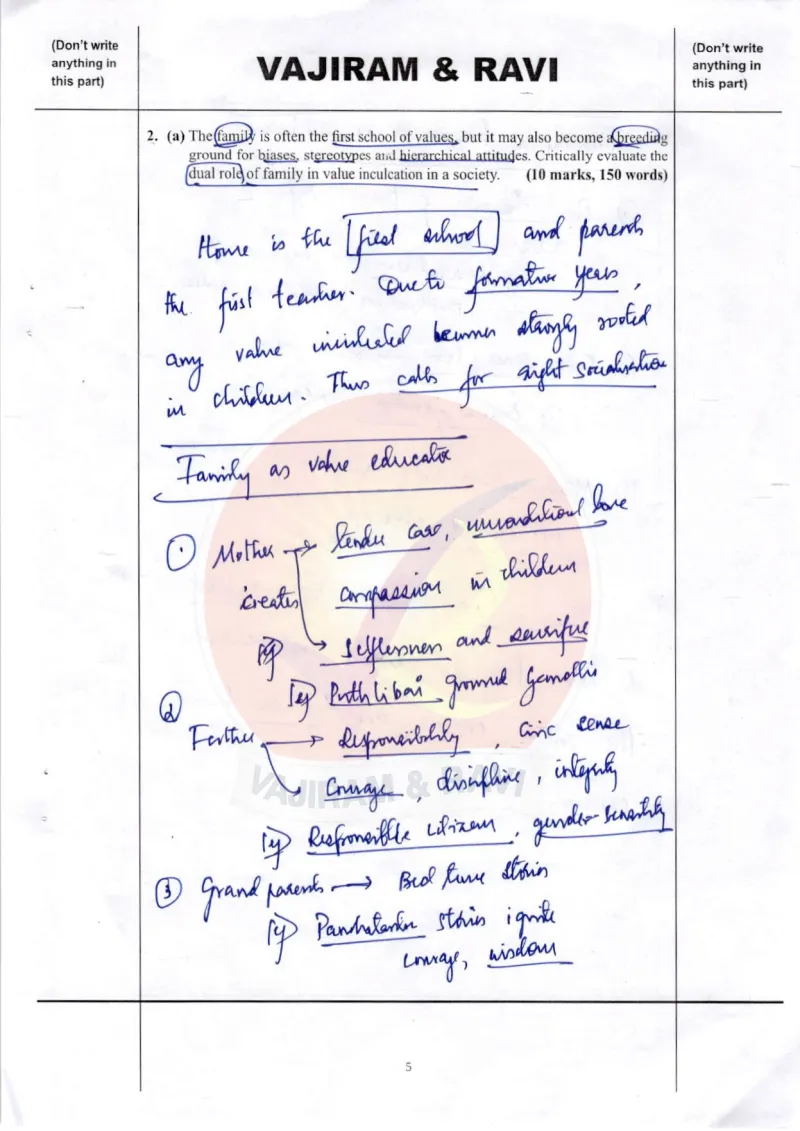
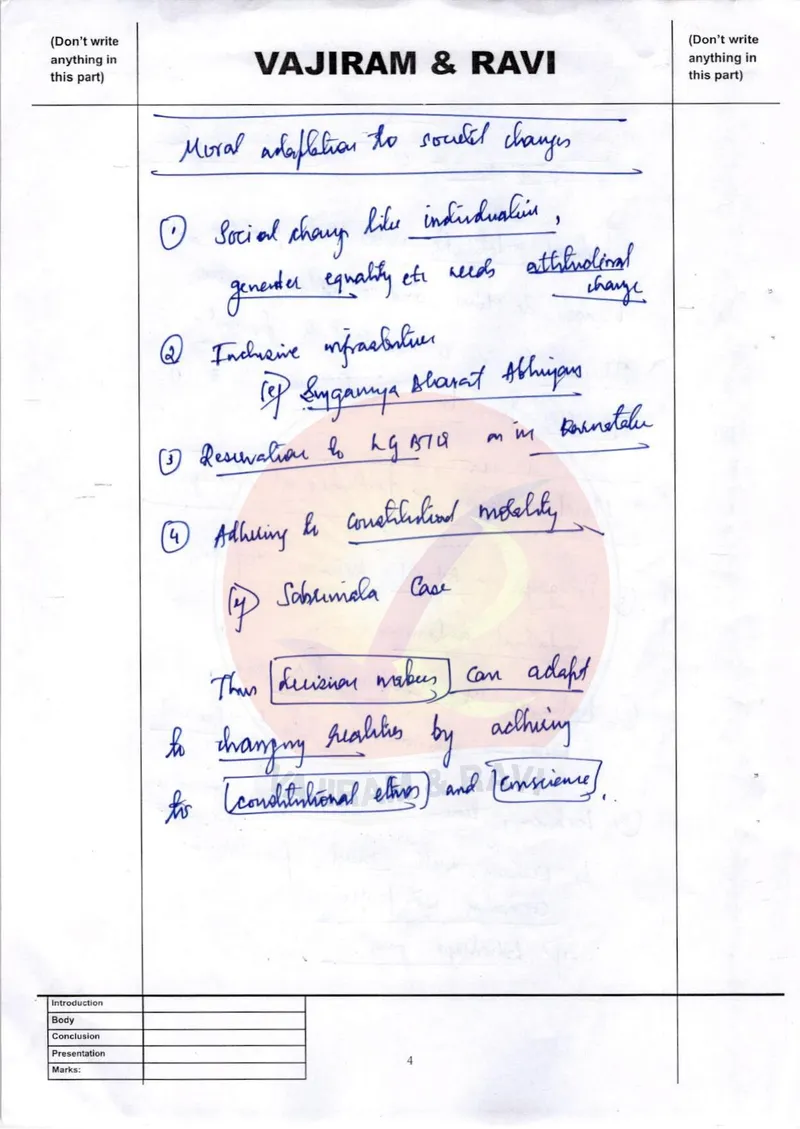
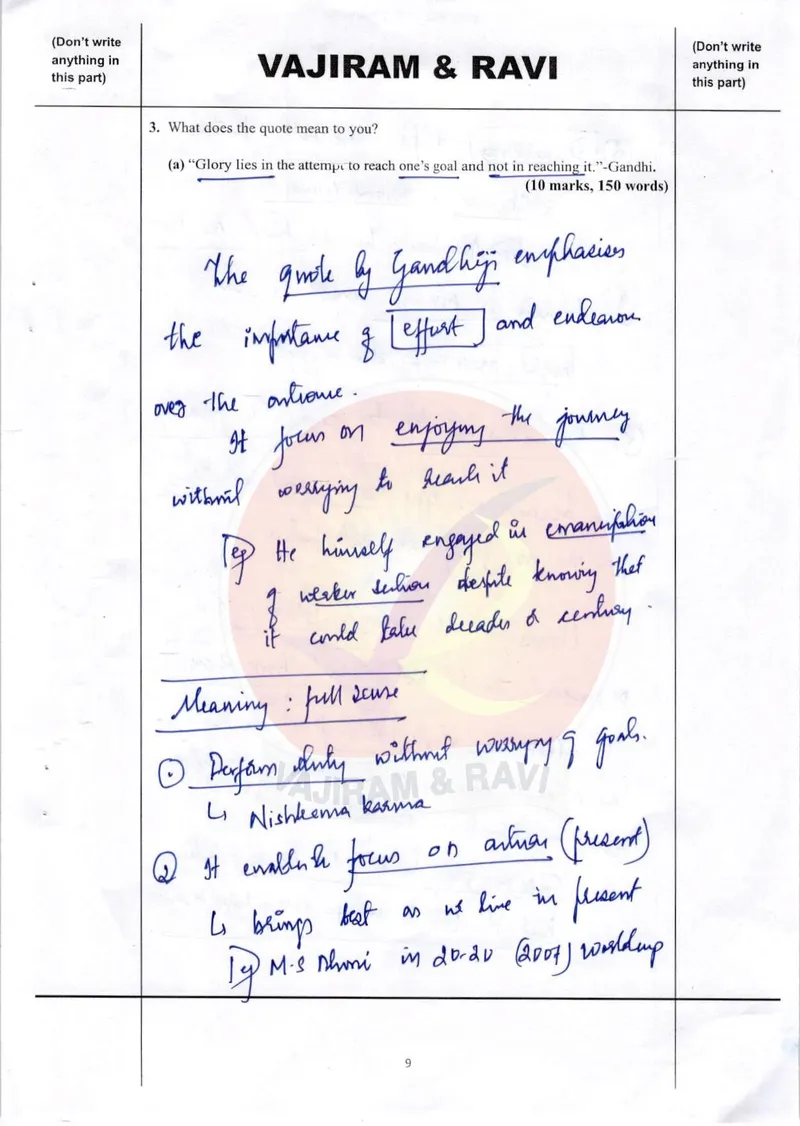
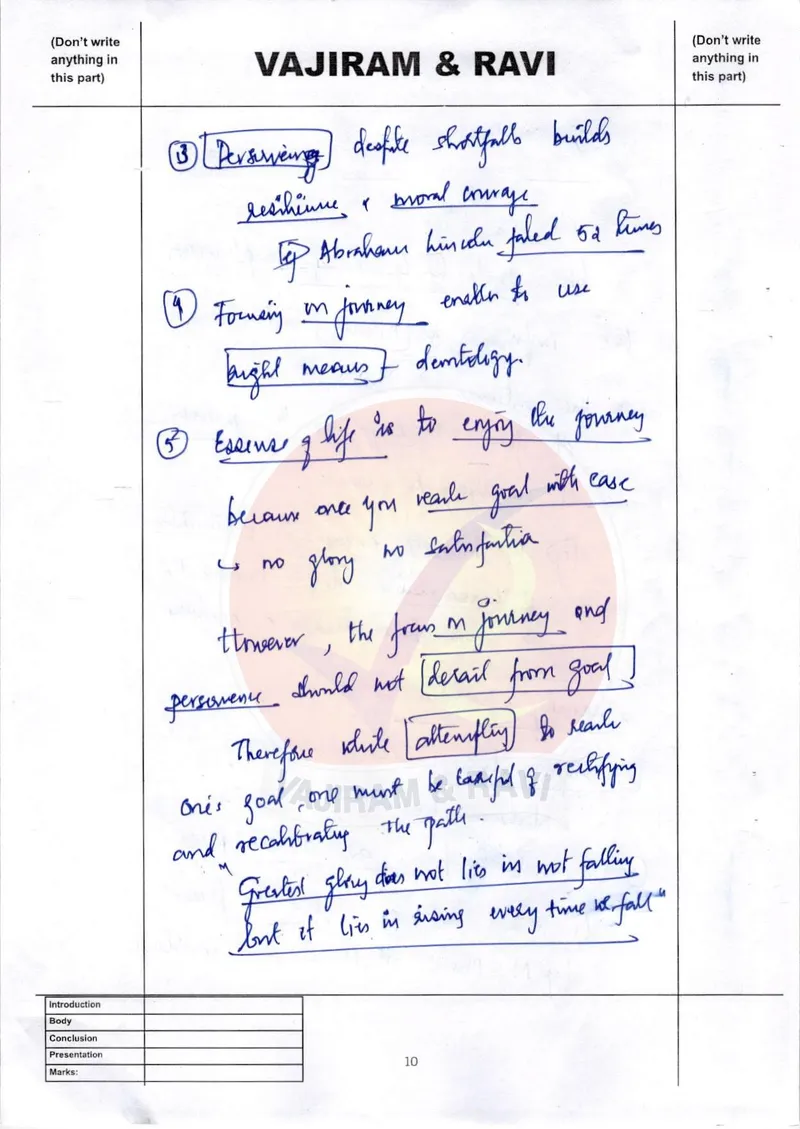
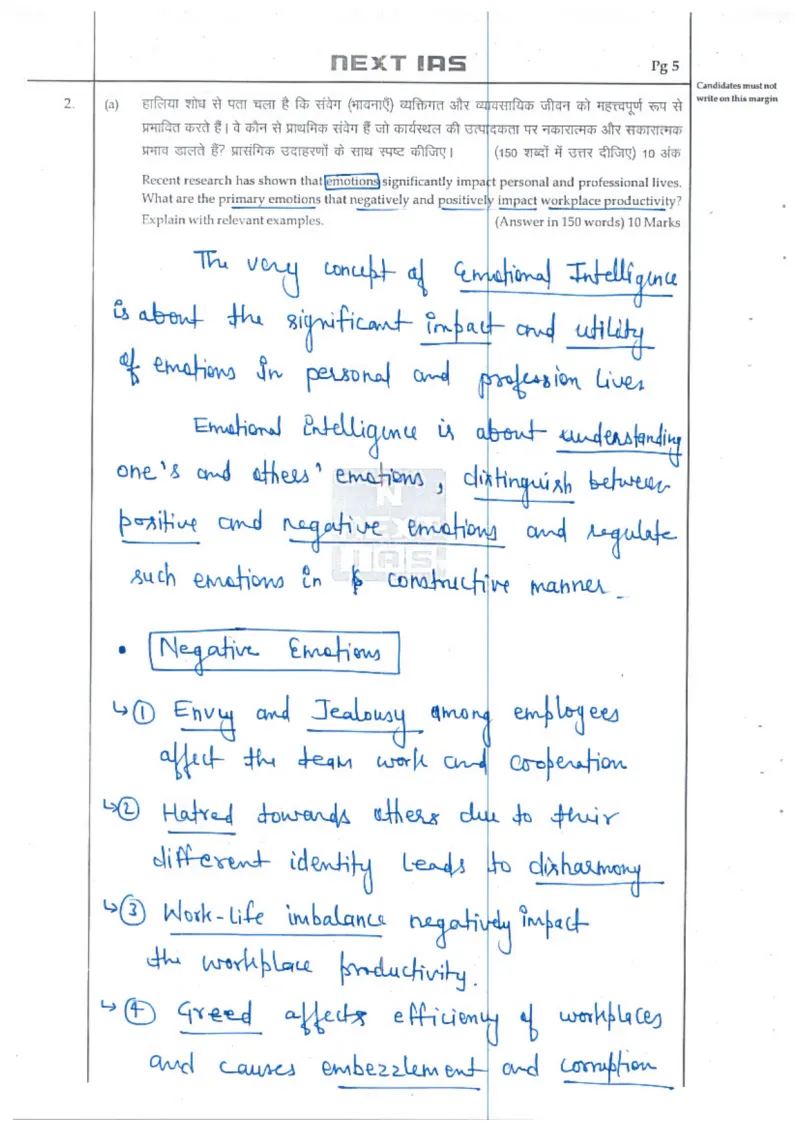
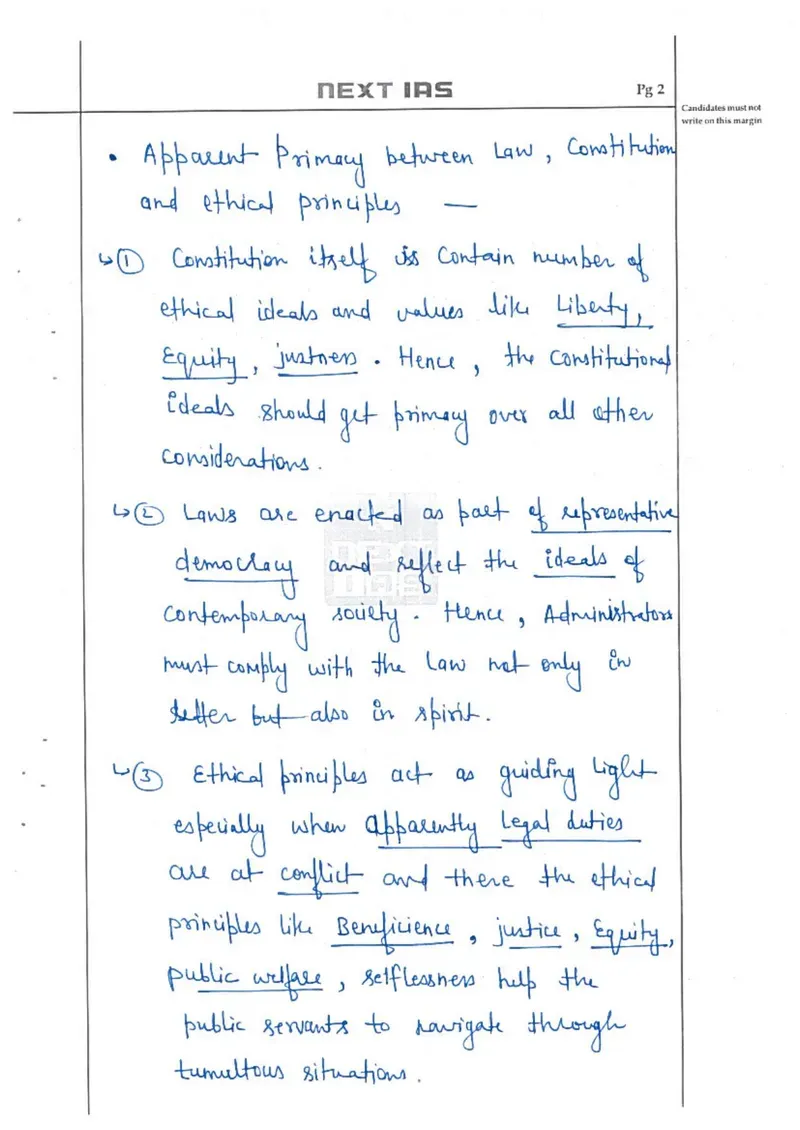
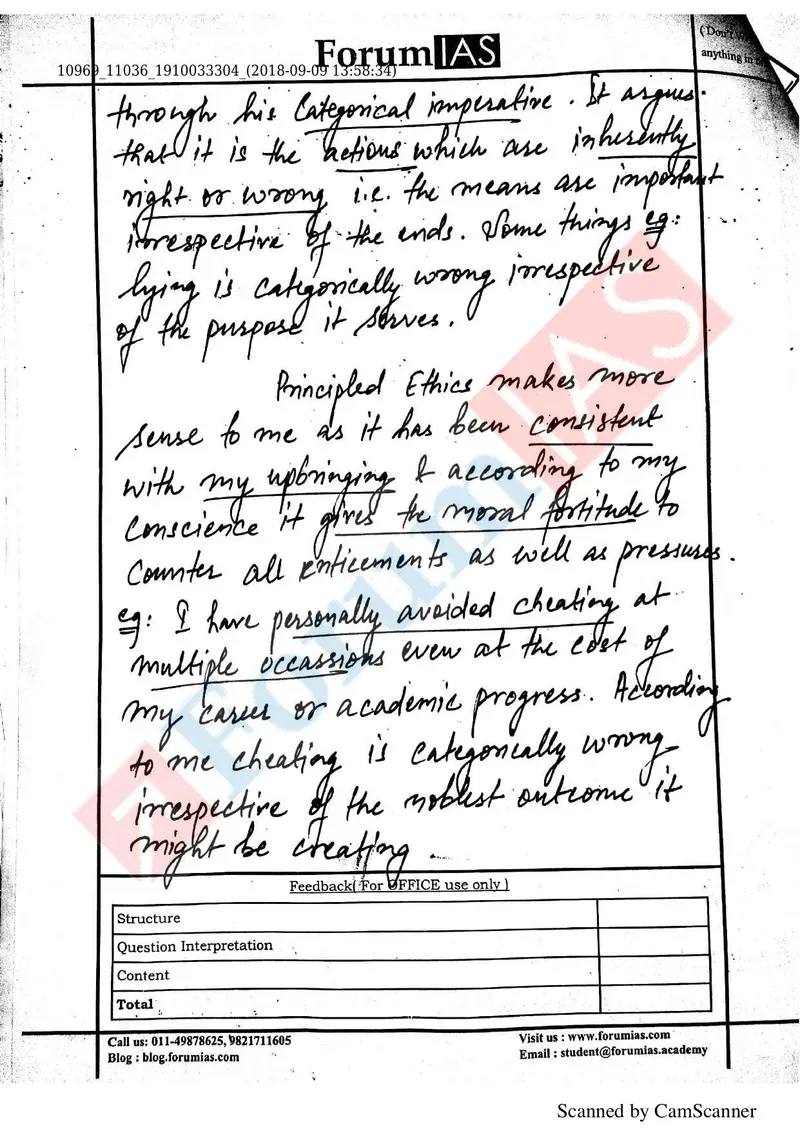
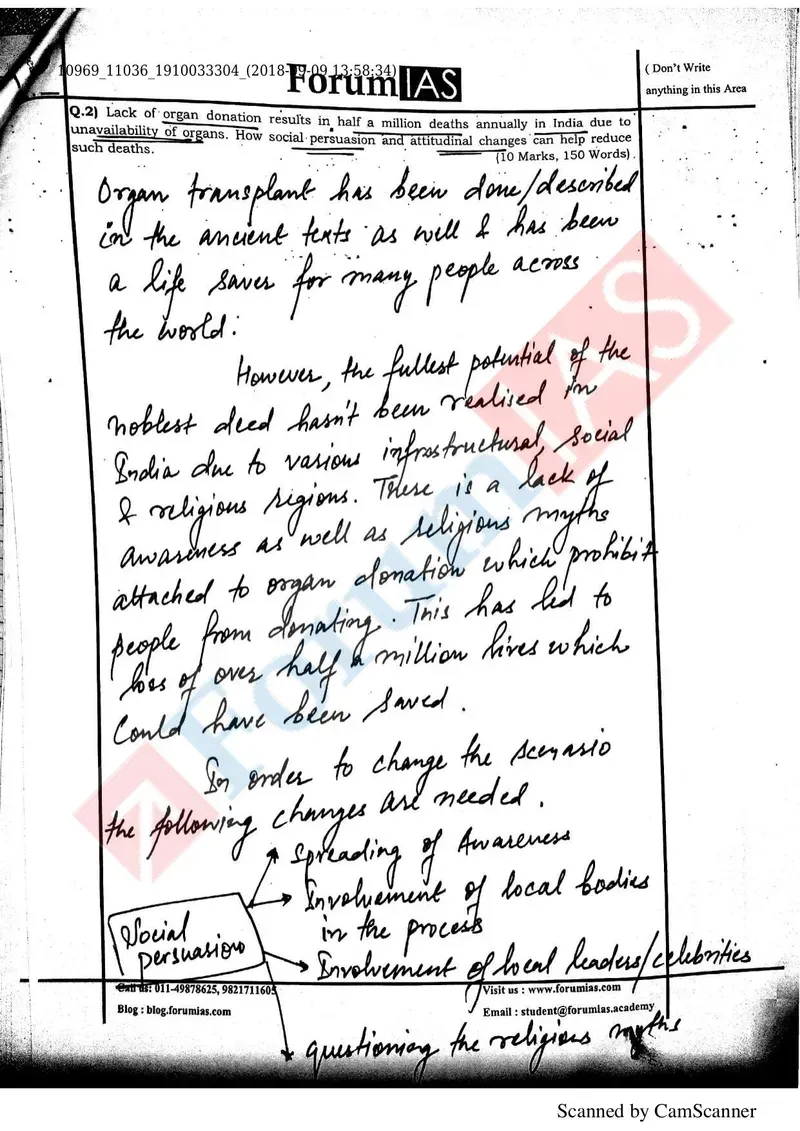
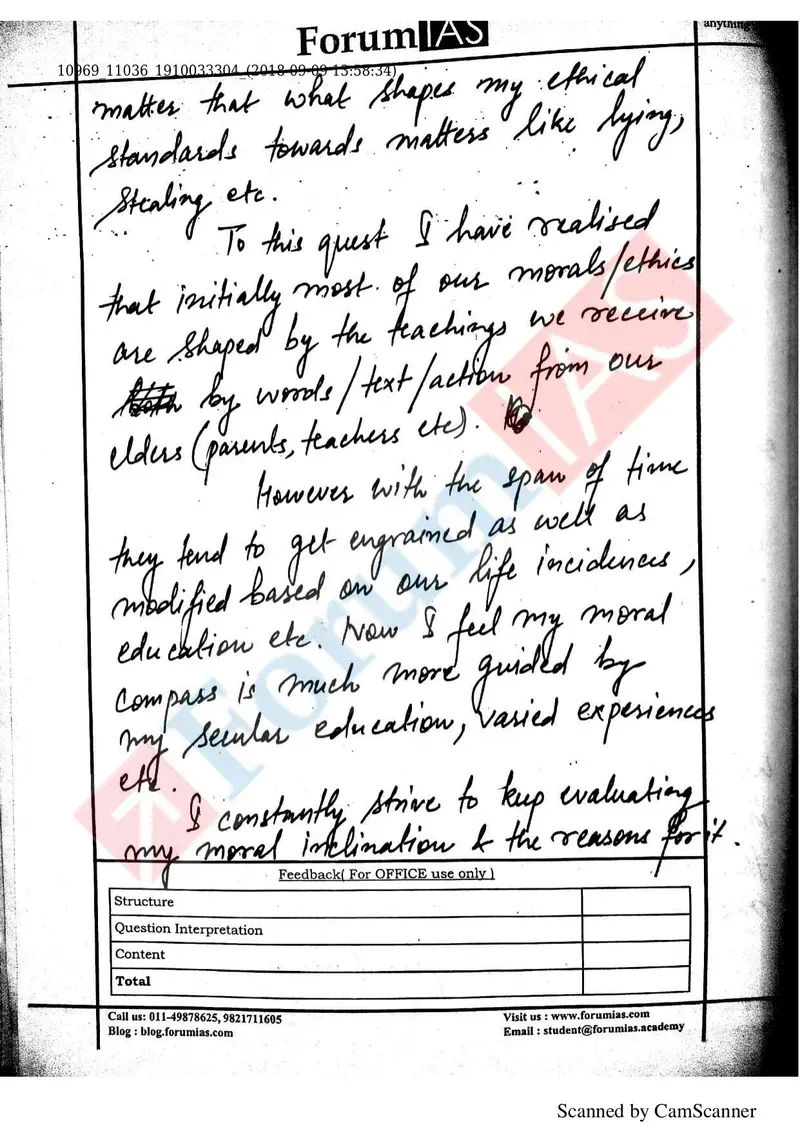
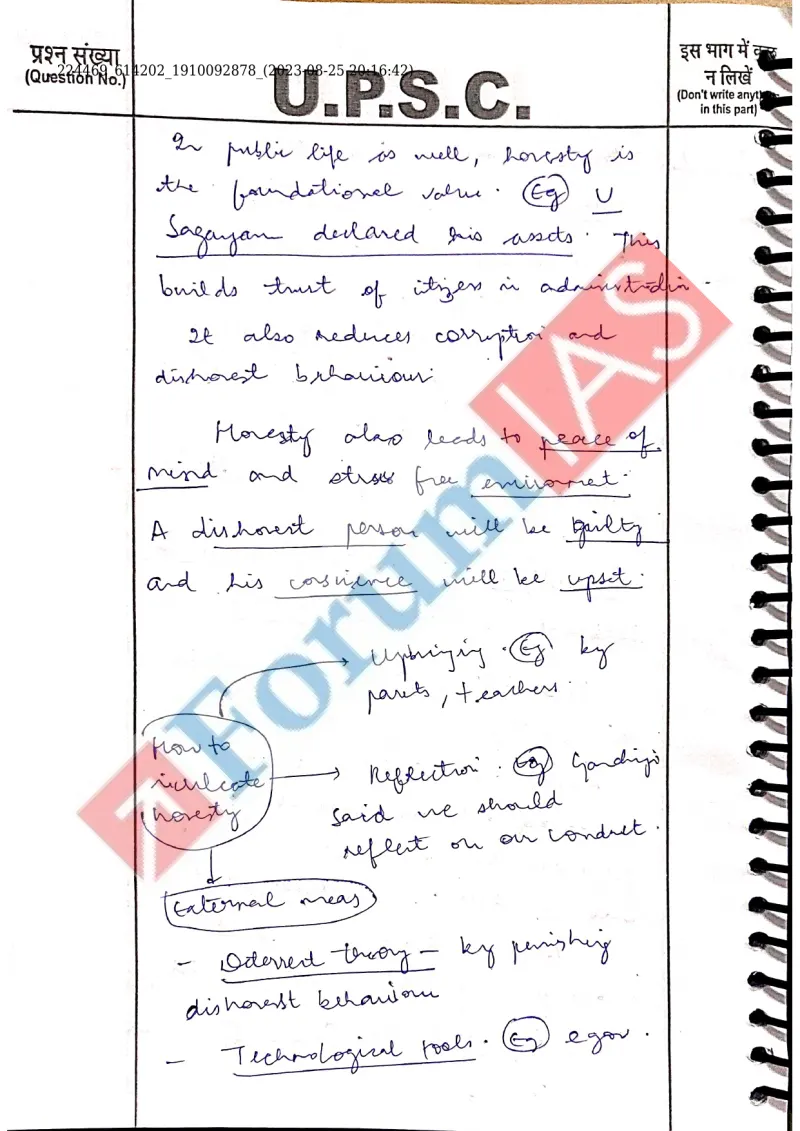
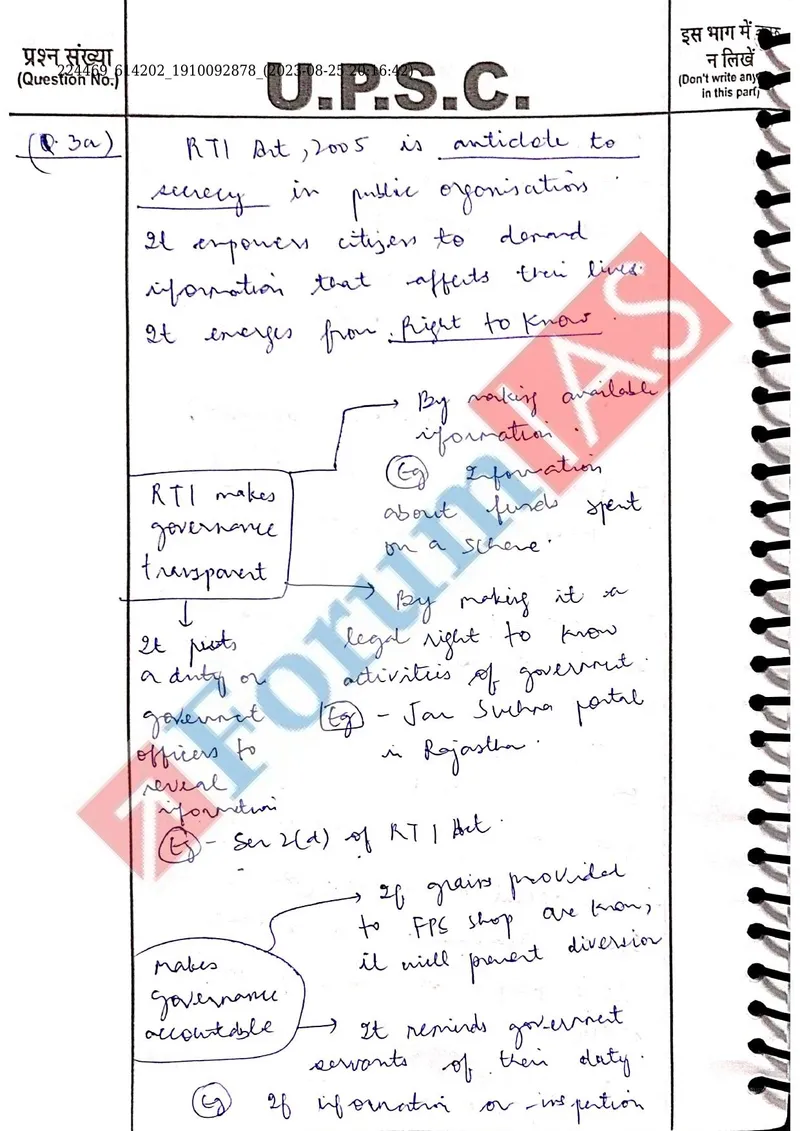
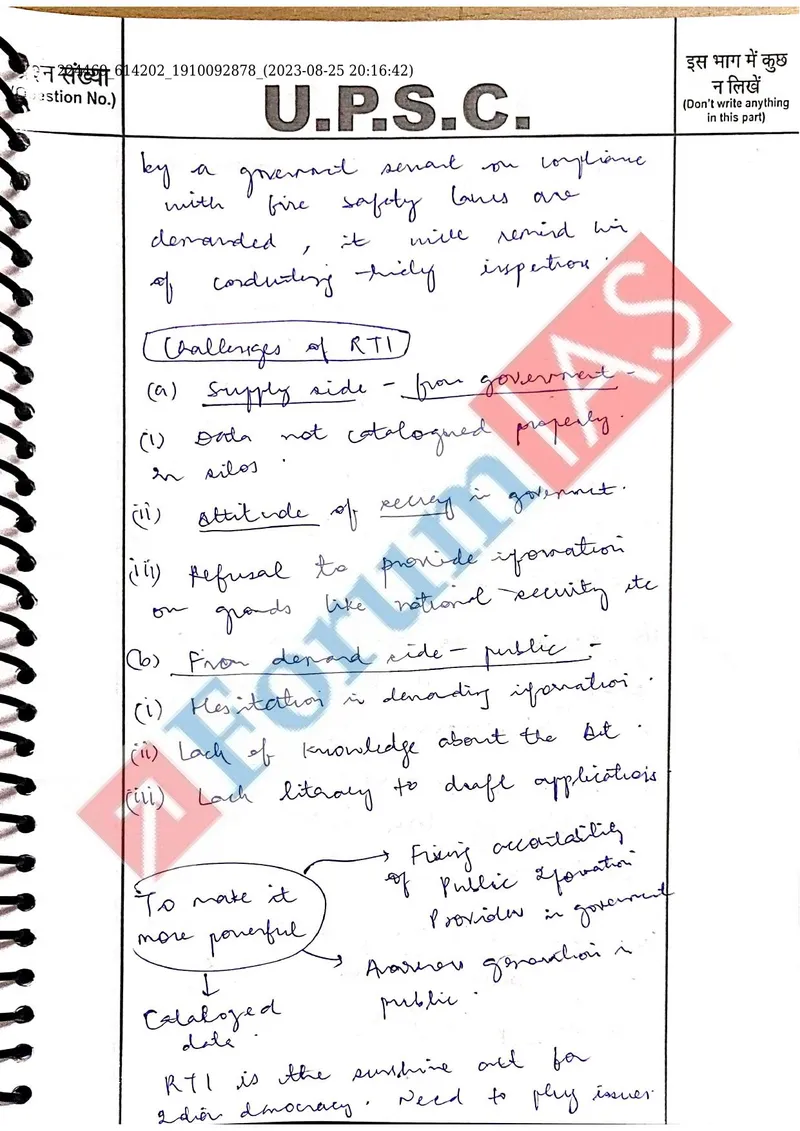
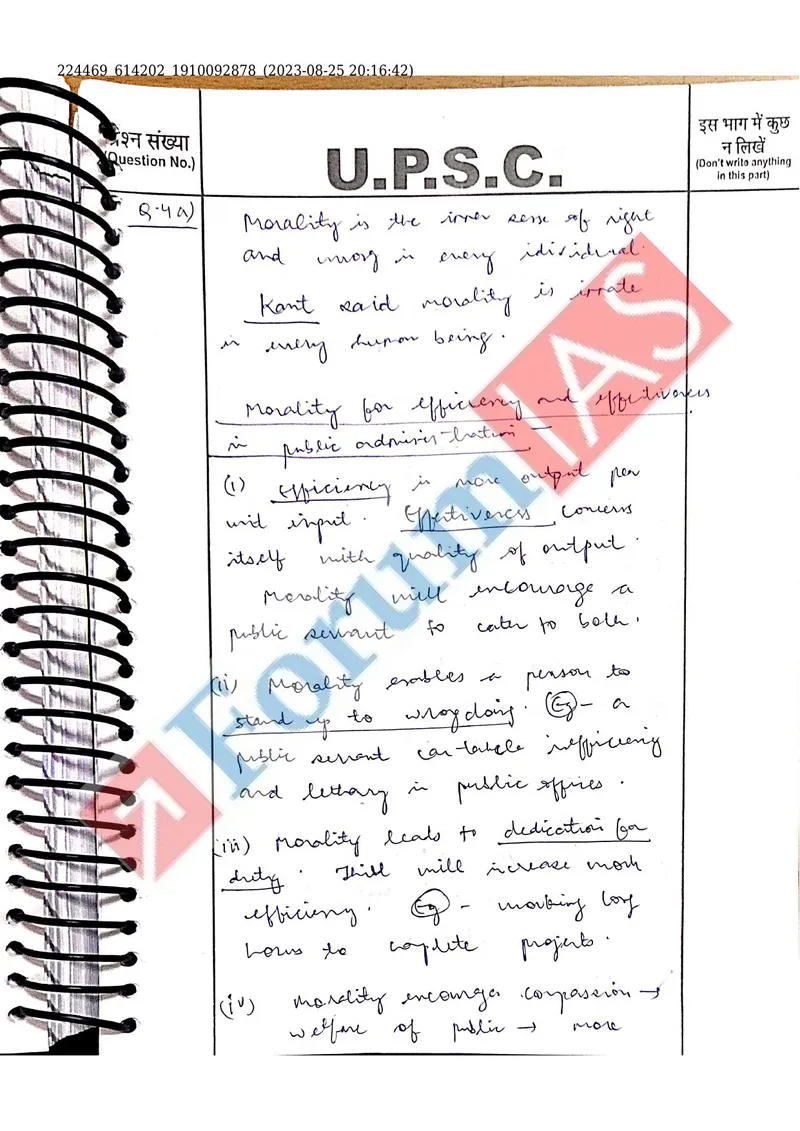
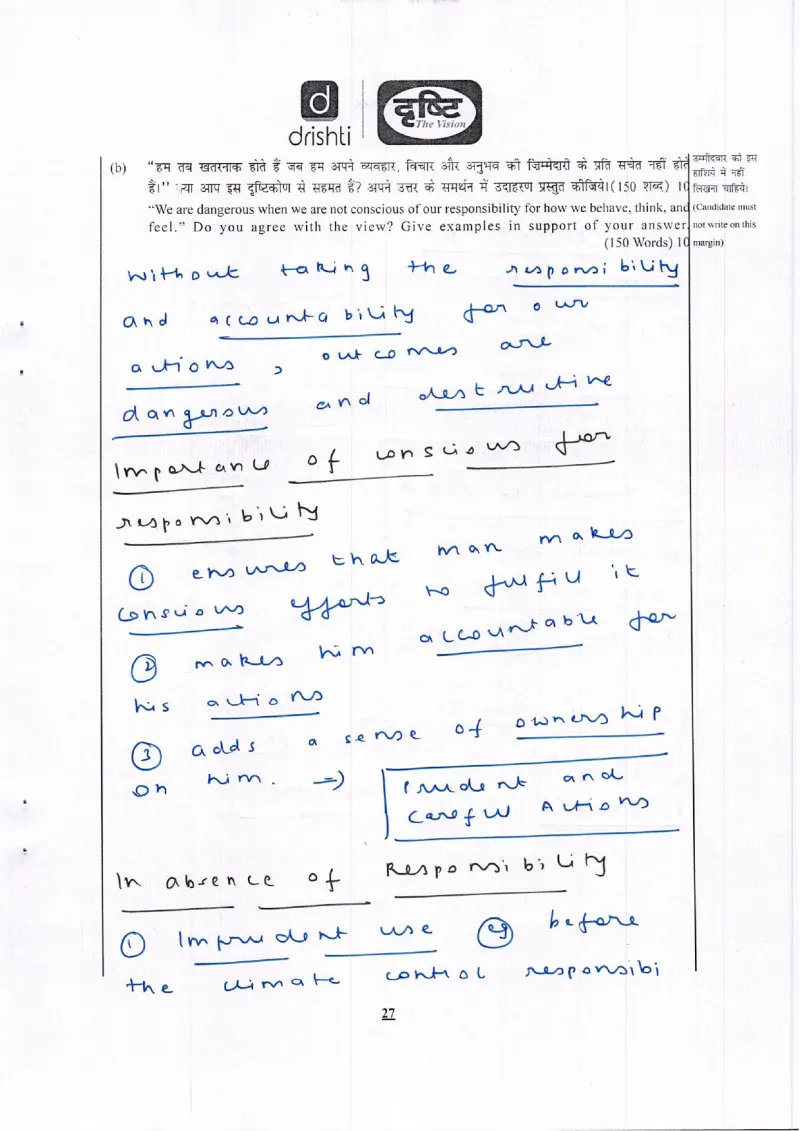
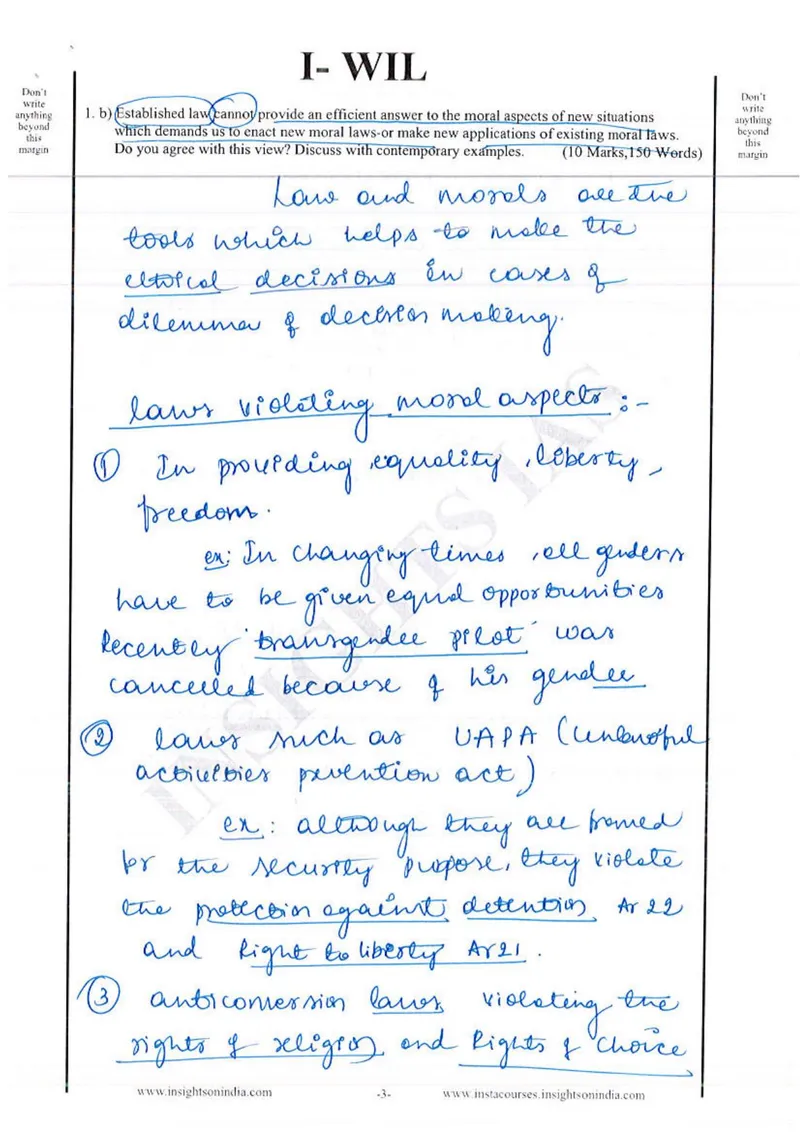
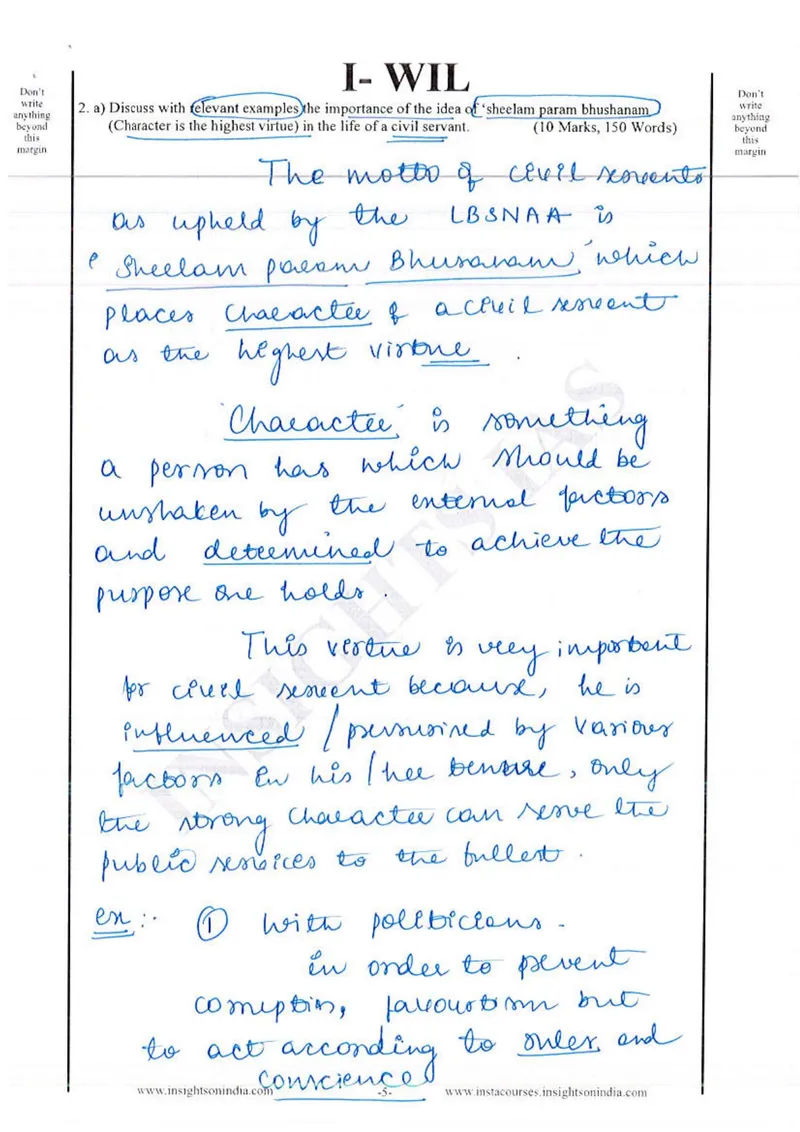
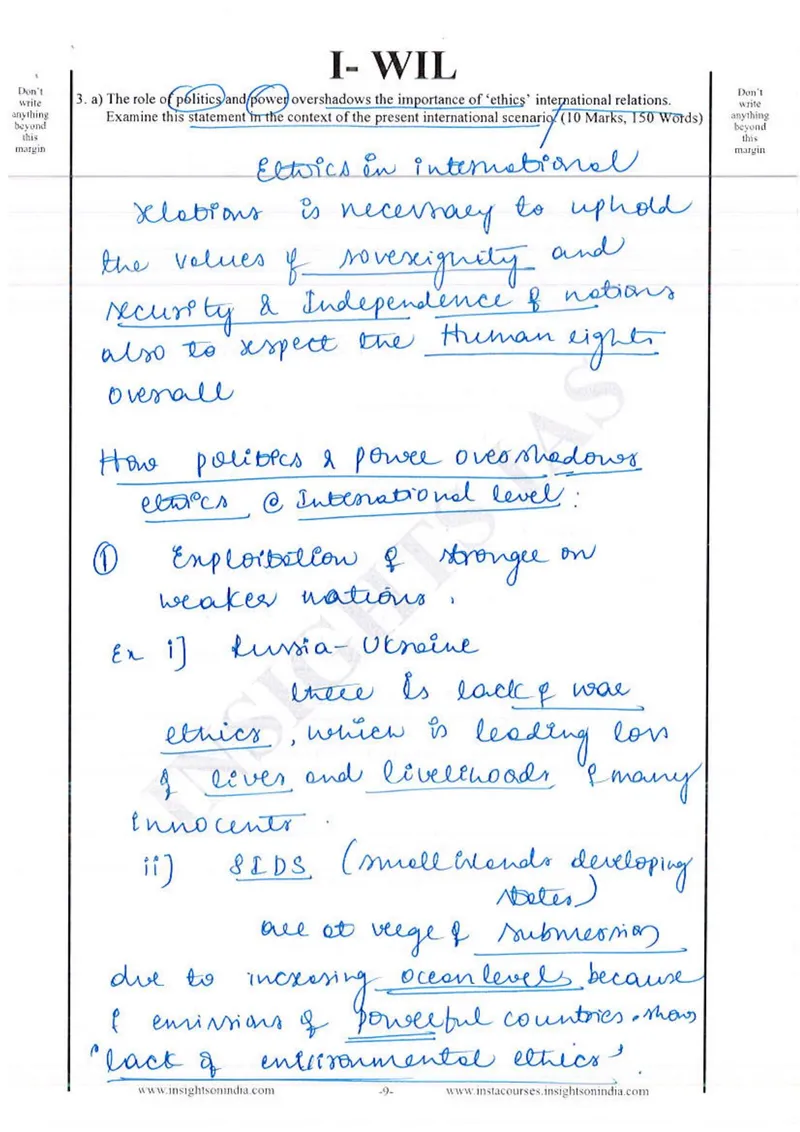
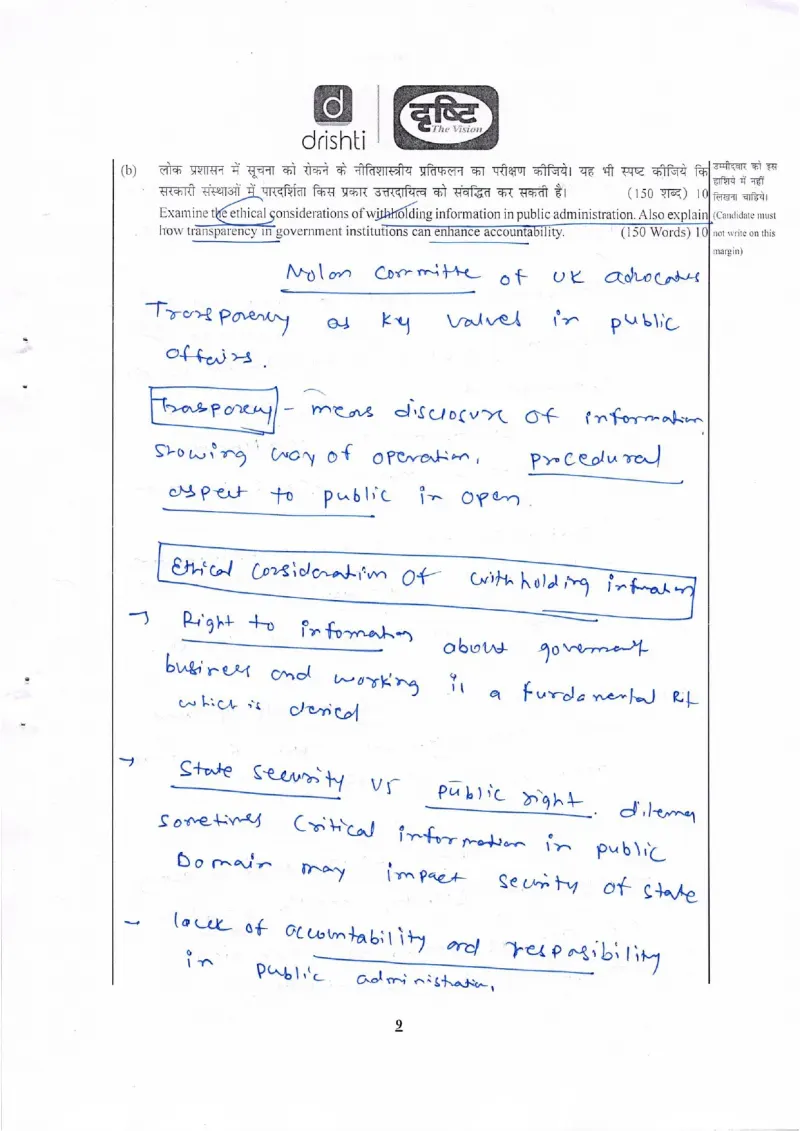
GS Paper 4 rewards structure and examples more than rote theory — which makes real ethics copies the highest-leverage reading in mains preparation. This collection holds 83 GS4 booklets, and for several of them a page-by-page breakdown of the theory questions and case studies attempted, the thinkers and examples used, and the answer structure — including both of Shakti Dubey’s (AIR 1, CSE 2024) Sure Shot ethics tests and Shruti Sharma’s (AIR 1, CSE 2021) full ethics paper.
What’s inside these ethics copies
Shruti Sharma — GS Paper 4 (Ethics) evaluated copy
GS Paper 4 · EthicsEvaluated · 111/250PDF · 3.6 MB
What’s inside this copy
▸Scored 111/250 overall on the Vajiram & Ravi GS-IV Ethics Full Paper (Test 04, 2021), evaluated 25 Dec and reviewed 26 Dec 2021.
▸Evaluator graded three of four parameters 'Very Good' (Language & Articulation, Conceptual Clarity & Content, Number of Attempts) and Structure & Presentation 'Good'.
▸Relentlessly example-driven: nearly every point is pinned to a real case — Tulasi Gowda, the Idu Mishmi tribe, Chetan Singh Rathore IPS, Sanjukta Parashar, the DoPT 4 E's and Mission Karmayogi.
▸Answers open with crisp, well-chosen quotes — Marcus Aurelius ('Masters of the world have been masters of their mind', praised as a 'good analogy'), Mark Twain and Plato.
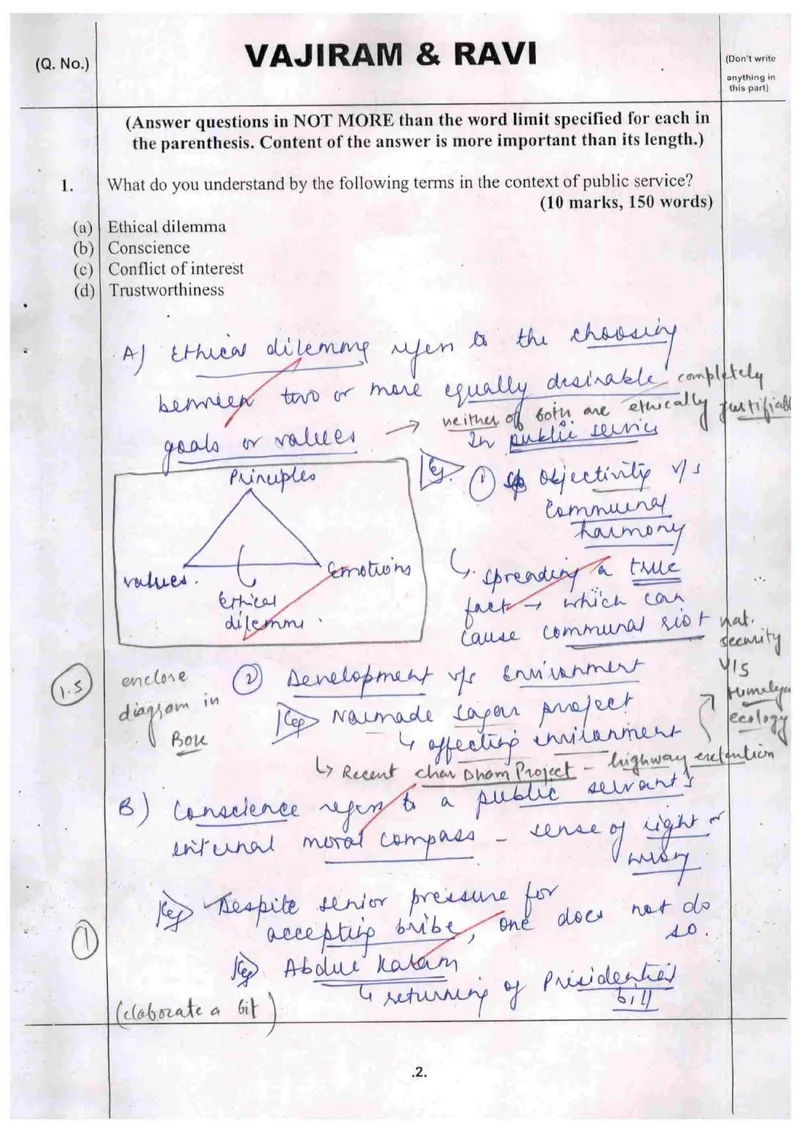
▸Visual thinker: boxed triangle for the ethical dilemma, a LAWS-vs-ETHICS table, and a COVID school-closure flow chart all used to compress arguments.
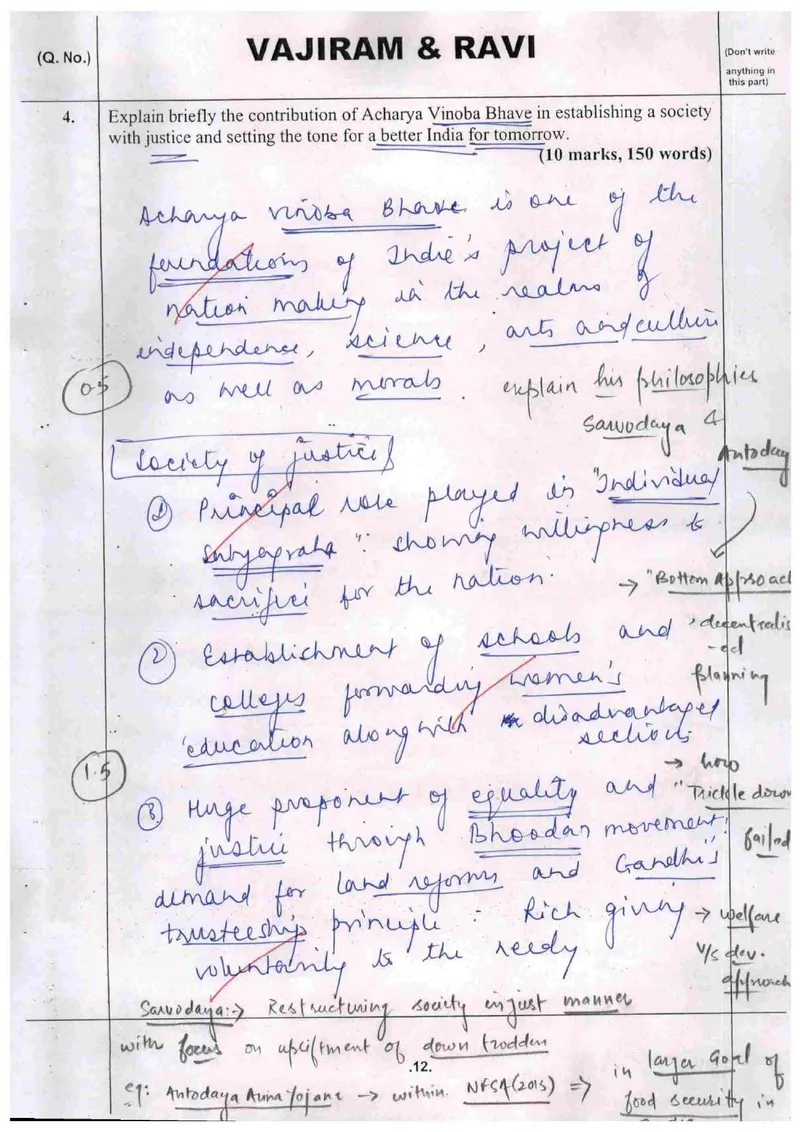
▸Marks were shed where the precise demand slipped — Q4 (Vinoba Bhave) drew 'Misunderstood the demand of Question' and Q5(b) 'missed demand of 2nd part'.
What to learn from this copy
★For environmental ethics Q2(a) she did not stop at one example — she stacked grassroots, named, verifiable cases: the 'pipal' tree worshipped since Harappan times, Telangana's Yadadri Tree Model, Padma Shri Tulasi Gowda, the Assam 'elephant doctor', and the Idu Mishmi tribe treating tigers as kin; the evaluator's note 'good articulation with examples' is the payoff. Lesson: in Ethics, convert every abstract value into a cluster of specific named real-world instances (people, schemes, tribes) rather than generic statements — that density is what drew the 'Very Good' on Conceptual Clarity & Content.
★Every answer opens with a deliberate 'anchor' in a short underlined intro — a quote, a constitutional article, or a named personality (e.g. Sardar Patel's 'steel frame' for Q6(a), Article 15 for Q5(a), Marcus Aurelius for Q5(b)) — and this consistency earned 'Very Good' on Language & Articulation. Lesson: build one repeatable opening template (quote/article/personality + underlined sub-headings like 'Importance', 'Society of justice') so every answer reads structured under time pressure.
★She picks quotes that actually fit the argument, not decoration: Marcus Aurelius's 'Masters of the world have been masters of their mind' for emotional intelligence in administration (Q5(b)) drew an explicit 'good analogy' from the evaluator. Lesson: a quote scores only when it maps tightly onto the question's demand — choose for relevance to the specific point, not for fame.
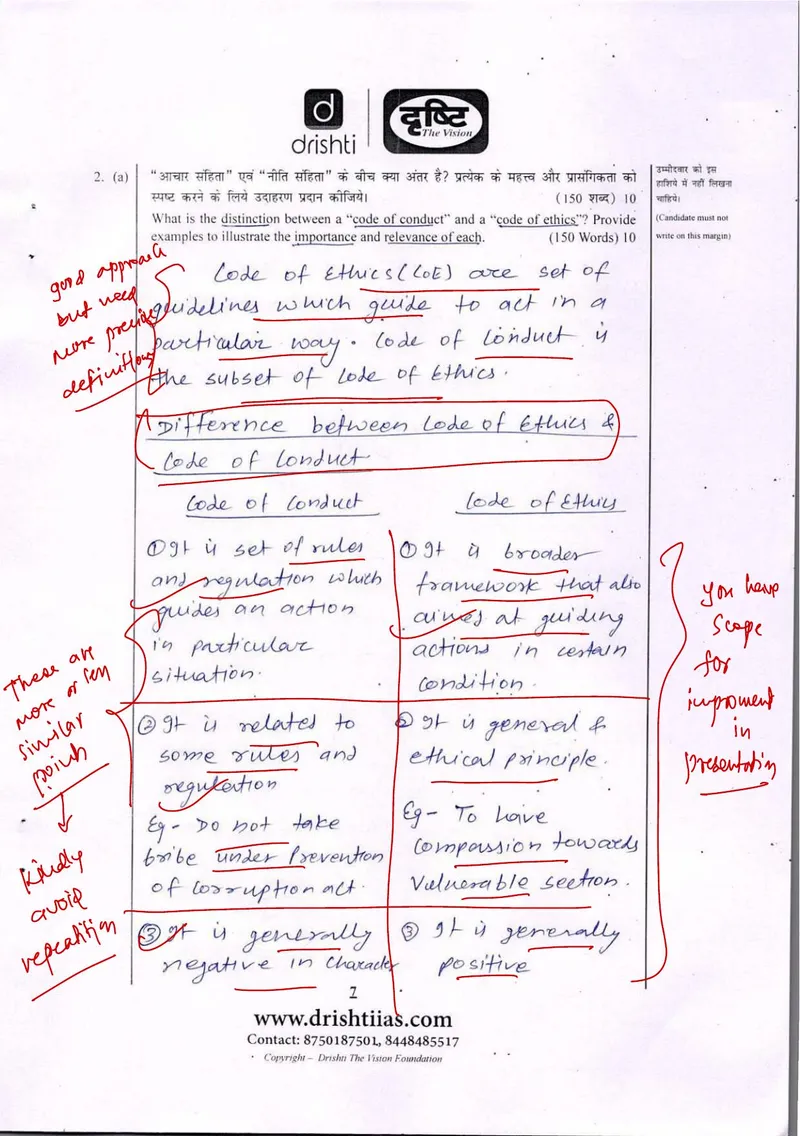
★She compresses arguments into labelled visuals — a boxed triangle of Principles + Values + Emotions converging on 'ethical dilemma' (Q1), a two-column LAWS vs ETHICS table (Q2a), and a flow diagram from 'academic development affected' to girl-child dropout/child labour (Q3b). Lesson: use diagrams to carry the structure of definitions and comparisons; note the examiner's 'enclose diagram in a box' — always frame diagrams cleanly so they read as deliberate, not scribbled.
★Where she lost marks the cause was named precisely: on Q4 she drifted from the demand ('misunderstood the demand of Question', only 5/10) and even claimed Vinoba Bhave laid the foundation for India's space and nuclear programme — a stretch the evaluator flagged with '??'; Q5(b) lost marks for 'missed demand of 2nd part'. Lesson: re-read what the question actually asks (especially each sub-part) and never inflate a personality's contribution with unverifiable claims — examiners catch the overreach and the off-demand content both.
Questions attempted: Public-service terms explained: (a) ethical dilemma (b) conscience (c) conflict of interest (d) trustworthiness; Environmental ethics; how laws and ethics differ; Whether the utilitarian approach can be the foundation of morals and legislation, and 6 more below.
Q2(a).Environmental ethics; how laws and ethics differ — 5/10
Q2(b).Whether the utilitarian approach can be the foundation of morals and legislation — 4.5/10
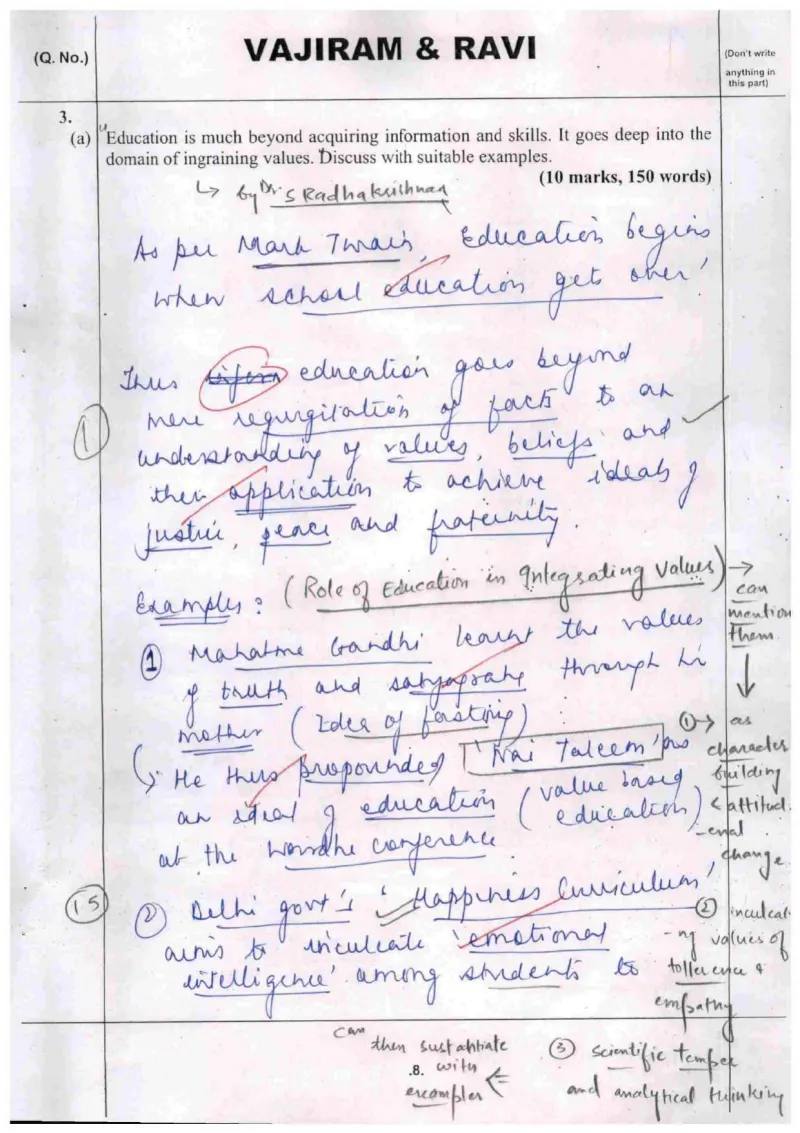
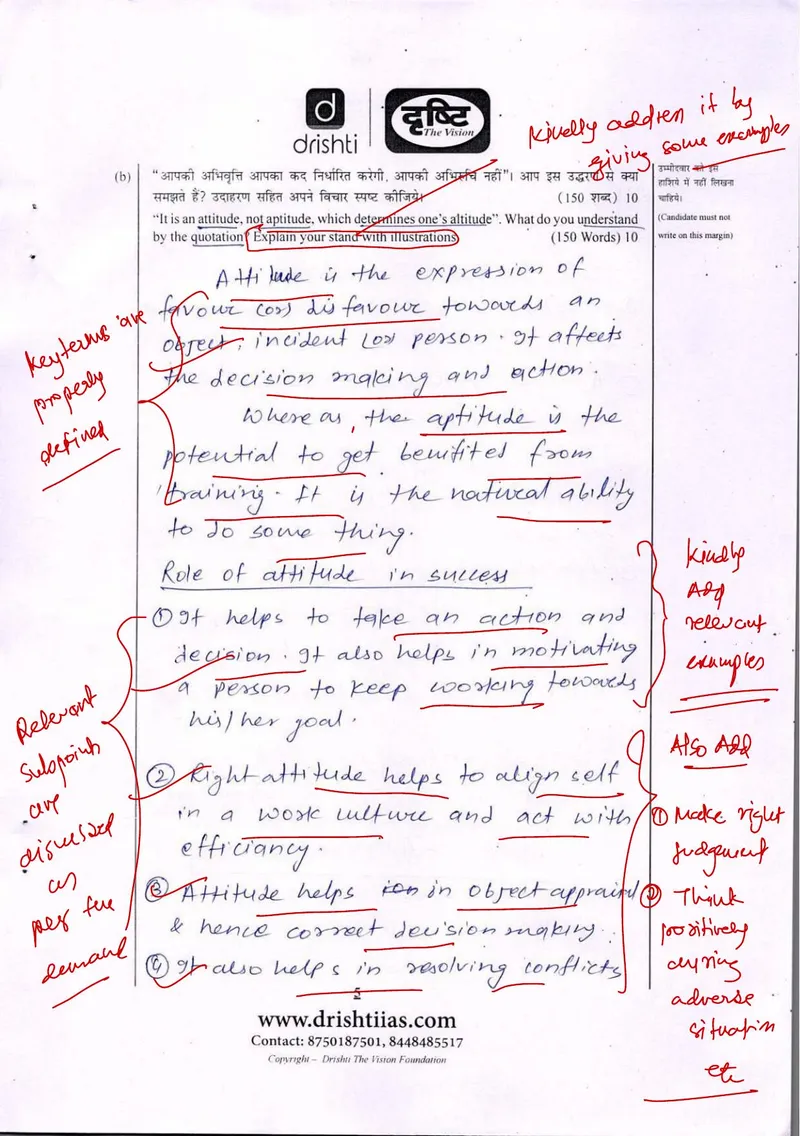
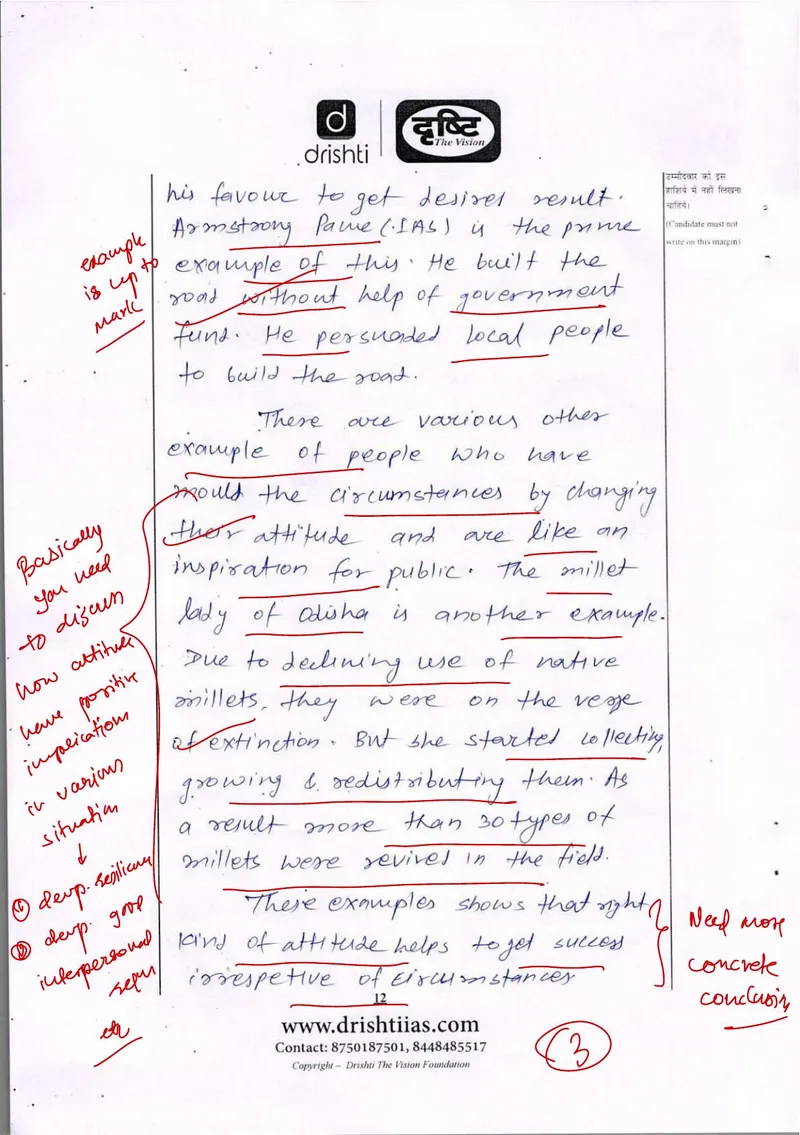
Q3(a).Education goes beyond information/skills into ingraining values — 4.5/10
Q3(b).Pandemic school closure hampering both academic and moral development of pupils — 3/10
Q4.Contribution of Acharya Vinoba Bhave to a society with justice / a better India — 5/10
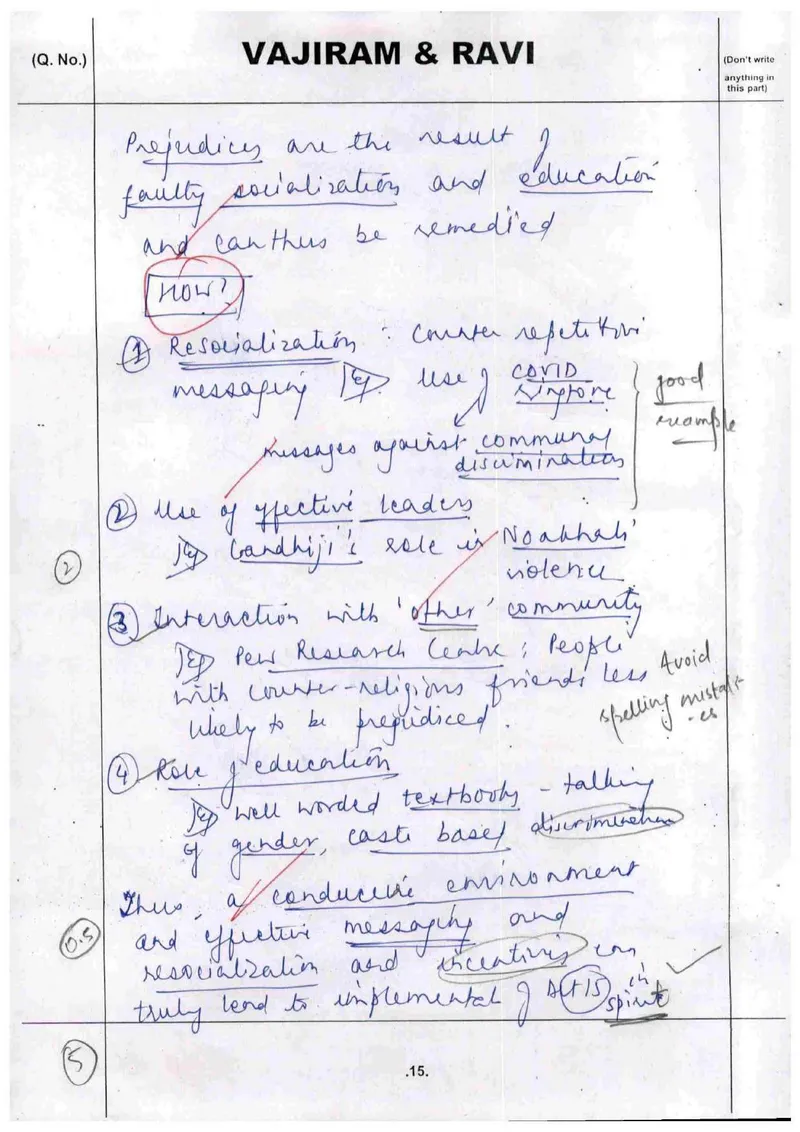
Q5(a).Difference between prejudice and discrimination; ways to overcome prejudice — 5/10
Q5(b).Application of emotional intelligence to administration; how EI can be enhanced — 4/10
Q6(a).Civil servants as custodians of public resources — importance of holistic competence — 4.5/10
Examples, data & evidence used
Q1: Development v/s Environment framed via Narmada Sagar dam and the recent Char Dham highway project; Dr A.P.J. Abdul Kalam returning the President's bill (conscience); objectivity v/s communal harmony in national security
Q2(a): the 'pipal' tree worshipped since Harappan times; Yadadri Tree Model of urban forestry (Telangana); Tulasi Gowda (Padma Shri); the 'elephant doctor' of Assam (Padma Shri); Idu Mishmi tribe of Arunachal treating tigers as kin; abortion laws (context-dependence); the Holocaust in Germany (legal but unethical); affirmative-action laws
Q2(b): Jeremy Bentham and James Mill (utilitarianism); the Trolley problem; Kantian ethics / torture to extract information (means ignored); dam-displacement; Gandhiji on matters of conscience; Plato's virtue ethics
Q3(a): statement attributed in margin to Dr S. Radhakrishnan; Gandhi's 'Nai Taleem' (Wardha conference); Delhi government's 'Happiness Curriculum'; Tagore's Vishwa Bharati / Shanti Niketan ('universal citizen'); Japanese 'Chi-Toku-Tai' (knowledge-body-mindfulness); NEP 2020
Q3(b): Azim Premji Institute report (>2/3rd children); ASER (only ~50% online access); UNICEF (2021); girl-child dropout/early marriage and boys into child labour; mid-day meal and uniform dress glossing over class/caste; Leonardo da Vinci as 'multifaceted' human
Q4: Acharya Vinoba Bhave — Individual Satyagraha, Bhoodan movement, Gandhi's trusteeship, Sarvodaya and Antyodaya, Antyodaya Anna Yojana within NFSA (2013); claim that he laid the foundation for India's space and nuclear programme with Homi Bhabha / ISRO & BARC (evaluator flagged this with '??')
Q5(a): Article 15 of the Constitution; stereotype illustrations ('women inherently weak', 'Bania' community, 'Blacks'); apartheid in South Africa; untouchability of Dalits; non-employment of women in the army; Gandhiji's role in Noakhali; Pew Research Centre (counter-religious friends less prejudiced); COVID-warrior anti-communal messaging
Q5(b): Chetan Singh Rathore (IPS) using the national anthem to control a crowd; an IAS officer in Bijapur (legible as 'Tambeli Ayyaj') building a hospital for adivasis in a Maoist area; the Naga–Kuki conflict; the 2008 nuclear deal (diplomacy); Sanjukta Parashar (Bodo militancy); SP K. Sinha carrying a dead body for 2 km (empathy); Mo Sarkar initiative (Odisha)
Marcus Aurelius (Stoic), Q5(b): 'Masters of the world have been masters of their mind' — evaluator wrote 'good analogy' beside it
Mark Twain, Q3(a): 'Education begins when school education gets over'
Plato, Q3(a): 'Information must be passed through the sieve of wisdom to become knowledge'
Gandhiji, Q2(b) (paraphrased): in matters of conscience, the law of the majority (utilitarianism) has no place
Q5(b) used 'War happens when language fails' with no author attribution visible (reported unattributed)
How it’s written: Highly consistent template across every answer: a short underlined intro that opens with an anchor — a quote, a constitutional article, or a named personality (e.g., Sardar Patel's 'steel frame', Article 15, Marcus Aurelius) — followed by clearly labelled, underlined sub-headings ('Importance', 'Society of justice',…
Diagrams & visuals: Q1: boxed triangle diagram — Principles + Values + Emotions converging to 'Ethical dilemma' (evaluator margin: 'enclose diagram in Box'); Q2(a): two-column comparison table, LAWS vs ETHICS; Q3(b): branch/flow diagram from 'Academic development affected' to girl-child dropout, child labour, inaccessibility to online education, forgotten learning; Q5(a): small flow — negative attitude breaking into Behavioural / Affective / Cognitive aspects; Q6(a): boxed triangle (Resources–Civil servants–Information–Trust) plus bracketed flow diagrams for 'Areas of competence' and DoPT's '4 E's'; No maps were used anywhere in the scanned pages
Evaluator: Fully evaluated: 111/250 on the Vajiram & Ravi GS-IV ethics full test (evaluated 25 Dec 2021). Parameter ratings — Language & Articulation, Conceptual Clarity & Content and Number of Questions Attempted all “Very Good”; Structure & Presentation “Good”. Sample examiner notes: “enclose diagram in a box”, “good articulation with examples”, and on Q4 (Vinoba Bhave) “misunderstood the demand of the question”.
The scan holds the answers through Q6(a); the cover marks table records the full 111/250 even though the later answer sheets aren’t in this file.
Shakti Dubey — GS Paper 4 Ethics (Sure Shot Test 08)
GS Paper 4 · EthicsPDF · 15.8 MB
What’s inside this copy
▸Every 10-marker opens with a hook — a quote (Gandhi, Greta Thunberg, Thiruvalluvar, Mother Teresa) or a report/data point (IPCC 6th AR, World Economic Forum, 2nd ARC) — before defining the core term.
▸Bodies are crisp numbered points and almost every point is fused to a real 'eg:-' example, making the answers example-dense rather than abstract.
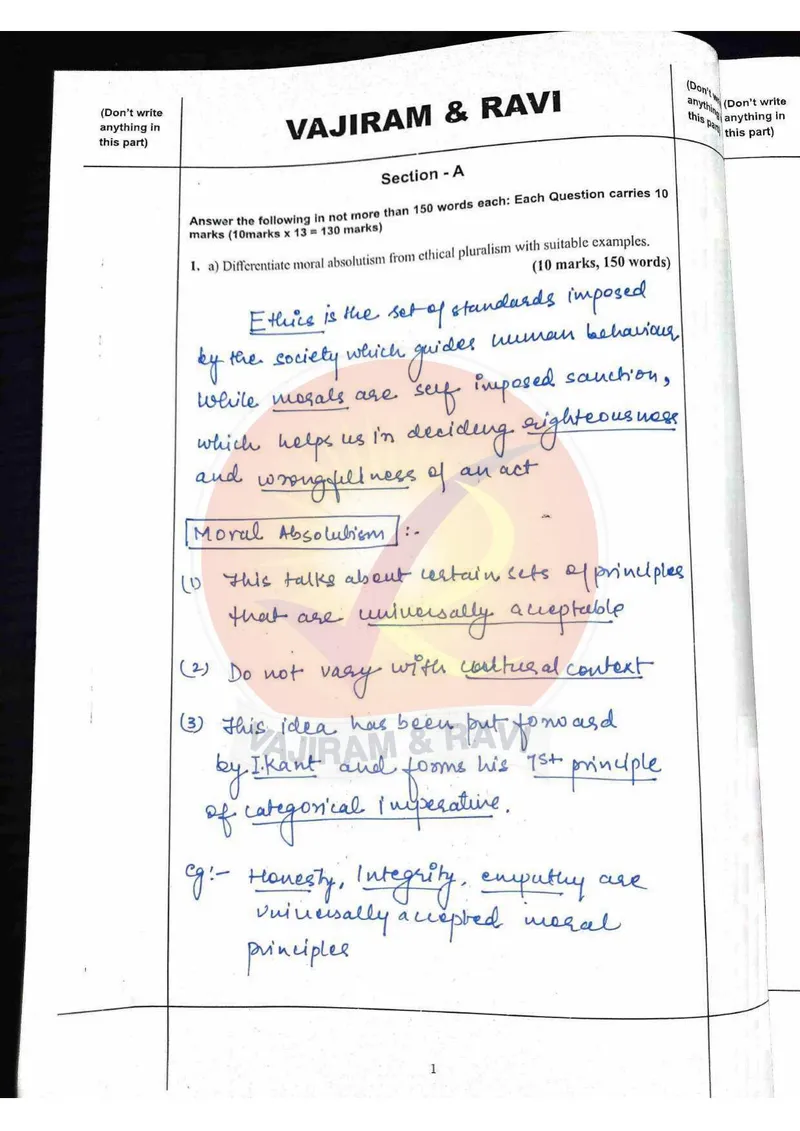
▸Signature move: pair an ethics thinker with an Indian instance — Rawls' Difference Principle, Kant's categorical imperative, Plato's cardinal virtues, Bentham–Mill utilitarianism, Bhagavad Gita's Nishkama Karma.
▸The attitude answer (4a) is anchored by a hand-drawn flowchart: Belief/Value system → Attitude (positive/negative) → Behaviour.
▸Section-B case studies use a fixed template: framing line → stakeholder diagram → numbered ethical issues → each option weighed Positive vs Negative → chosen option with reasons → way forward.
▸Leans on a deep bench of named role models to concretise values — Kiran Bedi (Tihar), Chhavi Rajawat (Soda Sarpanch), Satyendra Dubey, U. Sagayam, Ela Bhatt (SEWA), Dashrath Manjhi, Lal Bahadur Shastri.
What to learn from this copy
★Every 10-marker opens with a 'hook' before the term is even defined — a quotation (e.g. 'Sunlight is the best disinfectant' to open the citizen-charter/transparency answer 2a, Greta Thunberg's 'act as if our house is on fire' to open the climate-finance answer 5a, Gandhi's 'court above the court of law' to open the conscience answer 6a) OR an authority/data anchor (2nd ARC, IPCC 6th AR, WEF) -> Bank one or two relevant hooks per ethics theme and lead with them, so the examiner sees framing before content; an authority/report works just as well as a quote when you don't have one.
★Shakti's signature move is pairing a Western ethics thinker with a concrete Indian instance — Kant's categorical imperative (1a), Rawls' Difference Principle, Plato's cardinal virtues, Bentham-Mill utilitarianism, and Bhagavad Gita's Nishkama Karma, then grounding values in named role models like Kiran Bedi (Tihar), Chhavi Rajawat (Soda Sarpanch), Satyendra Dubey, U. Sagayam, Ela Bhatt (SEWA) and Dashrath Manjhi -> Build a fixed 'thinker + Indian example' bench so abstract ethics points always land on a real referent instead of staying theoretical.
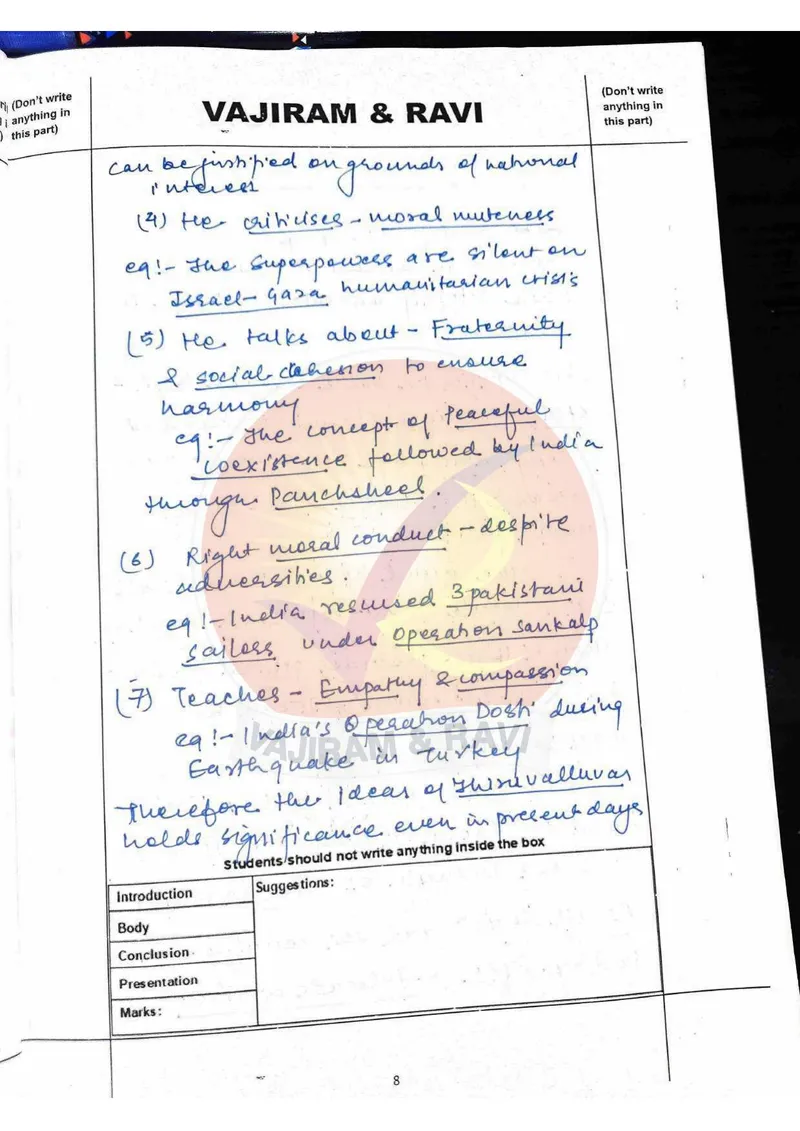
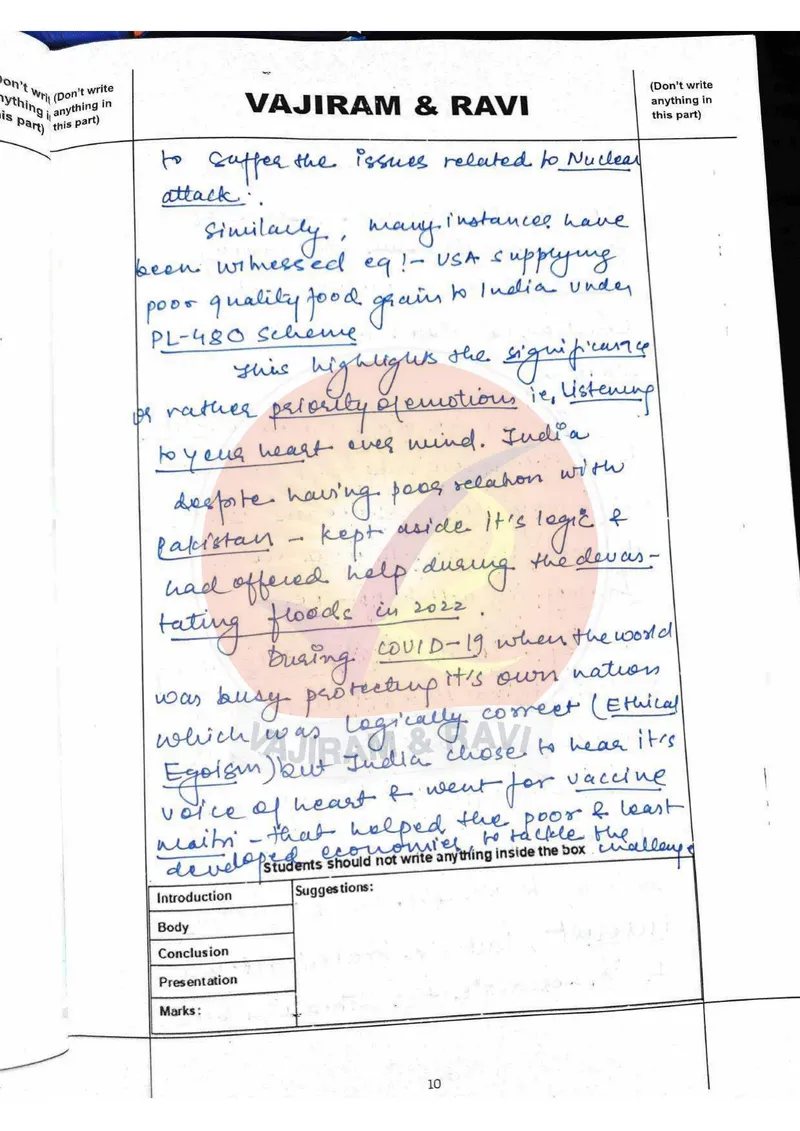
★Body points are not abstract — almost every numbered point is fused to a real 'eg:-' instance: she defends national interest in 2b with the Pathankot strike, Panchsheel, Operation Sankalp and Turkey earthquake relief, and illustrates 'mind over heart' in 3a with the US atomic bombing of Japan, PL-480, and COVID Vaccine Maitri -> Attach a current-affairs or policy example to each point you make; example-density is what separates a topper's ethics answer from a generic one.
★The attitude answer (4a) is anchored by a hand-drawn flowchart — Belief/Value system (core & peripheral) -> Attitude (branched into Positive/Negative) -> Behaviour — turning an abstract definition into a visual the examiner can grade at a glance -> When a question hinges on how concepts relate (attitude vs behaviour, belief->action), draw the causal chain rather than describing it in prose.
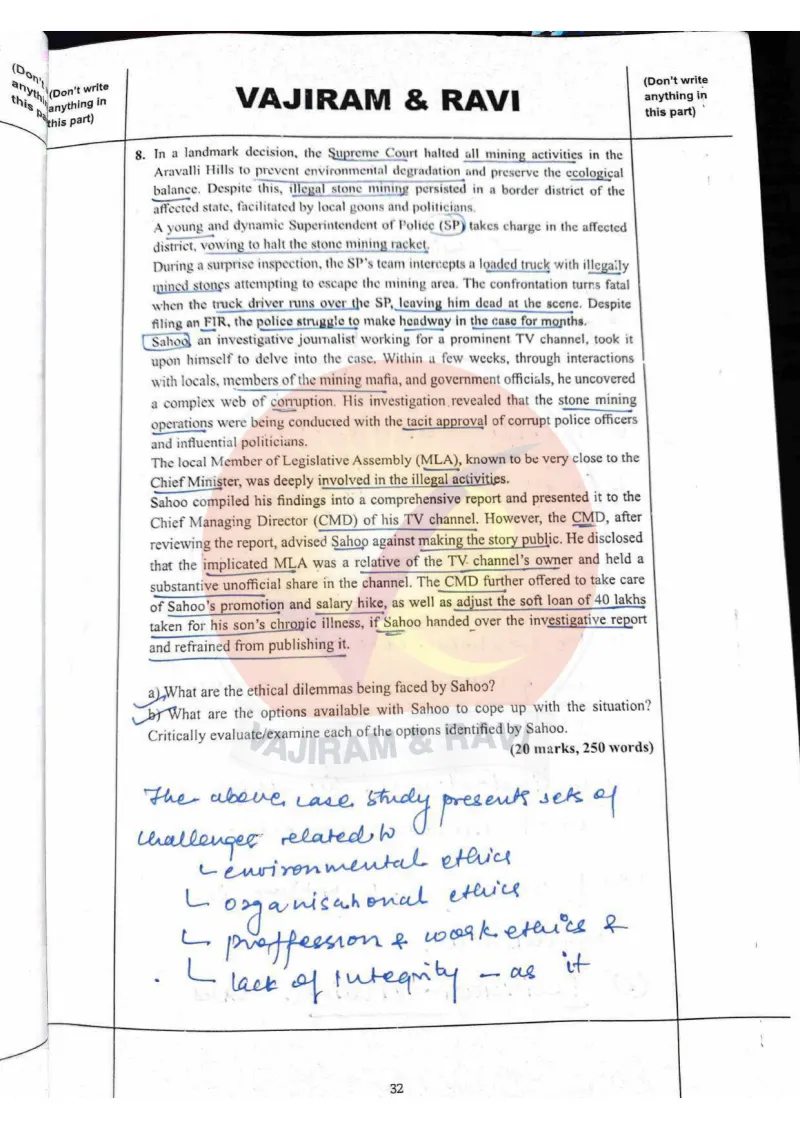
★Section-B case studies follow one rigid, repeatable template: framing line -> stakeholder bubble/spider diagram (e.g. Q7 maps DCP Aakash, SI Shipra, DIG Samar, Dinesh, public; Q8 maps SP, journalist Sahoo, MLA, channel owner, environment, society) -> numbered ethical issues -> each option weighed in a two-column Positive vs Negative layout (Q8, Q9, Q10) -> chosen option with reasons -> way forward -> Internalise one such case-study skeleton so that under time pressure you only fill content into a structure you never have to invent on the spot.
Questions attempted: Differentiate moral absolutism from ethical pluralism, with examples; Ethical implications of using generative AI in creative industries; How citizen charters enhance transparency and combat corruption in public institutions, and 16 more below.
Questions attempted in this booklet (19)+
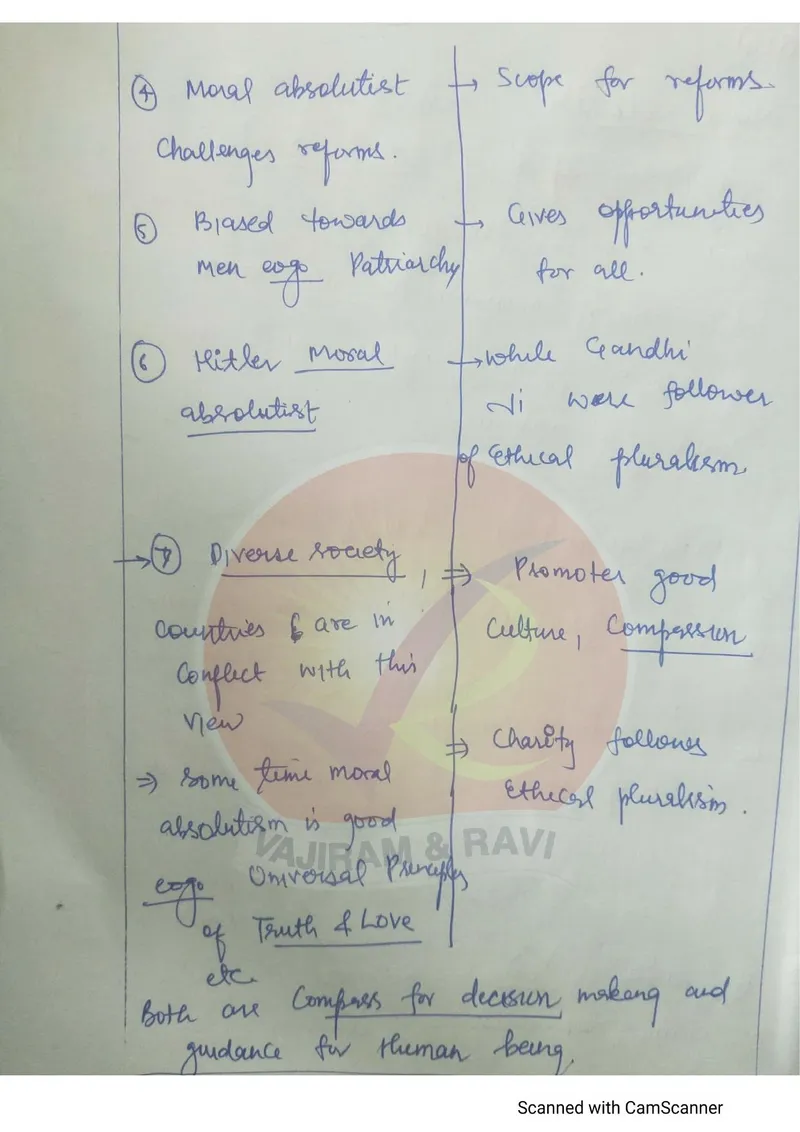
1a.Differentiate moral absolutism from ethical pluralism, with examples
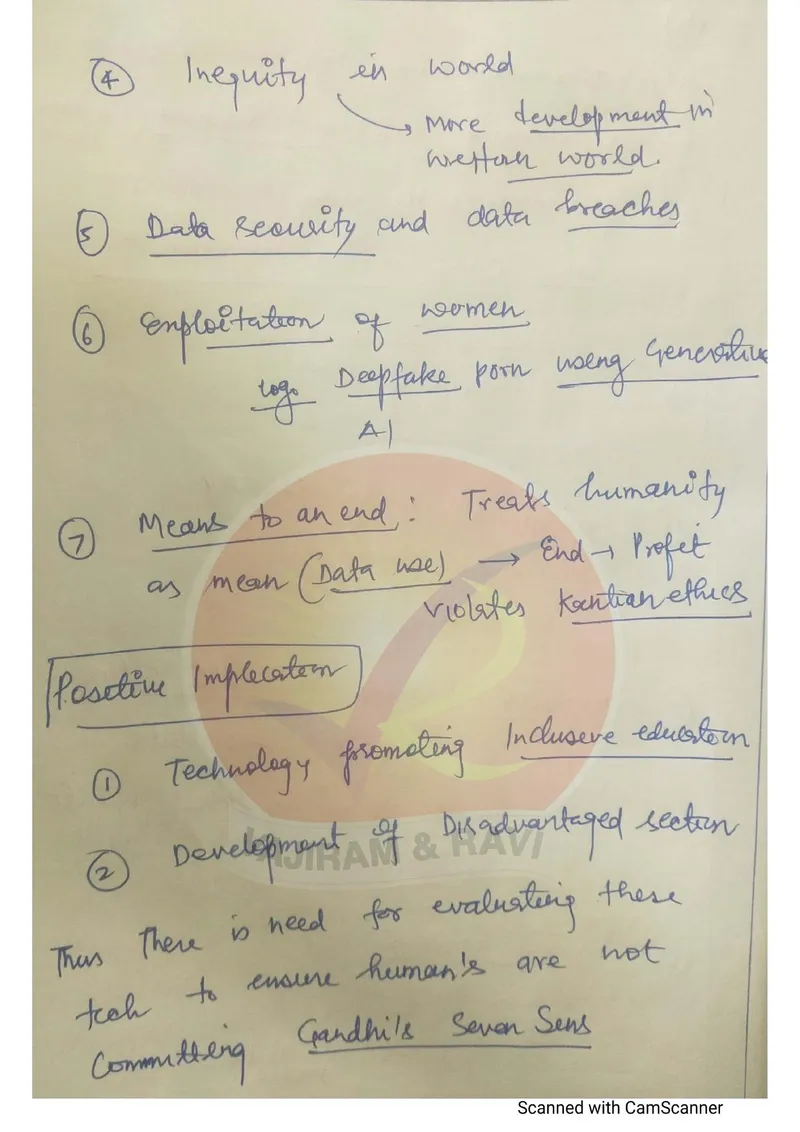
1b.Ethical implications of using generative AI in creative industries
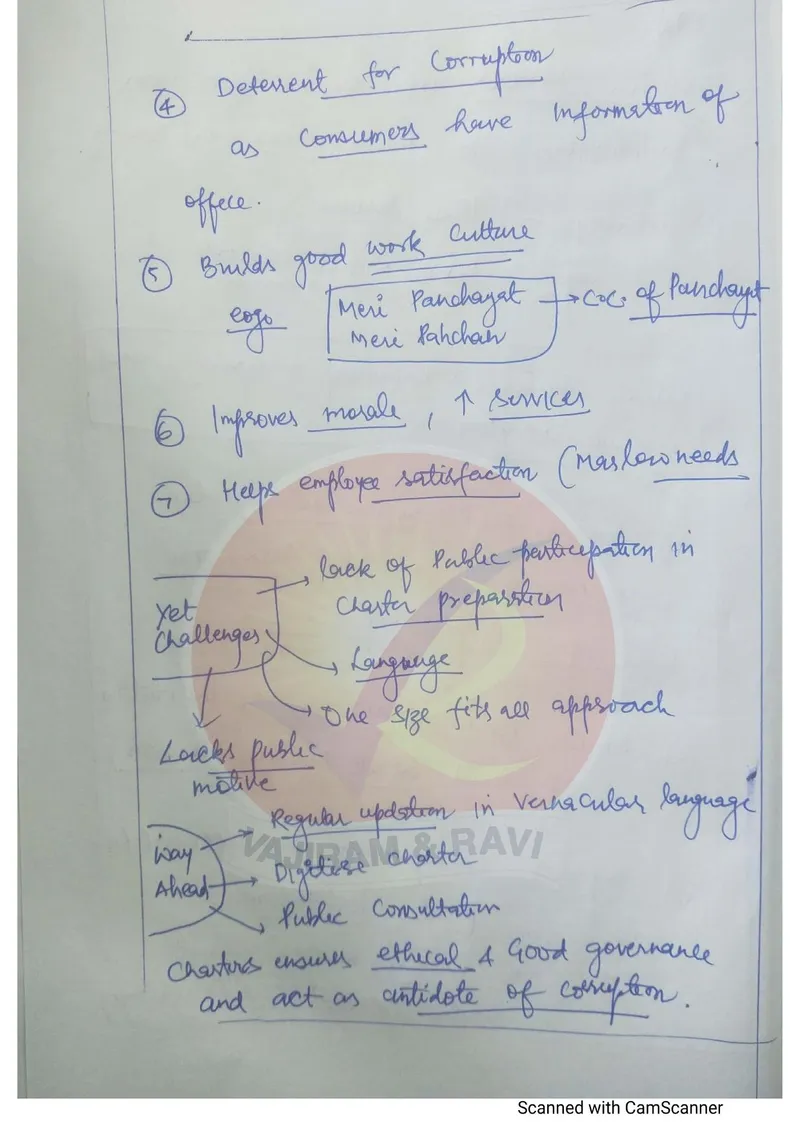
2a.How citizen charters enhance transparency and combat corruption in public institutions
2b.Key teachings of Thiruvalluvar and their present-day relevance
3a.Quotation: 'In a conflict between the heart and the brain, follow your heart' — Swami Vivekananda
3b.Quotation: 'To see what is right and not do it is the want of courage' — Confucius
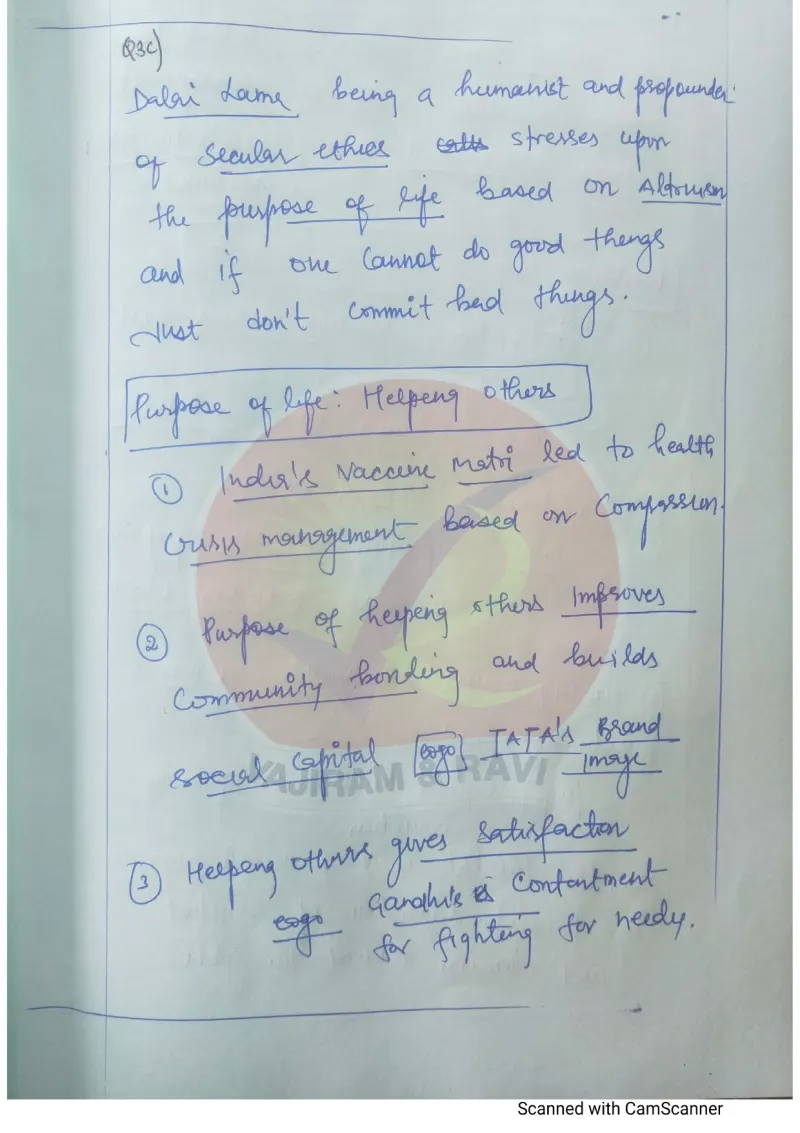
3c.Quotation: 'Our prime purpose in this life is to help others; if you can't help them, at least don't hurt them' — Dalai Lama
4a.Attitude shapes perceptions/intentions while behaviour is its tangible real-world expression — Discuss
4b.Emotional intelligence in high-stress environments — impact on resilience and decision-making
5a.Ethical concerns of developed nations setting climate targets for developing countries without adequate finance
5b.Moral consequences of misusing benefits meant for weaker sections, and how to prevent it
6a.Role of conscience in upholding personal integrity and fostering moral responsibility
6b.Resolving ethical dilemmas where organisational policy conflicts with personal moral principles
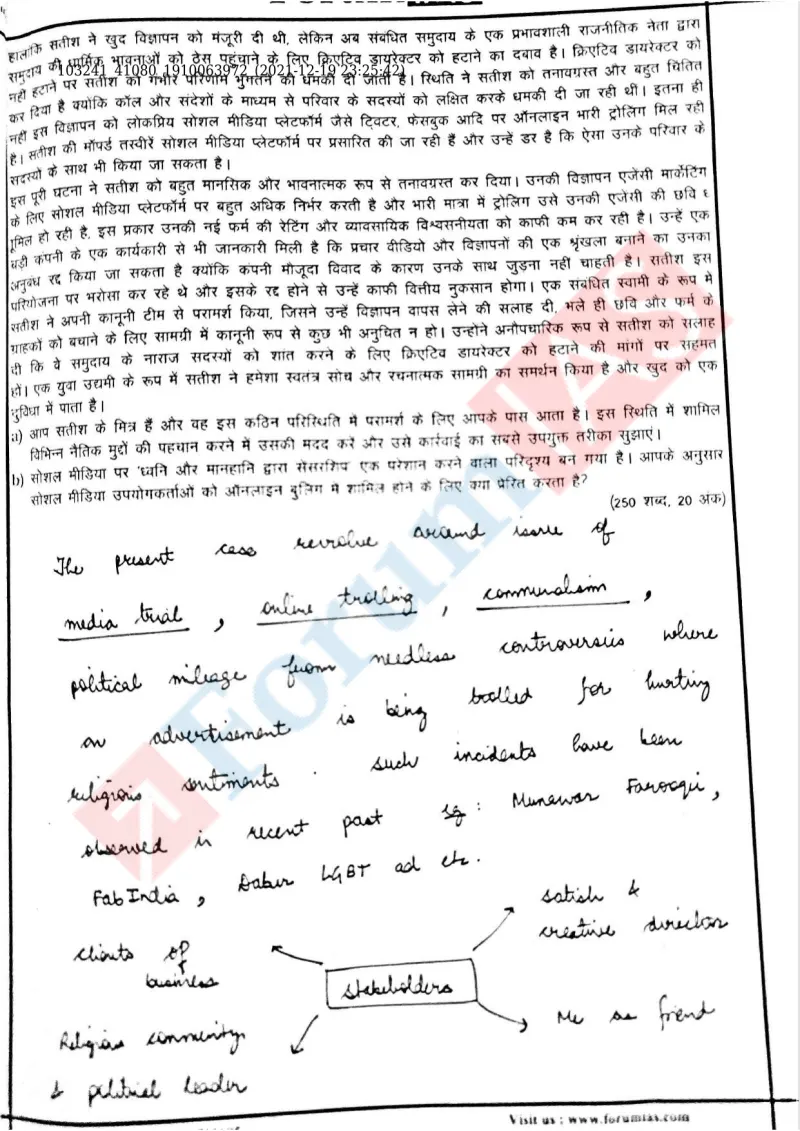
8.Case study: Aravalli illegal stone mining, SP killed, journalist Sahoo bribed by CMD to suppress report; ethical dilemmas + options
9.Case study: financial influencer endorsing Digital PayTech stock that crashes; moral values, ethical issues, options
10.Case study: strategic disinvestment of State Public Sector Bank, union head offered a bribe; ethical issues, options, steps to improve banking sector
11.Case study: Anil Gupta appointing son Rohan as CEO (nepotism) damaging ABC Industries; ethical issues, revival action, corporate-governance steps
12.Case study: Ms. Radhika, RTE, death of Dalit student Rani from caste-based assault; ethical issues, guiding values, navigating caste discrimination
World Economic Forum; Industrial Revolution 4.0 (1b)
2nd ARC — basis for citizen-charter benefits (2a)
Jan Soochna Portal, Rajasthan (2a)
Thiruvalluvar / Thirukkural; gifting of Thirukkural to G20 summit guests (2b)
Pathankot air strike — national-interest justification (2b)
Israel–Gaza humanitarian crisis — moral muteness of superpowers (2b)
Panchsheel / peaceful coexistence (2b)
Operation Sankalp (2b)
India's earthquake relief to Turkey (2b)
US atomic bombing of Japan in WWII — 'mind over heart' (3a)
PL-480 scheme — US foodgrain supply to India (3a)
COVID-19 Vaccine Maitri — India aiding poorer economies (3a)
Quotes the candidate used
'Sunlight is the best disinfectant' — opening of 2a (transparency)
'Knowledge without integrity is sin, while integrity without knowledge is hollow' — opening of 3a
'There are no victors in war' — used in 3b
'If you can't feed a hundred, just feed one... do small things with great love' — Mother Teresa, opening of 3c
'We must act as if our house is on fire, because it is' — attributed to Greta Thunberg, opening of 5a
'There is a court above the court of law, i.e., the court of conscience' — attributed to Gandhi, opening of 6a
A Thiruvalluvar / Thirukkural couplet on falsehood being acceptable only when it serves the common good — quoted in 2b (exact wording OCR-garbled)
'Sabka Saath, Sabka Vikas' — closing line of 5b
How it’s written: Highly templated, point-driven answers with strong word-limit discipline (each answer fits its allotted box/page). Section-A pattern: (1) a hook opener — either a quotation (Gandhi, Greta Thunberg, Thiruvalluvar, Mother Teresa) or a report/authority/data point (IPCC 6th AR, World Economic Forum, 2nd ARC); (2) a one-…
Diagrams & visuals: Hand-drawn flowchart in 4a: Belief / Value system (core & peripheral belief) → Attitude (branched into Positive and Negative) → Behaviour; Stakeholder bubble/spider diagrams in the Section-B case studies (e.g., Q7: DCP Aakash, SI Shipra, DIG Samar, Dinesh, public/society; Q8: SP, journalist Sahoo, MLA, channel owner, environment, society); Two-column 'Positive impact / Negative impact' layout used to evaluate each option in the case studies (Q8, Q9, Q10); No maps and no formal data tables observed
Evaluator: The Vajiram & Ravi evaluation template is present — a cover-sheet parameter grid (Language & Articulation, Structure & Presentation, Conceptual clarity & Content, Number of questions attempted; scale Excellent / Very Good / Good / Averag…
Raghav Jhunjhunwala — NextIAS GS Paper 4 (Ethics) copy
GS Paper 4 · EthicsPDF · 16.9 MB
What’s inside this copy
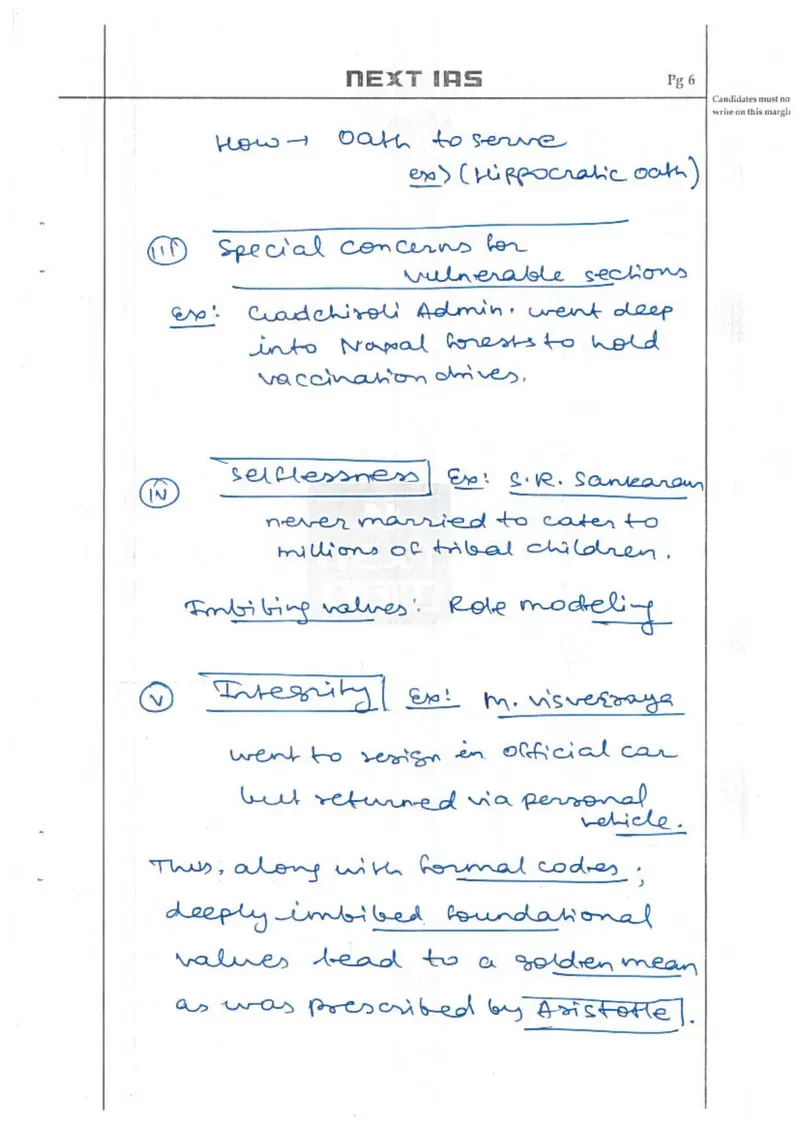
▸Example density is the signature strength - named role-models (Bose, Shastri, S.R. Sankaran, Ashok Khemka, Visvesvaraya, E. Sreedharan, Prasanth Nair) are deployed for almost every point.
▸Nearly every answer opens with a hook (film, Sanskrit maxim, or quote) and closes with a thinker's line - a deliberate, repeatable answer-writing rhythm.
▸Case studies use a clean, consistent template: stakeholder web-diagram -> ethical issues -> options as pros/cons -> Action|Rationale table -> way forward.
▸Strong constitutional and administrative anchoring: Art. 47, Art. 48A, MC Mehta v. UOI, Conduct Rules 1961, Companies Act 2013, 2nd ARC.
▸Current-affairs and corporate hooks woven in: Wayanad landslide 2024, Yes Bank/Videocon, ESG, Triple Bottom Line, 'Data is the new oil'.
▸Booklet is UNEVALUATED - no marks, grand total, remarks or evaluator feedback are filled anywhere (shared as a sample/topper copy).
What to learn from this copy
★For 'ends justify means' (Q1a) Raghav reached for a hard, debatable case - Subhas Chandra Bose joining the Axis powers for the freedom struggle - rather than a safe textbook line, and paired role-models like Lal Bahadur Shastri resigning after the Ariyalur train accident and Shastri-type conscience cases with the constraint-violation theme -> Mine history for the genuinely contested example that fits the exact wording of the question; a well-chosen real instance does the arguing for you.
★Almost every theoretical point is welded to a named bureaucrat-exemplar - S.R. Sankaran staying unmarried to serve tribal children, Ashok Khemka's 53 transfers, M. Visvesvaraya returning home in his personal vehicle to keep official and private separate, E. Sreedharan, Prasanth Nair's 'Compassionate Kozhikode', Awanish Sharan's bike ambulance -> Build a personal stock of ~8-10 administrator role-models with one crisp signature act each, so any 'ethical attribute / how to develop it' answer (Q2a) is illustrated, not asserted.
★He engages the quote prompt directly instead of paraphrasing it - on J.S. Mill's 'it is not because men's desires are strong... it is because their consciences are weak' (Q6a) he answers with the contrast of Ravana (strong desires) and reinforces it with the Sanskrit maxim 'Sheelam Param Bhushanam' (character is the ultimate ornament) -> In quote questions, restate the author's own claim, then prove it with a contrasting example plus a second corroborating line; layering a maxim onto the given quote shows you grasped its logic.
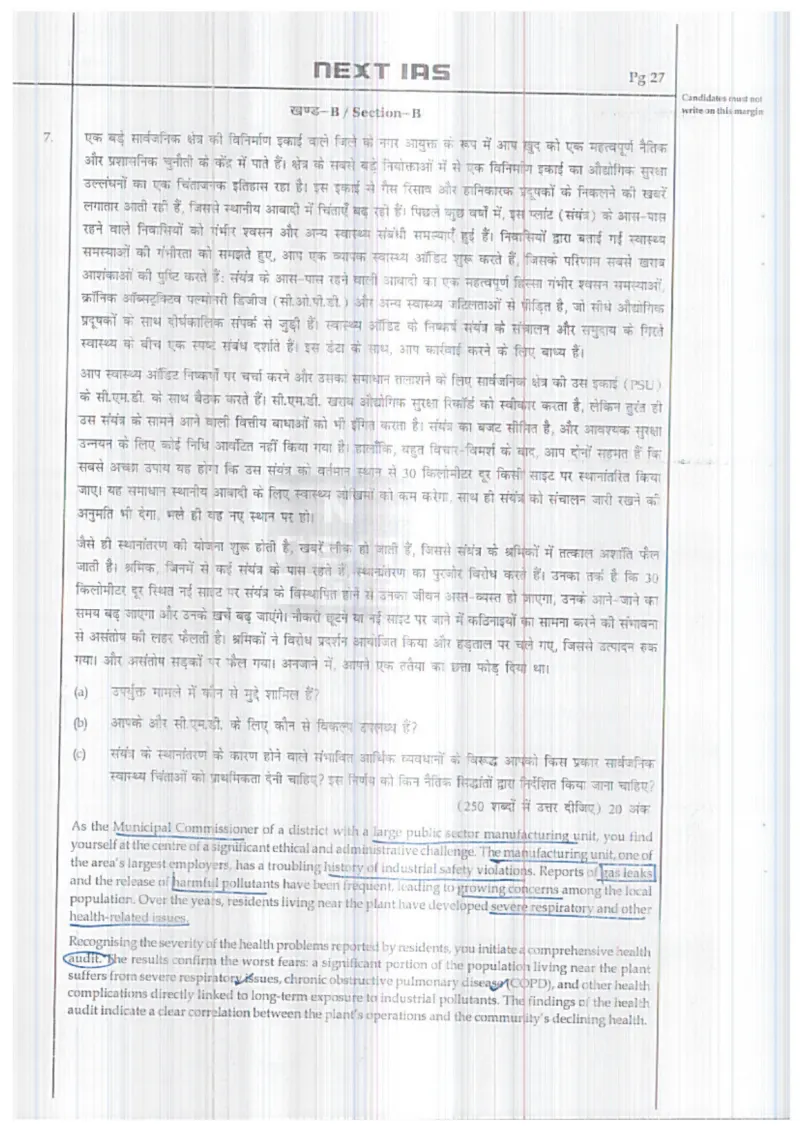
★Every case study (Q7-12) runs the same disciplined skeleton: a stakeholder web/bubble diagram with the candidate placed in it (Q7 hub branching to municipal staff, Govt, 'Municipal Commissioner (me)', Residents, Plant CMD, Plant workers) -> ethical issues -> options as pros/cons tables -> a two-column 'Course of Action vs Rationale' table -> way forward -> Pre-decide one repeatable case-study template so under time pressure you spend thought on content, not format; the Action|Rationale table forces you to justify each step rather than just narrate.
★Theory answers are anchored in citable law and reports, not vague principle - Art. 47 (Right to Health), Art. 48A, MC Mehta v. UOI, Conduct Rules 1961, Companies Act 2013, and the 2nd ARC's 'RTI = golden key to good governance' - and on the RTI question (Q4b) he layers current hooks like the MGNREGA scam, '80% PMO requests withheld' and the 2019 amendment dilution -> Even in Ethics, back claims with specific articles, cases, conduct rules and ARC lines; it converts a moral essay into a governance-literate answer.
★He varies hooks and closers deliberately so the templated rhythm doesn't read as formulaic - opening Q3b with 'It is easier to build strong children than to repair broken men' and Q8 with 'A stitch in time saves nine, and the failure to do so invites famine', then closing with thinkers' lines (Dalai Lama, Buddha's 'compassion itself is the righteous path' in Q9) -> Curate a small bank of openers and closers spanning proverbs, scripture and philosophers so each answer has a fresh frame while keeping a consistent open-with-a-hook, close-with-a-thinker discipline.
Questions attempted: Is it ethically justified for leaders to violate deepest moral constraints for greater good / 'ends justify means'; Humans as intuitive virtue theorists vs deontologists/consequentialists - critical analysis; Five ethical attributes for an administrator and how to develop them, and 16 more below.
Questions attempted in this booklet (19)+
1(a).Is it ethically justified for leaders to violate deepest moral constraints for greater good / 'ends justify means'
1(b).Humans as intuitive virtue theorists vs deontologists/consequentialists - critical analysis
2(a).Five ethical attributes for an administrator and how to develop them
2(b).Political vs professional vs personal responsibility and prioritisation in conflict
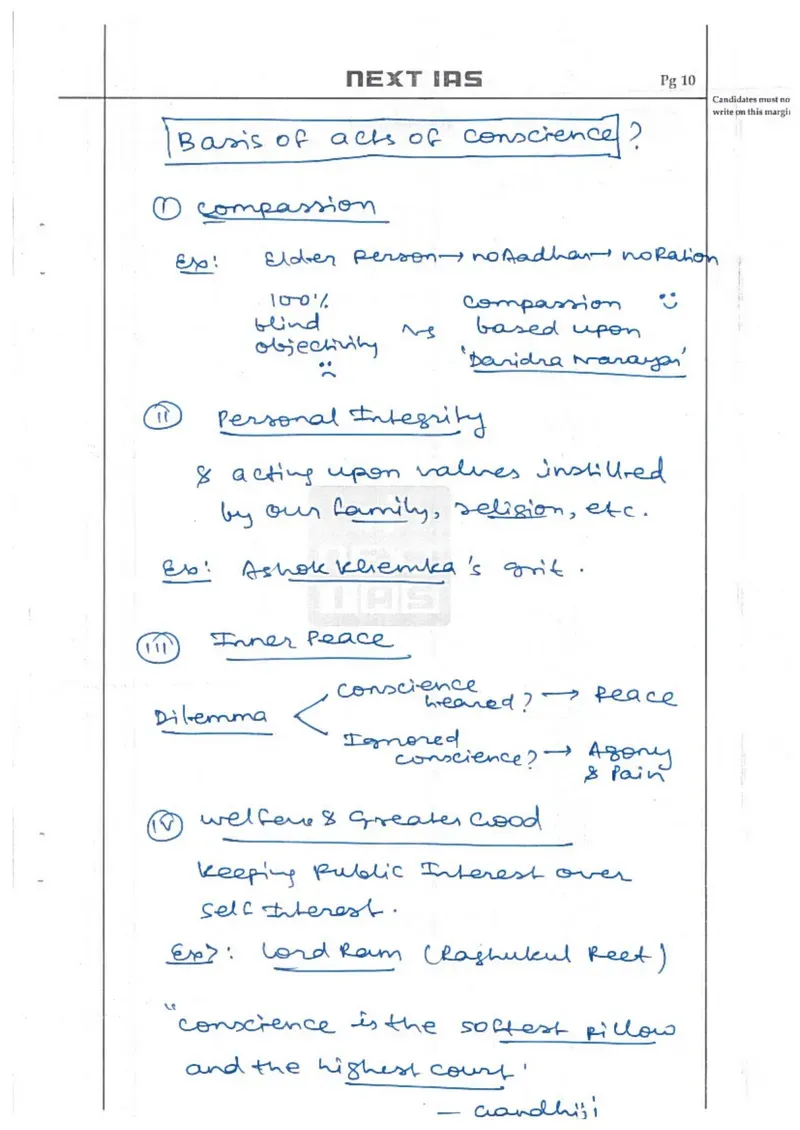
3(a).'Acts of conscience' in civil service - meaning, example, basis
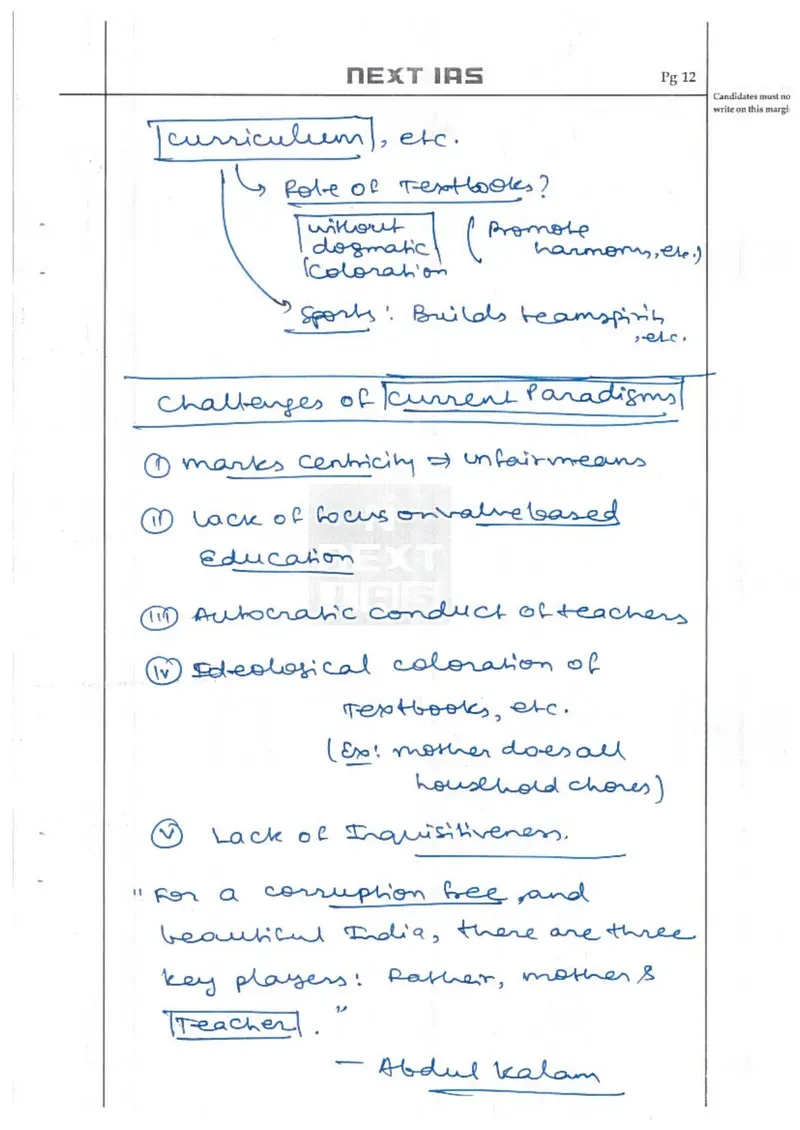
3(b).Role of educational institutions in shaping ethical decision-making in future civil servants
4(a).Ethical challenges of persuasion/social-influence techniques for rural health interventions
4(b).RTI 2005 and ethical accountability / curbing bureaucratic corruption
5(a).Ethical implications of high-quality service delivery; probity and marginalised communities
5(b).Regulatory frameworks in corporate governance without stifling innovation
6(b).Quote - B.R. Ambedkar: ascending reverence / descending contempt and compassionate society
6(c).Quote - Gandhi: unwise to be too sure of one's own wisdom; strongest may weaken, wisest may err
7.Case study - Municipal Commissioner: PSU plant relocation, public health vs local economy/workers
8.Case study - Executive Assistant: bid-rigging concealment, loyalty to superior vs duty to report
9.Case study - Audit Officer: DM diverting road funds to build a school; rules vs public benefit
10.Case study - SP: forest conservation vs tribal rights, political pressure to go soft
11.Case study - CDO: conflicting directives (Chief Secy speed-up vs anti-corruption audit halt)
12.Case study - FMCG greenwashing, BSI conflict of interest, profit vs ethical responsibility
Examples, data & evidence used
Subhas Chandra Bose joining Axis powers for the freedom struggle (ends-justify-means)
Lal Bahadur Shastri resigning after the Ariyalur train accident (moral responsibility / conscience)
S.R. Sankaran (stayed unmarried to serve tribal children) and Ashok Khemka (grit despite 53 transfers)
M. Visvesvaraya returning via personal vehicle (integrity); E. Sreedharan; Prasanth Nair's 'Compassionate Kozhikode'; Awanish Sharan's bike ambulance
Gadchiroli administration's vaccination drives in Naxal-affected forests; Hippocratic oath; Aristotle's golden mean
Constitutional/legal anchors: Art. 47 (Right to Health), Art. 48A, MC Mehta v. UOI, Conduct Rules 1961, Companies Act 2013, 2nd ARC ('RTI = golden key to good governance')
RTI 2005 + MGNREGA scam, '80% PMO requests withheld', 2019 amendment dilution; 'Data is the new oil, information is the new currency'
Corporate cases: Tata Group (paid families affected by 26/11), Videocon & Yes Bank failures, ESG / Triple Bottom Line (People-Planet-Profit), Tesla; Singapore zero-tolerance on corruption
Pop-culture/current hooks: Taare Zameen Par, 'Panchayat' web-series family-planning slogan, Bhilwara model on child marriage, Japanese 'Chi-Toku-Tai', Wayanad landslide 2024 (300+ deaths), Bhopal Gas Tragedy
Mythology/history: Abhimanyu in the Chakravyuh (virtue/courage), Lord Ram / 'Raghukul Reet', Ravana (strong desires), Sant Ravidas's 'Begumpura', Athens vs Sparta, Rukhmabai, Non-Cooperation Movement
Quotes the candidate used
'It is not because men's desires are strong that they act ill; it is because their consciences are weak' - J.S. Mill (the Q6a prompt, engaged directly)
'Conscience is the softest pillow and the highest court' - attributed to Gandhi (Q3a)
'Love and compassion are not the necessities but the minimum requisites for harmonious functioning of our society' - Dalai Lama (Q6b)
'Sheelam Param Bhushanam' (character is the ultimate ornament/fortitude) - Sanskrit maxim (Q6a)
'Prakriti Rakshita Rakshati' - those who protect Mother Earth, she protects them too (Q7 case study)
Lord Buddha: 'sometimes compassion overpowers righteousness because compassion itself is the righteous path' (Q9 case study)
'It is easier to build strong children than to repair broken men' - opening of Q3b (no author written)
'A stitch in time saves nine, and the failure to do so invites famine' - opening of Q8 case study
How it’s written: Highly consistent, templated structure across all answers. Neat blue-ink cursive with disciplined underlining of keywords; the right-hand margin rule ('Candidates must not write on this margin') is respected throughout. Theory answers open with a hook (a quote, Sanskrit maxim, film or named example), develop via cir…
Diagrams & visuals: Stakeholder web/bubble diagrams (e.g. Q7 'Stakeholders' hub branching to municipal staff, Govt, Municipal Commissioner (me), Residents, Plant CMD, Plant workers); Flow/relationship diagrams (e.g. conscience-behaviour chain; individual-societal values); 'Course of Action vs Rationale' two-column tables in every case study; Pros/cons (merit-demerit) option tables; Triple Bottom Line (People-Planet-Profit) schematic in Q12; No maps (not applicable to an Ethics paper)
Evaluator: No examiner marks or comments are filled in on this copy.
▸Complete attempt — all 12 questions answered, copy runs continuously pages 1-58 (then rough-work pages), no question skipped
▸Genuine Aakash Garg copy: cover 'Name: Aakash Garg', Medium English, UPSC Roll 0833621 — single candidate throughout, no interleaving or mislabelled pages
▸Quote-and-example heavy: C.S. Lewis on integrity, Gandhi and Rawls on means-ends, Vasudhaiva Kutumbakam, plus Satyendra Dubey, T.N. Seshan, Rafale case, Vaccine Maitri, MGNREGA social audit
▸Every answer is tightly structured — short intro, headed/numbered body, one-line conclusion; case studies consistently open with a stakeholder list
▸Each case study explicitly commits to a 'best course of action' rather than hedging (e.g., Sonia should disclose and seek formal inquiry; Ravi should disclose maximum info to avoid panic)
▸Evaluator marks grid and feedback rubric are blank in this scan — no scores, ticks or comments to report
What to learn from this copy
★On every Section-A 10-marker Aakash opens with a one-line definition/context of the key term, then a clearly headed body split into lettered (a,b,c) or Positive/Negative buckets, and closes with a one-line conclusion -> for Ethics, a predictable intro-definition + headed-contrast-body + crisp-conclusion skeleton lets the examiner find your demand-fulfilment instantly; build one reusable template and run every 10-marker through it.
★He doesn't just name thinkers, he pairs them as a debate: on means-ends (Q2a) he sets Gandhi ('both means and ends ought to be pure') against Rawls's 'pure procedural justice' (pure means make ends pure automatically), and backs probity (Q1b) with C.S. Lewis's 'Integrity is doing the right thing even when no one is watching' -> pre-load 2-3 quotable lines per core Ethics theme and deploy them as contrasting positions, not decoration, so the answer reads as reasoned argument.
★His examples are concrete, current and verifiable rather than vague: Satyendra Dubey exposing road-contract corruption (probity), T.N. Seshan and the Nolan Committee (ethics in public life), the Rafale/2G/Adarsh cases and RTI Act 2005 (transparency), and India's Vaccine Maitri to Nepal/Sri Lanka/Maldives (vaccine diplomacy) -> stock a small bank of named real-world instances mapped to standard Ethics demands so abstract concepts always land with a specific, factual peg.
★Every case study (Q7-Q12, 20 marks each) consistently opens with a stakeholder list, then explicitly commits to a single 'best course of action' instead of hedging, e.g. Sonia Patel should disclose and seek a formal inquiry, and Collector Ravi Kumar should disclose maximum information to avoid panic -> in case studies, identify stakeholders up front and take a clear, defensible decision; evaluators reward a candidate who chooses and justifies over one who lists options and sits on the fence.
★He localises Western/abstract frameworks into Indian ethical vocabulary, e.g. answering Plato's justice (Q6b) with the written relation 'Justice = Wisdom/Prudence + Courage' and tying it to Jan Dhan/Swachh Bharat, and answering Kofi Annan on tolerance (Q3c) with Langar, Vasudhaiva Kutumbakam and Sarva Dharma Sambhav -> translate philosophical prompts into a simple equation or Indian example so a dense theory question becomes readable and rooted.
Questions attempted: How persuasion impacts public opinion and fosters social change (150 words / max 10); Difference between probity and integrity with examples; measures to ensure probity in governance (max 10); Means shape the outcome, so ends cannot justify the means — discuss with examples (max 10), and 16 more below.
Questions attempted in this booklet (19)+
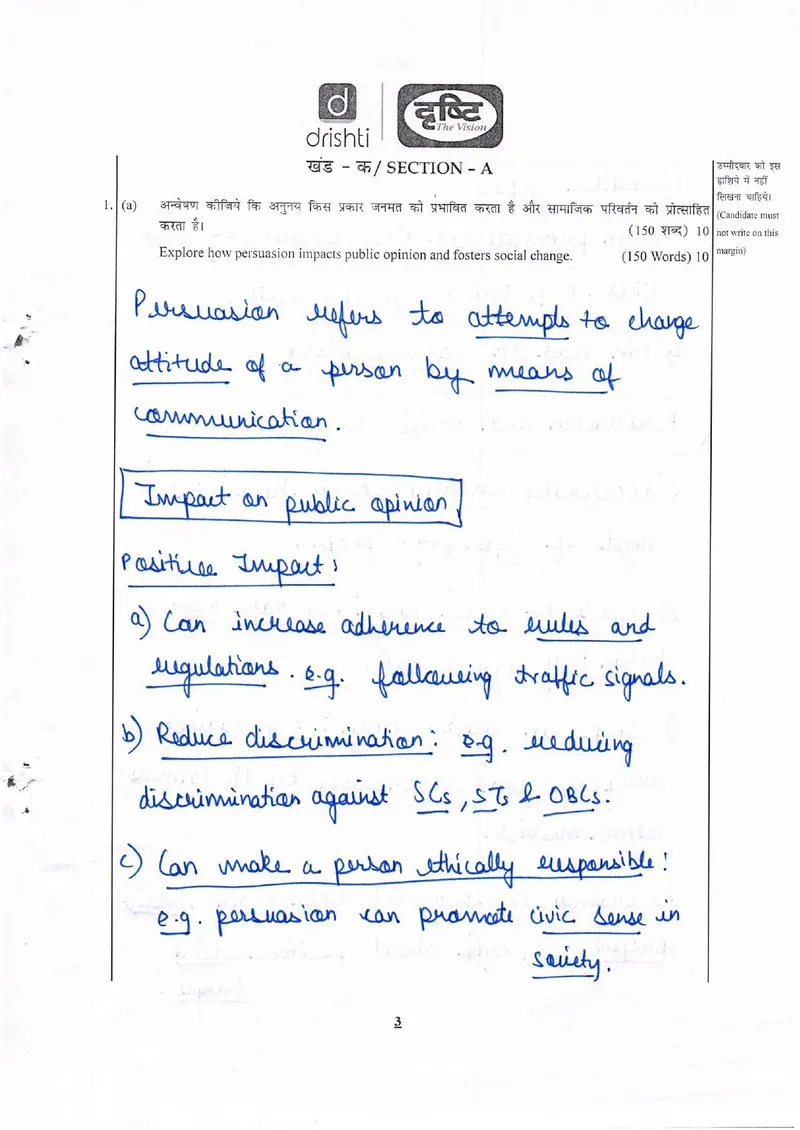
1(a).How persuasion impacts public opinion and fosters social change (150 words / max 10)
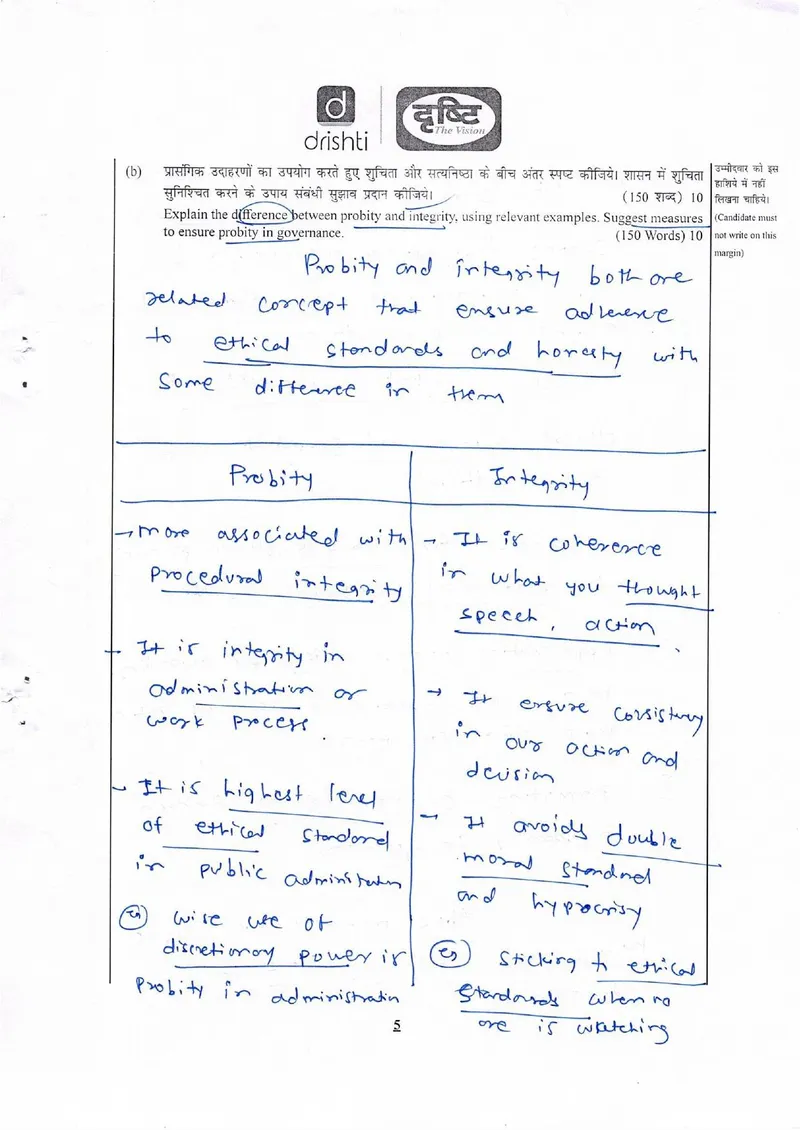
1(b).Difference between probity and integrity with examples; measures to ensure probity in governance (max 10)
2(a).Means shape the outcome, so ends cannot justify the means — discuss with examples (max 10)
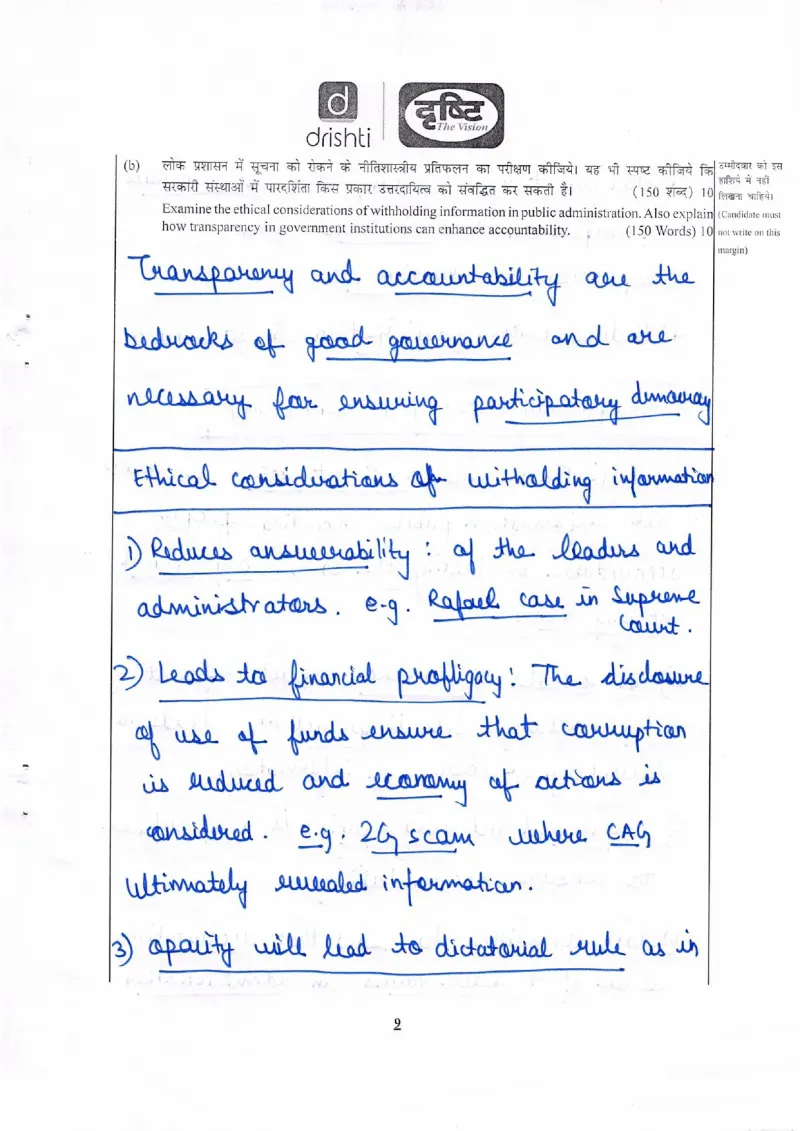
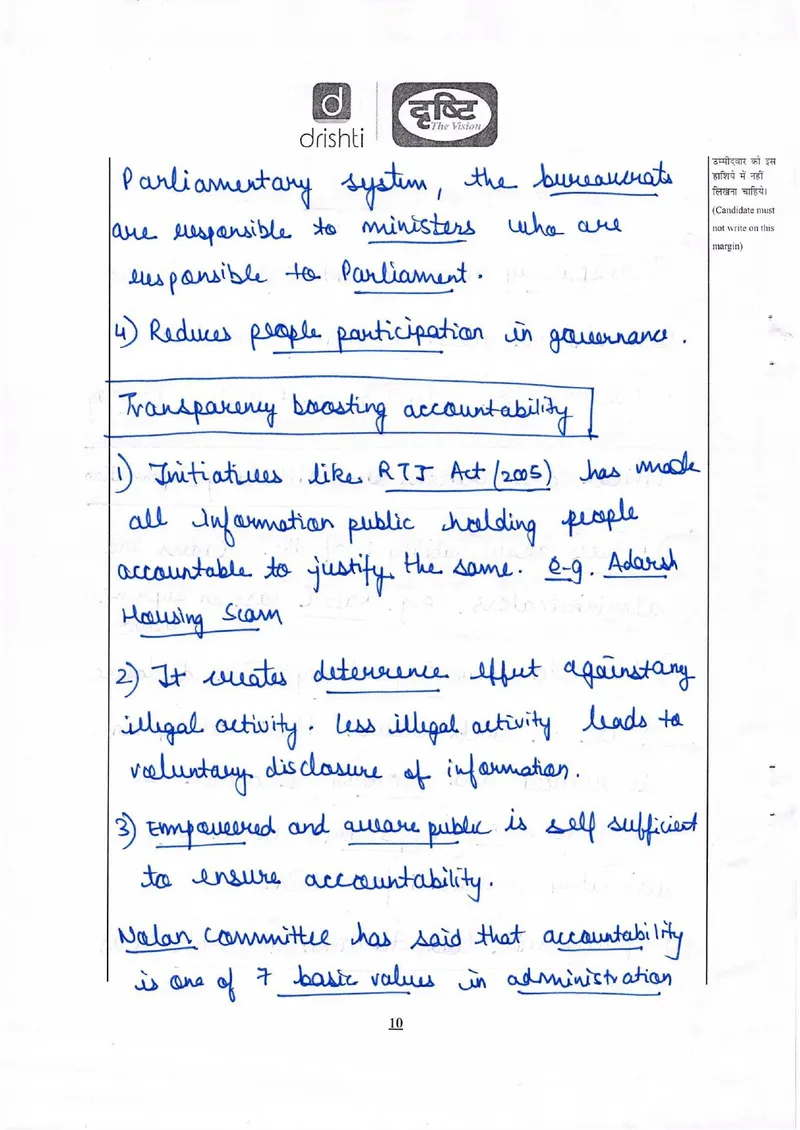
2(b).Ethical considerations of withholding information in public administration; transparency enhancing accountability (max 10)
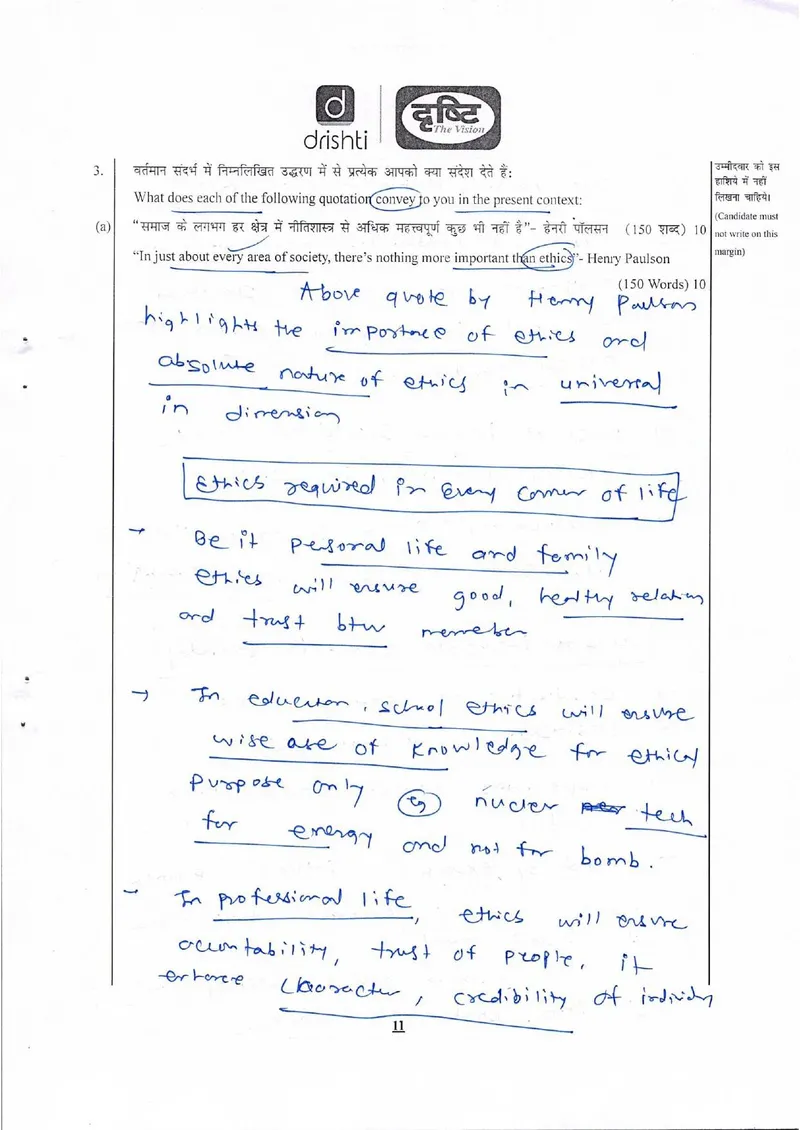
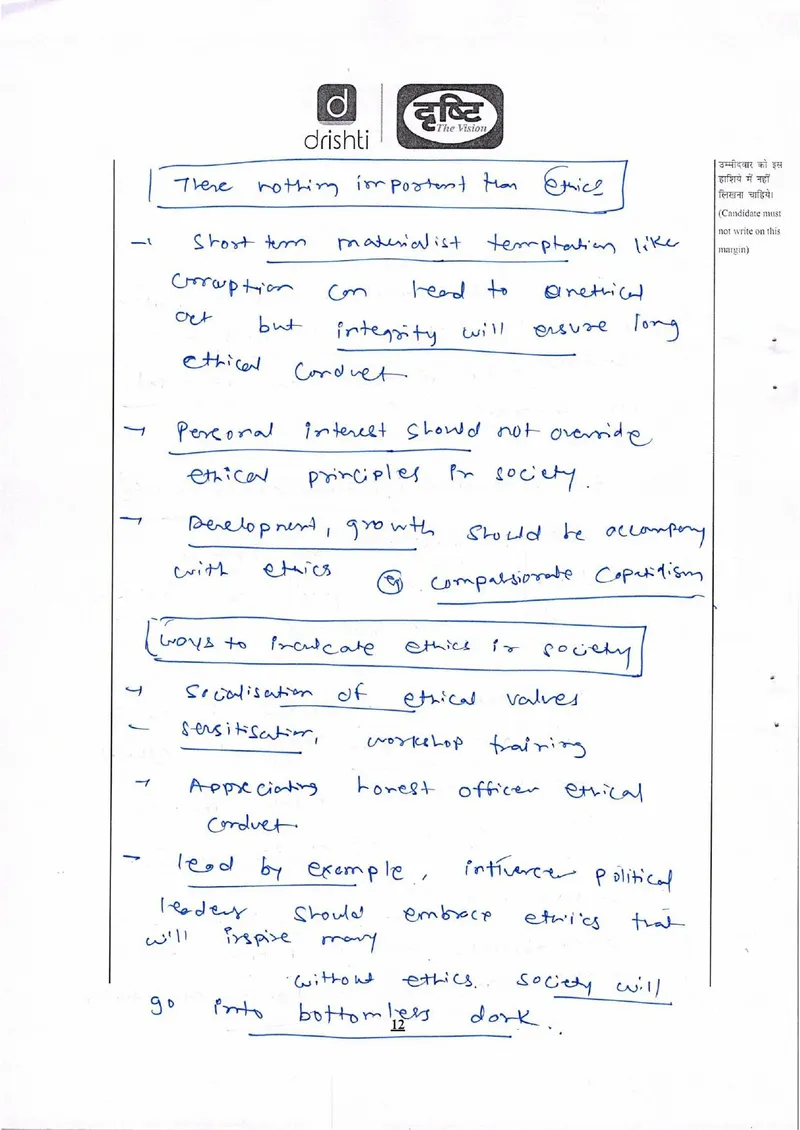
3(a).Quotation — Henry Paulson: nothing more important than ethics in every area of society (max 10)
3(b).Quotation — Rabindranath Tagore: love is not a mere impulse, it must contain truth, which is law (max 10)
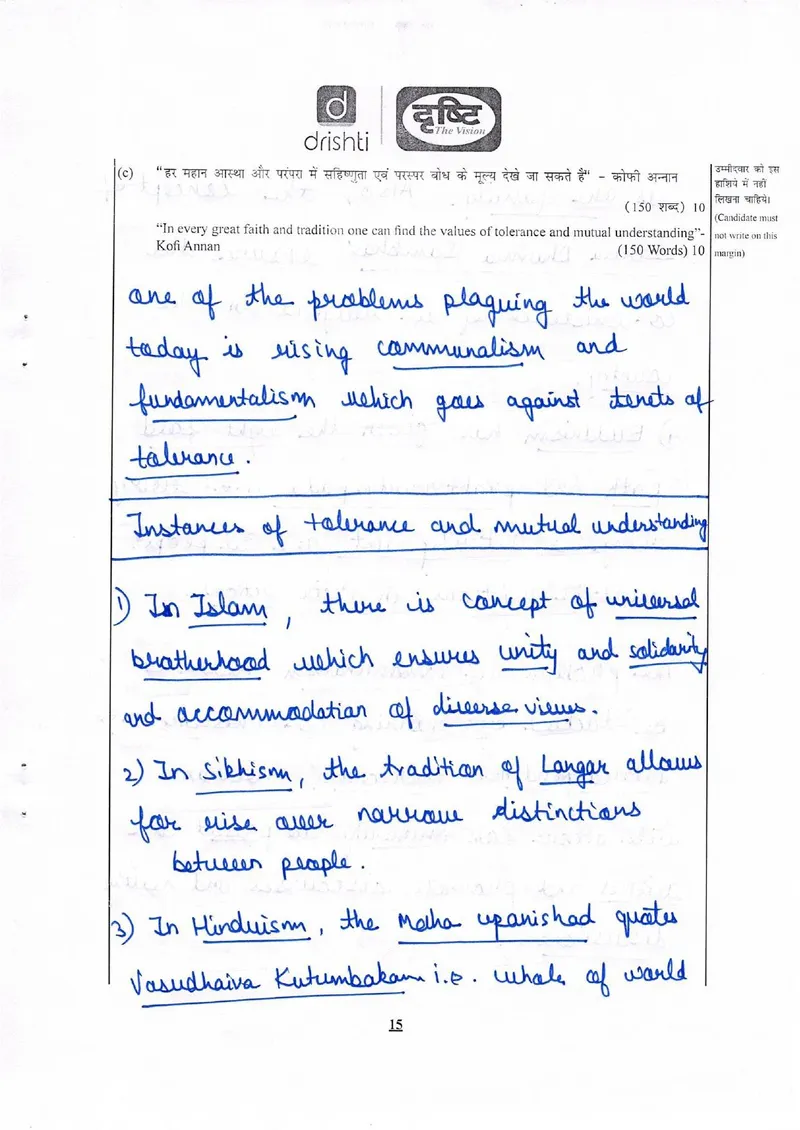
3(c).Quotation — Kofi Annan: every great faith holds values of tolerance and mutual understanding (max 10)
4(a).Role of ethics in the application of international aid to less developed nations (max 10)
4(b).Key ethical challenges in the workplace; effect on organizational culture and employee morale; strategies to foster an ethics culture (max 10)
5(a).Vaccine diplomacy; ethics of prioritizing domestic vaccine distribution over sharing during a pandemic (max 10)
5(b).Major teachings of Adi Shankaracharya and their relevance to current social/ethical challenges (max 10)
6(a).SEBI Chief allegations / corporate ethics — role of regulatory bodies in upholding ethical standards and trust (max 10)
6(b).Plato's Republic — justice as a virtue of people and of institutions; comment (max 10)
8.Case study — Sonia Patel, PIO, RTI dilemma over disclosing adverse environmental impact assessment; stakeholders, principles, options (max 20)
9.Case study — HealthInnovate Inc. experimental drug / compassionate-use access; ethical principles and fair access criteria (max 20)
10.Case study — Ravi Kumar, District Collector, flood disaster management; evacuation priority, disclosure vs panic, relief and recovery (max 20)
11.Case study — Ganganagar stray-dog bite; Mayor's dilemma between public health and animal welfare; guiding principles (max 20)
12.Case study — PMGSY Suryavilla road embezzlement by contractor Vikram Joshi; role of social audit and contractor's ethical responsibilities (max 20)
Examples, data & evidence used
Following traffic signals; reducing discrimination against SC/ST/OBC; betting advertisements (persuasion impacts)
LGBTQIA+ rights; Raja Ram Mohan Roy against sati; anti-drug/alcohol disclaimers before movies (social change)
Satyendra Dubey uncovering corruption in road contracts (probity)
Ethics paper in the Civil Services exam as a recruitment-stage probity measure
Subhas Chandra Bose justifying violence; Krishna advising Arjun in the Mahabharata; cheating in a World Cup match (means-ends)
Rafale case in the Supreme Court; 2G scam; Adarsh housing scam; RTI Act 2005 (withholding information / transparency)
Nolan Committee — accountability as a core value; former CEC T.N. Seshan (ethics in public life)
Islam's universal brotherhood; Sikhism's Langar; Hindu 'Vasudhaiva Kutumbakam' and Sarva Dharma Sambhav; Buddhist Eightfold Path and Pratityasamutpada (tolerance — Kofi Annan)
IMF conditionalities impinging on Sri Lanka / African nations' sovereignty; NGOs and Kudankulam Nuclear Plant; climate finance by historical emitters (international aid ethics)
India's Vaccine Maitri initiative to Nepal, Sri Lanka, Maldives, Pacific Island States during COVID-19 (vaccine diplomacy)
Adi Shankaracharya's Advaita Vedanta / non-dualism (Advaitavada)
SEBI, Competition Commission of India, TRAI, ESG framework; 'minimum government, maximum governance' (regulatory bodies)
PM Modi's Jan Dhan Yojana and Swachh Bharat Abhiyan (Plato — wisdom in governance)
Gandhi's seven sins — 'Commerce/Business without morality' (Apex Tutorials case)
Quotes the candidate used
Henry Paulson — 'In just about every area of society, there's nothing more important than ethics' (Q3a prompt quotation)
Rabindranath Tagore — 'Love is not a mere impulse, it must contain truth, which is law' (Q3b prompt quotation)
Kofi Annan — 'In every great faith and tradition one can find the values of tolerance and mutual understanding' (Q3c prompt quotation)
C.S. Lewis — 'Integrity is doing the right thing even when no one is watching' (cited in Q1b)
Gandhi — both means and ends ought to be pure (Q2a)
John Rawls — pure procedural justice: pure means make ends pure automatically (Q2a)
'Vasudhaiva Kutumbakam' attributed to the Maha Upanishad (Q3c)
How it’s written: Highly templated, examiner-friendly format throughout. Section A 10-markers each open with a one-line definition/context of the key term, then a clearly headed body broken into lettered (a, b, c) or numbered (1, 2, 3) sub-points — often split into Positive/Negative or contrasting buckets — and close with a crisp one…
Diagrams & visuals: No conventional diagrams, flowcharts or maps in the text layer; the only visual structuring is a written relation in Q6(b) Plato answer: 'Justice = Wisdom/Prudence + Courage'
Evaluator: No examiner marks or comments are filled in on this copy.
Komal Punia — Vajiram & Ravi GS Paper 4 (Ethics) copy
GS Paper 4 · EthicsPDF · 2.1 MB
What’s inside this copy
▸Complete attempt - all 20 question-parts answered: Section-A Q1-Q6 (including the five-quote Q5 and five short-notes in Q6b) and all six 250-word case studies Q7-Q12.
▸Every theory answer opens with a crisp definition and closes with a quote or maxim (Socrates, Swami Vivekananda) - textbook intro-body-conclusion discipline.
▸Accurate, by-name use of ethical frameworks: Bentham's Utilitarianism, Rawls' Justice, Kant's Categorical Imperative, Gandhian Talisman and the 'Madhyam Marg' middle path.
▸Wide, well-chosen example bank spanning history, current affairs, judgments and Indian schemes (Hitler's Germany, Viktor Frankl, S. Balaji vs Tamil Nadu freebies verdict, Amma Vodi, Mother Teresa, Sindhutai Sapkal, Dashrath Manjhi, Balasore rail tragedy, Kakodkar Committee).
▸Strong visual structuring via flow/tree diagrams, stakeholder maps and merit-demerit tables; no geographical maps.
What to learn from this copy
★She bookended every theory answer with a one-line definition open and a quotation close - e.g. opening Q1(a) with Socrates' 'Education is the kindling of a flame, not the filling of a vessel' and closing Q4(a) with Vivekananda's 'Truth doesn't pay homage to any society; society has to pay homage to truth or else perish' -> a fixed intro-body-conclusion template lets you start fast under time pressure and finish each answer with a memorable, examiner-pleasing line instead of trailing off.
★She named ethical frameworks precisely rather than gesturing at them - Bentham's Utilitarianism, Rawls' Justice (and Veil of Ignorance), Kant's Categorical Imperative, Gandhi's Talisman and the Madhyam Marg middle path - applied to the right prompts (Talisman to Q4b's public-servant dilemma) -> in Ethics, attaching the correct thinker by name to a dilemma signals genuine command of the syllabus and beats vague 'one should do the right thing' reasoning.
★She gave every Section-B case study the same scaffold: stakeholder map drawn first, then ethical issues, then an option-wise merit/demerit table, then a reasoned final choice, then the relevant laws/schemes (NDPS Act, Juvenile Justice Act, PMLA 2002 for the Q7 drug-network case) -> a repeatable case-study skeleton ensures you never skip the option-evaluation or the legal/administrative grounding that distinguishes a top case answer.
★Her example bank was wide and deliberately matched to each prompt - Hitler's Germany and North Korea vs A.P.J. Abdul Kalam to contrast content-without-values for Q1(a), Viktor Frankl surviving the Holocaust through positive attitude for Q1(b), the S. Subramaniam Balaji vs State of Tamil Nadu freebies verdict alongside Amma Vodi for Q3, and Mother Teresa / Sindhutai Sapkal / Dashrath Manjhi for the quote questions -> build a stock of versatile illustrations spanning history, a Supreme Court judgment, current affairs and named Indian schemes so each abstract value lands on a concrete, verifiable anchor.
★She completed all 20 parts - the five-quote Q5, the five short-notes Q6(b), and all six 250-word case studies Q7-Q12 - with the same disciplined structure throughout -> in a paper with this many sub-parts, finishing every part is itself a major scoring lever, and a consistent template is what makes full completion possible within the time limit.
Questions attempted: Ideal institution balancing values & content; measures to move education beyond mere content learning; Attitude as a crucial factor in building an individual's social capital (agree/disagree); Emotional intelligence as primary in managing workplace conflicts, and 16 more below.
Questions attempted in this booklet (19)+
Q1(a).Ideal institution balancing values & content; measures to move education beyond mere content learning
Q1(b).Attitude as a crucial factor in building an individual's social capital (agree/disagree)
Q2(a).Emotional intelligence as primary in managing workplace conflicts
Q2(b).Panchsheel promoting ethical relations between countries amid mutual suspicion in bilateral conflicts
Q3(a).Freebie culture: ethical issues of public funds used in populist measures for electoral gains
Q3(b).Probity in governance as vital for socio-economic development
Q4(a).Quote: 'Wisdom is attained when a person is always ready to accept the truth and renounce untruth'
Q4(b).Application of Gandhi's Talisman in decision-making for public servants facing ethical dilemmas
Q5(a).Quote: 'The highest result of education is tolerance' - Helen Keller
Q5(b).Quote: 'Service rendered without joy helps neither the servant nor the served' - Mahatma Gandhi
Q5(c).Quote: 'Faith is of no evil in the absence of strength; faith and strength both essential to accomplish any great work' - Vallabhbhai Patel
Q6(a).Scope for corruption when accountability is fragile and division of power is ambiguous
Q6(b).Short notes (30 words each): Non-Partisanship, Cognitive Dissonance, Veil of Ignorance, Moral Relativism, Social Influence
Q7.Case study: Dr. Aanand, chemistry professor; campus drug network with UGC rep's son (Aditya) as lynchpin - dilemmas, options, anti-drug-abuse laws
Hitler's Germany / North Korea - content without values leading to cult leadership (Q1a)
A.P.J. Abdul Kalam, 'Missile Man' with integrity - balance of content and values (Q1a)
Viktor Frankl surviving Holocaust atrocities through positive attitude (Q1b)
Mob lynching and harassment as outcomes of negative attitude (Q1b)
SAARC dysfunction due to India-Pakistan conflict; India-China conflict from breach of trust (Q2b)
India-Sri Lanka relations / doctrine of non-reciprocity; Buddhist circuits and India-Nepal cultural ties; Vasudhaiva Kutumbakam; China's debt-trap as unethical practice (Q2b)
Supreme Court in S. Subramaniam Balaji vs State of Tamil Nadu on freebies disturbing the level playing field (Q3a)
Loan waivers, irrational subsidies, electricity subsidies making DISCOMs debt-ridden (Q3a)
Patwani (UP) public-grievance scheme; Amma Vodi (Andhra Pradesh) as compassionate administration (Q3b)
Black Lives Matter movement and #MeToo - accepting truth, voicing against discrimination (Q4a)
Israel-Hamas war as a result of intolerance; Gandhi's Nai Talim promoting non-violence; colonial 'divide and rule' education and Partition (Q5a)
Mother Teresa and Sindhutai Sapkal (mother of orphans) - service rendered with joy (Q5b)
Dashrath Manjhi carving a road through a mountain; Sardar Patel integrating India via persuasion and power - faith plus strength (Q5c)
'Education is the kindling of a flame, not the filling of a vessel' - Socrates (Q1a intro)
'Truth doesn't pay homage to any society; society has to pay homage to truth or else perish' - Swami Vivekananda (Q4a conclusion)
'The highest result of education is tolerance' - Helen Keller (Q5a; the question prompt, expounded)
'Service which is rendered without joy helps neither the servant nor the served' - Mahatma Gandhi (Q5b; the question prompt, expounded)
'Faith is of no evil in the absence of strength...' - Vallabhbhai Patel (Q5c; the question prompt, expounded)
Proverb: 'Give a man a fish, feed him for a day; teach him how to fish, feed him for a lifetime' (Q3a, author not attributed)
'It is the mark of an educated mind to entertain a thought without accepting it' paraphrased in Q5a conclusion (author not written - commonly attributed to Aristotle; flagged as uncertain)
How it’s written: Highly disciplined, consistent template across all 20 parts. Theory answers (Section A) follow Introduction (almost always a one-line definition, e.g., attitude, emotional intelligence, probity, corruption 'per Transparency International', wisdom, faith) -> point-wise Body using circled/arrow bullets, sub-headings a…
Diagrams & visuals: Flow / tree diagrams to break down concepts (e.g., components of Emotional Intelligence; probity-in-governance outcomes); Stakeholder maps drawn at the start of each Section-B case study; Merit-demerit option tables/columns for evaluating case-study options; Boxed and underlined keywords / bracketed point-groupings for visual structure; No geographical maps used
Evaluator: No examiner marks or comments are filled in on this copy.
Aayushi Bansal — Vajiram & Ravi GS Paper 4 (Ethics) copy
GS Paper 4 · EthicsPDF · 10.4 MB
What’s inside this copy
▸Near-complete paper: legible answers for essentially all questions Q1-Q17, with every case study (Q12,13,15,16,17) answered fully across parts a/b/c.
▸Exceptional, specific example bank — Anne Sullivan & Helen Keller, Jijabai-Shivaji, Copernicus, Vidyasagar, Baba Amte, T.N. Seshan, Umakant Umrao's Dewas pond model, Divya Devarajan.
▸Consistently closes answers on a value-laden maxim (Yogakshema, Vasudhaiva Kutumbakam, eudaimonia, Nari Shakti, Ek Bharat Shreshtha Bharat) — strong ethical 'signature' endings.
▸Disciplined use of two-column comparison tables (family vs education, impartiality vs neutrality, private vs public life) to structure compare/contrast questions.
▸Case studies lead with an enumerated 'ethical issues' list, then stepwise action, then short-term-vs-long-term justification; Q12 explicitly splits cognitive vs affective dimensions.
★She pairs almost every abstract ethics point with a precise, named example rather than a vague reference -- e.g. Anne Sullivan mentoring Helen Keller and Jijabai teaching values to Shivaji for value-inculcation (Q2), Copernicus defending heliocentrism and Vidyasagar's widow-remarriage campaign for courage-under-controversy (Q6b/6c), and Baba Amte empathising with leprosy patients for empathy (Q7). Lesson: build a stocked, named example bank so each ethical claim lands on a concrete person/event instead of a generic platitude.
★She closes answers on a deliberate value-laden maxim that fits the question -- 'Yogakshema' for the welfare-state accountability answer (Q5), 'Vasudhaiva Kutumbakam' for global inequality (Q8), Aristotelian 'eudaimonia' for the AI-policy answer (Q14), 'Nari Shakti' for women's participation (Q13). Lesson: a short, topic-matched maxim as your last line gives Ethics answers a memorable 'signature' ending -- but pick one that actually maps to the question, not a stock phrase.
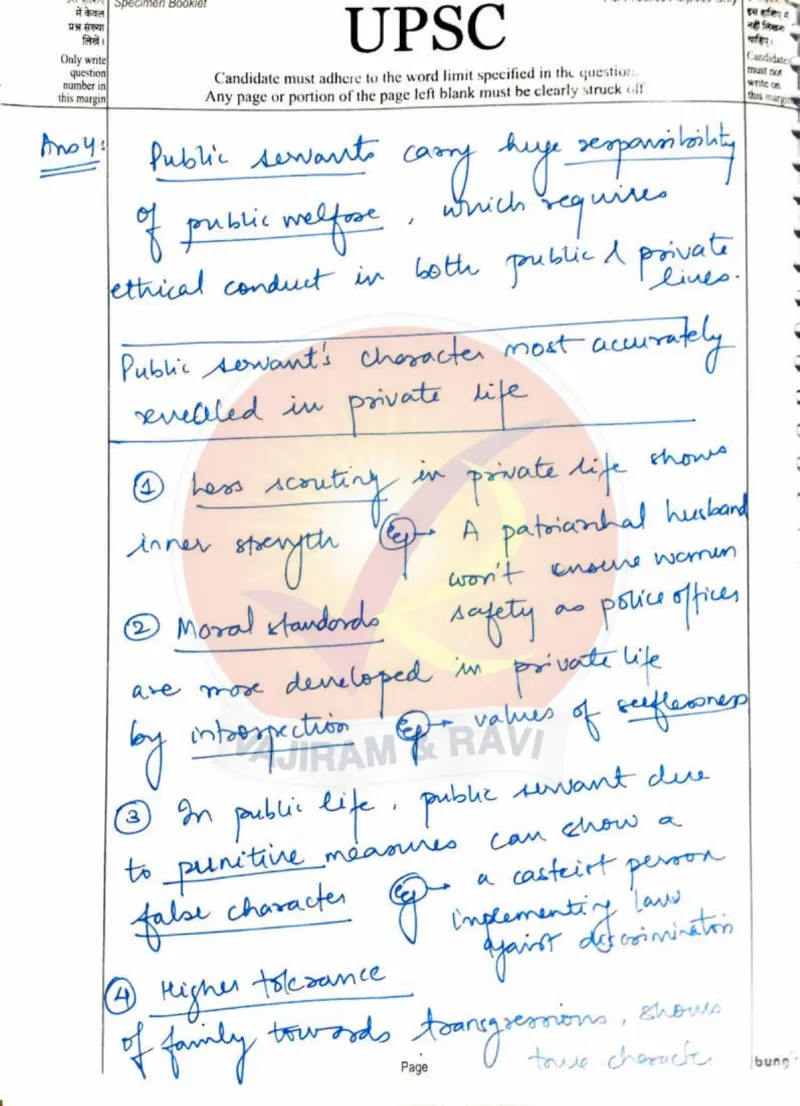
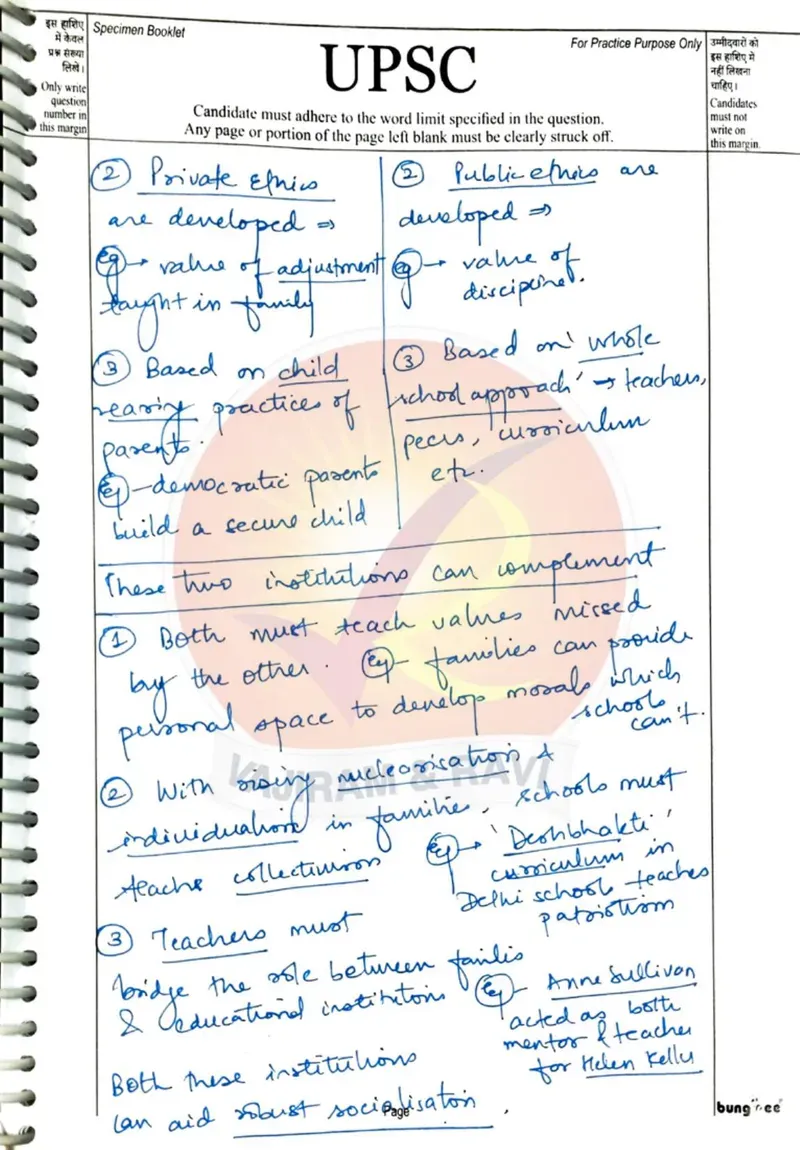
★She structures every compare/contrast question as a two-column table -- Family vs Educational institution (Q2), Impartiality vs Neutrality (Q10), character in private vs public life (Q4). Lesson: when a question literally asks you to compare/contrast or distinguish, a two-column table is the fastest way to make the contrast unmissable to an examiner skimming the page.
★Her case-study answers follow a fixed, examiner-friendly skeleton: an enumerated 'ethical issues' list first, then stepwise action, then a short-term-vs-long-term justification -- and Q12 (Kerala landslides) explicitly splits the cognitive vs affective dimensions. Lesson: a repeatable case-study template (issues -> stakeholders/action -> short- vs long-term) lets you answer all five case studies (Q12,13,15,16,17) fully and consistently under time pressure.
★She grounds ethics arguments in specific legal and governance hooks rather than leaving them theoretical -- K.C. Puttaswamy & Article 21 and the DPDP Act for the AI-privacy answer (Q14), DBT/RTI/mandamus writ for accountability-vs-efficiency (Q5), CPGRAMS and Citizen Charters like LIC/IRCTC for governance (Q1/Q5). Lesson: tying an ethical point to a real judgment, Act or scheme turns it from opinion into a defensible, administration-aware answer.
Questions attempted: Short notes: (i) Intellectual integrity in administrative decision-making; (ii) Citizen Charter in good governance; Compare/contrast roles of family vs educational institutions in value inculcation; how they complement each other; Tolerance and diversity — importance for governance; how civil servants foster tolerance/inclusivity, and 15 more below.
Questions attempted in this booklet (18)+
1.Short notes: (i) Intellectual integrity in administrative decision-making; (ii) Citizen Charter in good governance
2.Compare/contrast roles of family vs educational institutions in value inculcation; how they complement each other
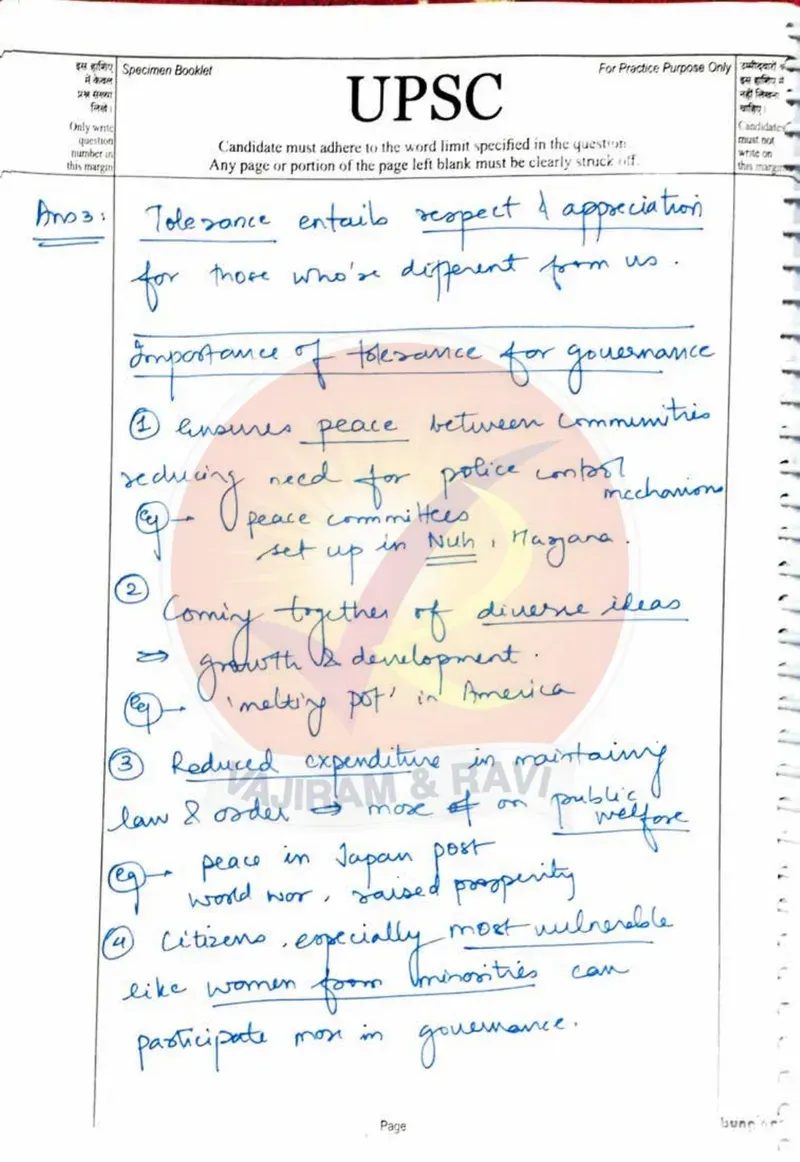
3.Tolerance and diversity — importance for governance; how civil servants foster tolerance/inclusivity
4.'Character revealed in private life, not public persona' — critical exam re public servants' ethical conduct
5.Accountability mechanisms vs bureaucratic delays/efficiency; can a balance be struck
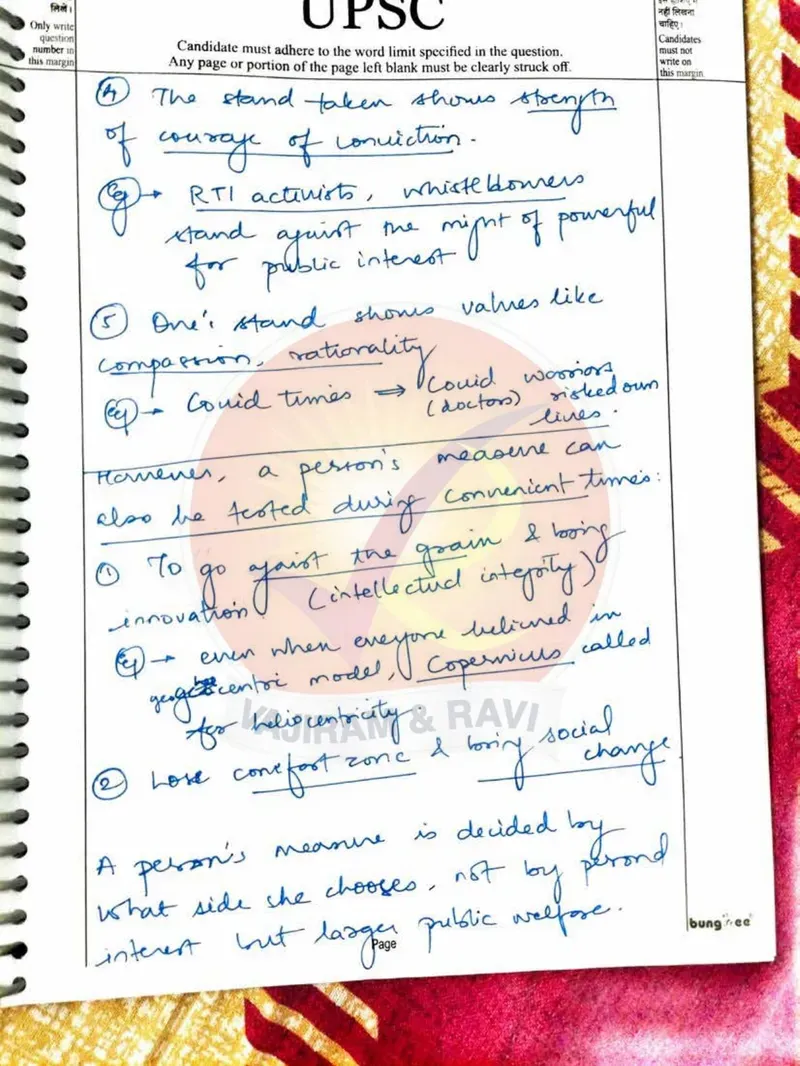
6b.MLK Jr quote — measure of a person at times of challenge/controversy
6c.Gandhi quote — 'In matters of conscience, the law of the majority has no place'
7.Empathy and emotionally intelligent civil servants improving governance/service delivery
8.Ethical implications of widening rich-poor nation gap; moral obligation of developed countries
9.Environmental ethics — responsibilities of individuals, corporations, governments to future generations
10.Impartiality vs neutrality in the civil service
11.Relevance of Bhagavad Gita teachings for ethical conduct in contemporary public service
12.Case study (a/b/c): Kerala landslides — District Collector; relief, transparency, community empowerment, relocation vs cultural attachment
13.Case study (a/b/c): Women's participation in SHGs/village councils; engaging men; institutional/policy changes
14.Formulate a comprehensive national AI policy framework — jobs, privacy, bias, accountability, black-box
How it’s written: Highly structured, point-wise/bullet format throughout. Each Section-A answer opens with a one-line definition/conceptual framing, develops numbered/bulleted points each anchored to a concrete example, and closes on a value-laden maxim (Yogakshema, Vasudhaiva Kutumbakam, eudaimonia, Ek Bharat Shreshtha Bharat, Nari…
Diagrams & visuals: Two-column comparison table — Family vs Educational institution (Q2); Two-column comparison table — Impartiality vs Neutrality (Q10); Two-column contrast — character in private life vs public life (Q4); No maps or flowcharts discernible in the text layer
Evaluator: No examiner marks or comments are filled in on this copy.
▸Opens the duty-ethics answer (Q1a) by naming the cost of over-emphasising duty — Red Tapism, disregard for ends, short-sightedness — before mapping it in a branching diagram
▸Anchors the slum-eviction case study in precedent + the Constitution, quoting the Supreme Court's Olga Tellis case on slum dwellers' dignity under Article 21
▸Breaks the 250-word case study into three boxed blocks — Ethical Challenges, Course of Action, Ways to Reconcile — each a crisp numbered list
▸Backs recommendations with a real scheme: cites Odisha's Jaga Mission as an innovative model for regularising informal colonies
▸Names the core tension as 'judicial populism' vs administrative reality, and advises filing a review / seeking an SC timeline extension to avoid contempt while protecting evictees
▸Closes on a values-led one-liner — a 'right balance (Madhyam Marg)' between legal compliance and humanitarian obligation
What to learn from this copy
★On the slum-eviction case study Pakshal didn't argue from sentiment — he anchored compassion in hard law, quoting the Supreme Court's Olga Tellis ruling that 'Right of Slum Dwellers to live with dignity is protected under Article 21'. -> In GS4 case studies, ground the humane option in a named precedent + constitutional article so the examiner reads it as a defensible administrative position, not a soft opinion.
★He named a real, replicable model instead of vague suggestions — citing Odisha's Jaga Mission as an innovative way to regularise informal colonies as part of his course of action. -> Back your recommended course of action with one concrete existing scheme/best-practice by name; it converts a generic 'rehabilitate them' into an actionable, credible answer.
★He coined a sharp label for the central tension — 'judicial populism' (court decisions ignoring administrative reality) vs the state's rehabilitation duty — and gave a precise, contempt-aware route: file a review / seek an SC timeline extension. -> Diagnose the ethical conflict in one crisp phrase, then offer a legally safe, specific step rather than a vague 'balance both sides'.
★The 250-word case study was split into three boxed blocks — Ethical Challenges, Course of Action, Ways to Reconcile — each a tight numbered list mirroring the sub-parts asked. -> Mirror the question's sub-demands as labelled boxed sections so the examiner can tick each requirement; structure that matches the demand reads as completeness.
★Q1(a) opened by first stating the cost of the wrong approach — over-focus on duty producing 'Red Tapism', disregard for ends, and short-sightedness — then mapped those three consequences in a branching diagram before building the answer. -> Lead by naming the problem/cost concretely (and visualise multi-part consequences as a quick branch diagram) before prescribing the fix; it shows you understood the demand's nuance.
★He closed on a values-led one-liner, framing the resolution as a 'right balance (Madhyam Marg)' between legal compliance and humanitarian obligation. -> End ethics answers with a short, named principle (here the golden-mean/middle-path) that reconciles the competing values — a memorable synthesis beats a flat summary.
Questions attempted: Administrative ethics: "Duty forms the cornerstone of administrative ethics, yet without integration of other ethical perspectives, it risks becoming mechanical compliance." Discuss how the interplay of duty, virtue, principle and consequences can enrich ethical decision-making in public administration. (150 words / 10 marks). NOTE: only the first page of this answer is present; the continuation is missing/replaced.; Court-ordered eviction of a long-vacant slum/informal settlement via PIL vs the state's rehabilitation commitment under its urban housing scheme; sub-parts ask for the core ethical challenges, how to reconcile legal mandates with humanitarian obligations in informal urban settlements, and a course of action respecting judicial authority while upholding compassion, fairness and responsible governance..
Questions attempted in this booklet (2)+
Q1(a).Administrative ethics: "Duty forms the cornerstone of administrative ethics, yet without integration of other ethical perspectives, it risks becoming mechanical compliance." Discuss how the interplay of duty, virtue, principle and consequences can enrich ethical decision-making in public administration. (150 words / 10 marks). NOTE: only the first page of this answer is present; the continuation is missing/replaced.
Case study (booklet Pg 53-56; Q-number not determinable, one of the 20-mark / 250-word case studies, Q7-Q12).Court-ordered eviction of a long-vacant slum/informal settlement via PIL vs the state's rehabilitation commitment under its urban housing scheme; sub-parts ask for the core ethical challenges, how to reconcile legal mandates with humanitarian obligations in informal urban settlements, and a course of action respecting judicial authority while upholding compassion, fairness and responsible governance.
Examples, data & evidence used
Olga Tellis case (Supreme Court) — cited for slum dwellers' right to live with dignity
Article 21 (right to life/dignity)
Jaga Mission, Odisha — cited as an innovative model for regularising informal colonies
State 'Urban Housing Scheme' rehabilitation commitment (referenced from the case)
Concept of 'Madhyam Marg' (middle path / golden mean) used in the conclusion
Concept of 'judicial populism' (court decisions without regard to administrative challenges)
Whole-of-government approach; human-centric eviction process
'Red Tapism' / 'Red carpet instead of Red Tapism' (Q1a)
Quotes the candidate used
"Right of Slum Dwellers to live with dignity is protected under Article 21" — attributed by the candidate to the Supreme Court in the Olga Tellis case
How it’s written: Pakshal's GS4 answers are written in blue ink, in a points-based format with circled serial numbers (1,2,3...), heavy underlining of keywords, and boxed sub-headings. Q1(a) opens by stating the problem (over-focus on duty leading to Red Tapism, non-regard to ends, short-sightedness), then uses a branching diagram ("…
Diagrams & visuals: Q1(a): a hand-drawn branching/flow diagram of 'Problem of mechanical duty focus' with three arrowed consequences, plus boxed sub-headings; Case study: boxed section headers ('Ethical Challenges', 'Course of Action', 'Ways to Reconcile') and arrow-led points (structured lists rather than full diagrams)
Evaluator: No examiner marks or comments are filled in on this copy.
From the part of this booklet that is Pakshal’s GS4 — the duty-ethics theory question and the Olga Tellis slum-eviction case study.
Madhav Agrawal — Vajiram & Ravi GS Paper 4 (Ethics) copy
GS Paper 4 · EthicsPDF · 2.9 MB
What’s inside this copy
▸Genuine Madhav Agarwal copy — cover shows Roll 6907627, Admin 16301324, 'UPSC CSE 2024 AIR-16', V&R Ethics Full Length Test (250 marks), submitted 30 Aug 2024
▸Entirely unevaluated: cover marks table, parameter rubric, suggestions box and all Remarks columns are blank — no marks/ticks/comments
▸Extremely example-dense — nearly every point is backed by a real case (Vinod Rai, Awanish Sharan's bike ambulances, Ira Singhal, Chhavi Rajawat, Lijjat Papad, Jaga Mission)
▸Strong keyword discipline: answers open with a sharp definition and underline thinker-terms (Kant's dignity, Vasudhaiva Kutumbakam, Nishkama Karma)
▸Consistent value-add structure: definition → numbered points with 'eg:' → forward-looking conclusion ('future is GREEN or BLACK'; 'sound work culture that attracts best talent')
▸Quotes attributed to authors — MLK on adversity (Q6b) and Gandhi on conscience (Q6c)
What to learn from this copy
★He anchors nearly every numbered point with a concrete 'eg:' case rather than a generic claim - e.g. Awanish Sharan's bike ambulances for innovation, the Uttarakhand social audit that exposed 11,000 fake pensioners for accountability, Ira Singhal hiring transgenders for inclusion, and Chhavi Rajawat / Lijjat Papad / Jaga Mission for grassroots empowerment -> Build a personal bank of 2-3 real, specific administrative cases per ethics theme so you can attach a named example to each point instead of writing in abstractions.
★For the impartiality-vs-neutrality question he drew a true comparison table with named axes (Basis / Meaning / Association / positive-vs-negative concept / Scope) rather than prose -> When a question asks you to 'distinguish' two close concepts, a labelled two-column table on chosen parameters shows the difference faster and more clearly than paragraphs.
★He attributes his quotes to their authors - Martin Luther King for adversity being the real test of character (Q6b) and Mahatma Gandhi for conscience working irrespective of the majority (Q6c) -> In quote-based and value questions, naming the thinker behind a line (and only when you're sure of it) adds weight; an unattributed line like his 'first we make our choices, later our choices make us' stays a plain closing line.
★He opens answers with a crisp one-line definition and underlines the thinker-terms he invokes - Kant's human dignity in the Oxfam inequality answer, Vasudhaiva Kutumbakam, Nishkama Karma -> Lead with a sharp definition and visually flag your keywords (underline) so an examiner skimming the page instantly sees you've used the right ethical vocabulary.
★Every answer closes with a forward-looking line rather than a summary, e.g. framing environmental stewardship as a future that is 'GREEN or BLACK' and reform ending in 'a sound work culture that attracts the best talent' -> End on a constructive, future-facing note tied to the question's stake instead of merely restating points - it leaves the evaluator with a solution-oriented impression.
Questions attempted: Intellectual integrity and its role in ethical decision-making; Family and school as agents of value formation / building ethical citizenry for Amrit Kaal; Tolerance — accepting and celebrating diversity in public life and governance, and 14 more below.
Questions attempted in this booklet (17)+
Q1.Intellectual integrity and its role in ethical decision-making
Q2.Family and school as agents of value formation / building ethical citizenry for Amrit Kaal
Q3.Tolerance — accepting and celebrating diversity in public life and governance
Q5.Accountability in ethical governance — merits and the red-tape/delay downside
Q6(b).Quote-based: adversity/challenge (not comfort) as the true test of character
Q6(c).Quote-based: conscience as the inner voice irrespective of majority
Q7.Emotional intelligence and empathy for ethical governance and service delivery
Q8.Oxfam report on rising global inequality — ethical implications
Q9/Q10 (env, approx.).Environment as a common good — shared ethical/environmental stewardship
Q11 (approx.).Impartiality vs neutrality — distinction for civil servants
Q12 (20m, approx.).Nishkama Karma / Gita — public service as selfless duty
Q13 (20m case, approx.).Disaster case — relocating people and cultural/temple heritage to safety
Q14 (20m case, approx.).Equitable relief distribution and courage of conviction in disasters
Q15 (20m case, approx.).Women's empowerment against societal rigidity
Q16 (20m case, approx.).AI / personal-data regulation and governance framework
Q? (20m case, approx.).Pharma whistleblower dilemma — unsafe drug release ('Good Life Pharma')
Q17 (20m case, approx.).Toxic work culture / corruption in public offices — reform measures
Examples, data & evidence used
CAG Vinod Rai (objective decision-making)
IAS Awanish Sharan — Bike Ambulances
Jijabai (role model for Shivaji); HC Verma (teacher)
Akbar's Sulh-i-kul; IAS Ira Singhal hiring transgenders
CJI DY Chandrachud; Justice Venkatesh (LGBTQ sensitivity)
Uttarakhand social audit — 11,000 fake pensioners
Hardik Pandya; LBSNAA director; India's legal aid to Kasab
Chauri Chaura (Gandhi); Ashoka after Kalinga
CRPF suicides; Google team-building; IAS Minga Sherpa
E Sreedharan; Antyodaya/PDS; IAS U Sagayam disclosing assets
Mission LiFE; Save Soil; The Body Shop; Patagonia; International Solar Alliance; FAME-II EV subsidy; net-zero 2070
Martin Luther King — adversity/challenge as the real test of a person (Q6b, author written by candidate)
Mahatma Gandhi — conscience works irrespective of numbers/majority (Q6c, author written)
Kant — humans must be treated with dignity (invoked as principle in Q8 inequality answer)
'As first we make our choices, later our choices make us' — used as a concluding line (no author attributed; echoes Churchill)
How it’s written: Neat, consistent blue-ink cursive on Vajiram & Ravi answer template (columns: Date / Question No. / 'UPSC' header / Topic / Remarks). Each answer follows a definition → numbered points → conclusion arc: opens with a crisp one-line definition, then 3–6 numbered points each anchored by an 'eg:' example, ending with a…
Diagrams & visuals: Impartiality vs Neutrality two-column comparison table (Basis / Meaning / Association / positive-vs-negative concept / scope); No maps or formal flowcharts elsewhere — visual structure is limited to numbered points, underlining and arrow (→) cause-effect chains
Evaluator: No examiner marks or comments are filled in on this copy.
▸Complete attempt — all 12 questions (Q1-6 theory parts plus six full case studies) answered in English across ~54 handwritten pages; clean, legible blue ink.
▸Diagram-rich: a Venn, two pyramids/flowcharts, Manas-Vachan-Karma triangle, Profit-People-Planet triangle, governance spider-map and a priority bar chart appear across the answers.
▸Every answer lands a value-laden closing line (Golden Mean/Summum Bonum, karmayogi, 'Yatra Naryastu Pujyate', 'Sunlight is the best disinfectant').
▸Wide, well-matched example bank fusing governance instruments (PRAGATI, Gati Shakti, MGNREGA, 2% CSR, Article 39/44) with thinkers (Kant, Aristotle, Kautilya, Gandhi, Vivekananda, J.S. Mill).
▸Case studies use a rigorous issues -> options -> merit/demerit table -> chosen action -> justification scaffold, frequently choosing a consultative 'middle path' (stakeholder committee, internal escalation).
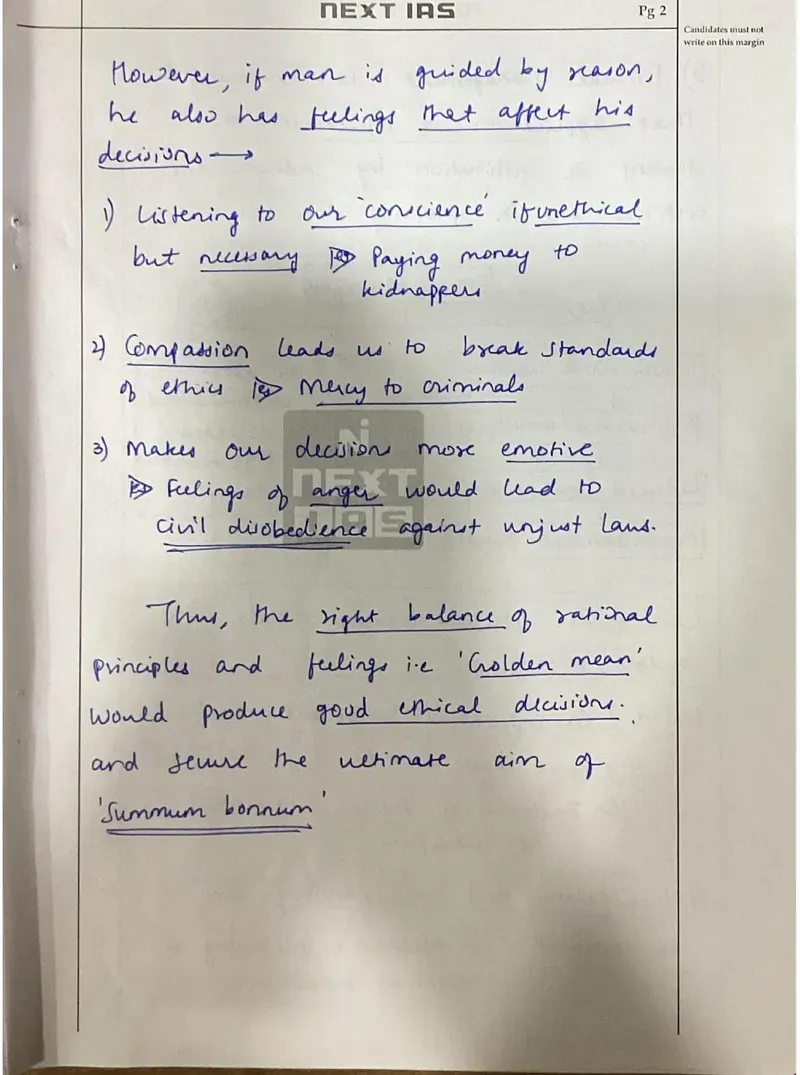
★For Q1A (feelings vs purely rational/principled decisions) he refused to pick a side and instead drew a Venn diagram showing Reason/Rationality intersecting Passion/Feeling resolving into 'Ethical Decisions' -> when a question pits two values against each other, the high-scoring move is to visually show their integration rather than argue one beats the other.
★Across all six case studies he ran a single rigorous scaffold: issues -> options -> a merit/demerit table -> chosen action -> justification, repeatedly landing on a consultative 'middle path' (stakeholder committee, internal escalation before going public) -> a fixed, table-driven case-study template lets you show you weighed alternatives instead of jumping to a verdict, and the examiner can see the reasoning at a glance.
★His closing lines were matched to the specific question, not generic: the Sanskrit shloka 'Yatra Naryastu Pujyate Ramante Tatra Devta' to close the temple-excluding-women case study (Q8/CS2), and 'Sunlight is the best disinfectant' to close the MGNREGA whistleblowing case (CS6) -> end every answer with a quote or maxim that is topically wired to that exact dilemma, so the conclusion reinforces the argument rather than ornamenting it.
★He fused live governance instruments with empathy examples in the same answer — for ethics of care (Q2A) he cited Divya Devrajan IAS learning the Gondi language for tribals, 'mohalla darbar' and 'Yogakshema'; for service quality (Q2B) he cited PRAGATI Portal, Gati Shakti, social/formal audits and outcome-output budgeting -> back each abstract ethics concept with both a named administrator's act and a current scheme, which proves the idea works on the ground and keeps it from sounding bookish.
★In the quote section (Q6) he didn't just define the printed lines — he engaged each of Adam Smith (benevolent affections), Aristotle (virtue/vice and the power to act) and Socrates ('I know that I know nothing') and pulled them into wider debates (e.g. linking Q6A to Maslow, Gandhi's trusteeship and critiques of 'white man's burden') -> treat a quote question as a prompt to build an argument around the thinker's idea, not as a one-line gloss.
Questions attempted: Feelings as inseparable part of ethical life vs purely rational/principled decisions; Ethics management; whether codes of ethics (CoE) and conduct (CoC) suffice in workplace; Traditional ethics (justice) vs ethics of care (connectedness) for public service, and 16 more below.
Questions attempted in this booklet (19)+
Q1A.Feelings as inseparable part of ethical life vs purely rational/principled decisions
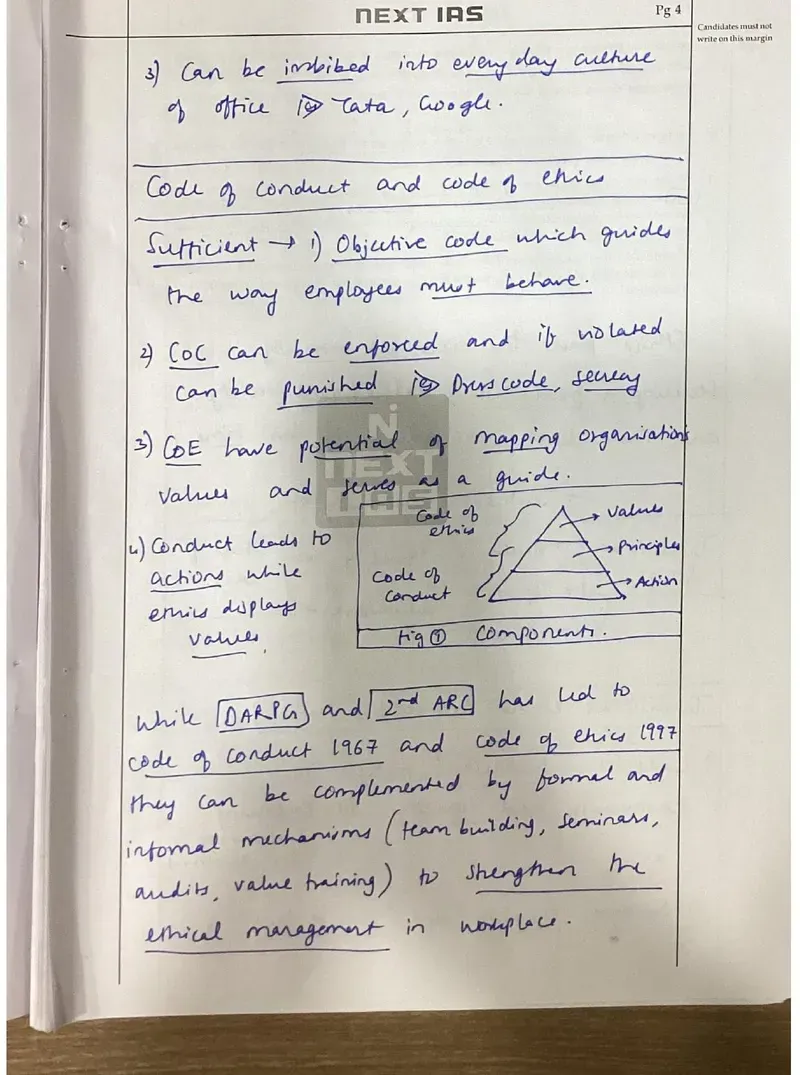
Q1B.Ethics management; whether codes of ethics (CoE) and conduct (CoC) suffice in workplace
Q2A.Traditional ethics (justice) vs ethics of care (connectedness) for public service
Q2B.Meaning/components of 'quality' in service delivery; efficiency, economy, effectiveness
Q3A.Public service attitude; attitude biases in field decisions and overcoming them
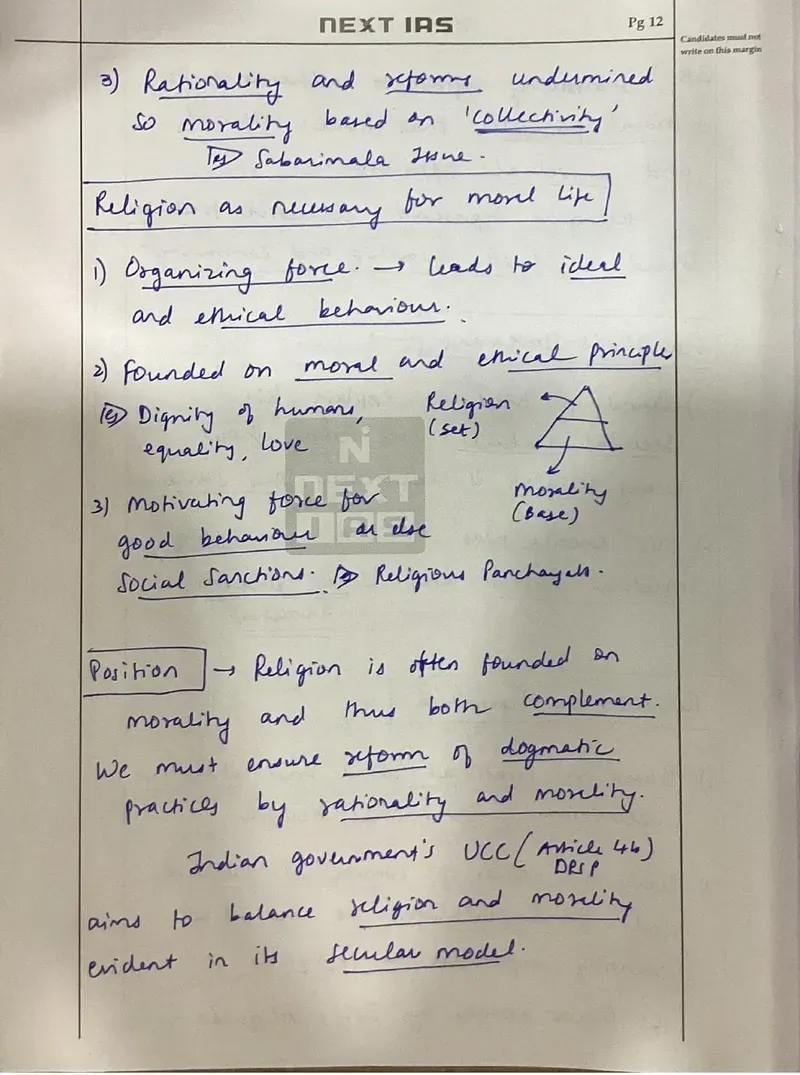
Q3B.Gandhi's 'I am a Moslem/Hindu/Christian/Jew'; relationship between religion and morality
Q4A.Friedman's 'one responsibility of business is profit'; is CSR an unproductive diversion
Q4B.Relevance of tyaga/seva/daanam/damah for modern public servants
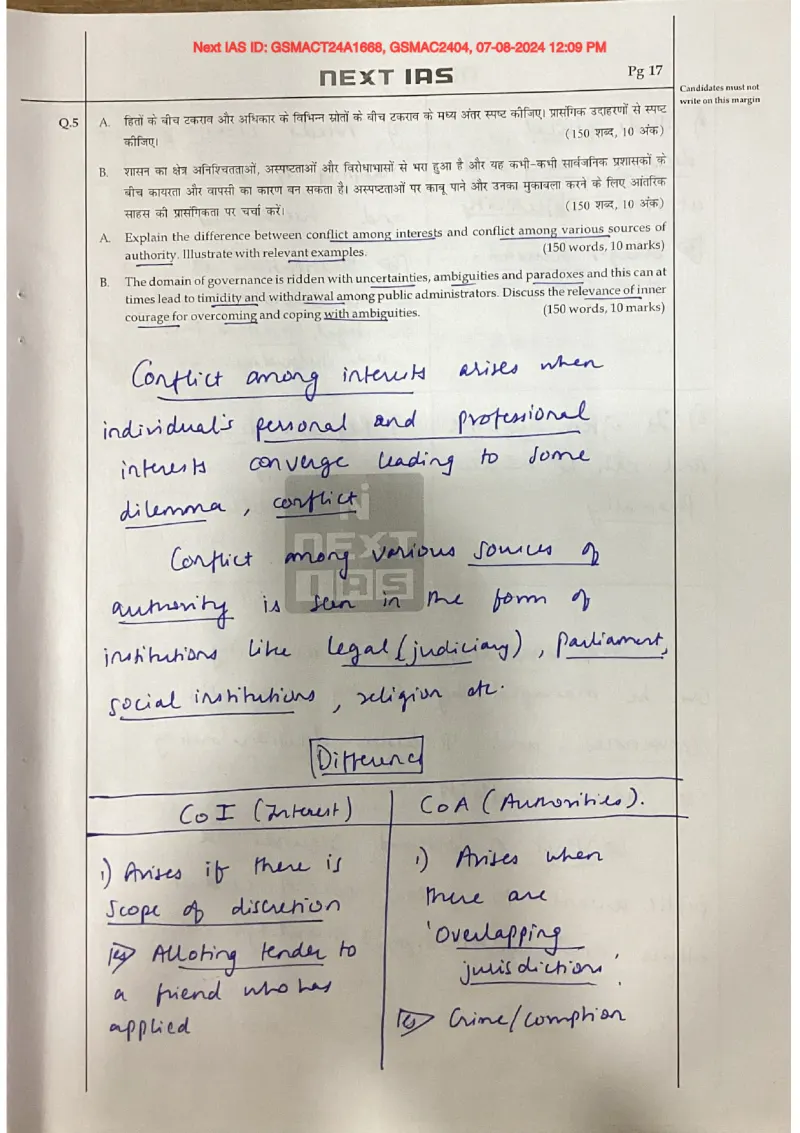
Q5A.Difference between conflict among interests and conflict among sources of authority
Q5B.Governance ambiguities/paradoxes; relevance of inner courage
Q6A.Adam Smith quote on benevolence/feeling for others as perfection of human nature
Q6B.Aristotle quote on virtue, vice and the power to act/not act
Q6C.Socrates quote 'I know that I know nothing' — humility and knowledge
Withdrawal of Non-Cooperation Movement; climate change (Q6B)
Quotes the candidate used
'Service is joy' — attributed to Tagore (Q4B, Q6A)
'Power corrupts and absolute power corrupts absolutely' — used in Q4B (Lord Acton; author not written by candidate)
'A good leader knows the way, goes the way and shows the way' — Case Study 3 (author not written)
'Sunlight is the best disinfectant' — Case Study 6 (author not written; Brandeis)
'Silence of good men in the face of injustice is a bigger crime' — Case Study 6 (author not written)
'Sarva Dharma Sambhav' invoked for Gandhi's statement (Q3B)
Sanskrit shloka 'Yatra Naryastu Pujyate Ramante Tatra Devta' (where women are worshipped, gods are happy) — Case Study 2
Engaged with the three printed thinker-quotes in Q6: Adam Smith (benevolent affections), Aristotle (virtue/vice & power to act), Socrates ('I know that I know nothing')
How it’s written: Highly disciplined, examiner-friendly format throughout. Each answer opens with a one-line definitional/contextual intro, develops in numbered points, and closes with a value-laden concluding sentence (often a quote or Sanskrit/ethical maxim). Heavy use of boxed/underlined sub-headers, '->' arrows linking a point to…
Diagrams & visuals: Venn diagram: Reason/Rationality intersecting Passion/Feeling -> Ethical Decisions (Q1A); Flowchart 'Ethics Managed' branching Yes (good work culture->motivated employees->reduced corruption->growth) vs No (poor culture/decay) (Q1B); Pyramid: Code of Ethics = Values/Principles vs Code of Conduct = Action (Q1B); Branch diagram contrasting Traditional Ethics (justice/equality/rights/procedure) vs Ethics of Care (community/equality/substantive) (Q2A); 'Components' tree of service quality with 5 nodes (Q2B); Manas-Vachan-Karma triangle -> Overall Attitude (Q3A)
Evaluator: No examiner marks or comments are filled in on this copy.
Ranga Manju — Vajiram & Ravi GS Paper 4 (Ethics) copy
GS Paper 4 · EthicsPDF · 4.1 MB
What’s inside this copy
▸Full-length topper attempt: every one of the 13 Section-A items and all 6 Section-B case studies attempted, in order, within page limits.
▸Exceptionally example-dense — names real administrators (IAS Sagayam, Prashant Nair's 'Compassionate Kozhikode', Shashank's nutrition gardens, 'Lunch with the Collector') and sharp negative cases (Asaram, Ram Rahim, KPS Gill via Rupan Deol Bajaj v. KPS Gill).
▸Strong philosophical anchoring: Charvaka/Epicurus/hedonism for Hume, Karmaphala + Doctrine of Double Effect for the Gita, Polluter Pays/Public Trust/Gaia/deep ecology for environment.
▸Clean presentation — boxed keywords, underlined sub-headers, arrows, and genuine two-column compare-and-contrast (Q2 family vs school; Q10 impartiality vs neutrality).
▸Signature format: each answer opens with a quotation hook and closes with a one-line takeaway; body is crisp and keyword-driven.
★In Q4 ("character revealed in private life") Ranga Manju stacked matched real cases on both sides — positives like IAS Sagayam, Lal Bahadur Shastri (wealth under Rs 500 at death), and the AC-shifted-to-the-maternity-ward officer, against negatives Asaram, Ram Rahim, and KPS Gill (citing the actual case Rupan Deol Bajaj v. KPS Gill) -> stock an Ethics answer with named, verifiable people and cite the case law by name; balanced positive-and-negative examples prove a claim far better than abstract assertion.
★Quotation answers were anchored in named philosophy, not vague morality — Charvaka/Lokayata, Epicurus and hedonism to unpack Hume's "reason is slave of the passions" (Q6a), and Karmaphala plus the Doctrine of Double Effect for the Gita (Q11), with environmental ethics framed via Polluter Pays / Public Trust / Gaia / deep ecology (Q9) -> attach a specific named doctrine or school to abstract prompts so the examiner sees conceptual depth rather than commentary.
★Genuine two-column compare-and-contrast layouts with boxed column headers were used exactly where the question demanded comparison — Q2 (family vs educational institutions) and Q10 (impartiality vs neutrality) -> match the visual structure to the verb of the question; a side-by-side table for an explicit 'compare and contrast' or 'difference between' question is high-signal, unlike decorative diagrams.
★Every answer ran a consistent template: a quotation/proverb hook opening (e.g., "Integrity is to do the right thing when no one is watching" for Q1, "Family is the first school" for Q2) into a framing line, then underlined sub-headers, closing on a one-line takeaway -> a repeatable intro-body-conclusion skeleton lets you write fast and uniformly under time pressure across 19 attempts without reinventing structure each time.
★Current affairs were woven in as concrete data points, not name-drops — Oxfam 2024 (1% holds ~40% of wealth) for the rich-poor gap (Q8), the Kamakoti panel for AI policy (Q14), plus Puja Khedkar, the cough-syrup export crisis, PM-LiFE and SEBI BRSR -> ground ethics arguments in dated, specific contemporary references to show the answer is current and rooted in real governance, not timeless platitude.
★It was a complete full-length attempt: all 13 Section-A items and all 6 Section-B case studies (Kerala landslides, AI task force, GoodLife Pharma/Revivol, CPWD harassment, etc.) attempted in order, within page limits -> finishing the whole paper within limits is itself a scoring strength; partial papers cap your ceiling regardless of per-answer quality.
Questions attempted: Short notes (75 words each): (i) Role of intellectual integrity in administrative decision-making; (ii) Role of Citizen's Charter in good governance; Compare and contrast family vs educational institutions in value inculcation; how they complement each other; Tolerance as appreciating/celebrating diversity; importance for governance; how civil servants foster tolerance and inclusivity, and 16 more below.
Questions attempted in this booklet (19)+
Q1.Short notes (75 words each): (i) Role of intellectual integrity in administrative decision-making; (ii) Role of Citizen's Charter in good governance
Q2.Compare and contrast family vs educational institutions in value inculcation; how they complement each other
Q3.Tolerance as appreciating/celebrating diversity; importance for governance; how civil servants foster tolerance and inclusivity
Q4."A person's character is revealed in private life, not public persona" — critically examined for public servants' ethical conduct
Q5.Accountability mechanisms vs bureaucratic delays/inefficiency in Indian administration; balancing accountability and efficiency
Q6a.Quotation — David Hume: "Reason is, and ought only to be the slave of the passions"
Q6b.Quotation — Martin Luther King Jr.: ultimate measure of a person is where they stand at times of challenge and controversy
Q6c.Quotation — Mahatma Gandhi: "In matters of conscience, the law of the majority has no place"
Q7.Empathy and emotional intelligence in civil servants to improve governance and service delivery
Q8.Ethical implications of the widening rich-poor nation gap; moral obligation of developed countries to assist developing ones
Q9.Environmental ethics — "we borrow the earth from our children"; responsibilities of individuals, corporations, governments to future generations
Q10.Difference between impartiality and neutrality in the civil service
Q11.Relevance of Bhagavad Gita teachings for ethical conduct in contemporary public administration
Q12.Case study — Kerala landslides; District Collector balancing relief/rehabilitation, transparency, safety vs cultural attachment to ancestral land, equitable distribution under media scrutiny
Q13.Case study — Ministry of Rural Development; limited women's participation in SHGs/village councils; engaging male members; institutional/policy changes
Q14.Case study — Head of national AI task force; formulating a comprehensive national AI policy framework (jobs, privacy, bias, accountability/black-box)
Q15.Case study — 'GoodLife Pharma'/'Revivol'; undisclosed fatal side effects, suppressed trial data, complicit superior; dilemmas, course of action, corporate governance fixes
Q16.Case study — Young IAS SDM; absenteeism, file backlog, bribery/favouritism; steps to improve work culture and service delivery; challenges
Q17.Case study — Additional DG, CPWD; insecure Chief Architect harassing new Senior Architect (Seema); ethical issues, options to retain her, preventive measures
Examples, data & evidence used
Indian Railways Citizen's Charter — toll-free numbers and complaint-escalation (Q1)
Abraham Lincoln on character tested in adversity; COVID-19 frontline 'warriors' (Q6b, MLK)
Galileo's heliocentrism vs the Church's geocentrism; Orwell's 1984; demand for Dravida Nadu (Q6c, majority can be wrong)
Harper Lee, 'Go Set a Watchman' (conscience) (Q6c)
Quotes the candidate used
David Hume — "Reason is, and ought only to be the slave of the passions..." (Q6a, paper-set quote)
Martin Luther King Jr. — "The ultimate measure of a person is... where they stand at times of challenge and controversy" (Q6b, paper-set quote)
Mahatma Gandhi — "In matters of conscience, the law of the majority has no place" (Q6c, paper-set quote)
"We do not inherit the earth from our ancestors; we borrow it from our children" — attributed by candidate to Gandhi (Q9, paper-set quote)
"Integrity is to do the right thing when no one is watching" — used as intro hook (Q1; unattributed in copy)
"Family is the first school" — proverb used as intro (Q2)
Rudyard Kipling, 'If' — treat commoners and kings, success and failure alike (Q6b)
"Give me a mask and I'll tell you the truth" — saying used in intro (Q4; unattributed in copy)
How it’s written: Highly consistent template across all answers: an intro hook (a quotation or proverb in quote marks, sometimes bracketed) leading into a stated framing line, then clearly headed/underlined sub-sections (e.g., "Importance...", "How civil servants can...", conclusion). Body is keyword-dense and telegraphic, organised…
Diagrams & visuals: Two-column compare-and-contrast layout with boxed column headers — Q2 (Family vs Educational Institutions); Two-column comparison — Q10 (Impartiality vs Neutrality); Boxed keywords/headers used as emphasis devices throughout (e.g., boxed 'Father/Mother/Grandparents', 'Moral obligations: Yes'); Arrows (->) used to show linkage/flow between points; Underlining of sub-headers for visual segmentation. No geographic maps and no elaborate pictorial flowcharts/diagrams beyond these presentation devices.
Evaluator: No examiner marks or comments are filled in on this copy.
▸No marks or evaluator comments anywhere — boxes and rubric left entirely blank (unevaluated copy)
What to learn from this copy
★Vikas pairs each ethics concept with a strikingly *current* concrete instance instead of textbook stock examples — 'All eyes on Rafah' AI-generated image for gen-AI's social utility, the Rashmika Mandanna/Sachin Tendulkar/PM Modi deepfakes for betting-app fraud, SEBI's 'Endorsement Know-Hows' guidelines in the finfluencer case, and SP Surender Bishnoi's real Aravalli sand-mafia death in Case 8 -> Mine the last 12-18 months of news for one named, verifiable example per ethics theme; a 2024-25 instance signals you actually follow ethics-in-action and instantly out-scores a generic 'a corrupt officer' illustration.
★He opens answers with a tight quote-hook matched to the exact theme — Elon Musk's 'AI is far more dangerous than a nuclear bomb' to launch the gen-AI question, Guterres' 'Earth has passed from global warming to global boiling' for the climate-finance question, and Gandhi's 'in matters of conscience, the law of majority has no place' for the conscience answer -> Bank 8-10 thinker quotes you can deploy as theme-specific intros (Musk for tech, Guterres for climate, Gandhi/Kant for conscience-duty); a quote that names the precise dilemma beats a decorative one parachuted in.
★In every case study (Q7-Q11) he runs a clean two-column Merit/Demerit evaluation of each option *before* committing to a reasoned 'I would choose...' verdict, rather than jumping straight to a conclusion -> In case studies, visibly weigh each option's pros and cons in a comparison layout first, then justify your choice — the examiner rewards the structured reasoning trail, not just the 'right' final answer.
★His administrative-ethics vocabulary is precise and loaded: in the climate answer alone he deploys CBDR, Polluter Pays, Just Transition, New Collective Quantified Goal, India's ~2.6 tonnes per-capita figure and the Brandt Line; the welfare-corruption answer cites the ARC-II definition, Kant's Categorical Imperative, DBT, Meghalaya's social-audit law and Nishkam Karma -> Build a per-topic terminology kit (the exact frameworks, one statistic, one Indian-thinker concept) so each answer reads like an informed practitioner's, not a layperson's — specificity of vocabulary is itself a scoring signal.
★He grounds Indian-administration answers in named role models tied to the exact virtue under discussion — T.N. Seshan's 'zero deficiency' and E. Sreedharan the 'Metro Man' for integrity/efficiency, Lal Bahadur Shastri's resignation after a rail accident for accountability, and Dhoni 'Captain Cool'/Modi motivating ISRO after Chandrayaan-2 for emotional intelligence under stress -> Keep a roster of real administrators and figures slotted to specific ethical qualities so you can substantiate abstract claims with a person who embodied them, which makes the answer concrete and memorable.
Questions attempted: Differentiate moral absolutism from ethical pluralism (with examples); Ethical implications of generative AI in creative industries; Citizen charters for transparency & combating corruption, and 16 more below.
Questions attempted in this booklet (19)+
1a.Differentiate moral absolutism from ethical pluralism (with examples)
1b.Ethical implications of generative AI in creative industries
2a.Citizen charters for transparency & combating corruption
2b.Key teachings of Thiruvalluvar and their present-day relevance
3a.Quote: 'In a conflict between heart and brain, follow your heart' (Vivekananda)
3b.Quote: 'To see what is right and not do it is the want of courage' (Confucius)
3c.Quote: 'Our prime purpose is to help others... at least don't hurt them' (Dalai Lama)
4a.Attitude shapes perception/intention; behaviour as its tangible expression
4b.Emotional intelligence in high-stress environments — resilience & decision-making
5a.Ethics of developed nations setting climate targets without adequate finance
5b.Misuse of welfare benefits for weaker sections — moral consequences & prevention
6a.Role of conscience in personal integrity & moral responsibility
6b.Ethical dilemmas: organisational policy vs personal moral principles
T.N. Seshan ('zero deficiency'); E. Sreedharan ('Metro Man of India'); Lal Bahadur Shastri's resignation after a rail accident
Gandhi: 'Golden Mean', conscience as highest court, Talisman, withdrawal of civil disobedience after violence; Aristotle (courage as a cardinal virtue); Bhishma as role model
Daniel Goleman (Emotional Intelligence/EQ); PM Modi motivating ISRO after Chandrayaan-2; M.S. Dhoni 'Captain Cool'; Balakot strikes; Covid warriors
Climate: Antonio Guterres 'global boiling', CBDR, historical responsibility, Brandt Line, IPCC, per-capita emissions (India ~2.6 tonnes), New Collective Quantified Goal, Polluter Pays, Just Transition, COP/UNFCCC, greenwashing
Corruption/welfare: ARC-II definition, Kant's Categorical Imperative, Direct Benefit Transfer, MGNREGA Aadhaar-enabled payments, social audit & Meghalaya's social audit law, Article 21/POSH Act, Gita's Nishkam Karma, constitutional morality
Case 8: SP Surender Bishnoi killed by sand-mafia truck in Aravalli (real incident); Einstein attribution on cowardice
Case 9: UPI revolution, 'finfluencers', SEBI 'Endorsement Know-Hows' guidelines
Quotes the candidate used
'AI is far more dangerous than a nuclear bomb' — Elon Musk (Q1b intro)
'In a conflict between the heart and the brain, follow your heart' — Swami Vivekananda (Q3a, question quote)
'To see what is right and not do it is the want of courage' — Confucius (Q3b, question quote)
'Our prime purpose in this life is to help others. And if you can't help them, at least don't hurt them' — Dalai Lama (Q3c, question quote)
'A person without morals & ethics is like a beast unleashed upon this world' — attributed to Albert Camus (Q3a)
'Knowledge/intelligence without character is a sin' — Gandhi (Q3a)
'In matters of conscience, the law of majority has no place as it is the highest court' — Gandhi (Q6a intro)
'Earth has passed from global warming to global boiling' — Antonio Guterres (Q5a intro)
How it’s written: Consistent, disciplined structure across all answers. 10-markers open with a one-line definition or a quote-hook, then a clearly sub-headed body (e.g. 'Positives/Negatives', 'Enhance transparency', 'Limitations', 'Way ahead') with circled numbered points and circled 'eg' examples, closing with a one-line forward-loo…
Diagrams & visuals: No formal diagrams, flowcharts or maps drawn; Two-column comparison table for Q1a (moral absolutism vs ethical pluralism); Two-column Merit/Demerit option-evaluation layouts in case studies (Q7-Q11)
Evaluator: No examiner marks or comments are filled in on this copy.
▸Genuine NextIAS 'Ethics Enhancer Test 2024' (EE2401, Test 01) full GS4 paper by Deepali Mahto — all 12 questions attempted in English across a ~52-page booklet
▸Quote-led throughout: Gandhi (court of conscience), MLK (injustice in health), Voltaire, Vivekananda (treatment of women), 'this is not the era of war'
▸Polished case-study craft: stakeholder web/triangle diagrams, ethical-issue mapping, merit-demerit option tables, decisive 'my course of action' + way forward
▸Data-anchored answers: NCRB 44% cybercrime rise, Central Water Board 53% stressed districts, World Bank 40% jobs / 66.66M women-hours, SDG-1
▸Balanced ethical reasoning — repeatedly weighs deontological vs utilitarian lenses (Nishkam Karma, Kant's imperative, Aristotle's golden mean)
What to learn from this copy
★She matched each quote to the exact topic rather than scattering generic ones: Gandhi's 'there is a higher court of justice than the court of law, and that is the court of conscience' for the conscience question (Q1b), MLK's 'injustice in health is the most shocking and inhuman' for empathy in healthcare delivery (Q3b), and Voltaire's 'I may not agree with what you say but I will defend your right to say it' for moral relativism/tolerance (Q6c). -> Don't memorise quotes for show; map a specific quote to the specific demand of the question so it does analytical work, not decoration.
★Every case study (Q7-Q12) opened with a stakeholder diagram naming all parties before any decision was taken — e.g. Q7's web of CEO, Beta investor, Mr Mehta, vendor, competitor and society at large, and Q8's DDO, village community, teacher, poor family and government. -> In case studies, visually surface the full stakeholder set first; it forces you to weigh every affected interest before committing to 'my course of action' and prevents tunnel-vision answers.
★She anchored ethics answers in hard data instead of vague assertions: NCRB's 44% rise in cybercrime (Q9, insurance mis-selling), Central Water Board's 53% stressed districts (Q10, water scarcity), and the World Bank figures of 40% of jobs / 66.66M women-hours (Q12, witchcraft/women's safety). -> Even in a 'philosophical' paper like Ethics, a precise statistic converts an opinion into an evidence-backed argument and signals current-affairs grounding.
★She deliberately ran both ethical lenses against each other rather than picking one — weighing utilitarian vs deontological reasoning on the economic-sanctions dilemma (Q5b), and threading Nishkam Karma, Kant's categorical imperative and Aristotle's golden mean through the action-and-consequences questions (Q6b). -> Show the examiner you can hold competing moral frameworks in tension and then resolve them; balanced reasoning beats a one-sided verdict in Ethics.
★Her examples were specific and lesser-used, not the tired textbook set: Ashok Khemka's 36 transfers for integrity, Armstrong Pame's self-funded Manipur road, IAS Sanjay Singh's selfie with his daughter to counter patriarchy, and the Saharia tribe's breastfeeding-ritual delay linked to high IMR. -> Build a stock of precise, named, verifiable examples (person + specific act) — they're far more persuasive than generic 'an honest officer once...' illustrations.
★Theory answers followed a consistent, examiner-friendly skeleton: open by unpacking the prompt/quote or a definition, develop a sub-pointed (i, ii, iii) body with examples, and close with a 'Hence...' line tied back to a thinker — with key terms boxed and keywords underlined throughout. -> A repeatable structure plus visual signposting lets an evaluator find your argument fast under time pressure; standardise your own template so quality holds across all 12 answers.
Questions attempted: Public service values vs administrative ethics — relationship & application (trust, transparency, accountability); Conscience as a guiding light for the public servant; deontology to use right means; Good governance: public administration vs corporate sector (comparison table), and 16 more below.
Questions attempted in this booklet (19)+
1(a).Public service values vs administrative ethics — relationship & application (trust, transparency, accountability)
1(b).Conscience as a guiding light for the public servant; deontology to use right means
2(a).Good governance: public administration vs corporate sector (comparison table)
2(b).Ethical principles in government procurement (open tender/GeM, quality standards, social audit)
3(a).Civil-servant decision-making: balancing official obligation, stakeholder interest, regional values
3(b).Emotional skills (empathy, compassion) in healthcare/welfare delivery
4(a).Civil servant's political & moral attitude — positive and negative manifestations
4(b).Means vs ends / 'motive is irrelevant to action' — when motive matters in judging morality
5(a).Jain philosophy and its contemporary relevance (Ahimsa, Satya, Aparigraha, Brahmacharya)
5(b).Ethical dilemma of economic sanctions (Russia-Ukraine; utilitarian vs deontological)
6(a).'War begins in the mind' — war and peace as products of the mind
6(b).Action and its consequences — just means, Nishkam Karma, Kantian imperative
6(c).Moral relativism / context-dependent ethics and tolerance
8.Case study: diversion of mid-day-meal foodgrain to feed a starving family (rule vs humanity)
9.Case study: cyber fraud / insurance mis-selling to low-literacy villagers
10.Case study: water scarcity / denial of basic amenity, tanker cartel & politician collusion
11.Case study: accountability for a fatal accident at a defence-tech firm (Aqua Tech) as ethics officer; also AI ethical issues (deepfakes, jobs, data privacy)
12.Case study: witchcraft accusations against women (Odisha anti-witchcraft law); under-reporting & women's safety
ADR v Union of India — electoral bonds struck down
Gandhi's trusteeship model
Coca-Cola / PepsiCo formula-leak (integrity)
GeM portal — public procurement
Social audit of PDS in Odisha
Jal Jeevan Mission (tender to family member, Bihar; implementation in letter & spirit)
CPGRAMS
Saharia tribe — breastfeeding ritual delay & high IMR
IAS Sanjay Singh — selfie with daughter to counter patriarchy
IAS Armstrong Pame — road construction (Manipur)
IPS Kiran Bedi — prison reform
Quotes the candidate used
Gandhi: 'there is a higher court of justice than the court of law, and that is the court of conscience' (Q1b)
Jeff Bezos: choose the employee with integrity over energy (Q3a)
Martin Luther King Jr.: 'Of all forms of inequality, injustice in health is the most shocking and inhuman' (Q3b)
'Sheelam Param Bhushanam' — character is the highest virtue (Q4a)
'Peace is eternal and war is transient' (Q5b)
PM (to Putin): 'this is not the era of war' (Q5b)
'War begins in the minds of men' — UNESCO-style prompt quote (Q6a)
Voltaire: 'I may not agree with what you say but I will defend your right to say it' (Q6c)
How it’s written: Highly structured, exam-ready format. Theory answers open with a definition or by unpacking the prompt/quote, develop a numbered/sub-pointed body (i, ii, iii with sub-examples), and close with a 'Hence...' line, usually anchored to a thinker or quote. Candidate consistently boxes key terms and underlines keywords fo…
Diagrams & visuals: Q2: two-column comparison table — good governance in public administration vs corporate; Q3(a): small triangle/relationship diagram linking official obligation, stakeholder interest, regional values; Q7: stakeholder web diagram (Stakeholder -> CEO, investor of Beta, Mr Mehta, vendor, competitor, society at large); Q8: stakeholder diagram (DDO, village community, teacher, poor family, government); Q10: stakeholder diagram (society at large, politician, caste, junior engineer, people); Q11: stakeholder bracket diagram (Aqua Tech firm, operation officer who died, project leader, ethics committee, society/government)
Evaluator: No examiner marks or comments are filled in on this copy.
▸Genuine Diksha Rai copy — NextIAS 'Ethics Enhancer Test 2024' (EE2401, Test 01, 07-Aug-2024); all 12 questions attempted across Section A (theory) and Section B (case studies), ~56 booklet pages.
▸Example-saturated answer writing — almost every point carries an 'eg-': Nolan Committee, 2nd ARC, Sreedharan, V. Kurien, Shastri, T.N. Seshan, Irom Sharmila, Armstrong Pame, M. Visvesvaraya, Satyendra Dubey, Enron, Amazon's biased AI tool, and many more.
▸Strong thinker/quote scaffolding: Kant (categorical imperative, human dignity), Gandhi (conscience, trusteeship, 'commerce without morality'), Amartya Sen (capability approach), Plato, Daniel Goleman, Vivekananda's Daridra Narayan.
▸Neat, legible blue-ink cursive with hand-drawn mind-maps and two-column tables — clean, examiner-friendly presentation.
▸Copy is UNEVALUATED: no marks awarded and no evaluator feedback anywhere — it is shared as a topper reference, so no scores can be reported.
What to learn from this copy
★In Q1(a) Diksha opened the abstract 'public service values vs eloquent statements' debate not with theory but with a hand-drawn mind-map of the Nolan Committee's seven principles (Openness, Selflessness, Honesty, Objectivity, Integrity, Leadership), then anchored each value to a real officer -- U. Sagayam voluntarily declaring assets, E. Sreedharan, V. Kurien's White Revolution, Lal Bahadur Shastri resigning after a rail accident -> convert a vague 'are values just words?' prompt into something concrete by pairing each named value with one real administrator who lived it, so the examiner sees evidence, not assertion.
★Across Section A nearly every body point carries an 'eg-' tag rather than floating as a bare claim -- in Q1(b) on conscience vs loyalty she stacks Kiran Bedi towing Indira Gandhi's car, Vibhishan, Raja Ram Mohan Roy opposing sati, T.N. Seshan, Aruna Roy, and Irom Sharmila's 16-year hunger strike -> in ethics, one illustrative example per point is the unit of credibility; build a deep, reusable bank of named figures so you can attach a concrete case to any argument under time pressure.
★She ran one disciplined, repeatable template for all six case studies (Q7-Q12): framing intro -> stakeholder spider-map -> each option laid out in a Merits/Demerits two-column table -> a numbered chosen course of action -> an ethical-theory conclusion -- e.g. Q7 Beta Technologies maps CFO, Legal Head, company, CEO, Government, Shareholders and Society as distinct stakeholders -> a fixed, mechanical case-study skeleton guarantees you never omit stakeholders or the decision step, and makes the answer instantly navigable for an examiner.
★She wove thinkers precisely to the question rather than decoratively -- Kant's categorical imperative for Q6(b), Gandhi's 'commerce without morality' as a deadly sin against the Q10 water-tanker cartel, Amartya Sen's capability approach, and Daniel Goleman plus Jacinda Ardern's 'not enough fuel in the tank' resignation for the Q3(b) emotional-intelligence prompt -> match each quote/theorist to the specific dilemma it actually resolves; relevance, not name-dropping, is what a thinker citation buys you.
★Even for high-abstraction theory questions she used structural devices to organise thought -- a comparative two-column public-administration-vs-corporations layout for Q2(a) on good governance -> use tables/columns not just in case studies but to discipline comparative theory answers, forcing parity of treatment on both sides.
Questions attempted: Relationship between Public Service Values and Public Administration Ethics; whether PSV are mere eloquent statements or have utility; How a conscientious public servant sorts competing considerations and puts values into practice; Good governance in public administration vs corporations; three principles for corporate good governance, and 16 more below.
Questions attempted in this booklet (19)+
1(a).Relationship between Public Service Values and Public Administration Ethics; whether PSV are mere eloquent statements or have utility
1(b).How a conscientious public servant sorts competing considerations and puts values into practice
2(a).Good governance in public administration vs corporations; three principles for corporate good governance
2(b).Ethical principles to maintain integrity of the public procurement process
3(a).Balancing stakeholder interests, official obligations and regime values; which deserves most moral weight
3(b).Whether self-awareness and empathy (emotional skills) are essential for effective health/social interventions
4(a).How civil servants' political and moral attitudes impact work ethics and daily decision-making
4(b).'Motive has nothing to do with morality of an action' — is motive irrelevant?
5(a).Contemporary relevance of Jain Tirthankaras' vow-based moral philosophy
5(b).Ethical dilemmas of economic sanctions in international relations and how to balance them
6(a).Quote: 'Wars begin in the minds of men...love and compassion would have built the defences of peace'
6(b).Quote: Kant's categorical imperative — 'live as if the maxim of your actions were to become universal law'
6(c).Quote: 'The golden rule of conduct is mutual toleration...truth in fragments'
7.Case study: new CEO of Beta Technologies — CFO's earnings manipulation and vendor conflict-of-interest
8.Case study: DDO — mid-day-meal grain diverted by schools to feed starving families (compassion vs rules)
9.Case study: SP — Bima Yojna premiums deducted from illiterate villagers without informed consent
10.Case study: junior engineer — water-tanker cartel with political backing; SP unwilling to act
Jacinda Ardern — NZ PM resignation citing self-awareness ('not enough fuel in the tank'); Daniel Goleman on EI (Q3b)
Quotes the candidate used
'There is no higher court than the court of conscience' — Mahatma Gandhi (Q1b)
'Commerce without morality' as one of the seven deadly sins — Mahatma Gandhi (Q10)
'May you live your life as if the maxim of your actions were to become universal law' — Immanuel Kant (Q6b, question prompt expanded by candidate)
'Do unto others what you want done to yourself' — Bhagavad Gita (Q6b)
'I may not agree with what you said, but I will defend to death your right to say so' — written unattributed (commonly Voltaire/Evelyn Beatrice Hall) (Q6c)
Jacinda Ardern paraphrase — 'not enough fuel in the tank left' (Q3b)
How it’s written: Full-length booklet, all 12 questions attempted in printed order, each answer keyed to its question number. Section A (Q1-6, ~150-word theory answers): definition-first opening, then point-wise body where nearly every point is backed by an 'eg-' example, frequent underlining of headers/keywords, occasional hand-draw…
Diagrams & visuals: Hand-drawn mind-map / spider diagram of Nolan Committee public-service values (Openness, Selflessness, Honesty, Objectivity, Integrity, Leadership) — Q1(a); Comparative two-column structure: good governance in public administration vs corporations — Q2(a); Stakeholder spider-maps in case studies (e.g., Q7 Beta Technologies: CFO, Legal Head, company, CEO, Government, Shareholders, Society; also Q10, Q11, Q12); Merits/Demerits two-column tables for each option in every Section-B case study (Q7-Q12); No geographic maps used
Evaluator: No examiner marks or comments are filled in on this copy.
▸MISASSEMBLED FILE: only Pg 1-3 of Animesh's NextIAS booklet are present (Q1a + Q1b); booklet Pg 4-54 are replaced by a different candidate's 'VAJIRAM & RAVI' Ethics booklet (PDF p9-59) — do not attribute that work to Animesh.
▸Genuine content confirms GS4 Ethics, NextIAS Main Test Series 2023, Full Length Test-8 (TC042), candidate hand-named 'Animesh Jain' on the cover.
▸Q1(a) frames 'giving back' via social contract + Yogakshema + trusteeship, with crisp examples: Parameswaran Iyer/Swachh Bharat, TN Seshan/Election Commission, and Gandhi's Talisman as the closing value.
▸Q1(b) anchors on Max Weber's bureaucracy and maps the authority chain PM -> Cabinet Secretary -> Departmental Secretary; cites Code of Conduct Rules 1968, CVC, CBI, RTI, Citizens Charter.
▸Even on 10-mark questions, technique is exam-ready: definitional intro, underlined keywords, numbered points, one concrete administrator example per point.
▸No marks or evaluator comments anywhere on Animesh's pages — marks table and MACRO COMMENTS left blank.
What to learn from this copy
★On a 10-marker (Q1a, the Kalidasa 'taxes like the sun gives back moisture' prompt), Animesh built the answer on a stack of three named ethical frames in sequence — social contract theory -> the Indian 'Yogakshema' concept (welfare in return for taxation) -> Trusteeship (civil servant as trustee of society's wealth) -> then closed with Gandhi's Talisman (help the poorest man). -> Even short answers gain depth by layering Western theory + an indigenous concept + a values close, rather than one generic definition; this directly counters the 'all answers sound the same' trap in Ethics.
★He paired each abstract value with one concrete administrator example instead of staying theoretical — Parameswaran Iyer/Swachh Bharat Mission and TN Seshan as Election Commissioner (credibility + voter turnout) to evidence 'giving back'. -> Anchor every ethical claim to a real named bureaucrat and what they concretely achieved; specific Indian admin examples are what separate a top Ethics answer from a textbook recital.
★In Q1(b) on bureaucratic structure, he opened with Max Weber's rule-oriented bureaucracy as the definitional anchor, then drew the literal authority chain PM -> Cabinet Secretary -> Departmental Secretary with downward arrows, and grounded accountability in named instruments: Conduct Rules 1968, CVC, CBI, RTI, Citizens Charter. -> Convert an abstract 'influences on decision-making' question into a visible structure (a simple arrow flow) plus a checklist of real statutory/oversight bodies — concreteness reads as authority and saves words.
★His exam technique stays disciplined even where marks are low: a definitional intro, boxed/underlined mini-headers ('Civil servants -> giving it back', 'It also included ->'), then numbered points each carrying one example, in legible blue-ink cursive. -> Apply the same skeleton (anchor -> underlined signpost -> numbered points with embedded examples) to 10-markers, not just 15s/20s — structure should not collapse just because the question is small.
Questions attempted: Indian concept of 'giving it back' (Kalidasa quote on taxes/Sun) and its relevance as a guiding value for civil servants (150 words, 10 marks); Influences within a bureaucratic structure (authority lines, value standardization, accountability) that impact a public servant's ethical decision-making (150 words, 10 marks).
Questions attempted in this booklet (2)+
1(a).Indian concept of 'giving it back' (Kalidasa quote on taxes/Sun) and its relevance as a guiding value for civil servants (150 words, 10 marks)
1(b).Influences within a bureaucratic structure (authority lines, value standardization, accountability) that impact a public servant's ethical decision-making (150 words, 10 marks)
Examples, data & evidence used
Social contract theory (basis for state's duty toward people's prosperity)
Yogakshema concept — welfare/prosperity of people in return for taxation
Trusteeship — civil servants as trustees of society's wealth and nation's resources
'We the People' (Preamble) + Daridra Narayan seva to frame accountability/service
IAS Parameswaran Iyer — Swachh Bharat Mission
TN Seshan — work as Election Commissioner increasing EC credibility and voter turnout
Gandhi's Talisman — helping the poorest man while discharging duties
Max Weber — bureaucracy as a top-down mechanical, rule-oriented system implementing laws
Line of authority chain: Political executive (PM) -> Cabinet Secretary -> Departmental Secretary
Code of Conduct (Conduct) Rules, 1968; impartiality / no association with political party
Accountability mechanisms: Annual Confidential Reports, CVC, CBI, social audits, RTI, Citizens Charter
Quotes the candidate used
Kalidasa — 'The State took taxes from the people only to ensure their prosperity, in return like the sun takes moisture from the earth only to give it back in thousandfold measure.' (this is the printed question prompt, which Animesh answers)
Mahatma Gandhi — Gandhi's Talisman (paraphrased: a civil servant should be guided by helping the poorest/weakest man while discharging duties)
How it’s written: Genuine Animesh pages: neat blue-ink cursive, legible. Strong exam technique even on a 10-marker — opens with a definitional anchor (Q1a: social contract/Yogakshema; Q1b: Max Weber), then boxed/underlined mini-headers ('Civil servants -> giving it back', 'It also included ->'), followed by numbered points (1. Truste…
Diagrams & visuals: Simple authority-flow chain in Q1(b): PM -> Cabinet Secretary -> Departmental Secretary (drawn with downward arrows); No maps. No other diagrams on the genuine pages.
Evaluator: No examiner marks or comments are filled in on this copy.
Kumud Mishra — InsightsIAS GS Paper 4 (Ethics) copy
GS Paper 4 · EthicsPDF · 17.9 MB
What’s inside this copy
▸Full 250-mark GS4 mock (InsightsIAS IPM/YLM 6.0 2025, Ethics Test 15): 13 theory sub-parts plus 6 case studies, all attempted across 51 handwritten pages
▸Every theory point is anchored to a concrete, real Indian example — Sreedharan, Durga Shakti Nagpal, Armstrong Pame, Sanjukta Parashar, Satish Dhawan and more
▸Signature flourish: nearly every answer closes with a Sanskrit shloka or value-line (Sarvodaya, Sarve Bhavantu Sukhinah, Vasudhaiva Kutumbakam, Prakriti Rakshati Rakshita, Appa Deepo Bhava)
▸Theory firmly grounded in named thinkers — Rawls' veil of ignorance, Kant's categorical imperative, Bentham vs Mill utilitarianism, Stoicism/Taoism/Confucianism
▸Case studies follow a tight template: stakeholders, then ethical issues, then options weighed in Merits/Demerits tables, a clear chosen course, and a way-forward list
▸Current, topical material woven in: Hema Committee, #MeToo, POSH Act 2013, Vaccine Maitri, Elon Musk's ketamine use
What to learn from this copy
★Every theory point is followed by a concrete real-Indian example tagged 'Ex.' — E. Sreedharan as the 'Metro Man', Armstrong Pame's 'People's Road' in Manipur, Vinoba Bhave's Bhoodan revolution, Sindhutai Sapkal's work for orphans, Dr. Rajendra Prasad quitting law for peasants -> in Ethics, never let an abstract value float free: pin each point to a named administrator or reformer so the examiner sees you can operationalise the concept, not just define it.
★Theory answers are anchored to the correct named thinker AND their signature idea, not vague paraphrase — Rawls' 'veil of ignorance', Kant's categorical imperative and means-vs-ends dignity, and Bentham vs Mill via the actual lines 'Two sovereign masters — pain and pleasure' (Bentham) answered by Mill's 'Poetry is better than pushpin' -> learn one precise phrase or device per philosopher so you can deploy the thinker accurately under time pressure instead of generic 'as per utilitarianism'.
★Nearly every answer closes with a Sanskrit shloka or value-line matched to the topic — 'Vasudhaiva Kutumbakam' (Maha Upanishad) for the global-family question, 'Sarve bhavantu sukhinah', 'Atmano Mokshartham Jagat Hitaya cha', 'Prakriti Rakshati Rakshita' for the environment case, 'Appa Deepo Bhava' -> build a small bank of topic-tagged value-lines so conclusions land with cultural weight rather than a flat summary, but keep the shloka relevant to the specific question (the environment case got the Prakriti line, not a generic one).
★Case studies run a tight repeatable template — identify stakeholders, list ethical issues, weigh the realistic options in a two-column Merits/Demerits table (used in Q8 Election Commissioner, Q11 conflict-of-interest, Q12 harassment committee), commit to one clear chosen course, then give a way-forward list -> a visible decision structure with options explicitly weighed in a table shows the examiner your reasoning process, which scores higher than jumping straight to the 'right' answer.
★Current and topical hooks are woven directly into the ethics case studies — Hema Committee and #MeToo and POSH Act 2013 for the film-industry harassment case (Q12), Elon Musk's ketamine use for the performance-enhancing-drug CEO case (Q9), plus Vaccine Maitri -> mapping a live news anchor onto the exact scenario proves the case is real to you and makes the answer current, but match the reference to the specific dilemma rather than dropping unrelated GK.
Questions attempted: Gandhian philosophy — politically charged, non-violent and ethical leadership (Satya, Ahimsa, Sarvodaya); Emotional Intelligence: increasing relevance, components, role in public service delivery; Rawls' 'veil of ignorance' and promoting fairness/impartiality in public policy, and 16 more below.
1(b).Emotional Intelligence: increasing relevance, components, role in public service delivery
2(a).Rawls' 'veil of ignorance' and promoting fairness/impartiality in public policy
2(b).Emotional Intelligence is important, but its dark side — manipulation and undue influence
3(a).Kant's ethical theory — categorical imperative, deontology, human dignity (means and ends)
3(b).Short notes: (i) Stoicism, (ii) Taoism, (iii) Confucianism
4(a).Critically evaluate Emotional Intelligence vis-a-vis AI / sentient machines
4(b).Utilitarianism as a normative ethics — Bentham (felicific calculus) and J.S. Mill
5(a).Significance and applications of Emotional Intelligence in administration
5(b).Ethos and philosophy of 'Vasudhaiva Kutumbakam' (from Maha Upanishad)
6(a).Quote answer — strength of character & EI; failures as stepping stones to success
6(b).Quote answer — 'All knowledge should be subject to' continuous scrutiny/examination
6(c).Quote answer — 'The greatest religion is to be true to oneself/one's nature'
7.Case study — District Magistrate executing disaster management amid public outrage
8.Case study — Election Commissioner (Mr. Raghav) under political pressure; free & fair elections
9.Case study — CEO of global tech firm (Mr. Varun); ketamine/performance-enhancing drug use
10.Case study — Rajesh Kumar; environment protection vs development projects
11.Case study — Anita Verma, social activist; conflict of interest involving husband Rajesh
12.Case study — 2017 actress/regional film industry harassment; head of Special Investigative Committee
Examples, data & evidence used
Champaran Satyagraha (Gandhian leadership)
Dr. Rajendra Prasad — gave up lucrative law practice for peasants/workers
Vinoba Bhave's bloodless (Bhoodan) revolution
Sindhutai Sapkal — welfare of orphaned children
Tech Mahindra employee engagement
Ratan Tata's engagement with colleagues
Sevottam model (2nd ARC)
IAS G.K. Pillai's negotiation with the Nagas
Role in Kudumbashree (Kerala)
E. Sreedharan — the 'Metro Man'
Armstrong Pame — 'People's Road' in Manipur
S.K. Patel IAS — Digi Gaon initiative
RTI Act and social audits
Jeremy Bentham — felicific calculus
Quotes the candidate used
'Atmano Mokshartham Jagat Hitaya cha' — emancipation of self and welfare of all (Gandhian/Vivekananda tradition)
'Forgiveness is the attribute of the strong' — Gandhi
'Seva paramo dharma' — service is the supreme duty
Nishkama Karma (Bhagavad Gita)
'Sarve bhavantu sukhinah, Sarve santu niramaya'
'Poetry is better than pushpin' — J.S. Mill (on Bentham's pushpin)
'Two sovereign masters — pain and pleasure' — Bentham
'Vasudhaiva Kutumbakam' — Maha Upanishad
How it’s written: Highly consistent, formula-driven structure. Theory answers open by defining/restating the concept and naming the thinker, then build the body as short point-paragraphs each immediately backed by a real Indian example prefixed 'Ex.', and close with a 'Thus...' conclusion tied to a Sanskrit shloka or value-line. Heav…
Diagrams & visuals: No conventional diagrams or maps; Two-column Merits/Demerits tables used to weigh options in case studies (e.g., Q8, Q11, Q12); Bracketed/listed enumeration of EI components (self-awareness, self-regulation, motivation, empathy, social & communication skills)
Evaluator: No examiner marks or comments are filled in on this copy.
Sandeep Badad — Vajiram & Ravi GS Paper 4 (Ethics) copy
GS Paper 4 · EthicsPDF · 45.6 MB
What’s inside this copy
▸Authentic Sandeep Badad (AIR-82) copy — handwritten cover 'Sandeep Badad', Admin No 25VR101489, Vajiram & Ravi Sure Shot FLT-2025 Test-8 (GS-4); single consistent hand throughout, matching the PDF metadata (UNCK_SSTS_FLT_2025_T8_SANDEEP_BADAD).
▸Attempted 11 of 12 questions — Section A Q1–Q6 and case studies Q7–Q11; the final case study Q12 (Solar Energy Park vs heritage/ecology) was left completely blank.
▸Strikingly example-dense — nearly every point carries an 'eg': M.S. Dhoni (2007 WC), E. Sreedharan, Satyendra Dubey, Operation Sindoor, c-Vigil, MGNREGA social audit, Namami Gange, Amrit Sarovar, NCRB dowry data.
▸Anchored in ethical theory — Rawls, Kantian imperative, utilitarianism, doctrine of double effect, Nishkama karma, Buddha's 'akusala kamma', Nolan principles.
▸Highly visual presentation — merit/demerit 'lens' diagrams, branching flowcharts, boxed keywords and heavy underlining; case studies take a clear, reasoned stand.
▸Liberal quote usage — Gandhi ('Glory lies in the attempt', 'science without humanity is sin'), MLK ('injustice anywhere...'), 'Jal hai to kal hai', plus self-coined lines.
What to learn from this copy
★On the Gandhi quote question (Q3, 'Glory lies in the attempt to reach one's goal and not in reaching it'), Badad fused a scriptural anchor (Nishkama karma/Gita's 'perform duty without worrying about the goal') with a vivid pop-culture proof (M.S. Dhoni's focus on action in the 2007 T20 World Cup) and a counter-example of failure (the bystander effect in road accidents) -> when you 'unpack a quote', stack a philosophical root + one concrete real-world success + one failure case so the abstract idea is demonstrated from multiple angles rather than just paraphrased.
★He matched specific named exemplars to specific demands instead of recycling one hero everywhere: E. Sreedharan + Delhi Metro to show ethical AND technical competence together (Q5b), Satyendra Dubey/whistleblower protection in the corruption answers, Davinder Singh and Rawls' 'treating the weakest specially is not discrimination' for impartiality-vs-compassion (Q2b) -> build a tagged mental bank where each example is filed against the exact concept it proves, so you deploy the right illustration for the right sub-part rather than a generic all-purpose name.
★In the case studies (Q7 Kulkarni's scholarship-fund diversion, Q9 Neha's ex-gratia, Q10 dowry) he drew merit/demerit 'lens' schematics and took a clear reasoned stand under headings like 'Course of Action' and 'Ethical dilemmas' rather than hedging -> in ethics case studies, lay out the options visually with a stakeholder/merit-demerit weighing AND then commit to a decision, because examiners reward a defensible verdict over a balanced non-answer.
★He grounded administrative answers in cited governance machinery, not vague reform-talk: c-Vigil (ECI), MGNREGA social audit, Gram Sabha and Mission Karmayogi for participative vigilance (Q4b/Q8), and Nolan Committee principles + Operation Sindoor (emotional intelligence) for public-service ethics (Q5b) -> back every ethical prescription with a real, nameable scheme/committee so 'transparency' and 'accountability' read as concrete mechanisms an officer can actually invoke.
★He triaged time deliberately, fully answering 11 of 12 (Q1-Q11) and leaving the final case study Q12 completely blank rather than thinning every answer -> in a tight ethics paper it is better to write fewer answers well and abandon one entirely than to dilute all of them; protect depth on attempted questions instead of spreading effort to half-finish the last.
Questions attempted: Nature of ethics — how it differs from yet overlaps with morality, religion, law and values (explain with examples); Dual role of the family as the first school of values yet a breeding ground for biases/stereotypes; Reconciling objectivity/impartiality with compassion and empathy in governance, and 12 more below.
Questions attempted in this booklet (15)+
Q1.Nature of ethics — how it differs from yet overlaps with morality, religion, law and values (explain with examples)
Q2(a).Dual role of the family as the first school of values yet a breeding ground for biases/stereotypes
Q2(b).Reconciling objectivity/impartiality with compassion and empathy in governance
Q3.'What does the quote mean to you?' — Gandhi's 'Glory lies in the attempt to reach one's goal and not in reaching it,' plus a quote on justice/duty
Q4(a).How NEP 2020 restores the ethical/holistic purpose of education beyond mere employability
Q4(b).Combating corruption through participative vigilance and transparency (exact prompt partly illegible; answer covers social audit, c-Vigil, Gram Sabha)
Q5(a).Whether the separation of private and public ethics is difficult and may be counterproductive
Q5(b).'Ethical competence is as essential as technical competence in public service' — examine with examples
Q6(a).'A well-developed conscience is the foundation of ethical governance' — discuss with examples
Q6(b).Ethical defensibility of pursuing space-mission prestige while everyday injustices (hunger, women's safety) remain unresolved
Q7 (case study).Priya/Arjun — Mr Kulkarni's diversion of dormant scholarship funds for staff emergencies, with an external audit looming
Q8 (case study).Rajesh, IAS — whistleblowing on corruption and protecting whistleblowers
Q9 (case study).Neha (DM) — ex-gratia for a deceased garbage-truck driver (Rajiv); compassion vs rules
Q10 (case study).Aarav — dowry harassment; legal and social mechanisms to address it
Q11 (case study).Ananya (SDM), Neelgram — dam breach, flooding, water rationing, illegal borewells and farmer unrest
Examples, data & evidence used
Nishkama karma / 'perform duty without worrying about the goal' (Gita) — Q3
M.S. Dhoni in the 2007 (T20) World Cup — focus on action/present — Q3
Martin Luther King — 'Injustice anywhere is a threat to justice everywhere' (attributed by candidate) — Q3
Bystander effect in road accidents (apathy / moral bankruptcy) — Q3
Rawls' principle of justice — treating the weakest specially is not discrimination — Q2(b)
Davinder Singh case — impartiality / creamy layer — Q2(b)
Uniform Civil Code — balancing diverse laws with constitutional morality — Q2(b)
NEP 2020 — vocational education till grade VIII, multidisciplinary higher education, value development through sports, 'Pledge' in schools — Q4(a)
Nolan Committee principles of public life — Q5(b)
Mission Karmayogi — building holistic ethical competency — Q5(b)/Q8
E. Sreedharan — Delhi Metro (ethical + technical competence) — Q5(b)
Operation Sindoor — need for emotional intelligence — Q5(b)
Social audit in MGNREGA — Q4(b)/Q8
c-Vigil app, Election Commission of India — Q4(b)
Quotes the candidate used
'Glory lies in the attempt to reach one's goal and not in reaching it.' — Gandhi (Q3 prompt, analysed by candidate)
'Injustice anywhere is a threat to justice everywhere.' — attributed by candidate to Martin Luther King (Q3)
'Science without humanity is sin.' — Gandhi (Q6b)
'Justice delayed is justice denied.' (Q5b/Q7)
'Jal hai to kal hai' / 'Water is life' (Q11 conclusion)
'Beti is not Paraya Dhan' and 'Nari tu Narayani' (Q10)
'Dowry is not just a crime but corruption of human relationship...' (candidate's own line, Q10)
'Governance of the people, for the people' (Q9 conclusion)
How it’s written: Every answer follows a clear introduction–body–conclusion arc with explicit sub-headings (e.g. 'Ethics is not morality', 'Family as value education', 'Ethically defensible / Undefensible', 'Course of Action', 'Ethical dilemmas', 'Ethical dimensions'). The candidate writes in dense numbered points (1,2,3...) with arr…
Diagrams & visuals: Merit–demerit 'lens/leaf' schematic diagrams in the case studies (Q7, Q9, Q10); Tree/branching flow diagrams and arrow-linked flowcharts (e.g. Q8, Q11); Boxed keywords and key terms with heavy underlining for emphasis throughout; No maps used
Evaluator: No examiner marks or comments are filled in on this copy.
▸Genuine, very neat blue-ink handwriting with key terms consistently underlined — fully legible throughout
▸Ungraded copy: the examiner marks table, grand total, evaluator code and signature are all blank, with no ticks or marginal comments anywhere
▸Selective attempt in Section A — only 5 of 13 sub-parts answered (1a, 2a, 5b, 6a, 6b); all quotation parts (Q4a-c) plus 1b, 2b, 3a, 3b, 5a left blank (verified blank on page images)
▸Skipped case study Q10 (GAMA defence/foreign-policy ethics) and instead answered Q11 (Sharma pharma case) inside Q10's answer space, clearly labelling it 'Q-11'
▸Strong, repeatable case-study template: stakeholder map, value-conflict list, option-wise advantage/disadvantage weighing, then a stated chosen course of action
▸Rich administration examples woven in — Operation Sulaimani (Prashant Nair), K.S. Puttaswamy (2017), PM SVANidhi/PM Awas for rehabilitation, IB & NITI Aayog reports on environment-vs-development
What to learn from this copy
★He runs every case study (Q7 municipal-officer slum clearance, Q9 fraudulent EIA report, Q11 Sharma pharma overcharging) through one identical four-step scaffold: a stakeholder map, a value-conflict list, an option-wise advantage/disadvantage weighing, then a clearly stated chosen course of action -> Build ONE repeatable case-study template you can execute under time pressure, so structure is automatic and you spend thinking time on content, not layout.
★His examples are matched to the exact phrasing of the question rather than dropped in generically: for Q6a on 'mixing persuasion with a little force,' he cites Athar Aamir (IAS) running a Rajasthan child-marriage drive that paired awareness with the threat of legal action; for Q5b on civic engagement he cites Prashant Nair's Operation Sulaimani -> Pick administrative examples that literally enact the question's keyword, not famous officers you happen to know — relevance to the precise demand beats fame.
★In the Q8 data-privacy case (merging govt datasets to catch welfare fraud) he anchors the answer in K.S. Puttaswamy (2017) right-to-privacy plus the principle of maleficence ('first do no harm') and proportionality, rather than arguing on gut feeling -> Tie ethics-case judgements to a named landmark verdict and a named ethical principle so your conclusion reads as reasoned, not opinionated.
★He converts an abstract verdict into a visual in Q12, sketching an overlapping Venn of 'Lawful' + 'Ethical' + 'Profit' meeting at 'Ideal Corporate Practice,' and uses a quasi-tabular option-wise advantage/disadvantage layout in Q9 -> Use a small diagram or table to compress a multi-factor judgement the examiner can grasp in one glance, instead of a long paragraph.
Questions attempted: Primacy among Constitution, laws and ethical principles for a public servant; Primary positive/negative emotions affecting workplace productivity (Emotional Intelligence); Civic engagement mechanisms for ensuring ethics in governance, and 7 more below.
Questions attempted in this booklet (10)+
1(a).Primacy among Constitution, laws and ethical principles for a public servant
8.Case study: welfare-fraud detection by merging govt datasets vs citizens' data privacy
9.Case study: fraudulent EIA report in mining — duty/whistleblowing vs hierarchy
11.Case study: Mr. Sharma pharma firm overcharging govt hospitals — report fraud vs risk of blacklisting (written in Q10's answer space, labelled 'Q-11')
12.Case study: Rashmi's anti-child-marriage NGO vs workers' union — corporate social responsibility
Examples, data & evidence used
K.S. Puttaswamy case (2017) — right to privacy / Aadhaar use in welfare (Q8)
Beti Bachao Beti Padhao scheme (Q6a)
PM SVANidhi (Q7)
PM Awas Yojana (Q7)
RTI Act 2005 (Q5b)
Prashant Nair (IAS) — Operation Sulaimani (Q5b)
Athar Aamir (IAS) — Rajasthan child-marriage drive mixing awareness with threat of legal action (Q6a)
Kant's Categorical Imperative (Q11)
Utilitarian maxim 'greatest good of greatest number' (Q7, Q8)
Principle of maleficence / 'first do no harm' & proportionality (Q8)
Social Contract (Q5b, Q7)
SDG 11 — sustainable/inclusive cities (Q7)
Intelligence Bureau report on NGOs/environmental activism hampering development (Q9)
NITI Aayog report citing SC environmental verdicts causing economic loss (Q9)
Quotes the candidate used
Candidate did not embed attributed quotations in his attempted answers. He invoked the utilitarian maxim 'greatest good of greatest number' and 'first do no harm' (maleficence) as principles, without naming authors. (The Gandhi and other quotations printed in the paper belong to Q3(a)/Q4, which were left blank.)
How it’s written: Neat, fully legible blue-ink hand. Heavy use of arrow/sub-bullets (the OCR shows them as down-arrows and small circled numbers) with liberal underlining of key terms (e.g., 'ethical administration', 'impartiality', 'emotional intelligence', 'Greatest good of greatest number'). Case studies follow a disciplined scaff…
Diagrams & visuals: Stakeholder maps/lists drawn in the case studies (e.g., Q7: municipal officer/me, industrial units, city dwellers, slum & sidewalk dwellers; Q11: Sharma & CEO, three corrupt staff, company, employees, public, state government); A small overlapping/Venn-style sketch in Q12 linking 'Lawful' + 'Ethical' + 'Profit' as the 'Ideal Corporate Practice'; Option-wise advantage/disadvantage layout used as a quasi-tabular structure in Q9 (no formal charts or maps elsewhere)
Evaluator: No examiner marks or comments are filled in on this copy.
Vimal Kumar — Vajiram & Ravi GS Paper 4 (Ethics) copy
GS Paper 4 · EthicsPDF · 43.8 MB
What’s inside this copy
▸Complete 250-mark booklet - all 12 questions (Q1-Q12) fully attempted, including all six case studies.
▸Disciplined house-style: boxed sub-headings + numbered points + a concrete 'eg' example attached to nearly every single point.
▸Strong visual presentation - comparison tables, spider/stakeholder diagrams, a think-say-act integrity triangle, and merit/demerit tables in every case study.
▸Wide thinker range woven in: Kant, Aristotle, Rousseau, Confucius, Thiruvalluvar, Vivekananda, Dalai Lama, Goleman and Gandhi.
▸Case studies resolve by weighing options and picking a balanced 'mix' justified on justice/Preamble and Kantian grounds.
What to learn from this copy
★Vimal anchors nearly every numbered point to a named, concrete 'eg' callout rather than abstract assertion -- Palak Muchhal's 3000 children's heart surgeries (compassion), MS Dhoni's 2007 WC last over and 2011 captaincy (emotional intelligence/decision-making), Bezwada Wilson eradicating manual scavenging, IPS Atal Kulkarni's Bharosa Cell, E. Sreedharan and Satyendra Dubey -> in Ethics, attach a specific real person/event to each value-claim; a stocked, varied example bank turns generic ethics points into evidence.
★He matches the thinker to the exact question -- Confucius's own definition of courage as 'seeing the right thing and having determination to do that act in the face of adversity' (Q3b), Gandhi's conscience as the 'highest court of justice' (Q6a) and 'commerce without morality is sin' for the influencer-fraud case (Q9), Dalai Lama's 'if one cannot do good things, just don't commit bad things' (Q3c) -> deploy quotations precisely on the question they illuminate (and use the thinker's own words on a quote-based question), instead of scattering generic philosophers everywhere.
★Every case study (Q7-Q12) follows a repeatable resolution engine: a stakeholder spider-diagram + a merit/demerit two-column table for each option, then a chosen balanced 'mix' justified on justice/Preamble and Kantian grounds -> for case studies, make your decision auditable -- map stakeholders, weigh each option's pros/cons visually, then justify the final choice on a stated ethical principle rather than asserting an answer.
★He hard-anchors ethics answers in law and the Constitution -- Articles 39(b)/(c), 21, 43A, KS Puttaswamy (privacy) on the police data-leak case, SC/ST Atrocities Act 1989 on the caste-discrimination case (Q12), Companies Act 2013 and RTE -> in GS4, citing the precise article/statute that governs the dilemma adds rigour and shows the answer is grounded, not just sentimental.
★He converts abstract concepts into recall-able visual devices -- a Think-Say-Act triangle equalling Integrity for the conscience answer (Q6a), a two-column Moral Absolutism vs Ethical Pluralism comparison table (Q1a), and a spider mind-map of Thiruvalluvar's key teachings (Q2b) -> design a simple diagram that encodes the concept's structure (a definition made visual), not a decorative box, so the examiner sees the framework at a glance.
★He completed the full 250-mark booklet -- all 12 questions including all six case studies fully attempted under a disciplined house-style (underlined key term, boxed thematic sub-heading, numbered points) -> full attempt with a consistent, fast template is itself a scoring strategy in time-pressured GS4; a repeatable structure lets you finish without quality dropping on the last answers.
Questions attempted: Moral Absolutism vs Ethical Pluralism (comparison); Ethical implications of Generative AI; Citizen Charters - transparency & anti-corruption, and 16 more below.
Questions attempted in this booklet (19)+
Q1a.Moral Absolutism vs Ethical Pluralism (comparison)
Q2b.Thiruvalluvar's teachings (Thirukkural) and present relevance
Q3a.Vivekananda - following heart vs mind
Q3b.Confucius on courage (knowing right vs doing it)
Q3c.Dalai Lama / secular ethics - purpose of life, altruism, 'don't hurt'
Q4a.Attitude - meaning, ABC model, behaviour as expression
Q4b.Emotional Intelligence - role in success, resilience, decisions
Q5a.Climate change ethics - developed vs developing, climate justice
Q5b.Moral consequences of misusing benefits meant for weaker sections
Q6a.Conscience and personal integrity
Q6b.Ethical dilemmas - meaning and ways to resolve
Q7.Case study - police conflict of interest & privacy leak (Akash/Shipra/DIG Samar)
Q8.Case study - illegal sand mining, journalist Saho's dilemma
Q9.Case study - influencer / brand endorsement & defrauded investors
Q10.Case study - bank disinvestment, bribe, workers' interest
Q11.Case study - nepotism & corporate governance (Anil Gupta/Rohan)
Q12.Case study - caste discrimination, Dalit student's death (Ms Radhika)
Examples, data & evidence used
Vasudhaiva Kutumbkam (cited as G20 theme)
ChatGPT / Microsoft GenAI; deepfake porn via Generative AI
Indian Railway Charter; Passport office; Meri Panchayat Meri Pahchan
Social audit in MGNREGA (Meghalaya)
Palak Muchhal - 3000 children's heart surgeries
MS Dhoni - 2011 World Cup captaincy & 2007 WC last over
Bezwada Wilson - eradicating manual scavenging
IPS Atal Kulkarni's Bharosa Cell for women safety
2047 Viksit Bharat goal
Shah Rukh Khan during son's drug case
India's Vaccine Maitri; TATA brand image; India's investment in Afghanistan
China's Uyghur Muslims; West supplying arms in Russia-Ukraine war
Bulli Bai case; IAS Pooja Singhal (Rs 3 crore seized by ED)
Kiran Bedi; Vinesh Phogat; E. Sreedharan (Metro Man); Satyendra Dubey
Quotes the candidate used
Confucius: courage is 'seeing the right thing and having determination to do that act in the face of adversity' (Q3b, paraphrased in his words)
Gandhi: conscience is the 'highest court of justice' (Q6a)
Gandhi: 'wealth without conscience' - cited as one of Gandhi's seven sins (Q5b)
Gandhi: 'commerce without morality is sin' (Q9)
Dalai Lama: 'if one cannot do good things, just don't commit bad things' (Q3c)
Gandhi/proverb: 'Be the change you want to see in others' (Q12)
How it’s written: Highly structured, consistent template across all answers: a 2-3 line definition/intro (often with the key term underlined), a boxed thematic sub-heading (e.g. 'Ethical Implications of GAI', 'Ways to address ethical dilemma'), then numbered points. Almost every point is anchored to a concrete example flagged with hi…
Diagrams & visuals: Two-column comparison table - Moral Absolutism vs Ethical Pluralism (Q1a); Spider/mind-map of Thiruvalluvar's 'Key Teachings' (Q2b); Mind-map of 'Role of Conscience in Personal Integrity' with a Think-Say-Act triangle = Integrity (Q6a); Stakeholder spider-diagrams for each case study (Q7, Q8, Q9, Q10, Q11, Q12); Merit/Demerit two-column tables for every option in the case studies (Q8, Q9, Q10, Q11); Boxed sub-headings and bracketed 'eg' callouts used throughout
Evaluator: No examiner marks or comments are filled in on this copy.
▸Every answer leads with a crisp definition of the central term, then uses a boxed/underlined heading before bullet points - a clean, examiner-friendly template repeated across all 12 questions
▸Almost every point is anchored to a concrete 'Eg:' - real officers, schemes, court cases and current events (T.N. Seshan, Durga Shakti Nagpal, Iqbal Chahal, Aryan Khan case, Harshad Mehta)
▸Each Section-B case study starts with a hand-drawn radial 'Stakeholders' map, then branches the dilemmas actor-by-actor before prescribing immediate and long-term measures
▸Decision-type case studies (Q10, Q11) weigh each option in tidy two-column Merits/Demerits tables before committing to a reasoned best course of action
▸Deploys ethics and legal vocabulary precisely - categorical imperative, deontological vs teleological, Kant's 'ends not means', mens rea and strict liability
▸Sharpened with data and Articles - NFHS-4's 42%/52% figures, ~21% FLFP, ILO ~34% wage gap, Articles 14/19/21, FRA 2006, 2nd ARC
What to learn from this copy
★Every Section-B case study (Q7-Q11) opens with a hand-drawn radial 'Stakeholders' web (arrows out of a central box), then branches the dilemmas actor-by-actor before prescribing immediate AND long-term measures - e.g. the Amit/diverted-Covid-vaccine and Niranjanpur poisoned-sacred-lake cases. -> For case studies, map every stakeholder visually first; it forces you to surface conflicting interests you'd otherwise miss and structures the whole answer before you commit to a course of action.
★For decision-type case studies (Q10 NCB officer Kuldeep pressured to go soft, Q11 drug controller deciding lenient vs strict), each option is weighed in a tidy two-column Merits/Demerits table before a single reasoned 'best course of action' is chosen. -> Don't just assert your decision - lay out the trade-offs of each option side by side so the examiner sees the reasoning, then commit; the visible weighing is what earns the marks, not the verdict.
★Ethics and legal vocabulary is deployed precisely, not decoratively - categorical imperative, deontological vs teleological, Kant's 'ends not means', and mens rea vs strict liability (the last directly relevant to Q11's Drugs & Cosmetics Act violation). -> Learn a small set of ethical-theory and legal terms well enough to apply them to the exact fact-pattern in front of you; precise terminology signals a trained ethical mind far more than generic 'right/wrong' talk.
★Arguments are hardened with specific data and constitutional anchors rather than vague claims - NFHS-4's 42%/52% figures and ~21% FLFP, ILO's ~34% wage gap, and Articles 14/19/21 and FRA 2006 (the data clustering around the Q12 domestic-violence and Q9 tribal/FRA answers). -> Keep a handful of exact statistics and Article numbers ready for recurring GS4 themes (gender, rights, tribal welfare) and drop them in to convert opinion into evidence.
★The copy uses counter-examples to challenge the prompt rather than agree by default - Harshad Mehta (virtuous in personal life yet exploited the stock market) is used to rebut Q1's 'knowing virtue means acting virtuously', and Justice H.R. Khanna's lone ADM Jabalpur dissent (basis of the 44th Amendment) anchors the dissent-vs-disobedience argument in Q2. -> Pick examples that test the statement's limits, not ones that merely echo it; a well-chosen counter-case shows nuanced engagement with the exact wording of the question.
Questions attempted: (a) 'Once one knows what virtue is, it is impossible not to act virtuously' - agree/justify; (b) 'Courage is what it takes to stand up and speak; courage is also to sit down and listen' - meaning + two examples from own life; (a) Good citizen may disagree with a democratically derived law but never carry it to open disobedience - Indian context; (b) Persuasion vs coercion in shaping attitude; (a) Limitations of code of conduct in upholding integrity/probity & whether code of ethics overcomes them; (b) Importance of emotional intelligence for a civil servant (personal vs professional cleavage), and 9 more below.
Questions attempted in this booklet (12)+
1.(a) 'Once one knows what virtue is, it is impossible not to act virtuously' - agree/justify; (b) 'Courage is what it takes to stand up and speak; courage is also to sit down and listen' - meaning + two examples from own life
2.(a) Good citizen may disagree with a democratically derived law but never carry it to open disobedience - Indian context; (b) Persuasion vs coercion in shaping attitude
3.(a) Limitations of code of conduct in upholding integrity/probity & whether code of ethics overcomes them; (b) Importance of emotional intelligence for a civil servant (personal vs professional cleavage)
4.(a) Differentiate Envy vs Jealousy and Conscience vs Consciousness; (b) Two values every child should adopt to benefit humanity (Honesty, Tolerance)
5.(a) Manager vs leader; important qualities of a leader & why leadership matters for civil servants; (b) Work culture of government offices - features & measures to improve
6.Quotations: (a) J.F. Kennedy on govt's responsibility for ethical behaviour; (b) Dalai Lama on inner vs outer peace; (c) Woodrow Wilson on human service / common good
7.Case study: Amit & diverted Covid vaccines (meant for rural Village Gumla PHC) via politically-connected Mr Chadda - dilemmas + best course of action
8.Case study: Satish's ad agency, ad hurting religious sentiments, online trolling/morphed pics, pressure to fire creative director - ethical issues + course of action; (b) motivations behind online bullying
9.Case study: Niranjanpur tribal sub-division, sacred lake poisoned by MNC mining chemical, violent clash, demoralized staff - as DM, response + qualities of a public servant
10.Case study: NCB officer Kuldeep, drug case against well-connected Raghav, senior's hint to go soft, media trial - evaluate options & best course of action
11.Case study: NGO Swikriti/MP Karamveer bulk-buying 2 million medicine packets causing shortage (Drugs & Cosmetics Act violation) - as drug controller, act leniently vs strictly
12.Case study: 'slap her' social experiment & NFHS-4/NCRB data on domestic violence - (a) why boys' attitude changes; (b) why women accept violence more; (c) measures to change societal attitude
Examples, data & evidence used
Gandhiji - non-violence sustained after Chauri Chaura; Salt March/Dandi as disobedience to unjust British law; 40 years of composure enabling bloodless liberation; Antyodaya-to-Sarvodaya philosophy
T.N. Seshan - did not bow to political pressure
Harshad Mehta - exploited stock market despite being virtuous in personal life
Ela Bhatt and P.A. Sangma - cited as people known for their virtues
Justice H.R. Khanna - lone dissent in the Habeas Corpus (ADM Jabalpur) case, became basis for the 44th Amendment
Jayaprakash Narayan - Total Revolution
Capitol Hill riots; CAA and farm-laws protests (peaceful vs violent protest)
Daniel Goleman - definition of emotional intelligence
2nd ARC - distinction between Code of Conduct and Code of Ethics
Baba Amte and Bindeshwar Pathak / Sulabh International - serving the marginalised
General (Sam) Manekshaw - leadership in 1971 war
Quotes the candidate used
Exam-prompt quotes the candidate engaged with: J.F. Kennedy - 'No responsibility of the government is more fundamental than the responsibility of maintaining the higher standards of ethical behaviour'; Dalai Lama - 'We can never obtain peace in the outer world until we make peace with ourselves'; Woodrow Wilson - 'There is no higher religion than human service. To work for the common good is the greatest creed'
Candidate-added: 'Perseverance is the highest virtue' (attributed to Plato)
Candidate-added: 'service to the poor is service to mankind' / Daridra Narayan (attributed to Swami Vivekananda)
Candidate-added: 'our mind is our only biggest enemy and only best friend'
Candidate-added: 'A successful civil servant is 80% EQ and 20% IQ'
Candidate-added: Dr Ambedkar - the moral compass of a society can be judged by its behaviour towards women
Candidate-added closing mantras: 'Nari Tu Narayani' and a Sanskrit-style 'all disease-free, all happy' (Sarvjan Sukhaya) line
How it’s written: Highly templated and disciplined. Every answer opens with a one-line definition of the key term ('Virtue refers to...', 'Courage refers to...', 'Attitude refers to...', 'Work culture refers to...', 'Code of conduct refers to...'). Key terms/headings are boxed or underlined to signpost sections ('Knowledge of virtue…
Diagrams & visuals: Two-column comparison tables for all 'differentiate'/'vs' answers (Persuasion|Coercion, Envy|Jealousy, Conscience|Consciousness, Manager|Leader, govt work-culture features|steps to improve); Radial 'Stakeholders' web diagrams (arrows out of a central box) at the start of every Section-B case study (Q7-Q11); Cloud/bubble mind-maps with radiating arrows ('Benefits of Code of Ethics', 'Important qualities of a leader', 'Developing inner peace', 'Ethical principles to be considered', 'Importance' of values); Curly-brace branching/tree lists to break dilemmas, ethical issues and reasons (cognitive/affective/behavioural) into sub-points; A small stacked-block schematic 'COC & COE (II ARC)' showing Code of Conduct resting on Code of Ethics (Base); A vicious-cycle flow diagram linking Personal life <-> Professional life for the emotional-intelligence answer
Evaluator: No examiner marks or comments are filled in on this copy.
A ForumIAS MGP practice booklet; the “Rank 184, CSE 2024” tag is the candidate’s later result.
▸Picks Kantian 'Principled ethics' as most convincing and backs it with a personal example — refusing to cheat even when it cost his career/studies.
▸Diagram-first approach: nearly every case study leads with a hand-drawn stakeholder web plus a clean three-column Option/Merit/Demerit table.
▸Strong theory anchoring throughout — Kant's Categorical Imperative, Bentham's utilitarianism, Goleman's EI, Second ARC, Just War theory, Aristotle's teleology.
▸Rich current-affairs hooks: Lancet (1bn climate migrants), CAMPA, Paris Deal, ISA, Rohingya, New York Declaration, SC passive-euthanasia verdict.
▸Closes the refugee case with the punchy line 'Humanity is the biggest religion!!'.
▸Three items left entirely blank — Q4(a) (destructive-emotion quote), Q6(b) (moral conduct amid uncertainty), and the whole whistleblower case Q15.
What to learn from this copy
★He doesn't just name a theory, he stakes himself on it: in Q1 he argues for Kant's 'Principled (Kantian) ethics' over Bentham's utilitarianism, then validates it with his own life — refusing to cheat 'even at the cost of career/academic progress.' Lesson: in Ethics, defend your chosen framework with a first-person experience you actually lived, so the abstract position reads as conviction rather than bookish recall.
★On the most personal/abstract prompts he answers reflexively rather than dodging — for Q3(b) ('you are one of the subjects of your own inquiry') he uses his own life, questioning why his family insists on same-caste/same-religion marriage and rejects inter-caste unions. Lesson: when a question invites self-examination, supply a real, slightly uncomfortable personal dilemma; it directly demonstrates the reflexivity the question is testing.
★He pairs theory with a specific, recent, named hook in the same answer instead of vague gestures — Q10 stacks the Lancet finding (climate change risking migration of 1bn+ people in 50 years) with CAMPA fund, International Solar Alliance and the Paris Climate Deal; Q12 nails the passive-euthanasia mechanism (the SC verdict, the living will, the 3-member expert doctor board, DM sanction). Lesson: anchor each ethics/case answer with one concrete data point or a precise procedural detail (named journal, named scheme, the actual safeguard), not a generic 'studies show'.
★Section B case studies lead with a hand-drawn stakeholder web plus a clean three-column Option/Merit/Demerit table (seen across his case answers), turning a wall of text into a scannable decision framework. Lesson: for case studies, externalise your reasoning visually — a stakeholder map plus an options-and-tradeoffs table proves you weighed alternatives before deciding.
★He converts the diagram into a thinking tool, not decoration — Q5(a) breaks 'Just War' into a Just Cause / Just Conduct / Just Reconstruction tree, Q6(a) puts the two sides of capital punishment as two opposing webs, and Q5(b) maps Goleman's five EI components as a spider diagram. Lesson: use a labelled tree/web to structure a contested or multi-part concept so the examiner sees the full taxonomy at a glance.
Questions attempted: Virtue / Consequentialist / Principled ethics — which makes most sense; picks Principled (Kantian) ethics; Organ donation — social persuasion & attitudinal change to cut deaths; Can one be ethical professionally but not personally — argues the two cannot be compartmentalised, and 13 more below.
Questions attempted in this booklet (16)+
1.Virtue / Consequentialist / Principled ethics — which makes most sense; picks Principled (Kantian) ethics
2.Organ donation — social persuasion & attitudinal change to cut deaths
3(a).Can one be ethical professionally but not personally — argues the two cannot be compartmentalised
3(b).'In ethics you are one of the subjects of your own inquiry' — agrees, with personal example
4(b).'Happiness is harmony of thought, speech and action' — integrity / walking the talk
5(a).International ethics — meaning, importance; illustrated via 'Just War'
5(b).Components of emotional intelligence (Goleman); three most important for a civil servant
6(a).'To take a life when a life has been lost is revenge, not justice' — capital punishment debate
7.Clinical trials — ethical issues; can compensation justify them
8.Reasons for rising mob lynching; measures to rebuild tolerance & compassion
9.'You can't teach good judgment through general rules' — good judgment & ensuring it among civil servants
10.Case: India importing timber from SE Asia / negative externalities — environmental ethics in international dealings (20m)
11.Case: manager whose company X (customer satisfaction) is acquired by company Y (profit maximisation) — culture clash (20m)
13.Case: homeowner / homeless man / fleeing victim — analogy to global refugee crisis (20m)
14.Case: DM in communally sensitive district, sword-distributing religious procession (20m)
Examples, data & evidence used
Q1: own life — personally refused to cheat on multiple occasions even at the cost of career/academic progress
Q1: Bentham's utilitarianism (max happiness for max people) for consequentialism; Kant's Categorical Imperative for principled ethics; lying as categorically wrong
Q3(a): a corrupt person breaking trust at first opportunity; introvert in a marketing/sales job as cognitive-dissonance example
Q3(b): own life — questioning why family insists on same-caste/religion marriage and rejects inter-caste/inter-religious unions
Q4(b): own UPSC preparation as a childhood dream, enjoying the present moment
Q5(a): 'Just War' as the illustrative international issue; UNHRC and WHO as ethics-founded institutions
Q5(b): Daniel Goleman's five components of emotional intelligence
Q6(a): Kant's Categorical Imperative; 100+ countries having abolished capital punishment; terrorism, naxalism, rape, genocide as counterpoints
Q8: independent studies citing 100+ mob-lynching deaths in past 4 years; social media rumours/fake news
Q9: Second ARC's recommended Code of Ethics
Q10: Lancet Journal — climate change risking migration of 1 billion+ people in 50 years; CAMPA fund, International Solar Alliance, Paris Climate Deal; Indonesia
Q12: recent Supreme Court judgement legalising passive euthanasia; living will; 3-member expert doctor board; District Magistrate sanction
Q13: Aristotle's Teleological Argument; Rohingya crisis; New York Declaration on Refugees
Q14: Section 144; CCTV/drones for monitoring; secular credentials of the Constitution & Preamble
Quotes the candidate used
Q4(b): 'Watch your thoughts as they become your words, which later become your actions, personality and being' — attributed by the candidate to Mahatma Gandhi
Q13 (candidate's own closing line): 'Humanity is the biggest religion!!'
How it’s written: Consistent intro-body-conclusion. Almost every answer opens with a crisp one-line definition (e.g. 'Ethics is the set of principles which guides an individual's conduct...'), then develops the argument, then closes by tying back to values/idealism. Section B case studies follow a near-templated scaffold: a framing s…
Diagrams & visuals: Q2: branching diagrams for 'Social Persuasion' and 'Attitudinal Change'; Q3(a): Professional Life <-> Personal Life feedback loop ('have influence' / 'impacts'); Q5(a): 'Just War' tree — Just Cause / Just Conduct / Just Reconstruction; Q5(b): emotional-intelligence spider diagram (5 Goleman components around 'EI'); Q6(a): two opposing webs — 'Doing away with capital punishment' and 'Arguments in favour of capital punishment'; Q8: 'Reasons behind mob lynching' spider diagram + 'Tolerance' and 'Compassion' branch lists
Evaluator: No examiner marks or comments are filled in on this copy.
▸Cover confirms authorship - 'Name: Shailputri, Roll 1910092878, ForumIAS MGP + Cohort 13 Alternate, Sectional Test 6, 24/8/23' - genuine and continuous across all 51 pages.
▸This is a ForumIAS Ethics sectional MOCK copy, not the live UPSC CSE 2023 Mains script.
▸Diagram-heavy answer style - Venn diagrams, stakeholder mind-maps and flow charts deployed across both theory and case-study sections.
▸Quote-rich introductions drawing on Vivekananda, Tagore, Jefferson, Buddha, Kant, JRD Tata and Robin Sharma.
▸Strong, current example bank - Joshimath, Bihar hooch tragedy, Jan Soochna Portal, BRSR/ESG, U. Sagayam and the WEF 257-year wage-gap stat.
▸The examiner's right-hand margin ('Don't write anything in this part') is blank on every page - no marks, ticks or comments anywhere.
What to learn from this copy
★She matched each quote to the exact concept being tested rather than dropping a generic line: Buddha's 'When we control our emotions we control our life' opens the Emotional Intelligence answer (Q5a), Jefferson's 'Honesty is the first chapter in the book of wisdom' anchors the honesty quote (Q6a), and Kant's 'moral law within' frames the conscience question (Q6b). -> Choose a quote that literally restates the keyword of the question, so the introduction doubles as a thesis instead of decoration.
★She used Gautam Buddha's 'Madhyam Marg' / Middle Path as the analytical spine of Q4a to argue that moral rigidity hinders efficiency while morality aids it. -> A single well-chosen framework can resolve a 'balance these two ideas' question better than listing points for each side separately.
★She chose diagram forms that fit the underlying logic, not just any visual: a Venn diagram for the overlap of private/public/self ethics (Q1a), a two-side contrast diagram for leaders vs managers (Q2b), and flow maps for processes like inculcating Emotional Intelligence (Q5a). -> Let the relationship dictate the diagram - overlap means Venn, comparison means two columns, process means a flow map.
★She built a specific, current example bank mapped to each theme: Jan Soochna Portal (Rajasthan) and Marrivan/Mariappan IAS's CCTV-in-office for RTI/transparency, BRSR/ESG and JRD Tata 'agents of change' for corporate governance (Q5b), and Sevottam plus CVC integrity pacts for probity (Q1). -> Pre-load 2-3 concrete, name-able examples per Ethics sub-topic so you can substantiate claims instead of staying abstract.
★When she could not verify an author, she wrote the line 'Always do good - it will gratify half of humanity and astound the other half' as 'It is said' rather than inventing an attribution. -> Don't fabricate a quote's source; flagging an unattributed line is more credible than a confident wrong attribution.
Questions attempted: (a) Probity in governance + role of values; (b) Citizen's Charters as a tool of accountability; (a) Code of Conduct vs Code of Ethics; Accountability vs Responsibility; (b) Leaders vs Managers; (a) RTI Act 2005 - transparency/accountability and its challenges; (b) Article 44 UCC - reconciling legal principles with moral considerations, and 9 more below.
Questions attempted in this booklet (12)+
Q1.(a) Probity in governance + role of values; (b) Citizen's Charters as a tool of accountability
Q2.(a) Code of Conduct vs Code of Ethics; Accountability vs Responsibility; (b) Leaders vs Managers
Q3.(a) RTI Act 2005 - transparency/accountability and its challenges; (b) Article 44 UCC - reconciling legal principles with moral considerations
Q4.(a) Morality for efficiency/effectiveness and moral rigidity as a hindrance (Madhyam Marg); (b) Transparency, accountability and fairness as cornerstones of good governance
Q5.(a) Emotional Intelligence and ways to inculcate it; (b) Corporate governance and ESG/CSR/BRSR
Q6.Quote-based: (a) Honesty; (b) conscience / moral law / doing good; (c) Change (Robin Sharma)
Q7.Case study - Joshimath/Prachinmath (Uttarakhand) land subsidence; conflicting interests (environment vs development, national security vs sustainability), DM's steps and disaster avoidance
Q8.Case study - Bihar hooch tragedy and DPSP (Part IV-A); Anjali (Jt. Secretary) - stakeholders and measures, with pros and cons
Q9.Case study - Kamlesh; ethical dilemmas (integrity vs order of superior, honesty vs personal benefit, professional ethics vs personal morality, transparency vs corruption); options and referral to Anti-Corruption Dept
Q10.Case study - Joseph (municipal commissioner) and fire-safety lapse at XYZ coaching; stakeholders, ethical concerns and advice
Q11.Case study - honest govt servant facing a poor work culture; 2nd ARC report, course of action, Prevention of Corruption Act 1988
Q12.Case study - Geetanjali/Varun/MD sexual-harassment matter; POSH Act, ICC enquiry and measures for a safer workplace
Examples, data & evidence used
Civil Services (Conduct) Rules 1964
Prevention of Corruption Act 1988 / Benami Property Act
Section 2(d) and Section 377 IPC / Victorian morality
Unjust laws example - slavery laws / Nazi laws
CCTV in office - Marrivan/Mariappan IAS, Bengaluru
Gandhiji's Talisman
APJ Abdul Kalam
Book - 'The Power of Your Subconscious Mind'
Vipassana training for Myanmar officers
Quotes the candidate used
Swami Vivekananda - on private vs public ethics (Q1a)
Rabindranath Tagore - we learn by reflecting on our experiences (Q1a and Q6b)
Thomas Jefferson - 'Honesty is the first chapter in the book of wisdom / first virtue' (Q6a)
Robin Sharma - 'Change is hard at the beginning, messy in the middle and gorgeous at the end' (Q6c)
Gautam Buddha - 'When we control our emotions we control our life' (Q5a) and 'Madhyam Marg' / Middle Path (Q4a)
Immanuel Kant - moral law within / morality is innate (Q6b)
JRD Tata - corporates as 'agents of change' (Q5b)
'Always do good - it will gratify half of humanity and astound the other half' (written as 'It is said', no author attributed) (Q6b/c)
How it’s written: Highly structured, well-organised answers throughout. Each question is clearly labelled (Q1, Q2... and sub-parts (a)/(b)/(i)/(ii)) in the left 'Question No.' margin. Theory answers (Q1-Q6) typically open with a definition/quote-based introduction, use underlining of keywords for emphasis, and frequently deploy boxed…
Diagrams & visuals: Q1(a) Venn diagram - overlap of private / public / self ethics; Q1(b) flow/spider map on Citizen's Charters; Q2(b) diagram contrasting leaders and managers; Q3(a) map on RTI transparency/accountability; Q4(b) diagram on good-governance cornerstones; Q5(a) flow map on inculcating Emotional Intelligence
Evaluator: No examiner marks or comments are filled in on this copy.
▸Confirmed genuine Vandita copy — Drishti IAS GS-4 Ethics test (Test-6), English medium, 14/8/24, Reg 2790, UPSC Roll 0803478; all 12 questions attempted.
▸Updates classic ethical thinkers with sharp contemporary hooks — Uyghurs in China, Kuki-Meitei Manipur, Abraham Accords, USA-Cuba — to make Mandela/Buddha/Tagore lessons current.
▸Anchors the EI section in Daniel Goleman, including the '80% career success from EQ, 20% from IQ' line.
▸Case studies follow a disciplined template — issue framing → stakeholders → ethical issues → course of action / my decision.
▸Vivid persuasion examples: K.R. Narayanan shaking hands with HIV patients, PM Modi washing safai karmacharis' feet, Amitabh Bachchan's polio drive.
What to learn from this copy
★For the Q2a/Q3 quote-interpretation questions, Vandita pairs each classic thinker with a sharp current-affairs hook rather than abstract gloss -- Mandela's lesson on minority atrocities linked to Uyghurs in China, Buddha's anger/forgiveness quote to USA-Cuba relations, and Tagore's 'letting go' quote to the Kuki-Meitei Manipur conflict and the Abraham Accords -> in Ethics, prove you understand a thinker by mapping their idea onto a specific live event, not by restating the quote.
★She anchored the Emotional Intelligence answers (Q1a, Q2b) in a named authority and a concrete figure -- Daniel Goleman plus the '80% of career success comes from EQ, 20% from IQ' line -- instead of generic definitions -> attaching one credible thinker and a memorable statistic to a core concept signals real reading and makes the answer stick.
★Her persuasion/social-influence answer (Q4b) ran on three vivid, specific Indian examples -- President K.R. Narayanan shaking hands with HIV/AIDS patients, PM Modi washing safai karmacharis' feet, and Amitabh Bachchan's polio vaccination drive -> stock 'leading by example' claims become convincing only when backed by named, recognisable instances.
★She converted abstract ethics points into compact visual devices -- a two-column 'Lesson | Example-in-today's-time' table for Mandela (Q2a), the ABC (Cognition/Affection/Behaviour) model for attitude (Q4b), and arrow 'equations' like 'Positive Attitude = Commitment + Dedication + Motivation + Perseverance -> SUCCESS' (Q5b) -> structuring content as a table or equation forces clarity and lets the examiner grab your point in seconds.
★Across all six 20-mark case studies (Q7-Q12) she held a single disciplined template -- issue framing -> stakeholders (with a stakeholder map drawn for each) -> ethical issues -> course of action / my decision -> a repeatable case-study skeleton lets you cover every required element under time pressure without missing the stakeholder or decision component.
★She attempted all 12 questions (confirmed in the copy), including full case-study coverage Q7-Q12 -> completing the paper matters: leaving questions blank forfeits marks no amount of polish elsewhere can recover.
Questions attempted: What is Emotional Intelligence; comparison between EI and IQ/EQ; Difference between morals and ethics; contribution of ethics to professional life; Lessons from Nelson Mandela's life applied to present situations, with examples, and 16 more below.
Questions attempted in this booklet (19)+
1(a).What is Emotional Intelligence; comparison between EI and IQ/EQ
1(b).Difference between morals and ethics; contribution of ethics to professional life
2(a).Lessons from Nelson Mandela's life applied to present situations, with examples
2(b).Significance of Emotional Intelligence for civil servants and ways to inculcate it
3(a).Swami Vivekananda quote on education forming character (interpretation)
3(b).Buddha quote on anger as grasping a hot coal (interpretation)
3(c).Rabindranath Tagore quote on crying over a lost sun / missing the stars (interpretation)
4(a).Role of family and society in inculcating values
4(b).What constitutes attitude; how persuasion and social influence foster positive attitude
5(a).Ethical issues in (i) Abortion (ii) Euthanasia (iii) Death Penalty
5(b).Vivekananda 'Never say no' quote — role of positive attitude in decision-making
6(a).Impact of Artificial Intelligence on individuals' ethical decision-making (brief/partial answer)
6(b).'We are dangerous when not conscious of our responsibility' — agree/disagree with examples
Daniel Goleman — paraphrased EI definition cited by candidate (Q1a)
Swami Vivekananda — 'We want the education by which character is formed...' (Q3a prompt)
Gautama Buddha — 'Holding on to anger is like grasping a hot coal...' (Q3b prompt)
Rabindranath Tagore — 'If you cry because the sun has gone out of your life, your tears will prevent you from seeing the stars.' (Q3c prompt)
Swami Vivekananda — 'Never say no, never say I cannot, for you are infinite...' (Q5b prompt)
'We are dangerous when we are not conscious of our responsibility for how we behave, think, and feel.' — author not stated in paper (Q6b prompt)
How it’s written: Standard Drishti QCA booklet, pages numbered ~1–60. Section A = Q1–Q6 (twelve 10-mark sub-parts, 150 words each); Section B = Q7–Q12 (six 20-mark case studies, 250 words each); pages 59–60 are blank rough-work sheets. Answers are point-/bullet-driven with clear sub-headings (e.g. 'Significance of EI', 'Inculcation o…
Diagrams & visuals: Two-column comparison table: Emotional Intelligence vs IQ (Q1a); Lesson | Example-in-today's-time two-column layout (Q2a, Mandela); ABC model of attitude — Cognition / Affection / Behaviour (Q4b); Flow/arrow diagrams and 'equations', e.g. 'Positive Attitude = Commitment + Dedication + Motivation + Perseverance → SUCCESS' and anger→negative-outcome chains (Q3b, Q5b); Stakeholder maps drawn for each Section-B case study (Q7–Q12); No geographical maps (Ethics paper)
Evaluator: No evaluator marks or written comments captured. The "To be filled by Evaluator only" marks grid and the six-parameter feedback rubric (Context/Introduction/Content/Language-Flow/Conclusion/Presentation Proficiency) are present as the pr…
▸Complete GS-4 attempt — all six Section-A items (including the three quote questions) and all six Section-B case studies attempted; nothing left blank.
▸Copy is unevaluated: index table, the Very Good/Good/Average/Bad parameter grid and the examiner-observation fields are all empty; no marks or comments anywhere.
▸Consistent self-underlining of ethics keywords (honesty, integrity, probity, transparency) in the candidate's own blue pen.
▸Two diagrams in Q5b — a CAB (Cognition-Affection-Behaviour) model plus a sources-of-attitude flow chart.
▸Personalised value answers — Q4a (dropping a stranger at night after sharing live location) and Q9 (grandparents' Ramayana-Mahabharata stories).
What to learn from this copy
★She wrapped abstract ethics prompts in hard current affairs instead of textbook theory — Q3a (politics/power overshadowing ethics in IR) was answered with Russia-Ukraine loss of lives, SIDS facing submersion, China-Taiwan, and Taliban's violation of women's rights, while Q1b (law vs morals) cited Article 377 decriminalisation, a cancelled transgender 'priest' appointment, UAPA clashing with Art 21/22, and anti-conversion/abortion laws -> stock real-world cases pinned to each specific clause of the question turn a vague ethics answer into a concrete, gradeable one; build a small bank of dated examples you can map onto recurring GS-4 themes.
★For the law-vs-morals question (Q1b) she didn't just list examples, she landed the precise legal hooks — Shreya Singhal, Puttaswamy, Srikrishna committee, SC/ST Prevention of Atrocities Act, Prohibition of Manual Scavenging Act, and named constitutional articles (Art 21, 22) -> citing the exact case/Act/Article rather than 'a Supreme Court judgment' signals genuine command and is the difference between a generic and an authoritative ethics answer.
★Q5b (how attitudes form) carried two purpose-built diagrams — a CAB (Cognition-Affection-Behaviour) model and a separate sources-of-attitude flow chart (family, friends, teachers, conscience, values/morals/laws, past experiences feeding into attitude) -> diagrams in GS-4 work only when they encode an actual model or causal flow the prose can't show as fast; reserve them for conceptual questions (attitude, foundational values) rather than decorating every answer.
★She personalised the value/conscience answers with her own life rather than hypotheticals — Q4a used dropping a stranger home at night after sharing her live location, and Q9 used grandparents narrating Ramayana-Mahabharata stories -> a specific, slightly vulnerable personal anecdote is what makes a conscience/values answer read as lived rather than memorised; keep one or two genuine episodes ready for the 'personal example' prompts.
★She delivered a complete GS-4 attempt with nothing blank — all three quote questions (Plato, Aristotle, Einstein) and all six case studies done — and her case studies followed a consistent intro -> options with merits/demerits -> course-of-action template (clearest in Q8 and Q12, where she explicitly chose the honest/probity option) -> finishing the full paper inside word limits with a repeatable case-study skeleton is itself a scoring discipline; a fixed structure lets you move fast under time pressure instead of reinventing the format per case.
Questions attempted: Ethical choices in 4 situations: exaggerating resume experience, downloading music/movies (piracy), taking office supplies home, overstating a product to make a sale (10m/150w); Whether established law cannot answer moral aspects of new situations / need for new moral laws — law vs morals with contemporary examples (10m/150w); 'Sheelam param bhushanam' (Character is the highest virtue) in a civil servant's life — LBSNAA motto (10m/150w), and 16 more below.
Questions attempted in this booklet (19)+
1(a).Ethical choices in 4 situations: exaggerating resume experience, downloading music/movies (piracy), taking office supplies home, overstating a product to make a sale (10m/150w)
1(b).Whether established law cannot answer moral aspects of new situations / need for new moral laws — law vs morals with contemporary examples (10m/150w)
2(a).'Sheelam param bhushanam' (Character is the highest virtue) in a civil servant's life — LBSNAA motto (10m/150w)
2(b).Transparency and citizen participation as mechanisms for public ethics and accountability (10m/150w)
3(a).Politics and power overshadowing ethics in international relations (10m/150w)
3(b).Impact of ethical behaviour in the modern workplace and ethical climate aiding employee retention (10m/150w)
4(a).Role of conscience in ethical decision-making, with a personal-life example (10m/150w)
4(b).Rabindranath Tagore's concept of nationalism (10m/150w) — answer is brief/thin, ~1 page, trails off
5(a).Civil servants' commitment to improving policy-making and service-delivery abilities of the state (10m/150w)
5(b).How attitudes are formed and the role of attitude in influencing behaviour/actions — includes CAB model diagram (10m/150w)
6(a).Quote interpretation — Plato: 'Reality is created by the mind; we can change reality by changing our mind' (10m/150w)
6(b).Quote interpretation — Aristotle: 'It is the mark of an educated mind to entertain a thought without accepting it' (10m/150w)
6(c).Quote interpretation — Albert Einstein: 'Anyone who doesn't take truth seriously in small matters cannot be trusted in large ones either' (10m/150w)
7.Case study — Nari-shakti / low women participation in STEM; as Secretary, Dept of Science, suggest measures (20m/250w)
8.Case study — CEO of struggling film company; controversy over minority-religion lead actor and social-media boycott; options/merits-demerits/course of action (20m/250w)
9.Case study — Ramesh in a joint family; rational views vs parents' superstitions; role of grandparents and steps for healthy upbringing of kids (20m/250w)
10.Case study — young IPS officer heading a special cyber-crime cell; priorities/strategy and reasons cyber-criminals thrive (20m/250w)
11.Case study — Dalit boy beaten by upper-caste teacher and dies; ethical issues and why caste discrimination persists after 75 years (20m/250w)
12.Case study — Manjula vs political pressure / Company X; probity in governance, two options with merits-demerits, chooses the honest option (20m/250w) — present but appears with some pages out of sequence in the scan
Examples, data & evidence used
Russia-Ukraine war — lack of ethics causing loss of lives and livelihoods (Q3a)
SIDS (Small Island Developing States) facing submersion from rising ocean levels — environmental ethics (Q3a)
China's attitude towards Taiwan (Q3a)
Taliban rule — violation of women's rights/justice/liberty (Q3a)
Article 377 decriminalisation as moral law catching up with changing times (Q1b)
Transgender 'priest' appointment cancelled due to gender (Q1b)
UAPA conflicting with Art 22 (protection against detention) and Art 21 (Q1b)
Anti-conversion laws and abortion rights vs right to reproduction (Q1b)
SC/ST Prevention of Atrocities Act and Prohibition of Manual Scavenging Act (Q1b, Q11)
RTI, Social Audit, Citizen's Charter (Q2b)
2nd ARC recommendations (Q5a)
Book 'The Secret' / law of attraction (Q6a, Plato quote)
NEP 2020 and scientific temperament; Fundamental Duty Art 51A (Q6b)
COVID-19 pandemic and natural disasters as realities to adapt to (Q6a)
Quotes the candidate used
Plato — 'Reality is created by the mind; we can change the reality by changing our mind.' (Q6a prompt, interpreted)
Aristotle — 'It is the mark of an educated mind to be able to entertain a thought without accepting it.' (Q6b prompt, interpreted)
Albert Einstein — 'Anyone who doesn't take truth seriously in small matters cannot be trusted in large ones either.' (Q6c prompt, interpreted)
Dr B.R. Ambedkar — paraphrased: 'I measure the progress of society by the progress achieved by women' (cited by candidate in Q7)
How it’s written: Answers in legible blue-ink cursive, written within word limits. Sub-parts clearly labelled (a)/(b)/(1)/(2) with arrow (↳) bullets. Case studies follow a consistent intro → options with merits/demerits → course-of-action structure (clearest in Q8 and Q12). Heavy self-underlining of ethics keywords (honesty, integrit…
Diagrams & visuals: Q5b — CAB model diagram (Cognition–Affection–Behaviour) for attitude; Q5b — sources-of-attitude flow diagram (family, friends/neighbours, teachers, conscience, values/morals/laws, past experiences feeding into attitude); No maps used
Evaluator: No examiner marks or comments are filled in on this copy.
▸Case studies follow a consistent template: stakeholders -> ethical principles -> available options -> recommended best course of action
▸Q6(b) on Plato's Republic is markedly thin (under a page) versus the fuller treatment elsewhere
What to learn from this copy
★Ran all six 20-mark case studies (Apex Tutorials, Sonia Patel/RTI, HealthInnovate, Ravi Kumar flood, Mayor Mehta stray-dogs, PMGSY/Vikram Joshi) on one fixed template — stakeholders -> ethical principles at stake -> available options -> recommended best course of action -> A repeatable scaffold lets you write every case at consistent depth under time pressure instead of improvising structure six times.
★Anchored the abstract 'means shape the outcome, so ends cannot justify means' question (Q2a) in three named frameworks at once — Kant's universalisability, Gandhi on means-ends, and Utilitarianism's 'greatest good' — plus a live dilemma (encounter killing of a rapist under public pressure) -> Theory questions score when you name and contrast specific thinkers and then test them against a concrete case, not when you stay in vague generalities.
★Reused one deeply-developed example across two linked questions — India's Vaccine Maitri / vaccines to African countries served both Q4a (ethics of international aid) and Q5a (vaccine diplomacy) -> Build a few rich, fact-specific examples you can redeploy across related questions rather than collecting many shallow ones.
★Illustrated Tagore's quote 'love must contain truth' (Q3b) with a sharp contrast — Naxalites' compassion rooted in genuine poverty versus corporate greenwashing as a false 'love' for nature -> For quotation questions, prove the quote with one positive and one negative real-world instance so the abstract claim becomes concrete and arguable.
★Backed Kofi Annan's 'every faith holds tolerance' (Q3c) with multi-tradition evidence pulled directly to the prompt — Guru Nanak/Sikhism, Akbar's Din-i-Ilahi, the Gita and 'Sarva Dharma Sambhav', and tribal syncretism -> When a quote makes a universal claim, supply diverse, specific examples that each independently support that exact claim.
★Stocked answers with a current, India-specific example bank — SEBI/Adani-Hindenburg and regulatory trust (Q6a), MGNREGA digitisation and social audit exposing scams (Q2b), Nolan Committee on standards in public life, CCPA action on misleading ads (Case 7) -> Pairing each ethics concept with a named institution, committee or recent episode signals current-affairs grounding and lifts answers above textbook definitions.
Questions attempted: How persuasion impacts public opinion and fosters social change (10); Difference between probity and integrity with examples; measures to ensure probity in governance (10); 'Means shape the outcome, so the ends cannot justify the means' — discuss with examples (10), and 16 more below.
Questions attempted in this booklet (19)+
1(a).How persuasion impacts public opinion and fosters social change (10)
1(b).Difference between probity and integrity with examples; measures to ensure probity in governance (10)
2(a).'Means shape the outcome, so the ends cannot justify the means' — discuss with examples (10)
2(b).Ethics of withholding information in public administration; transparency enhancing accountability (10)
3(a).Quote — Henry Paulson on ethics being most important in every area of society (10)
3(b).Quote — Rabindranath Tagore, 'Love is not a mere impulse, it must contain truth, which is law' (10)
3(c).Quote — Kofi Annan on tolerance and mutual understanding in every faith/tradition (10)
4(a).Role of ethics in international aid to less-developed nations, with examples (10)
4(b).Key workplace ethical challenges; effect on organisational culture/morale; strategies to foster ethics (10)
5(a).Vaccine diplomacy; ethics of prioritising domestic vaccine distribution over sharing (10)
5(b).Major teachings of Adi Shankaracharya and their relevance to current social/ethical challenges (10)
6(a).SEBI Chief allegations / corporate ethics; role of regulatory bodies in upholding trust (10)
6(b).Plato's Republic — justice as virtue of people and of institutions; comment (10) [notably brief]
China's debt-trap diplomacy; Sri Lanka; IMF/World Bank aid conditionality; US/Europe arming Ukraine (Q4a)
India's Vaccine Maitri during Covid-19, vaccines to African countries (Q4a, Q5a)
Google's friendly/informal work culture (Q4b)
Quotes the candidate used
Henry Paulson — 'In just about every area of society, there's nothing more important than ethics' (Q3a prompt, interpreted)
Rabindranath Tagore — 'Love is not a mere impulse, it must contain truth, which is law' (Q3b prompt, interpreted)
Kofi Annan — 'In every great faith and tradition one can find the values of tolerance and mutual understanding' (Q3c prompt, interpreted)
Gandhi — 'Commerce without morality' (candidate-introduced, Case 7)
'Sarva Dharma Sambhav' (cited in Q3c)
How it’s written: Answered entirely in English in a tight point/bullet format rather than flowing prose. Each answer opens with a 1-2 line intro defining the concept, develops the body as short bulleted points (often led by dashes/arrows), and closes with a brief conclusion; underlined mini sub-headings are used ("Ethical Challenges"…
Diagrams & visuals: None clearly visible in the OCR/scan — answers appear to be text and bullet points only; no flowcharts, diagrams or maps detected
Evaluator: No evaluator marks, ticks, scores or written comments are legible in the scan. The printed Drishti evaluation apparatus is present — the cover 'To be filled by Evaluator only' marks grid (1(a) through 12 plus Grand Total), the 6-paramete…
Gyanendra Bharti — DrishtiIAS GS Paper 4 (Ethics) copy
GS Paper 4 · EthicsExaminer-markedPDF · 15.5 MB
What’s inside this copy
▸Scored 107/250 on this Drishti GS-4 (Test-4) ethics mock and attempted all 12 questions (candidate later Rank 537, CSE 2023).
▸Signature strength noted by evaluator: every answer opens by defining the key term ('very well defined the key term', 'your habit of introducing with defining key terminologies is good').
▸Memorable framing devices - a boxed 'Attitude + Aptitude = Altitude' and a three-circle Venn for 'probity'.
▸Section B case studies (Q7-12) were the strongest, scoring 8.0-9.5 each, vs Section A theory parts running 3.0-5.0.
▸Case-study method is solid: clear stakeholder mapping ('very well discussed/identified') and option-by-option Merit/Demerit analysis.
▸Recurring real examples - Armstrong Pame (IAS), Metroman Sreedharan, Satyam scam, Rajat Gupta, Osama Bin Laden, Odisha 'millet lady'.
What to learn from this copy
★His case studies (Q7-12) carried the copy, scoring 8.0-9.5 each versus 3.0-5.0 on the theory parts, by doing two concrete things the evaluator flagged: explicit stakeholder mapping ('very well discussed/identified') and an option-by-option Merit/Demerit table for each course of action (e.g. the Aravalli illegal-mining SP case and the mid-day-meal snake/mob-justice BDO case) -> in GS4, weight your prep and exam time toward case studies, and answer them with a structured stakeholders-then-options-then-merit/demerit format rather than a narrative.
★Every answer opened by defining the key term, underlined, which the evaluator singled out twice ('very well defined the key term', 'your habit of introducing with defining key terminologies is good') -> lead each ethics answer with a crisp definition of the central concept (aptitude, probity, ethical dilemma) before any discussion; it is a low-cost, repeatable opening that examiners reward.
★He built memorable visual anchors that compressed the whole answer: a boxed equation 'Attitude + Aptitude = Altitude' as the Q1(b) conclusion, a nested Venn putting 'Code of Conduct' inside the larger 'Code of Ethics' circle (Q2a), and a three-circle Venn (Integrity, Transparency, Honesty around Accountability) for probity (Q6a) -> turn a definition or distinction into one self-explanatory diagram or equation; it makes the relationship instantly clear and gives the answer a recall hook.
★He sourced examples widely and matched each to the exact point: Armstrong Pame (IAS) building a ~100 km road without government funds for attitude/leadership, the Odisha 'millet lady' reviving 30+ native millets, Satyam scam and Rajat Gupta insider trading for corporate-governance failures, and Osama Bin Laden as 'knowledge without integrity' for the Samuel Johnson quote -> keep a small bank of versatile real examples (an IAS innovator, a corporate scandal, an unconventional changemaker) and deploy the specific one that fits the prompt's exact theme, not a generic name-drop.
Questions attempted: What is aptitude? Is it different from interest, skill and intelligence?; Quote: 'It is an attitude, not aptitude, which determines one's altitude'; Distinction between code of conduct and code of ethics (with examples), and 16 more below.
Questions attempted in this booklet (19)+
1(a).What is aptitude? Is it different from interest, skill and intelligence?
1(b).Quote: 'It is an attitude, not aptitude, which determines one's altitude'
2(a).Distinction between code of conduct and code of ethics (with examples)
2(b).Anonymity and impartiality as fundamental characteristics of the Indian Civil Service
3(a).Quote (Eleanor Roosevelt): 'You can often change your circumstances by changing your attitude'
3(b).Quote (Samuel Johnson): 'Integrity without knowledge is weak and useless, and knowledge without integrity is dangerous and dreadful'
3(c).Quote (Swami Vivekananda): 'I care only for the spirit - when that is right, everything will be righted by itself'
4(a).Emotional intelligence and interpersonal relationships in the workplace (team dynamics, collaboration, conflict resolution)
4(b).Corporate governance and ethical issues with corporate governance in India
5(a).What is an ethical dilemma? Ethical concerns and dilemmas in public institutions
Aptitude/skill/interest illustrations: a child painting an object (aptitude), drawing a good portrait (skill), being interested in singing (interest)
Code of conduct vs code of ethics: 'do not take bribe under Prevention of Corruption Act', not revealing official secrets, coming to office on time (conduct) vs compassion towards vulnerable, giving medicine without prescription to save a life (ethics)
Armstrong Pame (IAS) - built a ~100 km road without government funds by persuading local people (cited in Q3a and Q6b)
Metroman E. Sreedharan - role in development of Delhi Metro (Q6b)
The 'millet lady of Odisha' - revived 30+ types of native millets by collecting, growing and redistributing them (Q3a)
Osama Bin Laden - had knowledge but used it for destruction (knowledge without integrity, Q3b)
Helping a friend cheat in an exam; supporting dowry before marriage (integrity without knowledge, Q3b)
Corporate governance ethical issues: Rajat Gupta case (insider trading), Satyam scam (auditor-management nexus), Cyrus Mistry case (opaqueness); Uday Kotak Committee and OECD framework (Q4b)
Voting for a corrupt politician / voting on caste-religious lines leading to defective democracy (Q3b)
Eleanor Roosevelt - 'You can often change your circumstances by changing your attitude' (Q3a prompt, interpreted by candidate)
Samuel Johnson - 'Integrity without knowledge is weak and useless, and knowledge without integrity is dangerous and dreadful' (Q3b prompt)
Swami Vivekananda - 'I care only for the spirit - when that is right, everything will be righted by itself' (Q3c prompt)
'It is an attitude, not aptitude, which determines one's altitude' (Q1b prompt; no author printed)
Note: evaluator SUGGESTED quoting Daniel Goleman on EI (Q6b) - the candidate did NOT actually cite him
How it’s written: Disciplined, repeatable template. Theory answers open with a definition of key terms (heavily underlined), then labelled sub-headings ("Element of aptitude", "Role of anonymity in civil services", "Purpose & importance of probity", "Tools to ensure probity"), numbered points, and a short conclusion - sometimes a box…
Diagrams & visuals: Q1(a): flow diagram 'before -> interest -> Task' with an arrow noting 'during task we need aptitude'; Q1: arrow diagram contrasting 'Skill -> Past' vs 'Aptitude -> Futuristic'; Q1(b): boxed equation 'Attitude + Aptitude = Altitude' as the conclusion; Q2(a): Venn diagram - 'Code of Ethics' (outer circle) containing 'Code of Conduct' (inner circle); Q6(a): three-circle Venn diagram for probity (Integrity, Transparency, Honesty overlapping with Accountability), shaded centre labelled 'figure probity'; No geographical maps used
Evaluator: Extensive red-ink annotation throughout plus a full one-page handwritten overall feedback letter and per-question circled marks. Overall letter ('Dear Gyanendra'): (1) 'You have attempted all the questions which is really appreciated'; (…
Shruti Sharma’s full ethics test (Vajiram & Ravi, Test 04) carries a complete scorecard — 111/250 overall, with question-wise splits — and a structured evaluator verdict: Language & Articulation “Very Good”, Conceptual Clarity & Content “Very Good”, Structure & Presentation “Good”.
The examiner’s sample notes on it are a free masterclass: “enclose diagram in a box”, “good articulation with examples”, and on the Q4 (Vinoba Bhave) answer “misunderstood the demand of the question”. Her answers define the keyword first (ethical dilemma, conscience, conflict of interest), then branch into principles with flow arrows, and land on concrete examples — Tulasi Gowda, the Happiness Curriculum, Nai Taleem.
Read two copies side by side — e.g. Shruti Sharma (2021) and Shakti Dubey (2024) — and you’ll see the same skeleton beneath different handwriting: definition → framework → example → balanced conclusion. Practise it on GS4 previous-year questions and compare with the essay topper copies.
Which UPSC ethics (GS4) topper copies can I read here?+
This page collects evaluated GS Paper 4 booklets of rank holders — including Shakti Dubey (AIR 1, CSE 2024), Shruti Sharma (AIR 1, CSE 2021) and Pakshal Secretry (Rank 8, 2025 collection) — and, for several of them, a faithful breakdown of the theory questions and case studies attempted, the thinkers and examples cited, and how the answers were structured.
What does a real GS4 topper copy look like inside?+
A high-scoring GS4 answer pairs an ethics thinker with a concrete Indian example — e.g. Rawls’ Difference Principle, Kant’s categorical imperative, Plato’s cardinal virtues or the Bhagavad Gita’s Nishkama Karma — opens with a quote or a definition, and keeps the body in crisp numbered points. The case studies (Section B) follow a fixed scaffold: name the ethical challenge → list stakeholders → state the ethical issues → weigh each option as Positive vs Negative → choose one with reasons → a way-forward. The copies on this page show that pattern repeatedly.
Did these toppers score high marks in ethics, and are the marks shown?+
Most of these are test-series fair copies that are unmarked — their value is the answer content and structure, not a score. One exception in the wider archive is Shruti Sharma’s full ethics test, which carries the evaluator’s scorecard and qualitative verdict. We never imply a copy is marked when it is not.
Are these ethics copies free to download?+
Yes — every GS4 PDF here is free to view and download, with no sign-up. UnlockIAS hosts this index for free educational use; credit for each booklet belongs to the candidate and the evaluating test series.