
Nisar Dishant — NextIAS GS Paper 4 (Ethics) copy
What’s inside this copy
- ▸Complete attempt — all 12 questions (Q1-6 theory parts plus six full case studies) answered in English across ~54 handwritten pages; clean, legible blue ink.
- ▸Diagram-rich: a Venn, two pyramids/flowcharts, Manas-Vachan-Karma triangle, Profit-People-Planet triangle, governance spider-map and a priority bar chart appear across the answers.
- ▸Every answer lands a value-laden closing line (Golden Mean/Summum Bonum, karmayogi, 'Yatra Naryastu Pujyate', 'Sunlight is the best disinfectant').
- ▸Wide, well-matched example bank fusing governance instruments (PRAGATI, Gati Shakti, MGNREGA, 2% CSR, Article 39/44) with thinkers (Kant, Aristotle, Kautilya, Gandhi, Vivekananda, J.S. Mill).
- ▸Case studies use a rigorous issues -> options -> merit/demerit table -> chosen action -> justification scaffold, frequently choosing a consultative 'middle path' (stakeholder committee, internal escalation).
- ▸Recurrent, apt administrative exemplars: T.N. Seshan (fearless poll enforcement), E. Sreedharan (integrity), Divya Devrajan IAS (last-mile empathy).
What to learn from this copy
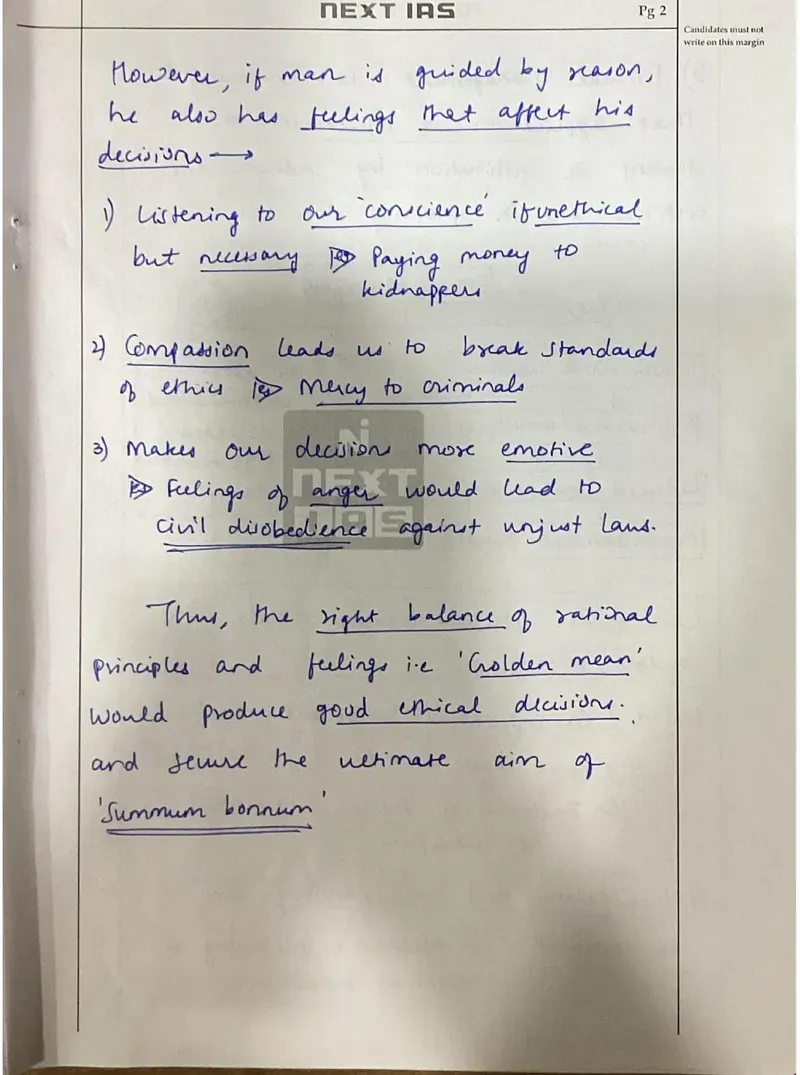
- ★For Q1A (feelings vs purely rational/principled decisions) he refused to pick a side and instead drew a Venn diagram showing Reason/Rationality intersecting Passion/Feeling resolving into 'Ethical Decisions' -> when a question pits two values against each other, the high-scoring move is to visually show their integration rather than argue one beats the other.
- ★Across all six case studies he ran a single rigorous scaffold: issues -> options -> a merit/demerit table -> chosen action -> justification, repeatedly landing on a consultative 'middle path' (stakeholder committee, internal escalation before going public) -> a fixed, table-driven case-study template lets you show you weighed alternatives instead of jumping to a verdict, and the examiner can see the reasoning at a glance.
- ★His closing lines were matched to the specific question, not generic: the Sanskrit shloka 'Yatra Naryastu Pujyate Ramante Tatra Devta' to close the temple-excluding-women case study (Q8/CS2), and 'Sunlight is the best disinfectant' to close the MGNREGA whistleblowing case (CS6) -> end every answer with a quote or maxim that is topically wired to that exact dilemma, so the conclusion reinforces the argument rather than ornamenting it.
- ★He fused live governance instruments with empathy examples in the same answer — for ethics of care (Q2A) he cited Divya Devrajan IAS learning the Gondi language for tribals, 'mohalla darbar' and 'Yogakshema'; for service quality (Q2B) he cited PRAGATI Portal, Gati Shakti, social/formal audits and outcome-output budgeting -> back each abstract ethics concept with both a named administrator's act and a current scheme, which proves the idea works on the ground and keeps it from sounding bookish.
- ★In the quote section (Q6) he didn't just define the printed lines — he engaged each of Adam Smith (benevolent affections), Aristotle (virtue/vice and the power to act) and Socrates ('I know that I know nothing') and pulled them into wider debates (e.g. linking Q6A to Maslow, Gandhi's trusteeship and critiques of 'white man's burden') -> treat a quote question as a prompt to build an argument around the thinker's idea, not as a one-line gloss.
Questions attempted: Feelings as inseparable part of ethical life vs purely rational/principled decisions; Ethics management; whether codes of ethics (CoE) and conduct (CoC) suffice in workplace; Traditional ethics (justice) vs ethics of care (connectedness) for public service, and 16 more below.
Questions attempted in this booklet (19)+
- Q1A.Feelings as inseparable part of ethical life vs purely rational/principled decisions
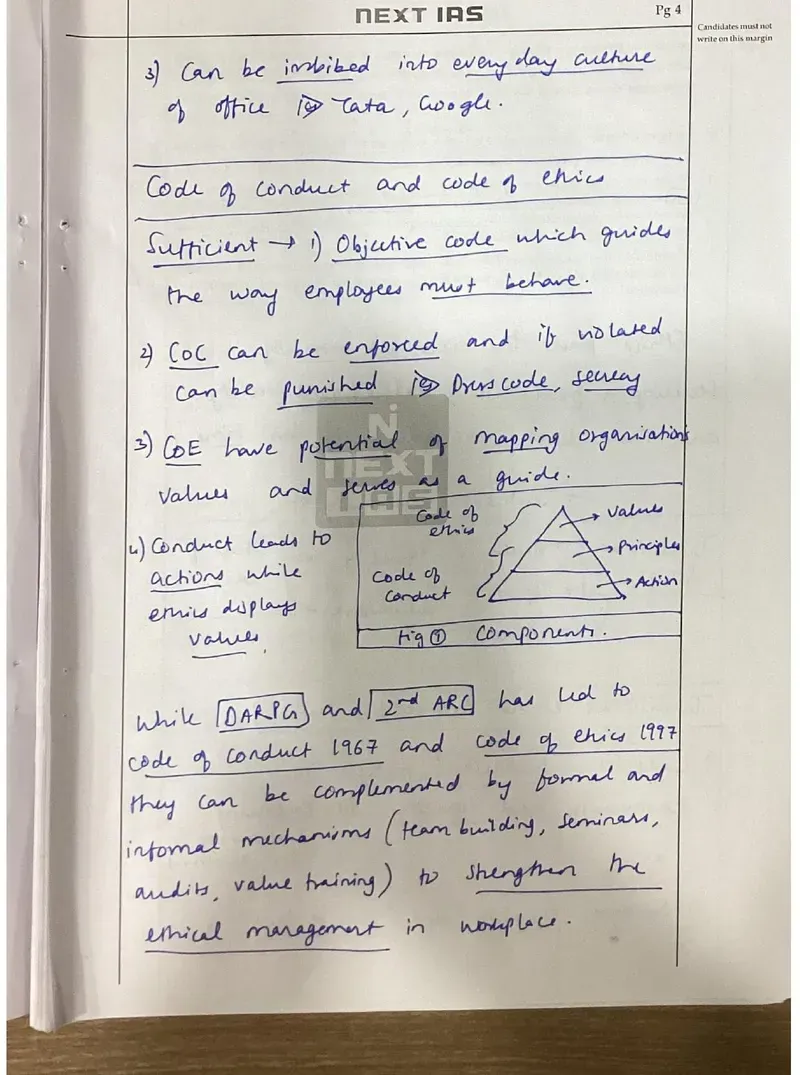
- Q1B.Ethics management; whether codes of ethics (CoE) and conduct (CoC) suffice in workplace
- Q2A.Traditional ethics (justice) vs ethics of care (connectedness) for public service
- Q2B.Meaning/components of 'quality' in service delivery; efficiency, economy, effectiveness
- Q3A.Public service attitude; attitude biases in field decisions and overcoming them
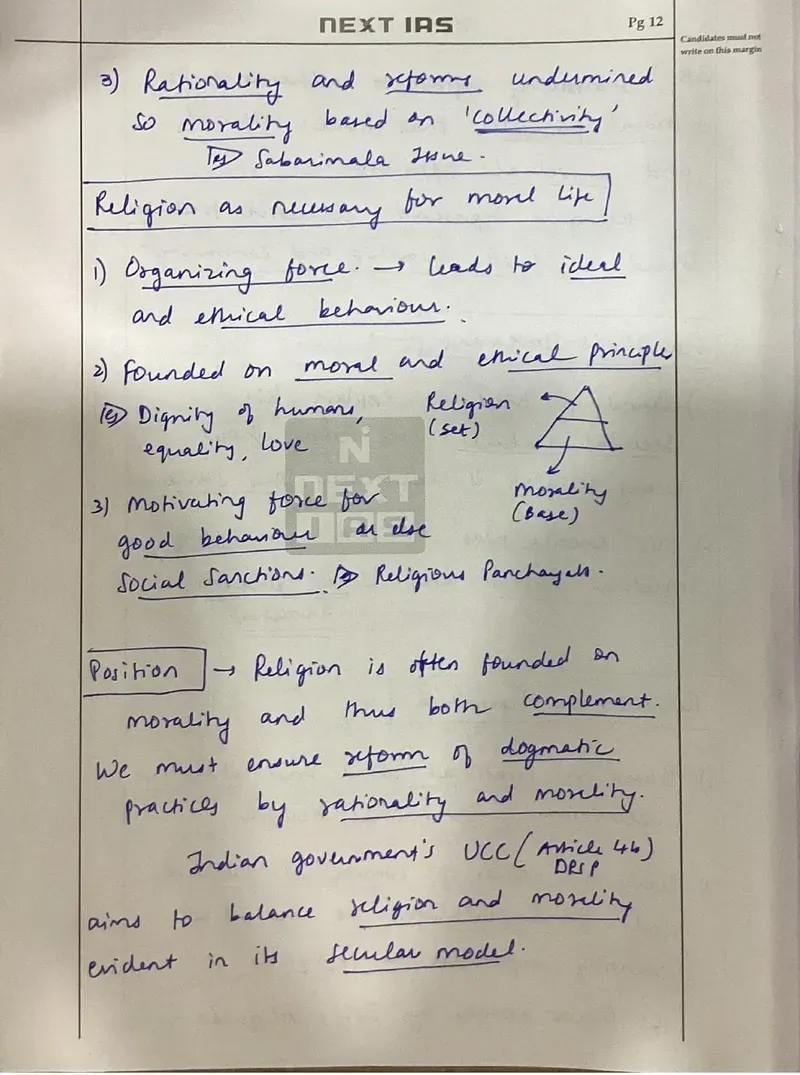
- Q3B.Gandhi's 'I am a Moslem/Hindu/Christian/Jew'; relationship between religion and morality
- Q4A.Friedman's 'one responsibility of business is profit'; is CSR an unproductive diversion
- Q4B.Relevance of tyaga/seva/daanam/damah for modern public servants
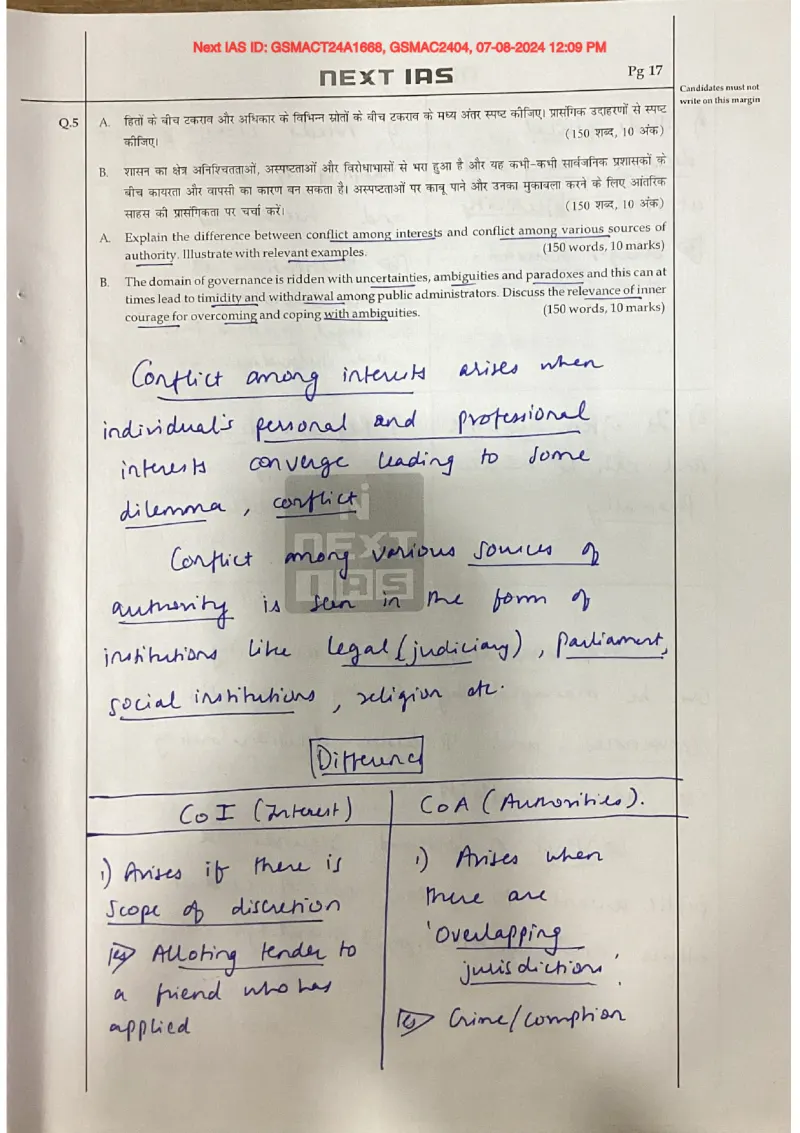
- Q5A.Difference between conflict among interests and conflict among sources of authority
- Q5B.Governance ambiguities/paradoxes; relevance of inner courage
- Q6A.Adam Smith quote on benevolence/feeling for others as perfection of human nature
- Q6B.Aristotle quote on virtue, vice and the power to act/not act
- Q6C.Socrates quote 'I know that I know nothing' — humility and knowledge
- Q7 (Case Study 1).GreenTech compliance officer; legal-but-harmful hazardous waste disposal / greenwashing
- Q8 (Case Study 2).District Collector; temple excluding women — gender equality vs religious custom
- Q9 (Case Study 3).Election duty; criminalization of politics; staff safety vs duty
- Q10 (Case Study 4).Smart-city procurement; alleged conflict of interest (Sharma/Patel tender)
- Q11 (Case Study 5).Dept downsizing/outsourcing; going over the head to the Minister
- Q12 (Case Study 6).MGNREGA fund corruption by senior officials; whistleblowing dilemma
Examples, data & evidence used
- Kant's categorical imperative (humans as ends — used in CS1, CS3, Q1A)
- Aristotle's Golden Mean & 'Summum bonum' (Q1A, Q6B)
- DARPG, 2nd ARC, Code of Conduct 1967, Code of Ethics 1997 (Q1B)
- Tata and Google office ethics culture (Q1B); Tata 'Grandpal' elderly-care CSR (Q4A)
- Divya Devrajan IAS learning Gondi language for tribals; 'mohalla darbar'; 'Yogakshema' (Q2A)
- Gati Shakti, PRAGATI Portal, social/formal audits, outcome-output budgeting (Q2B)
- Panchayati Raj sarpanch ignored by bureaucracy; Gandhiji's Talisman; Manas-Vachan-Karma triad; 'steel frame'; value education (Q3A)
- 'Sarva Dharma Sambhav'; ISIS/Al-Qaeda terror; Sabarimala issue & verdict's dissenting opinion; UCC / Article 44 DPSP; secular model (Q3B)
- India's 2% CSR rule (Companies Act); Phillip Morris tobacco 'whitewashing'; Profit-People-Planet triple bottom line; 'compassionate capitalism' (Q4A)
- Lal Bahadur Shastri's simplicity; Tagore 'Service is joy'; Mission Sampoorna / IAS Lakshmi Krishna on malnutrition; P.C. Mahalanobis; Lord Acton 'power corrupts'; 'karmayogi' / SMART civil servant (Q4B)
- Judge recusal; sub-judice matters; constitutional morality; Articles 14/15/25/26 (Q5A, Q8)
- Sameer Wankhede media-trial; E. Sreedharan; T.N. Seshan (Q5B, CS3, CS4); Model Code of Conduct / Election Commission (CS3)
- Maslow's hierarchy; Seva Parmo Dharma / Vedas; 'white man's burden'/benevolent despotism & slavery; Gandhi's trusteeship & sarvodaya (Q6A)
- Withdrawal of Non-Cooperation Movement; climate change (Q6B)
Quotes the candidate used
- 'Service is joy' — attributed to Tagore (Q4B, Q6A)
- 'Power corrupts and absolute power corrupts absolutely' — used in Q4B (Lord Acton; author not written by candidate)
- 'A good leader knows the way, goes the way and shows the way' — Case Study 3 (author not written)
- 'Sunlight is the best disinfectant' — Case Study 6 (author not written; Brandeis)
- 'Silence of good men in the face of injustice is a bigger crime' — Case Study 6 (author not written)
- 'Sarva Dharma Sambhav' invoked for Gandhi's statement (Q3B)
- Sanskrit shloka 'Yatra Naryastu Pujyate Ramante Tatra Devta' (where women are worshipped, gods are happy) — Case Study 2
- Engaged with the three printed thinker-quotes in Q6: Adam Smith (benevolent affections), Aristotle (virtue/vice & power to act), Socrates ('I know that I know nothing')
How it’s written: Highly disciplined, examiner-friendly format throughout. Each answer opens with a one-line definitional/contextual intro, develops in numbered points, and closes with a value-laden concluding sentence (often a quote or Sanskrit/ethical maxim). Heavy use of boxed/underlined sub-headers, '->' arrows linking a point to…
Diagrams & visuals: Venn diagram: Reason/Rationality intersecting Passion/Feeling -> Ethical Decisions (Q1A); Flowchart 'Ethics Managed' branching Yes (good work culture->motivated employees->reduced corruption->growth) vs No (poor culture/decay) (Q1B); Pyramid: Code of Ethics = Values/Principles vs Code of Conduct = Action (Q1B); Branch diagram contrasting Traditional Ethics (justice/equality/rights/procedure) vs Ethics of Care (community/equality/substantive) (Q2A); 'Components' tree of service quality with 5 nodes (Q2B); Manas-Vachan-Karma triangle -> Overall Attitude (Q3A)
Evaluator: No examiner marks or comments are filled in on this copy.